
Specs are compiled from manufacturer listings and verified buyer reviews and can change over time — please confirm the key details on the product page before buying.
You need a weed killer that won’t poison your tomatoes, peppers, or lettuce. The real challenge is finding a product that kills the weeds fast without leaving dangerous residues in the soil where your food grows — because many organic options are weak, slow, or simply don’t work on established roots.
I’m Rikta — the founder and writer behind Lawn Gear Lab. This guide is built by comparing the manufacturers’ published specifications and the patterns across verified customer reviews, so you get each pick’s real strengths and trade-offs instead of marketing spin.
Here are the top-rated, garden-safe options for keeping your vegetable beds weed-free without toxic chemicals, so you can find the right weed killer for vegetable garden that fits your specific weeds and your growing season.
Our Picks at a Glance

How To Choose The Best Weed Killer For Vegetable Garden
Picking the wrong product can mean killing your vegetable plants or leaving your garden full of weeds. Here are the two main decisions you need to make first.
Contact Killer vs Pre-Emergent
A contact killer (like the Sunday Weed Warrior or the Avenger concentrate) kills weeds that are already growing by burning or dehydrating the leaves and stems. It works fast — you see results in hours or a day — but it does not prevent new weeds from sprouting later. A pre-emergent (like the Monterey Weeder) stops weed seeds from germinating in the soil, so you apply it early in the season to prevent weeds before they appear. It does not kill existing weeds. For a fully weed-free vegetable garden, many gardeners use a contact killer on visible weeds now and a pre-emergent to stop the next batch.
Concentrate vs Ready-to-Use
A concentrate bottle requires you to mix it with water in a sprayer, which gives you far more finished spray per dollar. The Sunday kit, for example, makes 2 gallons total from its two 22 oz concentrate bottles. Ready-to-use (RTU) formulas cost more per spray and you run out faster, but you do not need to measure or mix anything. For a large vegetable garden, a concentrate is almost always the better value.
Quick Comparison
| Model | Best For | Type | Unit Count | Coverage (Diluted) | Amazon |
|---|---|---|---|---|---|
| Avenger Weed Killer Concentrate★ Best Overall | Budget-friendly organic concentrate | Contact (Acetic/Citric Acid) | 32 oz | Up to 16 gallons | Amazon |
| Sunday Weed Warrior Kit | Fast-acting organic contact killer | Contact (Herbicidal Soap) | 44.0 oz (2 x 22 oz) | 2 gallons total | Amazon |
| Monterey Vegetable & Ornamental Weeder | Pre-emergent prevention for garden beds | Pre-Emergent (Trifluralin) | 32.0 oz | — | Amazon |
In-Depth Reviews
1. Avenger Weed Killer Concentrate, for Organic Gardening, 32 oz
You cover up to 16 gallons of spray from one 32 oz bottle — that is eight times the area of the Sunday kit — using acetic and citric acids (natural compounds that burn leaves on contact).
The Avenger concentrate uses acetic and citric acids to kill weeds on contact. A single 32 oz bottle mixes into up to 16 gallons of diluted solution, which is a huge amount of coverage compared to the Sunday kit’s 2 gallons total. This makes it the best option if you have a really large property or lots of gravel areas to treat. The liquid volume is 0.95 liters per bottle, and it comes as a sprayable liquid that you mix in your own garden sprayer. Buyers who have used it for years say it works quickly and has a pleasant, vinegar-like aroma.
Here is the honest catch: the consistency has dropped off recently. Several 2024 reviewers point out that the last three bottles “did absolutely nothing” — even at the highest concentration, the weeds survived. One reviewer who used it for years said it worked great, then suddenly stopped working after a formula change. For central Florida weeds, one reviewer noted it kills surface growth but not roots, with weeds sprouting again within 48 hours. Unlike the Sunday product, you need to shake the mixture every 3-5 minutes while spraying because it separates when sitting. If you catch a batch that works, the value is class-leading. If you get a dud, you are stuck with 16 gallons of useless spray.
Trade-off: The Avenger delivers incredible coverage for the price (16 gallons vs Sunday’s 2 gallons), but its recent quality inconsistency makes it a risk compared to the more reliable Sunday kit. It also kills slower than the Sunday — a day or less, versus hours.
Grab it if: You need a budget-friendly concentrate for a large area and are willing to test a bottle before committing to the whole season.
Look elsewhere if: You cannot afford to waste time on a product that may have lost its formula — the Sunday kit costs more upfront but delivers guaranteed fast results.
2. Sunday Weed Warrior Concentrate Kit, Organic Weed & Grass Killer
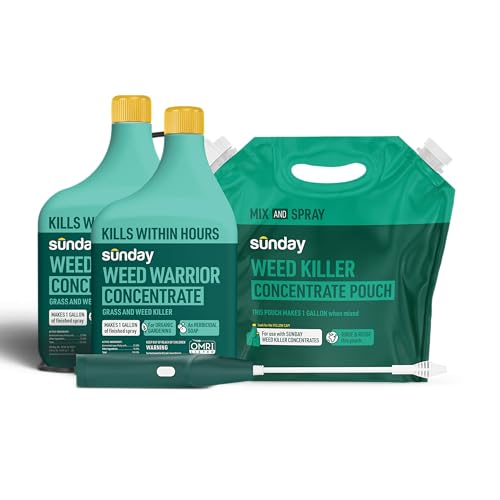
You see weeds wilting in as little as 20 minutes, not days. That is the speed this organic herbicidal soap delivers, thanks to its 22.00% ammoniated soap of fatty acids (a concentrated soap that strips the waxy coating off leaves so they dehydrate fast).
If you want a weed killer that shows visible results within hours, this is your pick. The active ingredient is an ammoniated soap of fatty acids (22.00%) — a herbicidal soap that works by dehydrating the weed on contact. That means you see weeds wilting in as little as 20 minutes, and full results within a few hours. Buyers report that “after just a few hours of application weeds were already turning brown.” The big advantage over the Avenger below is speed: the Sunday kit kills consistently fast, while several recent Avenger owners mention it has stopped working entirely.
The kit comes with two 22 oz concentrate bottles that together make 2 gallons of finished spray, plus a reusable mixing pouch and a battery-powered wand sprayer. The 3-hour rain-fast window (the time after spraying before rain can wash it off) means you can spray and feel confident a rain shower won’t wash it away. Because it is non-selective, it kills anything it touches — so keep the spray off your tomato leaves and on the weeds in the cracks and bed edges. Reviewers love the speed but note the pouch-applicator handle is small and the batteries require a tiny screwdriver to replace.
Speed advantage: The Sunday kit kills broadleaf weeds and grasses like dandelion, crabgrass, clover, and moss in hours — the Avenger below takes up to a day and has inconsistent results in recent batches. For a contact killer that actually works every time, this is the one.
Best for: Gardeners who want organic, fast-acting results and don’t mind replacing sprayer batteries occasionally.
Reach for this if: You need fast, reliable organic weed control near your vegetable beds and don’t want to mess with harsh chemicals.
Look elsewhere if: You need a pre-emergent to stop weeds before they sprout — for that, you want the Monterey below instead.
3. Monterey Vegetable and Ornamental Weeder Bundled with Measuring Spoon
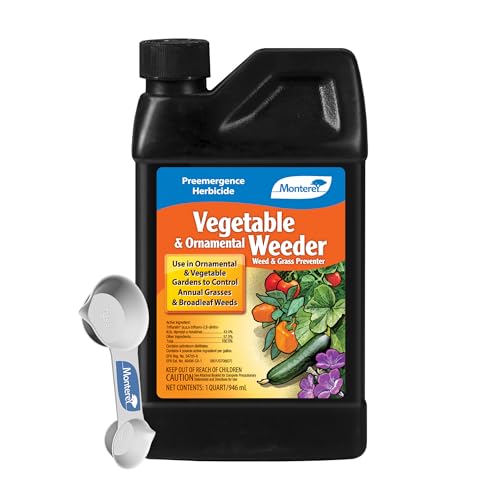
You stop weeds before they sprout with this pre-emergent (a chemical that prevents seeds from germinating), using 43% Trifluralin (a synthetic compound that stops cell division in germinating seeds).
Unlike the Sunday and Avenger products that kill weeds you can already see, the Monterey Weeder is a pre-emergent herbicide. You apply it to the soil to kill weed seeds as they germinate, so weeds never get a chance to grow. The active ingredient is Trifluralin at 43% concentration, and it works on annual grasses and broadleaf weeds. The maker recommends mixing 3 fluid ounces in 2 gallons of water and applying to 1,000 square feet. Because it targets seeds, it is safe to use around established vegetables, flowers, shrubs, and ornamental trees — just follow the directions to avoid harming the plants you want.
Customers note this will be the third year they’ve used it, and it performs better than other pre-emergents they have tried. One buyer reports that after tilling the garden twice, the weeds kept coming back, calling it a waste of money — but pre-emergents require the right timing and watering schedule for success. Several users emphasize that you need to saturate the soil with water after applying so the solution soaks in. It comes in a 32.0 oz bottle with a measuring spoon included, though one reviewer points out the spoon is in tablespoons while the instructions ask for fluid ounces, requiring a conversion.
Strong suits
- 43% active Trifluralin for extended control of annual grasses and broadleaf weeds
- Safe for use on established vegetable gardens, roses, and ornamentals
- One yearly application can prevent weeds for most of the growing season
What to watch
- Does not kill existing weeds — you need a contact killer like the Sunday kit for that
- Works best only when applied before weeds germinate and watered in properly
Best for: Gardeners who want to prevent weeds proactively rather than chasing them all season, especially in rock ground cover or established flower beds.
skip it if: You already have a garden full of visible weeds and need something to kill them now — grab the Sunday Weed Warrior kit instead.
Understanding the Specs
Contact vs Pre-Emergent Herbicide
A contact herbicide (like the Sunday Weed Warrior and Avenger) kills weeds by burning or dehydrating the parts of the plant it touches above ground. You see results in hours or a day, but it does not affect weed seeds in the soil. A pre-emergent herbicide (like the Monterey Weeder) creates a chemical barrier in the soil that kills weed seeds as they germinate, so you apply it before weeds appear. Many gardeners use both: a contact killer for visible weeds now, and a pre-emergent to prevent the next generation.
Active Ingredient Types
Herbicidal soap (ammoniated soap of fatty acids) — used in the Sunday kit — dehydrates weeds on contact by breaking down the waxy outer layer of leaves. It is OMRI listed (approved for organic gardening by the Organic Materials Review Institute) for organic gardening and safe for vegetable gardens when used as directed. Acetic and citric acids — used in the Avenger — work similarly by burning leaves with natural acids. Trifluralin — used in the Monterey — is a synthetic pre-emergent that stops cell division in germinating seeds. Always check the active ingredient to understand whether you are buying a contact killer or a pre-emergent.
FAQ
Can I spray weed killer directly on my vegetable plants?
How long should I wait after spraying before harvesting vegetables?
Will these weed killers hurt my soil or worms?
Which product works fastest on visible weeds?
Do I need a pre-emergent if I already use a contact killer?
How much area will one 32 oz bottle of concentrate cover?
Are these products safe for pets and children?
Can I use these on weeds in my lawn near my vegetable garden?
What is the difference between herbicidal soap and vinegar-based weed killers?
Why do some weeds come back after using a contact killer?
Final Thoughts: The Verdict
If you want one dependable pick, the weed killer for vegetable garden winner is the Sunday Weed Warrior Concentrate Kit because it kills weeds reliably within hours using an organic herbicidal soap that is safe for vegetable gardens, pets, and the soil. If you want to prevent weeds before they sprout rather than chase them all season, grab the Monterey Vegetable and Ornamental Weeder — it stops weed seeds from germinating for most of the growing season. And for a budget-friendly concentrate that covers a huge area, the Avenger Weed Killer Concentrate is worth trying if you get a fresh, effective batch.
How We Picked
We do not accept paid placement. Every pick is matched to a real buyer and a real use-case; we do not hands-on test units.
Sources & Methodology
Specifications: manufacturer listings and product documentation. Review insights: verified customer reviews, as of July 2026. Pricing: not shown on this page (it changes often); check the current price via the retailer link.
As an Amazon Associate, Lawn Gear Lab earns from qualifying purchases. This does not affect which products we feature.