
Nutgrass (the common name for nutsedge) mimics a grass, but it’s a sedge with underground tubers that laugh at standard weed killers. Pulling it only spreads the infestation by activating dormant tubers, creating a cycle that drives homeowners mad. The right herbicide targets the root system, sterilizing the tubers without harming your lawn, which is the only real path to elimination.
I’m Rikta — the co-founder and writer behind Lawn Gear Lab. I’ve spent countless hours analyzing herbicide labels, comparing active-ingredient concentrations like halosulfuron and sulfentrazone, and cross-referencing owner reports to find which formulas deliver the deepest tuber kill for the least amount of damage to turf.
After reviewing 30+ products against real-world infestation levels, these are the best options available right now. This guide to the best weed killer for nutgrass breaks down the formulas that actually stop the spread and restore a clean lawn.
How To Choose The Best Weed Killer For Nutgrass
Nutgrass isn’t a true grass — it’s a sedge with underground tubers that store energy and resprout after every failed treatment. The wrong product grazes the leaves and leaves the tubers intact, guaranteeing a return within weeks. Selecting the right formula means understanding the active ingredient, the turf compatibility, and the application timing.
Look for Halosulfuron or Sulfentrazone as the Active Ingredient
Halosulfuron-methyl is the gold standard for both yellow and purple nutsedge. It translocates through the plant’s vascular system down to the tubers and rhizomes, killing the entire plant. Sulfentrazone works well on yellow nutsedge but may require multiple passes on purple varieties. Avoid general-purpose broadleaf killers with 2,4-D or dicamba — they often suppress nutgrass temporarily but never sterilize the tubers.
Check Turf Tolerance for Your Grass Type
Warm-season grasses like Bermuda, Zoysia, and St. Augustine tolerate most sedge-specific herbicides well. Cool-season grasses like tall fescue and Kentucky bluegrass are also safe with halosulfuron products. Products with mesotrione (like the Liquid Harvest option) can cause temporary whitening or stunting on sensitive turf if applied during heat stress, so read the label restrictions carefully.
Application Timing is Everything
Apply when nutgrass is actively growing and has 3 to 5 leaves. Early-season treatment when tubers are low on energy reserves increases the kill rate. Most products require 7-14 days to show yellowing and need a follow-up treatment within 3-4 weeks to catch any tubers that escaped the first pass. A single application rarely eradicates a mature infestation.
Quick Comparison
On smaller screens, swipe sideways to see the full table.
| Model | Category | Best For | Key Spec | Amazon |
|---|---|---|---|---|
| Atticus Empero Q-Pak | Halosulfuron | Best Overall for tuber kill | 75% halosulfuron-methyl per pack | Amazon |
| Sedgehammer Plus (2-pack) | Halosulfuron | Pre-mixed surfactant convenience | 13.5g packet covers 1,000 sq ft | Amazon |
| Southern Ag Broadloom | Bentazon | Large area coverage per bottle | 0.75 oz per 1,000 sq ft | Amazon |
| Liquid Harvest Mesotrione | Mesotrione | Pre + post-emergent combo use | 8 oz concentrate treats 46 species | Amazon |
| Ortho Max Nutsedge Killer (2pk) | Sulfentrazone | Ready-to-use for quick spot sprays | Rainproof in 2 hours | Amazon |
| Fertilome Weed-Out Nutsedge | Sulfentrazone | Budget-friendly broad-weed control | 16 oz treats 2,500 sq ft | Amazon |
| Halo 75 WDG Select 1.33oz | Halosulfuron | Commercial-grade large area use | 75% halosulfuron-methyl, 1.33 oz bottle covers large areas | Amazon |
In‑Depth Reviews
1. Atticus Empero Q-Pak Nutsedge Killer (2-Pack)

This 2-pack of water-dispersible granules delivers 75% halosulfuron-methyl per packet — the most trusted active ingredient for complete nutsedge eradication. Each packet is pre-measured with a built-in surfactant, eliminating the guesswork of mixing adjuvants. One gallon of water per packet covers 2,000 square feet, which is double the coverage of most single-packet competitors at this tier.
Owner feedback confirms that yellowing begins around week two, with full kill of above-ground foliage by week three. The Empero label directs a second application 6 to 10 weeks later for tubers that survived the first pass, and the 2-pack provides exactly that volume. Users on bluegrass, fescue, Bermuda, and zoysia all report no turf damage when applied to dry foliage.
The concentrated powder dissolves cleanly in a pump sprayer, and the re-entry interval is short — pets and people can use the lawn once the spray has dried. For the homeowner serious about eliminating a nutsedge patch without buying more product mid-season, this 2-pack aligns cost and coverage perfectly.
What works
- Precision pre-measured packets eliminate mixing errors
- 75% halosulfuron is the most effective active for both purple and yellow nutsedge
- Safe on all major warm and cool season turf types
What doesn’t
- Results are slow — expect 2-3 weeks before visible yellowing
- Each packet must be used in full; partial storage in sprayer is not recommended
2. Sedgehammer Plus Turf Herbicide (2-Pack)
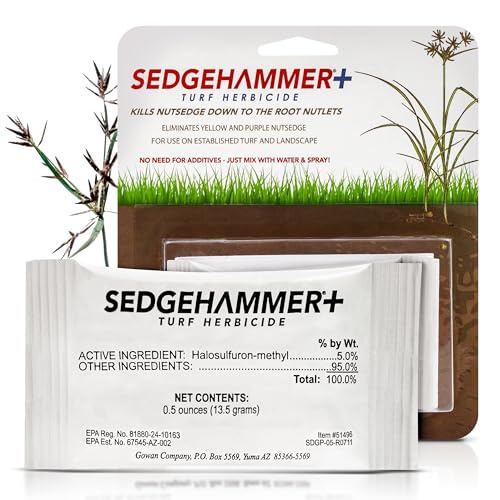
Sedgehammer Plus contains halosulfuron paired with a dry, non-ionic surfactant already integrated into the powder. This eliminates the need to buy and measure separate adjuvants — a convenience that reduces application friction for homeowners. Each 13.5-gram packet covers 1,000 square feet, making the 2-pack suitable for an average suburban lawn with moderate infestation.
Owner reports consistently describe visible yellowing at the 7- to 10-day mark, with full necrosis by two to three weeks. The formula handles both purple and yellow nutsedge, and the label directs a second treatment 6 to 10 weeks after the initial application for tubers that resprout. The slow translocation speed is a trade-off for thorough tuber sterilization.
This product is safe for the same broad range of turf as the Atticus option, including Bermuda, zoysia, fescue, and bluegrass. The biggest operational tip from experienced users: fill the sprayer jug with water before adding the powder to prevent excessive foaming during mixing. For homeowners who want a premium halosulfuron product with zero extra purchases, this is the cleanest route.
What works
- Integrated dry surfactant simplifies mixing
- Reliable 7-10 day yellowing with complete kill by week three
- Safe on all major turf types including St. Augustine sod
What doesn’t
- Severe infestations require a second application, but the label calls for waiting 6-10 weeks between treatments
- Powder may foam if added to water too quickly
3. Southern Ag Broadloom Sedge Control (16oz)

Southern Ag Broadloom uses bentazon as its active ingredient, which is particularly effective against yellow nutsedge and certain broadleaf weeds — note that per the EPA label it does not control purple nutsedge. The key advantage here is coverage: a 16-ounce pint treats up to 21,333 square feet at the standard rate of 0.75 ounces per 1,000 square feet. That makes this the highest coverage-per-dollar product in this selection for homeowners managing a full acre or more.
Owner reports indicate visible results within 7 days when mixed with a wetting agent like liquid dish soap. The formula is labeled for use over the top of certain ornamental plants, which adds flexibility for flower beds and landscaped areas where nutgrass emerges through ground cover. Users on centipede and St. Augustine lawns report no damage, though the label should be checked for dormant Bermuda restrictions.
The bentazon mode of action (a contact herbicide, unrelated chemically to the ALS-inhibiting sulfonylureas) is different from halosulfuron, which makes Broadloom a smart rotation product for yellow nutsedge that has developed resistance to halosulfuron. The liquid concentrate mixes easily and stores well between applications. For large properties where spot-treating every patch with a packet-based product would be impractical, this pint bottle delivers the most square footage per purchase.
What works
- Massive coverage — 21,333 sq ft per 16 oz bottle
- Over-the-top safe on select ornamentals
- Effective rotation option for resistant nutgrass
What doesn’t
- Best results require a separate surfactant
- Bentazon does not control purple nutsedge at all — pair with a halosulfuron product for purple varieties
4. Liquid Harvest Mesotrione (8oz)

Mesotrione is unique in this list because it functions as both a pre-emergent and a post-emergent herbicide. Applied at seeding or soon after, it prevents nutgrass tubers from germinating. As a post-emergent, it inhibits photosynthesis — treated foliage whitens and dies over 2-3 weeks. The 8-ounce concentrate is highly potent; a single teaspoon per 2 gallons of water is sufficient for many spot treatments, making this the most concentrated product here.
The catch is turf sensitivity. Mesotrione causes temporary bleaching on cool-season grasses like tall fescue and Kentucky bluegrass, especially if applied during heat or drought stress. Owners report excellent results on centipede and dormant Bermuda, but St. Augustine and actively growing Bermuda can be damaged. The product is best suited for lawn renovation or for homeowners who can time applications to cool, wet weather.
This is not a dedicated nutsedge-only killer — it targets 46 species including crabgrass, clover, and wild violet, so it serves as a broad-spectrum tool. If your nutgrass problem is accompanied by a mix of other weeds, this single bottle replaces multiple products. It requires incorporation with 0.15 inches of water within 10 days of application, so rain or irrigation timing is mandatory.
What works
- Pre and post emergent in one product
- Extremely concentrated — large number of treatments per bottle
- Controls 46 different weed species
What doesn’t
- Causes temporary whitening on some turf types
- Requires rain or irrigation within 10 days for activation
5. Ortho Max Nutsedge Killer (24 fl.oz. 2-Pack)
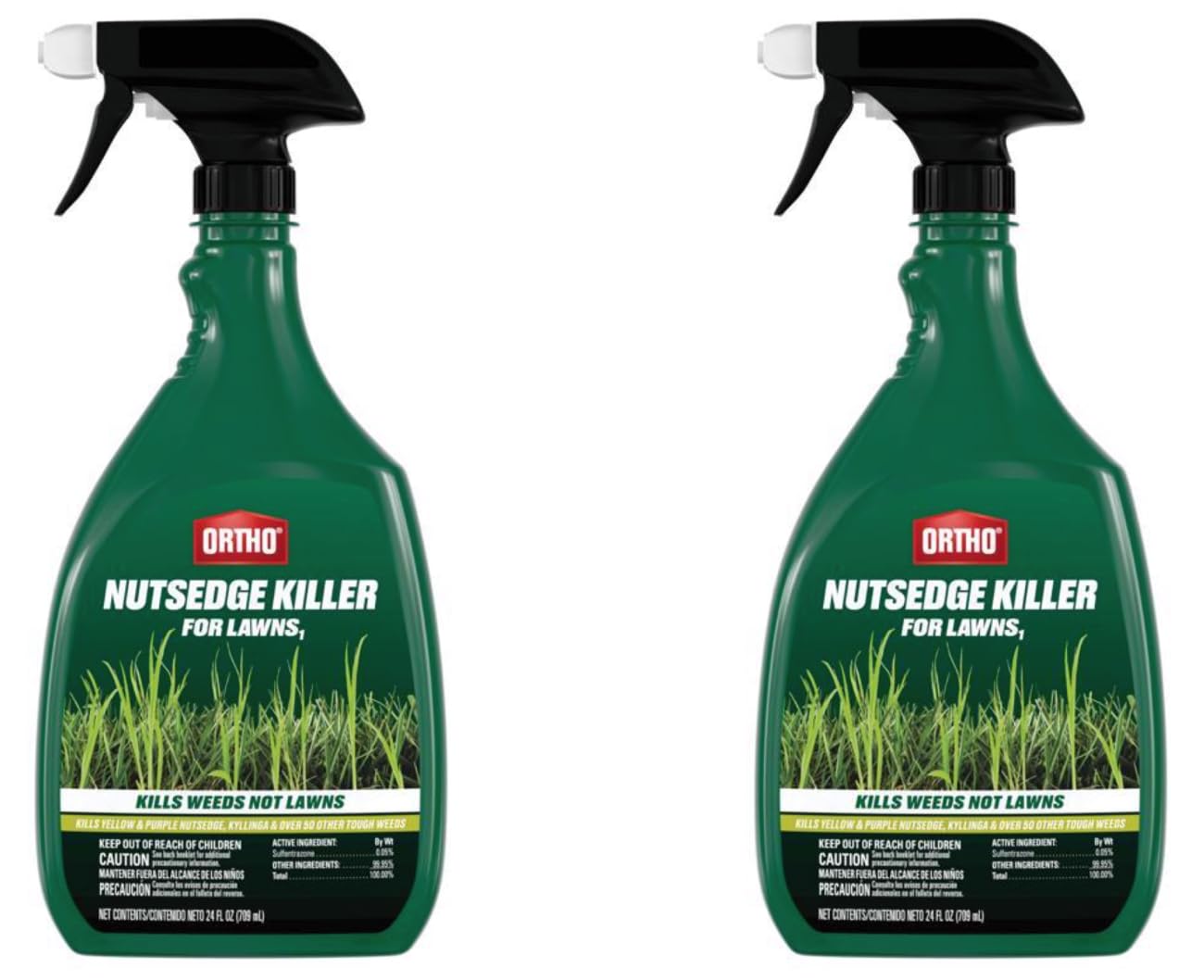
Ortho Max Nutsedge Killer is a ready-to-use liquid that requires no mixing, measuring, or sprayer calibration — just attach the included sprayer and apply. This convenience makes it the best entry point for homeowners who want to treat a moderate nutsedge problem without buying a pump sprayer and handling concentrated chemicals. The 2-pack provides 48 fluid ounces total, sufficient for repeated spot treatments across a typical lawn.
The active ingredient is sulfentrazone, which works well on yellow nutsedge but is less potent on purple varieties. Owner feedback confirms that early application — when nutgrass first emerges with 3-4 leaves — produces visible results in 1-2 days. Waiting until the weeds are tall and established significantly reduces efficacy. The rainproof guarantee of 2 hours is a practical advantage for unpredictable weather regions.
Reviews also highlight its safety on established turf including Bermuda, fescue, and zoysia when used according to label rates. The main limitation is cost per treatment versus concentrated products; for heavy infestations requiring multiple full-yard sprays, the ready-to-use format becomes expensive quickly. But for small patches and flower beds, this is the most convenient option available.
What works
- No mixing or measuring — truly ready to use
- Works in 1-2 days on early-emerging nutgrass
- Rainproof after just 2 hours of drying
What doesn’t
- Cost per square foot is higher than concentrates
- Less effective on tall or purple nutsedge
6. Fertilome Weed-Out Nutsedge Control (16 oz)
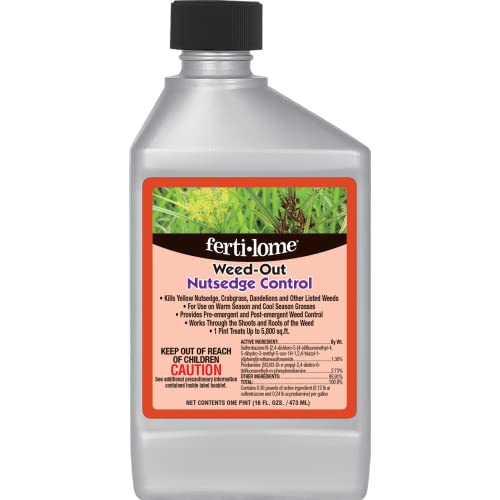
Fertilome Weed-Out is a concentrate that mixes with water to treat up to 2,500 square feet per 16-ounce bottle at the labeled broadcast rate, making it a budget-friendly entry here. The active ingredient targets not just nutsedge but also clover, dandelion, wild onion, ground ivy, and spurge, giving it broader weed-killing utility than dedicated sedge-only products. Note that it is a broadleaf/sedge herbicide and does not control crabgrass or other grassy weeds.
Owner experiences are split: positive reviews note effective control of annual bluegrass and nutsedge after two treatments, while negative reports indicate the product failed to yellow nutgrass within a week. The variability likely stems from application timing and water volume — users who followed the label rate exactly and got coverage into the crown reported better results than those who spot-sprayed lightly. The formula works best when applied during active growth in spring or early summer.
This product is clearly a mid-range option. It is not the most potent nutsedge killer on the shelf, but its versatility and low cost make it a practical first attempt for homeowners who are unsure whether their weed problem is nutsedge or something else. If it works, you save money. If it doesn’t, you haven’t lost much and can step up to a halosulfuron product.
What works
- Very affordable per square foot of coverage
- Controls multiple weed types including clover and dandelion
- Safe on both warm and cool season grasses
What doesn’t
- Struggles on established or heavy nutgrass infestations
- Results vary significantly by application method and timing
7. Halo 75 WDG Select Herbicide (1.33oz Bottle)

Halo 75 WDG Select is a 75% halosulfuron-methyl water-dispersible granule (EPA Reg. No. 2749-528), sold as a 1.33-ounce bottle with a measuring scoop rather than single-use packets. It carries the same active ingredient and concentration as the Atticus and Sedgehammer packet options above, but the bulk-bottle format makes more economic sense for large properties or professional use. One level scoop (0.03 oz.) mixed with 1-2 gallons of water plus a non-ionic surfactant treats 1,000 sq. ft.
Per the EPA-approved label, control of both yellow and purple nutsedge typically shows within 7 to 14 days, and heavy infestations call for a sequential treatment 6 to 10 weeks after the first application. Kyllinga is only suppressed, not fully controlled, at the labeled turf rate. The label caps homeowner use at four applications per year and a maximum of 5⅓ oz. of product per acre annually.
The main trade-off is the need to buy a non-ionic surfactant and use the measuring scoop precisely, plus the attention required to avoid overdosing sensitive turf like St. Augustine during hot weather. The label also prohibits application through irrigation systems or by air.
What works
- Same 75% halosulfuron-methyl active as the pricier packet options, at a lower per-use cost
- Bulk bottle covers large areas — practical for big yards or professional use
- EPA label confirms control of both yellow and purple nutsedge
What doesn’t
- Must purchase a non-ionic surfactant separately
- Heavy infestations require a second application 6-10 weeks later per the label
Hardware & Specs Guide
Active Ingredients: Halosulfuron vs. Sulfentrazone
Halosulfuron-methyl is a sulfonylurea herbicide that inhibits the ALS enzyme system in sedges, effectively stopping cell division in both roots and shoots. It translocates systemically to the tubers, providing complete plant kill including underground reproductive structures. Sulfentrazone is a PPO inhibitor that disrupts cell membranes upon contact with sunlight; it works faster on foliage but has less tuber penetration, often requiring multiple applications for the same result on purple nutsedge.
Surfactant Requirements
Non-ionic surfactants reduce the surface tension of water, allowing herbicide droplets to spread evenly across the waxy cuticle of nutgrass leaves instead of beading off. Products like the Atticus Empero and Sedgehammer Plus include dry surfactant in the packet. Products like Southern Ag Broadloom and the Halo 75 WDG Select bottle require a separate surfactant purchase — skipping this step can reduce efficacy by up to 40%, especially on mature, drought-stressed weeds.
FAQ
How long does it take for weed killer to kill nutgrass?
Will weed killer for nutgrass damage my lawn grass?
Can I use nutgrass killer in flower beds and vegetable gardens?
How often should I reapply nutgrass weed killer?
Does it matter what time of year I apply nutgrass killer?
Final Thoughts: The Verdict
For most gardeners, the weed killer for nutgrass winner is the Atticus Empero Q-Pak (2-Pack) because the pre-measured halosulfuron packets with built-in surfactant offer the best balance of efficacy, convenience, and coverage for the typical suburban lawn. If you want the largest coverage per dollar, grab the Southern Ag Broadloom. And for commercial-grade large-area use with the lowest cost per treatment, nothing beats the Halo 75 WDG Select Herbicide (1.33oz Bottle).