
Japanese knotweed isn’t a typical weed — it’s a rhizome-driven invader that punches through asphalt, foundations, and concrete缝隙. Standard weed killers barely faze it because its root system stores enough energy to regrow from a fragment the size of a fingernail. Beating it demands a herbicide strategy built on systemic translocation, high-concentration triclopyr, and a strict application calendar that aligns with the plant’s fall carbohydrate drawdown.
I’m Rikta — the co-founder and writer behind Lawn Gear Lab. This guide stacks the chemistry, coverage rates, and owner-verified outcomes of seven herbicides specifically tested against the above-ground foliage and below-ground crown of Japanese knotweed.
After cross-referencing triclopyr percentages, mix ratios, and hundreds of real-world reviews, the most effective strategy centers on choosing the right weed killer for japanese knotweed that targets the deep rhizome network with persistent residual activity.
How To Choose The Best Weed Killer For Japanese Knotweed
Japanese knotweed isn’t killed by surface contact. The herbicide must translocate from the leaf down through the phloem into a rhizome system that can extend six feet deep and sixty feet laterally. Every product on this list targets that network, but the right pick depends on your application method, the size of your infestation, and whether you need selective grass-safe control or total vegetation removal.
Active Ingredient Concentration
The active ingredient that consistently stops knotweed regrowth is triclopyr, often paired with 2,4-D or dicamba. Products with triclopyr above 8 percent by weight deliver the knockdown power needed for established stands. Glyphosate-only formulas rarely suppress knotweed beyond one season because the rhizome regenerates from nodes the glyphosate never reaches.
Application Method Matching
For dense patches taller than waist height, a foliar spray with a surfactant (non-ionic or crop oil) maximizes leaf uptake. For individual stems growing through fences or near desirable plants, the hack-and-squirt method — cutting the stem at its base and applying concentrate directly into the hollow internode — delivers the herbicide straight into the vascular system without drift. Products sold as concentrate rather than ready-to-use allow you to adjust the mix ratio for either method.
Soil Residual and Re-Treatment Window
Knotweed crowns can lie dormant for months before sending up new shoots. Herbicides with moderate soil residual activity, such as those containing aminopyralid or clopyralid, suppress regrowth from underground buds longer than fast-degrading formulas. The ideal window for the first application is late summer to early fall, when the plant is pulling carbohydrates into the roots. Expect at least two full seasons of treatment before the stand is eradicated.
Quick Comparison
On smaller screens, swipe sideways to see the full table.
| Model | Category | Best For | Key Spec | Amazon |
|---|---|---|---|---|
| Crossbow Herbicide | Premium | Large knotweed thickets | 16.5% Triclopyr + 2,4-D | Amazon |
| Southern Ag Crossbow | Premium | High-volume acreage | 2.23 acres per gallon | Amazon |
| Remedy Ultra | Premium | Pasture & fence line control | Low-odor Triclopyr concentrate | Amazon |
| Corteva Remedy | Mid-Range | Spot treatment of saplings | 1 acre coverage | Amazon |
| Roundup Weed & Grass Killer₄ | Mid-Range | Mixed weed & grass patches | Rainproof in 30 minutes | Amazon |
| Roundup Poison Ivy Plus | Value | Hack-and-squirt on vines | 32 fl. oz. concentrate | Amazon |
| Hi-Yield Killzall 365 | Value | Bare-ground total control | 17,200 sq. ft. coverage | Amazon |
In‑Depth Reviews
1. Crossbow Herbicide Brush Killer 1 Gallon
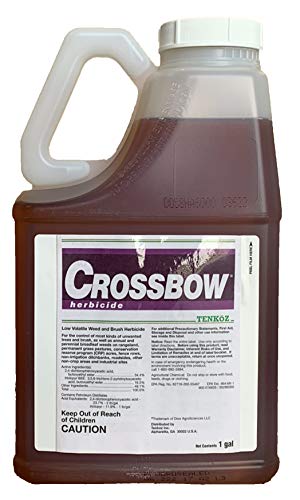
Crossbow doesn’t just suppress knotweed — it stops regrowth at the rhizome level for up to two years, according to multiple verified buyers tackling fence-row thickets. The 16.5 percent triclopyr amine formulation penetrates the waxy leaf cuticle of knotweed and moves systemically into the root storage nodes. Farmers and land managers routinely recommend Crossbow over standard glyphosate mixes for woody brush because the dual action of triclopyr plus 2,4-D hits both the foliage and the underground crown simultaneously.
Application with a backpack sprayer at a 1:50 dilution rate covers roughly one acre, making this a practical choice for medium to large patches. Buyers report visible wilting within 24 hours on poison ivy and knotweed canes, with total browning completed within seven days on warm, dry afternoons. The concentrate is thick enough to stick to vertical stems without excessive runoff, which matters when knotweed is growing on slopes or along ditch banks.
A few users note that the mix requires constant agitation in the tank because the oil-based carrier can separate. On extremely windy days, drift can carry onto nearby ornamentals, so a shielded spray nozzle or a calm window below five mph is necessary. For the knotweed holdouts that survive the first spray, a late-follow-up application the next season is usually enough to exhaust the rhizome completely.
What works
- High triclopyr content stops knotweed rhizome regrowth for multiple seasons
- Visible knockdown within 24 hours on mature canes
- Covers roughly one acre per gallon of concentrate
What doesn’t
- Requires tank agitation to prevent oil separation
- Drift risk on windy days can harm nearby ornamentals
2. Southern Ag Crossbow Specialty Herbicide

Southern Ag’s Crossbow formulation mirrors the same active ingredient profile as the Tenkoz version — triclopyr and 2,4-D — but packs enough concentrate to cover 2.23 acres per gallon, making it the highest-volume option for large-scale knotweed eradication. Verified buyers praise the 1 percent solution efficacy on vines, shrubs, and ivy, noting that a cut-stem application with undiluted concentrate knocks back knotweed shoots within a week without harming nearby trees.
The heavy weight of the bottle (11 pounds) reflects the dense, emulsified concentrate that doesn’t separate as quickly as some competitors. Users applying via backpack sprayer at a 2-ounce flow rate report complete vegetation die-off within 48 hours, with only spider lilies surviving among targeted species. The 3-day half-life in soil reduces the risk of residual damage to future plantings, a clear advantage if you’re rotating the treated area back to grass or ornamentals the following season.
On the downside, effectiveness drops significantly if rain occurs within two hours of application. Buyers on heavier clay soils in the Midwest report needing two applications at double the recommended rate to fully suppress knotweed and creeping Charlie. The strong odor is noticeable during mixing, so a respirator and gloves are strongly advised. Despite those cautions, the acre-per-dollar value is unmatched for large infestations.
What works
- Highest coverage per gallon at 2.23 acres
- Compatible with cut-stem hack-and-squirt method
- Short 3-day soil half-life reduces residual risk
What doesn’t
- Rain within 2 hours noticeably reduces efficacy
- Heavy soils require multiple applications at higher rates
3. Remedy Specialty Herbicide (Remedy Ultra)
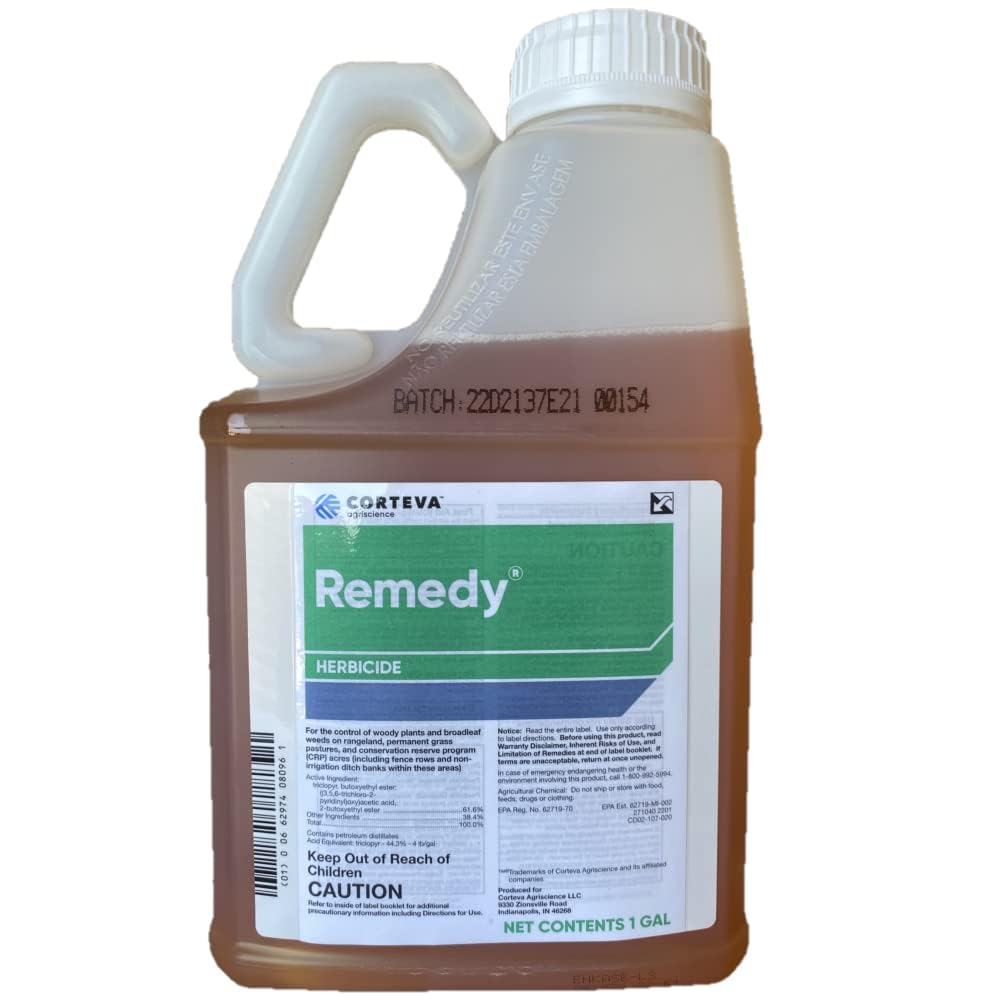
Remedy Ultra stands out for knotweed control because it’s labeled for basal bark application — you mix it 1:3 with diesel and paint the solution onto the lower 12 inches of the stem. This method bypasses the foliage entirely, delivering triclopyr directly through the bark into the phloem where it travels to the rhizome without any drift exposure to nearby plants. Buyers tackling honey locust and multiflora rose report zero regrowth after a single basal treatment, and the same biology applies to knotweed canes.
The low-odor formulation is a practical advantage when working near homes or occupied pastures. Gardeners treating fence lines and pond edges note that the product stays active through moderate rain and doesn’t require reapplication after light showers. At a 1:50 spray mix for foliar application, one gallon of concentrate handles multiple seasons of spot treatment on established knotweed patches.
The main limitation is cost — this is one of the pricier concentrates on the list, and buyers fighting large knotweed monocultures may burn through it quickly. A few users mention that the concentrate is ineffective on grassy weeds, so if knotweed is mixed with grass species you want to keep, you’ll need to spot-treat each cane individually. The basal bark method also requires a separate diesel purchase and careful handling of a flammable mix.
What works
- Effective basal bark delivery stops knotweed regrowth without drift
- Low-odor formula suitable for residential border treatment
- Works through light rain without losing potency
What doesn’t
- Premium price per gallon compared to alternative triclopyr products
- Requires separate diesel purchase for basal bark method
4. Corteva Agriscience Remedy Herbicide

Corteva’s Remedy is the same active chemistry as Dow’s Remedy Ultra but available in a fresh stock that aligns with current registration labels. Buyers specifically call it out as effective against palm trees and mesquite, which share the same deep-rooted growth habit as knotweed. The concentrate mixes cleanly with diesel for basal applications and with water plus a non-ionic surfactant for foliar sprays, giving the user flexibility to match the treatment method to the infestation pattern.
The herbicide has minimal odor compared to older triclopyr formulations, which matters when treating knotweed along the perimeter of a home or near a patio. Gardeners on well-drained sandy loam report seeing top-kill within three days and no resprouting from cut stumps for the remainder of the season. The one-acre coverage rate makes this a solid mid-range option for properties with multiple knotweed patches rather than a single dense thicket.
Runoff is the biggest risk — Corteva’s Remedy is highly mobile in water and can kill ornamentals 10 feet downhill from the application zone if overspray reaches their root zone. The concentrate has a tendency to foam in the spray tank if agitated too vigorously, so a slow swirl rather than a shake is recommended during mixing. Some buyers note that the price per fluid ounce is higher than the Tenkoz or Southern Ag alternatives, so budget-conscious users may prefer one of those for large volumes.
What works
- Effective on deep-rooted woody plants including knotweed and mesquite
- Low odor formula suitable for residential perimeter work
- Compatible with both foliar and basal application methods
What doesn’t
- Runoff risk can kill ornamentals downhill from treated area
- Tends to foam in tank if agitated too vigorously
5. Roundup Weed & Grass Killer₄ Concentrate 1 Gal

Roundup Weed & Grass Killer₄ concentrate includes triclopyr, fluazifop, and diquat dibromide — a multi-pathway mix that works faster than triclopyr alone. The diquat dibromide desiccates leaf tissue within hours, creating visible browning that confirms the herbicide is on target, while the triclopyr component handles the systemic movement into the knotweed rhizome. This dual-speed action helps you confirm coverage immediately, reducing the guesswork about whether the application was effective.
The 30-minute rainproof window is the best on this list, a critical factor when treating knotweed during unpredictable fall weather. Each gallon of concentrate diluted at 3 ounces per gallon of water covers roughly 300 square feet, making this a better fit for small-to-medium patches rather than acres of infestation. Verified buyers with small residential knotweed problems report complete top-kill within 10 days and limited regrowth the following season when applied in late August.
The biggest tradeoff is that this product is not selective — it kills everything it touches, including grass. If knotweed is growing through a lawn you want to preserve, you’ll need to spot-treat each cane individually or use a shielded sprayer. The concentrate is also significantly pricier per square foot than the heavy-duty triclopyr options, so it’s best suited for precision work where coverage volume is low.
What works
- Fast visible browning within hours confirms accurate application
- Rainproof after 30 minutes beats all competitors
- Multi-active ingredient mix provides systemic and contact action
What doesn’t
- Non-selective — kills any grass or ornamentals it contacts
- Higher cost per square foot than dedicated brush herbicides
6. Roundup Poison Ivy Plus Tough Brush Killer₂ Concentrate

This 32-ounce concentrate is specifically formulated for woody vines like poison ivy and poison oak, which share knotweed’s waxy leaf surface and aggressive rhizome growth. The active ingredient lineup — triclopyr, fluazifop, and diquat — provides both fast surface burn and systemic translocation. Buyers using the hack-and-squirt method find that applying the undiluted concentrate directly into the hollow knotweed stems after cutting them just above the first node delivers the herbicide straight into the vascular system without drift.
The small bottle size is a deliberate tradeoff — it’s designed for spot treatment rather than broad-acre coverage. For a property with a few isolated knotweed canes or a cluster along a fence line, the 1500-square-foot coverage of the diluted mix is adequate, and the compact bottle is easy to carry along with loppers during a single work session. Users report visible wilting within four hours on poison ivy and comparable speed on knotweed when applied during warm, sunny weather.
Where this product falls short is the concentrated price per ounce — it’s the most expensive option on the list when calculated by fluid ounce of active ingredient. The small volume also means you’ll run out fast if you’re facing a large knotweed monoculture. Additionally, the diquat dibromide adds plant surface toxicity but doesn’t contribute to long-term rhizome suppression, so follow-up applications in the spring are almost always necessary.
What works
- Hack-and-squirt method delivers concentrate directly to root system
- Visible browning within hours confirms leaf uptake
- Compact 32-ounce bottle easy to carry for spot treatments
What doesn’t
- Highest cost per ounce of any product on the list
- Diquat component doesn’t contribute to long-term rhizome kill
7. Hi-Yield Killzall 365 (1 gal)
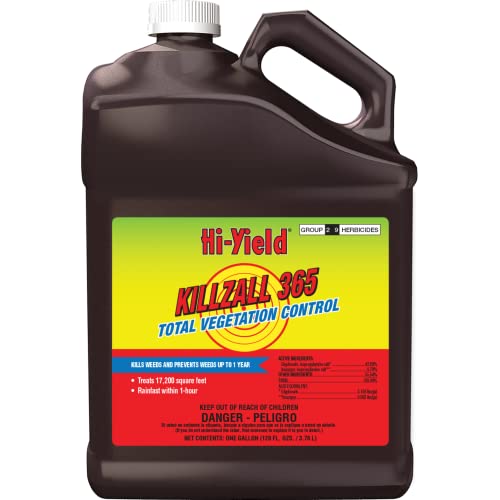
Hi-Yield Killzall 365 treats up to 17,200 square feet per gallon, making it the highest-coverage option on this list by a wide margin. For the price, you’re getting roughly 10 times the coverage area of the premium triclopyr concentrates, which makes it a practical choice if you’re experimenting with large-scale knotweed suppression on a tight budget. The active ingredient is a non-selective systemic that kills all vegetation, including grass, broadleaf weeds, and woody brush.
The recommended mix rate for brush control is 6 ounces per gallon of water, which is close to the label’s maximum rate and necessary for knotweed. Buyers on sandy soils report good results against stubborn weed species with two applications per season, but note that knotweed can require three or four treatments before the crown stops sending up new shoots. The large one-gallon container is economical for repeated applications across a full acre.
The main limitation is that Killzall 365 uses a different active chemistry than the triclopyr-heavy products — it’s built around a generic glyphosate-based formula with a soil residual additive. Knotweed that has developed any tolerance to glyphosate in its region may show limited dieback, and the residual activity prevents replanting for several months after the last application. If you’re committed to a multi-season knotweed battle, the triclopyr products on this list are more reliable for complete eradication.
What works
- Highest coverage at 17,200 square feet per gallon
- Economical for large-acreage knotweed suppression
- Available at local retailers for convenient refills
What doesn’t
- Requires 3-4 applications per season for knotweed control
- Glyphosate-based formula may be ineffective on resistant knotweed strains
Hardware & Specs Guide
Triclopyr Concentration
Triclopyr is the active ingredient that controls knotweed at the rhizome level. Products with 8 percent triclopyr or higher (Crossbow, Southern Ag Crossbow, Remedy Ultra) deliver systemic movement that reaches the deep root nodes. Lower-concentration products like Roundup Poison Ivy Plus rely on multi-pathway mixes that work faster but may not suppress the crown as thoroughly into the next season.
Coverage Volume
Coverage varies from 300 square feet per gallon of concentrate (Roundup Weed & Grass Killer₄) to 17,200 square feet (Hi-Yield Killzall 365). For small residential patches, the smaller coverage is acceptable. For large knotweed thickets covering half an acre or more, the Crossbow or Southern Ag options at one to two acres per gallon are more practical.
Application Method Compatibility
Foliar sprays require a surfactant (non-ionic or crop oil) to penetrate knotweed’s waxy leaf cuticle. Cut-stem hack-and-squirt requires a concentrate that can be applied undiluted directly into the hollow cane — Roundup Poison Ivy Plus and Corteva Remedy work well this way. Basal bark treatment needs an oil-soluble concentrate like Remedy Ultra, diluted 1:3 with diesel.
Rainfast Window
The time between application and rain that won’t wash the herbicide off matters for fall timing. Roundup Weed & Grass Killer₄ is rainproof in 30 minutes, the fastest on the list. Crossbow and Southern Ag Crossbow require about 2 hours without rain. Products with diquat (Roundup Poison Ivy Plus) show the fastest visible results but can still be washed off within the first hour.
FAQ
Can I use a weed killer that only contains glyphosate to control Japanese knotweed?
When is the best time of year to spray Japanese knotweed?
How many treatments does it take to kill Japanese knotweed completely?
Final Thoughts: The Verdict
For most gardeners, the weed killer for japanese knotweed winner is the Crossbow Herbicide Brush Killer 1 Gallon because its 16.5 percent triclopyr content provides the deepest systemic translocation into the rhizome network, and its one-acre coverage per gallon balances power with practicality for moderate-to-large patches. If you need the highest volume per dollar for a multi-acre infestation, grab the Southern Ag Crossbow Specialty Herbicide. And for precision spot treatment using the hack-and-squirt method on individual canes near desirable plants, nothing beats the Roundup Poison Ivy Plus Tough Brush Killer.