
Goat heads — those nightmare-inducing puncture vines (Tribulus terrestris) — turn bare soil, pastures, and walkways into a carpet of agony for bare feet, bike tires, and pet paws. Standard broadleaf weed killers often fail against this drought-hardened, prostrate-growing annual because its waxy cuticle repels weak herbicide formulations and its seeds can lie dormant for years. Winning the war requires a selective strategy: pre-emergent barriers to block germination and post-emergent translocated herbicides that reach the deep taproot before new seed heads form.
I’m Rikta — the co-founder and writer behind Lawn Gear Lab. I’ve spent hundreds of hours cross-referencing active-ingredient chemistry against owner-reported kill rates, turf safety data, and soil half-life figures to isolate the products that actually stop goat heads without sterilizing the ground for seasons to come.
Whether you are reclaiming a driveway strip, protecting a pasture, or clearing a play area, this guide analyzes seven concentrated formulations to find the weed killer for goat heads that delivers lasting suppression with minimal collateral damage to desirable turf or animals.
How To Choose The Best Weed Killer For Goat Heads
Goat heads are not your average broadleaf weed. Their aggressive taproot, waxy leaf surface, and prolific seed production demand a specific approach. Selecting the wrong active ingredient wastes money and leaves the infestation to grow stronger. Focus on three decisive factors.
Active Ingredient Chemistry: Translocated vs. Contact Killers
Contact herbicides burn foliage quickly but rarely penetrate the root crown of a mature goat-head vine. Translocated actives — such as Triclopyr, Mesotrione, and 2,4-D — move through the phloem into the root system, stopping regrowth and preventing new seed heads from developing. For established mats of Tribulus terrestris, a translocated formula is non-negotiable.
Turf-Grass Compatibility and Selectivity
Goat heads often invade lawns, pastures, and warm-season turf like Bermuda, Zoysia, and St. Augustine. Some actives (like MSMA) can severely stress or kill certain grass types if overapplied. Match the product label to your specific turf species — cool-season blends like Tall Fescue tolerate different chemistries than hot-climate sod. Non-selective glyphosate works in gravel driveways and fence lines but kills everything green on contact.
Pre-Emergent Timing and Residual Control
Because goat-head seeds remain viable in soil for years, a post-emergent-only strategy is a losing battle. Pair the spray with a pre-emergent barrier (applied when soil temperatures reach 60°F) that prevents new seeds from germinating after you kill the mature plants. Products containing Mesotrione or certain dinitroaniline compounds provide early-season protection when applied at the correct label rate.
Quick Comparison
On smaller screens, swipe sideways to see the full table.
| Model | Category | Best For | Key Spec | Amazon |
|---|---|---|---|---|
| Liquid Harvest Mesotrione | Post/Pre-Emergent | Selective lawn use | Mesotrione 8 oz concentrate | Amazon |
| Roundup Poison Ivy Plus | Brush Killer | Fence lines, trails | Triclopyr + Diquat 32 oz | Amazon |
| PBI/GORDON Trimec | Lawn Weed Killer | Cool-season turf | Trimec 1 gal (128 oz) | Amazon |
| Compare-N-Save Glyphosate | Non-Selective | Gravel, bare soil | 41% Glyphosate 1 gal | Amazon |
| Remedy Specialty Herbicide | Pasture/Brush | Rangeland, fence rows | Triclopyr 1 gal | Amazon |
| Southern Ag Crossbow | Weed & Brush | Heavy brush, vines | 2,4-D + Triclopyr 1 gal | Amazon |
| Target 6 Plus MSMA | Turf Herbicide | Warm-season lawns | MSMA 48.2% 2.5 gal | Amazon |
In-Depth Reviews
1. Liquid Harvest Mesotrione – 8oz Concentrate

Mesotrione stands apart because it works both as a pre-emergent barrier in spring and as a post-emergent root killer during active growth. This 8-ounce concentrate treats a significant area — mix one teaspoon per two gallons of water for spot treatments — and targets 46 broadleaf species plus crabgrass. The product bleaches susceptible foliage within days as it disrupts photosynthesis, but full weed death typically takes two to three weeks after absorption.
Owner reports confirm it is gentle on Centipede, Tall Fescue, and St. Augustine (sod only), though over-application can temporarily discolor or stress Bermuda and Zoysia. For goat heads specifically, applying Mesotrione before the vines flower and watering in 0.15 inches within 24 hours activates the pre-emergent layer that blocks new seeds from sprouting for several weeks.
The 8-ounce bottle provides a strong cost-per-square-foot value compared to ready-to-use sprays. Use a tank sprayer with a dye indicator to prevent overlap burns, and avoid applying during drought stress or heat waves to protect the turf canopy.
What works
- Dual pre- and post-emergent action stops goat heads at two life stages
- Safe on popular warm- and cool-season grasses when label rates are respected
- Highly concentrated — a little goes a long way for large areas
What doesn’t
- Slower visual results compared to contact killers; patience is required
- Can bleach or stunt turf if overlapping or applied during heat stress
2. Roundup Poison Ivy Plus Tough Brush Killer₂ Concentrate

Roundup’s brush-killer formula combines Triclopyr with Fluazifop and Diquat Dibromide — a three-act chemistry that scorches foliage on contact while the Triclopyr translocates to the root system. This makes it a strong option for goat heads growing along fences, around sheds, and in mixed brush where you do not care about preserving grass. The visible wilting within hours provides quick satisfaction while the deeper kill prevents the vine from reshooting.
The 32-ounce concentrate covers about 1,500 square feet at the recommended mix rate. Rainproof in 30 minutes gives flexibility during unpredictable weather. Owner reviews highlight its effectiveness on poison ivy and blackberry, but for goat heads the key advantage is the Triclopyr component, which penetrates waxy cuticles that weaker formulas miss.
Be aware that this product is non-selective — it will kill or damage any grass it contacts. Use a shield or wick applicator to keep spray drift away from lawns. The 1- to 30-day replant window (depending on rate) means you can reseed bare spots after the infestation clears.
What works
- Extremely fast visual die-off within hours of application
- Triclopyr penetrates waxy goat-head cuticle effectively
- Rainproof in 30 minutes for reliable results
What doesn’t
- Non-selective — kills any turf or desirable plants it touches
- Concentrate volume is relatively small for large pasture applications
3. PBI/GORDON Trimec Lawn Weed Killer – 1 Gallon

Trimec is a trusted name in selective lawn weed control, built around a three-way blend of 2,4-D, Mecoprop, and Dicamba. This combination targets broadleaf weeds without harming cool-season turfgrasses like Tall Fescue, Kentucky Bluegrass, and Perennial Ryegrass. For goat heads that have established in the lawn, Trimec provides reliable translocated control when applied at the first sign of leaf expansion.
The one-gallon container covers up to 64,000 square feet, making it a volume-efficient choice for larger lawns with hot-spot infestations. Owners note that strong or mature weeds may require 1.5x to 2x the standard mix rate, and multiple applications spaced two weeks apart are often necessary to kill deeply rooted goat-head crowns.
Trimec works best on cool-season turf; apply it when temperatures are between 60°F and 85°F and the goat heads are actively growing. Avoid mixing with wetting agents that increase drift, and stay off treated areas until spray has fully dried. The 2,4-D component volatilizes above 85°F, so time your application for morning lows.
What works
- Selective — kills goat heads without damaging cool-season turf
- Excellent value per gallon for large lawn areas
- Translocated chemistry reaches deep taproots
What doesn’t
- Weak on mature, drought-hardened goat heads at standard rates
- Not suitable for warm-season grass like St. Augustine or Centipede
4. Compare-N-Save 75324 Glyphosate – 1 Gallon
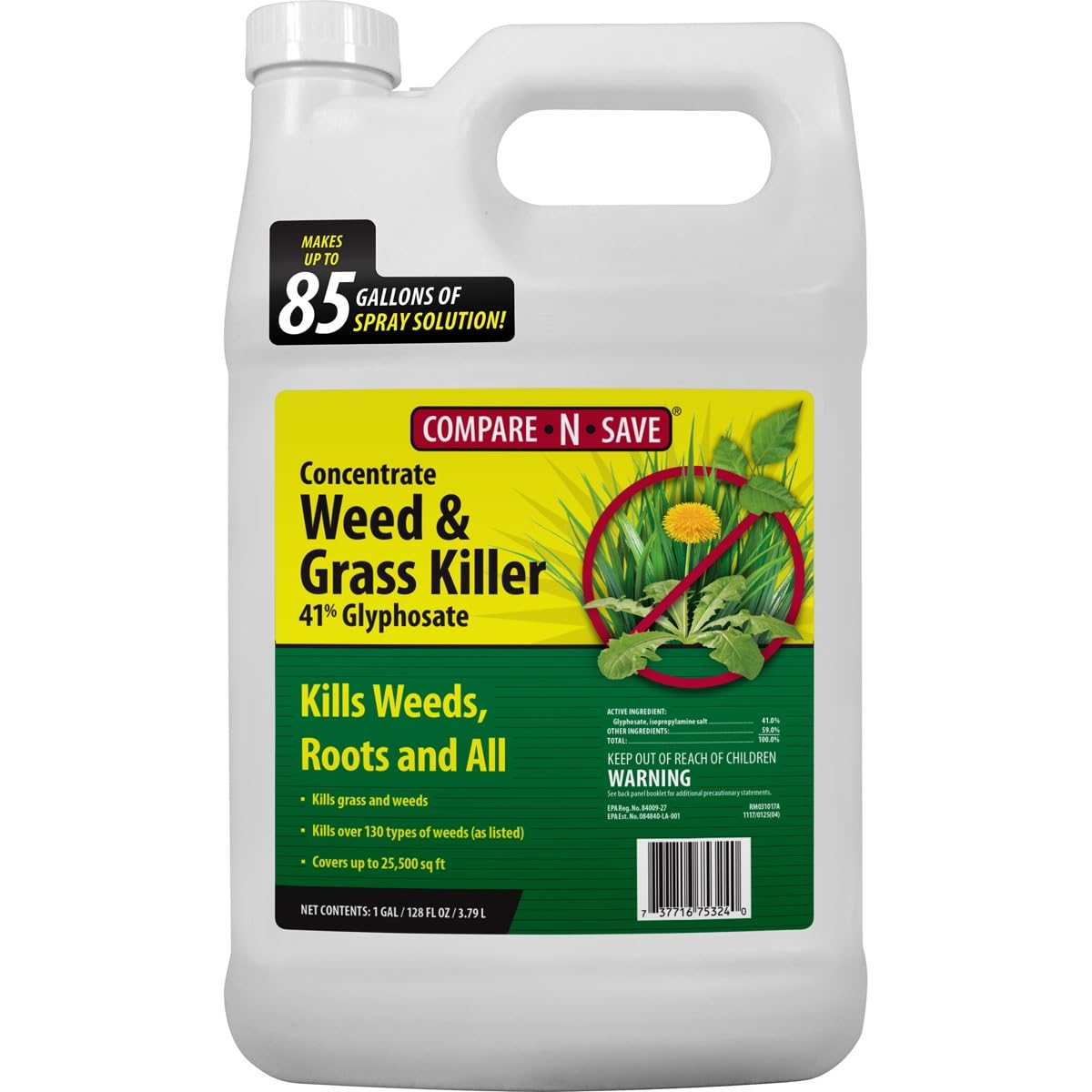
At 41 percent glyphosate, this is a high-concentration non-selective killer suited for areas where you want total vegetation removal: gravel driveways, concrete cracks, fence lines, and bare-dirt patches where goat heads thrive. The one-gallon jug makes up to 85 gallons of ready-to-use spray, covering roughly 25,000 square feet at the standard rate — enormous coverage for the volume.
Glyphosate works by inhibiting the EPSP synthase enzyme, a pathway absent in animals, making it safe for use around pets and livestock once dry. Rainproof in two hours, it shows visible results within two to four days, though full root kill on goat heads can take several weeks. Multiple owner reviews confirm that it kills weeds completely, including the root system, but requires patience and strict adherence to mix ratios.
The primary trade-off is non-selectivity: any desirable grass, flower, or shrub that receives drift will die. Use a fan nozzle on a low-pressure pump sprayer on windless days to avoid overspray. Because goat heads produce seeds quickly, combine a glyphosate spray with a pre-emergent barrier to prevent the next generation from germinating in the same spot.
What works
- Highest glyphosate concentration for maximum root kill
- Extremely cost-effective for large areas of bare soil and gravel
- Rainproof in 2 hours for reliable application
What doesn’t
- Kills every green plant — zero selectivity for lawns
- Slow visual results compared to contact-type formulas
5. Remedy Specialty Herbicide – 1 Gallon
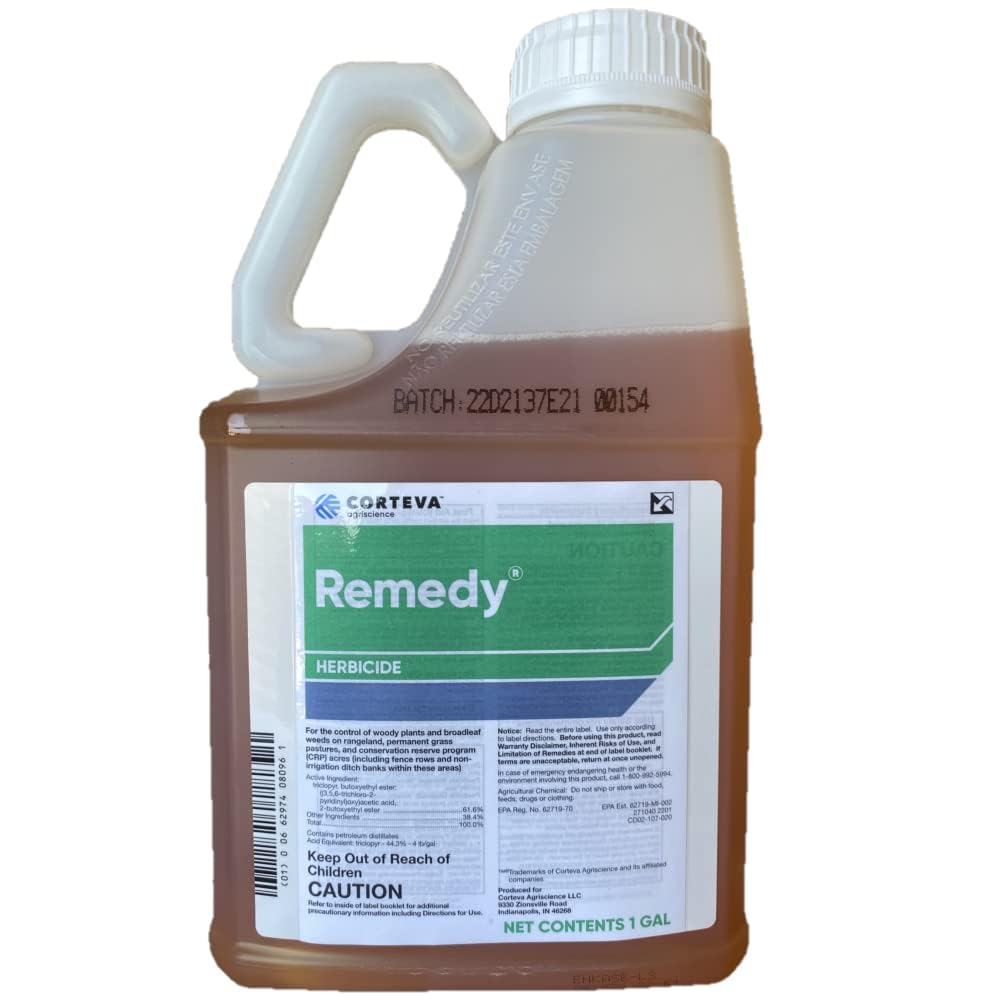
Remedy Ultra is a premium Triclopyr-based herbicide formulated for rangeland, pasture, and fence-line brush control. Its low-odor profile makes it more pleasant to apply than older ester formulations, and it provides long-lasting suppression of woody plants and annual broadleaf weeds — including goat heads. The product works on the entire plant, from leaves to root crown, preventing the vine from generating new seed heads after dieback.
Owner reports from Florida to the Midwest confirm it annihilates tough weeds like cogon grass and multiflora rose, and for goat heads, the Triclopyr concentration is powerful enough to stop mature vines with a single application. Use it alone or tank-mix with GrazonNext for broader pasture weed control. The gallon jug lasts for dozens of spot treatments when mixed at the standard rate of 1 to 2 ounces per gallon of water.
Because Remedy is selective to broadleaf plants and safe on grass, it is ideal for Bahia, Bermuda, and native pasture grasses. However, it is expensive at the gallon level — owners pay a premium for the specialized chemistry. Apply when goat heads are actively growing and temperatures are between 60°F and 85°F for maximum translocation.
What works
- Powerful translocated Triclopyr kills mature goat-head taproots
- Safe for pasture grasses and livestock after drying
- Low-odor formulation for comfortable application
What doesn’t
- High cost per gallon compared to general-purpose herbicides
- Overkill for small lawn patches — better suited to acreage
6. Southern Ag Crossbow Specialty Herbicide – 1 Gallon

Southern Ag Crossbow combines 2,4-D and Triclopyr into a dual-action formula that tackles both broadleaf weeds and woody brush. The synergy between the two actives provides fast defoliation and deep root translocation, making it a strong candidate for goat head infestations mixed with blackberry, ivy, and small trees. The one-gallon container makes up to 96 gallons of spray solution, covering 2.23 acres.
Owner feedback consistently highlights its effectiveness on tough vines and brush — one application killed ivy and eight-foot weeds within 48 hours, and the 2,4-D component adds a second mode of action that reduces the chance of chemical resistance developing in goat-head populations. For pasture and fence row use, Crossbow is selective to broadleaf plants and does not harm established grass when applied at the correct rate.
The strong odor is the most common complaint — the 2,4-D ester formula has a noticeable chemical smell that lingers for hours. Apply with a respirator and avoid drift onto ornamental plants. Crossbow also requires three dry days after application for maximum absorption, so check the forecast before spraying.
What works
- Dual active ingredients reduce resistance risk in goat-head populations
- Massive coverage area — over 2 acres per gallon
- Fast visual die-off on vines and brush within 48 hours
What doesn’t
- Strong chemical odor requires protective gear
- Requires 3 rain-free days for optimal performance
7. Target 6 Plus (MSMA 48.2%) Turf Herbicide – 2.5 Gallon

MSMA (Monosodium acid Methanearsonate) is a time-tested organic arsenical herbicide that targets warm-season turf weeds without killing Bermuda, Zoysia, or Centipede grass. This 2.5-gallon jug at 48.3 percent concentration is a commercial-grade product sold for golf courses, sod farms, and highway rights of way — but it works just as effectively on residential goat-head outbreaks in warm-climate lawns.
The correct mix ratio is 2 ounces per gallon of water for general applications, and owners confirm it kills Dallisgrass, Johnsongrass, Nutsedge, and broadleaf weeds like goat heads quickly. One reviewer reported that a single application at 1.25 tablespoons per 2 gallons eliminated all weeds, while over-mixing stressed Bermuda grass into dormancy. Follow the supplemental data sheet for goat-head-specific rates to avoid browning the turf.
MSMA is restricted for use on golf courses and sod farms in some states, so verify local regulations before purchase. The 2.5-gallon volume is substantial — a single purchase can last multiple seasons even for heavy infestations. Because it is an arsenical compound, use gloves and goggles during mixing, and do not allow runoff into drainage ditches or water sources.
What works
- Highly selective for warm-season grass — safe on Bermuda and Zoysia
- Extremely potent and fast-acting on goat heads
- Large 2.5-gallon volume offers multi-season supply
What doesn’t
- Restricted use in some states — verify local legality
- Precise mixing is critical to avoid turf injury
Hardware & Specs Guide
Understanding the chemical properties behind each weed killer helps you match the product to your specific goat-head situation — lawn type, infestation severity, and environmental conditions. Here are the key specs that define performance.
Active Ingredient Concentration
The percentage of the killing agent in the concentrate directly affects coverage and required mix rate. Higher concentrations like 41 percent glyphosate or 48.3 percent MSMA offer more treated gallons per jug but increase the risk of overdose. Lower-concentration specialty formulations like Mesotrione (about 40 percent in the Liquid Harvest bottle) require careful measurement but provide selectivity for lawn use. Always calculate the actual pounds of active ingredient per acre, not just the percentage on the label.
Translocation vs. Contact Mode of Action
Translocated herbicides (Triclopyr, 2,4-D, Glyphosate, MSMA) move through the plant’s vascular system to the roots, stopping regrowth and preventing seed production. Contact killers (Diquat Dibromide in some Roundup formulas) burn foliage on contact but leave the root system alive — goat heads can regrow from the crown within a week. For established Tribulus terrestris, a translocated active is mandatory; contact-only actives are only useful as a rapid knockdown before a translocated follow-up spray.
FAQ
Will mesotrione kill goat heads without harming my St. Augustine grass?
How soon after spraying can I let my pets walk on treated goat-head areas?
Final Thoughts: The Verdict
For most gardeners, the weed killer for goat heads winner is the Liquid Harvest Mesotrione because its pre- and post-emergent dual action stops both actively growing vines and the next generation of seeds in a single product. If you want non-selective control over gravel or bare soil, grab the Compare-N-Save Glyphosate for the highest concentration at the lowest per-gallon cost. And for pasture-grade suppression of goat heads mixed with woody brush, nothing beats the Remedy Specialty Herbicide.