
Specs are compiled from manufacturer listings and verified buyer reviews and can change over time — please confirm the key details on the product page before buying.
Clover in a lawn is a stubborn problem. Most weed killers either miss it completely or take so long you wonder if anything happened. The real trick is finding a selective spray that kills the clover down to the root without burning the grass you actually want. This guide cuts through the marketing to the seven weed killers that actually deliver on that promise — ranked by how fast they work, how much ground they cover, and whether they spare your turf.
I’m Rikta — the founder and writer behind Lawn Gear Lab. This guide is built by comparing the manufacturers’ published specifications and the patterns across verified customer reviews, so you get each pick’s real strengths and trade-offs instead of marketing spin.
Choosing the right weed killer for clover in lawns depends on matching the spray to your grass type and the size of your infestation, because a treatment that saves St. Augustine can torch Bermuda, and vice versa.
Quick Picks
- Ortho WeedClear Weed Killer for Lawns Refill – 1 Gal. — Best Overall
- Ortho Weed B Gon Weed Killer, 24oz, RTU Trigger — Premium Pick
- Bonide Chickweed, Clover & Oxalis Killer, 128 oz Ready-to-Use Spray — Best Value for Volume
- Fertilome Weed Free Zone (32 oz) – Concentrate — For Stubborn Weeds
- Scotts TouchUp Weed Control for Lawn (Dandelion, Clover, & Crabgrass Killer) – 24 fl oz — Patient Pick
- Scotts EZ Feed Plus Weed Control, 32 fl. oz. – Hose-End Spray — Two-in-One
- Hi-Yield Atrazine Weed Killer RTS (32 oz) — Grass-Specific
How To Choose The Best Weed Killer For Clover In Lawns
Clover is a broadleaf weed (it has wide, flat leaves, not narrow grass blades), so the sprays that work best are “selective” herbicides — they target broadleaf weeds while leaving most lawn grasses alone. The core decision depends on your grass type, the size of your yard, and how quickly you want to see results.
Check Your Grass Type Before You Spray
This is the single most common mistake. Many clover killers are only safe for St. Augustine, Centipede, Bermuda, Zoysia, or Fescue — and some list specific exclusions like Floratam St. Augustine or certain hybrids. Read the “where to use” line on the label before you buy. Spraying the wrong chemistry on a sensitive grass can leave brown patches that last all season.
Ready-to-Use vs Concentrate vs Refill
Ready-to-use (RTU) trigger sprays (sprays that are pre-mixed and squirt on demand) are perfect for spot-treating small clover patches — you pull the trigger and spray exactly where the weed is. Refills and concentrate bottles (mixing your own with water in a pump or hose-end sprayer) cover much more ground and cost less per ounce, but require a separate applicator and a few minutes of setup.
Speed of Results and Active Ingredients
Some clover killers show browning within a few hours; others take three to four weeks. Active ingredients like Dicamba and Triclopyr are generally faster on clover than straight Atrazine, but Atrazine is safer for Centipede and St. Augustine lawns. If you need the weeds gone in days, look for a product that mentions visible results “in hours” in the features.
Quick Comparison
| Model | Best For | Coverage | Liquid Volume | Item Weight | Amazon |
|---|---|---|---|---|---|
| Ortho WeedClear Refill | Fast, Whole-Yard Results | 5000 sq ft | 128 fl oz | — | Amazon |
| Ortho Weed B Gon RTU | Gentle Spot Treatment | — | 24 fl oz | 24 oz | Amazon |
| Bonide Chickweed, Clover & Oxalis Killer | Large Volume Value | — | 128 fl oz | 8 lbs | Amazon |
| Ferti-lome Weed Free Zone | Stubborn Weeds (Creeping Charlie) | Full | 32 fl oz | — | Amazon |
| Scotts TouchUp Weed Control | Patience-Based Spot Killer | — | 24 fl oz | 24.96 oz | Amazon |
| Scotts EZ Feed Plus Weed Control | Fertilizer + Weed Control Combo | 4000 sq ft | 32 fl oz | 33.28 oz | Amazon |
| Hi-Yield Atrazine Weed Killer | St. Augustine & Centipede Only | Full | 32 fl oz | 2 lbs | Amazon |
In‑Depth Reviews
1. Ortho WeedClear Weed Killer for Lawns Refill – 1 Gal.
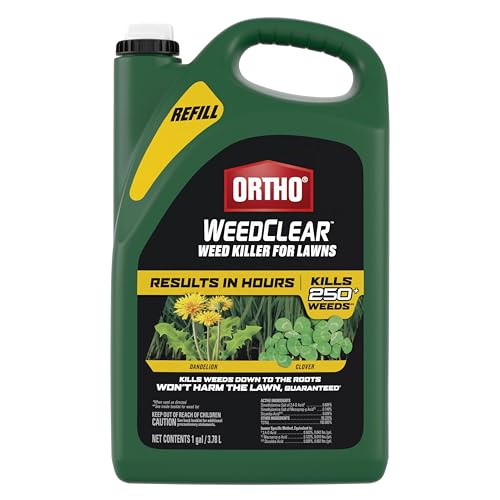
A big refill that kills 250+ weeds in hours and saves your whole yard.
This is the pick for anyone who wants fast, whole-yard action without buying a separate applicator each time. The 128 fl oz liquid refill covers 5000 square feet and works on a long list of grass types — St. Augustine (not Floratam), Bermuda, Centipede, Zoysia, Buffalo, Bahia, Kentucky Bluegrass, Ryegrass, Tall Fescue, and Fine Fescue. Buyers report visible effects within an hour, with weeds brown and dead by day one.
The killer feature here is the speed: it kills clover and dandelion down to the root in one application, and unlike some competitors on this list, you see results the same day, not weeks later. The main trade-off is that it comes as a refill — you need to reuse the Comfort Wand from the original container, so if this is your first Ortho product, you will need to buy the initial wand separately.
One reviewer summed it up simply: “destroys flower weeds without killing the grass, just don’t spray a lot since it doesn’t take much.” That is good advice — a light, even coating is all it needs.
Speed and Safety
- One application knocks out both clover and dandelion, according to the manufacturer.
- Safe across a wide range of warm- and cool-season grasses (check for Floratam exclusion).
- Large 128 oz refill covers 5000 sq ft — more than most competitors at this price tier.
Setup Requirement
- Requires the original Ortho Comfort Wand applicator (not included in the refill).
- Not safe for Floratam St. Augustine — check your lawn variety.
Reach for it if: you want fast, full-yard clover control and already own the Ortho wand, or are willing to buy one.
Look elsewhere if: your lawn is mostly Floratam St. Augustine, or you need a spot-trigger for a few stray weeds.
2. Ortho Weed B Gon Weed Killer, 24oz, RTU Trigger

A trigger spray that spares your grass and starts killing clover in hours.
If your clover problem is a few scattered patches, not a yard-wide invasion, this is the most convenient way to handle it. The 24 fl oz ready-to-use trigger lets you squeeze exactly where the weed is — no mixing, no hose attachment, no cleanup. Owners mention “great results killing clover and other weeds without killing the grass,” and the label guarantees it will not harm the lawn when used as directed.
It kills over 250 broadleaf weeds down to the root, and the word “hours” in the feature set is not empty marketing — multiple reviewers confirm the browning starts fast. At 24 oz, it is close in size to the Scotts TouchUp at 24 fl oz, while the Scotts item weight is listed at 24.96 oz and takes 3-4 weeks. The trade-off is coverage: this is a spot-treat bottle, not a whole-yard refill, so a bad infestation will burn through it fast.
One reviewer noted the need for safety precautions: “I would suggest to wear gloves and masks while using it.” That is a fair note for any chemical spray, but the ease of the trigger makes it tough to top for a quick afternoon of spot-spraying.
Instant Spot Control
- Targets clover, dandelions, and 250+ broadleaf weeds without harming the lawn.
- Results visible in hours, not weeks — one of the fastest sprays on this list.
- No mixing or setup needed; just pull the trigger.
Coverage Limit
- Small 24 oz bottle — not economical for large lawns or heavy infestations.
- Read the label for your specific grass type to avoid damage.
The winning angle: immediate, pinpoint clover control with zero extra equipment — ideal for small patches and touch-ups.
One real catch: the bottle runs out fast if you are covering more than a few square feet of weeds.
3. Bonide Chickweed, Clover & Oxalis Killer, 128 oz Ready-to-Use Spray

A gallon of clover killer that weighs 8 lbs and uses Dicamba/Triclopyr chemistry.
This is the most literal value-for-volume option on the list. At 128 fl oz, it holds exactly the same liquid volume as the Ortho WeedClear refill, but the Bonide is ready to use out of the bottle (no separate applicator required) and weighs 8 pounds — a full 4 lbs heavier than the Hi-Yield Atrazine. The active ingredients are Dicamba and Triclopyr, a combination that customers note kills dandelions in one spray and turns clover brown in about three days.
One major advantage over the Ortho WeedClear refill is that you do not need to own a Comfort Wand — just unscrew the cap and spray. However, the built-in hand sprayer gets poor marks from some buyers, who recommend decanting into a pump sprayer for large lawns. A reviewer noted: “my husband uses with a pump sprayer and it works much better than the container it comes in.” The Bonide also covers double the volume of the 64-oz options at this price, so a heavy infestation on a large property will cost significantly less per application.
Not every experience is perfect — one reviewer found it ineffective on heavy clover patches, saying “only slightly turned some of the top clover leaves a very light brown.” For stubborn clover, you may need to reapply or bump up the concentration in a pump sprayer.
Big Volume, Smart Chemistry
- Gallon-sized bottle, ready to use — no mixing needed.
- Dicamba + Triclopyr formula targets clover, chickweed, and oxalis.
- Buyers confirm clover browns in 3 days and dandelions die in one spray.
Hand Sprayer Drawbacks
- The attached hand sprayer is weak for large lawn coverage— consider using a better pump sprayer.
- Mixed results on heavy clover patches; some users saw only slight discoloration.
Best suited for: large clover infestations where you want a gallon of ready-to-use chemical without buying a whole new applicator.
Not ideal for: small spot treatments with the included cheap sprayer — you will waste product.
4. Fertilome Weed Free Zone (32 oz) – Concentrate
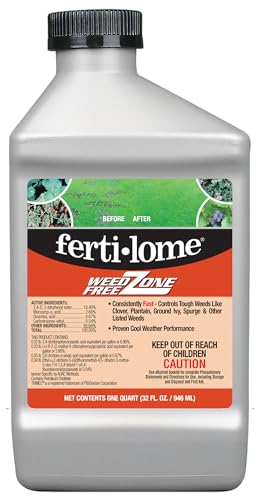
The only concentrate that cheats Clover’s defenses with a stronger mix strategy.
Where most clover killers fail is on tough, deep-rooted species or ground-hugging vines like Creeping Charlie. This 32 oz concentrate from Fertilome, with active ingredient Dicamba, is the weapon for those cases. The label says it provides evidence of injury within hours, but experienced users have a clear strategy: you need to roughly double the recommended concentration for clover specifically, and adding a drop of Dawn dish soap helps the spray stick to the waxy clover leaves.
Unlike the ready-to-use sprays above, this is a concentrate — you mix it with water, so a small 32 oz bottle goes a long way. It is safe on Kentucky Bluegrass, Bermuda, Bahia, and Zoysia. Buyers confirm it kills Creeping Charlie overnight, and one calls it “the only product on the market that truly kills creeping charlie.” The trade-off is that it costs more at the register than most ready-to-use sprays, and it takes a test spray to find the right concentration for your specific clover patch without harming adjacent plants.
A reviewer summed up the DIY approach: “must increase concentration ~2x for clover; adding Dawn dish soap improves adhesion.” If you are not comfortable tinkering with the mixture, a simpler ready-to-use spray may suit you better.
Effective on Tough Weeds
- Kills Creeping Charlie, spurge, clover, and thistle — some of the hardest weeds to eliminate.
- Concentrate means one small bottle covers more ground than a ready-to-use gallon.
- Safe on several common lawn grasses, including Bermuda and Bluegrass.
Requires Tuning
- May need to increase concentration about 2x for clover to work effectively.
- Premium-tier price compared to standard ready-to-use sprays.
Great for: experienced lawn caretakers fighting clover that has resisted other sprays, and anyone battling Creeping Charlie.
skip it if: you want a no-fuss, ready-to-use spray that works out of the bottle with zero mixing steps.
5. Scotts TouchUp Weed Control for Lawn (Dandelion, Clover, & Crabgrass Killer) – 24 fl oz

The slow-and-steady spray that wipes out clover by the root over a month.
This 24 oz ready-to-use spray from Scotts is for the patient homeowner. Unlike the Ortho Weed B Gon, which shows results within hours, the Scotts TouchUp takes its time. As one verified buyer explained: “you will think it didn’t do anything for the entire first week, no change. However, in 3-4 weeks the clover and dandelion are all gone.” The payoff is that it kills the weed at the root so thoroughly that some reviewers claim the same weed does not reappear the next year.
One big issue is that it costs about the same as the 128 fl oz Ortho WeedClear refill but holds only 24 fl oz. It also weighs 24.96 oz, while the Ortho Weed B Gon is listed at 24 oz, and the Ortho is faster. The Scotts works best as a very targeted spot treatment on clover, dandelion, and crabgrass, and it will not harm the surrounding lawn.
Not every user is happy. One review gave it one star, saying it did nothing to dandelions after two sprays. Results vary by weed maturity and weather, but the 3-4 week wait is a consistent pattern in the positive reviews.
Deep Root Elimination
- Kills clover and dandelion at the root; reviewers point out the same weed does not return the next year.
- Ready to use — no mixing or hose attachment required.
Slow and Pricey
- Requires 3-4 weeks to show full results — no instant gratification.
- Small 24 oz bottle makes it expensive relative to larger refill options.
Right for you if: you are willing to wait a month for permanent deep-root elimination on a few dozen weeds.
Not for you if: you need quick results or have a large area of clover to cover.
6. Scotts EZ Feed Plus Weed Control, 32 fl. oz. – Hose-End Spray

A hose-end formula that feeds the grass while killing clover in one pass.
This is a combo product that fertilizes your lawn and kills broadleaf weeds in the same application. You attach the 32 fl oz container to a garden hose, spray evenly across the lawn, and the weed-killing chemistry goes to work while the fertilizer feeds the grass. Shoppers say it “effectively suppresses clover-like weed (possibly creeping sedge) that cheaper brands fail to control.” However, some hard-to-control weeds may require a second application 3-4 weeks later.
The coverage is split by grass type: 6000 sq ft on warm-season lawns (Bermuda, Centipede, Zoysia) and 4000 sq ft on cool-season lawns (Bluegrass, Fescue, Ryegrass).
One buyer had a frustrating experience with the cap leaking at the hose connection and the liquid not coming through properly. Check the cap seal before your first use, and contact Scotts support if the bottle seems defective.
Two Jobs, One Pass
- Fertilizes the lawn and kills clover/dandelion in a single hose-end spray.
- Covers up to 4000 sq ft (cool-season) or 6000 sq ft (warm-season) per bottle.
- Buyers confirm it suppresses clover that cheaper brands fail to kill.
Setup Risks
- Hose connection can leak if the cap is not sealed properly, per some buyer experiences.
- Not all weed types die in one application; some need a second spray at 3-4 weeks.
Best for: homeowners who want to feed and weed in one trip around the yard, and who prefer a hose-end setup over a trigger bottle.
Consider a different pick if: you need a clover-only killer with no fertilizing component, or you have had trouble with hose-attachment sprays leaking in the past.
7. Hi-Yield Atrazine Weed Killer RTS (32 oz)
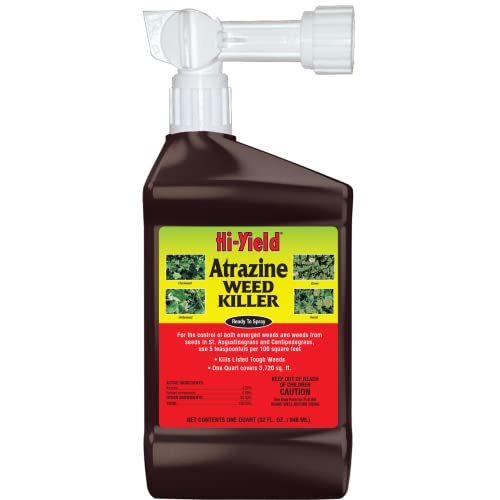
The Atrazine spray for Southern grasses that kills clover without the burn.
If you have St. Augustine or Centipede grass, this is your specialist. The active ingredient is Atrazine, a selective herbicide (a chemical that targets broadleaf weeds without harming certain grasses) that is notably gentler on those Southern warm-season grasses than most broadleaf formulas. A professional user in the reviews recommends a specific mixing ratio: “16 oz per 4 gal water for 2,000 sq ft St. Augustine” — and warns that overdosing or improper mixing will kill the grass. Apply in even 3-4 foot strips with the nozzle about 12 inches above the grass.
The 32 oz ready-to-spray bottle is convenient: just connect it to a hose and spray. Unlike the Ortho Weed B Gon, which shows results in hours, Atrazine takes about three weeks to fully kill clover and other listed weeds (henbit, chickweed, dove weed). The trade-off for this gentleness is that it is useless on any grass outside St. Augustine and Centipede — do not use it on Bermuda, Fescue, or Ryegrass. At 2 pounds, this is also notably lighter than the 8-pound Bonide bottle, so it is easier to carry around the yard.
One sore point from a reviewer: “the bottle lacks measuring markings.” If you are mixing it yourself, you should have your own measuring cup for accuracy.
Safe for Sensitive Grass
- Atrazine formula is designed specifically for St. Augustine and Centipede — among the hardest grasses to treat safely.
- Professional users confirm it kills clover, henbit, and chickweed in about 3 weeks.
- Ready-to-spray hose-end bottle is easy to use on medium lawns.
Narrow Compatibility
- NOT for use on Bermuda, Zoysia, Fescue, or Bluegrass — check your lawn type.
- No measurement markings on the bottle; you may need a separate measuring cup for accurate mixing.
Perfect for: St. Augustine and Centipede lawns where other clover killers cause burn damage.
Not for you if: you have Bermuda, Fescue, or any northern grass — this will not work safely on your lawn.
Understanding the Specs
Liquid Volume & Item Weight
Liquid volume tells you how much chemical you are getting in a single bottle — 24 fl oz for a spot-trigger, up to 128 fl oz for a gallon spray. Weight includes the container plus liquid; a heavier bottle like the 8-lb Bonide holds more product, but is also less comfortable to carry around the yard. If you have a large lawn, a big refill or concentrate saves money per ounce.
Coverage (Square Feet)
Coverage tells you how much lawn one bottle can treat if you apply it evenly. A 5000 sq ft refill can handle a quarter-acre lot in one go, while a trigger spray with no listed coverage is meant for small patches. Match the coverage to your lawn size — buying a small bottle for a half-acre yard means you will run out before you finish.
Item Form: RTU, Refill, or Concentrate
Ready-to-use (RTU) sprays need no mixing — just aim and spray. Refills (like the Ortho WeedClear 128 fl oz) require a separate applicator wand. Concentrates (like the Fertilome Weed Free Zone) require mixing with water in a garden sprayer. RTUs are the most convenient; concentrates give you the most control over the strength.
Active Ingredient: Atrazine vs Dicamba vs Triclopyr
These three chemicals attack weeds differently. Atrazine is gentler on St. Augustine and Centipede but slower (up to 3 weeks). Dicamba is faster (hours to a few days) and works on tough weeds like Creeping Charlie. Triclopyr targets woody broadleaf weeds like oxalis. Many products combine Dicamba and Triclopyr for broader coverage.
FAQ
Will a clover killer harm my Bermuda or St. Augustine grass?
How long does it take for a clover killer to work?
Can I use a clover killer on my whole lawn, or only on the spots?
What is the difference between a ready-to-use spray and a concentrate?
Will these clover killers also kill dandelions and crabgrass?
What is the best time of day to apply a clover killer?
Can I mix a clover killer with fertilizer?
Why does my clover survive the first application and need a second spray?
Is it safe to use these clover killers near flower beds or vegetable gardens?
Do these products have a strong smell while spraying?
Final Thoughts: The Verdict
For most people, the weed killer for clover in lawns winner is the Ortho WeedClear 128 fl oz Refill because it combines fast one-day results, huge 5000 sq ft coverage, and compatibility with the widest range of grass types. If you need a gentle spot-trigger for a few clover patches without harming the grass, grab the Ortho Weed B Gon 24 oz RTU. And for St. Augustine or Centipede lawns where other sprays cause burn damage, the Hi-Yield Atrazine Weed Killer is your safest bet.
How We Picked
We do not accept paid placement. Every pick is matched to a real buyer and a real use-case; we do not hands-on test units.
Sources & Methodology
Specifications: manufacturer listings and product documentation. Review insights: verified customer reviews, as of July 2026. Pricing: not shown on this page (it changes often); check the current price via the retailer link.
As an Amazon Associate, Lawn Gear Lab earns from qualifying purchases. This does not affect which products we feature.