
Bindweed’s deep, white root system can tunnel several feet into the soil, making it one of the most resilient weeds in any garden. A quick spray that only scorches the leaves often leaves the roots intact, allowing the plant to resprout within days.
I’m Rikta — the co-founder and writer behind Lawn Gear Lab. My approach to finding the best weed killer for bindweed involves cross-referencing active ingredient efficacy data, scrutinizing surfactant systems, and analyzing hundreds of verified owner reports to isolate which formulas actually starve the root network into submission.
For seasoned gardeners and frustrated property owners alike, the right post-emergent herbicide with systemic action is critical. This guide breaks down the top-performing concentrates available now to help you find the most effective weed killer for bindweed.
How To Choose The Best Weed Killer For Bindweed
Bindweed’s resilience demands a specific approach. A contact herbicide will burn the visible foliage, but the deep root system remains untouched and ready to regrow. Effective control requires a systemic herbicide that transports the active ingredient down to the entire root mass.
Active Ingredients: Triclopyr vs. Glyphosate
Triclopyr is a selective auxin-mimicking herbicide that is highly effective against broadleaf weeds like bindweed. It translocates efficiently through the plant’s vascular system, targeting the roots. Glyphosate, a non-selective inhibitor of the EPSPS enzyme, also moves systemically but can struggle on bindweed’s waxy leaf surface if not formulated with a strong surfactant or mixed with a crop oil concentrate. For persistent bindweed, a triclopyr-based product often delivers superior results.
Surfactant Systems and Adjuvants
Bindweed leaves have a waxy cuticle that repels water-based sprays. A built-in surfactant or an adjuvant like a non-ionic surfactant (NIS) or methylated seed oil (MSO) is essential. These adjuvants lower the surface tension of the spray droplets, ensuring the herbicide spreads evenly across the leaf and penetrates the cuticle to reach the vascular tissue below. Without them, the active ingredient simply beads up and dries on the leaf surface.
Concentrate vs. Ready-to-Use
Concentrates offer greater flexibility and cost-effectiveness for covering large areas. They allow you to mix a higher-strength solution frequently recommended for tough-to-kill weeds like bindweed. Ready-to-use (RTU) sprayers are convenient for small patches, but their fixed concentration is often insufficient for deep-rooted plants. For bindweed, a concentrate mixed according to the label’s maximum rate for brush/vines provides the necessary potency.
Quick Comparison
On smaller screens, swipe sideways to see the full table.
| Model | Category | Best For | Key Spec | Amazon |
|---|---|---|---|---|
| Roundup Poison Ivy Plus | Triclopyr Cocktail | Deep-rooted Brush | Triclopyr 2.5% + Fluazifop 2.0% | Amazon |
| RM43 43% Glyphosate Plus Weed Preventer | Glyphosate + Imazapyr | Total Vegetation Control | Kills & Prevents Regrowth Up To 1 Year | Amazon |
| Albaugh Gly Star Plus | Glyphosate Concentrate | Bulk Large-Area Spray | 41% Glyphosate + Surfactant | Amazon |
| Quali-Pro Prodiamine 65 WDG | Pre-Emergent Granule | Preventing New Seedlings | 65% Prodiamine WDG | Amazon |
| Remedy Specialty Herbicide | Triclopyr Concentrate | Rangeland & Brush | Triclopyr (1 Gal Professional) | Amazon |
In‑Depth Reviews
1. Roundup Poison Ivy Plus Tough Brush Killer₂ Concentrate

This concentrate isn’t just for poison ivy; its multi-active formula is precisely what bindweed’s root system fears. The combination of triclopyr (2.5%), fluazifop-P-butyl (2.0%), and diquat dibromide (1.5%) creates a three-pronged attack: triclopyr provides deep systemic transport into the root mass, fluazifop targets grassy competition, and diquat provides rapid desiccation of the foliage to stop photosynthesis immediately.
Owner reports consistently highlight its effectiveness on woody vines and deep-rooted perennials. Per the label, each gallon of mixed spray solution covers 300 sq. ft.; the 32 oz. concentrate makes enough solution to treat up to roughly 1,600 sq. ft. at the tough-weed mixing rate, making it suitable for moderate infestations along fence lines or in garden beds. The rainproof guarantee of 30 minutes provides flexibility even in unpredictable weather.
For bindweed, the maximum application rate from the label should be used. The label calls for a repeat application after 28 days if new growth appears, which is often necessary for the most established root networks, but the initial wilting is remarkably fast.
What works
- Multiple active ingredients target roots and foliage simultaneously
- Fast visible results often within hours
- Rainproof after 30 minutes for confident application
What doesn’t
- Concentrate size is 32 oz, which may be small for extensive acreage
- Strong chemical requires proper PPE like a respirator
2. RM43 43% Glyphosate Plus Weed Preventer, Total Vegetation Control

RM43 pairs glyphosate (43.68%) with imazapyr (0.78%), a soil-active herbicide that leaves a bareground barrier behind for up to a year. Per its EPA label (Reg. No. 84009-3), field bindweed (Convolvulus arvensis) is specifically named among the broadleaf species it controls, and the glyphosate component moves systemically into the root system while imazapyr keeps the treated strip weed-free long after the original plants die back.
This is a non-selective, bareground herbicide — the label covers driveways, gravel paths, fence lines, and other non-crop areas where no vegetation is wanted, not lawns, garden beds, or the root zone of desirable trees and shrubs. For spot treatment of bindweed and other tough perennial vines and brush, the label calls for mixing 6 fl oz of concentrate per gallon of water and thoroughly wetting the foliage; for larger bareground areas, the rate is 7.4 fl oz per gallon, treating roughly 1,000 sq ft.
Because imazapyr lingers in the soil, treated areas should not be replanted with grass, flowers, or vegetables for up to a year, and the label warns against use on slopes or near desirable plants whose roots may reach the treated zone. That trade-off is the point: for a gravel path or fence line overrun with bindweed, one correctly mixed application can keep the area bare through an entire growing season.
What works
- Field bindweed is specifically named on the EPA label’s controlled-species list
- Glyphosate + imazapyr combination kills existing growth and prevents regrowth for up to a year
- 1-gallon concentrate treats up to roughly 17,000 sq ft at the bareground rate
What doesn’t
- Non-selective — kills any grass, flowers, or shrubs it contacts or that share root zones
- Soil residual means the treated area can’t be replanted for up to a year
3. Albaugh Gly Star Plus Herbicide (2.5 Gallons)

When you have an acre of bindweed to manage, the 2.5-gallon jug of Gly Star Plus becomes an incredibly cost-effective solution. This is a professional-grade, non-selective glyphosate concentrate at 41% strength, which is equivalent to the original Roundup Pro formula. The built-in surfactant system is a critical inclusion — it saves you the step and expense of adding a separate adjuvant.
For bindweed, the label calls for a 2% solution — about 2.5 ounces per gallon of water for hand-held spot treatment of tough perennials — with thorough leaf coverage and application at or beyond full bloom. The systemic action moves slowly through the bindweed’s root system, taking 7-14 days for visible effect. Owners report excellent results on large patches, especially when applied in late summer when the plant is translocating nutrients to its roots.
One significant catch: this product is labeled for professional/commercial use only and is not for sale to California, Montana, Nevada, Oregon, Washington, or Wyoming. It has no soil residual activity, so it won’t prevent new seedlings, but it will not harm the soil for future planting.
What works
- Very economical for large areas with a 2.5-gallon supply
- Built-in surfactant improves bindweed leaf penetration
- Effective systemic action that travels to the root system
What doesn’t
- Not labeled for residential use in some states
- Slow-acting on perennials, taking up to two weeks
4. Prodiamine 65 WDG 5lbs Pre-emergent (Generic Barricade)

This is a pre-emergent, meaning it stops bindweed seeds from germinating and emerging — but it will not kill existing bindweed plants. For a comprehensive bindweed management program, using a pre-emergent like Prodiamine 65 WDG in early spring and late fall is a critical defensive layer that prevents the massive seed bank from creating new infestations.
The 5-pound bag of wettable dispersible granules provides extensive coverage. The application rate varies from 0.185 oz per gallon for spot prevention up to 0.55 oz per gallon for heavy pressure areas. Owners appreciate that one bag can last multiple seasons, making the upfront cost worthwhile. The active ingredient is the same as Barricade, a trusted professional product.
It is important to note that Prodiamine 65 WDG should only be used in established lawns or non-crop areas. It will prevent grass seed germination if applied near a seeding project. For bindweed control, pair it with a post-emergent triclopyr product to kill existing plants while preventing future germination.
What works
- Very low per-application cost over multiple seasons
- Effective at stopping a wide range of broadleaf and grass weeds from germinating
- Easy to mix as a spray or apply as a granule
What doesn’t
- Does not kill existing bindweed plants
- Requires precise timing in spring and fall for best results
5. Remedy Specialty Herbicide Weed Killer & Brush Control, 1 Gallon
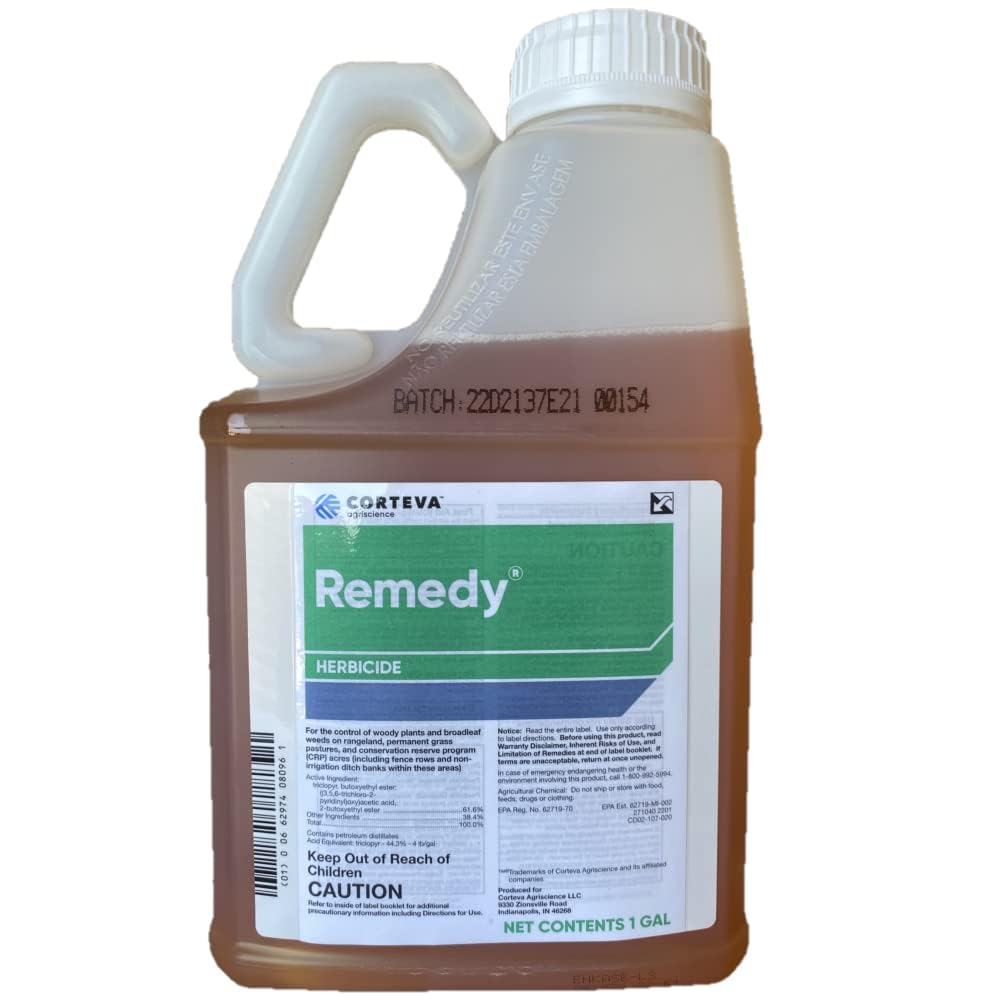
Remedy Ultra is a triclopyr-based herbicide specifically designed for woody brush and deep-rooted broadleaf weeds in rangeland and fence rows. Its mechanism of action is highly effective against bindweed: triclopyr mimics natural auxins, causing uncontrolled growth that depletes the plant’s energy reserves and eventually starves the root system. The systemic translocation is excellent, even in mature vines.
Its EPA label is built around pasture, rangeland, and fence-line brush — naming species like blackberry and honeysuckle rather than garden bindweed specifically — so treat it as a heavy-duty brush and vine herbicide first. Triclopyr’s auxin-mimicking action can suppress bindweed growing in among brush, but always confirm your target weed against the current label before applying. The low-odor formula is a welcome advantage for residential areas near pasture or fence lines. The 1-gallon concentrate offers a long-lasting supply for large properties.
The main considerations are cost and application method. It is a premium-priced professional chemical. For serious brush control, many users apply it in a basal bark treatment mixed with diesel, but for bindweed, a standard foliar broadcast with a backpack sprayer works reliably. This is an excellent choice for property owners dealing with heavy, established bindweed infestations.
What works
- Highly effective triclopyr formula for deep-rooted brush and vines
- Low odor compared to many other professional herbicides
- Safe around children and pets when dry
What doesn’t
- Premium price point per gallon
- Not suitable for lawns; labeled for rangeland, pasture, and non-crop areas
Hardware & Specs Guide
Concentrate Strength and Mixing Ratios
The effectiveness of a herbicide against bindweed often comes down to the concentration of the active ingredient in the final spray solution. A 41% glyphosate concentrate mixed at a 2% solution (about 2.5 oz per gallon of water) provides sufficient strength for mature bindweed per the label’s hand-held rate for tough perennials. A triclopyr-based product like Remedy, on the other hand, is typically mixed at a lower rate because the auxin-mimicking chemistry is more potent per unit of volume. Always follow the label’s specified maximum rate for brush/vines, not the general weed rate.
Surfactant Integration
Bindweed’s waxy leaf surface is a formidable barrier to foliar absorption. A built-in surfactant, as found in Gly Star Plus, simplifies application and ensures effective wetting. If your chosen herbicide lacks a surfactant, you must add a non-ionic surfactant (NIS) at 0.5-1% of the final spray volume (2-4 teaspoons per gallon). Methylated seed oil (MSO) is an even stronger adjuvant that can dramatically improve penetration on mature leaves, especially in dry conditions.
FAQ
Why does my bindweed keep coming back after spraying?
Can I use a pre-emergent like Prodiamine to stop established bindweed?
Final Thoughts: The Verdict
For most gardeners, the weed killer for bindweed winner is the Roundup Poison Ivy Plus Tough Brush Killer₂ because its multi-active blend of triclopyr, fluazifop, and diquat offers a comprehensive systemic kill that binds to the root mass effectively. If you want a bulk solution for acres of infestation, grab the Albaugh Gly Star Plus. And for a bareground kill-and-prevent strategy along fence lines and gravel paths where no vegetation is wanted for a year, reach for RM43 43% Glyphosate Plus Weed Preventer.