
The frustration of pulling the same dandelions and crabgrass clumps season after season is a cycle every lawn owner knows. Breaking that cycle demands a strategy that handles both the weeds already choking your turf and the seeds waiting to sprout. Stacking a post-emergent knockdown with a long-lasting pre-emergent barrier is the only way to shift from reactive weeding to proactive lawn management.
I’m Rikta — the co-founder and writer behind Lawn Gear Lab. After analyzing hundreds of owner reports, cross-referencing active-ingredient profiles like mesotrione, prodiamine, and 2,4-D, and comparing coverage specs across concentrates, granules, and ready-to-spray formulations, this guide identifies the seven strongest dual-action solutions that justify a spot in your shed.
Whether you need a lawn-safe selective spray or an industrial bare-ground sterilant, the right best weed killer and preventer depends on your grass type, weed pressure, and whether you want granules you can spread or a liquid you can spot-treat.
How To Choose The Best Weed Killer And Preventer
The most common mistake is buying a single product expecting it to fix both visible weeds and future seeds. A one-bottle kill-everything approach often either damages your lawn or lacks the residual chemistry needed to block the next germination cycle. Understanding the four pillars below keeps you from wasting money on the wrong active ingredient.
Selective vs. Non-Selective Chemistry
Selective herbicides like 2,4-D, dicamba, and mesotrione target broadleaf weeds and specific grassy weeds while leaving your desired turf intact. These are your go-to for lawn-wide applications. Non-selective products like glyphosate (found in Roundup Dual Action) kill any plant they touch — perfect for driveways, patios, and fence lines, but disastrous if overspray drifts into your flower beds or lawn.
Pre-Emergent Duration and Water Activation
The “preventer” side of a dual-action formula hinges on a pre-emergent herbicide like prodiamine. This chemical creates a soil barrier that kills germinating seeds. The barrier won’t form without 0.5 to 1 inch of water within a specific window — usually 24-48 hours. Products like The Andersons Barricade list a 4-6 month control period, but skipping the watering step cuts that protection to zero.
Grass-Type Compatibility
Not all cool-season and warm-season turf react the same. Bermuda, zoysia, and tall fescue tolerate a wider range of chemistries. St. Augustine (except sod), bentgrass, and centipede grass are fragile — mesotrione is one of the few selective pre-emergents safe on centipede and St. Augustine sod. Always check the label for a “Grass Types” section before buying.
Formulation: Granules vs. Liquid Concentrate
Granular products like Scotts Turf Builder Weed & Feed5 or The Andersons Barricade are easy to spread with a rotary spreader and cover large acreage quickly. The downside: you cannot spot-treat or control the exact chemical dose on a per-weed basis. Liquid concentrates give you precise control, better leaf coverage, and the ability to skip healthy turf, but require a pump or hose-end sprayer and more careful mixing.
Quick Comparison
On smaller screens, swipe sideways to see the full table.
| Model | Category | Best For | Key Spec | Amazon |
|---|---|---|---|---|
| Liquid Harvest Mesotrione | Selective Concentrate | Safe selective crabgrass & broadleaf control on centipede grass | 8 oz concentrate treats large areas; 46 weed species | Amazon |
| Ferti-lome Weed Free Zone | Selective Concentrate | Knocking down creeping charlie and thistle overnight | 32 oz; 80+ broadleaf weeds | Amazon |
| Roundup Dual Action | Non-Selective Concentrate | Hardscapes, fences, gravel — kill + 4-month prevention | 32 fl oz covers 1,600 sq ft; 4-month barrier | Amazon |
| Scotts Turf Builder Weed & Feed5 | Granular Weed & Feed | Large lawns needing simultaneous fertilizing and weed killing | 33.95 lb bag covers 12,000 sq ft | Amazon |
| Hi-Yield Killzall 365 | Non-Selective Concentrate | Bare-ground total vegetation control for large properties | 1 gal concentrate treats 17,200 sq ft | Amazon |
| Quali-Pro Prodiamine 65 WDG | Pre-Emergent Dry Flowable | Professional-grade long-term crabgrass and broadleaf seed prevention | 5 lbs; 65% prodiamine; high per-application value | Amazon |
| The Andersons Barricade | Granular Pre-Emergent | Easy broadcast prevention for spring and fall schedules | 50 lb bag covers 14,200 sq ft; 0.48% prodiamine | Amazon |
In‑Depth Reviews
1. Liquid Harvest Mesotrione – 8oz Concentrate

Mesotrione is one of the few active ingredients that functions as both a pre-emergent and a post-emergent, which is why this 8-ounce concentrate from Liquid Harvest commands serious attention. The chemistry inhibits photosynthesis in susceptible plants, bleaching foliage within days and killing roots within 2-3 weeks. It targets 46 broadleaf and grassy weed species including barnyard grass, chickweed, clover, crabgrass, and dandelion — a broad spectrum that covers most suburban lawn headaches. Activation requires 0.15 inches of water within 10 days; without that trigger, the barrier never forms.
Grass-type compatibility sets mesotrione apart from harsher alternatives. It is labeled safe for Kentucky bluegrass, centipede grass, buffalo grass, tall fescue, perennial ryegrass, fine fescue, and St. Augustine grass (sod only). Avoid it on bentgrass, poa annua, zoysia, kikuyugrass, and bermudagrass unless the bermuda is fully dormant. Owner reports confirm it wipes out crabgrass and clover on centipede grass without browning the lawn, making it the strongest choice for warm-season southern turf that rejects glyphosate-based mixes.
The biggest caveat is the bleaching effect. Mesotrione can temporarily bleach or stunt treated turf, especially if overlapping occurs during application or if applied during heat/drought stress. Using a spray dye indicator and a backpack sprayer helps avoid double-coverage. A fall fertilizer application helps cool-season grasses recover. For the price per ounce and the dual-action capability, this is the most versatile toolbox product in the category.
What works
- True pre-emergent and post-emergent in one bottle
- Safe on centipede, St. Augustine sod, and most cool-season turf
- Highly concentrated — 1 tsp per 2 gal for most applications
What doesn’t
- Can temporarily bleach healthy turf if sprayed unevenly
- Requires precise watering-in to activate pre-emergent barrier
- Not safe on bentgrass, zoysia, or bermudagrass
2. Ferti-lome Weed Free Zone (32 oz)
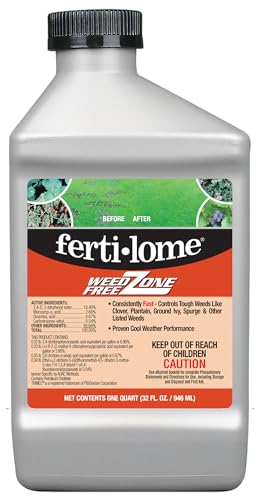
For stubborn broadleaf weeds that laugh at general-purpose sprays, the dicamba-based chemistry in ferti-lome Weed Free Zone is the closest thing to a flamethrower. It controls over 80 broadleaf species including creeping charlie, spurge, chickweed, thistle, and wild violet — weeds that often survive 2,4-D-only products. Visible injury appears within hours, and complete kill usually happens within 5 days. The label claims safety on Kentucky bluegrass, bermudagrass, bahiagrass, and zoysiagrass, giving it wider turf compatibility than mesotrione for warm-season lawns.
Owner reports consistently highlight creeping charlie elimination as this product’s superpower. Multiple verified reviews state it killed creeping charlie overnight where nothing else worked, which aligns with the dicamba volatility profile. The 32-ounce bottle is concentrate — mixing rates vary, but several owners found that doubling the recommended concentration for clover improved results. Adding a drop of dish soap as a surfactant improves leaf adhesion on waxy weed leaves.
The trade-off is price per gallon of mixed spray. This is a premium concentrate, and heavy infestations require multiple applications at higher-than-label rates. It is also temperature-sensitive — dicamba volatilizes above 85°F and can drift onto non-target plants. Use a low-drift nozzle and spray in the morning when temperatures stay below 80°F. For spot-treating deep-rooted perennials in a mixed lawn, this offers the fastest visible results of any selective on this list.
What works
- Destroys creeping charlie and thistle faster than any alternative
- Warm-season and cool-season grass safe
- Visible wilting within hours of application
What doesn’t
- May need double concentration for heavy clover infestations
- Highly volatile above 85°F — risk of drift damage
- Cost per treatment is higher than standard 2,4-D mixes
3. Roundup Dual Action Weed & Grass Killer Plus 4 Month Preventer

Roundup Dual Action solves the perennial problem of weeds returning within weeks after spraying. This concentrate combines glyphosate for immediate kill with a pre-emergent that creates a 4-month barrier preventing new seeds from germinating. The formulation goes rainproof in 30 minutes and shows visible results in as fast as 6 hours. Applications are specifically intended for hardscapes — driveways, sidewalks, patios, fence lines, gravel areas, and mulched beds around established shrubs and trees.
The 32-ounce bottle mixes at 6 fl oz per gallon of water and covers approximately 1,600 square feet per fill. Users report it kills ivy, Virginia creeper, and greenbriar within 24 hours of contact, and the barrier keeps those areas clean through most of the growing season. The non-selective nature means you cannot use it on your lawn — any contact with desirable grass results in dead patches. The pre-emergent also prevents ornamental bedding plants, trees, and shrubs from being planted in treated soil for 4 months after application.
While the preventative duration is marketed as 4 months, some reviewers noted the barrier strength degrades faster on porous surfaces like decomposed granite compared to solid concrete. The concentrate price sits at a mid-range cost per gallon, but the dual-action eliminates the need for a separate pre-emergent spray later. If your primary battle is against weeds that colonize paths, patios, and gravel edges, this is the most time-efficient option available.
What works
- Single product kills existing weeds and prevents regrowth for 4 months
- Rainproof in 30 minutes — reliable after application
- Devastating on aggressive vines like ivy and greenbriar
What doesn’t
- Non-selective — kills any plant it touches
- 4-month barrier weakens on porous surfaces
- Requires spraying entire area for prevention, not just visible weeds
4. Scotts Turf Builder Weed & Feed5 (33.95 lb)

The convenience of spreading granules that simultaneously kill weeds and fertilize an entire lawn is hard to beat. Scotts Turf Builder Weed & Feed5 combines 2,4-D and dicamba for broadleaf weed kill with a slow-release nitrogen fertilizer that thickens turf and crowds out future weeds. The 33.95-pound bag covers 12,000 square feet, making it the most area-efficient option on this list for large properties. Active ingredients target over 50 weeds including dandelion, clover, plantain, morningglory, and purslane.
Application requires a wet lawn so granules stick to weed leaves — dry granules that roll off do nothing. Owners emphasize a critical sequence: wet the lawn before spreading, do not water for 2-3 days after, and avoid walking on treated areas for 48 hours to prevent chemical burn footprints. The weed-and-feed approach works best in early spring and fall when temperatures sit between 60°F and 90°F. Warm-season grasses like bermuda, zoysia, and centipede respond well, but the label explicitly warns against use on St. Augustinegrass, dichondra, carpetgrass, and bentgrass.
The limitation is the granular format. You cannot spot-treat individual weeds without fertilizing the entire lawn at the same time, and the pre-emergent component is weaker than dedicated prodiamine products. Crabgrass and clover sometimes survive the standard dose. For a homeowner who wants a single step that handles both weed control and lawn greening across thousands of square feet, this delivers the best cost-per-coverage ratio in the guide.
What works
- Massive 12,000 sq ft coverage per bag
- Combines weed kill with nitrogen fertilization in one spread
- Excellent on dandelions and plantain in warm-season turf
What doesn’t
- Cannot spot-treat without also fertilizing the whole lawn
- Not safe on St. Augustine, dichondra, or bentgrass
- Weaker on crabgrass and clover than targeted alternatives
5. Hi-Yield Killzall 365 (1 Gal)
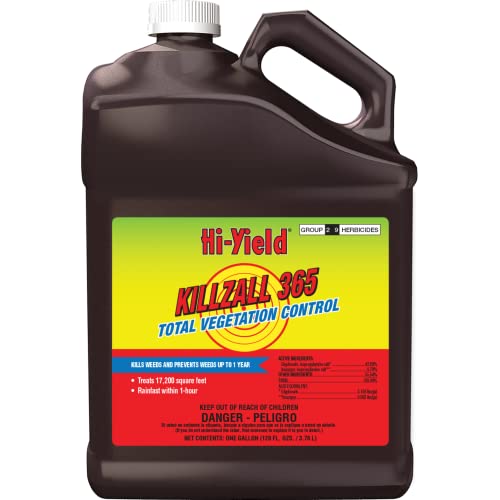
When the job requires bare-ground total vegetation control on non-crop areas, Hi-Yield Killzall 365 delivers the highest concentration-to-coverage ratio in this lineup. One gallon of this non-selective liquid concentrate treats up to 17,200 square feet — enough to clear a half-acre of fence lines, gravel drives, equipment pads, and foundation perimeters. The mix rate for bare-ground sterilization is 7.4 oz per 1 to 10 gallons of water; for spot control of brush and vines, 6 oz per gallon is sufficient.
The formulation targets more than just weeds — it kills grasses, trees, brush, and vine species. This makes it the only product on the list capable of clearing woody encroachment like blackberry brambles and poison ivy. Reviews confirm it works effectively on stubborn perennial weeds, though some users note that complete moss control is not achieved despite the “total vegetation” claim. Expect full results within 7-14 days depending on temperature and weed maturity.
The main drawback is the 365-day residual claim. Multiple owner reports state that in practice, the bare-ground effect lasts approximately 2-3 months before spot re-treatments are needed, especially in high-rainfall areas or clay soils where chemical leaching occurs faster. The cost per gallon of mixed spray is extremely low, making this the most economical choice for large-scale industrial or agricultural clearing projects. It is not labeled for lawn use — applying it on turf will sterilize the soil.
What works
- Highest coverage area per bottle (17,200 sq ft)
- Kills woody brush, vines, and trees alongside weeds
- Extremely low cost per application for large properties
What doesn’t
- Residual soil activity fades faster than advertised in wet climates
- Not safe on lawns or near desirable ornamentals
- Does not control moss effectively despite the vegetation claim
6. Quali-Pro Prodiamine 65 WDG (5 lbs)
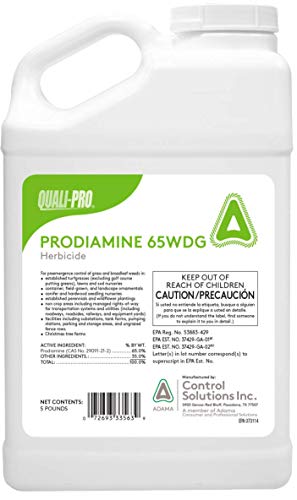
For turf managers who understand that prevention is the only real strategy against crabgrass and annual broadleaf weeds, prodiamine 65 WDG is the gold standard. This 5-pound bag contains 65% prodiamine — a concentration roughly 135 times stronger than granular consumer products like The Andersons Barricade. The coverage varies by rate: at the standard 0.185 oz per gallon per 1,000 sq ft, a single bag handles multiple acres over several seasons. It is a dry flowable formulation that must be mixed with water and applied through a sprayer, then watered in.
The active ingredient prevents germination of crabgrass, foxtail, barnyardgrass, and over 30 other grass and broadleaf weed species. It offers no post-emergent control — existing weeds must be killed separately before the barrier goes down. Users report that a single spring application followed by watering keeps treated areas weed-free for 4-6 months. The high concentration means the per-application cost is dramatically lower than buying pre-mixed granular products season after season, making this the best long-term investment for committed lawn care enthusiasts.
The learning curve is real. Mixing dry flowable powder requires accurate scale measurement and a sprayer with agitation to keep the product suspended. Applying too high a rate can stunt turf root development, and the product is not safe on all grass types — check the label for your specific turf. Owners emphasize rotating active ingredients yearly to prevent resistant weed populations. For a homeowner ready to graduate from granular spreaders to professional-grade chemistry, this is the most cost-effective insurance policy against weed germination.
What works
- Unmatched cost per application — one bag lasts multiple seasons
- 65% prodiamine delivers professional-grade weed prevention
- Reliable 4-6 month barrier when watered in properly
What doesn’t
- No post-emergent action — existing weeds require separate treatment
- Requires accurate scale and sprayer agitation for mixing
- Over-application can stunt turf root growth
7. The Andersons Barricade (50 lb Bag)
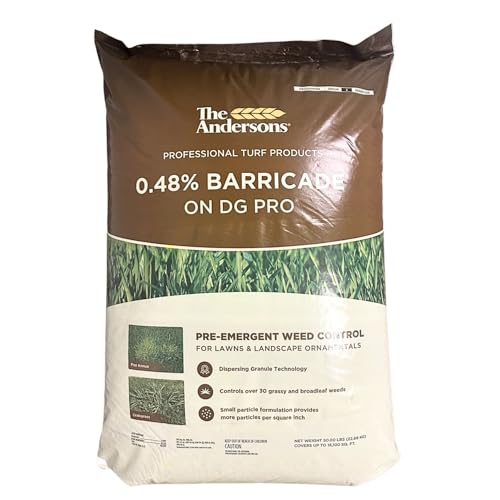
The Andersons Barricade is the granular pre-emergent that professionals trust for broadcast applications on large lawns. Each 50-pound bag covers 14,200 square feet, making it the highest volume granular option in this guide. The active ingredient is prodiamine at 0.48% concentration — lower than the Quali-Pro dry flowable, but formulated with a DG Pro delivery system that provides more particles per square inch for even distribution. The label targets over 30 grass and broadleaf weeds including crabgrass, foxtail, and annual bluegrass.
The application window is early spring and fall. Barricade stops seeds from germinating — it cannot kill existing weeds, so it must be paired with a post-emergent spray if the lawn already has weeds present. Owners report that a single application in early spring followed by fall reapplication keeps treated areas nearly weed-free through the entire season, with some users noting the effect extends into the second year. The granular format makes application simple with a standard rotary spreader — no mixing, no sprayer cleanup, no measuring.
The low prodiamine concentration means you are paying mostly for filler weight. The bag is heavy and expensive upfront, but the cost per square foot is competitive with consumer-grade pre-emergents. One common complaint is that Barricade does not prevent clover — clover seeds often survive the barrier and require a separate broadleaf post-emergent spray. The 50-pound bag is overkill for small lots under 5,000 sq ft, but for anyone managing an acre or more with a walk-behind spreader, this is the most convenient set-and-forget pre-emergent solution.
What works
- Simple rotary spreader application — no mixing or spraying
- DG Pro formulation provides better particle distribution than standard granules
- One bag covers 14,200 sq ft with season-long control
What doesn’t
- 0.48% concentration means heavy bag for low active ingredient
- No effect on clover or existing weeds — requires separate spray
- Overwhelming for small lawns under 5,000 sq ft
Hardware & Specs Guide
Mesotrione — The Dual-Action Bleacher
Mesotrione inhibits the HPPD enzyme, blocking carotenoid production and causing sensitive weeds to bleach white before dying. It is absorbed through both roots and foliage, making it effective as a pre-emergent (soil barrier) and a post-emergent (leaf contact). Activation requires 0.15 inches of water within 10 days. Safe on centipede, tall fescue, and St. Augustine sod; dangerous on bentgrass and bermudagrass. Visible bleaching appears within 3-5 days; full death takes 2-3 weeks.
Prodiamine — The Germination Blocker
Prodiamine is a dinitroaniline herbicide that inhibits microtubule formation in germinating seeds, preventing root and shoot development. It is strictly a pre-emergent — no effect on established weeds. The barrier forms only after 0.5-1 inch of rain or irrigation within 48 hours. Professional-grade products use 65% concentration (Quali-Pro); consumer granules use 0.4-0.5% (The Andersons). Coverage duration ranges from 4-6 months depending on soil type and rainfall.
Glyphosate + Pre-Emergent Combo
Products like Roundup Dual Action combine glyphosate (a non-selective systemic) with a residual pre-emergent. Glyphosate inhibits the EPSPS enzyme, killing everything green in 6-24 hours. The pre-emergent component extends control for up to 4 months by blocking seed germination in the treated zone. Best for hardscapes and non-lawn areas. Rainproof in 30 minutes. Do not use near desirable plants — the pre-emergent prevents replanting for 4 months.
2,4-D / Dicamba — The Broadleaf Specialists
2,4-D and dicamba are synthetic auxins that cause uncontrolled growth in broadleaf weeds, leading to stem twisting and plant death within 3-7 days. Dicamba (found in Ferti-lome Weed Free Zone) is particularly effective on creeping charlie and thistle but volatilizes above 85°F. 2,4-D (in Scotts Weed & Feed5) is slower but safer on warm-season turf. Both are selective — they spare most grass species while destroying broadleaf weeds.
FAQ
Can I apply a weed killer and a pre-emergent at the same time?
How long does a pre-emergent barrier last before needing reapplication?
Why did my pre-emergent fail to prevent crabgrass this year?
Is it safe to use weed killer on a newly seeded lawn?
Final Thoughts: The Verdict
For most gardeners, the weeder killer and preventer winner is the Liquid Harvest Mesotrione because it delivers pre-emergent and post-emergent action in a single bottle, targets 46 weed species, and remains safe on centipede and St. Augustine sod. If you want a fast-acting spray that annihilates creeping charlie overnight, grab the Ferti-lome Weed Free Zone. And for massive chronic weed prevention on lawns over 10,000 square feet, nothing beats the long-term value of the Quali-Pro Prodiamine 65 WDG combined with a separate post-emergent spray.