
The dual-action promise of a weed and feed product sounds simple enough — kill the intruders, then nourish the grass you actually want. In practice, the balance between effective herbicide chemistry and a fertilizer blend that pushes root mass without burning the lawn is where most formulas stumble. Get the timing or the N-P-K ratio wrong, and you end up with bare patches instead of the dense turf you were after.
I’m Rikta — the co-founder and writer behind Lawn Gear Lab. I’ve spent many hours comparing granular release systems, herbicide active ingredient spectra, and nitrogen formulations to give you a recommendation grounded in real chemical analysis and aggregated owner experience.
If you want the healthiest lawn on the block without wasting money on a product that can’t handle your local weed pressure or grass type, you need to understand the specific chemistry and coverage numbers behind the best weed & feed options available today.
How To Choose The Best Weed & Feed
Not every weed and feed is designed for every grass type or climate. The wrong formula can damage sensitive warm-season grasses like St. Augustine or leave cool-season turf looking scorched. Focus on three factors before you buy: the nitrogen source and percentage, the herbicide spectrum, and the coverage rate relative to your lawn size.
N-P-K Ratio and Nitrogen Release
The three numbers on the bag tell you the percentage of nitrogen, phosphorus, and potassium by weight. A high first number (like 27-0-3 or 21-0-3) means aggressive green-up, but if most of that nitrogen is fast-release, you risk burn and a short-lived color spike. Look for a product that specifies slow-release nitrogen — at least 40% of the total. This gives you sustained feeding for 8–12 weeks and reduces the chance of leaf tip burn.
Herbicide Coverage
A broad-spectrum post-emergent herbicide targets existing broadleaf weeds like dandelion, clover, chickweed, and plantain. Some products also include a pre-emergent component that prevents new weed seeds from germinating. If your lawn has a heavy crabgrass or annual bluegrass pressure, you may need a separate pre-emergent application timed differently than your feed. Check the active ingredients list — 2,4-D, MCPP, and dicamba are common combinations that handle most broadleaf weeds.
Grass Type Compatibility
Warm-season grasses (Bermuda, St. Augustine, Zoysia, Centipede) and cool-season grasses (Fescue, Bluegrass, Rye) have different tolerances to herbicide chemistry and nitrogen levels. Over-feeding a St. Augustine lawn with a high-nitrogen formula can lead to thatch buildup and disease. Some products are explicitly labeled for specific grass species, like Fertilome’s St. Augustine formula or the Safer Brand natural option that works across all types but lacks strong post-emergent weed control.
Quick Comparison
On smaller screens, swipe sideways to see the full table.
| Model | Category | Best For | Key Spec | Amazon |
|---|---|---|---|---|
| GreenView Fairway Formula | Granular Feed | Healthy green color with slow release | 27-0-5, 63% slow release N | Amazon |
| Scotts Turf Builder Weed & Feed | Granular | Powerful broadleaf weed control | Weedgrip Technology | Amazon |
| Jonathan Green Veri-Green | Granular Feed | Controls 250+ broadleaf weeds | 21-0-3, 3‑month feed | Amazon |
| Safer Brand Lawn Restore | Organic Granular | Pet-safe natural fertilizer | 9-0-2, non-burning | Amazon |
| Fertilome St. Augustine Weed & Feed | Granular | Pre- + post-emergent for warm-season | 15-0-4 for St. Augustine/Zoysia | Amazon |
| Spectracide Weed & Feed 20-0-0 | Liquid Spray | Convenient hose-end dual action | 20-0-0, 7500 sq ft per 32 oz | Amazon |
| Yard Mastery 7-0-20 Stress Blend | Granular Feed | Summer stress relief and root health | 7-0-20 + 3% Iron, 15000 sq ft | Amazon |
In‑Depth Reviews
1. GreenView Fairway Formula 27-0-5

The 27-0-5 NPK ratio delivers a heavy nitrogen punch, but the key advantage is that 63% of that nitrogen is slow-release. This means you get the deep green color and growth surge of a high-nitrogen feed without the rapid flush that causes leaf burn and requires frequent reapplication. Owners report seeing a visible green-up within a week and steady color for roughly 12 weeks, with no yellowing or patchy spots between applications.
Coverage of 10,000 square feet from a 33-pound bag makes this a strong value for medium to large lawns. The fine particle size works cleanly through rotary spreaders without clumping, and the formula is phosphorus-free (the zero in the middle), which is a plus for lawns near waterways where phosphate runoff is a concern. It is designed primarily as a feed — it does not contain a herbicide, so you’ll need a separate weed control step if broadleaf pressure is high.
Customer reports highlight its effectiveness on Carpet Grass, Centipede, and Bermuda, with consistent results across zones. The 27-0-5 blend is especially effective for post-winter recovery, pushing roots deep before the summer heat arrives. For anyone prioritizing a sustained feeding schedule over a one-step weed kill, this is the most reliable granular feed on the list.
What works
- Very high slow-release nitrogen percentage for long green-up
- No phosphate to protect waterways
- Covers 10,000 sq ft per bag at a low per-square-foot cost
What doesn’t
- Does not contain any herbicide for weed killing
- Not suitable for lawns needing a combined weed + feed step
2. Scotts Turf Builder Weed & Feed
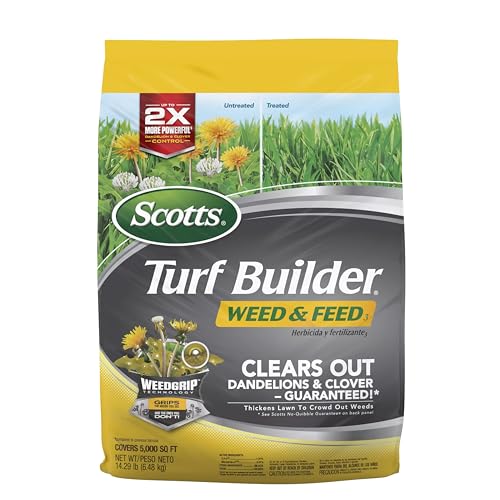
Scotts claims this is their most powerful weed and feed formula, and the active ingredient combination of 2,4-D and Mecoprop backs that up. The Weedgrip Technology is a proprietary approach that helps the granules stick to weed leaves even when the weed is hidden below the grass canopy. This improves contact time and translocation to the roots, which is why many users report dandelions disappearing within days.
The granular version (reviewed here) requires a specific application technique — water the lawn first so the granules stick to wet weed leaves, then leave the product on the weeds for 2–3 days without additional watering. Users who followed that pattern consistently report dead dandelions and a darker green lawn within two weeks. The feed side thickens the grass, which naturally crowds out new weed emergence over time.
Coverage is 5,000 square feet per 14.3-pound bag. It is not ideal for serious crabgrass or clover infestations according to some reviews, but for general broadleaf weed maintenance combined with a good fertilization program, it is the best-performing single-application herbicide feed in this range. The hose-end version exists for those who prefer liquid application, but the granular gives more even distribution for larger lawns.
What works
- Excellent dandelion and broadleaf knockdown
- Weedgrip Technology improves granule adhesion to leaves
- Feeds well enough to thicken grass and crowd out future weeds
What doesn’t
- Less effective on crabgrass and clover
- Requires precise watering timing for best results
3. Jonathan Green Veri-Green Weed & Feed

The selling point here is the herbicide coverage — Jonathan Green claims control of over 250 broadleaf weeds, including tough species like wild onions, poison ivy, and thistle that many standard formulas miss. The granular formulation uses a fine particle size that allows even distribution through rotary, drop, or hand-held spreaders, and the particles are designed to remain active on the weed leaf surface long enough for absorption.
The 21-0-3 NPK analysis provides a strong nitrogen boost, and the slow-release mechanism feeds the grass for up to three months. The zero-phosphorus formula makes it environmentally friendly for use near drainage areas. This product works best when applied in late spring when weeds are actively growing and the grass is already greening up. Users report a noticeable improvement in lawn health within two weeks, with dandelion infestations resolving in about 10 days.
One important restriction: this product cannot be used at the same time as seeding a new lawn, as the herbicide will inhibit germination of grass seed. If you are overseeding, you need to wait at least 3–4 weeks after application or seed first and wait until the grass is well established before applying.
What works
- Broadest weed control claim on this list — 250+ species
- Fine granules spread evenly without clogging
- Three-month slow-release feeds longer than most competitors
What doesn’t
- Cannot use during overseeding — kills grass seeds
- Best results depend on precise spring/fall timing
4. Safer Brand Lawn Restore 9-0-2
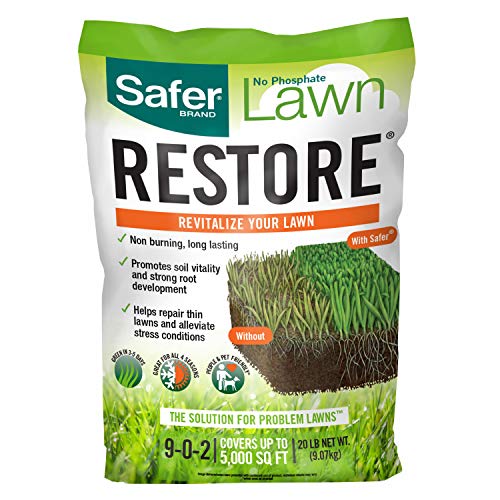
This is the only naturally derived formula on the list with a 9-0-2 NPK ratio that will not burn the lawn even if applied in slightly higher-than-recommended amounts. The non-burning property makes it ideal for homeowners who want to avoid the yellow striped pattern that synthetic fertilizers can leave. The formula focuses on strengthening root systems rather than pushing a rapid top-growth flush, resulting in thicker turf over time.
It contains corn gluten, which acts as a natural pre-emergent — it inhibits weed seed germination but will also prevent grass seed from germinating. This means you should not apply it during overseeding; wait until after seeds have established. Users report seeing a green-up within 3–5 days and note that the lawn recovers from fertilizer burn from previous synthetic applications in under a week. It is safe for kids and pets immediately after application, a major plus for families.
At a 9-0-2 ratio, it is much lower in nitrogen than synthetic competitors. It will not produce the same deep emerald color that a 27-0-5 blend delivers. It is a maintenance feed, not a quick green-up accelerator. For someone who values safety, soil health, and a natural approach over maximum visual pop, this is the best option available.
What works
- Non-burning formula — safe even in warmer weather
- Pet and kid safe immediately after application
- Revives lawns damaged by previous synthetic fertilizer burn
What doesn’t
- Low nitrogen content — less dramatic green-up
- Corn gluten interferes with grass seed germination
5. Fertilome St. Augustine Weed & Feed
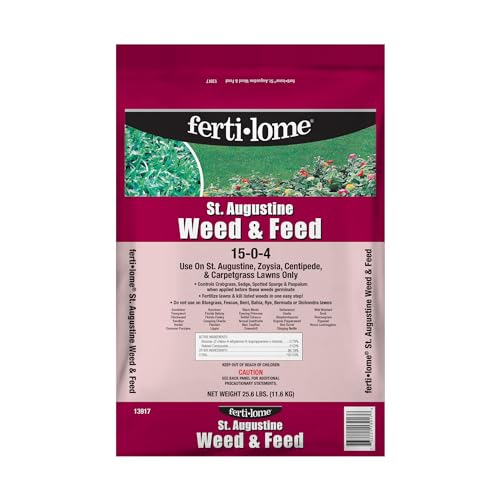
This formula is specifically designed for St. Augustine, Centipede, and Zoysia lawns. The 15-0-4 NPK ratio is moderate in nitrogen compared to general-purpose feeds, reducing the risk of thatch accumulation that plagues high-nitrogen applications on St. Augustine. It combines a pre-emergent and a post-emergent herbicide, giving you season-long protection against germinating weeds while also killing existing broadleaf weeds.
Application timing is important — early spring is recommended so the pre-emergent component can stop summer annual weeds before they sprout. Users report a noticeable thickening of St. Augustine turf within a few weeks, with reduced weed pressure from dollarweed, clover, and dandelions. It is specifically formulated for southern grass types and should not be used on Bermuda, Fescue, or northern cool-season grasses, as the chemistry can damage them.
The 25.6-pound bag covers 5,000 square feet, making it comparable in coverage to other premium granular products. Reviews consistently mention that this product saved St. Augustine lawns that were declining from weed pressure combined with nutrient deficiency. If you maintain a warm-season southern lawn, this is the most targeted and effective option available for combined weed control and feeding.
What works
- Pre-emergent + post-emergent in one application
- Specifically safe and effective for St. Augustine, Centipede, Zoysia
- Moderate nitrogen prevents thatch buildup
What doesn’t
- Cannot use on Bermuda or northern grass types
- Requires precise early spring timing for best pre-emergent effect
6. Spectracide Weed & Feed 20-0-0
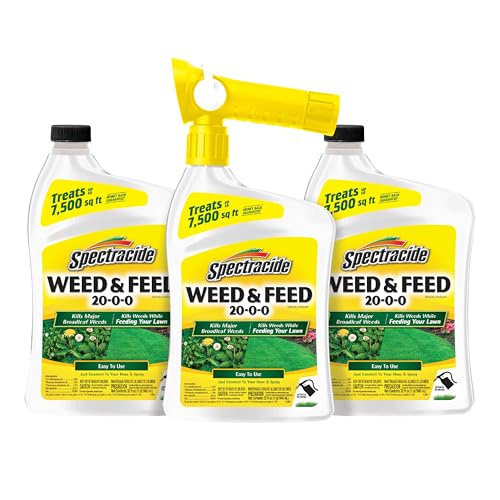
This liquid formulation uses a hose-end sprayer for convenient distribution across up to 7,500 square feet per bottle. The 20-0-0 ratio provides a high nitrogen content without phosphorus, targeting leaf growth and green color. The herbicide component kills major broadleaf weeds including dandelion, chickweed, knotweed, plantain, clover, mallow, and purslane. The three-pack includes one sprayer nozzle and three 32-ounce bottles, giving you three full treatments.
Application is simple — attach the sprayer, turn on the water, and walk the lawn at a steady pace. Users report that weeds begin yellowing within 2–3 days and are mostly dead within a week. The lawn typically shows greener color within two weeks after rain or watering. Some reviews note that the sprayer mechanism can be inconsistent, requiring a gentle touch on the trigger to avoid overflow or uneven coverage.
This product is labeled safe for St. Augustine grass, which is a key consideration for southern homeowners. However, it does not perform well against tough perennial weeds like wild violets, which may require multiple applications. The liquid form is a better choice for small to medium lawns where carrying a large bag of granular product is inconvenient, but it lacks the sustained slow-release feeding of good granular options.
What works
- Easy hose-end application — no spreader needed
- Fast visual results on broadleaf weeds
- Safe for St. Augustine and other sensitive grasses
What doesn’t
- Sprayer quality is inconsistent across units
- Less effective on hard-to-kill perennials like wild violets
7. Yard Mastery 7-0-20 Stress Granular Blend

The 7-0-20 NPK ratio is unconventional — very low nitrogen and very high potassium (potash) and 3% iron. This formulation is designed for a specific purpose: relieving heat and drought stress during the summer months when high-nitrogen feeds can burn the lawn. The high potassium strengthens cell walls, improves drought tolerance, and helps the grass recover from traffic and heat damage. The iron provides a non-nitrogen green-up that won’t push excessive growth.
It covers a massive 15,000 square feet from the 45-pound bag, making it the most cost-effective per-square-foot option for large lawns. It is safe for all grass types, including Bermuda, Centipede, Zoysia, Fescue, and St. Augustine. Users in southern zones (8B coastal NC) report that this product revived centipede grass that was yellowing from summer stress and helped zoysia plugs establish. It does not contain any herbicide, so it is purely a stress-management feed.
The key limitation is that it does not provide weed control — you will need a separate application for broadleaf weeds. Its best use case is as a mid-summer supplement after your spring weed and feed has worn off. Applying it when temperatures are below 80°F and watering it in for 3–4 days produces the best results, with a deep green color that lasts through the hottest months.
What works
- High potassium and iron relieve summer heat stress
- Massive coverage of 15,000 sq ft per bag
- Safe for all grass types including St. Augustine and Centipede
What doesn’t
- No herbicide — must buy separate weed control
- Best applied under 80°F to avoid burn risk
Hardware & Specs Guide
N-P-K Ratio Meaning
The three numbers indicate the percentage by weight of Nitrogen (greening and growth), Phosphorus (root development and flowering), and Potassium (overall plant health and stress tolerance). A high first number like 27-0-3 means aggressive top-growth feeding. A zero middle number means no phosphate, which is better for waterways. A high last number like 20 in the Yard Mastery formula indicates strong stress and drought tolerance support.
Slow-Release vs Fast-Release Nitrogen
Slow-release nitrogen (often labeled as controlled-release or polymer-coated) breaks down over weeks or months via microbial activity or moisture, providing steady feeding. Fast-release nitrogen (usually urea or ammonium sulfate) gives an immediate green-up spike but can burn the lawn and fades quickly. Look for at least 40–50% slow-release nitrogen in a granular product for sustained results.
Herbicide Active Ingredients
Common weed-killing chemicals in weed and feed formulas include 2,4-D (broadleaf control), MCPP/Mecoprop (clover and chickweed), and dicamba (tough perennials like thistle and poison ivy). Pre-emergent ingredients like dithiopyr or pendimethalin stop weed seeds from germinating. A product with both pre-emergent and post-emergent (like Fertilome St. Augustine) offers season-long protection.
Coverage Rate and Spreader Settings
Coverage is listed per bag — 5,000 sq ft is most common for mid-range bags. A 10,000–15,000 sq ft coverage reduces the per-treatment cost but requires a larger spreader hopper. Always check the spreader setting chart on the bag for rotary or drop spreaders. Applying too thickly causes burn; applying too thinly leaves weeds untreated. Walking speed matters — calibrate with a test pass on the driveway.
FAQ
Can I use weed and feed on a newly seeded lawn?
How long after applying weed and feed can I water my lawn?
What is the best time of year to apply weed and feed?
Will weed and feed damage my St. Augustine lawn?
Final Thoughts: The Verdict
For most gardeners, the best weed & feed winner is the GreenView Fairway Formula because of its high 63% slow-release nitrogen that sustains green color for 12 weeks without the burn risk of other high-N formulas. If you need powerful broadleaf weed control in a single granular application, grab the Scotts Turf Builder Weed & Feed for its Weedgrip Technology and fast dandelion knockdown. And for a southern warm-season lawn that requires a pre-emergent plus feed in one step, nothing beats the Fertilome St. Augustine Weed & Feed.