
The hot months turn a lush lawn into a battlefield. Broadleaf weeds like dandelions, clover, and chickweed thrive in the heat, stealing water and nutrients from your grass just when it needs them most. A standard fertilizer alone won’t stop the invasion — you need a dual-action product that feeds your turf while eliminating those summer weeds at the root.
I’m Rikta — the co-founder and writer behind Lawn Gear Lab. I’ve spent hundreds of hours cross-referencing N-P-K ratios, active herbicide ingredients, coverage specs, and thousands of verified owner reports to build this guide around the specific stresses a lawn faces in summer heat.
Whether you are battling crabgrass or reviving a stressed fescue lawn, this guide breaks down the top-performing granular and liquid options. Here is everything you need to find the best weed and feed for summer application that actually works without burning your turf.
How To Choose The Best Weed And Feed For Summer
Summer applications come with a unique set of risks: high temperatures can burn grass if the wrong nitrogen source is used, and fast-growing weeds laugh at weak formulas. Choosing the right product means matching your grass type, weed pressure, and application schedule to a specific N-P-K analysis and herbicide package.
Look for slow-release nitrogen and low burn potential
Quick-release nitrogen forces a growth flush that your lawn may not sustain in 90°F heat. Slow-release nitrogen sources — often listed as polymer-coated sulfur-coated urea (PCSCU) or brands like Bio-Nite — feed the grass steadily over 8 to 12 weeks. A high-potash ratio (the K in N-P-K) strengthens cell walls and improves drought tolerance, which is why summer blends often have a 7-0-20 or 24-0-6 profile rather than a high-first-number spring mix.
Match the herbicide to your weed pressure
Post-emergent weed-and-feed products rely on herbicides like 2,4-D, Dicamba, Mecoprop, and Quinclorac. If your dominant enemy is clover or creeping charlie, look for Dicamba-based formulas. Crabgrass requires Quinclorac or a pre-emergent barrier like Prodiamine. Check the active ingredient list on the bag — a generic “weed killer” claim often means it skips the tough perennial weeds that peak in summer.
Confirm your grass type compatibility
Not all products are safe for St. Augustine, Centipede, or fine fescues. Dicamba, for example, can damage Floratam St. Augustine. The Andersons Surge and Fertilome Weed Free Zone both explicitly warn against certain warm-season grasses. Read the label’s turfgrass safety table before buying — especially if you overseeded in spring and have a mixed lawn.
Coverage and spreader calibration
Coverage ratings (5,000 sq ft, 16,000 sq ft) assume a calibrated drop or rotary spreader. Most granular products require 1–1.5 lbs of product per 1,000 sq ft. A bag that covers 5,000 sq ft at 15 lbs will run out fast on a 10,000 sq ft lot. Buy the larger bag if you have more than 5,000 sq ft of turf to avoid uneven application from a single bag.
Quick Comparison
On smaller screens, swipe sideways to see the full table.
| Model | Category | Best For | Key Spec | Amazon |
|---|---|---|---|---|
| Yard Mastery Flagship 24-0-6 | Premium | Large lawns needing deep greening | 24% slow-release N, 45 lb bag | Amazon |
| Yard Mastery 7-0-20 Stress Blend | Premium | Summer heat stress recovery | 3% iron, Bio-Nite, 20% potash | Amazon |
| The Andersons Surge 16-0-9 | Premium | Killing 250+ weeds all season | 16,000 sq ft coverage per bag | Amazon |
| Jonathan Green Green-Up 21-0-3 | Mid-Range | Family-safe lawn greening | Fine particle size, 3-month feed | Amazon |
| Scotts Turf Builder Weed & Feed | Value | Everyday dandelion & clover control | Weedgrip Technology, 5,000 sq ft | Amazon |
| Fertilome Weed Free Zone | Value | Spot-treating creeping charlie | Dicamba-based liquid concentrate | Amazon |
| The Andersons Barricade 18-0-4 | Mid-Range | Preventing summer crabgrass | Prodiamine 0.426%, DG Technology | Amazon |
In‑Depth Reviews
1. Yard Mastery 24-0-6 Flagship Granular Lawn Fertilizer

The Yard Mastery Flagship earns the top spot because its 24-0-6 analysis hits the perfect summer balance: high nitrogen for dense green growth, significant slow-release formulation to avoid burn in the heat, and 6% potassium to fortify grass against drought stress. The 45 lb bag covers 15,000 sq ft, making it a cost-efficient choice for medium to large lawns that need a single late-spring application to carry them through July.
Owner reports consistently highlight two outcomes: a dark green color visible within a week and a noticeable thickening of bermuda and zoysia that chokes out existing weeds without requiring a separate herbicide pass. The 3% iron content produces that deep bluish-green tint that triggers neighbor comments. A few users noted that the high nitrogen pushes growth fast enough to require mowing twice weekly during peak growing weeks.
The product does not include a built-in post-emergent herbicide — it relies on feeding the grass to crowd out weeds. For lawns already under heavy weed pressure, pair it with a targeted post-emergent spray. The slow-release Bio-Nite technology feeds for 8 to 10 weeks, so time your application for early summer before the worst heat arrives.
What works
- Massive coverage per bag reduces cost per application
- High iron and slow-release nitrogen deliver visible greening without burn
- Thickens Bermuda and zoysia dramatically, crowding out weeds
What doesn’t
- No built-in herbicide — needs separate weed killer for heavy infestations
- Strong nitrogen pushes fast growth, requiring more frequent mowing
2. Yard Mastery 7-0-20 Summer Lawn and Turf Stress Granular Fertilizer

The 7-0-20 stress blend is engineered for the exact moment most fertilizers become dangerous: mid-summer when soil temperatures climb past 80°F. The 7% nitrogen is low enough to avoid pushing fragile growth, while the 20% potash (potassium) and 3% iron deliver the root-strengthening and color boost a stressed lawn needs without risking burn. The Bio-Nite coating extends the feeding window to roughly 6 to 8 weeks under high heat.
Users in zones 7 to 9 report this product revived centipede and zoysia lawns that had turned pale yellow from summer stress. Many combine it with a monthly chelated iron spray for deeper color. The 18 lb bag covers 6,000 sq ft, so it works best for owners who want targeted summer maintenance rather than a blanket spring application across a large property.
A critical detail: do not apply when temperatures exceed 80°F. Apply in the evening and water in thoroughly for three consecutive days. The formula does not contain a weed killer — it is a pure stress-relief feed. For lawns with active summer weeds, apply this first to strengthen the turf, then spot-treat with a post-emergent spray after two weeks.
What works
- Ideal low-nitrogen, high-potash ratio for hot-weather feeding
- Effectively reverses yellowing and heat stress in centipede and zoysia
- Iron content provides rapid color improvement without excess growth
What doesn’t
- Small bag size means higher cost per square foot than general-purpose feeds
- No weed control — must be paired with a separate herbicide
3. The Andersons Professional Surge Weed and Feed 16-0-9
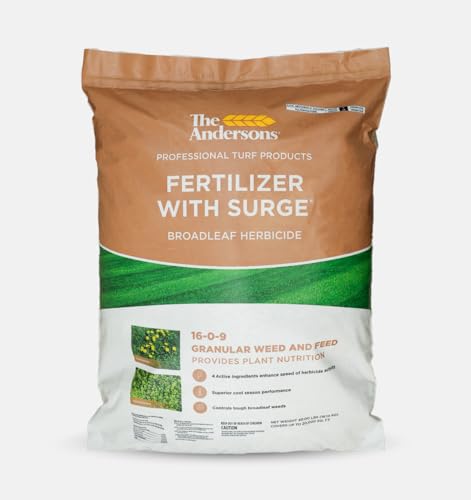
This is the heavy hitter for homeowners with large properties tired of persistent broadleaf weeds. The 40 lb bag covers up to 16,000 sq ft, and the four-way herbicide blend — built around 2,4-D, Dicamba, Mecoprop, and Quinclorac — targets over 250 weed species including dandelion, clover, chickweed, plantain, and creeping charlie. The 16-0-9 N-P-K analysis leans toward root and stress support rather than aggressive top growth, which suits summer conditions.
The proprietary DG Technology means the granules break down rapidly after watering, pushing the herbicide into the soil profile where weed seeds germinate and root systems develop. Users report visible weed die-off within 5 to 10 days on crabgrass and charlie, with the grass filling in behind it over the next two weeks. The product is explicitly not for Floratam St. Augustine, dichondra, or carpetgrass — check compatibility before buying.
A small number of users felt the performance matched cheaper alternatives, but the majority of verified reviews show superior results on tough weeds that Scott’s couldn’t touch. One 3-star review noted no visible difference from budget brands, which may indicate user error in spreader calibration or timing. Apply when weeds are actively growing and rain is not forecast for 24 hours.
What works
- Exceptional weed spectrum — kills over 250 species including creeping charlie
- Large 16,000 sq ft bag reduces per-application cost for big lawns
- DG Technology ensures quick uptake and minimal wasted granules
What doesn’t
- Not safe for Floratam St. Augustine or dichondra lawns
- Premium price compared to basic weed-and-feed blends
4. Jonathan Green Green-Up Weed & Feed 21-0-3

Jonathan Green markets this product as a dual-action weed killer and feeder with a 21-0-3 analysis that delivers a rapid greening effect from the high nitrogen content. The fine particle size is a genuine advantage: small granules stick to weed leaves better than coarse particles, improving herbicide contact and uptake. The product controls over 250 broadleaf weeds including poison ivy and wild onion, which are notoriously resistant to weaker formulas.
Verified users report the most dramatic results on dandelions — multiple owners note that dandelions vanished within a week. However, the feedback on clover and general broadleaf weeds is inconsistent. One 5-star reviewer claimed it made his lawn the best on the street, while several others reported that weeds survived and even greened up alongside the grass. The 15 lb bag covers 5,000 sq ft, which is average coverage for this price tier.
The fine particle size is also a potential drawback: if your spreader is not calibrated exactly, you risk uneven distribution and green stripes. The bag arrives with some clumping reported in humid conditions. Break up clumps before loading the spreader. Best applied in late spring or early fall — summer application in extreme heat may burn the lawn given the 21% nitrogen level.
What works
- Fine granules stick to weed leaves for better herbicide contact
- Controls poison ivy and wild onion that resist generic blends
- Fast greening effect from high first-number nitrogen
What doesn’t
- Inconsistent clover control reported by multiple buyers
- Small bag size limits cost efficiency for larger lawns
5. Scotts Turf Builder Weed and Feed 3
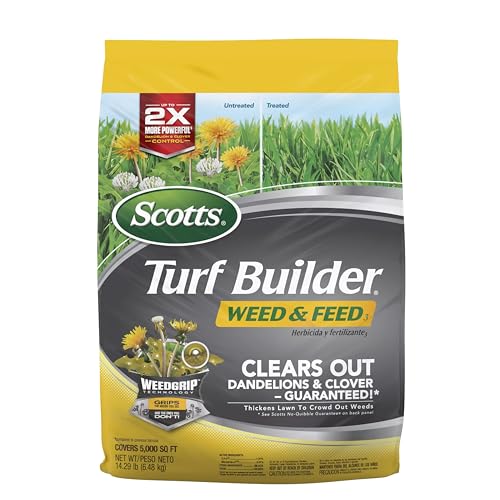
The Scotts Turf Builder Weed and Feed is the most widely recognized name in the category, and for good reason: it uses Weedgrip Technology, a proprietary adhesion system that helps the granules stick to weed leaves even when the weed is not fully wet. The active herbicide package contains 2,4-D and Mecoprop, which effectively targets dandelions and clover while feeding the grass to thicken and crowd out future weeds. It is available in both granular and hose-end spray formulations.
Owner feedback is consistently positive on dandelion control — multiple reviewers note that dandelions disappeared after one application, and the lawn achieved a dark green color within two weeks. The hose-end spray version is particularly praised for ease of use and even coverage. However, several reports confirm the product is weak against crabgrass and established clover, requiring a second application or a supplemental product to fully clear those weeds.
One critical tip from experienced users: water the lawn before applying the granular version, then do not water for 48 hours after. Walking on the treated areas too soon can cause burn spots. The 14.3 lb bag covers 5,000 sq ft. For the price, it is a reliable entry-level weed and feed that handles common broadleaf weeds well, but it is not a heavy-duty solution for persistent perennial invaders.
What works
- Weedgrip Technology ensures granules stick to dry or damp weed leaves
- Reliable dandelion and general broadleaf control with fast greening
- Simple hose-end spray option reduces spreader calibration guesswork
What doesn’t
- Weak performance on crabgrass and established clover
- Requires strict watering and foot-traffic discipline to avoid burn
6. Fertilome Weed Free Zone (32 oz)

This is not a granular weed-and-feed — it is a liquid concentrate that you mix with water and spray directly onto weeds. Its reputation among homeowners with creeping charlie (ground ivy) is unmatched: hundreds of verified owners report that no other product kills charlie as fast or as completely. The active ingredient is Dicamba, a systemic herbicide that travels to the root system and kills broadleaf weeds without harming most turfgrasses when applied correctly.
The 32 oz bottle concentrates to make enough spray for a medium-sized lawn. Users consistently note visible wilting within 4 to 6 hours on dandelions, spurge, and clover, with full die-off in 3 to 5 days. The common complaint is that the recommended label rate is too weak for tough weeds — many owners double the concentration or add a surfactant like dish soap to improve adhesion on waxy weed leaves. This raises the effective cost per treatment.
Fertilome is safe on Kentucky bluegrass, Bermuda, bahia, and zoysia, but check the label for fescue and bentgrass sensitivity. It is not a fertilizer — you will still need a separate summer feed application. For spot-treating summer weeds without broadcasting a granular product over the entire lawn, this is the most targeted solution in the guide.
What works
- Gold standard for killing creeping charlie and clover
- Visible results within hours — fast systemic action
- Safe on most common warm-season and cool-season turfgrasses
What doesn’t
- Label rate is often too weak — requires experimentation and double dosing
- No fertilizer included — requires a separate summer feeding product
7. The Andersons Barricade 18-0-4 Pre Emergent Weed Control Fertilizer
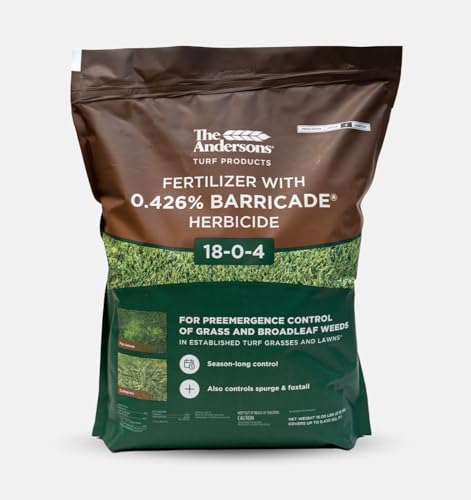
This product is not for killing weeds that already exist — it is a pre-emergent barrier designed to prevent summer weeds from germinating in the first place. The active ingredient is Prodiamine at 0.426%, a professional-grade herbicide that targets crabgrass, poa annua, goosegrass, and henbit. The 18-0-4 fertilizer analysis feeds the lawn with a modest nitrogen level and 4% potassium for root support, making it a good fit for early summer application before soil temperatures hit 55°F consistently.
The Andersons’ patented DG Technology means the granules dissolve rapidly when watered in, pushing the Prodiamine into the top inch of soil where weed seeds germinate. User reports from Texas with zoysia and Bermuda lawns confirm that a single spring application prevented crabgrass all summer long. One 4-star reviewer felt it was overpriced compared to generic Prodiamine alternatives, but the convenience of a combined feed-and-barrier is a major time saver.
Do not apply this if your lawn is already full of actively growing weeds — it will not kill them, and you will be disappointed. Use it as a preventative step in late spring, then follow up with a post-emergent spot spray or a weed-and-feed like The Andersons Surge if summer weeds break through. The 18 lb bag covers 5,000 sq ft.
What works
- Professional-grade Prodiamine stops crabgrass, poa annua, and goosegrass
- DG Technology dissolves quickly for fast soil penetration
- Fertilizer component feeds the lawn while building the weed barrier
What doesn’t
- Ineffective on existing weeds — strictly a preventative tool
- Some users find it expensive for the 5,000 sq ft coverage
Hardware & Specs Guide
N-P-K Ratio Meaning
The three numbers on any fertilizer bag (e.g., 21-0-3) represent Nitrogen (top growth and green color), Phosphorus (root development — often zero in summer blends to avoid runoff), and Potassium (drought tolerance and disease resistance). For summer, look for a moderate N (7% to 18%) and a higher K (6% to 20%) to protect grass from heat stress. High first-number summer products like 21-0-3 require careful watering to avoid burn.
Active Herbicides Explained
2,4-D attacks broadleaf weeds by mimicking plant growth hormones, causing uncontrolled growth and death. Dicamba (found in Fertilome Weed Free Zone) is effective against clover and creeping charlie. Mecoprop works with 2,4-D to expand the weed spectrum. Prodiamine (in The Andersons Barricade) is a pre-emergent that stops weed seeds from germinating. Quinclorac (in The Andersons Surge) targets crabgrass specifically.
Granule Size and DG Technology
Fine particle fertilizers (like Jonathan Green) cover more surface area per pound, sticking better to weed leaves for herbicide absorption. Coarser granules are easier to spread evenly but may bounce off weed leaves. The Andersons’ DG (Dispersible Granule) technology breaks granules down upon watering, pushing the herbicide into the soil rather than leaving visible pellets on the lawn. DG products often perform better in dry conditions where traditional granules would sit on the surface.
Coverage Math for Summer Applications
Always measure your lawn area using a mapping tool or wheel to determine total square footage. A 5,000 sq ft bag (Scotts, Jonathan Green) barely covers a quarter-acre lot. The 16,000 sq ft bag (The Andersons Surge) or the 15,000 sq ft bag (Yard Mastery Flagship) offers better value if your lawn exceeds 5,000 sq ft. Overspraying or overlapping too much with a high-nitrogen product in summer can cause chemical burn patches that take weeks to recover.
FAQ
Can I apply weed and feed in July during a heatwave?
What is the difference between pre-emergent and post-emergent weed and feed?
Why did my weed and feed turn my lawn yellow or cause burn spots?
How long should I wait after applying weed and feed to see results?
Final Thoughts: The Verdict
For most gardeners, the weed and feed for summer winner is the Yard Mastery 24-0-6 Flagship because it combines high slow-release nitrogen with iron for unmatched color and density, smothering weeds through competition rather than a single herbicide pass. If you need a true dual-action killer that wipes out over 250 weed species in one application, grab the The Andersons Professional Surge. And for heat-stressed lawns that cannot tolerate high nitrogen, nothing beats the Yard Mastery 7-0-20 Stress Blend for keeping grass alive and green through the worst of July and August.