
St. Augustine grass has a notoriously low tolerance for many common lawn herbicides, making weed control a high-stakes game where the wrong product can cause serious damage. A weed and feed formulated specifically for this sensitive turf combines a balanced fertilizer with herbicides that St. Augustine can handle, delivering nutrients while eliminating broadleaf invaders like dollarweed, clover, and dandelion without burning the lawn.
I’m Rikta — the co-founder and writer behind Lawn Gear Lab. I’ve analyzed the chemical composition and owner-reported results of dozens of lawn care products to determine which formulations actually deliver on their promises for the unique physiological needs of St. Augustine grass.
After evaluating customer feedback and weighing the active ingredients, coverage areas, and nutrient ratios of the top contenders, this guide highlights the most reliable weed and feed for st augustine grass.
How To Choose The Best Weed And Feed For St Augustine Grass
St. Augustine is a sensitive warm-season grass that can be severely damaged by herbicides containing 2,4-D or other broadleaf killers at high concentrations. Selecting a weed and feed requires close attention to the active ingredients, the nitrogen-to-potassium balance, and the timing of application relative to the grass’s growth cycle.
Herbicide Safety & Active Ingredients
Atrazine is the most widely recommended active ingredient for St. Augustine because it controls many broadleaf weeds without harming the grass when applied at labeled rates. Products using atrazine as the primary herbicide offer a wider margin of safety. Avoid formulas with high concentrations of dicamba or triclopyr unless the label explicitly states St. Augustine compatibility. Always check that the product does not list St. Augustine as a grass type to avoid.
NPK Ratio & Nutrient Timing
St. Augustine prefers a balanced or slightly higher nitrogen ratio — look for ranges like 15-0-4 or 21-0-3. Potassium supports root strength and disease resistance, which is crucial for St. Augustine’s susceptibility to large patch fungus. Phosphorus is typically low or absent because most established lawns do not need it. Apply in late spring when the grass is actively growing and can metabolize the nutrients efficiently.
Granular vs. Liquid Delivery
Granular weed and feed products provide a slow-release nutrient supply and require moisture to activate the herbicide. They are easier to apply uniformly with a spreader but need 24-48 hours of dry weather after watering-in. Liquid concentrates offer spot treatment flexibility and faster weed knockdown but require careful dilution and even spraying to avoid chemical burns on the St. Augustine blades.
Quick Comparison
On smaller screens, swipe sideways to see the full table.
| Model | Category | Best For | Key Spec | Amazon |
|---|---|---|---|---|
| The Andersons Premium Weed and Feed | Granular | Deep greening + root strength | NPK: 24-0-16 | Amazon |
| PBI/GORDON Trimec Lawn Weed Killer | Liquid | Stubborn broadleaf control | 128 fl oz concentrate | Amazon |
| Fertilome (10525) Weed Free Zone | Liquid | Fast-acting on creeping charlie | 32 oz concentrate | Amazon |
| Jonathan Green Green-Up Weed & Feed | Granular | Extended 3-month feeding | NPK: 21-0-3 | Amazon |
| Scotts Turf Builder Weed and Feed 3 | Granular | Broad weed spectrum control | Covers 5,000 sq ft | Amazon |
| Southern Ag Atrazine Weed Killer | Liquid | Safe spot treatment | 1% atrazine | Amazon |
| Fertilome (13915) St. Augustine Weed & Feed | Granular | Budget-friendly maintenance | NPK: 15-0-4 | Amazon |
In‑Depth Reviews
1. The Andersons Premium Weed and Feed 24-0-16

The Andersons Premium Weed and Feed delivers a high 24-0-16 NPK ratio that provides both quick-release nitrogen for rapid green-up and slow-release nitrogen for sustained feeding over weeks. The inclusion of iron gives St. Augustine a deeper, richer green color that stands out from typical granular fertilizers. This product controls over 250 broadleaf weeds including dandelions and clover while remaining safe for St. Augustine when applied at the labeled rate.
Owner feedback highlights the visible thickening of the turf within two weeks of application, with several reviewers noting superior results compared to Scott’s Turf Builder. The granular format means even coverage with a standard spreader, and the 18-pound bag covers up to 5,000 square feet. It is not for sale in NY, FL, CA, or IN due to state restrictions on certain herbicide ingredients.
A small number of users reported that it did not eliminate every weed after the first application, particularly nutsedge. However, for general broadleaf control and healthy St. Augustine growth, this product earned strong marks for its balanced nutrition and effective weed suppression when applied at the correct time of year.
What works
- High nitrogen with iron delivers intense greening
- Controls dandelions and over 250 broadleaf weeds
- Both quick and slow-release nitrogen provide extended feeding
What doesn’t
- Not available in NY, FL, CA, or IN
- Less effective on nutsedge and tough perennial weeds
2. PBI/GORDON Trimec Lawn Weed Killer

PBI/GORDON Trimec is a selective broadleaf herbicide concentrate that targets hard-to-control weeds like creeping charlie, Virginia buttonweed, and clover. The one-gallon bottle treats between 32,000 and 64,000 square feet depending on the dilution rate, making it an extremely cost-efficient solution for large St. Augustine lawns. The liquid concentrate must be mixed with water and applied with a hose-end sprayer for uniform coverage.
Long-time users describe Trimec as the most effective weed killer they have used over decades of lawn care, with visible wilting of treated weeds within 2-3 days. The product is labeled for use on St. Augustine, but the manufacturer recommends avoiding application during the hottest part of the day to prevent chemical burn. Multiple reviewers pointed out that stubborn weeds like Virginia buttonweed required a second application after 10-14 days.
A few customers received a different brand variant (Weed-Out by ferti-lome) instead of the PBI/GORDON label, though the active ingredient profile was similar and performance was unaffected. For anyone needing to cover a large St. Augustine lawn with aggressive broadleaf pressure, this concentrate offers unmatched coverage and knock-down power per gallon.
What works
- Extremely high coverage — up to 64,000 sq ft per gallon
- Kills creeping charlie and Virginia buttonweed reliably
- Selective formula safe for St. Augustine
What doesn’t
- Requires careful mixing and multiple applications for tough weeds
- Some customers received a different brand label
3. Fertilome (10525) Weed Free Zone
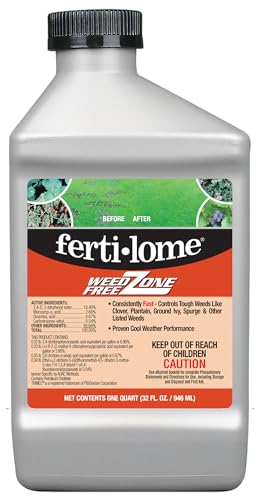
Fertilome Weed Free Zone is a liquid concentrate that uses dicamba as its primary active ingredient to control over 80 broadleaf weeds including creeping charlie, spurge, chickweed, and thistle. The formula shows visible injury to treated weeds within hours of application, which is faster than most granular options. It is labeled safe for St. Augustine when applied according to the recommended dilution rates.
Reviewers consistently report that this product is the only solution that effectively kills creeping charlie overnight, making it a standout choice for lawns overrun with that aggressive ground cover. Users also found it safe for spot spraying around flower beds without damaging ornamentals. A common tip from experienced users is to add a few drops of dish soap to improve adhesion on waxy weed leaves, as the recommended mixture can be slightly weak for clover.
The 32-ounce bottle is relatively small compared to gallon-sized competitors, and the concentrate is priced at a premium per ounce. Some users needed to double the recommended concentration for stubborn clover infestations. For targeted control of specific hard-to-kill weeds like creeping charlie, this liquid delivers the fastest visible results available.
What works
- Fastest knockdown — visible injury within hours
- Superior creeping charlie control
- Safe for spot treatment near flowers
What doesn’t
- Expensive per ounce compared to gallon alternatives
- May require stronger mix for clover
4. Jonathan Green Green-Up Weed & Feed 21-0-3

Jonathan Green’s Green-Up Weed & Feed uses a 21-0-3 NPK ratio with a fine particle size designed to reach the soil surface and root zone more effectively than larger granules. The slow-release nitrogen feeds St. Augustine for up to three months, which reduces the number of applications needed per season. The herbicide component claims control over 250 broadleaf weeds including dandelions, chickweed, clover, and thistle.
Several customers praised the product for making their lawn the best on the street with noticeable thickening and greening. However, a notable number of reviews reported that the weed killer did not perform as expected, with some users finding that weeds continued to grow after application. The bag is relatively small at 15 pounds for 5,000 square feet, and some bags arrived with clumps that were difficult to break apart in the spreader.
This product works best as a maintenance feed for lawns with light weed pressure. For heavy infestations, users may need a separate targeted herbicide application first, then follow up with this granular product for ongoing nutrition and prevention. It cannot be used at the same time as seeding a new lawn.
What works
- Fine particles provide good soil contact
- 3-month slow-release nitrogen saves reapplications
- Controls a very broad spectrum of weed species
What doesn’t
- Weed control inconsistent in some users’ experience
- Bag clumps can be hard to spread evenly
5. Scotts Turf Builder Weed and Feed 3
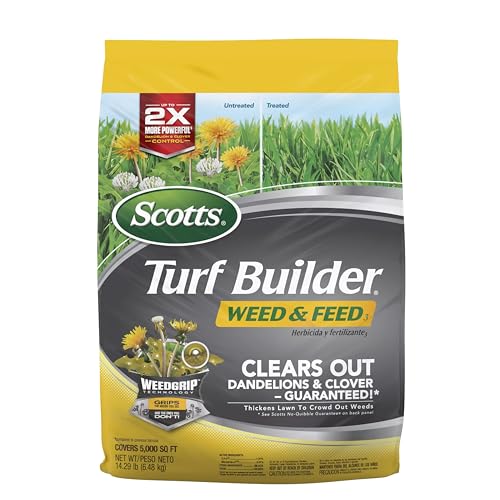
Scotts Turf Builder Weed and Feed 3 is a widely available granular product that uses Weedgrip Technology to help herbicide particles adhere to weed leaves even after watering. The formula claims up to 2X more powerful dandelion and clover control compared to the previous generation. It feeds the lawn to thicken turf density, which naturally crowds out future weeds over time. The 14.3-pound bag covers 5,000 square feet.
User reviews are largely positive, with many reporting beautiful dark green grass and effective weed elimination after a single application. Several experienced users emphasized that granular application requires wetting the weeds first for adhesion, then leaving the lawn unwatered for 2-3 days to maximize herbicide absorption. The product was less effective on crabgrass and clover in some cases, and a few St. Augustine owners noted they preferred a formulation specifically labeled for their grass type.
Scotts Turf Builder is a solid mid-range choice for homeowners who want a simple broadcast application with reliable results for common lawn weeds. It may not be the strongest option for heavy infestations or sensitive St. Augustine lawns, but it performs well under normal conditions when applied at the correct time.
What works
- Weedgrip Technology improves herbicide adhesion
- Thickens lawn to prevent future weeds
- Widely available and easy to apply
What doesn’t
- Less effective on crabgrass and clover
- Not St. Augustine-specific; requires caution
6. Southern Ag Atrazine St. Augustine Weed Killer

Southern Ag Atrazine Weed Killer is a straight atrazine concentrate that provides the safest broad-spectrum weed control for St. Augustine grass. Atrazine is the gold-standard active ingredient for this turf type because it kills emerged broadleaf weeds while also providing suppression of germinating crabgrass. The 128-ounce gallon treats approximately 500 square feet per application depending on the dilution rate, making it ideal for spot spraying or small lawns.
Users reported excellent results against dollarweed and other broadleaf invaders without harming St. Augustine runners. Several gardeners mix this atrazine with other herbicides like Weed Free Zone for a broader spectrum of control, targeting both pre-emergent and post-emergent weeds in one pass. The product requires reapplication every 2-3 weeks during peak growing season to maintain suppression of new weed emergence.
One serious safety complaint involved a jug arriving without a label or instructions, which is hazardous for a chemical concentrate. For most buyers, this is a highly effective and safe option for St. Augustine, but always verify that the bottle is properly labeled before use. It should not be sprayed on actively growing Bermuda grass.
What works
- Atrazine is the safest herbicide for St. Augustine
- Controls emerged weeds and suppresses crabgrass
- Can be mixed with other herbicides for broader control
What doesn’t
- Some bottles arrived without safety labels
- Requires frequent reapplication every 2-3 weeks
7. Fertilome (13915) St. Augustine Weed & Feed 15-0-4
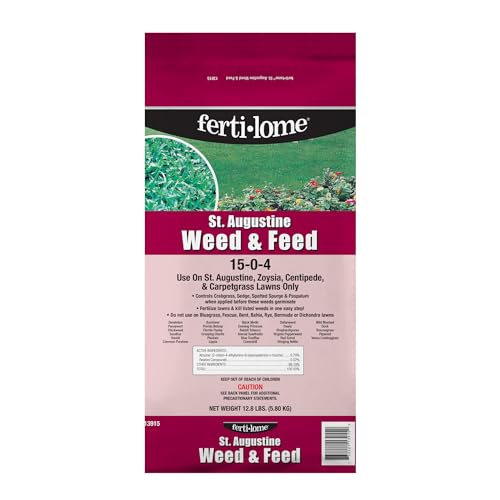
Fertilome (13915) St. Augustine Weed & Feed is formulated specifically for St. Augustine, Centipede, and Zoysia lawns with a 15-0-4 NPK ratio that supports steady growth without forcing excessive top growth that can attract fungus. The granules combine pre-emergent and post-emergent herbicides to provide season-long weed defense when applied in early spring. The 12.8-pound bag covers up to 5,000 square feet.
Florida St. Augustine owners reported that this product made their turf thicken up and green significantly with the help of regular rain. The product should not be used on Bermuda grass or any northern grass type. Users recommend applying when the grass is about 5 inches tall and watering it in immediately to activate the herbicide.
Some users noted that the coverage is based on 2,500 to 5,000 square feet depending on application rate, which can be confusing when planning for larger lawns. The price is entry-level for the category, making this a good option for maintenance applications rather than heavy rescue treatments. It is best used as a preventative measure in early spring rather than a curative for an existing weed explosion.
What works
- Specifically formulated for St. Augustine turf
- Pre-emergent + post-emergent dual action
- Affordable entry-level price point
What doesn’t
- Coverage rate can be confusing with dual ranges
- Best as preventive treatment, not curative
Hardware & Specs Guide
NPK Ratio
The NPK ratio represents the percentage of nitrogen (N), phosphorus (P), and potassium (K) in the fertilizer. For St. Augustine, a ratio with 15-24% nitrogen and 0-4% potassium is ideal. Phosphorus is typically omitted because established lawns rarely need it, and excess phosphorus can contribute to runoff problems. Products like The Andersons 24-0-16 provide high nitrogen for vigorous green growth, while the Fertilome 15-0-4 offers a more moderate maintenance level.
Coverage Area
Granular weed and feed bags are typically rated for 5,000 square feet, but the actual coverage depends on the spreader setting and walking speed. Liquid concentrates like Trimec can treat up to 64,000 square feet per gallon, making them far more economical for large properties. Measure your lawn’s square footage before purchasing to avoid running short or over-applying, which can stress St. Augustine.
FAQ
Can I use any weed and feed on St. Augustine grass?
What is the best time of year to apply weed and feed to St. Augustine?
Should I water after applying granular weed and feed to St. Augustine?
Final Thoughts: The Verdict
For most gardeners, the weed and feed for st augustine grass winner is the The Andersons Premium Weed and Feed because its 24-0-16 NPK ratio with iron delivers the deepest greening and strongest feeding while controlling over 250 broadleaf weeds. If you want liquid flexibility and extreme coverage for large lawns, grab the PBI/GORDON Trimec. And for fast-acting spot treatment of creeping charlie and other stubborn weeds, nothing beats the Fertilome Weed Free Zone.