
Specs are compiled from manufacturer listings and verified buyer reviews and can change over time — please confirm the key details on the product page before buying.
You want a self-propelled lawn mower that saves you real effort without draining your wallet. The catch is that many budget-friendly models skimp on traction or durability, so you end up pushing more than you planned. This guide breaks down six gas-powered mowers that balance a strong engine, a wide cutting deck, and a reliable drive system at honest prices—with the actual specs and trade-offs that matter on your lawn.
I’m Rikta — the founder and writer behind Lawn Gear Lab. This guide is built by comparing the manufacturers’ published specifications and the patterns across verified customer reviews, so you get each pick’s real strengths and trade-offs instead of marketing spin.
if you need a machine for a hilly half-acre or a flat quarter-lot, these are the gas-powered mowers that earn their keep. Here is a detailed look at the best value self-propelled lawn mower options available right now.
Quick Picks
- PowerSmart 22 in. 170cc Self Propelled Gas Lawn Mower (V8622S2) — Best Overall
- YARDMAX 22 in. 201cc Select PACE 6 Speed CVT High Wheel FWD (YG2860) — Top Performer
- BILT HARD 21″ Self Propelled Gas Lawn Mower, 201cc 4-Cycle OHV Engine — Best Value
- SENIX 21” Self-Propelled Gas Lawn Mower (FWD), 170 cc 4-Cycle Engine (A025054-A) — Compact Pick
- PowerSmart 22-Inch Gas Lawn Mower Self-Propelled, 150cc B&S Engine (B8622S) — Pro Build
- SENIX 22 Inch 3-in-1 Gas Lawn Mower, 201cc Rear Wheel Single Speed Self-Propelled (G-H-FIVE) — Heavy Duty
How To Choose The Best Value Self-Propelled Lawn Mower
Finding the right mower means looking past the price tag and focusing on the specs that affect your actual mowing experience. Here are the key areas to think about.
Engine Power and Displacement
The engine’s displacement, measured in cubic centimeters (CC), tells you how much raw cutting power it has. A 170cc engine is plenty for flat, well-maintained lawns of a third to half an acre. If you regularly face thick grass, uneven terrain, or a larger yard (over half an acre), stepping up to a 201cc engine gives you the torque to cut through without slowing down. Look for an “OHV” (overhead valve) design for better fuel efficiency and longer engine life.
Drive System: Front-Wheel vs. Rear-Wheel Drive
The drive system determines how the mower pulls itself forward. Front-wheel drive (FWD) is lighter and easier to turn, making it a good choice for flat, small-to-medium yards. Rear-wheel drive (RWD) provides much better traction on slopes and hills because the drive wheels are under the weight of the engine and the operator’s pushing force. For any yard with a significant incline, a RWD mower is the one that will actually save you from huffing and puffing.
Cutting Width and Deck Construction
A wider cutting deck means fewer passes to finish your lawn. A 21-inch deck is standard for most residential yards, while a 22-inch deck shaves off a bit more time per row. The deck material matters too—a heavy-duty steel deck is more durable and resistant to dents from rocks and roots than stamped steel or aluminum. Consider the included functions: a 3-in-1 system (mulching, bagging, side discharge) gives you flexibility throughout the growing season.
Height Adjustment Range and Positions
The ability to change cutting height is crucial for adapting to seasonal growth and different grass types. Look for a mower with a wide range (from about 1.25 inches for a close trim to 3.9 inches for taller, cooler-weather grass) and multiple positions (6 to 8 are common). Single-lever adjustment that changes all four wheels at once is much faster than adjusting each wheel individually.
Quick Comparison
On smaller screens, swipe sideways to see the full table.
| Model | Best For | Engine (CC) | Drive Type | Cutting Width | Amazon |
|---|---|---|---|---|---|
| PowerSmart 22″ (V8622S2) | Flat, small yards | 170cc | RWD | 22 Inches | Amazon |
| YARDMAX 22″ (YG2860) | Variable speed & hills | 201cc | FWD | 22 Inches | Amazon |
| BILT HARD 21″ | Height versatility | 201cc | RWD | 21 Inches | Amazon |
| SENIX 21″ (A025054-A) | Light & maneuverable | 170cc | FWD | 21 Inches | Amazon |
| PowerSmart 22″ (B8622S) | Briggs & Stratton power | 150cc | RWD | 22 Inches | Amazon |
| SENIX 22″ (G-H-FIVE) | Heavy-duty & large yards | 201cc | RWD | 22 Inches | Amazon |
In‑Depth Reviews
1. PowerSmart 22 in. 170cc Self Propelled Gas Lawn Mower (V8622S2)

The lightest RWD mower in the lineup that starts without a fight.
This PowerSmart model nails the formula for small-to-medium flat yards: a 22-inch steel deck paired with a 170cc gas engine that owners mention has “easy setup, starts first pull.” The rear-wheel drive system gives you traction on gentle slopes, and at 68 pounds it is lighter than the YARDMAX at 84.9 pounds, making it easier to maneuver around flower beds and gardens.
The 3-in-1 capability (mulch, bag, side discharge) covers the full season, and the 60-liter bag is easy to lift and empty. You get six cutting positions between 1.5 and 3.9 inches, controlled by two levers. This gives you a low cut for a tidy trim at 1.5 inches, the same minimum height listed for the BILT HARD, and a tall enough cut for cool-season grass. The trade-off? A few customers note the blade isn’t razor-sharp from the start, but it still cuts well, and one review noted the self-propel engages briskly—so be ready for a little pull when you squeeze the lever.
Why it wins
- Lightest RWD option at 68 lbs makes it easy to handle
- Starts reliably on the first pull according to multiple verified reviews
- 22-inch cutting deck is wider than most in this price tier, covering ground faster
Real trade-offs
- Self-propel engages aggressively, can surprise new users
- Some arrive with quality control issues like faulty safety switches requiring DIY repair
Who should buy this: You have a flat yard under half an acre and want a mower that starts easily every time without wrestling a heavy machine.
Who should think twice: If you need a single-lever height adjustment for speed, or dislike the jolt of an aggressive self-propel trigger, look at the SENIX 22-inch (G-H-FIVE) instead.
2. YARDMAX 22 in. 201cc Select PACE 6 Speed CVT High Wheel FWD (YG2860)
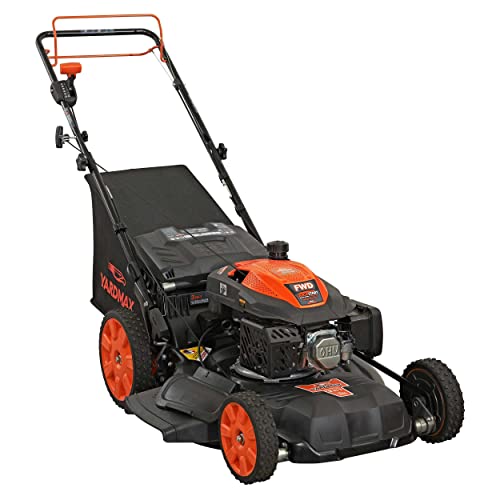
A powerful 201cc engine with a CVT that lets you dial your exact walking pace.
If your yard is hilly and spans closer to an acre, the YARDMAX brings serious grunt. Its 201cc engine is a step up in power from the 170cc units from PowerSmart and SENIX, and the continuously variable transmission (CVT) lets you shift through 6 speeds to match your walking speed. Reviewers point out it “starts on second pull, great for 3/4 acre, gas saver, easy to use.” The automatic choke removes the fuss of priming—just pull and go.
However, the drive system is front-wheel drive (FWD), not rear-wheel. That 84.9-pound weight sits over the front wheels, which helps on flat ground but loses traction on wet grass or steep climbs according to some reviewers. There is a noticeable gap here: at 84.9 pounds versus the 61.7-pound SENIX 21-inch, it can be a beast to push if the self-propel ever struggles. Buyers love the 22-inch blade and the deck clean-out port for quick under-deck cleaning. The 2-year residential warranty is standard, but the lack of a return option on large items caught some owners off guard.
What stands out
- CVT with 6 speeds lets you fine-tune pace to your walk
- 201cc engine handles thick grass and larger yards without bogging
- Automatic choke means no priming or choking before each start
What holds it back
- Heaviest pick at 84.9 lbs—difficult to push if drive fails or on steep hills
- Front-wheel drive loses traction on wet grass, limiting use after rain
Best suited for: Larger, moderately sloped yards where the CVT speed control and 201cc power are worth the heavier weight.
skip it if: Your terrain is steep or wet; a RWD mower will serve you better here.
3. BILT HARD 21″ Self Propelled Gas Lawn Mower, 201cc 4-Cycle OHV Engine
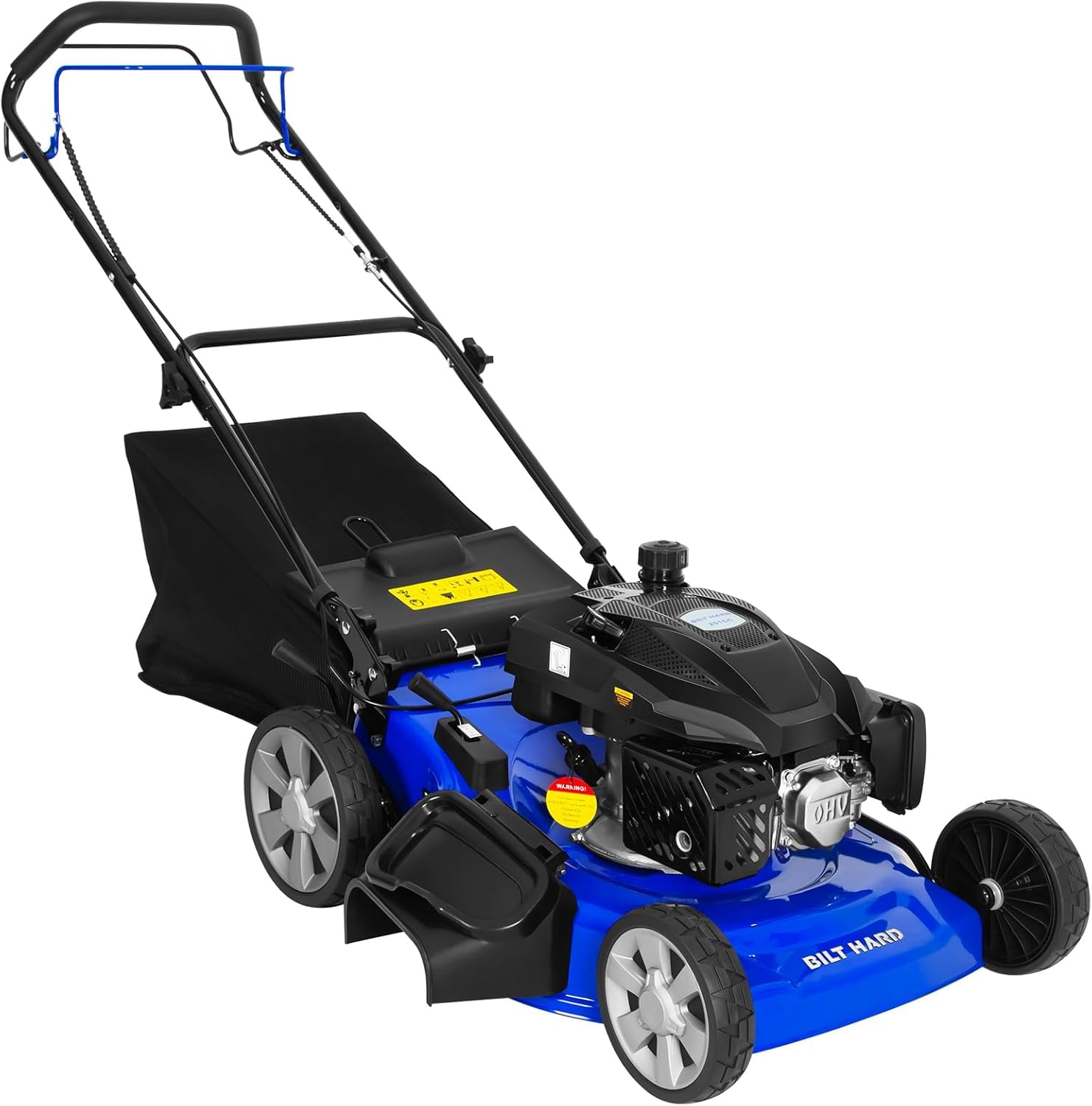
Eight height positions and a 201cc engine for any grass condition.
The BILT HARD packs a 201cc OHV engine that delivers 9.0 ft·lb of torque into a 21-inch steel deck with rear-wheel drive. It offers the most height versatility in this lineup: 8 positions from 1.2 to 3.75 inches, versus 6 positions on the PowerSmart 22-inch (V8622S2). This means you can dial in a very precise cut for different grass types and seasons without compromise. Buyers confirm it “starts first pull, cuts great, powerful.”
The single-speed rear-wheel drive system pulls the mower forward on its own, ideal for flat to moderately hilly yards. The handle is foam-wrapped to reduce vibration fatigue. However, the reviews tell a mixed story on build quality: one owner described the mower as vibrating itself apart, with a bent drive shaft and plastic components cracking after about 8 hours of use. Another buyer reported that the wheel fell off during the first use but fixed it with a plastic part. The 21-inch cutting deck is an inch narrower than the PowerSmart 22-inch (B8622S) and the SENIX 22-inch (G-H-FIVE), so you will make slightly more passes on very large lawns.
Where it shines
- 8 height positions give the widest cutting range adjustment (1.2 to 3.75 inches)
- Powerful 201cc engine with 9.0 ft-lb torque cuts through tough grass
- Rear-wheel drive provides solid traction on slopes
Where it falls short
- Reports of significant vibration and build quality issues, including cracked parts
- 21-inch deck is the narrowest among the 22-inch options
Reach for this if: You want maximum height adjustment control and a strong engine for a budget-friendly price.
Watch out for: The build quality is a gamble; inspect all screws and the drive shaft immediately upon arrival.
4. SENIX 21” Self-Propelled Gas Lawn Mower (FWD), 170 cc 4-Cycle Engine (A025054-A)
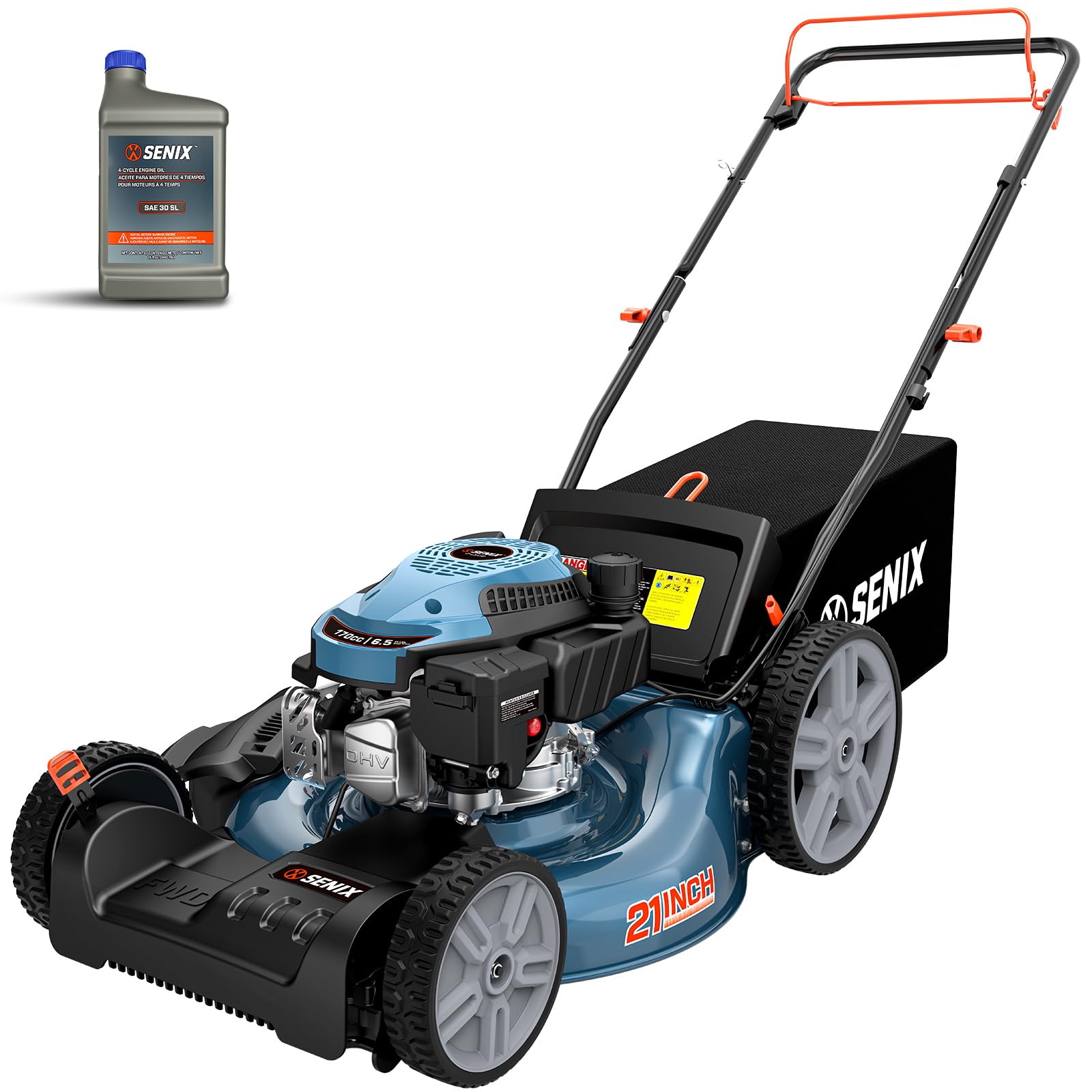
The lightest model here that can still chew through overgrown grass.
Weighing 61.7 pounds, this SENIX is lighter than the YARDMAX at 84.9 pounds and the PowerSmart (B8622S) at 72 pounds. That makes it the easiest to steer around obstacles like trees and flower beds. It is powered by a 170cc OHV engine that delivers 3.8 HP and 6.5 ft-lb of torque, and the front-wheel drive system pulls itself along, needing only your guidance. The 21-inch steel deck cuts a clean path, and buyers confirm it handles “overgrown grass easily; cuts clean and even.”
A standout feature is its ability to cut as low as 1.25 inches, versus 1.5 inches on the PowerSmart 22-inch (V8622S2). This is perfect for a final scalping cut in the spring or for Bermuda grass lawns that need a close shave. The 1.7-bushel bag is modest, so expect more frequent emptying on larger yards. There are reports from owners that it uses fuel at about 27 oz per hour, which tracks with the larger tank, and one reviewer noted it can be “hard to restart after stopping.” The single-lever height adjustment is a nice touch, avoiding snags on fence lines.
Key strengths
- Lightest in the roundup at 61.7 lbs for easy maneuvering
- Lowest possible cut at 1.25 inches for scalping and close trimming
- Handles overgrown grass without clogging the deck
Main drawbacks
- Front-wheel drive struggles on slopes and wet grass
- Some owners found restarting after stopping the mower difficult
This pick works for: Small, flat lawns (up to 1/3 acre) where lightweight handling and a very low cut are the top priorities.
Not ideal for: Hills or wet terrain—the FWD system will leave you pushing more than expected.
5. PowerSmart 22-Inch Gas Lawn Mower Self-Propelled, 150cc B&S Engine (B8622S)

A USA-made Briggs & Stratton engine backing a wide 22-inch RWD deck.
This PowerSmart is built around the Briggs & Stratton EX625 150cc engine, a well-respected American-made powerplant with ReadyStart technology for easy starting in any temperature. At 72 pounds, it sits right in the middle of the weight range, and the rear-wheel drive gives it the traction the lightweight SENIX (A025054-A) lacks on slopes. The 22-inch steel deck cuts a wide path, and buyers found they could “start easily” and that it is “sturdy, well-built.”
The 1.4-bushel bag is slightly smaller than the 1.7-bushel bag on the SENIX, meaning more trips to the compost pile on larger lawns. One notable complaint from buyers is that the self-propel is aggressive and non-adjustable, potentially dragging the user forward too fast. Another owner pointed out that the large rear wheels can spin on inclines, reducing some of the RWD advantage. The 6-position cutting height spans from 1.5 to 3.9 inches, matching the same range as the other PowerSmart 22-inch model (V8622S2). For yards with level terrain, this is a solid, reliable choice with a trusted engine name.
What sells it
- Briggs & Stratton EX625 engine is known for reliability and easy cold starts
- Rear-wheel drive provides good traction on inclines
- Tool-free assembly takes about 4 minutes according to owners
What hurts it
- Self-propel speed is fixed and aggressive, cannot be slowed down
- Larger rear wheels can lose grip on steeper hills, spinning instead of pulling
Grab this for: Level or slightly sloped yards where a trusted, reliable engine is your main concern.
Look elsewhere if: You need adjustable self-propel speed or have steep inclines where wheel spin is a problem.
6. SENIX 22 Inch 3-in-1 Gas Lawn Mower, 201cc Rear Wheel Single Speed Self-Propelled (G-H-FIVE)
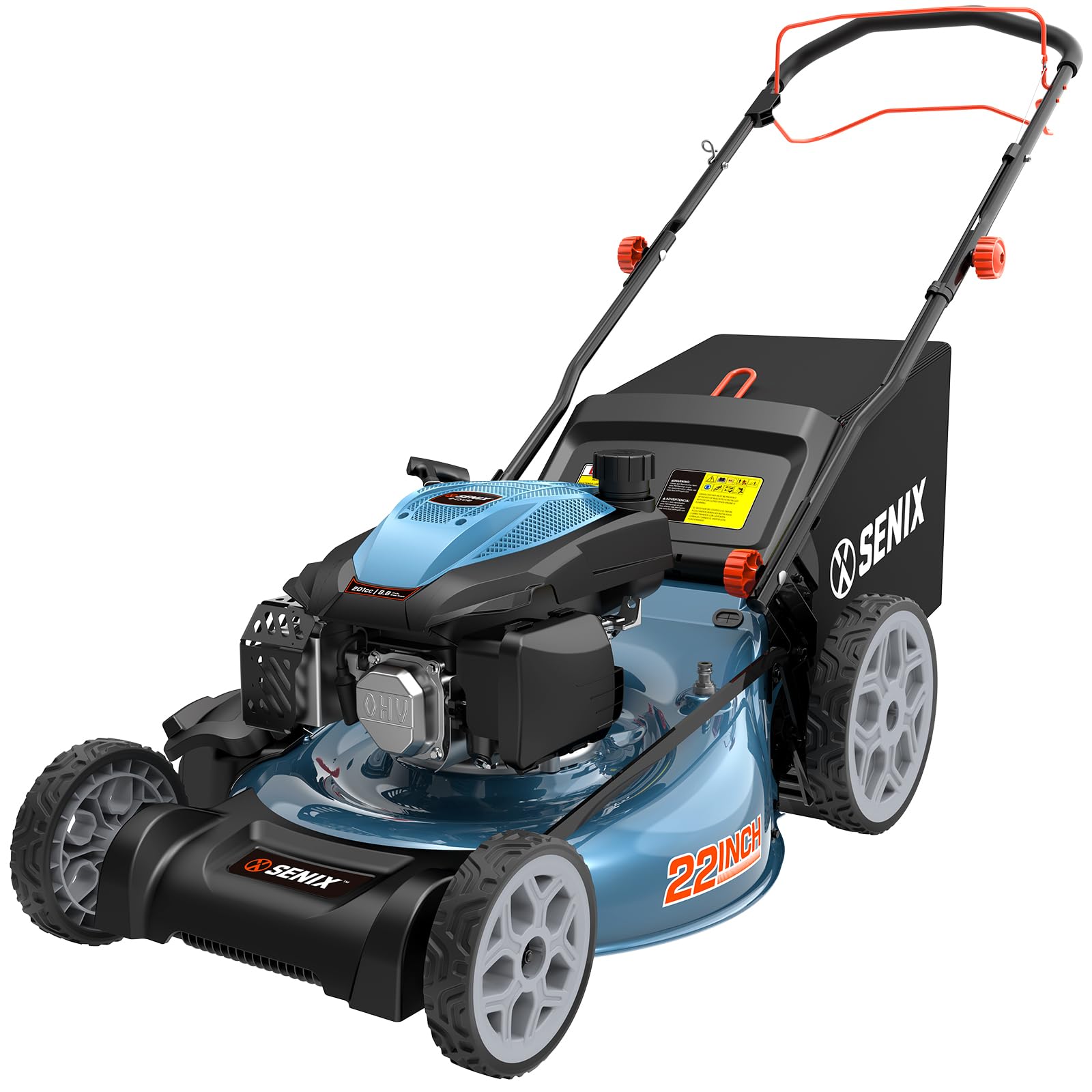
A 4.7 HP engine with RWD built for toughest lawns and 22-inch coverage.
Sitting at the top of the power chart, this SENIX combines a 201cc OHV engine (producing 4.7 HP and 8.8 ft-lb of torque) with a rear-wheel single-speed drive system that tops out at 2.9 MPH. The 22-inch cutting deck is the widest in the range, paired with a heavy-duty steel deck that is built to last. It is recommended for lawns up to 11/20 of an acre, making it the best pick for larger properties. Shoppers say it “started on second pull” and that it “mows smoothly.”
The cutting height adjusts from 1.25 to 4 inches via a central 6-position lever—the highest maximum height in this roundup, versus the 3.9-inch cap on the PowerSmart models. The foldable handle saves storage space in a garage or shed. On the downside, the single speed means you cannot match your walking pace as precisely as with the YARDMAX’s CVT. Some buyers found the grass catcher accessory availability unclear, and a couple of reviewers mentioned wheels falling off after a few uses. For sheer power and deck width, however, this mower is a workhorse.
Biggest pluses
- Most powerful engine in the group with 4.7 HP and 8.8 ft-lb torque
- Widest deck at 22 inches cuts more grass per pass, saving time
- Rear-wheel drive handles rough terrain and thick grass reliably
Biggest minuses
- Single-speed self-propel cannot adjust to your walking pace
- Poor manual lacking oil and gas capacity info, and wheel durability questioned
Best for: Large, rough lawns where raw cutting power and a wide 22-inch deck are the priority over speed customization.
pass on it if: You prefer fine speed control or value clear instructions and accessory details from the manufacturer.
Understanding the Specs
Engine Displacement (CC) and Torque
The engine’s cubic centimeter (CC) rating tells you its internal volume—more CC generally means more power to spin the blade and drive the wheels. For a self-propelled mower, 150 to 170cc is enough for flatter lawns under half an acre. Above 200cc provides the torque (measured in ft-lb) needed to cut through dense, wet, or overgrown grass without the engine bogging down. Look for OHV (overhead valve) engines, which run cooler and last longer than older side-valve designs.
Self-Propelled Drive: FWD vs. RWD
Front-wheel drive (FWD) mowers pull from the front, making them easier to steer and lighter to handle on flat ground. They are a good fit for smaller, level yards. Rear-wheel drive (RWD) mowers pull from the back, which places the drive wheels under the mower’s heaviest parts and your pushing weight. This gives you much better traction on hills and uneven terrain, preventing wheel spin. If your lawn has any slope at all, upgrading to a RWD mower makes a noticeable difference in how much work you do.
FAQ
What size engine do I need for my lawn?
Is front-wheel drive or rear-wheel drive better for hills?
How do I know what cutting height to use?
Can I use a self-propelled mower without engaging the drive?
How often should I change the oil in a gas lawn mower?
Is a 21-inch or 22-inch cutting deck better for me?
What does 3-in-1 mean on a lawn mower?
Why does my new mower need assembly if it says self-propelled?
What should I do if my mower vibrates excessively?
Can I use a self-propelled mower on wet grass?
Final Thoughts: The Verdict
For most homeowners, the value self-propelled lawn mower winner is the PowerSmart 22″ (V8622S2) because it combines a reliable 170cc engine, rear-wheel drive for traction, and a wide 22-inch steel deck at a price that beats its RWD rivals. If you need maximum power for a larger, rougher lawn, grab the SENIX 22″ (G-H-FIVE). And for lightweight handling and the lowest cut possible on a flat yard, the standout is the SENIX 21″ (A025054-A).
How We Picked
We do not accept paid placement, and we did not hands-on test every unit. Instead, we match each pick to a real buyer and use-case by comparing the manufacturers’ published specifications against the patterns in verified customer reviews — so you get each pick’s real strengths and trade-offs instead of marketing copy.
Sources & Methodology
Specifications: manufacturer listings and product documentation. Review insights: verified customer reviews, as of July 2026. Pricing: not shown on this page (it changes often); check the current price via the retailer link.
As an Amazon Associate, Lawn Gear Lab earns from qualifying purchases. This does not affect which products we feature.