
Specs are compiled from manufacturer listings and verified buyer reviews and can change over time — please confirm the key details on the product page before buying.
The real test of a leaf vacuum isn’t how fast it blows — it’s how much it shrinks the pile before you have to stop and empty the bag. A machine that promises a 15:1 or 16:1 reduction but fills up in five minutes defeats the whole purpose. This guide separates the tools that genuinely cut your work from the ones that just move leaves around.
I’m Rikta — the founder and writer behind Lawn Gear Lab. This guide is built by comparing the manufacturers’ published specifications and the patterns across verified customer reviews, so you get each pick’s real strengths and trade-offs instead of marketing spin.
If you want a tool that lives up to its mulch ratio and makes fall cleanup faster instead of longer, this roundup of the best value leaf vacuum options points you to the models that actually earn their keep on a real lawn.
Quick Picks
- BLACK+DECKER Blower Vacuum and Mulcher 3-in-1 (BV6000) — Best Overall
- WORX Trivac 3 in 1 (WG512) — 600 CFM — High-Flow Mulcher
- WORX Trivac 3 in 1 (WG509) — Narrow Access
- MZK 3 in 1 Electric Leaf Blower (ET1712) — Budget Pick
How To Choose The Best Value Leaf Vacuum
A leaf vacuum that saves you time is the one where the bag fills with finely shredded material at a pace that matches your raking. Here are the core specs to watch.
Airflow (CFM) vs. Speed (MPH) — Which Actually Matters for Vacuuming?
For vacuuming, CFM (Cubic Feet per Minute, or the volume of air the fan moves) is more important than MPH (Miles per Hour, or how fast that air is pushed). A high-CFM vacuum pulls leaves into the nozzle from a wider area. A high-MPH blower is better for moving a single pile across the yard. You want at least 400 CFM for consistent pickup on a typical lawn.
Mulch Ratio: What It Promises vs. What It Delivers
The advertised ratio (18:1 or 16:1) is the maximum possible under ideal lab conditions with dry leaves. In the real world with mixed oak and damp leaves, buyers often report a 3:1 or 4:1 reduction. A metal impeller (the spinning blade inside that shreds the leaves) is a better indicator of durability than a high ratio number — plastic impellers wear down faster.
Bag Size and Comfort When Full
A 40-liter (roughly 1.4 bushel) bag is standard, but a full bag of mulched leaves can weigh 10-15 pounds. A shoulder strap helps distribute the load. If the bag attaches to the bottom of the unit, it unbalances the tool as it fills. Look for a model with a top-mounted bag or a well-designed harness for longer sessions.
Quick Comparison
In‑Depth Reviews
1. BLACK+DECKER Blower Vacuum and Mulcher 3-in-1 (BV6000)

The 8.1-pound vacuum that runs quieter than its predecessor while shredding through a season’s leaves.
You get 400 CFM of airflow and a top speed of 250 MPH — a combination that makes it the fastest blower in this roundup, and buyers report the “strong suction” easily mulches leaves to fit into a 40-gallon bag. That 250 MPH speed gives it 250 MPH versus the WORX WG512’s 70 MPH, meaning it moves wet, matted leaves with far less effort when you use it as a blower. Its 12-amp motor powers a high-impact metal fan (a metal impeller, or a durable shredding blade) that grinds up to 16 bags of leaves down to one, according to the manufacturer.
Black & Decker claims this model is 50% quieter (measured against its own LH4500) — a real relief for the neighbor who usually hears you coming. The disposable leaf bag system is unusual: you get two bags, you fill them, tie them, and toss them. Owners mention that a shoulder strap is included, but a full bag gets heavy and the tool is “very dusty,” so a mask and goggles are recommended. The built-in cord retainer keeps your extension cord plugged in securely.
Unlike the WORX WG512, which requires you to juggle a heavy bag with no second handle, the BV6000 is lighter at 8.1 pounds and has a rear handle for better balance. The catch is the short power cord — customers note you’ll need a heavy-duty extension cord, and switching between blower and vacuum modes takes some practice.
What Shines
- Fastest blower speed at 250 MPH for wet debris
- 16:1 mulch ratio with a metal fan that resists clogging
- Lightest in the test at 8.1 pounds
- Disposable bag system for no-touch disposal
What to Watch
- Switching modes requires two hands and some practice
- Disposable bags are an ongoing cost after the included two
- Reviewers point out the auto-shutoff can kick in if you clog it with wet leaves
Reach for this if: you want the fastest, lightest blower-vacuum combo that mulches reliably and lets you toss the bag without touching the mess.
Look elsewhere if: you prefer a reusable bag you can dump on the compost pile and you don’t want to buy refills.
2. WORX Trivac 3 in 1 (WG512) — 600 CFM

The 600-CFM beast that pulls leaves from a wider swath than anything else here.
This is the airflow champion of the list, delivering 600 CFM — compared to the BLACK+DECKER BV6000’s 400 CFM. That means when you switch to vacuum mode, the 36.6-inch-long nozzle pulls in more leaves per second, reducing the amount of raking you need to do before starting. It moves at 70 MPH, so as a blower it is slower than the 250-MPH BV6000, but the trade-off is raw suction power for the vac function. The manufacturer claims a 16:1 mulch ratio with its metal impeller.
Shoppers say that “excellent mulching reduces 4 bags of oak leaves to 2/3 of one bag” — close to that 16:1 promise on dry material. The quick-release bag is a 1.4-bushel unit that zips open for dumping. However, a common complaint is the weight distribution: at 9.1 pounds, it is a pound heavier than the BV6000, and there is no second handle for support, making a full bag unbalance the entire unit. One reviewer noted that the vacuum struggles with tiny dried leaves on pavement, and “small sticks may not be sucked up.”
This model stands apart from the MZK LB67M, which gives you 460 CFM but pairs it with a 40L (smaller) bag and no shoulder strap. The WG512 is built for large yards where throughput matters more than portability.
What Shines
- Highest airflow at 600 CFM for fast vacuuming
- 16:1 mulch ratio with a metal impeller
- Two speeds for adjusting to different debris types
What to Watch
- No second handle — full bag pulls the unit off balance
- 70 MPH blower is weak compared to the BV6000
- Reviewers report clogs if you push the nozzle directly into a pile
Ideal if: you have a large lawn with lots of dry leaves and you value raw suction volume over blowing speed.
skip it if: you need to reach under bushes or into tight flower beds — the long 36.6-inch tube can be clumsy in confined spaces.
3. WORX Trivac 3 in 1 (WG509)

The compact 14.1-inch tool that slips under patio furniture and lawn chairs.
With its shorter 14.1-inch body, the WG509 is built for the spots the other vacuums can’t reach — under deck furniture, between shrubs, and into flower bed corners. It produces 350 CFM of airflow at 210 MPH, making it a decent blower but a significantly weaker vacuum than the 600-CFM WG512. The key number here is the advertised 18:1 mulch ratio, which is the highest in this group. In reality, buyers report a more modest 3:1 or 4:1 ratio, noting that “bag fills very fast.” One reviewer says it reduces four bags of oak leaves to about two-thirds of a bag — a real-world result that still beats using a rake but falls short of the marketing claim.
The variable speed trigger gives you control from light sweeping to full blast. The collection bag has a quick-release design with a zipper for emptying, and the metal impeller handles twigs up to a point — buyers warn that larger sticks can wrap around the rotor. The unit weighs 9.3 pounds, which is similar to the WG512, but at least it has a shoulder strap to take some of the load. Owners mention that the blower function is “weak” and recommend using a separate blower to gather leaves, then switching to vacuum mode for pickup.
Unlike the MZK LB67M which delivers 460 CFM in a 17-inch package, the WG509 excels in tight quarters but gives up raw power to get there. It is the right tool for the person who has more flower beds than open lawn.
Advantages
- Compact design fits under patio furniture and low shrubs
- Variable speed trigger for fine control
- Metal impeller for durability on twigs
Trade-offs
- 350 CFM makes it the weakest vacuum in the test
- Blower is weak — you will need a separate blower for heavy cleanup
- Bag fills fast; customers note the real mulch ratio is 3:1 or 4:1
Best for: getting into narrow spaces under deck furniture and between shrubs — it is the most maneuverable pick here.
Not for: large open lawns or heavy wet debris; the suction is too weak for those jobs.
4. MZK 3 in 1 Electric Leaf Blower (LB67M)
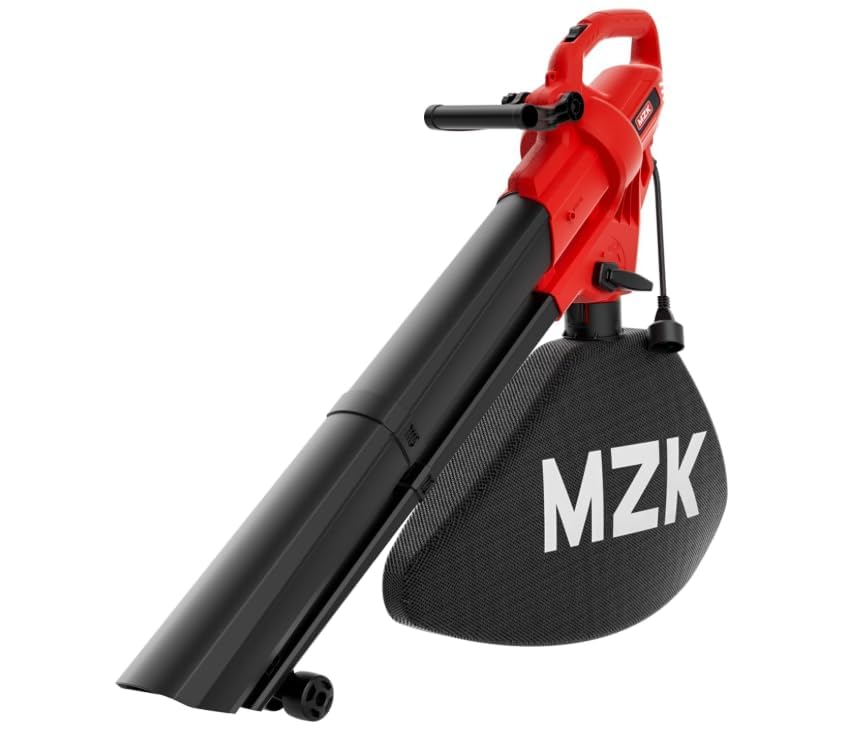
The 17-inch lightweight that packs 460 CFM into a budget-friendly frame.
This is the surprise performer of the group. At just 17 inches long and 8 inches wide (compared to the WORX WG512’s 36.6-inch tube), the MZK is the most compact full-power option and also the most affordable. It pushes 460 CFM at 167 MPH — a higher volume than the WORX WG509 (350 CFM) and faster speed than the WG512 (70 MPH) — so you aren’t sacrificing performance to save money. The manufacturer claims a 15:1 mulch ratio (turn 15 bags into one), and reviewers point out it handles dry and damp leaves without clogging, calling it “surprisingly powerful” for the size.
The 40-liter collection bag (equivalent to about 1.4 bushels) is spacious enough for extended sessions, and switching between blower and vacuum modes requires no tools. Shoppers say it is “lightweight” and “easy to assemble.” The trade-offs: the cord restricts mobility (you need a good extension cord), and it is less effective on heavy, wet debris than the 250-MPH BLACK+DECKER. One buyer mentioned the bag is “spacious” but not much else — it does what it says without extra features.
Where this model differs from the WORX WG509 is in pure value: you get 110 more CFM for less money, making it the smart pick for the budget shopper who still wants real vacuum power.
Why It Works
- 460 CFM is strong for its size — beats the WORX WG509 in volume
- 15:1 mulch ratio reduces yard waste significantly
- Compact and lightweight — easy to carry and store
Limitations
- Cord restricts movement; you’ll need an extension cord for larger yards
- Not as effective on wet, matted leaves as the 250-MPH BV6000
- No variable speed trigger — it is either on or off
Grab this one if: you want the best bang for your buck with real 460 CFM suction in a compact package, and you don’t mind a power cord.
Avoid it if: your yard is full of wet, heavy leaves that need the 250-MPH blast of the BLACK+DECKER.
Understanding the Specs
Airflow (CFM) vs. Speed (MPH)
CFM (Cubic Feet per Minute) measures the volume of air the fan moves — the higher the number, the wider the vacuum’s pickup path. MPH (Miles per Hour) measures how fast that air is traveling. For vacuuming, CFM matters more: a 600-CFM machine pulls leaves in from a wider area than a 350-CFM one. For blowing wet leaves or a single pile, MPH matters more — 250 MPH will move heavy debris that 70 MPH cannot. Look for at least 400 CFM and 150 MPH for a balanced tool.
Mulch Ratio and the Metal Impeller
The mulch ratio (e.g. 16:1) tells you how many bags of whole leaves the machine can compress into one bag of shredded material. This number is achieved under ideal lab conditions. In the real world with mixed dry leaves, you will get closer to 4:1 or 3:1. The more important spec is the impeller material — a metal impeller (a spinning blade that shreds the leaves) lasts longer and handles small twigs better than a plastic one. All four picks here use metal impellers.
FAQ
Will a leaf vacuum work on wet leaves?
How much extension cord do I need for a leaf vacuum?
What does the mulch ratio (16:1) actually mean in real use?
Can I use a leaf vacuum as my only leaf tool?
How do I switch from blower to vacuum mode on a 3-in-1 tool?
How do I clean a clogged leaf vacuum?
Is a leaf vacuum loud enough to need ear protection?
How do I carry a full bag without it being too heavy?
What is the difference between 350 CFM and 600 CFM?
Can a leaf vacuum handle small sticks and acorns?
Final Thoughts: The Verdict
For most people, the value leaf vacuum winner is the BLACK+DECKER BV6000 because it balances the fastest blower speed (250 MPH), the lightest weight (8.1 pounds), a reliable 16:1 mulch ratio with a metal fan, and the convenience of disposable bags — all for a price that keeps it in the value conversation. If you want the highest suction volume for large, open lawns, grab the WORX WG512 with its 600 CFM of airflow. For the shopper who prioritizes a low price tag without giving up real power, the MZK LB67M is the surprise value king with 460 CFM in a compact frame.
How We Picked
We do not accept paid placement. Every pick is matched to a real buyer and a real use-case; we do not hands-on test units.
Sources & Methodology
Specifications: manufacturer listings and product documentation. Review insights: verified customer reviews, as of July 2026. Pricing: not shown on this page (it changes often); check the current price via the retailer link.
As an Amazon Associate, Lawn Gear Lab earns from qualifying purchases. This does not affect which products we feature.