
Specs are compiled from manufacturer listings and verified buyer reviews and can change over time — please confirm the key details on the product page before buying.
A dead branch hanging 25 feet up is a problem. A ladder under that branch is a hospital visit waiting to happen. A tree trimmer pole saw keeps both feet on the ground and turns a hazardous job into a straightforward chore.
I’m Rikta — the founder and writer behind Lawn Gear Lab. This guide is built by comparing the manufacturers’ published specifications and the patterns across verified customer reviews, so you get each pick’s real strengths and trade-offs instead of marketing spin.
For most people, the tree trimmer pole saw worth buying is the EGO Power+ PS1001 because it balances a rear-mounted battery that reduces arm fatigue with a 56V motor that cuts like a gas tool. If you want extreme height on a budget, the MEFBANT 30.1 FT manual saw reaches 30.1 ft with a 17.5-inch blade — at 30.1 ft versus the Hooyman 10 ft saw.
Quick Picks
- EGO Power+ Pole Saw (PS1001) — Best Overall
- Greenworks 60V 10″ Brushless Cordless Pole Saw — Top Performer
- Autubin Brushless 2-in-1 Cordless Pole Saw — Best Value Cordless
- MEFBANT 30.1 FT Pole Saw for Tree Trimming — Extreme Reach Manual
- LETYANGER Pole Saws for Tree Trimming — Best Value Manual
- EXTEND-A-REACH 5-30 ft Telescopic Tree Saw — Premium Manual
- Hooyman Extendable Tree Saw (10 ft) — Compact / Portable
How To Choose The Best Tree Trimmer Pole Saw
Picking a pole saw starts with one question: how high do you actually need to reach? A 30-foot reach sounds impressive on paper, but in practice the pole will wobble and torque will fight you. Most buyers find that 15-20 feet of usable reach gets the job done without the frustration. From there, your choice splits between manual and battery-powered.
Manual vs. Battery-Powered
A manual saw is simple — no batteries to charge, no motor to break, and it weighs less so your arms do not tire as fast. The trade-off is that cutting takes elbow grease. For a few thick branches, that is fine. For a whole afternoon of yard cleanup, a cordless pole saw with a brushless motor saves your shoulder. The catch is that the motor and battery add weight, and you pay more.
Reach, Blade Length, and Pole Material
Reach is the advertised number, but usable reach is about 75% of that once the pole starts bending. Aluminum poles are stiffer and lighter than epoxy resin but cost more. Blade length matters: longer blades cut wider in a single stroke but require more force. A 17.5-inch blade on a manual saw bites deep, while a 7-inch blade on a compact saw is slower on 3-4 inch limbs. Real buyers consistently report that poles over 20 feet need two hands and some arm strength to control.
Quick Comparison
| Model | Best For | Max Reach | Blade Length | Power Source | Amazon |
|---|---|---|---|---|---|
| EGO Power+ PS1001 | Best Overall (Cordless) | 13–17 ft | 10 in | 56V Battery | Amazon |
| Greenworks 60V | Top Performer | 14.5 ft | 10 in | 60V Battery | Amazon |
| Autubin 2-in-1 | Best Value Cordless | 16 ft | 8 in | 21V Battery | Amazon |
| MEFBANT 30.1 FT | Extreme Reach Manual | 30.1 ft | 17.5 in | Manual | Amazon |
| LETYANGER 27 ft | Best Value Manual | 27 ft | — | Manual | Amazon |
| EXTEND-A-REACH 30 ft | Premium Manual | 30 ft | 14 in | Manual | Amazon |
| Hooyman 10 ft | Compact / Portable | 10 ft | 7 in | Manual | Amazon |
In‑Depth Reviews
1. EGO Power+ Pole Saw (PS1001)
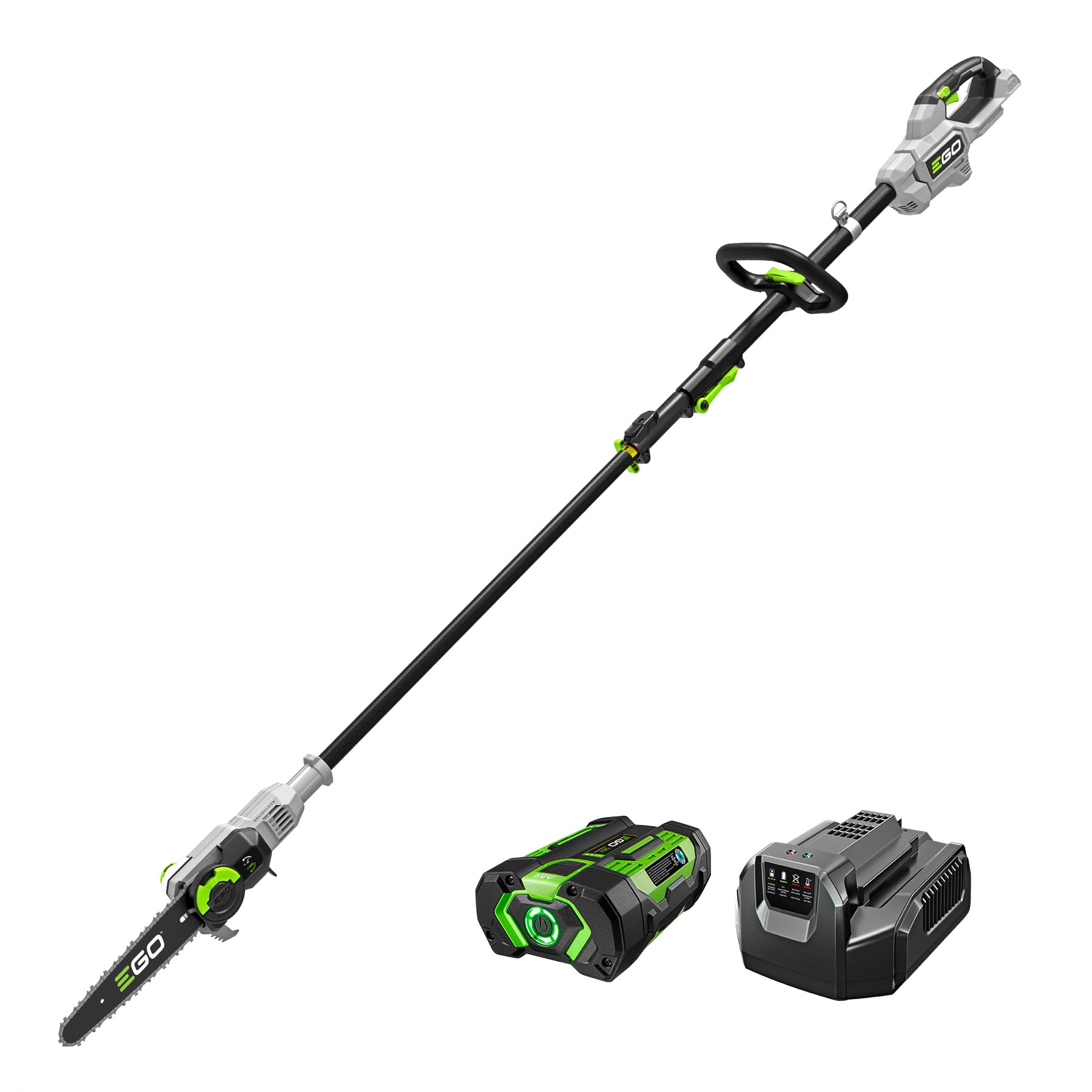
The cordless pole saw that feels balanced in your hands and cuts like a gas unit.
The first thing you notice about the EGO PS1001 is the design: the 56V 2.5Ah battery sits at the rear of the tool, not on the cutting head. That shifts the center of gravity back toward your grip, so you are not wrestling a heavy head at the end of a long pole. Buyers report that this balance makes it easier to hold and lets the cutting blade fit into tighter spaces around branches.
It delivers up to 100 cuts per charge, and the chain speed reaches 20 m/s (about 65 ft/s) driven by a high-efficiency brushless motor. The telescopic carbon fiber shaft extends to a total reach of 13 feet, or up to 17 feet with the EP1000 extension pole sold separately. That is a shorter max reach than the 30-foot manual saws, but the usable reach is realistic — the pole does not sag or twist. The LED cut line indicator is a first among pole saws, giving you a bright line on the branch so you can cut accurately even in shaded or dusk conditions.
The catch is the price — it sits at the premium end of the category. One reviewer who has used it for a full season for limbing and log cutting noted the thin-kerf chain stays super sharp and reduces friction in the cut, but also pointed out the carbon fiber pole option is expensive. If you only need to trim a couple of branches once a year, a manual saw costs a fraction of this. But if you have a wooded property and want a tool that starts with a push button and runs quietly enough that a neighbor described the noise as “like a drill,” this is the one that pays for itself.
Balanced and powerful: The rear-mounted battery design means less fatigue overhead compared to top-heavy cordless saws like the Greenworks 60V, which owners mention is very top-heavy.
The honest trade-off: You pay premium money for premium reach and balance — not the right choice if your trimming needs are once-a-year light pruning.
Reach for this if: you have regular limbing work and value a balanced, powerful cordless saw that cuts fast and clean.
Look elsewhere if: your budget is tight or you only need to trim one or two branches annually.
2. Greenworks 60V 10″ Brushless Cordless Pole Saw

Gas-equivalent power in a cordless package that cuts branches at 43 ft/s.
Greenworks claims this pole saw delivers 21cc gas equivalent power, and buyer experiences back it up. The brushless motor drives the chain at up to 43 ft/s and reaches 6,823 rpm, making short work of medium branches. With a 10-inch bar and a 2.0Ah 60V battery, you get up to 120 cuts on a single charge, and the rapid charger refills the battery in 40 minutes. That is faster recharging than the EGO’s 2.5Ah battery, though the Greenworks delivers more cuts per charge overall (100 vs 120 at different battery capacities).
The three-piece aluminum shaft extends to 9 feet for a 14.5-foot reach. One reviewer noted the extension is an insert, not telescopic, so you have to stop and reconnect sections to change length. The automatic chain oiler and transparent oil fill window make maintenance straightforward — you see when you need to top up. The push-button start means no priming or pull cords.
The real-world trade-off is balance. Reviewers consistently report that the tool is very top-heavy because the power unit sits in the head. One buyer stated the head is very heavy, causing poor balance, and that the tool feels awkward for long use. This is the opposite of the EGO’s rear-battery design. If you are a Greenworks 60V ecosystem user (it is compatible with over 75 Greenworks 60V tools), the battery-sharing convenience may outweigh the balance issue.
what separates it
- 120 cuts per charge and 40-minute rapid recharge
- No priming or pull cords — push-button start
- Works with over 75 Greenworks 60V tools
The Real Limitation
- Top-heavy design makes extended overhead use tiring
- Insert-style pole requires stop-and-reconnect to change length
Best for: buyers already in the Greenworks 60V ecosystem who want gas-level cutting power without the gas.
Not for: users who need a balanced, fatigue-free saw for long sessions — the head-heavy design wears on your arms.
3. Autubin Brushless 2-in-1 Cordless Pole Saw & Mini Chainsaw
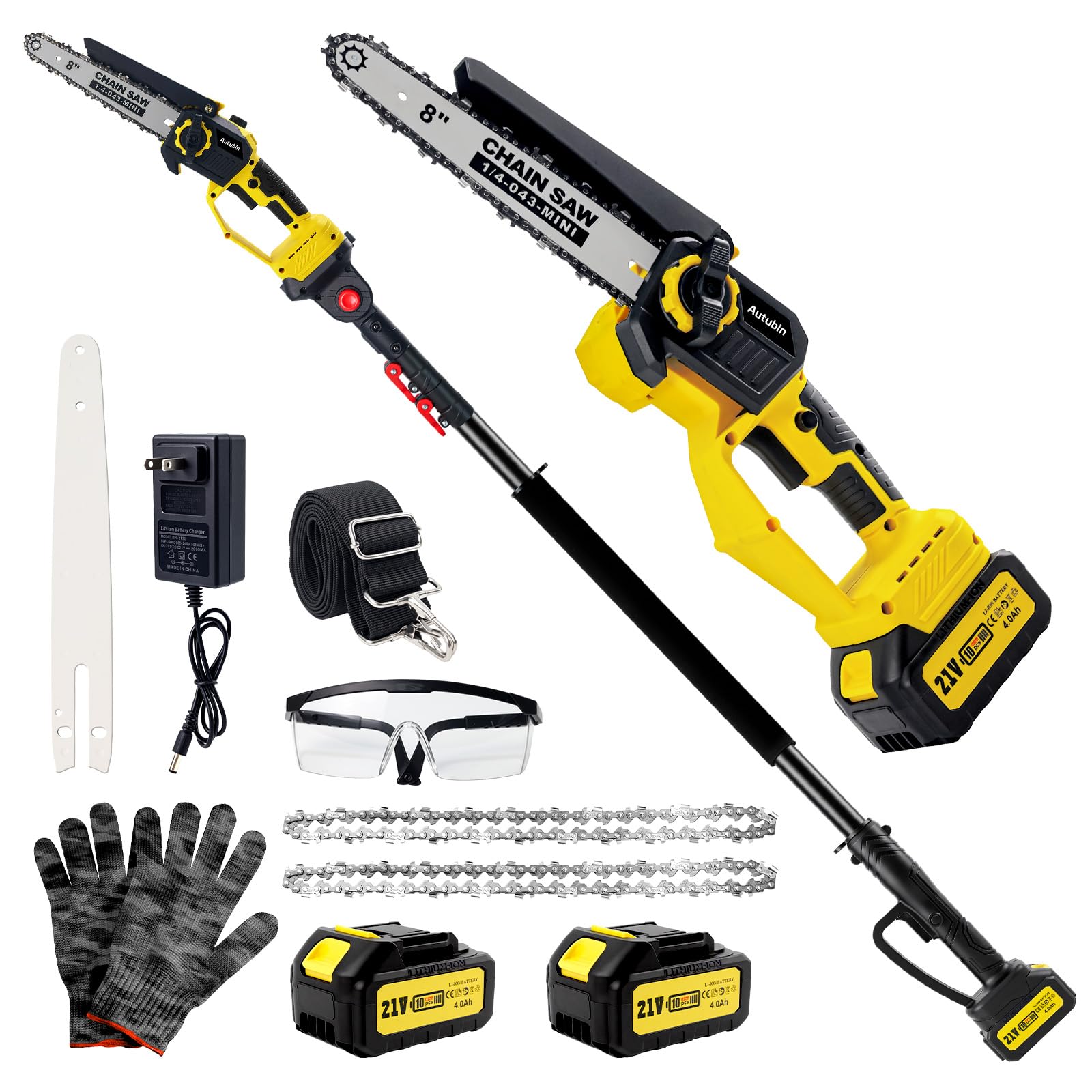
A pole saw and a mini chainsaw in one kit for under a premium brand’s battery.
This Autubin kit gives you two tools for the price of one: an 8-inch mini chainsaw that detaches from the telescopic pole. The pole extends from 4 feet to 9 feet, giving a max reach of 16 feet based on a 6-foot user. With a 0-180 degree angle adjustment, you can cut branches overhead or at tricky angles without a ladder. The 1200W brushless motor drives the chain at 26.2 ft/s, which customers note handles branches efficiently.
It comes with two 21V 4.0Ah batteries. Alternating use supports up to 120 minutes of trimming, and the LED display on each battery shows remaining power at a glance. That is a solid runtime for a mid-range cordless saw. The mini chainsaw weighs 3.96 lbs alone, and the full pole saw setup weighs about 6.9 lbs — lighter than the Greenworks 60V at 12.1 lbs, making it easier to maneuver overhead.
The main concern is replacement parts. One long-term buyer reported that after 9 months, they could not find proper replacement chains. The manufacturer spec is 1/4″ pitch, 47 drive links, and 0.043″ gauge, but the buyer found that chains meeting that spec were too long, causing unsafe slack. If you buy this, keep the included extra chains and guide plates (the kit includes three chains and two guide plates) as backups.
Value-per-dollar is high: Two tools, two batteries, and a shoulder belt for less than the cost of the premium cordless picks.
The catch: Replacement chain sourcing appears problematic — the included extras are your lifeline.
Buy it for: the versatility of a pole saw and handheld chainsaw in one affordable package.
skip it if: you need guaranteed long-term parts availability — you may struggle to find fitting replacement chains.
4. MEFBANT 30.1 FT Pole Saw for Tree Trimming
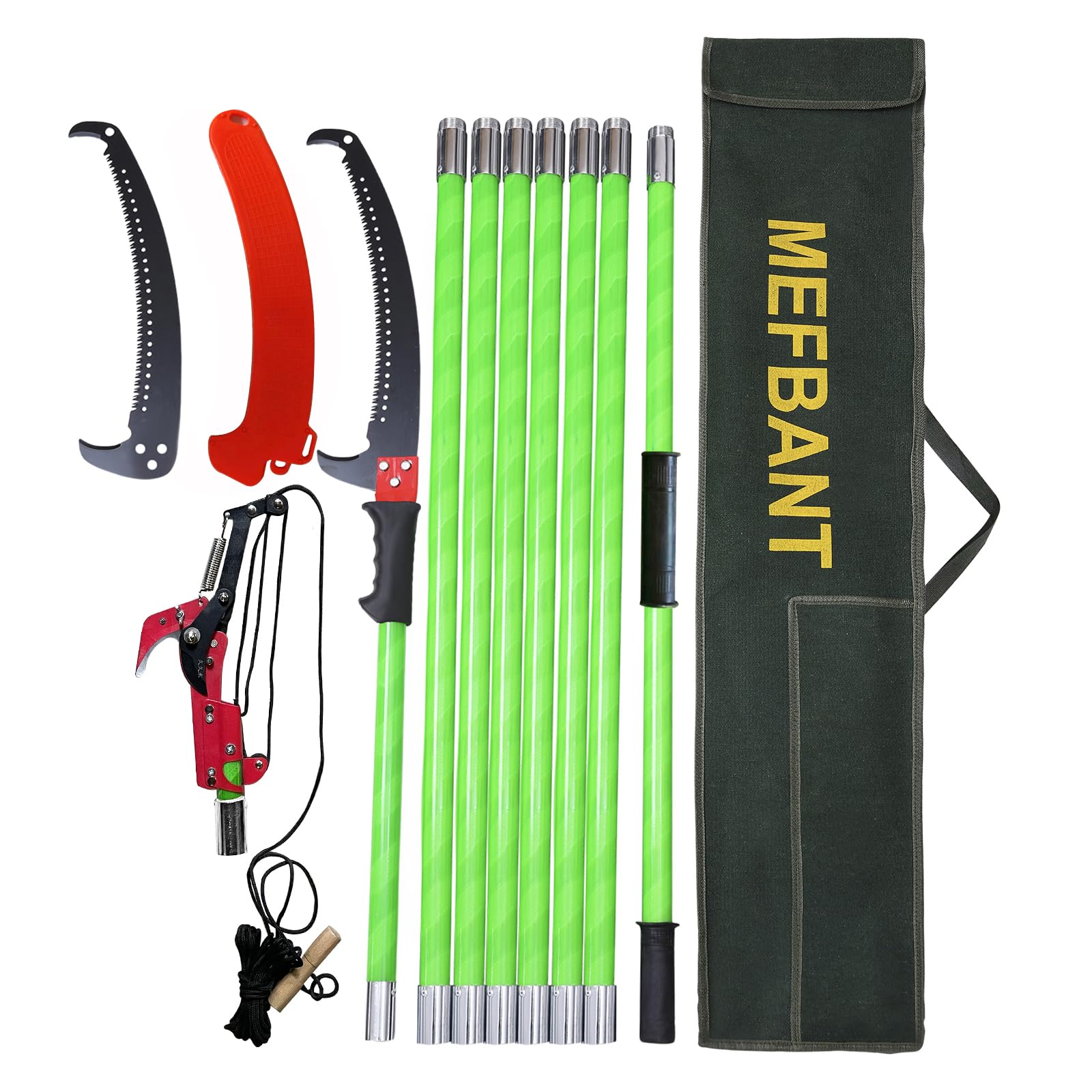
Manual reach that dwarfs cordless options — 30.1 feet with a 17.5-inch blade.
This MEFBANT kit includes 8 extension poles, a tree pruning saw, a pruner head, an extra blade with sheath, and a carry bag. The 17.5-inch blade length versus the Hooyman’s 7-inch blade, meaning each stroke bites deeper into the wood. Buyers confirm this matters: one reviewer used the saw on hard oak limbs up to 6 inches in diameter and got through in quick time, noting the saw had no trouble cutting through oak.
The pole reaches 30.1 feet, making it the longest reach in this roundup. However, that extreme reach comes with a physics problem. Multiple reviewers point out that at 20+ feet the pole becomes difficult to wield and bends on the upstroke. One strong buyer stated that at 30 feet, uprighting the pole feels like fishing for marlin due to the torque. The 20-foot setup (using 6 of the 8 sections) offers better balance, as the manufacturer suggests wearing back support for prolonged use. The pulley-assisted pruner head handles smaller branches, with the saw taking over for anything thicker.
Build quality gets mixed marks. The threaded aluminum joints connect smoothly, and the hardened steel saw blade features a hooked tip for stabilizing branches. But the rubber handles can slide off easily, and the pole’s flex at full extension is a common concern. Still, for the reach:blade-length ratio, this manual saw beats every cordless option by a wide margin — the 30.1 ft reach versus the Hooyman’s 10 ft reach.
What It Excels At
- 30.1 ft max reach — gets to branches no cordless saw can touch
- 17.5-inch hardened steel blade cuts oak quickly
- Complete kit with saw, pruner, and extra blade
Honest Drawbacks
- Very hard to control at full extension — torque overwhelms
- Rubber handles slide off during use
Ideal for: the tallest branches on your property where no cordless reaches.
Not for: one-handed or casual trimming — you need real arm strength above 20 ft.
5. LETYANGER Pole Saws for Tree Trimming (7.3–27 ft)

A budget manual saw that punches above its price with two cutting heads.
This LETYANGER kit comes with 7 extension poles (7.0 Count) that reach a max of 27 feet, plus both a saw blade head and a scissor-style lopper head that you swap depending on branch thickness. Shoppers say a clear division: “The lopper works best for branches up to about 1-1/4″ thick, the saw is best for anything thicker than that.” That dual-head system gives you precision on thin branches and power on thick ones without needing a second tool.
The poles are made of epoxy resin with aluminum alloy joints, and the saw blade uses 65 Mn alloy steel. One buyer who needed non-conductive poles for safety near power lines specifically valued the epoxy resin. At the full 27-foot setup, the total weight is 9.5 lb — lighter than the Greenworks 60V at 12.1 lb, but buyers warn it does feel heavy and may be hard to control at max extension. Several reviewers suggest the 20-foot length (6 poles) is the balance for balance and control.
The “ugly yellow” color is intentional — the manufacturer chose it so others can easily see you are trimming and avoid walking into your work area. It comes with a zippered canvas carry bag, an extra saw blade, and a pair of cloth gloves.
The budget workhorse: Two cutting heads and 27 ft of reach for entry-level money.
The honest limit: At full 27 ft the resin poles get bendy, and the 20 ft balance is the real usable reach.
Pick this if: you need an affordable manual saw for occasional trimming and value the two-head versatility.
Avoid it if: you have heavy daily pruning work and need a stiffer, longer-lasting pole.
6. EXTEND-A-REACH 5-30 ft Telescopic Tree Saw
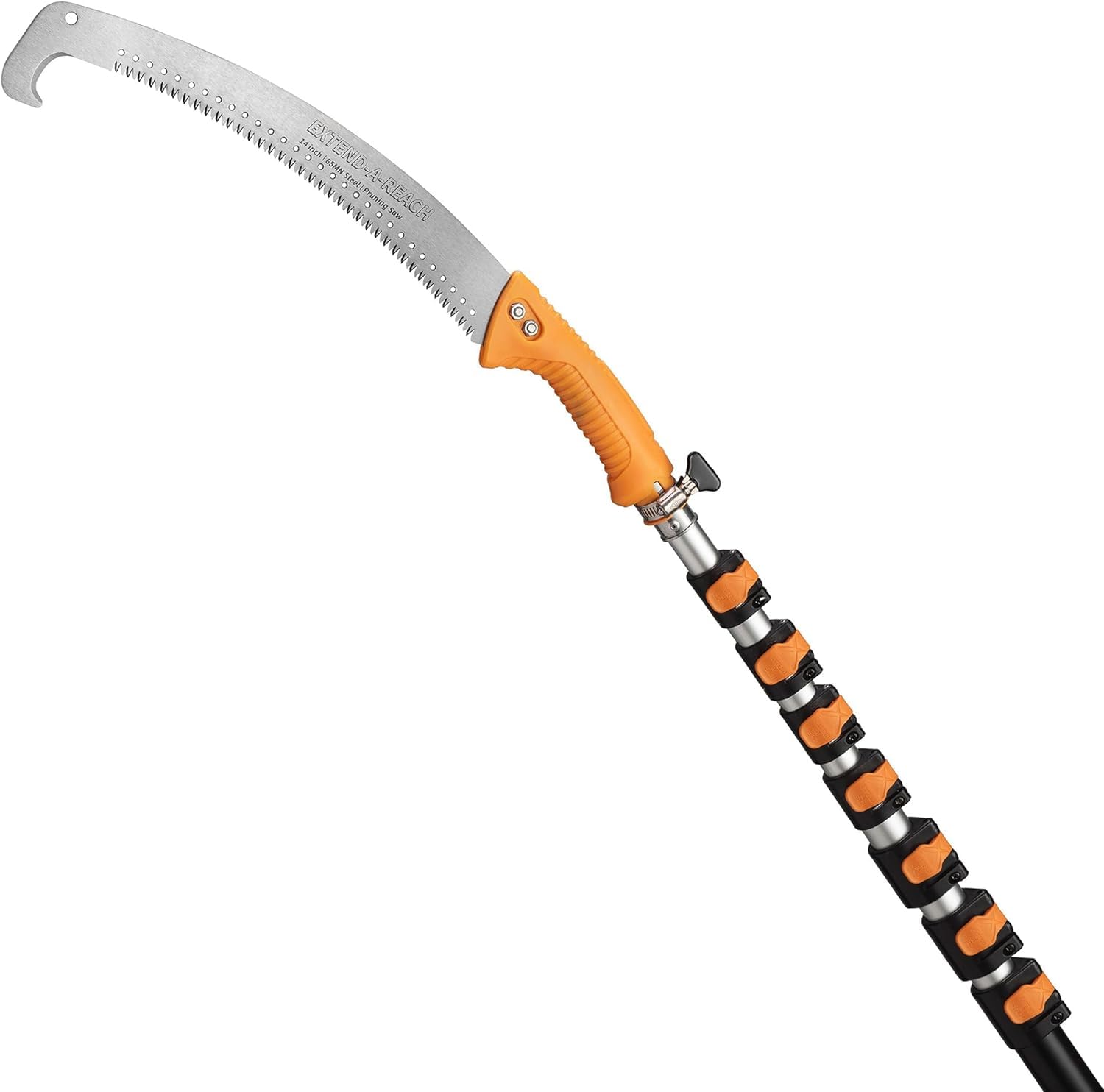
An aluminum telescopic pole that stays rigid when others wobble, backed by a 3-year warranty.
The EXTEND-A-REACH is different from the screw-together pole saws above. It uses a telescopic aluminum design with quick-release thumb lever clasps, so you extend the pole in seconds without threading sections together. The manufacturer states the extra-thick aluminum is “stiffer, tougher, and stronger” than resin poles, and buyers agree the pole does not twist under load like the cheaper epoxy resin options. The 30-foot pole collapses to 58 inches for storage.
The 14-inch carbon steel saw blade is curved, which helps prevent pinching as the cut progresses — the blade cuts from the top down. One buyer in their 70s cut through 3-4 inch diameter branches with this saw, calling it as easy as using a pole chainsaw. Buyers also note the attachment point on the extension pole is cast metal, a clear improvement over the plastic connectors found on many competitors. The company offers an extended 3-year warranty and donates a portion of profits to cleaning cancer patients’ homes.
The weak point is the locking clamps. One buyer mentioned that the clamps do not prevent the segment from extending during use, and another saw the tip extension come out of the pole entirely on the third use. These reports suggest quality control inconsistency. The pole also shifts from the 30 ft max reach to roughly 5 ft minimum, but the max 30 ft is listed as more of a marketing reach — the manufacturer itself recommends not using the smallest extension at full length due to wobble.
Premium Touches
- Aluminum telescopic design is stiffer than resin pole saws
- 14-inch curved carbon steel blade resists pinching
- 3-year warranty and non-slip grip handles
Reported Issues
- Locking clamps may not hold sections securely
- Some units experienced pole separation during use
Best for: buyers who want a rigid manual pole saw with a long reach and don’t want to thread extensions together.
Check carefully: if you buy, test the locking mechanism on every section before taking it to a tree.
7. Hooyman Extendable Tree Saw (10 ft)
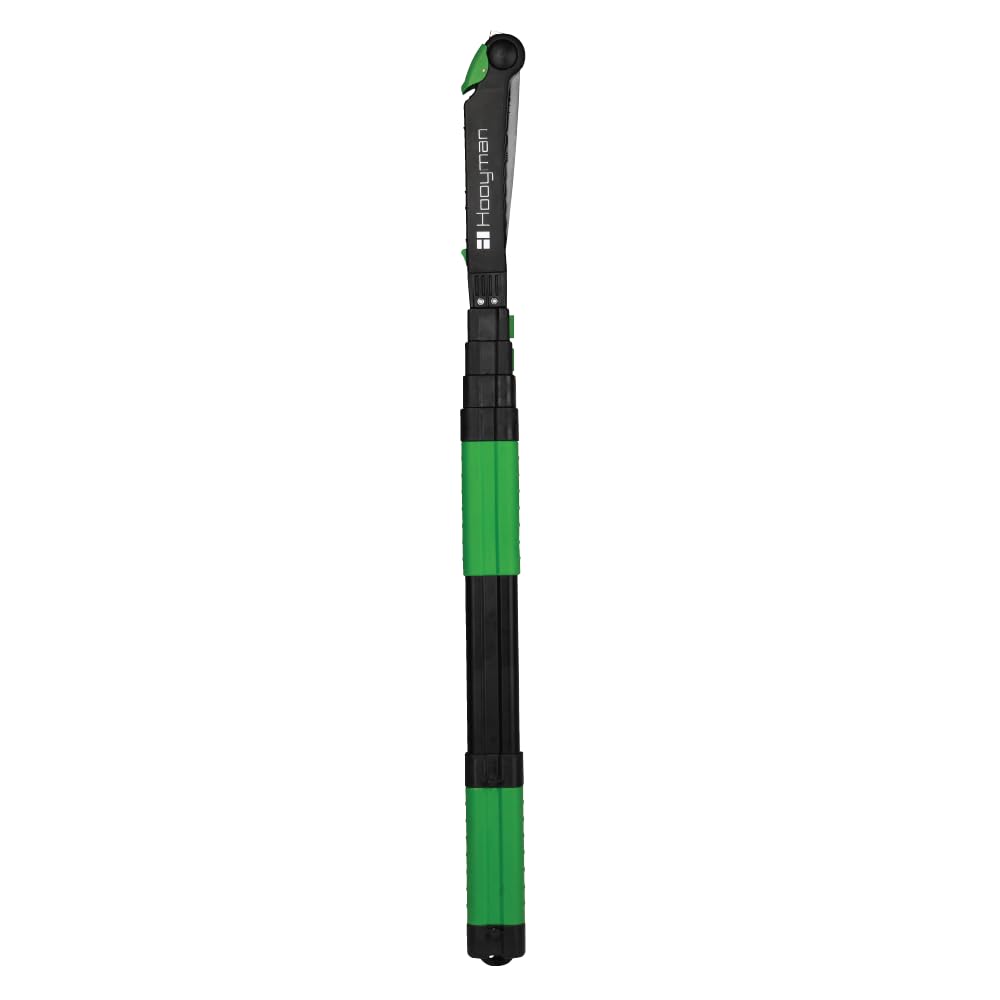
A compact saw that fits in a backpack and collapses to 28 inches for hiking or hunting.
The Hooyman is the outlier in this roundup: a 10-foot reach and a 7-inch blade, compared to the 30-foot giants above. The trade-off makes sense for a specific buyer. The saw collapses to 28 inches and weighs just 4 lbs, which lets you throw it in a day pack for camping, hunting, or trail clearing. One buyer uses it to clear blocking branches from bow-hunting spots, and another carries it in a pack while hiking.
The blade is high carbon SK5 steel with impulse-hardened 4-edge teeth (MegaBite XP design). The I-beam aluminum construction keeps the pole rigid despite the compact size. The in-line design lets the saw head detach and lock into the extension arm when you need the pole, or detach completely to use as a handsaw. The positive locking extension system adds sections one at a time — no twisting required.
Buyers report two common complaints. First, the plastic knobs for the saw clip broke on first use for one buyer, though Hooyman’s customer service was responsive. Second, the short straight blade is slow on 3-4 inch limbs; the 7-inch blade is shorter than the MEFBANT’s 17.5-inch blade, so it takes more strokes per cut. For its intended use — quick, portable trimming of smaller branches — it performs well, but do not expect it to replace a full-size pole saw for big jobs.
Purpose-built for mobility: Collapses to 28 inches and weighs 4 lbs — the only saw here that fits in a pack.
The limitation: The short blade and small pole mean it is slow on limbs over 3 inches and the plastic clips are fragile.
Reach for this if: you need a portable saw for hunting, camping, or trail clearing where weight and pack size matter.
Leave it behind if: you need to cut thick hardwood branches or reach above 10 feet.
Understanding the Specs
Blade Length and Material
Blade length determines how much wood you cut with each stroke. A 17.5-inch blade (like the MEFBANT) cuts deeper in one pull than a 7-inch blade (like the Hooyman), meaning fewer strokes per branch. But a longer blade also requires more force and is harder to control when the pole is fully extended. Blade material matters too: 65 Mn alloy steel and SK5 high carbon steel hold an edge longer than standard carbon steel.
Reach vs. Usable Reach
Every manufacturer lists the max reach, but usable reach is what matters. At 30 feet, a manual pole saw becomes a wobbly, torque-heavy tool that is hard to control. Real-world reviews consistently show that 15-20 feet is the comfortable working range for most people. Consider your actual branch heights and whether a 30-foot reach is a marketing number or a genuine need.
Pole Material: Epoxy Resin vs. Aluminum
Epoxy resin poles are lighter and non-conductive (important near power lines), but they flex more, especially above 12 feet. Aluminum poles are stiffer and stronger at full extension, but they cost more. The EXTEND-A-REACH uses aluminum with a groove that prevents the sections from spinning during use, a feature buyers appreciate.
Power Source: Manual vs. Battery
Manual saws are cheaper, lighter, and never need charging. But they require arm strength and take more time per cut. Battery-powered saws (like the Greenworks 60V or EGO 56V) cut faster with less effort, but they weigh more (up to 12 lbs) and cost two to five times more. The battery voltage indicates power: 56V and 60V are gas-equivalent, while 21V is entry-level.
FAQ
What is the best tree trimmer pole saw for reaching 30+ feet?
Can I use a manual pole saw on oak branches?
How do I choose between a manual saw and a battery-powered pole saw?
Will a 30-foot pole saw actually work at 30 feet?
What does a lopper attachment do on a pole saw?
How does the Greenworks 60V compare to the EGO Power+ PS1001?
Can I take a pole saw apart for storage?
How do I prevent the pole sections from getting stuck?
Are battery-powered pole saws powerful enough for thick branches?
Should I get a pole saw with an auto-oiler?
Final Thoughts: The Verdict
For the majority of shoppers, the tree trimmer pole saw winner is the EGO Power+ PS1001 because it balances power, lightweight carbon fiber construction, and a rear-mounted battery that makes overhead cuts less fatiguing. If you want a cordless option that pairs with a Greenworks 60V ecosystem, grab the Greenworks 60V. And for the tallest branches on your property without spending battery money, the standout is the reach of the MEFBANT 30.1 FT manual saw.
How We Picked
We do not accept paid placement. Every pick is matched to a real buyer and a real use-case; we do not hands-on test units.
Sources & Methodology
Specifications: manufacturer listings and product documentation. Review insights: verified customer reviews, as of July 2026. Pricing: not shown on this page (it changes often); check the current price via the retailer link.
As an Amazon Associate, Lawn Gear Lab earns from qualifying purchases. This does not affect which products we feature.