
Discovering tree roots have invaded your sewer line is a plumbing nightmare that often leads to expensive augering bills and recurring backups. Choosing the right treatment means understanding whether a copper sulfate crystal or a foaming dichlobenil formula is best for your specific pipe situation and root severity.
I’m Rikta — the co-founder and writer behind Lawn Gear Lab. I’ve spent countless hours analyzing chemical formulations, EPA registrations, and hundreds of verified owner experiences to determine which sewer line root killers deliver real results without harming your plumbing or surrounding trees.
After evaluating copper sulfate crystals, foaming dichlobenil applications, and bulk chemical options, this guide breaks down the top contenders to help you find the most effective tree root killer for your home’s specific needs.
How To Choose The Best Tree Root Killer
Selecting the right root killer depends on whether your problem is active clogging from thick roots or preventative maintenance against fine hair-like roots. The two dominant active ingredients — copper sulfate and dichlobenil — behave very differently inside your pipes.
Copper Sulfate Crystals vs. Foaming Herbicides
Copper sulfate crystals dissolve in water and kill roots only where the water touches — typically the bottom of the pipe. This makes them budget-friendly for roots already submerged in standing water. Foaming products like those using dichlobenil expand to fill the entire pipe cross-section, reaching roots invading from the pipe crown and joints. If your camera inspection shows roots growing from the top of the pipe, a foaming killer is necessary for full contact.
Septic System Compatibility
Not all root killers are safe for septic systems. Copper sulfate can temporarily reduce bacterial action in your septic tank for about 15 days before returning to normal. Some foaming formulas are designed to be safe for septic enzymes. Always verify EPA acceptance and manufacturer statements regarding septic compatibility before application, especially if you have a drain field.
Application Method: Toilet vs. Cleanout
The easiest method involves flushing measured doses through your lowest toilet, but heavy products like ROOTX require direct application through the main cleanout to avoid clogging your toilet. Granular copper sulfate should be poured in half-pound increments with multiple flushes. Foaming products require restricting water usage for 4 to 8 hours after application to allow the foam to dwell and kill roots.
Quick Comparison
On smaller screens, swipe sideways to see the full table.
| Model | Category | Best For | Key Spec | Amazon |
|---|---|---|---|---|
| ROOTX 4LB | Foaming | Full pipe circumference coverage | Dichlobenil foaming action | Amazon |
| Roebic FRK | Foaming | Septic-safe root prevention | Dichlobenil, copper-free | Amazon |
| RectorSeal 81394 | Granular | Easy toilet application | Copper sulfate blue crystals | Amazon |
| Adios! Root Killer | Granular | Septic tank protection | Copper sulfate, 2 lb | Amazon |
| Sanco Root Destroyer | Granular | Budget copper sulfate treatment | Copper sulfate crystals, 2 lb | Amazon |
| Alpha Chemicals Copper Sulfate | Powder | Bulk value and versatility | 25.2% Cu, 5 lb powder | Amazon |
| Dibbs Farms Copper Sulfate | Crystals | Long-term bulk supply | 99.9% crystals, 10 lb | Amazon |
In‑Depth Reviews
1. ROOTX 4LB Jar with Applicator

ROOTX is the undisputed champion when roots are invading from the top of your pipe. Its dichlobenil-based formula creates an expanding foam that fills the entire pipe cross-section, ensuring the foaming herbicide reaches every root fiber — not just those submerged in water. The 4-pound jar treats up to 100 feet of 4-inch pipe, making it ideal for long main sewer lines. This product is EPA accepted and designed specifically for application through your main cleanout, not through a toilet.
Customers who had annual root clogs for six consecutive years reported that a single ROOTX application finally prevented the expected May blockage. The key is applying it within 30 minutes of a professional roto-rootering session to kill remaining root stubs before they regrow. Users emphasize that this is a preventative root growth inhibitor, not a degreaser or emergency unclogger — established blockages must be mechanically cleared first.
The included funnel applicator is functional but users recommend having four 5-gallon buckets ready to manage foam overflow during application. The foam expands aggressively and can cause caustic spray if the cap cannot be secured quickly. Wearing an N95 mask is advised. With proper application every 6 to 9 months, ROOTX reliably prevents root regrowth and eliminates annual plumbing bills.
What works
- Foaming action reaches roots at the pipe crown and joints
- Treats long pipe runs (100 ft of 4″ pipe per jar)
- Proven to prevent regrowth for 6 to 12 months
What doesn’t
- Requires application through main cleanout, not toilet
- Foam expands very rapidly, can cause messy overflow
- Premium price point compared to copper sulfate options
2. Roebic FRK Foaming Tree Root Killer
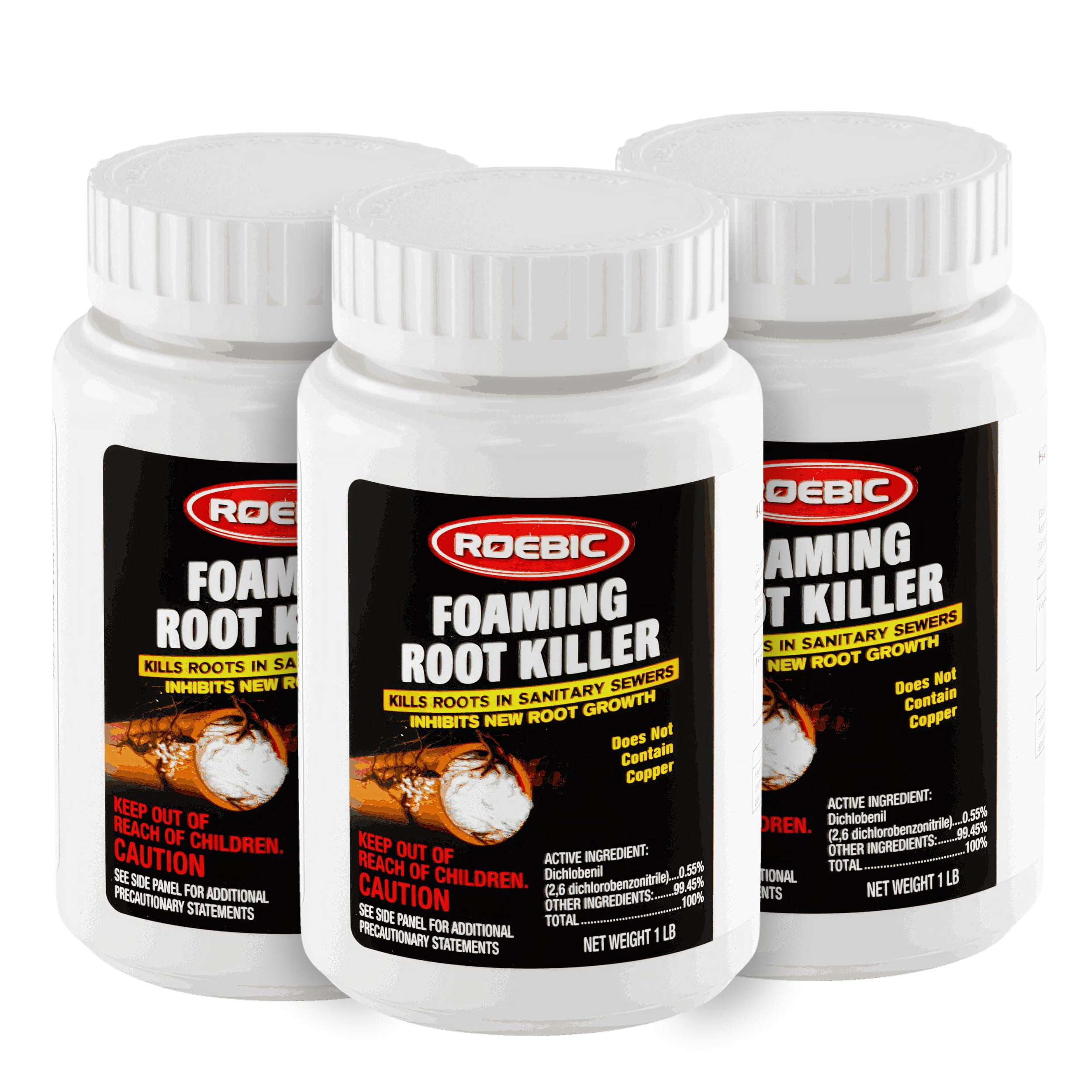
Roebic FRK delivers professional-grade foaming root control with a key advantage: it contains dichlobenil instead of copper sulfate, making it safe for copper plumbing and septic systems. The patented foaming action activates on contact with water, expanding to fill the entire pipe line and delivering the herbicide to roots growing from pipe joints. This pack of three 1-pound containers provides a full year of preventative treatment for most residential sewer lines.
The application process is straightforward: pour the entire contents into your toilet, flush, then restrict water usage for 4 to 6 hours. Some users mix the powder in a separate container first to break up lumps before flushing to ensure complete dissolution.
The main limitation is that Roebic FRK does not kill existing large roots already blocking the pipe — those must be mechanically removed before treatment. Some buyers expected it to dissolve thick root masses and were disappointed when it didn’t. Used as a routine maintenance product every 12 months, however, it prevents future clogs effectively and keeps surrounding trees safe without harming soil bacteria or plumbing materials.
What works
- Copper-free formula is safe for all plumbing types
- Foaming action reaches roots at pipe top
- Easy toilet application without specialized equipment
What doesn’t
- Does not remove established large root blockages
- Powder may arrive compressed and need mixing
- Requires 4-6 hours of restricted water usage post-application
3. RectorSeal Root Destroyer 81394

RectorSeal is a trusted name in the professional plumbing trades, and this 2-pound bottle of blue copper sulfate crystals is designed for easy, mess-free application. The crystals pour smoothly and dissolve upon contact with water, killing roots that have entered sewer systems through pipe joints or cracks. Designed to be absorbed only by the roots it contacts, this formula will not harm the tree or shrub above ground when used as directed.
Users consistently report that RectorSeal solves slow-flush problems caused by root infiltration. One reviewer documented a plumber-confirmed root blockage 9 feet into the drain that would have cost to auger — a twice-yearly application of RectorSeal resolved the issue for roughly worth of product. The recommended dosing involves pouring half-pound increments into the toilet nearest the sewer line and flushing after each pour, using about 6 gallons of water total.
The blue dye provides visual confirmation that the product has been fully flushed. Users note that results take time — this is a root killer that withers roots gradually, not an instant drain opener. It works best on roots contacting standing water in the pipe; roots invading from the pipe crown may not be reached effectively without a foaming agent. For regular preventative maintenance, RectorSeal offers a strong price-to-performance ratio that keeps plumbers away.
What works
- Clear blue color shows when product is fully flushed
- Widely used by professional plumbers for maintenance
- Simple toilet application with no special equipment
What doesn’t
- Only reaches roots in direct contact with water flow
- Not effective on roots at the top of the pipe
- Requires consistent bi-annual application for best results
4. Adios! Sewer and Septic Root Killer

Adios! positions itself specifically as a septic-system-friendly copper sulfate root killer, claiming its formula will not affect septic tank bacteria or enzymes. The 2-pound granular container is EPA registered and targets roots from all common tree types including maple, pine, and oak. The manufacturer recommends bi-annual application to prevent roots from taking hold and causing pipe breaks.
Customer feedback is mixed but leans positive for maintenance use. One reviewer called it the second-best overall root killer, noting it kills roots well but doesn’t reach the top of the pipe like ROOTX foam does — making it best for roots touching standing water. Another user appreciated the large container size and the mild odor compared to other chemical treatments. Several buyers were satisfied with the easy pour-and-flush application method.
The main drawback reported is that Adios! does not foam, so roots growing from the top of the pipe remain untreated. Some buyers expected faster results and were disappointed when standing root clogs didn’t dissolve immediately. The product works best as a preventative measure applied every six months, not as an emergency unclogger. For homeowners with septic systems seeking a straightforward copper sulfate maintenance treatment, Adios! provides a solid entry-level option.
What works
- Designed to be safe for septic tank bacteria
- Simple granule application via toilet flushing
- Affordable bi-annual maintenance approach
What doesn’t
- Does not reach roots at the pipe crown
- Not effective as an emergency clog remover
- Some users reported no visible improvement
5. Sanco Root Destroyer

Sanco Industries offers a basic copper sulfate crystal formulation that gets the job done without any frills. At 2 pounds, this budget-friendly option is designed to kill invasive septic and sewer pipe roots without harming the tree above ground. The manufacturer notes that it will temporarily reduce bacterial action in septic tanks, but normal levels return approximately 15 days after treatment. Application is through the toilet, using half-pound increments flushed one at a time.
Owner reviews are overwhelmingly positive for this straightforward approach. One user reported that a garage drain that had been non-functional for over 30 years due to root blockage began working again after using this product alongside rock salt as a foaming agent. Another reviewer praised the value compared to professional treatments, noting it saved them from spending hundreds on annual roto-rootering. The consensus is that consistent semi-annual application keeps drains running fast and prevents root backups.
The primary limitation is that Root Destroyer is applied only through the toilet, and the manufacturer explicitly advises against using it through sink or tub drains. It also only kills roots inside the leach line — exterior roots may not be affected. Some users noted that the lack of foaming action means it is less effective for roots growing from the top of the pipe. For homeowners on a tight budget who need a simple, proven copper sulfate treatment, Sanco Root Destroyer delivers reliable basic performance.
What works
- Extremely affordable copper sulfate treatment
- Proven effective on decades-old root blockages
- Simple flush-and-wait application process
What doesn’t
- Temporarily reduces septic bacteria for ~15 days
- No foaming action for top-of-pipe roots
- Cannot be applied through sink or tub drains
6. Alpha Chemicals Copper Sulfate Pentahydrate

Alpha Chemicals offers a 5-pound bag of high-purity copper sulfate powder containing 25.2% copper. The powder form dissolves extremely quickly in water, making it fast-acting when flushed into sewer lines. This is a bulk chemical product packaged as a raw ingredient, meaning it contains no specific usage instructions for root killing — you must already know the correct dosing and application method for your situation.
Experienced users appreciate the value and concentration of this product. One reviewer with an 90-foot sewer line reported using it successfully for 18 months to prevent root backups, but emphasized that it works best when mixed with a foaming additive such as salt-based root killer to help the solution reach roots at the top of the pipe. Without foaming action, the dissolved copper primarily treats roots submerged in standing water. The 5-pound bag lasts approximately three full applications.
The main challenge is the lack of included guidance. Novice users may under- or over-dose without clear instructions, and the fine powder requires careful handling with gloves and a mask to avoid inhalation. This product is also used widely for algae control in ponds, so it offers versatility beyond just sewer line maintenance. For knowledgeable DIYers seeking maximum value per application, Alpha Chemicals provides the most cost-effective raw material available.
What works
- Extremely cost-effective for regular maintenance
- Powder dissolves faster than crystal forms
- Versatile uses beyond root killing (algae control)
What doesn’t
- No usage instructions included for root killing
- Powder requires careful handling with PPE
- Best results require mixing with foaming additive
7. Dibbs Farms Copper Sulfate Pentahydrate

Dibbs Farms produces a massive 10-pound bag of 99.9% pure copper sulfate crystals, made in the USA and packaged in a heavy-duty 3-mil resealable bag. The larger crystal size is specifically recommended by users for root killing because the crystals tend to lodge in the drain rather than washing away with each flush, providing longer contact time with roots compared to fine powder. This is a raw farm chemical sold as an ingredient with no specific usage directions.
Customers using this product for sewer line maintenance report excellent results with just a couple of tablespoons flushed every few months. One reviewer noted that switching to larger crystals from smaller granules dramatically improved results because the crystals stayed in the pipe longer. Another user praised the packaging, saying it arrived with extra padding to prevent accidental bag cuts during shipping. The 10-pound supply lasts years for most residential applications.
Like other bulk chemicals, this product lacks application instructions for root control, requiring the buyer to research proper dosing independently. The crystal form dissolves more slowly than powder, which is actually an advantage for root killing but may be a drawback for those wanting fast dissolving. The resealable bag is functional but not as convenient as a rigid container with a pour spout. For homeowners committed to long-term sewer line maintenance who want the best unit price available, Dibbs Farms delivers exceptional endurance.
What works
- Large crystals stay in drain longer for sustained contact
- Extremely economical for multi-year supply
- Made in USA with high 99.9% purity
What doesn’t
- No usage instructions included for root control
- Bag packaging less convenient than rigid containers
- Requires careful storage to maintain reseal integrity
Hardware & Specs Guide
Active Ingredient: Copper Sulfate vs. Dichlobenil
Copper sulfate pentahydrate (CuSO₄·5H₂O) is the most common active ingredient in root killers. It works by disrupting cellular enzymes in root tips, causing them to wither and die. Products labeled with 99.9% purity or 25.2% copper content provide consistent results. Dichlobenil is a contact herbicide used in foaming products like ROOTX and Roebic FRK — it inhibits root cell division and prevents regrowth for up to 12 months. Dichlobenil-based products are typically more expensive but offer superior coverage for roots invading from pipe joints and the pipe crown.
Form Factor: Granules, Powder, or Foaming
Granular copper sulfate (blue crystals) pours easily and dissolves at a controlled rate, making it ideal for toilet-based application. Powder dissolves instantly but requires careful handling to avoid inhalation. Foaming products create an expanding foam that fills the entire pipe cross-section, ensuring active ingredient contacts roots at the top, bottom, and sides of the pipe. For roots visible in the bottom of the pipe, granules or powder suffice. For roots entering through cracks at the top of the pipe, foaming formulas are essential for complete coverage.
FAQ
How often should I apply tree root killer to my sewer line?
Will root killer harm my trees if I flush it down the toilet?
Can I use copper sulfate root killer if I have a septic tank and drain field?
What is the difference between foaming and non-foaming root killers?
Final Thoughts: The Verdict
For most homeowners, the tree root killer winner is the ROOTX 4LB Jar because its foaming dichlobenil action reaches roots at every point inside the pipe and prevents regrowth for up to a year. If you want a septic-safe foaming option with easy toilet application, grab the Roebic FRK. And for budget-conscious users who simply need to maintain existing clear pipes, nothing beats the value of the Dibbs Farms Copper Sulfate Crystals.