
Surface watering is a losing battle — evaporation, runoff, and wind steal the moisture before it ever reaches the roots that actually feed your trees. A dedicated tool bypasses that waste, injecting water and nutrients directly into the root zone where active growth happens, building a stronger, deeper root system that survives drought and stabilizes the tree against windthrow.
I’m Rikta — the co-founder and writer behind Lawn Gear Lab. I’ve spent hundreds of hours cross-referencing stainless steel grades, weld quality, tip designs, and brass valve threading to identify which root feeder systems deliver reliable long-term performance for real-world garden conditions.
If you want to save water, reduce fertilizer waste, and grow healthier trees without flooding your entire yard, this guide to the best tree root feeder system breaks down the key specs and real-world trade-offs of seven top options.
How To Choose The Best Tree Root Feeder System
A tree root feeder is a deceptively simple tool, but small differences in material, tip design, and valve integration determine whether it delivers effortless deep watering or becomes a frustrating clog-prone project. Focus on these three specs before buying.
Shaft Material & Weld Quality
Stainless steel is the gold standard — it resists corrosion from constant soil contact and won’t bend or rust when driven through compacted clay or gravel. The cheapest units use thin-walled tubing with weak spot welds that can separate under pressure. Look for units that advertise polished fusion welds and one-piece or tightly threaded two-piece construction. Powder-coated steel is a budget-friendly alternative but will eventually chip and rust at the tip.
Outlet Design & Clog Resistance
A single hole at the tip clogs almost immediately in damp soil. The most effective designs use four or more side-angled outlets that distribute water laterally and resist plugging from silt and root mass. Some premium units also incorporate a pointed solid tip that pushes soil aside rather than scooping it into the outlet holes — this is the best defense against clogging in heavy soil.
Flow Control & Shut-Off Valve
The ability to dial water pressure down to a slow trickle is critical — full hose pressure in a 32-inch shaft can hydro-excavate a cavity under your tree, causing root exposure or mud blowback. Brass shut-off valves are standard; they resist corrosion and provide smooth metering. Some feeders lack an integral valve entirely, requiring you to add an inline ball valve, which adds cost but gives superior control.
Quick Comparison
On smaller screens, swipe sideways to see the full table.
| Model | Category | Best For | Key Spec | Amazon |
|---|---|---|---|---|
| Varomorus Root Irrigator | Premium | Maximum durability in rocky soil | 37-inch one-piece stainless steel | Amazon |
| Dack Root Feeder | Premium | Lifetime warranty & fertilizer dispenser | 32-inch stainless steel with shut-off valve | Amazon |
| Corona RootIRRIGATOR | Mid-Range | Fast, high-volume watering | 41-inch length with depth markings | Amazon |
| Caulimo Deep Root Waterer | Mid-Range | Balanced features & fertilizer bottle | 32-inch stainless steel, 4 side holes | Amazon |
| enomol Deep Root Waterer | Mid-Range | Value-driven stainless build | 32-inch stainless steel, brass valve | Amazon |
| Ross Root Feeder #102A | Budget | Budget-friendly deep feeding | Adjustable flow lever, no fertilizer included | Amazon |
| Yard Butler Deep Root Irrigator | Budget | Powder-coated steel at entry price | Self-drilling tip, powder-coated steel | Amazon |
In‑Depth Reviews
1. Varomorus Stainless Steel Deep Root Irrigator

The Varomorus Irrigator stands apart because of its one-piece stainless steel construction — no threaded joints to separate, no weak seams to crack under pressure. At 37 inches overall, the shaft penetrates up to 32 inches deep, and the pointed solid tip pushes through hard clay and rocky soil without flexing. The polished fusion welds and brass hose connector resist corrosion, and the absence of an integrated shut-off valve is actually a feature for experienced users who prefer to add their own high-quality ball valve for precise trickle control.
Real-world feedback confirms the build quality is exceptional — owners report zero tip wear even after repeated use in compacted soil, and the clog-resistant design requires minimal maintenance. The trade-off is that you must supply your own inline valve; without one, full hose pressure can cause soil blowback around the insertion point. The unit also lacks a fertilizer reservoir, so you’ll need to mix supplements at the hose end or use a separate applicator.
For anyone who values absolute durability above all else — especially in heavy or rocky soil — this feeder is a buy-once, no-compromise investment. The limited lifetime warranty on stainless steel parts backs up the premium price tag with real accountability.
What works
- One-piece stainless steel shaft eliminates weak joints
- Clog-resistant pointed tip handles compacted soil
- Limited lifetime warranty on all steel parts
What doesn’t
- No integrated shut-off valve requires an add-on ball valve
- No fertilizer reservoir for direct root feeding
- Premium price point compared to budget options
2. Dack Root Feeder Deep Root Watering Tool

The Dack Root Feeder bundles everything you need in one package — a 32-inch stainless steel shaft, a brass shut-off valve, and a 3.5-ounce fertilizer bottle that allows you to switch between watering-only and feeding mode by twisting the dispenser. The four side outlet holes resist clogging, and the pointed solid tip drives through gravel and hardpan without deforming. The polished fusion welds look clean, and the included PTFE tape for the fine threads shows attention to detail that budget units skip.
Customers consistently praise the sturdy feel and immediate usability — assemble the two-piece shaft, attach a standard garden hose, and you’re deep-watering within five minutes. The fertilizer bottle is the weak link: several owners note the thin plastic feels fragile compared to the metal probe, and the instructions for mixing concentrate ratios are vague. In dense or clay soil, the side holes can still pick up silt, so a pre-drilled pilot hole helps maintain flow rate.
For the mid-range price point, this feeder delivers the most complete feature set — integrated flow control, a fertilizer reservoir, and a lifetime warranty. It’s the best option for gardeners who want one tool that does deep-watering and root feeding without separate attachments.
What works
- Integrated brass shut-off valve for flow control
- 3.5-ounce fertilizer bottle for direct root feeding
- Lifetime warranty on stainless steel components
What doesn’t
- Plastic fertilizer bottle feels less durable than metal probe
- Vague instructions for fertilizer mixing ratios
- Side holes can clog in heavy clay soil
3. Corona Tools RootIRRIGATOR
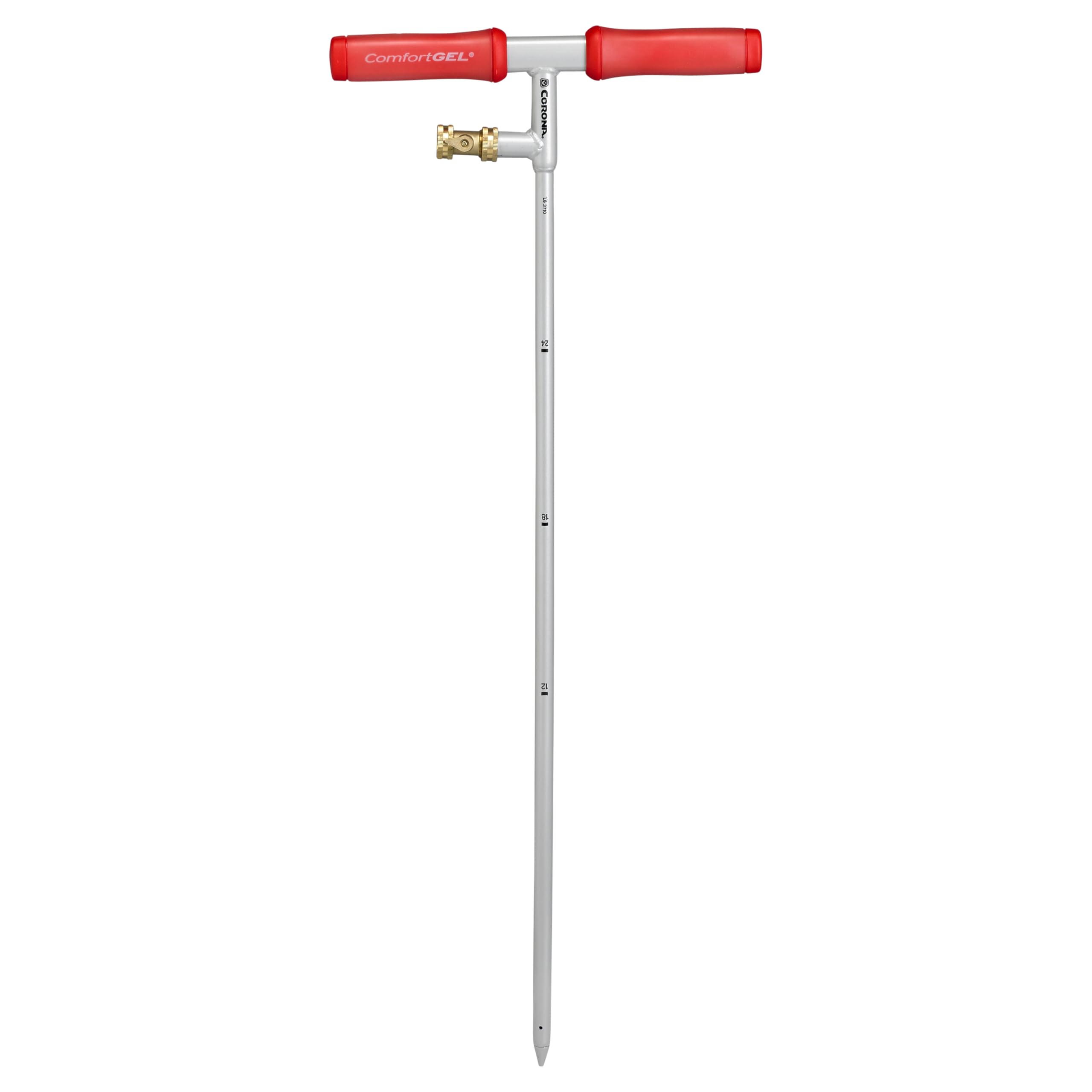
The Corona RootIRRIGATOR takes a different approach — instead of a narrow fertilizer-focused tool, it’s built for high-volume deep watering with a 41-inch total length that reaches deeper than most competitors. The side-outlet design prevents tip clogging, and the shaft includes depth markings so you can gauge insertion depth precisely. The brass hose fitting and comfortable grip handle make it easy to push into the soil, and the unit dispenses water quickly without the restriction of a built-in mixing reservoir.
Owner reports highlight excellent water delivery — the tool can supply a large volume below the surface without surface pooling, making it ideal for drought-stressed mature trees that need deep saturation fast. However, some units have exhibited a fitting issue where the female connector’s inner diameter is slightly too small for standard US hose threads, causing leaks that require grinding the male fitting to fix. The plastic nozzle attachment on some versions is also a known weak point — it’s not threaded and can detach if the tool is dropped.
For pure deep-watering capacity without the complexity of fertilizer mixing, the Corona delivers the most water per minute. Just verify threading compatibility before purchase, and consider adding a separate inline valve for flow control since the tool itself lacks one.
What works
- Longest shaft at 41 inches reaches deeper roots
- Depth markings help gauge insertion consistency
- High water flow rate for fast deep saturation
What doesn’t
- Fitting can leak with some US hose threads
- Plastic nozzle attachment is unthreaded and fragile
- No integrated shut-off valve or fertilizer reservoir
4. Caulimo Deep Root Watering Tool
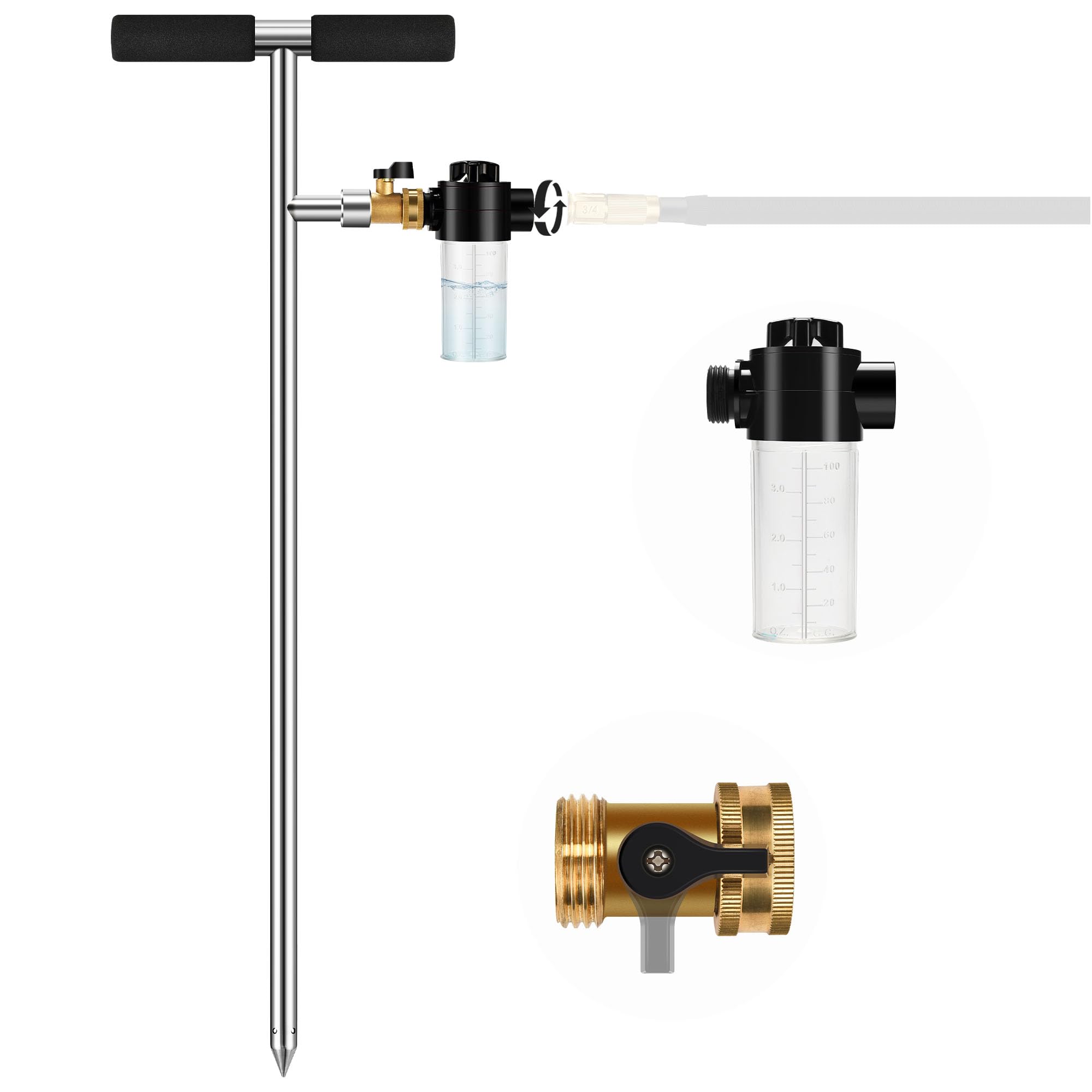
The Caulimo root waterer hits a strong middle ground — it pairs a 32-inch stainless steel probe with four side outlet holes, a solid pointed tip, a brass shut-off valve, and a 3.5-ounce fertilizer bottle. The welded construction feels rigid, and the polished finish resists soil adhesion. The included plumber’s tape and gloves are a thoughtful bonus that indicate attention to assembly experience; the unit took less than five minutes to assemble according to most buyers.
Real-world performance is consistent: the four-directional spray pattern distributes water laterally across the root zone, and the shut-off valve allows flow adjustment from full blast to slow trickle. Several owners noted that the 32-inch length reached the active root zone of struggling maples and revived them within weeks. The weak point is the plastic fertilizer jar, which one owner reported cracking after a few months of use — this is a common trade-off across mid-range feeders that use plastic reservoirs rather than glass or metal.
If you want a single tool that combines stainless steel durability, integrated flow control, and fertilizer delivery at a mid-range price, the Caulimo is a well-executed option. Just handle the plastic jar gently and consider replacing it with a glass equivalent if it fails.
What works
- Four side outlet holes provide even lateral water distribution
- Brass shut-off valve gives precise flow control
- Includes plumber’s tape and gloves for easy assembly
What doesn’t
- Plastic fertilizer jar can crack with prolonged sun exposure
- Two-piece shaft requires assembly and thread sealing
- No included mixing instructions for concentrated fertilizer
5. enomol Stainless Steel Deep Root Tree Watering Tool

The enomol root watering tool is the most budget-friendly stainless steel option on this list, offering a 32-inch two-piece shaft, a brass T-handle shut-off valve, and four exit holes for the water. The stainless steel probe resists interior rust, and the pointed tip is stiff enough to push through mulch and loam without bending. Assembly is straightforward — screw the two halves together with the included PTFE tape, attach a standard garden hose, and begin watering.
Customer feedback is generally positive, with repeated mentions of solid build quality for the price point. The depth markings on the shaft help you gauge insertion depth, and the brass valve provides reliable on/off control. However, the two-piece design introduces a potential leak point if the threads aren’t sealed perfectly, and some users found the tool struggles in extremely compacted or clay-heavy soil — you may need to pre-moisten the ground or use a separate soil probe to create a pilot hole. The lack of a fertilizer bottle means this is a watering-only tool.
For gardeners on a tight budget who still demand stainless steel durability, the enomol delivers respectable performance. Just be prepared for the two-piece thread maintenance and consider it a dedicated deep-watering wand rather than a full feeding system.
What works
- Stainless steel shaft resists rust at a low price point
- Brass T-handle valve for easy on/off control
- Depth markings help with consistent insertion depth
What doesn’t
- Two-piece design can leak if threads aren’t sealed
- No fertilizer reservoir for root feeding
- Struggles in compacted clay without pre-moistening
6. Ross Root Feeder Economy Model #102A

The Ross Root Feeder is a long-standing name in the category, using a proprietary cartridge system (sold separately) that releases fertilizer at the root zone without mixing or measuring. The economy model features an adjustable flow lever that lets you switch between light watering and heavier feeding, and the pointed steel shaft with a pivoting tip is designed for easy penetration in average soil conditions. This is not a stainless steel tool — the shaft is finished steel that will rust over time — but the replaceable cartridge system appeals to gardeners who prefer pre-measured feeding to mixing their own.
Long-term owners swear by the Ross system, some using the same feeder for decades with consistent results. The adjustable lever allows you to feed multiple trees on one side while another unit works elsewhere simultaneously. However, recent production runs have drawn complaints: missing washers cause zero water flow out of the box, the on/off lever can snap after minimal use, and some buyers report the shaft length has been shortened compared to older versions. The cartridge refill cost also adds up over time compared to bulk liquid concentrate.
If you value simplicity and are already invested in the Ross cartridge ecosystem, this economy model is a functional entry point. But inspect all parts immediately upon arrival, and be aware that material quality has declined compared to the brand’s older reputation.
What works
- Pre-measured cartridge system eliminates mixing guesswork
- Adjustable flow lever for light to heavy watering
- Proven 20-year reputation for root zone feeding
What doesn’t
- Shaft is finished steel, not rust-proof stainless
- Missing parts and fragile lever reported in recent batches
- Cartridge refills are an ongoing cost
7. Yard Butler Deep Root Irrigator
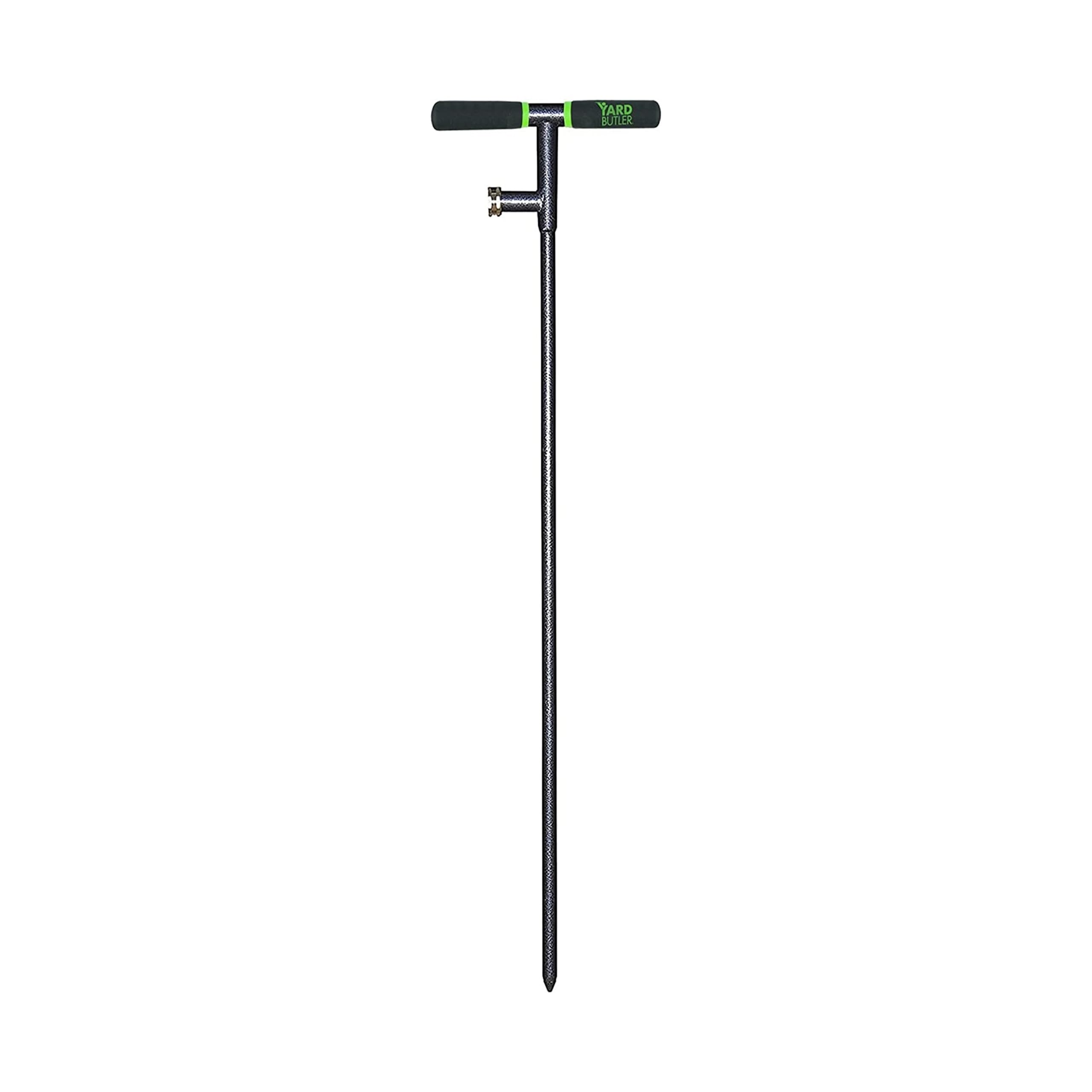
The Yard Butler Irrigator is a lightweight, powder-coated steel alternative that prioritizes portability and ease of insertion over heavy-duty durability. At just 0.75 pounds, it’s the lightest tool in this comparison, and the self-drilling tip is designed to penetrate soil without pre-digging. The green powder coating resists rust to a degree, but it will chip with repeated insertion into hard ground, exposing the underlying steel to corrosion over time.
Owner experiences are mixed: long-time users report the tool lasting over a decade when used in loamy soil and drained after each use, while others note the tip can clog with sand or mud, requiring forceful water pressure to clear. A common workaround is pairing the Yard Butler with a soil probe to pre-drill holes, reducing wear on the tip. The hose attachment requires a wrench to tighten, and without an integrated shut-off valve, you must use a separate inline valve or manage flow at the spigot — leaving the tool in the hole can cause mud blowback when the water is first turned on.
For occasional use in soft, established garden beds, this is a serviceable entry-level irrigator at a budget price. For heavy clay, rocky soil, or daily watering demands, the stainless steel options above will outlast it significantly.
What works
- Lightweight at 0.75 pounds for easy handling
- Self-drilling tip penetrates soft soil without pre-work
- Lifetime warranty on the steel body
What doesn’t
- Powder coating chips in hard soil, leading to rust
- Tip clogs easily in sand or mud
- No integrated shut-off valve; requires inline add-on
Hardware & Specs Guide
Stainless Steel vs. Powder-Coated Steel
Stainless steel shafts resist corrosion indefinitely, even when left in contact with damp soil. The material is also stiffer, allowing the pointed tip to penetrate hardpan and gravel without bending. Powder-coated steel is lighter and cheaper, but every scratch or chip exposes raw metal to moisture, creating rust pits that weaken the shaft over time. For a root feeder that will last a decade or more in consistent use, stainless steel is the only material that justifies the investment.
Side Outlet vs. Single End Outlet
A single hole at the tip is the cheapest design to manufacture, but it clogs after the first push into moist soil because the tip scoops dirt directly into the opening. Side outlet designs — typically four holes drilled 90 degrees apart — release water laterally into the surrounding soil rather than straight down. This pattern distributes moisture across a wider root zone and dramatically reduces clogging because soil is pushed past the side holes rather than forced into them. Every serious root feeder should have side outlets.
Integrated Shut-Off Valve Importance
A brass shut-off valve mounted at the T-handle lets you start water flow slowly while the tip is already inserted underground, preventing a burst of pressure that can create a cavity beneath the soil surface or send a muddy geyser out of the insertion hole. Without this valve, you must manage flow at the hose spigot, which is often out of reach or subject to pressure surges. A good valve meters from a trickle to full flow smoothly, and it also serves as an emergency shut-off if the hose tangles or the tip hits an obstruction.
Fertilizer Reservoir Capacity & Material
Most root feeders that include a fertilizer dispenser use a 3.5-ounce plastic jar that screws onto the T-handle. A larger reservoir requires less frequent refilling but adds weight and leverage that can stress the assembly. Plastic jars are the standard due to cost and weight, but they degrade under UV exposure and can crack in freezing temperatures. Glass or metal reservoirs are rare at this price point but provide better longevity. The dispensing mechanism typically uses a simple flow-diverting valve — turning the jar diverts water through the container to dissolve and carry the concentrate into the shaft.
FAQ
How deep should I insert a tree root feeder for mature trees?
Can I use a root feeder in clay soil without a pilot hole?
What fertilizer can I use with a root feeder without a reservoir?
How often should I deep water established trees with a root feeder?
Final Thoughts: The Verdict
For most gardeners, the tree root feeder system winner is the Varomorus Stainless Steel Deep Root Irrigator because its one-piece stainless steel build eliminates leak points and withstands years of hard soil without bending or rusting. If you want an integrated shut-off valve and a fertilizer dispenser in a single tool, grab the Dack Root Feeder. And for budget-conscious deep watering without the need for fertilizer mixing, nothing beats the value of the enomol Stainless Steel Watering Tool.