
Granular fertilizers scatter across the soil surface, wash away in rain, and often miss the active root zone entirely. Tree fertilizer spikes eliminate that waste by driving nutrition directly into the ground where fine feeder roots actually grow, delivering a slow-release nutrient supply without mixing, measuring, or runoff.
I’m Rikta — the co-founder and writer behind Lawn Gear Lab. I’ve compared NPK ratios, Biozome microbes, and TruSpike durability across dozens of formulations to build a guide based on spec-to-spec analysis and aggregated owner feedback from hundreds of verified plantings.
The most important metric when selecting spikes is the NPK ratio, which determines whether your tree gets balanced foliage growth or targeted root and bloom support. This guide breaks down the best tree fertilizer spikes by formula, spike durability, and application ease so you can feed with confidence.
How To Choose The Best Tree Fertilizer Spikes
Select the right N-P-K formulation and spike construction for your specific trees and local soil conditions.
Match the NPK Ratio to Your Goal
Nitrogen drives leafy top growth and dark green color — look for a high first number (16-4-4 or 15-5-10) for deciduous shade trees like maple, oak, and birch. Phosphorus supports flowering and fruiting — formulas like 8-4-8 or 3-5-5 are better for citrus, apple, and nut trees. Potassium strengthens root systems and drought resistance; spikes with a balanced or elevated third number (15-10-9) benefit established trees in compacted soils.
Assess Spike Durability for Hard Ground
Clay soil and dry summer ground can snap brittle spikes on impact. Look for spikes marketed as “TruSpikes” or non-shatter construction that can be hammered directly into the earth without pre-drilling. Spikes that crumble during installation waste nutrition and effort. If your soil is rocky or heavily compacted, pre-moisten the ground or use a metal rod to create pilot holes before driving the spike.
Count the Spikes per Package Against Your Trees
A single mature tree (6+ inch trunk diameter) typically needs 6 to 12 spikes per feeding — one spike per inch of trunk diameter, spaced evenly along the dripline. Packages of 12 or 15 spikes suit a single large tree or several smaller shrubs. Landscaper packs of 70 spikes cover larger properties or multiple feedings per season. Buying in bulk lowers per-spike cost if you have many trees to feed.
Quick Comparison
On smaller screens, swipe sideways to see the full table.
| Model | Category | Best For | Key Spec | Amazon |
|---|---|---|---|---|
| Jobe’s 16-4-4 (30 ct) | Premium All-Purpose | Deciduous trees & shrubs | 16-4-4 NPK, 30 spikes | Amazon |
| Old Farmer’s Almanac (24 ct) | Natural Ingredient | All trees & shrubs in hard soil | 13-3-3 NPK, non-shater spikes | Amazon |
| Jobe’s Fruit & Citrus (5 ct) | Fruiting Trees | Apple, orange, lemon trees | 9-12-12 NPK, 5 spikes | Amazon |
| Miracle-Gro Trees & Shrubs (12 ct) | Balanced Generalist | Deciduous trees & shrubs | 15-5-10 NPK, 12 spikes | Amazon |
| Jobe’s Organics Fruit & Citrus (6 ct) | Organic Formula | Container & in-ground fruit trees | 3-5-5 NPK, OMRI listed | Amazon |
| SimplyGro Citrus & Fruit (12 ct) | Break-Resistant | Citrus, berry, and nut trees | 8-4-8 NPK, 12 TruSpikes | Amazon |
| Winchester Gardens Landscaper Pack (70 ct) | Bulk Economical | Large properties with many trees | 15-10-9 NPK, 70 spikes | Amazon |
In‑Depth Reviews
1. Jobe’s Tree Fertilizer Spikes, 16-4-4 Time Release Fertilizer for All Shrubs & Trees, 15 Spikes per Package

The 16-4-4 ratio delivers high nitrogen for vigorous leaf growth and deep green color on deciduous trees and shrubs. With 30 spikes per package, this provides enough nutrition for two full feedings of a medium-sized maple or oak, or a one-time feed for multiple smaller ornamentals. The slow-release formulation feeds continuously through the entire growing season without burning roots.
Users report noticeable recovery in drought-stressed trees within a single season, and shrubs like hydrangea and lilac produce stronger blooms when fed annually. The spikes are easy to install — pre-moisten the soil or use a metal rod to create pilot holes in hard ground — and eliminate the mess and runoff of granular fertilizers entirely.
The 16-4-4 formula is not ideal for fruit and citrus trees that require lower nitrogen and higher phosphorus or potassium. Stick to this pack for shade trees, evergreens, and ornamental shrubs where foliage density and color are the primary goals.
What works
- High-nitrogen 16-4-4 drives excellent leaf color and canopy density
- 30 spikes provide heavy coverage for multiple trees and shrubs
- No mixing, measuring, or runoff — spikes feed directly at the root zone
What doesn’t
- Formula too nitrogen-rich for fruit-bearing trees and citrus
- Driving into dry clay soil may require pilot holes to avoid snapping
2. The Old Farmer’s Almanac Tree & Shrub Fertilizer Spikes (Box of 24 Spikes – 6 Lbs)
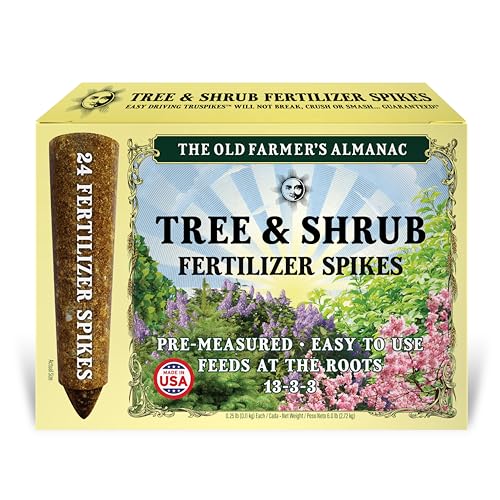
The 13-3-3 formula is balanced with natural ingredients including molasses, which feeds soil microbes and improves root-zone biology. Each 5-inch spike is engineered with TruSpike technology — users confirm these spikes will not break, crush, or shatter when hammered into hard clay, a durability advantage over many competitors.
Box of 24 spikes covers two full feedings (spring and fall) for several mature shrubs or a couple of medium deciduous trees. Owners of Japanese Stewartia and fountain beech trees reported more flowers and leafier canopies after one season. The higher nitrogen content supports both evergreens and deciduous trees effectively.
While the spikes hold up well in clay, some users still found it necessary to pre-dig holes in extremely compacted or rocky soil. The 13-3-3 ratio is a general-purpose blend — acid-loving plants like rhododendrons or blueberries would benefit from a lower-pH specialized formula instead.
What works
- TruSpike design withstands hammering in tough clay without splitting
- Natural molasses ingredients support root-zone microbial activity
- 24 spikes at 6 lbs provide good value for a season of feeding
What doesn’t
- Extremely compacted soil still requires pilot holes for best results
- General-purpose ratio not formulated for acid-loving species
3. Jobe’s 01002 Fertilizer Spikes, Fruit and Citrus, 5 Count, Slow Release

With a 9-12-12 NPK ratio, this spike supplies higher phosphorus and potassium to support blossom development, fruit set, and root strength rather than pushing excessive leafy growth. It works for apple, orange, lemon, grapefruit, mango, and many other fruiting species. The 5-count pack is a budget-friendly entry for a single young tree or for topping up an existing feeding regimen.
Verified owners report that neglected orange trees perked up within two months of spring application, producing noticeably better harvests. The slow-release design distributes nutrients directly at the dripline, eliminating runoff and preventing fertilizer burn. Spikes are easy to insert around each tree’s dripline with no measuring required.
With only 5 spikes per package, a large mature tree may need two boxes for proper feeding — space spikes 12–18 inches apart around the dripline. This pack is ideal for a single small to medium tree rather than a full orchard or multiple large specimens.
What works
- High phosphorus/potassium ratio tailored for fruiting and flowering trees
- Slow-release formulation feeds for months without burning roots
- No mess — spikes go directly into the soil with zero runoff
What doesn’t
- 5 spikes only cover one young-to-medium tree per feeding
- Low nitrogen may not green up foliage as quickly as a balanced blend
4. SimplyGro Fertilizer Spikes for Citrus & Fruit Trees & Shrubs (12 Spikes – 3.0 Lbs)
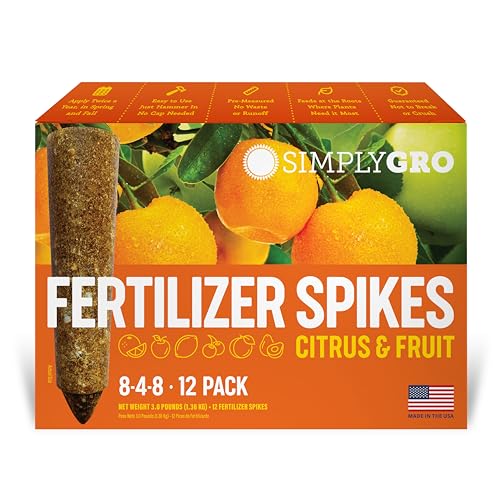
The 8-4-8 formula balances moderate nitrogen with elevated potassium to support fruit production and root development in citrus, berry, nut, and decorative trees. Each 5-inch spike is a patented TruSpike — guaranteed not to break, crush, or smash during installation, eliminating the frustration of crumbly spikes that waste nutrition before they reach the root zone.
Owners of apple, peach, and avocado trees reported fast, healthy growth and heavy fruit set after spring application. The slow-release feeding lasts up to 3 months, so a twice-yearly schedule (spring and fall) provides continuous nutrition. The 12-spike box offers strong value for feeding several medium trees or a single larger specimen with proper spacing.
Some users noted that while the spikes themselves are durable, the packaging could include clearer spacing guidelines for different trunk diameters. As with any spike, pre-wetting the soil simplifies installation in dry or compacted ground.
What works
- Non-shatter TruSpikes withstand hammering into tough soil
- Elevated potassium (8-4-8) supports fruiting and root strength
- 12 spikes cover multiple trees or shrubs per feeding season
What doesn’t
- Spacing instructions could be more detailed for trunk-diameter sizing
- Dry soil still requires pre-moistening for smooth installation
5. Miracle-Gro Fertilizer Spikes for Trees and Shrubs, 12 Pack

With a 15-5-10 NPK ratio, this spike provides high nitrogen for lush foliage and balanced potassium for root and stress tolerance. It’s formulated specifically for all deciduous trees and shrubs, making it a versatile choice for general landscape feeding. The two-feeding-per-year schedule (spring and fall) aligns with natural growth cycles and simplifies planning.
Verified owners report that shrubs with yellowing leaves regained color and maintained it through Texas summer heat after a single application. The nutrients release directly into the root zone, preventing the wasteful runoff common with surface-applied granules. Twelve spikes fit a typical suburban yard with a few mature trees and foundation shrubs.
This product is not sold in Pinellas County, Florida, due to local fertilizer regulations. Each spike is formulated for seasonal feeding — do not exceed the recommended application frequency to avoid over-fertilizing.
What works
- 15-5-10 formula corrects yellowing leaves and sustains summer color
- Seasonal spring/fall schedule is simple to maintain
- Root-zone delivery avoids runoff and environmental waste
What doesn’t
- Not available in Pinellas County, FL due to local ordinances
- 12 spikes may not be enough for larger properties with many trees
6. Jobe’s Organics Fruit & Citrus Tree Fertilizer Spikes, 3-5-5 Time Release, 6 Spikes per Package

The 3-5-5 NPK ratio is deliberately low in nitrogen and high in phosphorus and potassium, making it ideal for flowering and fruit production in container citrus, in-ground trees, and indoor fruit plants. Jobe’s Biozome — a proprietary blend of beneficial microorganisms including archaea — aggressively breaks down organic material, improving soil structure and helping trees resist disease, insects, and drought stress throughout the growing season.
OMRI-listed for organic gardening, these spikes contain no synthetic chemicals and are safe for use around children and pets. Owners of potted Meyer lemon trees reported abundant, juicy fruit production year after year. The 6-spike package suits a single container tree or a small in-ground tree — users report visible growth improvement when spikes are placed correctly along the dripline rather than too close to the trunk.
The low nitrogen content means these spikes will not produce the dramatic green foliage response that higher-nitrogen formulas deliver. If your fruit tree also needs leaf density, consider supplementing with a nitrogen source, or use a balanced organic fertilizer instead.
What works
- OMRI-certified organic formula with no synthetic chemicals
- Biozome microbes improve soil biology and drought tolerance
- Low-nitrogen 3-5-5 ratio targets blooms and fruit set
What doesn’t
- 6 spikes only cover one container tree or very small in-ground tree
- Low nitrogen won’t significantly green up yellowing foliage
7. Winchester Gardens Landscaper Pack Tree and Shrub Fertilizer Spikes, 15-10-9, 70 Spikes/Case

The 15-10-9 ratio delivers high nitrogen for canopy growth and solid potassium levels for root and stress support, formulated for deciduous trees like maple, beech, birch, oak, elm, and willow. With 70 spikes per case, this is the most economical option for landowners with extensive tree plantings. The pre-measured dosage eliminates waste and over-fertilization risk.
Users with half-acre properties and dozens of young trees report that these spikes eliminated the labor of removing mulch to apply granular fertilizer — they punch a hole with a pry bar, drop the spike, and cover it. Slow-release feeding lasts up to 6 months, reducing applications to spring and fall. Owners of 45-year-old sunburst locust trees saw tremendous new foliage growth after 20+ years of consistent use.
The plastic driving caps included in the case are reported as brittle, breaking too easily before all spikes are installed. Some users recommend pre-drilling holes with a metal rod for the toughest soil rather than relying on the caps. The spikes themselves are otherwise well-regarded for performance and value.
What works
- 70 spikes per case offers the lowest per-spike cost for large jobs
- 15-10-9 formula supports foliage, fruiting, and root health
- Direct root-zone feeding saves labor vs. granular alternatives
What doesn’t
- Included plastic driving caps often crack before finishing the job
- Heavy case (18 lbs) may be more than small-yard owners need
Hardware & Specs Guide
NPK Ratio — The Nutrient Triangle
The three numbers on a fertilizer label represent Nitrogen (N), Phosphorus (P), and Potassium (K) by percentage weight. Nitrogen fuels leaf and stem growth — choose ratios with a high first number (15-16 range) for shade trees and evergreens. Phosphorus drives flowers and fruit — look for elevated middle numbers (5-12 range) for citrus, apples, and berries. Potassium strengthens root systems and overall plant resilience — high third numbers (9-12 range) benefit trees in poor soil or drought-prone zones. Spikes with balanced or low N and higher P/K (like 3-5-5 or 8-4-8) are designed specifically for fruiting trees.
Spike Material and Durability
Standard fertilizer spikes are compressed mineral salts that can crumble when hammered into dry clay or rocky soil. TruSpike and non-shatter construction uses denser compression or binding agents so the spike stays intact during installation. This matters because a broken spike delivers uneven nutrition — fragments near the surface may dissolve too fast while deeper sections never reach active roots. If your soil is heavy clay or has a hardpan layer, opt for spikes explicitly marketed as break-resistant and pre-moisten the ground or use a metal rod to create pilot holes before installation.
FAQ
How far from the trunk should I hammer tree fertilizer spikes?
Can I use citrus tree spikes on other fruit trees like apple or peach?
Why do my fertilizer spikes keep breaking when I hammer them into clay soil?
Final Thoughts: The Verdict
For most gardeners, the tree fertilizer spikes winner is the Jobe’s Tree Fertilizer Spikes 16-4-4 30 Count because the high nitrogen ratio creates visible canopy density and color on deciduous trees and shrubs, and the 30-spike count covers multiple feedings at a mid-range investment. If you need break-resistant spikes for hard clay soil, grab the Old Farmer’s Almanac 24-pack. And for covering a property with dozens of young trees at the lowest per-spike cost, nothing beats the Winchester Gardens Landscaper Pack 70-count.