
Specs are compiled from manufacturer listings and verified buyer reviews and can change over time — please confirm the key details on the product page before buying.
A tree cutting axe needs to do one thing well — sink deep and come out swinging. Too heavy and you tire out in ten minutes. Too light and every swing bounces off without a real bite. The right one feels like an extension of your arm, transferring all your energy straight through the blade and into the wood. You don’t want to be guessing about steel quality or handle grain while you are halfway through a cord of firewood.
I’m Rikta — the founder and writer behind Lawn Gear Lab. This guide is built by comparing the manufacturers’ published specifications and the patterns across verified customer reviews, so you get each pick’s real strengths and trade-offs instead of marketing spin.
The handful of axes here range from budget-friendly to premium — and each one earns its spot for a different reason. We break down weight, steel type, handle feel, and the kinds of real-world feedback that separate a tool you will reach for year after year from one you will hang on the wall. This is the field-tested guide to finding the best tree cutting axe for your specific needs.
Our Picks at a Glance

How To Choose The Best Tree Cutting Axe
An axe is a simple tool — a steel head on a wooden or composite handle — but the details in that simplicity change everything about how it cuts, how it feels, and how long it lasts. Here is what separates a great tree cutting axe from a frustrating one, based on what matters most in actual use.
Head weight and what it does for you
Head weight determines how much force each swing delivers without you having to swing harder. Lighter heads (around 2.5 pounds) let you swing faster and with more control, which is ideal for limbing or cutting smaller trees. Heavier heads (closer to 3.5 pounds) drive deeper into larger logs but tire your arms out faster. There is no “perfect” weight — it depends on the wood you cut and how long you plan to swing. For general tree cutting, a head weight between 2.5 and 3 pounds is a solid starting point.
Handle material and grain orientation
The handle is the part you actually connect with, and its material matters for shock absorption and durability. Hickory is the classic choice because it absorbs vibration well and can be re-hung if the head loosens. Cheaper wood or poor grain orientation — where the wood grain runs across the handle instead of straight down its length — leads to handles snapping under heavy use. You want a handle where the grain runs parallel to the axe head’s cutting edge for maximum strength.
Steel type and edge geometry
Carbon steel (C50 grade is common in German axes) holds a sharp edge well and is easy to sharpen in the field. Alloy steel can be tougher but is harder to re-profile if you chip it. The edge geometry matters just as much as the steel. A convex edge — where the blade curves outward like a shallow dome — slices into wood and self-releases better than a flat grind. A good convex edge reduces friction so the blade doesn’t get stuck.
Quick Comparison
| Model | Best For | Head Weight | Total Weight | Handle Material | Amazon |
|---|---|---|---|---|---|
| Fiskars 28″ Chopping Axe★ Best Overall | All-purpose chopping, kindling | — | 3.5 lb | Steel / Wood | Amazon |
| 1844 Helko Werk Hessen WoodworkerAlso Great | Serious felling, traditional cutting | 2-3/4 lb | 4 lb | Grade A Hickory | Amazon |
| Gransfors Bruks Scandinavian Forest Axe | Backpacking, limbing, precision | 2.6 lb | 2.6 lb | Hickory | Amazon |
| 1844 Helko Werk Scout Light Felling Camping Axe | Base camp, longer excursions | 2.5 lb | 3-3/4 lb | Grade A Hickory | Amazon |
| GEDORE OX 620 H-1257 Multipurpose Forestry Axe | Heavy splitting, hard use | 1250 Grams | 2.1 kg | Hickory / Steel | Amazon |
In‑Depth Reviews
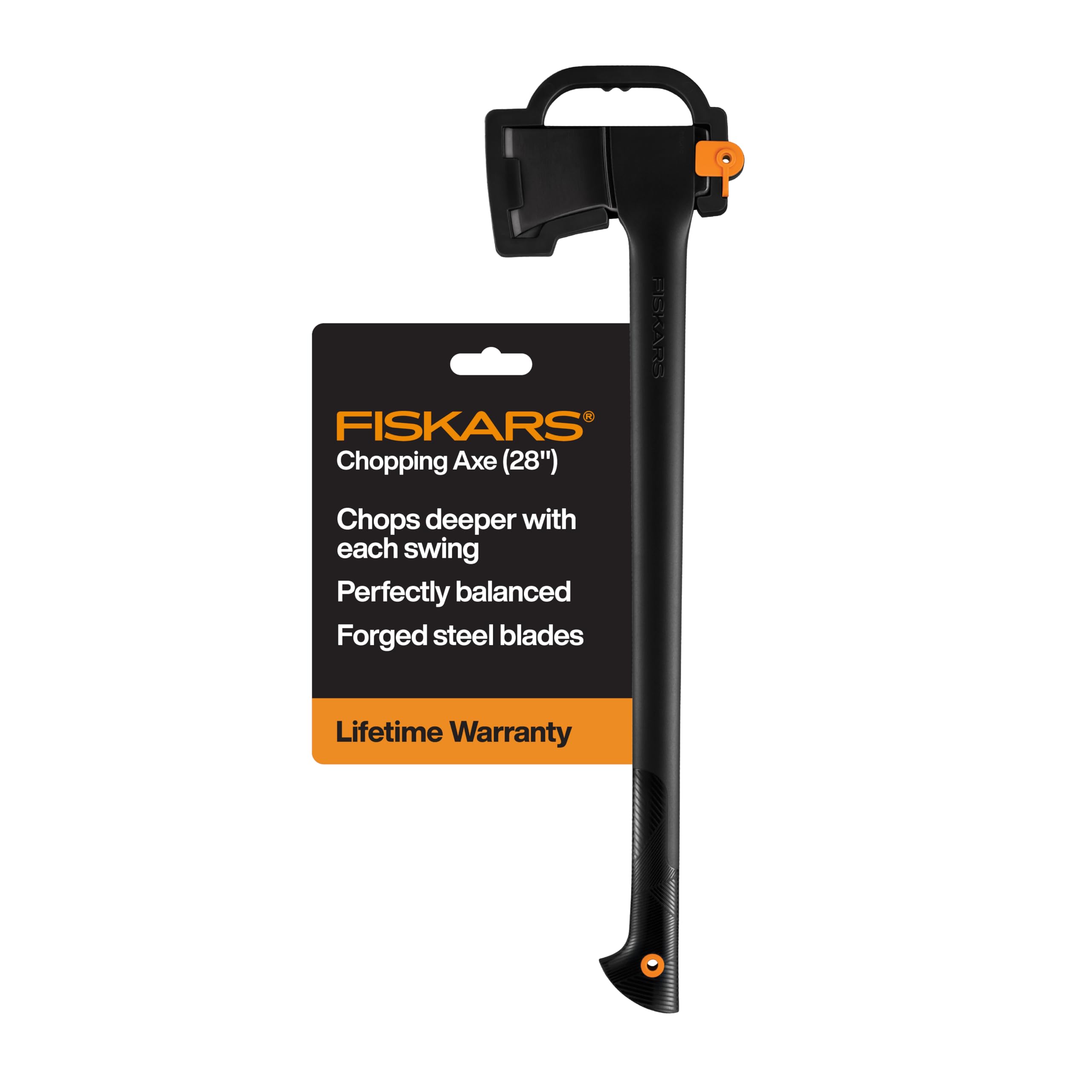
1. Fiskars 28″ Chopping Axe, Ultra-Sharp Blade
Our pick — over 4.5★ from 850+ verified ratings; the strongest balance of quality and price.
An ultra-sharp, precision-balanced axe that owners mention “slices through wood with ease” — no tuning required.
Fiskars brings a different approach compared to the traditional wooden-handled axes above. This 28-inch chopping axe has a steel handle core with a textured grip overmold, so there is zero risk of the head loosening or the handle cracking at the eye. The head is alloy steel with a non-stick, low-friction coating that reduces drag, and buyers consistently mention the blade is extremely sharp from the start. One reviewer summed it up: “The ultra-sharp blade makes quick and easy work of kindling and smaller logs – it truly slices through wood with ease.”
The total weight is 3.5 pounds, but it feels lighter because the weight is balanced right behind the blade. That balance lets you swing faster with less fatigue — one owner who also owns the Fiskars X25 splitting axe noted the 28″ feels more comfortable for short swings, even at 5’10”. The low-friction coating also does its job: the blade does not get wedged in the cut as often, so your work flow stays smooth. It comes with a lifetime warranty, which removes any hesitation about durability.
If you want a tool that works immediately from the start with no sharpening, sanding, or oiling, this is your pick. It is a design that prioritizes convenience and consistency over tradition. The trade-off is that the handle is not replaceable like a traditional wooden handle — when the blade dulls past resharpening, the whole axe is done.
Why it works
- Ultra-sharp alloy steel blade right from the start — no tuning needed
- Low-friction coating prevents sticking in the cut
- Balanced design at 3.5 lb reduces swing fatigue
The catch
- Handle is not replaceable — tool is sealed at the factory
- Not the best for heavy felling of large-diameter trees (prefers kindling and smaller logs)
Grab this if: You want a ready-to-work axe with no setup time — perfect for campsite prep, backyard cleanup, and chopping kindling.
Look elsewhere if: You need a traditional tool with a replaceable wooden handle and plan to fell large trees regularly.
2. 1844 Helko Werk Germany Traditional Hessen Woodworker Felling Axe
A hand-forged German cutting axe that outperforms most American felling axes at pure wood removal.
This is the tool you reach for when you need to drop trees up to 9-10 inches and you want the cut to be clean and efficient. The 2-3/4 lb Rheinland pattern head has a sharp, slim, wide-bit blade that slices through wood with less effort than a standard felling axe. Buyers report the forge finish is world-class — no grinding marks or paint, just polished steel ready to work. The Grade A American hickory handle is sanded to 150 grit and finished with boiled linseed oil, so your hands feel the wood grain rather than a varnish coating.
One reviewer noted the edge was sharp on arrival but needed a light grind to re-profile the shoulder for their standards. That is not unusual for a premium hand-forged axe — the convex edge geometry is there, but some users prefer to dial in the bevel themselves. The included full-grain leather sheath and a 1 oz bottle of Axe Guard protective oil mean you have everything to store it properly from day one. At 28 inches long and a total weight of 4 lb, this is not a light camp axe; it is a serious forest tool that demands respect and a bit of skill.
Compared to the Gransfors Bruks below, the Hessen Woodworker has a heavier head (2-3/4 lb vs. 2.6 lb) and a longer handle (28″ vs. 25″), giving it more torque for larger diameter wood. The steel is C50 high carbon at 53-56 HRC — hard enough to hold an edge well, soft enough to sharpen on a stone in the field. If you want a single axe that can handle years of felling and cutting work without complaint, this is the one.
What stands out
- Hand-forged C50 carbon steel head with convex edge for clean cuts
- Grade A hickory handle with perfect grain orientation — buyers call it “first class quality”
- Includes premium leather sheath and protective oil
What to consider
- Edge may need a light re-profile from the start for some users
- Not recommended for splitting — this is a pure cutting/felling axe
The serious cutter: If you are felling trees up to 10 inches and value clean cuts over brute force, this German-made axe outperforms almost everything in its weight class.
A note on skill: This is not a beginner’s tool — it rewards proper technique and demands you keep the edge dialed in.
3. Gransfors Bruks Scandinavian Forest Axe 25 Inch

A Swedish forest axe that delivers surgical precision in a 25-inch package, ideal for limbing and smaller felling tasks.
Gransfors Bruks has a reputation as one of the finest axe manufacturers in the world, and the Scandinavian Forest Axe lives up to it. The head weighs 2.6 pounds and sits on a 25-inch hickory handle, making it shorter and lighter than the Helko options above. That shorter length gives you more control for limbing and bucking in tight spaces, and it packs down small enough for backpacking trips. The sheath is vegetable-tanned leather, and the axe comes with the original Gransfors Axebook — a small guide that walks you through sharpening and care.
One reviewer who uses this axe in Alaska — where the trees are similar to the Swedish forests this axe was designed for — said it is “perfect for what I use it for” and emphasized that too much weight leads to inaccuracy. Multiple buyers mention the handle grain orientation is excellent, though the blade and poll come a bit rough from the factory. Many owners lightly sand and apply their own linseed oil, which transforms the hickory into a showpiece. The steel is easy to sharpen and holds an edge well, though some users found the factory edge needed a touch-up to reach true sharpness.
This axe is shorter than the Fiskars (25″ vs 28″) and lighter than the Helko Hessen (2.6 lbs vs 2-3/4 lbs), so it swings faster and with less momentum. That makes it less efficient for full-size felling but much better for limbing and processing downed trees. It comes with a twenty-year guarantee, and owners routinely describe it as a lifetime tool worth passing down.
What makes it special
- Perfectly balanced 25″ design for precision limbing and controlled cuts
- Twenty-year guarantee from one of Sweden’s most respected axe makers
- Includes leather sheath and illustrated care book
Keep in mind
- Factory finish is intentionally rough — expect to sand and oil the handle
- Shorter handle means less leverage for large-diameter felling compared to a 28″ axe
For the precision cutter: If your work involves limbing, bucking, and felling small to medium trees — and you value control over raw power — this is the best tool in its class.
A small warning: This is not a grab-and-go axe; it requires some initial tuning and regular care to keep it at its best.
4. 1844 Helko Werk Germany Classic Scout Light Felling Camping Axe

A hand-forged German “boy’s axe” that one buyer used to split 1/3 of a cord of ash in a single day.
The Scout is the smallest full-size axe in Helko’s Classic line, but do not let the modest head weight fool you. At 2.5 pounds on a 28-inch handle, it is light enough for comfortable all-day use but has enough length to generate real swing speed. The head is open-face drop forged from German C50 high carbon steel (53-56 HRC) with a polished Classic finish that reduces cutting friction and helps prevent rust. One buyer mentioned: “I split about 1/3 of a cord of ash with this axe the day i got it and i’m very impressed.”
The handle is sustainably sourced Grade A American hickory, sanded to 150 grit and finished with boiled linseed oil. Reviewers consistently praise the grain orientation as perfectly straight, which is a strong indicator the handle will last. The included full-grain leather sheath and 1 oz Axe Guard oil round out the package. At 28 inches long with a gentle 3.75-inch width, it is compact enough to stow in a canoe, raft, or vehicle for base-camp use — though it is slightly too large for ultralight backpacking.
Compared to the Helko Hessen above, the Scout has a lighter head (2.5 lb vs 2-3/4 lb) on the same 28-inch handle. That makes it swing faster but with less inertia on impact. It is a better choice for mixed work — splitting smaller logs, limbing, and camp chores — while the Hessen is dedicated to pure felling. The head is also narrower at 3.75 inches compared to the Hessen’s 7-inch width, giving it a more precise, controlled cut profile.
What works
- Light 2.5 lb head on a 28″ handle — fast swinging and easy to control
- Hand-forged C50 steel with polished finish and convex edge
- Includes premium leather sheath and protective oil
Considerations
- Not for backpacking — better suited for base camp or vehicle-stored use
- Lighter head means less splitting power on large rounds compared to a heavier axe
All-rounder for camp and light work: If you split firewood at base camp and want a well-balanced tool that won’t wear you out, this German-made axe delivers exactly that.
One limitation: If your primary task is felling large trees, the heavier Hessen above is a better match.
5. GEDORE OX 620 H-1257 Multipurpose Forestry Axe with ROTBAND-Plus
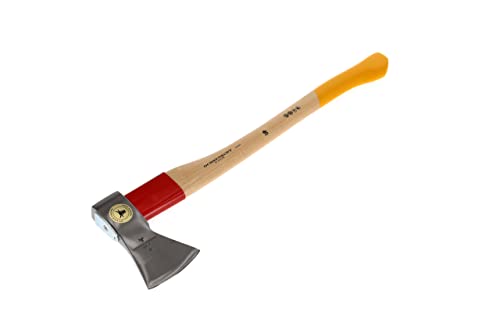
A heavy, German-made forestry axe with a steel sleeve that protects the handle when you miss your target.
The GEDORE OX 620 is built for serious splitting and hard outdoor use, not for delicate limbing or precision felling. Its head weighs 1250 grams (about 2.75 pounds), and the total weight comes in at 2.1 kilograms (roughly 4.6 pounds), making it noticeably heavier than any other axe here — 2.1 kg vs 3-3/4 lb for the Helko Scout (a significant gap). The ROTBAND-Plus technology bonds the handle and hammerhead into one unit for safety, and a steel handle sleeve protects the hickory wood from damage on over-strikes.
Buyers describe it as “great weight and balance, top-notch craftsmanship,” and professional arborists praise its ability to flip easily for wedge work. The fine-polished axe head with blade protection and high-quality hickory handle give it a serious, industrial feel. However, several customers note the factory sheath is flimsy — one called it “garbage” — and the edge requires sharpening from the start. One experienced user mentioned the Rotband fit was poor on their unit, and the haft (handle) was clunky and needed sanding.
This axe is best for the user who understands that premium tools often need tuning. It is a heavy hitter, closer to a splitting maul than a felling axe, and it performs best when you need to dismantle firewood rounds and process large logs. It is also the shortest of the group at just 10.63 inches long compared to the Helko Scout at 28 inches, making it more of a compact, heavy-handling tool for close work rather than a full-swing felling axe.
What it delivers
- Heavy 1250g head with steel sleeve for handle protection on mis-hits
- ROTBAND-Plus bonded head-to-handle connection for added safety
- Built for professional arborist-level splitting and chopping
Things to know
- Requires significant tuning — edge sharpening and paint removal from the start
- Flimsy factory sheath and some reports of poor Rotband fit
- Very heavy at 4.6 lbs total — tiring for extended sessions
For the dedicated woodworker: If you split firewood as a primary task and are comfortable tuning a high-quality tool, this German axe has the heft and steel to last a lifetime.
skip it if: You want an out-of-the-box tool or need an axe for limbing and felling — this is a specialist’s heavy splitter, not a general-purpose cutter.
Understanding the Specs
Head Weight and Total Weight
Head weight is the mass of the steel head alone — it is what determines how much force your swing generates. A 2.5-pound head swings fast and is good for limbing; a 3-pound head bites deeper into larger logs. Total weight includes the handle and tells you how much you will carry. A lighter total weight (under 3 pounds) means less fatigue over a long day. A heavier total weight (over 4 pounds) packs more punch but tires your arms faster. The right balance depends on your primary use — felling, splitting, or camp chores.
Handle Material and Handle Length
Hickory handles absorb shock well and can be replaced if the head loosens. Grain orientation is critical — straight grain running parallel to the cutting edge resists snapping. Longer handles (24-28 inches) give you more arc for a powerful swing, while shorter handles (16-20 inches) give you more control in tight spaces. Steel-handled axes like the Fiskars eliminate the risk of a cracked eye but cannot be re-hung. The handle length must match your height and the type of work you plan to do.
FAQ
What head weight is best for cutting down trees?
How do I know if a wooden axe handle has good grain orientation?
Is an alloy steel axe better than carbon steel for tree cutting?
What does a convex edge grind do for an axe?
Can I use a tree cutting axe to split firewood?
How short is too short for an axe handle?
Should I oil a new wooden axe handle?
How does the Fiskars composite handle compare to a hickory handle?
What does ROTBAND-Plus mean on the GEDORE axe?
Why do some axes come dull from the factory?
Final Thoughts: The Verdict
For most people, the tree cutting axe winner is the Fiskars 28″ Chopping Axe, Ultra-Sharp Blade because it offers an ultra-sharp blade, balanced design that reduces fatigue, and a lifetime warranty. If you want a ready-to-work tool with no sharpening or tuning, grab the Fiskars 28″ Chopping Axe. And for precision limbing and controlled cuts in a portable package, the standout is the Gransfors Bruks Scandinavian Forest Axe.
How We Picked
We do not accept paid placement. Every pick is matched to a real buyer and a real use-case; we do not hands-on test units.
Sources & Methodology
Specifications: manufacturer listings and product documentation. Review insights: verified customer reviews, as of July 2026. Pricing: not shown on this page (it changes often); check the current price via the retailer link.
As an Amazon Associate, Lawn Gear Lab earns from qualifying purchases. This does not affect which products we feature.