
Brown patches, dollar spots, and powdery mildew can turn a lush lawn into a patchy eyesore in a matter of days.
I’m Rikta — the co-founder and writer behind Lawn Gear Lab. I’ve compared the active ingredients, application methods, and coverage areas of dozens of fungicides to separate the curative heavyweights from the preventative also-rans.
This guide highlights the most effective treatment for lawn fungus options available, from systemic concentrates to dual-action granular formulas that both feed and protect turf.
How To Choose The Best Treatment For Lawn Fungus
Selecting the right fungicide starts with accurate disease identification and understanding the product’s active ingredient, application method, and coverage. A broad-spectrum approach works well for multiple diseases, but the most effective treatment targets the specific pathogen.
Active Ingredient: Systemic vs. Contact
Systemic fungicides like Propiconazole and Myclobutanil move through the plant tissue, protecting new growth from the inside out. These are ideal for curative control of established diseases like brown patch and dollar spot. Contact fungicides, such as Chlorothalonil, sit on the leaf surface and prevent spore germination but do not cure existing infections. For ongoing suppression, a rotational schedule using both classes is recommended.
Formulation: Liquid Concentrate vs. Granular
Liquid concentrates offer precise mixing ratios and are applied via a hose-end or pump sprayer for even, thorough coverage. Granular formulas, like the Scotts Turf Builder Healthy Plus, combine fertilizer with fungicide for a dual-action approach — feeding the lawn while suppressing disease. Granules are convenient for large, open lawns but take longer to break down in cool, dry conditions.
Spectrum of Control and Resistance Management
A product labeled for a wide range of diseases — covering brown patch, leaf spot, powdery mildew, rust, and anthracnose — provides a safety net when the exact pathogen is unclear. However, relying on a single mode of action year after year can breed resistance. The most effective treatment plan alternates between fungicides with different FRAC codes (fungicide resistance action committee groups). Propiconazole (Group 3) and Azoxystrobin (Group 11) are a common rotation pair for warm-season grasses.
Quick Comparison
On smaller screens, swipe sideways to see the full table.
| Model | Category | Best For | Key Spec | Amazon |
|---|---|---|---|---|
| Quali-Pro Propiconazole 14.3 | Systemic Concentrate | Curative brown patch & dollar spot | Propiconazole 14.3%; 32oz treats up to 32,000 sq ft | Amazon |
| Dow Eagle 20EW | Systemic Emulsion | Powdery mildew & rust on ornamentals | Myclobutanil 19.7%; 16oz makes ~128 gal spray | Amazon |
| Scotts Turf Builder Healthy Plus | Granular 2-in-1 | Preventative disease + feeding | Systemic fungicide + fertilizer; 13.7 lbs covers 4,000 sq ft | Amazon |
| Fertilome Triple Action | Neem Oil Spray | Vegetable & fruit tree protection | Neem oil; 32oz RTS covers ~300 sq ft | Amazon |
| Monterey Complete Disease Control | OMRI Organic | Organic garden disease prevention | Bacillus amyloliquefaciens; 16oz concentrate | Amazon |
| Select Source Propiconazole 14.3 | Economic Concentrate | Budget-friendly broad-spectrum | Propiconazole 14.3%; 16oz treats ~16,000 sq ft | Amazon |
| Fertilome Liquid Systemic Fungicide | RTU Systemic | Immediate spot treatment | Ready-to-use; 32oz bottle with sprayer | Amazon |
In‑Depth Reviews
1. Quali-Pro Propiconazole 14.3 Fungicide

The Quali-Pro Propiconazole 14.3 delivers agricultural-grade active ingredient in a microemulsion formulation that offers less odor and better tank stability than standard emulsifiable concentrates. At a 14.3 percent concentration, this 32-ounce bottle provides economical coverage for up to 32,000 square feet of turf, making it one of the highest-value systemic options per square foot. The locally systemic mode of action means the fungicide moves within the leaf blade to protect emerging growth, which is critical for stopping diseases like summer patch and zoysia patch before they spread.
Customer reports confirm its effectiveness against brown patch on Bermuda and St. Augustine grass — one user saw significant recovery within one month after two applications spaced 14 days apart. The product also proved successful against orange rust on blackberry bushes after three diluted sprays, showing its versatility beyond turf. Users warn that application during extreme heat can stress the lawn, and proper PPE — respirator, goggles, gloves — is non-negotiable when mixing concentrates at this strength.
For a comprehensive lawn program, Quali-Pro pairs well with a Group 11 fungicide like Azoxystrobin to rotate modes of action and prevent pathogen resistance. The 32-ounce bottle can last the average homeowner four to five years if used only for spot treatments, but even for full-lawn curative sprays, the cost per treatment remains well below most big-box granular products.
What works
- High-concentration 14.3% propiconazole treats large areas economically
- Microemulsion reduces odor and improves tank mix compatibility
- Broad label covers 15+ turf diseases including brown patch, dollar spot, and snow molds
What doesn’t
- Requires careful mixing and full PPE — not a simple spray-and-go
- Can cause turf burn if applied during temperatures above 90°F
2. Dow Eagle 20EW Fungicide

The Dow AgroSciences Eagle 20EW is a premium systemic fungicide formulated with 19.7 percent Myclobutanil, a sterol-inhibitor (FRAC Group 3) that works from the inside out to protect new foliage. Its label covers more than 15 diseases including powdery mildew, rusts, anthracnose, spring dead spot, and zonate leaf spot — making it one of the broadest-spectrum ornamental and turf products available to homeowners. The emulsifiable concentrate mixes easily with water and is well tolerated by popular turf species like Zoysia, Bermuda, and Fescue, as well as stone fruits, apples, and grapes.
User feedback highlights its effectiveness against stubborn powdery mildew that resisted copper-based sprays, with one reviewer calling it a “life-saving” treatment for plants in zone 7. A Connecticut user reported that two applications spaced 30 days apart completely eliminated clover and dandelions in Zoysia grass. The product is strong enough for use in tree injection systems — one reviewer successfully mixed it with imidacloprid and liquid fertilizer to treat a 66-inch girth red oak, though this use falls outside the standard label.
The 16-ounce bottle produces approximately 128 gallons of finished spray at typical rates, so even serious gardeners will find it lasts multiple seasons. The main drawbacks are the need for precise measuring — conversion from ounces per acre to ounces per gallon requires attention — and the mandatory use of PPE, including a respirator, when mixing at full strength. Eagle 20EW is a specialist tool for high-value ornamentals and turf where standard fungicides have failed.
What works
- Exceptional curative power against powdery mildew and rust that resist contact products
- Systemic action protects new growth for weeks after application
- Label covers turf, ornamentals, fruit trees, and grapes
What doesn’t
- Mixing ratios are complex (oz/acre/100 gal) — not beginner-friendly
- Very strong concentrate requires full PPE and careful handling
3. Scotts Turf Builder Healthy Plus Lawn Food

The Scotts Turf Builder Healthy Plus Lawn Food bundles a broad-spectrum systemic fungicide with a nitrogen-rich fertilizer in a single granular bag. The 13.7-pound bag covers 4,000 square feet and controls 27 listed diseases including brown patch, leafspot, powdery mildew, and red thread. This dual-action approach lets you feed the lawn while applying preventative disease control — reducing the number of trips across the yard during the stressful summer months when fungal pressure peaks.
User reviews confirm that the product not only stops active fungus but also noticeably improves grass color and thickness. One reviewer who switched from Scotts Disease-X reported that the Healthy Plus formula “made the grass look so green and healthy, the fungus was gone, and my clover infestation reduced dramatically.” The granular form is ideal for homeowners who prefer a fertilizer spreader over a hose-end sprayer, especially on large, open lawns where liquid application is tedious.
There are two important caveats. First, over-application can burn the grass — the nitrogen load requires careful adherence to spreader settings. Second, the bags are prone to tearing during shipping, with multiple reviewers reporting small holes and spillage. Despite the packaging issue, the formula itself is well-regarded for warm-season grasses, and using it once or twice per year during early summer provides a solid foundation for a disease-free lawn.
What works
- Combines fungicide and fertilizer in one easy granular application
- Controls 27 diseases while feeding the lawn
- Works well on all grass types including Bermuda, Fescue, and St. Augustine
What doesn’t
- Granules can burn grass if over-applied or not watered in immediately
- Bags frequently arrive torn, causing product leakage during delivery
4. Fertilome Triple Action Insecticide/Miticide/Fungicide
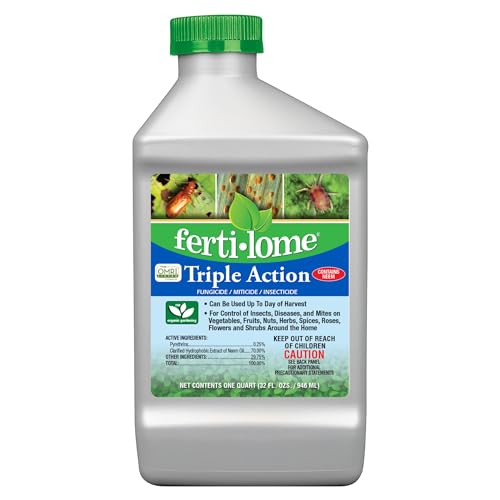
Fertilome Triple Action leverages neem oil as its sole active ingredient, targeting soft-bodied insects (aphids, spider mites, leafminers) while also preventing powdery mildew, rust, and leaf spot. The 32-ounce ready-to-use spray bottle attaches directly to a garden hose for quick coverage of fruit trees, vegetables, roses, and shrubs. Neem oil works through suffocation and antifeedant effects, making it a low-toxicity option for edible gardens — though it does not provide the rapid curative punch of synthetic systemic fungicides.
Long-time users report consistent protection on apple trees and general orchard maintenance, though one reviewer noted the price has climbed noticeably in recent years. The product is labeled for 7-to-14-day reapplication, which means it works best as a preventative schedule rather than a rescue treatment for advanced lawn fungus. Gardeners with integrated pest management (IPM) programs appreciate that neem oil breaks down quickly in the environment, though it can harm pollinators if sprayed directly on open blooms.
The ready-to-use format eliminates mixing errors, but the coverage area is limited compared to concentrates — a 32-ounce bottle covers roughly 300 square feet of dense foliage. For larger lawns with widespread brown patch or dollar spot, a synthetic systemic like Propiconazole will deliver faster, more thorough results. Fertilome Triple Action earns its spot as the go-to option for organic-leaning gardeners who value multi-pest control over raw curative speed.
What works
- Three-in-one control — insects, mites, and fungus from a single spray
- Neem oil is OMRI-compatible and safe for use on edibles when timed correctly
- Ready-to-use sprayer eliminates mixing and measuring
What doesn’t
- Preventative only — does not cure advanced fungal infections on turf
- Expensive per-square-foot compared to synthetic concentrates
5. Monterey Complete Disease Control
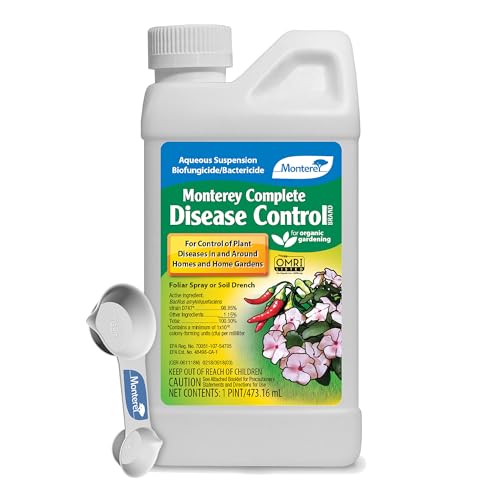
Monterey Complete Disease Control uses the beneficial bacterium Bacillus amyloliquefaciens as its active ingredient, making it one of the few products in this guide that holds OMRI certification for organic gardening. The biological fungicide works by colonizing root hairs and leaf surfaces, outcompeting pathogenic fungi and bacteria for space and nutrients. It controls powdery mildew, rust, leaf blight, brown rot, anthracnose, and gray mold on vegetables, fruits, ornamentals, and houseplants — all without synthetic chemistry.
Southern gardeners report it as a “life saver” for tomatoes during rainy seasons, and northern users in California found it “outstanding for peach leaf curl” when applied multiple times in spring. The product can be used as a foliar spray or as a soil drench, allowing the bacteria to enter the plant’s vascular system for internal protection. However, one reviewer noted that while it slowed leaf spot on cucumbers, it did not eliminate the problem — indicating that biological control is better suited for prevention than for curing an active, advanced infection.
The 16-ounce bottle concentrates quite a bit — 1 teaspoon per gallon of water — so it lasts a long time for the home gardener. The biggest limitation is that biological fungicides require consistent reapplication every 7 to 10 days, and they perform poorly in very hot, dry conditions where the bacteria struggle to establish. Monterey is the right choice for organic growers who want a root-colonizing bio-protectant rather than a strong curative spray.
What works
- OMRI-certified organic — safe for use on all edibles up to day of harvest
- Colonizes root hairs for systemic biological protection
- Effective as both foliar spray and soil drench
What doesn’t
- Controls but does not fully cure advanced fungal diseases
- Requires frequent reapplication (7–10 days) for consistent results
6. Select Source Propiconazole 14.3 Fungicide

The Select Source Propiconazole 14.3 offers the same active ingredient at the same 14.3 percent concentration found in the Quali-Pro product, but in a smaller 16-ounce bottle at a lower upfront cost. This makes it an ideal entry point for homeowners who want to test a systemic propiconazole fungicide without committing to the larger quart size. The low-odor formulation and high tank-mix compatibility — it pairs well with Azoxystrobin, fertilizers, and wetting agents — make it a flexible addition to any disease management rotation.
User reviews confirm its effectiveness against the classic brown circle patterns of centipede grass and Bermuda grass, with one reviewer calling it a “great treatment for the brown circles.” Another user who battled lawn fungus for years reported that combining Select Source Propiconazole with a different-class fungicide and neem oil, applied bi-weekly over two seasons, reduced fungal outbreaks to near-zero. The 16-ounce bottle mixed at typical rates covers approximately 16,000 square feet, providing several full-lawn treatments for a moderate-sized property.
The main trade-off with the Select Source product is that the bottle is the cheapest per-unit among the propiconazole options, but the concentration requires careful measurement and the label clearance is for turf and ornamentals — not for food crops. A few users noted that they prefer the Quali-Pro for the slightly larger volume and professional branding, but functionally the two are nearly identical. For budget-conscious lawn owners who need a reliable curative systemic, Select Source delivers proven results at a very accessible price.
What works
- Same active ingredient (Propiconazole 14.3%) as premium brands at a lower cost
- Excellent tank-mix compatibility with other fungicides and fertilizers
- Low-odor formulation for comfortable spraying
What doesn’t
- 16 oz bottle is smaller — fewer treatments than 32 oz competitors
- Not labeled for use on edible crops
7. Fertilome Liquid Systemic Fungicide II RTS
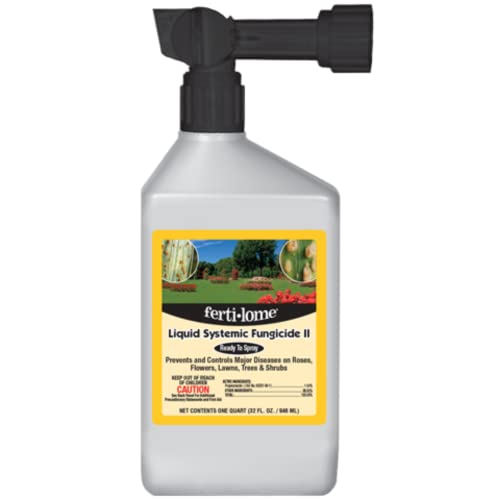
The Fertilome (11380) Liquid Systemic Fungicide II is a ready-to-use 32-ounce spray bottle that targets Take All Patch, Brown Patch, Dollar Spot, Leaf Spot, and Fire Blight — making it one of the few products on this list labeled for the destructive Take All Root Rot. The systemic formula is absorbed through leaves and roots, providing both preventative and early-curative control. The RTU format is a major convenience: no mixing, no measuring, no sprayer cleanup — just attach the nozzle and spray to the point of runoff.
User reviews show consistent success on ornamental trees and turf. One reviewer treated 1-year-old Live Oak trees showing yellowing leaves and saw results after a single application. Another used it to cure Fire Blight on a Crimson Maple after three bi-weekly hose-end sprays, and a third reviewer found it surprisingly effective as a dandelion killer — spraying individual weeds in spring and fall blackened them within days. The 32-ounce bottle covers a small to medium lawn or a number of ornamental beds, though large properties will need multiple bottles.
The primary limitation is cost per square foot — RTU products are inherently more expensive per ounce than concentrates. A second concern is that some users found it “too soon to tell” after application, meaning it may require a second treatment for complete control on established fungal colonies. For homeowners who want a grab-and-go solution for spot-treating visible lawn fungus or protecting young trees, Fertilome Liquid Systemic Fungicide is the simplest path to quick recovery.
What works
- Ready-to-use with attached sprayer — no mixing or equipment needed
- Controls Take All Patch, a disease that resists many granular fungicides
- Fast results on leaf spot and Fire Blight in trees
What doesn’t
- Expensive per square foot compared to concentrate alternatives
- Small bottle — may require multiple purchases for large lawns
Hardware & Specs Guide
Propiconazole 14.3% Concentration
Propiconazole is a sterol-inhibiting (FRAC Group 3) systemic fungicide that moves upward through the xylem to protect new leaf growth. At 14.3 percent concentration, a 32-ounce bottle treats up to 32,000 square feet at standard curative rates of 2 ounces per 1,000 square feet. The microemulsion formulation found in Quali-Pro and Select Source products reduces phytotoxicity risk and improves tank mixing with fertilizers and other fungicides.
Myclobutanil 19.7% Emulsifiable Concentrate
Myclobutanil is another FRAC Group 3 systemic that provides excellent control of powdery mildew, rust, and anthracnose on both turf and ornamentals. The 19.7 percent concentration in Dow Eagle 20EW produces roughly 128 gallons of finished spray per 16-ounce bottle at typical rates, making it the most concentrated option in this guide. Because it is a sterol inhibitor, it should always be rotated with Group 11 (QoI) fungicides to delay resistance development.
Granular 2-in-1 Systemic & Fertilizer
The Scotts Turf Builder Healthy Plus combines a broad-spectrum systemic fungicide — covering 27 diseases — with a nitrogen-rich lawn food in a single 13.7-pound bag. The systemic component penetrates grass blades within hours of watering, while the fertilizer promotes root growth and color. One bag covers exactly 4,000 square feet, and the granules should be applied with a standard broadcast or drop spreader when the grass is dry, then watered in thoroughly.
Biological & Botanical Active Ingredients
Bacillus amyloliquefaciens (Monterey Complete Disease Control) is a beneficial bacterium that colonizes root hairs and leaf surfaces, producing antifungal compounds that suppress pathogens. Neem oil (Fertilome Triple Action) extracts azadirachtin, which interferes with insect molting and fungal spore germination. Both are OMRI-compatible, but biological products require consistent 7-to-14-day reapplication schedules and perform best as preventative measures rather than curative treatments.
FAQ
What is the best time of day to apply a liquid fungicide to my lawn?
How often should I rotate between Propiconazole and Azoxystrobin?
Can I use a granular fungicide and a liquid fertilizer on the same day?
Does neem oil work for brown patch in St. Augustine grass?
Final Thoughts: The Verdict
For most gardeners, the treatment for lawn fungus winner is the Quali-Pro Propiconazole 14.3 because its high-concentration microemulsion delivers broad-spectrum curative control at an economical cost per square foot, and its compatibility with tank-mix partners makes it easy to rotate with other modes of action. If you want a granular no-mix solution that feeds the lawn while suppressing disease, grab the Scotts Turf Builder Healthy Plus. And for organic vegetable gardens where synthetic chemistry is not an option, nothing beats the biological root-colonizing protection of the Monterey Complete Disease Control.