
Black spot on roses is a relentless fungal disease that begins as dark, feathery blotches on leaves, then triggers yellowing and premature defoliation, leaving bushes weak and bloomless by mid-summer. The pathogen *Diplocarpon rosae* overwinters on fallen leaves and re-infects new growth each spring, making a targeted fungicide program essential for anyone serious about keeping their roses healthy and floriferous.
I’m Rikta — the co-founder and writer behind Lawn Gear Lab. For this guide, I compared the active ingredients, application methods, disease-spectrum coverage, and real-world owner feedback across seven leading treatments to identify the most reliable options for controlling black spot without guesswork.
Whether you prefer a systemic drench, a biological fungicide, or a multi-purpose spray, this analysis of the best treatment for black spot on roses will help you select a solution that matches your garden’s disease pressure and your personal growing philosophy.
How To Choose The Best Treatment For Black Spot On Roses
The right treatment depends on your local humidity levels, the existing infection pressure in your garden, and whether you prefer a systemic or contact-mode action. Three factors separate an effective treatment from a temporary band-aid.
Choose Between Systemic and Contact Fungicides
Systemic fungicides like the active ingredient in Bonide Rose Rx are absorbed into the rose’s vascular system, protecting the entire plant from the inside out for weeks. Contact fungicides like sulfur-based sprays coat leaf surfaces and prevent spore germination but wash off in rain and require reapplication every 7–14 days. For heavy disease pressure, a systemic drench provides more reliable long-term coverage.
Consider Biological vs. Chemical Active Ingredients
Biological fungicides such as *Bacillus amyloliquefaciens* colonize the root zone and leaf surfaces, competing with *Diplocarpon rosae* for space and nutrients without synthetic chemicals. They are OMRI-listed and safe for pollinators when dry. Chemical fungicides may work faster on active infections, but biological options are excellent for prevention and for gardeners seeking an organic program.
Evaluate Application Convenience
Ready-to-use sprays offer immediate treatment for a few bushes but become expensive when covering many plants. Concentrates require mixing but are far more economical per gallon of finished spray. Systemic drenches eliminate the need for spraying entirely — just mix and pour at the base — which saves time and ensures even distribution on tall or thorny climbers.
Quick Comparison
On smaller screens, swipe sideways to see the full table.
| Model | Category | Best For | Key Spec | Amazon |
|---|---|---|---|---|
| Fertilome Triple Action | Insecticide + Fungicide | Fruit trees and roses | Neem oil + sulfur mix | Amazon |
| Bonide Rose Rx Systemic Drench | Systemic Drench | Heavy black spot pressure | 6 weeks protection per dose | Amazon |
| Southern Ag Bio Fungicide 16oz | Biological Concentrate | Organic prevention | Bacillus amyloliquefaciens | Amazon |
| Monterey Complete Disease Control | Biological Drench/Spray | Root colonization | OMRI listed 16 oz | Amazon |
| Safer Brand 3-in-1 Garden Spray | Ready-to-Use RTU | Small gardens / container roses | Potassium salts + sulfur | Amazon |
| Earth’s Ally Disease Control | Citric Acid Concentrate | Edibles and ornamentals | Makes 10 gallons | Amazon |
| Southern Ag Bio Fungicide 8oz | Entry Biological | Budget-friendly start | 98.85% Bacillus strain D747 | Amazon |
In‑Depth Reviews
1. Fertilome Triple Action (16 oz)
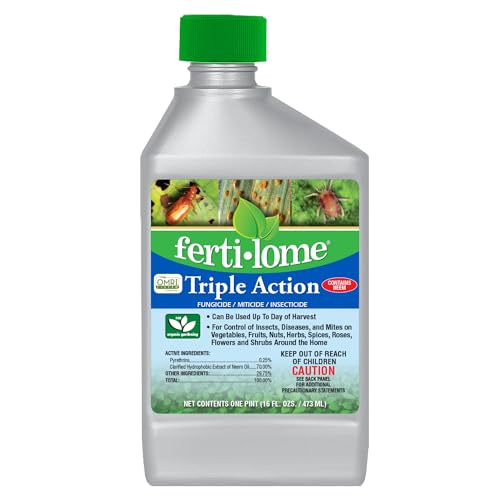
The Fertilome Triple Action concentrate combines neem oil and sulfur to deliver a three-in-one punch against black spot, rust, powdery mildew, spider mites, aphids, and leafminers. Its 7–14 day reapplication schedule keeps the protective layer active through wet weather, and the concentrated 16-ounce bottle treats a large number of plants before needing a refill. Long-time users report reliable control on apple trees, fruit orchards, and rose beds when applied consistently.
Because it kills on contact, thorough leaf coverage — including the undersides where black spot spores first land — is essential for full protection. The sulfur component also acts as a miticide, which is useful because spider mite populations often surge when broad-spectrum sprays are used in hot, dry conditions. Gardeners who already manage ornamentals alongside edibles will appreciate having a single bottle that works across both groups.
Be mindful that sulfur can cause leaf burn if applied when temperatures exceed 85°F. Several long-term users note the price has increased notably, but they continue buying because the product’s proven track record on black spot and secondary pests justifies the cost for serious rose growers.
What works
- Excellent multi-target control on fruit trees and roses.
- Concentrated formula stretches over many applications.
- Proven efficacy against both fungi and sap-sucking insects.
What doesn’t
- Risk of phytotoxicity in high heat.
- Requires vigilant reapplication every 7–14 days.
- Not a systemic — leaves unprotected if coverage is missed.
2. Bonide Rose Rx Systemic Drench (32 oz)

Bonide Rose Rx is a systemic concentrate you mix with water and pour around the base of each rose bush — no spraying, no drift, no missed leaf undersides. The active ingredient travels upward through the xylem to protect every leaf and stem for up to six weeks per application. This is a major advantage for climbers and large shrub roses where reaching every leaf with a sprayer is impractical.
Beyond black spot, it covers Japanese beetles, borers, aphids, powdery mildew, and rust. Multiple verified buyers who have used it for years report that their roses look noticeably healthier within weeks of the first drench, with new foliage emerging clean and glossy even after a wet spring. The convenience factor is high: one spring and one mid-summer application often suffice for the entire season.
The critical drawback is pollinator safety: the label warns against applying while bees are foraging because the systemic can translocate to flowers. Timing applications for early morning or late evening when pollinators are not active reduces risk. Some rose purists also prefer organic-only inputs, and this product is a synthetic chemical fungicide-insecticide.
What works
- Six weeks of systemic protection from a single drench.
- Eliminates spraying — ideal for thorny climbers.
- Controls both insects and fungal diseases simultaneously.
What doesn’t
- Cannot be applied when bees are actively foraging.
- Synthetic chemistry not suited for organic gardens.
- Not for use on edible crops near roses.
3. Southern Ag Garden Friendly Biological Fungicide (16 oz)

This 16-ounce biological concentrate uses a high concentration of *Bacillus amyloliquefaciens* strain D747, a beneficial bacterium that colonizes leaf surfaces and root hairs. The bacteria produce metabolites that suppress *Diplocarpon rosae* and other fungal pathogens, while also acting as a bio-stimulant that darkens foliage and strengthens the plant’s natural defenses. Gardeners in high-humidity regions like Florida report it keeps black spot manageable when used as a preventive spray starting in early spring.
One major advantage is that it can be applied as both a foliar spray and a soil drench. Drenching the root zone establishes a protective barrier in the rhizosphere that prevents soil-borne fungal spores from infecting the roots. Users note that it works well against powdery mildew on squash and cucumbers, and several hydroponic growers use it to prevent root rot in reservoirs — a testament to the versatility of the bacterial strain.
On the downside, it is a preventive product, not a curative. Once black spot lesions are visible, this biological will not erase them; it only stops further spread. The bottle design also makes measuring messy — a narrow opening causes liquid to dribble down the side. Still, for organic rose growers, this is one of the most effective living fungicides available.
What works
- Safe for pollinators when the spray dries.
- Can be used as both foliar spray and root drench.
- Acts as a bio-fertilizer, darkening leaves.
What doesn’t
- Preventative only — cannot cure active black spot.
- Bottle opening causes messy pouring.
- Requires multiple applications for sustained coverage.
4. Monterey Complete Disease Control (16 oz)
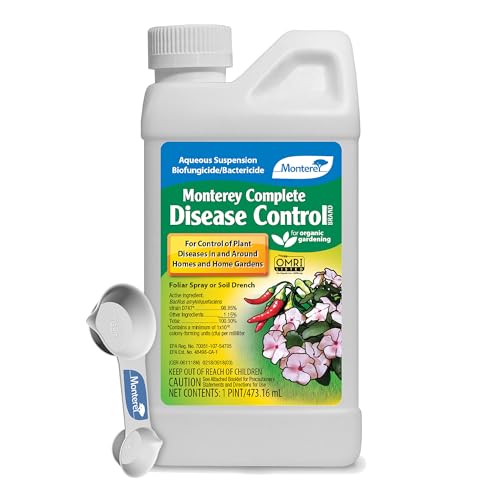
Monterey Complete Disease Control is formulated with a patented strain of *Bacillus subtilis* that colonizes root hairs and creates a physical barrier against fungal and bacterial pathogens. Unlike many biologicals that only work as leaf sprays, Monterey’s label explicitly promotes root colonization as part of its mechanism, making it particularly effective for protecting new transplants and roses under heavy soil-disease pressure. The concentrate comes bundled with a measuring spoon, a thoughtful inclusion for precise mixing.
Users living in the southern U.S. report that it essentially acts as “tomato insurance” during cool, rainy springs when black spot and early blight run rampant. It works best when applied preventatively as a drench at planting time and then as a foliar spray every 7-14 days. The bacterial residue is harmless to humans and beneficial insects once dry, allowing application right up to the day of bloom.
Gardeners note that while it drastically slows the spread of black spot and leaf spot, it does not completely eliminate an existing, severe outbreak. It needs multiple applications and consistent scheduling to stay ahead of aggressive fungal cycles. The 16-ounce bottle is concentrated, so one purchase treats a large number of bushes, but the upfront cost is higher than several competing products.
What works
- Colonizes root hairs for systemic disease resistance.
- Safe for use on edibles up to day of harvest.
- Concentrated formula with included measuring spoon.
What doesn’t
- Slows but does not cure severe active infections.
- Requires a strict 7-14 day spray schedule.
- Higher unit price than some chemical options.
5. Safer Brand 3-in-1 Ready-to-Use Garden Spray (32 oz)

Safer Brand 3-in-1 is a ready-to-use spray combining potassium salts of fatty acids (0.75%) and sulfur (0.4%) to kill black spot, powdery mildew, rust, aphids, mites, and whiteflies on contact. The OMRI-listed formula is approved for organic gardening and can be applied up to the day before harvest on edible crops. For rose growers with just a few bushes, having a trigger-spray bottle that requires no mixing is a genuine time-saver.
Buyers consistently praise its ability to stop soft-bodied insect infestations fast without burning leaves. It works well on indoor orchids, outdoor peppers, and even palm trees. The sulfur component provides reliable preventative control for black spot, though users emphasize it does not reverse existing fungal damage — it only prevents new spores from germinating on leaf surfaces.
The most common complaint is the sprayer: multiple buyers report the nozzle fails after one or two uses, either ceasing to spray when the bottle is still one-quarter full or becoming impossible to unscrew. A workaround is to transfer the liquid to a sturdier spray bottle. On a per-ounce basis, the RTU format is more expensive than concentrates, making it a poor choice for large rose gardens.
What works
- Immediate, no-mix convenience for small gardens.
- Organic and safe for use on edibles.
- Effective against both fungus and sap-sucking insects.
What doesn’t
- Sprayer frequently fails after a few uses.
- Prevents but cannot cure existing black spot.
- Expensive per-gallon compared to concentrates.
6. Earth’s Ally Disease Control Concentrate (32 oz)
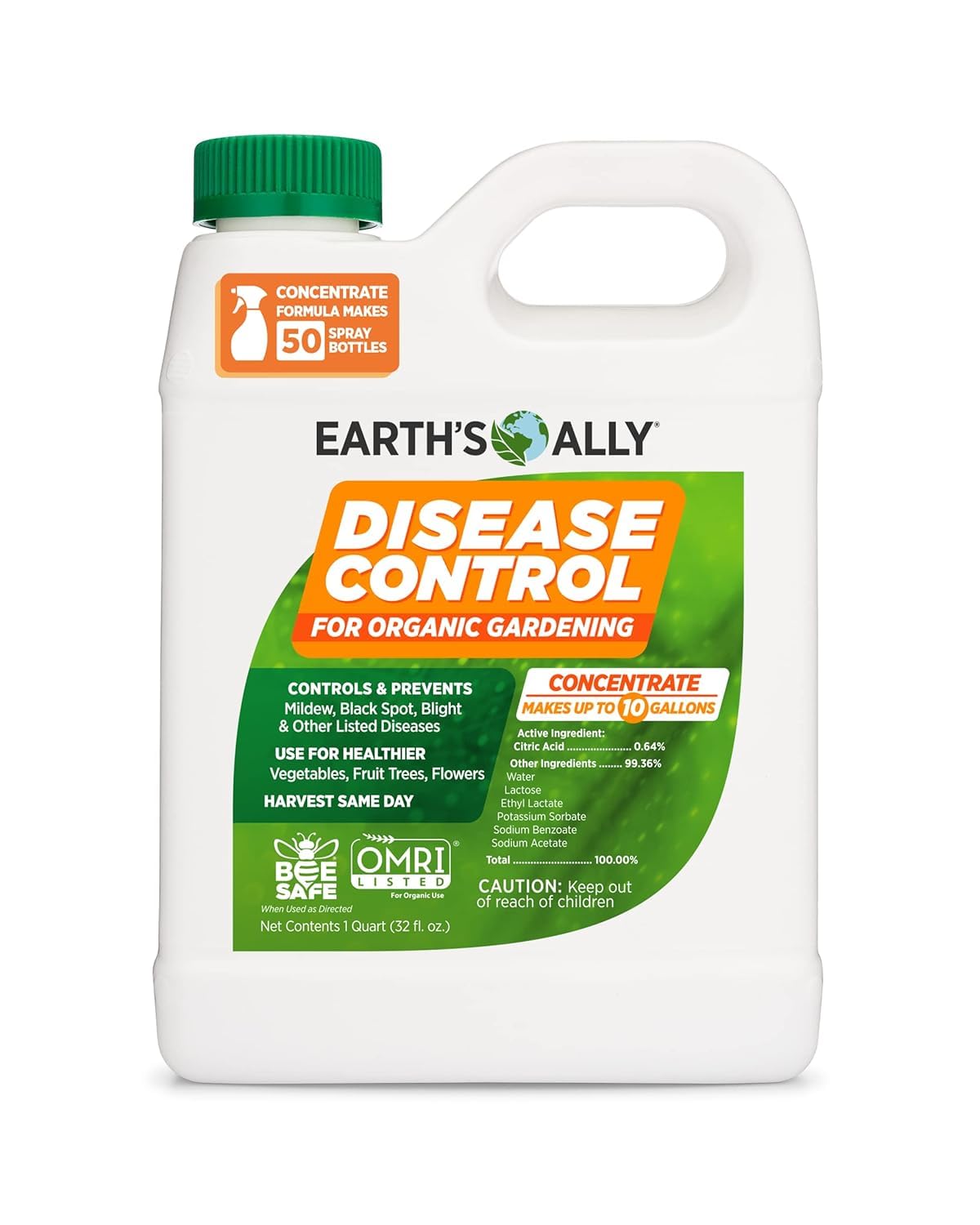
Earth’s Ally Disease Control uses citric acid as its active ingredient — a contact fungicide that disrupts the cell membranes of black spot spores on contact. The concentrate mixes at 6 tablespoons per gallon of water and yields 10 gallons of finished spray, making it one of the most economical options for covering a large rose bed every week. It is OMRI-listed and leaves no harsh residues, allowing application on edibles right up to harvest day.
Gardeners who switched from sulfur-based products appreciate that citric acid does not cause leaf burn even when applied in direct sun or high temperatures. Users report that regular weekly spraying keeps black spot and powdery mildew away from roses, grapefruit trees, and vegetable gardens without the sticky residue that neem-based sprays can leave behind. The product label covers downy mildew, blight, canker, and leaf spot in addition to black spot.
Because it is a contact fungicide rather than a systemic, thorough coverage of both leaf surfaces is mandatory — any missed patch remains vulnerable. It works best as a preventative; if black spot has already taken hold, it will stop new spores from germinating but will not cure existing lesions. The bottle ships without a measuring marker, so having a dedicated measuring spoon is helpful.
What works
- Very economical — one bottle makes 10 gallons.
- No phytotoxicity even in hot sun.
- OMRI-listed and safe for edibles.
What doesn’t
- Contact-only — cannot cure established black spot.
- Requires thorough, regular reapplication.
- No measuring cup included with the bottle.
7. Southern Ag Garden Friendly Biological Fungicide (8 oz)

This 8-ounce bottle of Southern Ag Bio Fungicide packs 98.85% *Bacillus amyloliquefaciens* strain D747, making it the highest concentration of beneficial bacteria in this lineup per dollar spent. Because it is extremely concentrated, a little goes a long way — users report mixing 2–3.5 milliliters per gallon of water for effective disease suppression. It is intended as a preventative measure, colonizing leaf surfaces and the root zone to outcompete black spot, powdery mildew, and soil-borne fungi.
Verified buyers in high-humidity Texas gardens use it as a pump-spray treatment from late April through June, reporting a noticeable reduction in leaf fungus compared to untreated years. The same bacterial strain is widely used in hydroponics to combat root rot, so gardeners who grow roses in containers will find it doubles as a root-zone inoculant. The small bottle size is easy to store and does not take up much shelf space.
Because it is a living organism, it has a short shelf life once opened if not stored properly — heat and direct sunlight kill the bacteria. Gardeners expecting a fast knockdown of existing black spot will be disappointed; it prevents infection but does not cure it. The 8-ounce size, while economical for the concentration, may be too small for gardeners with many bushes who prefer the larger 16-ounce format.
What works
- Extremely high bacterial concentration per dollar.
- Excellent for hydroponic and soil-drench prevention.
- Compact 8-ounce bottle stores easily.
What doesn’t
- Preventative only — not curative for active black spot.
- Bacterial viability degrades if stored improperly.
- Small bottle may require frequent repurchase for large gardens.
Hardware & Specs Guide
Systemic Drench vs. Foliar Contact
Systemic treatments like Bonide Rose Rx are absorbed into the plant’s sap stream and moved to all leaves and stems, providing full-plant protection for weeks. This is especially beneficial for black spot because the fungus can infect any leaf surface, including hidden interior leaves that a spray might miss. Contact treatments — whether sulfur, citric acid, or neem oil — only protect the surfaces they directly coat. Rain, overhead irrigation, and new growth will dilute or bypass contact sprays, requiring more frequent reapplication. For roses in regions with regular summer rain, a systemic drench removes the guesswork.
Biological Colony-Forming Units (CFUs)
Biological fungicides are measured not by volume but by the number of viable bacterial spores per gram, listed as colony-forming units (CFUs). The Southern Ag and Monterey products both contain *Bacillus* species at concentrations high enough to establish a dominant population on leaf surfaces and in the rhizosphere. The key advantage is that the bacteria reproduce on the plant, providing ongoing protection as long as humidity and temperature are favorable. Unlike chemical fungicides, biologicals do not create resistant pathogen strains. However, they require a few days to establish and are knocked back by certain synthetic fungicides, so they should not be tank-mixed with chemical sprays.
FAQ
How often should I apply a systemic fungicide to prevent black spot?
Can I use a biological fungicide and a chemical fungicide together?
Why does black spot return even after I treat my roses?
Should I apply black spot treatment before or after rain?
Final Thoughts: The Verdict
For most gardeners, the treatment for black spot on roses winner is the Bonide Rose Rx Systemic Drench because six weeks of systemic protection from a single pour-around application eliminates the risk of missed leaf surfaces and simplifies the entire spray schedule. If you want an organic, biological approach that builds long-term plant immunity without harming pollinators, grab the Southern Ag Biological Fungicide (16 oz). And for the most economical contact spray that covers an entire rose bed without leaf burn, nothing beats the Earth’s Ally Disease Control Concentrate.