
Specs are compiled from manufacturer listings and verified buyer reviews and can change over time — please confirm the key details on the product page before buying.
Bagworms spin tough, camouflaged silk bags that slowly strip your evergreens and shrubs bare. Left alone, a single infestation can weaken a mature arborvitae or juniper beyond recovery. The real question is which active ingredient—Spinosad (a naturally derived substance from soil bacteria), Bacillus Thuringiensis (Bt, a naturally occurring bacterium that stops caterpillars from feeding), or Bifenthrin (a lab-made chemical that attacks the insect’s nervous system)—stops them fastest without harming the good insects in your yard. This guide walks you through the best treatment for bagworms, breaking down what each formula does, which life stage it targets, and how real buyers got rid of the bags for good.
I’m Rikta — the founder and writer behind Lawn Gear Lab. This guide is built by comparing the manufacturers’ published specifications and the patterns across verified customer reviews, so you get each pick’s real strengths and trade-offs instead of marketing spin.
Whether you are spotting fresh bags in early summer or dealing with a heavy infestation on prized ornamentals, finding a treatment for bagworms that matches your yard’s specific conditions is the difference between quick control and a repeat battle next season.
Our Picks at a Glance
How To Choose The Best Treatment For Bagworms
Selecting the right spray depends on three decisions: the bagworm’s growth stage, your tolerance for synthetic chemicals, and the type of plants you are protecting. Here is what matters most.
Match the Active Ingredient to the Life Stage
Young bagworm larvae, which hatch in late spring to early summer, are the easiest to kill. Products with Spinosad or Bacillus Thuringiensis (a naturally occurring soil bacterium that stops caterpillars from feeding) work best on these small, actively feeding worms. Once the larvae seal their bags and pupate, they stop eating, and those same organic sprays have no effect. At that point, you need a residual synthetic pyrethroid (a lab-made chemical that mimics natural insect-repelling compounds) like Bifenthrin to penetrate the bag and kill the insect inside. The label on each product tells you which stage it covers—check it before you buy.
Organic vs Residual Chemistry
If you grow vegetables, herbs, or flowering plants around your ornamentals, an OMRI-listed (Organic Materials Review Institute—certified for organic production) Spinosad or Bt product keeps beneficial insects safer. Buyers report they see dead caterpillars in two days with Bt, and Spinosad users confirm bagworms vanish completely. The trade-off is short persistence in sunlight—these sprays break down within a day or two. Synthetic Bifenthrin, on the other hand, leaves a barrier that lasts several weeks, making it the better choice for large infestations on trees where you cannot spray every few days. One reviewer noted mixing 1-2 oz per gallon of Bifenthrin to treat a whole property with a single quart bottle lasting a couple years.
Application Equipment and Coverage
All three products come as concentrates you mix with water. A simple trigger sprayer works for a few small shrubs, but a pressure tank sprayer reaches the tops of tall arborvitae or shade trees. Read the dilution rates—the Spinosad concentrate requires 4 Tbs per gallon of water, while Bifenthrin uses just 1-2 oz per gallon. Buyers consistently stress covering both the upper and lower surfaces of the foliage because bagworms often feed on the underside of leaves.
Quick Comparison
| Model | Best For | Active Ingredient | Volume | OMRI Listed | Amazon |
|---|---|---|---|---|---|
| Ferti-lome Spinosad★ Best Overall | Organic control on ornamentals & vegetables | Spinosad | 16 oz | Yes | Amazon |
| Monterey Bt | Gentle caterpillar control near bees & edibles | Bacillus Thuringiensis | 16 oz | Yes | Amazon |
| Wisdom Pro Bifenthrin | Residual barrier for heavy infestations | Bifenthrin 7.9% | 1 Quart | No | Amazon |
In‑Depth Reviews
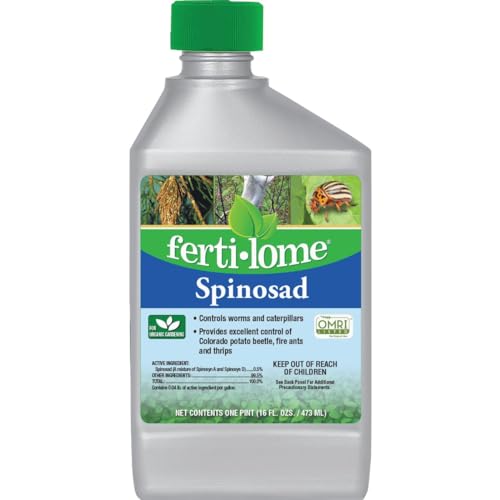
1. Fertilome (16062) Spinosad Insecticide
Our pick — over 4.5★ from 350+ verified ratings; the strongest balance of quality and price.
The organic Spinosad concentrate that eliminates young bagworms without harsh residuals.
This spray kills bagworms, tent caterpillars, leafminers, and even Colorado potato beetles, all while staying OMRI-listed (certified for organic gardening) —so you can use it on vegetables and ornamentals without worry. The active ingredient, Spinosad (a naturally derived substance from soil bacteria), gets inside chewing insects and stops them from feeding within hours. You mix just 4 Tbs per gallon of water, a straightforward ratio that buyers find easy to measure. One customer confirmed “I applied Spinosad as directed. I’ve checked back several times. All the bagworms are gone,” backing up the 4.6-star rating from 383 reviews. Unlike the Wisdom Pro Bifenthrin, this spray breaks down quickly in sunlight, so you need good coverage and proper timing when larvae are active.
Buyers also report it controls webworms, ants, crickets, and grasshoppers around the house, making it a versatile tool for a whole yard routine. Another reviewer noted it “keeps the worms from proliferating our apple crop which greatly increases yield.” That kind of broad-spectrum organic control is hard to find in a single bottle. The trade-off versus the Monterey Bt is speed—Spinosad works on more insect types and kills faster on contact, while Bt needs the insect to ingest it over a couple days. But both are OMRI listed, so you can use them on edible plants without worry.
The 16 oz bottle covers a decent area for small to mid-sized yards, but heavy infestations on tall trees may benefit more from the synthetic residual of the Wisdom Pro Bifenthrin. For most homeowners, though, this is the set-and-spray solution that buyers consistently call “eco-friendly” and “great for home owner use” over several years.
What Makes It Effective
- Kills bagworms, tent caterpillars, leafminers, thrips, and many more listed pests in one mix
- OMRI listed for use on vegetables, fruits, and ornamentals around edible gardens
- Buyers confirm bagworms vanish completely after a single application when timed correctly
Where It Falls Short
- Breaks down in direct sunlight within 24-48 hours—no long residual barrier
- Requires 4 Tbs per gallon dilution, which goes through concentrate faster than Bifenthrin’s 1-2 oz per gallon
Your best organic option: Use this on ornamentals, vegetables, and fruit trees when bagworms are still small and actively feeding—ideal for gardeners who want broad-spectrum insect control without synthetic chemicals.
The caveat: Not suited for late-season infestations where larvae have sealed their bags; at that point you need the penetrating power of the Wisdom Pro Bifenthrin.
2. Monterey BT – Bacillus Thuringiensis Concentrate

The caterpillar-only Bt that leaves bees, earthworms, and your vegetable garden completely unharmed.
Unlike the broad-spectrum Spinosad, Monterey’s Bt concentrate only works on caterpillars and worm-type insects such as bagworm, cabbage looper, gypsy moth, and fall cankerworm —that selective action means honeybees, ladybugs, and earthworms are unaffected. The active ingredient, Bacillus Thuringiensis (a naturally occurring bacteria that produces a protein toxic only to caterpillars), must be ingested by the larvae to work. After spraying my tomatoes following the directions on the bottle, two days later I found several caterpillars dead, one buyer mentioned. That narrow target range makes Bt the safer bet when bees are actively foraging nearby, compared to the Ferti-lome Spinosad which can affect a wider range of insects.
It handles bagworms, tent caterpillars, and a wide list of foliage pests on broccoli, cabbage, lettuce, tomatoes, melons, shade trees, and ornamentals. The downside is short persistence—Bt breaks down in sunlight within a day, so you must spray in late evening when moths are active and target only what you can use in one night, as a buyer noted. Compared to the Wisdom Pro Bifenthrin, which leaves a weeks-long barrier, Bt requires more careful scheduling and reapplication after rain. But for organic gardeners who grow edibles and keep bees, there is no better match.
The 16 oz bottle comes bundled with a measuring spoon, and the concentrate instantly mixes with water for use in a trigger sprayer or pressure tank. One owner reported “yes its expensive but it doesn’t take much!!! VERY much worth the cost!!!”—confirming a little goes a long way per treatment. Just remember to store the mixed solution only for one night, as the product loses potency rapidly once diluted.
Why It Stands Out
- No harm to honeybees, earthworms, or ladybugs when used as directed—ideal for pollinator gardens
- Effective against bagworms, loopers, cabbage worms, and many other caterpillar-type pests
- OMRI listed and approved for organic use on vegetables, fruits, and ornamentals
What to Watch For
- Very short shelf life once mixed—use the same night or lose potency
- Only works on actively feeding caterpillars; useless against mature bagworms in sealed bags
If you keep bees or grow vegetables: This is the safest bagworm spray for your garden—it kills only the caterpillars without collateral damage to your beneficial insects.
One honest limitation: The short residual means you must time your spraying precisely in the evening and be ready to reapply after rain, which is less forgiving than the synthetic residual of the Wisdom Pro Bifenthrin.
3. Wisdom Pro L&H 7.9% Bifenthrin Insecticide Concentrate

The professional-grade synthetic residual that kills bagworms on contact and keeps killing for weeks.
When bagworms have already sealed their bags or you are dealing with a large-scale infestation on tall trees, the Wisdom Pro Bifenthrin concentrate is your heavy hitter. Unlike the organic Spinosad and Bt options above, Bifenthrin (a synthetic pyrethroid that attacks the insect’s nervous system) paralyzes and kills on contact, and leaves a residual barrier that lasts several weeks—so you do not need to reapply every few days. One buyer explained: “I mix 1-2oz for one gallon” and noted the quart bottle “lasts couple weeks at least” and treats an entire house perimeter. Another reviewer said the same bottle “lasts me a couple years” using it four times a year—which shows how far a quart goes at the low dilution rate of 1-2 oz per gallon.
It is labeled for ants, fire ants, mosquitoes, spiders, ticks, chinch bugs, fleas, and a long list of caterpillars including bagworms, gypsy moth caterpillars, leaf feeding caterpillars, and tent caterpillars. This makes it far more versatile than the Monterey Bt, which only hits caterpillars. The trade-off is clear: Bifenthrin is synthetic and not OMRI listed, so you cannot use it on edible crops or around flowering plants where bees forage without risk. Buyers confirm they see “lots of dead critters” and consider it more effective than retail homeguard sprays they wasted money on. For tough, recurring bagworm problems on non-edible ornamentals, shade trees, and evergreens, this is the most potent tool in the lineup.
The 1-quart size is a significant volume advantage over the 16-oz bottles of Spinosad and Bt, but because the dilution is so economical, you get far more treatments per bottle. Just keep in mind that synthetic pyrethroids are broad-spectrum and can harm beneficial insects if sprayed directly on flowers or during bloom. Use it as a targeted barrier treatment rather than a blanket spray over your whole garden.
What Gives It an Edge
- Kills bagworms on contact and leaves a residual barrier that stays effective for weeks
- Extremely economical—1-2 oz per gallon means a quart bottle lasts for many treatments
- Also kills ants, mosquitoes, spiders, ticks, fleas, and many other household/yard pests
What You Sacrifice
- Not OMRI listed—cannot be used on edible crops or around bee-friendly flowering plants
- Broad-spectrum toxicity means it harms beneficial insects if sprayed carelessly
Reach for this when: You have a heavy bagworm infestation on large ornamentals, shade trees, or evergreens and need a long-lasting barrier that does not require frequent reapplication.
skip it if: You grow vegetables, herbs, or maintain a pollinator garden—the organic Spinosad or Bt options are safer choices for your setup.
Understanding the Specs
Active Ingredient and Mode of Action
The active ingredient determines how the spray kills bagworms. Spinosad and Bacillus Thuringiensis (Bt) are biological compounds that must be ingested by the feeding larvae—they stop feeding within hours and die over one to three days. Bifenthrin is a synthetic pyrethroid that attacks the nervous system on contact, providing an immediate knock-down effect. If bagworms are already in their sealed bags, only a penetrating synthetic like Bifenthrin will reach them.
OMRI Listed vs Conventional
OMRI (Organic Materials Review Institute) certification means the product has been reviewed and approved for use in organic production under USDA National Organic Program standards. Spinosad and Bt are OMRI listed, making them safe for vegetables, fruits, and herbs. Bifenthrin is synthetic and not OMRI listed—it is best reserved for non-edible ornamentals and structural perimeters. Always check the label for which plants and crops each spray can be applied to.
FAQ
What is the best time of year to spray for bagworms?
Can I use Bt and Spinosad on my vegetable garden?
Will Bifenthrin kill bees if I spray near flowers?
How long does each product last on the plant after spraying?
Can I mix these products together in one sprayer?
How much concentrate do I need for a full yard treatment?
Will these sprays harm my dog or cat after the plants dry?
What is the difference between bagworms and webworms or tent caterpillars?
Can I spray Bt or Spinosad in direct sunlight?
How do I know if the bagworms are dead after spraying?
Final Thoughts: The Verdict
For the majority of shoppers, the treatment for bagworms winner is the Ferti-lome Spinosad because it pairs OMRI-listed organic safety with broad-spectrum power against bagworms, tent caterpillars, and dozens of other pests on ornamentals and vegetables. If you keep bees or have a heavy flower garden, grab the Monterey Bt for targeted caterpillar control that spares your pollinators completely. And for advanced infestations on tall evergreens where you need a long-lasting residual barrier, the standout is the Wisdom Pro Bifenthrin.
How We Picked
We do not accept paid placement. Every pick is matched to a real buyer and a real use-case; we do not hands-on test units.
Sources & Methodology
Specifications: manufacturer listings and product documentation. Review insights: verified customer reviews, as of July 2026. Pricing: not shown on this page (it changes often); check the current price via the retailer link.
As an Amazon Associate, Lawn Gear Lab earns from qualifying purchases. This does not affect which products we feature.