
Manual soil preparation for a garden bed, a raised planter, or a flower border puts the real test on your body and the tool in your hands. A rake-like tine set that skims the surface wastes your effort, while a tool built with the right metal composition and leverage can turn compacted ground into a seed-ready bed without a gas engine.
I’m Rikta — the co-founder and writer behind Lawn Gear Lab. I spend my time comparing star-tine geometries, handle lengths, steel hardness ratings, and battery cell configurations to find which hand tillers actually deliver on their promise of breaking ground efficiently.
Whether you need to start a vegetable patch, aerate a lawn spot, or mix compost into a raised bed, the best tool to till soil by hand saves your back and your time without needing a gas engine or a heavy extension cord.
How To Choose The Best Tool To Till Soil By Hand
Hand tilling tools range from long-handled star-wheel cultivators to compact battery-powered rototillers. The right choice depends on your soil type, the size of your garden, and your physical strength. Here are the three factors that separate a tool you will use weekly from one that sits in the shed after the first try.
Handle Length and Leverage
A handle that reaches 66 to 67 inches lets you stand upright while working, transferring your body weight into the tines rather than relying on arm strength to push the tool. For raised beds or tight spaces, a handle that adjusts to three different heights is more flexible, allowing you to work from a seated position or reach into narrow borders without stooping.
Tine Design and Material
Star-shaped tines on a rotary cultivator bite into compacted soil by rolling as you push, requiring less downward force than fixed straight tines. The metal quality matters: tempered spring steel and quenched aluminum resist bending when you hit rocks or dense clay, while plain carbon steel blunts faster and may deform under heavy pressure. For power-assisted models, the number of steel tines—typically 48 in a battery tiller—determines how fine the soil texture becomes after a single pass.
Power Source: Manual vs. Cordless Electric
Pure manual tools are lightweight, cost less, and never need charging, but they demand consistent physical effort to penetrate hard ground. Cordless electric models with 20V or 21V batteries spin the tines at 240 to 360 RPM, doing the heavy mechanical work for you. A 2.0Ah battery handles a small raised bed, while dual 3.0Ah packs allow tilling 120 square feet in a session. Corded electric tillers offer unlimited runtime but tether you to a power outlet and add weight—usually 16 pounds or more.
Quick Comparison
On smaller screens, swipe sideways to see the full table.
| Model | Category | Best For | Key Spec | Amazon |
|---|---|---|---|---|
| ONEVAN Cordless Tiller | Cordless Electric | Medium beds & loose soil | 360 RPM / 9.5 in width | Amazon |
| IncwBo Corded Tiller | Corded Electric | Breaking new ground & roots | 8.5 AMP / 12 in width | Amazon |
| TaskStar Cordless Tiller | Cordless Electric | Raised beds & aeration | 360 RPM / 2×2.0Ah battery | Amazon |
| YEELOR Rotary Cultivator | Manual Rotary | Adjustable reach & storage | 67.3 in adjustable handle | Amazon |
| CKLT Rotary Cultivator | Manual Rotary | Hard clay & rocky soil | Tempered spring steel tines | Amazon |
| VNIMTI Fixed Tine Cultivator | Manual Fixed Tine | Heavy-duty weeding & hard ground | 4 tines / fiberglass handle | Amazon |
| Muylux Cordless Tiller | Cordless Electric | Small raised beds & containers | 240 RPM / 4 in depth | Amazon |
In‑Depth Reviews
1. ONEVAN Cordless Tiller Cultivator

The ONEVAN delivers a 550W motor spinning 48 steel tines at 360 RPM, cutting a 9.5-inch path and reaching 6.7 inches deep. The combination of two 3.0Ah batteries means you can swap packs and keep working through a 120-square-foot raised bed without waiting for a recharge cycle. Owners consistently report that the motor muscle handles both fluffy topsoil and compacted garden dirt, with one user clearing 2,000 square feet of grass in a single session using both battery packs.
The adjustable auxiliary handle lets taller gardeners set the grip at a comfortable position, and the 15-pound weight is light enough for a 5-foot-1 user to manage easily. Assembly requires attaching the handle and guard—no special tools needed. The safety switch prevents accidental startups, which matters when you are moving the tiller between beds or storing it in a shed.
Users note that the instructions could be clearer, and the tines do not self-clean when weeding in tall grass; you must stop and unwind tangled material. For the power-to-cost ratio, dual batteries, and genuine soil penetration, this is the most capable entry point to powered hand tilling.
What works
- Two 3.0Ah batteries provide nearly an hour of runtime total, enough for most small to medium gardens.
- 48 steel tines at 360 RPM break compacted soil and mix amendments effectively in a single pass.
What doesn’t
- Tines tangle with long grass and weeds, requiring manual cleanup during use.
- Assembly instructions lack detail, making first-time setup slightly confusing.
2. IncwBo 8.5AMP Corded Tiller Cultivator

This corded tiller runs an 8.5-amp motor that chews through a 12-inch swath of soil at 360 RPM, digging down to 8 inches. The real story here is the automatic stop mechanism—when the tines hit a rock, a tree root, or a buried steel rod, the motor shuts down instantly to protect both you and the drivetrain. Multiple owners confirm that it cut through 1-inch tree roots and river rock without breaking the machine, making it the pick for first-time soil breaking in an old rock bed or weedy patch.
You need an extension cord to reach across your yard—there is no battery freedom—but in return, you get unlimited runtime with no charging anxiety. The 16-pound weight gives enough heft for the tines to dig in, yet it is not so heavy that you cannot lift it over a garden edge. Assembly takes under five minutes, and the compact frame stores easily in a garage corner.
There is no depth adjustment wheel, so you control penetration by lifting or pressing down on the handles. The lack of a cord limits maneuverability around established plants, but the power and durability make it the strongest option for turning compacted ground into a soft seedbed.
What works
- 8.5-amp motor with automatic stop handles roots and rocks without damaging the motor or tines.
- 12-inch tilling width covers ground quickly, and 8-inch depth penetrates deep enough for most garden beds.
What doesn’t
- Corded design limits reach and requires a heavy-duty extension cord for large yards.
- No depth adjustment mechanism; penetration depends on user-applied pressure.
3. TaskStar Cordless Tiller Cultivator
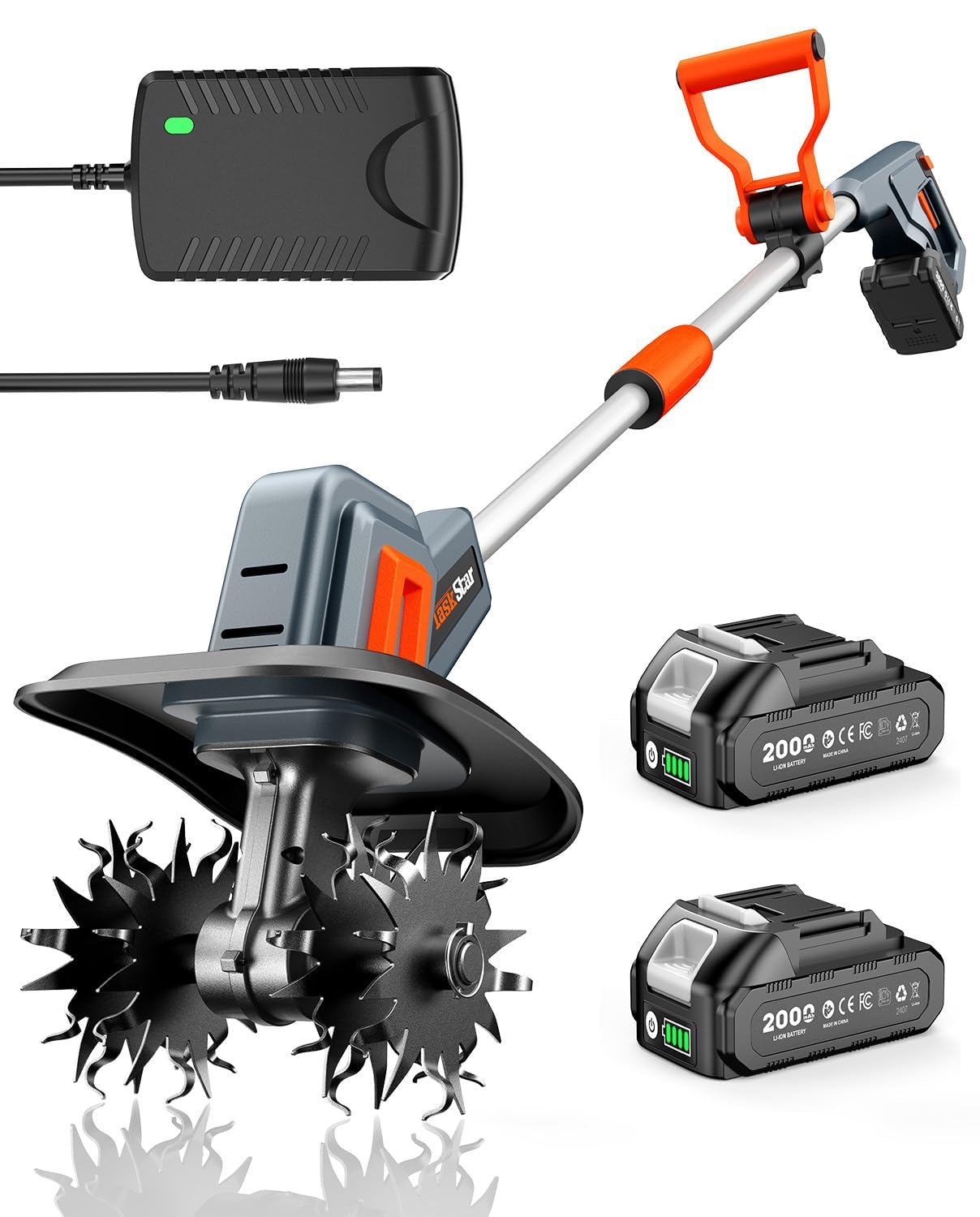
The TaskStar packs a 360 RPM motor with 48 alloy steel tines and a total battery capacity of 4000mAh split between two 2.0Ah packs. Owners report that a single charge handles a 30×40-foot vegetable garden in about an hour, and the motor has enough torque to break unbroken ground that had never been tilled before. The 12.8-pound weight keeps it maneuverable for older gardeners, and the compact design fits into a raised bed without damaging the frame.
The ergonomic handles reduce fatigue during extended use, and the quick-release tines make cleanup simple. Users praise the battery life—20 to 30 minutes per pack—and the fast charging that gets you back to work quickly. The tines do get tangled if you run through tall weeds, and the instruction sheet is minimal, but the assembly is straightforward
This model includes a three-year manufacturer warranty, which is unusual at this price tier and signals confidence in the motor and battery controller. For raised bed work and annual bed turnover, this tiller delivers cordless convenience with genuine power.
What works
- 48 steel tines at 360 RPM handle both loose and compacted soil, including previously unbroken ground.
- Two 2.0Ah batteries offer reliable runtime, and the three-year warranty provides long-term coverage.
What doesn’t
- Tines tangle with long grass and weeds, requiring periodic stops to clear debris.
- Assembly instructions are basic and could be more detailed for first-time users.
4. YEELOR Garden Rotary Cultivator
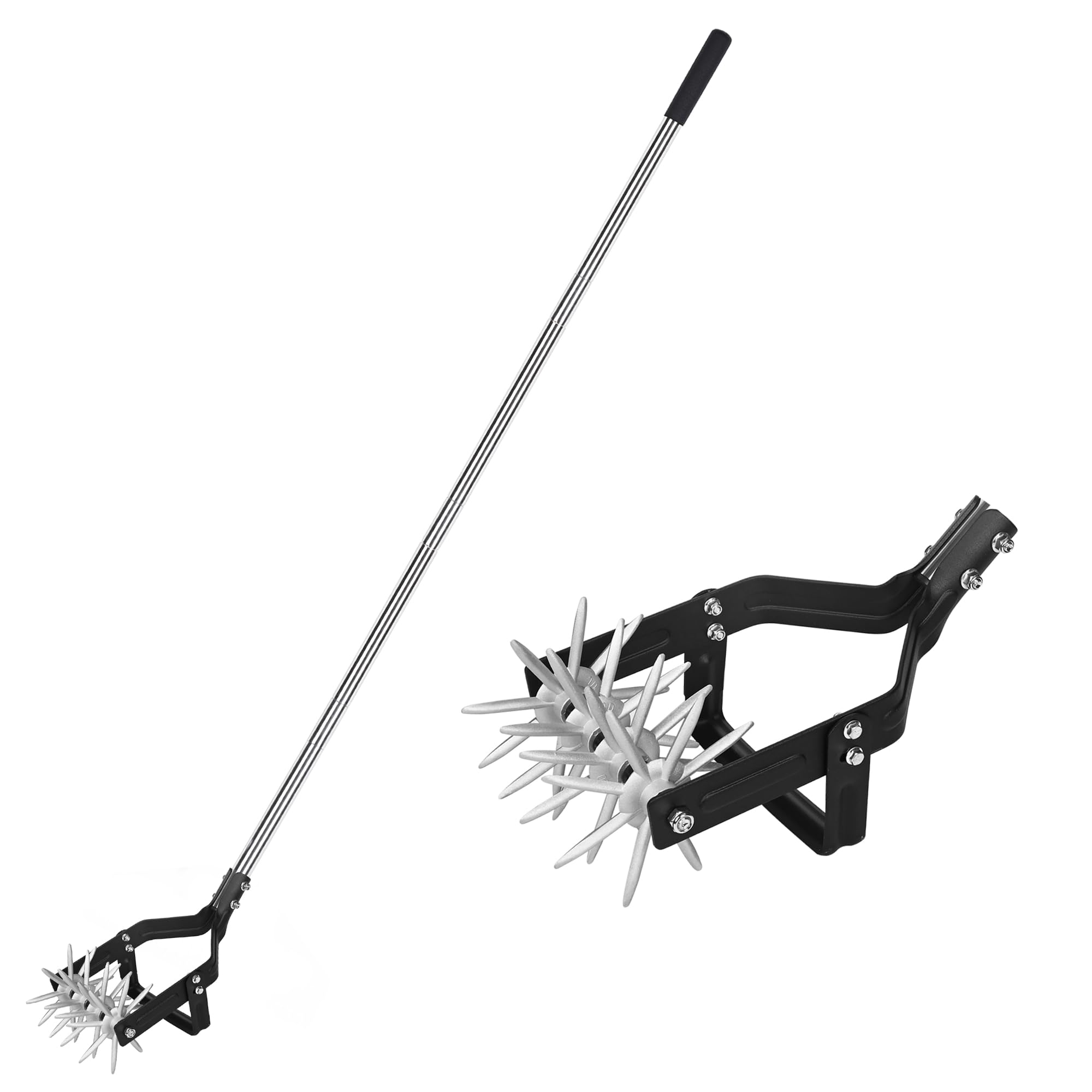
The YEELOR uses a set of aluminum tilling teeth paired with a movable manganese steel scraper to loosen soil and uproot weeds. Its standout spec is the three-position adjustable handle: 67.3 inches, 53.5 inches, or 39.7 inches. This lets a tall gardener stand upright while tilling a flower bed and, in seconds, shorten the handle to reach under low shrubs or work in an elevated planter while sitting. The 4.3-pound weight makes it the lightest manual option here.
Assembly takes a few minutes with the bolt-fixed structure, and the head can be disassembled for storage. The dual-function scraper clears weed roots as you pull backward, which reduces the need to bend over and pick out debris. Owners confirm it breaks up soil well for seed prep and mixes topsoil and dead plant matter effectively in small areas and raised beds.
The handle length adjustment relies on a bolt and wing nut rather than a quick-release clamp, so changing positions takes a little time. The tines work best in soil that is already loose or moderately damp; hard clay requires some initial digging. For a budget-friendly manual tool with genuine height flexibility, this cultivator earns its spot.
What works
- Three-position adjustable handle (39.7, 53.5, 67.3 inches) accommodates different user heights and working positions.
- Movable scraper clears weed roots effectively while tilling, reducing the need for manual cleanup.
What doesn’t
- Handle adjustment uses a bolt and wing nut, which is slower to change than a quick-release mechanism.
- Aluminum tines struggle to penetrate dense clay or very hard-packed soil without prior loosening.
5. CKLT 66in Rotary Cultivator
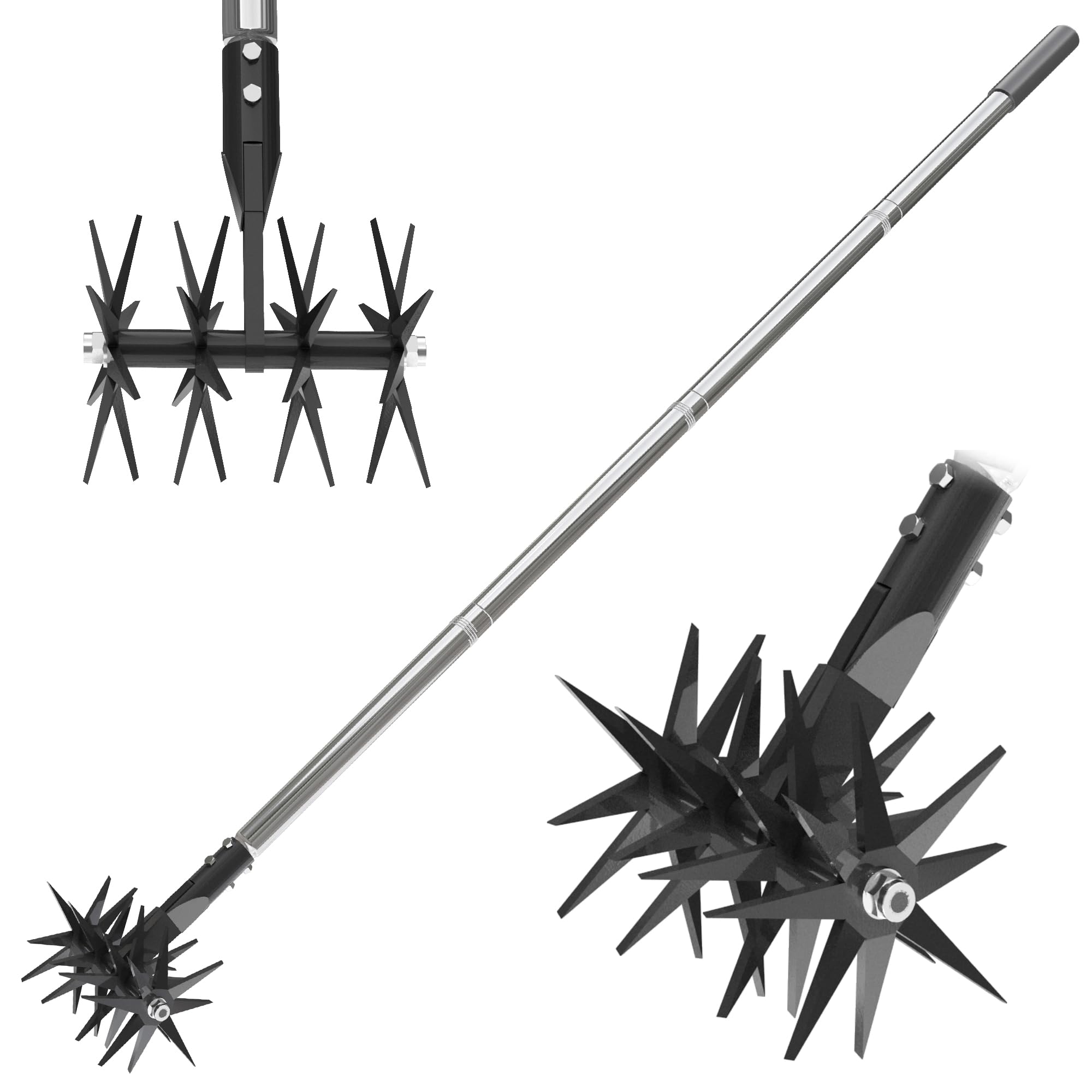
The CKLT uses tempered spring steel for its star-shaped tines, which are sharper and more resilient than standard carbon steel. Owners describe the tines as “sharp” and “tough,” capable of breaking through heavy clay and rocky soil that would deform a lower-grade tool. The 66-inch handle is made of stainless steel with a four-section detachable design, allowing you to shorten it for storage or extend it for upright use without tools.
A black powder coating on the blade head resists rust, and 304 stainless steel screws hold the assembly together. The ergonomic rubber grip reduces hand fatigue during longer sessions. One reviewer reported that adding 10 pounds of ankle weights near the tines helped the cultivator penetrate hard ground more effectively, indicating that the tool benefits from some extra downward force on very compacted soil.
The handle does not have multiple fixed height positions—it is one length of 66 inches—so it works best for average-height users. A squeak from the rotating head may require a quick spray of WD-40. For gardeners facing clay or stony ground, this cultivator’s spring steel construction is the most durable manual option in the lineup.
What works
- Tempered spring steel tines resist bending and stay sharp through heavy use, even in clay and rocky soil.
- Four-section detachable stainless steel handle enables compact storage and easy transport.
What doesn’t
- Single fixed handle length may be too tall for shorter users and too short for very tall users.
- Rotating head can develop a squeak that needs lubrication after several uses.
6. VNIMTI 4 Tine Cultivator

The VNIMTI is a fixed-tine cultivator—not a rolling star-wheel—built from a one-piece forged high-carbon steel head. This shape gives you a pry-bar feel when you need to break up tough ground or yank out deep-rooted weeds. The 58-inch fiberglass handle has two non-slip rubber grips that become tackier when wet, providing a secure hold even in damp conditions. Two rivets reinforce the head-to-handle joint, and owners confirm the tool can withstand extreme use: one gardener tore apart a beaver dam with it, and another used it to retrieve debris from a muddy creek.
At 2.6 pounds, it is light enough to swing repeatedly without tiring, but the four rigid tines require more physical force than a rotary cultivator because they do not roll. The one-piece head has no moving parts, so there are no joints to lubricate or adjust. The fixed 58-inch length is best for users around 5-foot-6 to 6-foot; shorter gardeners may find the handle too long for precise control.
The 4-tine design aerates soil well and mixes in fertilizer effectively, but it does not break new ground as aggressively as a star-wheel model. For heavy weeding, loosening compacted earth, and tasks that require a stout digging implement, this cultivator provides the most brute-force approach in the manual category.
What works
- One-piece forged high-carbon steel head is extremely durable and resists bending under heavy prying force.
- Fiberglass handle with dual non-slip grips stays secure in wet conditions and reduces vibration.
What doesn’t
- Fixed 4-tine design requires more downward force than a rotary cultivator for similar soil penetration.
- Handle length is fixed at 58 inches, offering no adjustability for different user heights or tasks.
7. Muylux Cordless Tiller Cultivator
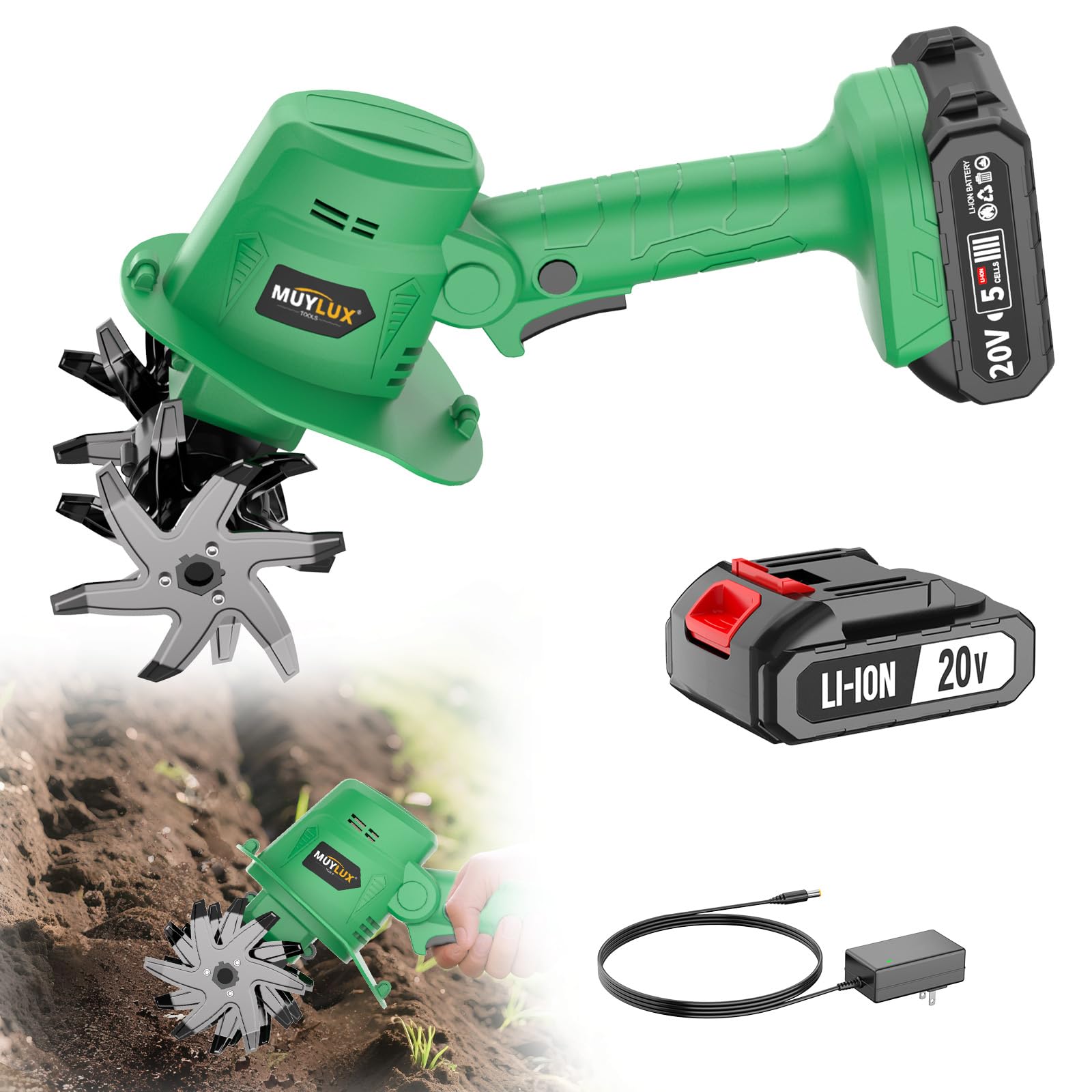
The Muylux is the smallest powered option in this roundup, with two steel tines spinning at 240 RPM and digging 4 inches deep. It comes with a single 2.0Ah battery that lasts about 45 minutes of intermittent use—enough to weed a 2-by-8-foot raised bed from a seated position. Owners aged 80 confirm that the controls are easy on arthritic hands and that the tool is light enough to operate with one hand while pulling weeds with the other.
The ergonomic grip and 3.7-pound weight make it ideal for container gardens, elevated planters, and tight spaces where a larger tiller cannot fit. The battery has overload and temperature protection, and the tines are removable for cleaning. One reviewer reported that it struggles with roots thicker than yarn, but it excelled at loosening topsoil and exposing weed roots for easy removal.
The plastic housing and single-speed trigger mean it is not built for heavy-duty ground breaking. The 4-inch depth limit makes it unsuitable for deep bed preparation. For a gardener who needs a lightweight, battery-powered weed remover and surface tiller for small spaces, the Muylux delivers surprising value.
What works
- Ultra-light 3.7-pound design is easy for seniors and those with limited strength to operate for extended periods.
- Battery lasts through several raised bed boxes on a single charge, cutting weeding time from hours to minutes.
What doesn’t
- Single 2.0Ah battery limits runtime; you may need a second pack for larger gardens.
- Only tills 4 inches deep and struggles with thick roots or very compacted clay soil.
Hardware & Specs Guide
Tine Material and Hardness
Tempered spring steel (found in the CKLT) offers the best balance of sharpness and flexibility, resisting deformation when hitting rocks. Quenched aluminum (YEELOR) is lightweight and rust-resistant but less suited for heavy clay. High-carbon steel (VNIMTI) is the toughest for a fixed-tine design but adds no rolling action. For battery tillers, the tine count—typically 48—directly influences how finely the tool breaks soil; more tines mean faster breakdown in a single pass.
Handle Length and Ergonomics
Manual rotary cultivators with handles between 66 and 67 inches allow upright posture, transferring body weight into the tines. Adjustable handles (YEELOR) add versatility for tall and short users or for working under low shrubs. Cordless tillers with auxiliary handles let you shift grip for comfort. The grip material matters: rubber sleeves stay secure when wet, while bare metal or smooth plastic can slip in damp conditions. Fiberglass handles (VNIMTI) are lighter and more vibration-dampening than steel.
Battery Specifications for Cordless Tillers
Voltage and amp-hour rating determine runtime and torque. A 20V 2.0Ah pack (Muylux) delivers roughly 45 minutes of light tilling, while dual 3.0Ah packs (ONEVAN) provide nearly an hour total. Higher RPM (360 vs. 240) increases the speed of soil breakdown but also draws more current. The type of cell (lithium-ion with overcharge protection) adds safety and longevity. Corded tillers like the IncwBo run on 8.5 amps with unlimited runtime but require a 12- or 14-gauge extension cord for distances over 50 feet.
Soil Penetration and Tilling Depth
Manual rotary cultivators typically reach 4 to 6 inches deep depending on user weight applied. Battery tillers with 48 tines at 360 RPM can reach 6.7 inches (ONEVAN) to 7 inches (TaskStar) in loose to moderately compact soil. Corded tillers (IncwBo) with an 8.5-amp motor dig 8 inches deep. The tilling width ranges from 4 inches (Muylux) to 12 inches (IncwBo). Wider widths cover ground faster but require more physical or electrical power to maintain depth.
FAQ
Will a rotary cultivator work in hard clay soil?
How does a cordless battery tiller compare to a manual rotary cultivator for small gardens?
What is the best handle length for a hand tiller to avoid back strain?
Can I use a hand tiller to break new ground for a garden bed?
Final Thoughts: The Verdict
For most gardeners, the tool to till soil by hand winner is the ONEVAN Cordless Tiller Cultivator because its 550W motor, 360 RPM tine speed, and dual 3.0Ah batteries provide the muscle for medium beds without the tether of a cord. If you need the absolute toughest tool for breaking new ground with rocks and roots, grab the IncwBo Corded Tiller. And for a lightweight, pure-manual option with flexible reach, nothing beats the YEELOR Garden Rotary Cultivator.