
Specs are compiled from manufacturer listings and verified buyer reviews and can change over time — please confirm the key details on the product page before buying.
Pulling grass out of a flower bed by hand is a losing battle — the roots snap off and the weed is back in a week. A decent hand tool changes that by cutting below the crown (the base where stems meet roots) or levering the whole root system out in one clean motion. This guide covers seven manual tools (no batteries, no gas) that do that job without wrecking the decorative plants you want to keep.
I’m Rikta — the founder and writer behind Lawn Gear Lab. This guide is built by comparing the manufacturers’ published specifications and the patterns across verified customer reviews, so you get each pick’s real strengths and trade-offs instead of marketing spin.
Whether you are waging war against creeping bermudagrass in a rose bed or just want a faster way to clean up the border edging, choosing the best tool to remove grass from flower bed depends on matching the tool shape to the weed type and your preferred working posture.
Quick Picks
- Japanese Weeding Sickle Very Sharp Edge Quick — Best Value
- Garden Guru Stainless Steel Hand Weeder Fork — Best Overall
- Japanese Weeding Sickle Hoe Snake-Neck 13-Inch — Pro Grade
- 3 in 1 Garden Weeding Tool Set — Swiss Army Pick
- Garden Guru Hand Weeder Trowel — Comfort Pick
- WORKPRO Hoe and Cultivator Garden Rake — Two-Sided Tool
- Grampa’s Garden Hook — Multi-Use Hook
How To Choose The Best Tool To Remove Grass From Flower Bed
The right tool for this job depends on one thing: whether the grass grows in clumps with a single taproot (a big central root) or spreads underground via runners (horizontal stems called rhizomes or stolons). A sickle-style blade (like a Japanese weeding sickle) slices horizontally under the surface to sever runners, while a forked puller grabs the crown and yanks out clump grasses root and all.
Blade Shape and Cutting Action
A curved, sharp blade that works just below the soil line is the fastest way to clear spreading grasses like bermudagrass or quackgrass from a bed. Straight tines on a hand fork are better for prying out dandelions or plantain that have a single deep root. The 3 in 1 Garden Weeding Tool Set covers both angles with separate tools, while a single Japanese sickle handles the slicing job with one motion.
Handle Comfort and Your Working Height
If you kneel or sit on a stool, a short 10-inch handle is fine and gives good control around delicate flowers. If you prefer to stand, a tool like the WORKPRO Hoe and Cultivator with a 14-inch wood handle lets you reach without hunching. Ergonomic soft-grip (cushioned) handles, such as those on the Garden Guru Weeder Trowel, matter most during long sessions where hand fatigue makes you sloppy.
Steel Thickness and Rust Resistance
Thin stainless steel tines (prongs) bend under heavy prying in compacted clay, so a heavier manganese steel fork (8mm bars on the 3-in-1 set) holds up better in tough ground. Carbon steel blades, like those on the Japanese sickles, hold a sharper edge longer but need occasional sharpening and can rust if left damp. Stainless steel requires less maintenance but does not get as razor-sharp.
Quick Comparison
| Model | Best For | Blade Material | Item Weight | Handle Length | Amazon |
|---|---|---|---|---|---|
| Garden Guru Hand Weeder Fork | Wide-rooted clump grasses in loose soil | Stainless Steel | 8.1 oz | 10″ | Amazon |
| Japanese Weeding Sickle | Slicing runner-type grasses | High Carbon Steel | 5.9 oz | 10″ (approx) | Amazon |
| Garden Guru Weeder Trowel | Precision cutting and scooping | Stainless Steel | 6.3 oz | 10″ | Amazon |
| 3 in 1 Garden Weeding Tool Set | Versatility across weed types | Manganese Steel / Stainless Steel | 1.46 lb | 12″ (puller) | Amazon |
| Japanese Weeding Sickle Hoe (Snake-Neck) | Deep-rooted taproot grasses | High-Carbon Steel | 7.1 oz | 13″ | Amazon |
| WORKPRO Hoe and Cultivator | Breaking up soil before weeding | Metal | 1 lb | 14″ | Amazon |
| Grampa’s Garden Hook | Pulling roots from cracks and edges | Alloy Steel | 0.5 lb | 15″ | Amazon |
In‑Depth Reviews
1. Japanese Weeding Sickle Very Sharp Edge Quick Work
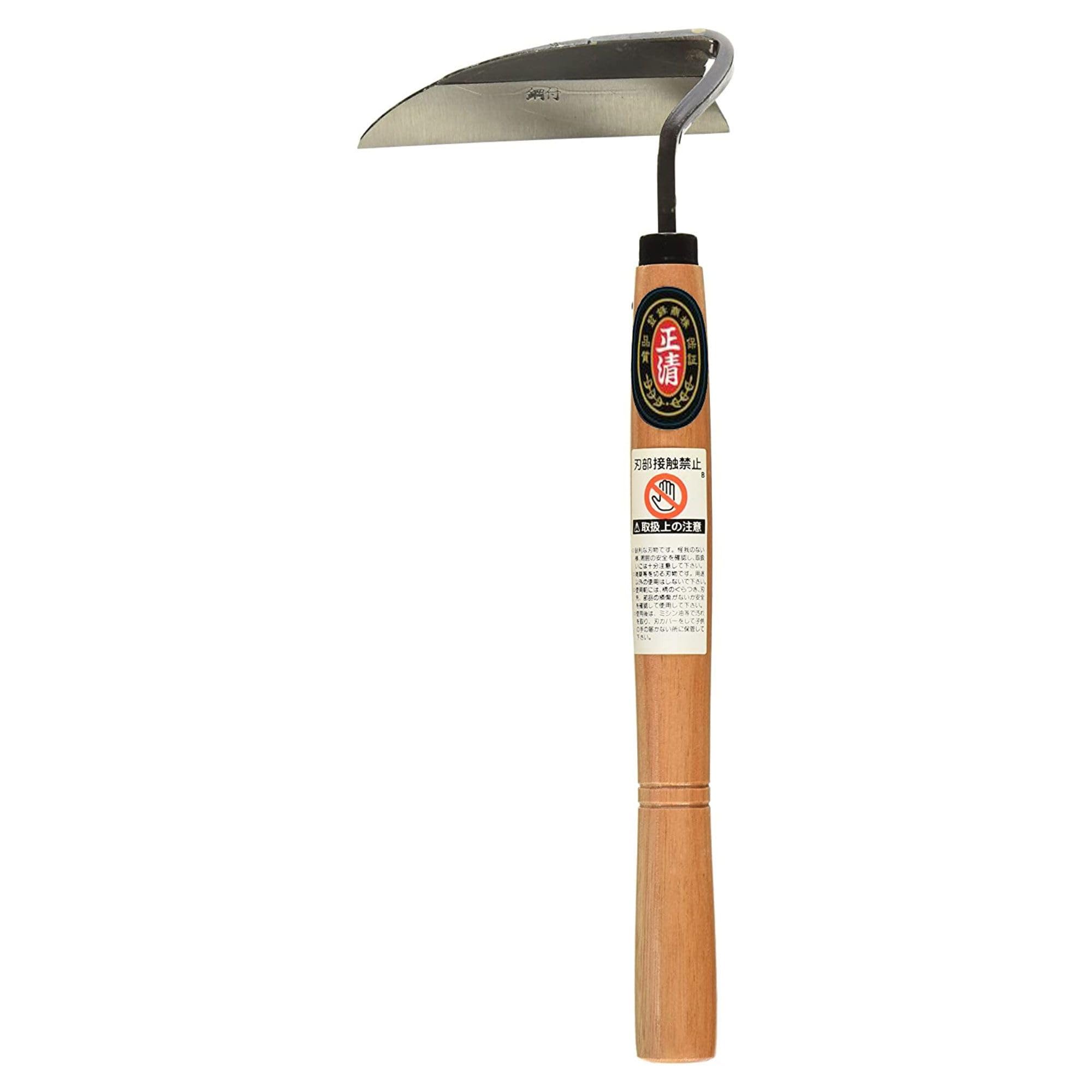
A razor-sharp carbon steel sickle that slices through grass runners like scissors through paper.
This Japanese weeding sickle gets into tight spaces — around plants, along edges, between rows — without disturbing the surrounding soil. The curved high carbon steel blade measures 5 inches and slices weeds at the root with very little effort. Buyers report clearing a 12 ft X 5 feet section in about 30 minutes with little effort, which is a pace that leaves a standard hand fork in the dust.
The sickle weighs only 5.9 ounces, so it feels nearly weightless during a long session, and the D-grip (looped handle) wooden handle gives you full control over the cutting angle. Unlike the Garden Guru Hand Weeder Fork below, this tool is built for a slicing motion rather than a prying motion, which makes it faster on lawns of creeping grasses but less suited for deep taproots that need to be levered out whole.
One limitation: the blade needs occasional sharpening to keep its edge, and if you leave it damp it can develop surface rust. It is not foldable, so you need a protective sheath or a safe storage spot.
Speed king: The fastest tool in this lineup for clearing large patches of runner-type grass from a flower bed.
Reach for this if: you have spreading grasses (bermudagrass, quackgrass) and want to clear a bed faster than any other hand tool allows.
Look elsewhere if: your main problem is single deep-rooted weeds — a hand fork will win that battle with less blade maintenance.
2. Garden Guru Stainless Steel Hand Weeder Fork Tool

A hand fork with wide tines that digs out clump grasses without the tines bending.
The Garden Guru Hand Weeder Fork is built around stainless steel tines that resist rust and are less likely to warp than cheaper forks. Owners mention that the wide tines work much better than narrow ones — they grab a bigger root mass with each plunge, making it fast to remove wild violets and other clump-forming weeds from flower beds.
At 8.1 ounces and 10 inches long, it is the heaviest hand fork in this group, but the weight pays off in sturdy leverage. The ergonomic grip (shaped to fit your hand) is designed to reduce palm and wrist fatigue, and one reviewer noted it still looks and feels new after two seasons of use, even after being left outside in the rain. It also has a handy large hang hole for storage.
Its 3 x 3 x 10 inch dimensions make it compact enough to slip into a garden apron pocket, and the lifetime warranty backs the build quality.
What stands out
- Wide, sturdy stainless steel tines grip root clumps effectively
- Comfortable ergonomic handle cushions your palm
- Lifetime warranty and the brand claims carbon-neutral production
One trade-off
- Tines are about a half-inch shorter than some competitors, which some customers note is a small reach disadvantage
Best for: gardeners who want a single fork that handles the majority of clump weeds, with a grip that feels good through a full afternoon of work.
skip it if: you have mostly spreading runner-type grass — a sickle will clear that faster than any fork.
3. Japanese Weeding Sickle Hoe Snake-Neck 13-Inch

A snake-necked sickle (curved neck) with a high-carbon steel blade that reaches deep taproots without bending over.
This Japanese weeding sickle features a one-piece high-carbon steel head that is strong and wear-resistant, paired with a hard solid wood handle. The 13-inch overall length (12.99 x 4.72 x 1.38 inches) offers a longer reach than the standard Japanese sickle above, which matters when you are working a large bed from a standing or kneeling position without hunching.
Reviewers point out it makes weeding three times as fast and 100% more successful compared to a trowel, and one owner called it their go-to tool for serious gardening. The curved snake-neck shape lets you hook under grass roots and lever them out with the steel neck rather than the handle joint, reducing the risk of breakage at the point of highest stress.
It weighs 7.1 ounces, which is 1.2 ounces more than the standard sickle — barely noticeable during use but enough to make the blade feel a bit more planted on the downstroke.
Deep-root champion: The longer handle and one-piece steel design give this an edge over the standard sickle when you are fighting dandelions or thistles with a taproot that goes 6 inches deep.
Choose this if: you want a three-in-one motion — slice, hook, and pry — from a single tool that reaches a bit further than a short sickle.
Pass on it if: you prefer a stainless blade that never needs sharpening; this carbon steel will dull with heavy use.
4. 3 in 1 Garden Weeding Tool Set
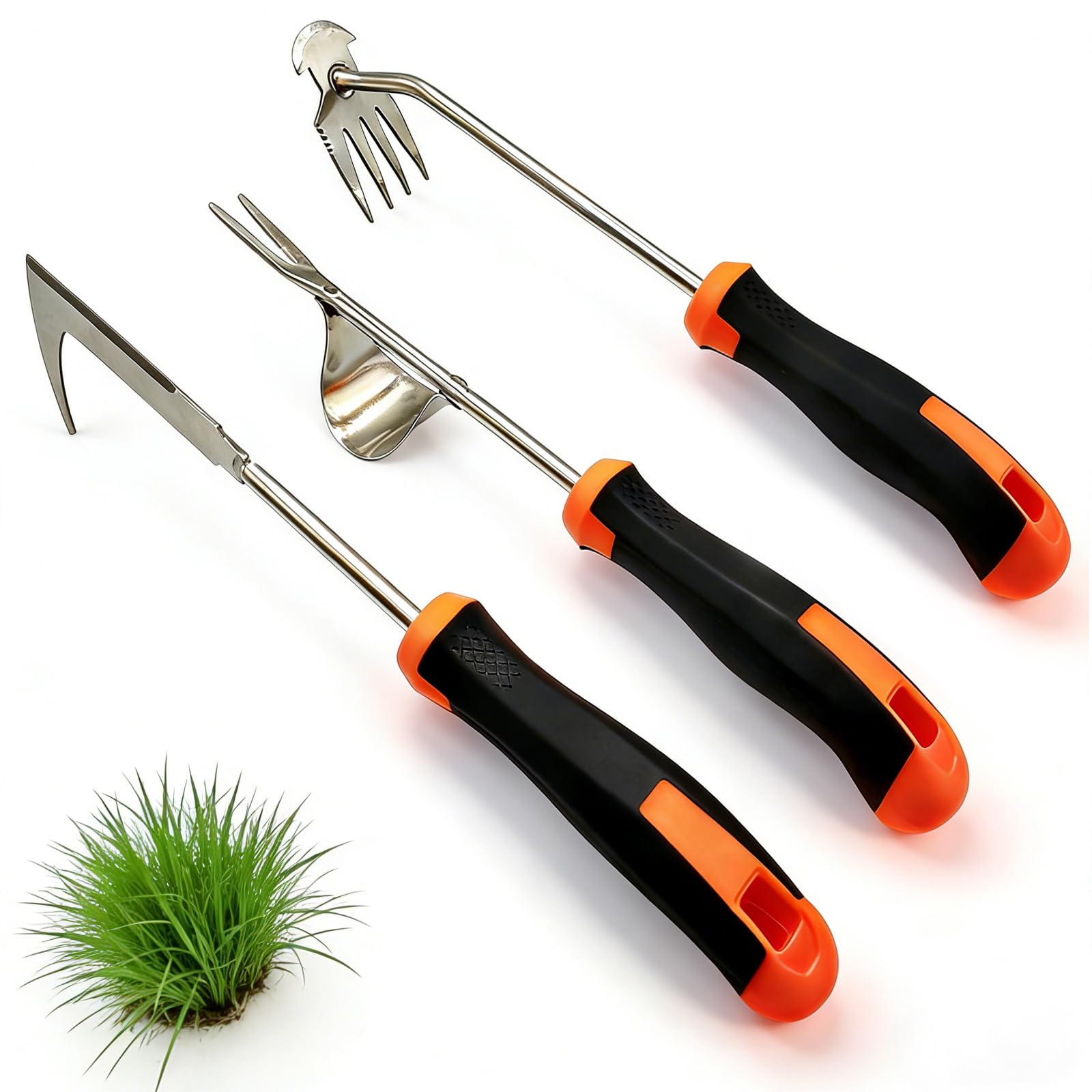
Three specialized tools in one kit that handles every weed scenario without chemical sprays.
This set gives you a 4-tooth manganese steel weed puller with 8mm steel bars (thicker than standard fork tines), a stainless steel L-shaped crack and crevice weeder, and an ergonomic scratch garden weeder with a SoftGrip handle. If you have a mix of dandelions in the lawn, moss between paving stones, and creeping grass in the flower bed, this kit covers all three with dedicated tools rather than forcing one shape to do everything.
The 4-tooth puller is built from heavy-duty manganese steel that resists deforming, and the L-shaped crevice weeder has a sharp blade that cleans out growth from tight spots where standard weeders cannot reach. Shoppers say the 3-tined scraper is a favorite for clearing lots of weeds at once, getting down to the roots. At 1.46 pounds, the set is heavier than any single tool here, but you are getting three tools that collectively tackle more weed types than any one tool can.
The tools measure 12 x 3 x 1 inches as a set, so they store in a small tote or tool bucket. The scratch weeder’s angled head gives you extra leverage for cutting through tough turf with less arm strain.
The upside
- Three very different tool shapes cover spreading grasses, taproots, and narrow cracks
- Manganese steel puller is tougher under strain than standard stainless forks
- Ergonomic grip on the scratch tool reduces wrist fatigue during long sessions
The downside
- Heavier to carry around the garden than a single multipurpose tool
- Blades are very sharp — the manufacturer recommends gloves during use
Versatile choice: If your garden throws every weed type at you, this three-tool set gives you the right shape for every job without buying separate tools.
Weight caution: At 1.46 lb the set is noticeably heavier than any single tool here, so it is best kept in a bucket rather than a pocket.
5. Garden Guru Hand Weeder Trowel
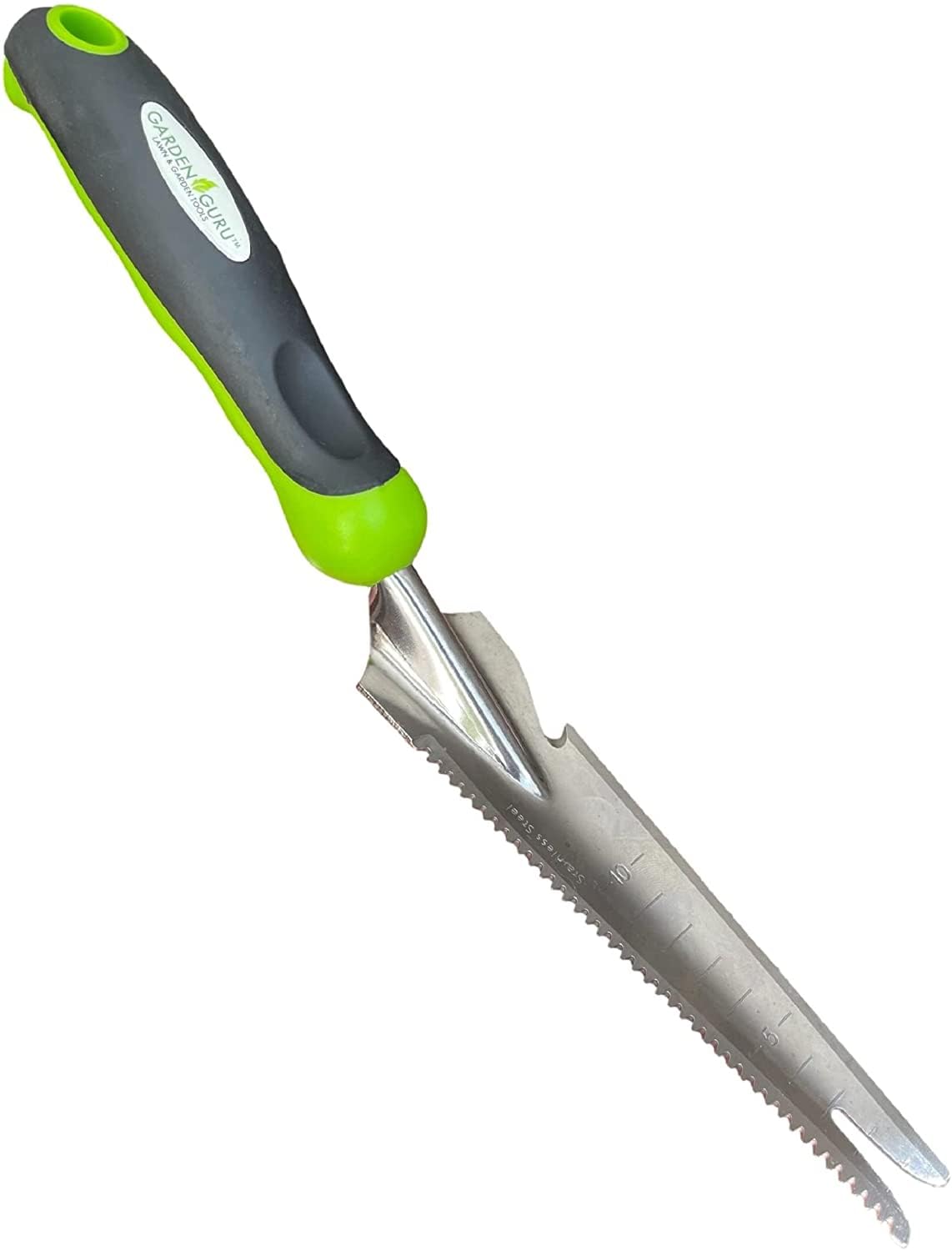
A five-in-one stainless steel trowel that digs, cuts, scoops, saws, and even opens a bottle.
The Garden Guru Weeder Trowel is not just a weeder — it has a two-pronged fork tip for prying out stubborn weeds, a sharp flat edge for scraping, a serrated edge for sawing through roots, a concave scoop for moving soil, and even a notch for cutting twine or opening a bottle. It weighs only 6.3 ounces and measures 10 x 2 x 0.5 inches, so it is nearly as light as the Japanese sickle while offering far more functions.
The ergonomic soft-grip handle with contoured finger grips is specifically designed for people with arthritis or weak grip strength. Many buyers report it makes weeding manageable again — one described it as a purchase you will make again and again, having already bought three. As a potential weakness, one buyer mentioned they did manage to break the blade while really cranking on it to pry up an iris, so it is best used for cutting and prying within reason.
Unlike the 3-in-1 set, this tool is a single stainless steel piece with no moving parts, so there is nothing to assemble or lose. The brand claims a lifetime warranty and carbon-neutral production, which adds confidence.
Ergo champ: The most comfortable handle in this lineup for gardeners who experience hand pain with standard narrow grips.
Best suited for: the gardener who needs one do-it-all hand tool that lives in their pocket for daily touch-ups.
Not built for: heavy prying in compacted clay — it is a cutting and scooping tool first, a pry bar second.
6. WORKPRO Hoe and Cultivator Garden Rake

A two-in-one hoe and cultivator that flips from chopping soil to raking debris without swapping tools.
The WORKPRO Hoe and Cultivator has a sharpened hoe blade on one side for breaking up hardened soil and cutting through grass clumps, and a 3-tine claw (3 prongs) on the other for loosening soil and raking out weeds. The head is 0.17 inches thick and finished with a protective plastic spray coating. You flip the handle to switch modes, which means you never put the tool down to grab a different one.
The beechwood handle measures 14 inches — the longest in this group aside from the Grampa’s Garden Hook — so you can reach into a wide bed without stepping on plants. Owners mention it is their favorite gardening tool and that it is durable and lightweight at the same time. It weighs 1 lb, which is heavier than the sickles but expected for a two-sided metal head. The handle has a hanging hole for storage.
One note: assembly requires the metal parts to enter from the green handle end, and the tool is not ideal for precision weeding around delicate seedlings because the hoe blade is fairly wide.
What works
- Two tools in one — hoe for cutting, cultivator for loosening — without carrying extra gear
- 14-inch beechwood handle reduces bending strain compared to shorter tools
- Thickened 0.17-inch hoe blade resists bending in tough soil
What to know
- Wider head is less precise for weeding very close to desired plants
- Assembly required — not ready from the start
Best for: clearing a large flower bed that has not been touched in a while — the hoe blade cuts through the crust, the cultivator pulls the weeds.
Skip it for: fine detailed weeding between established perennials — you want the precision of a sickle or a narrow fork for that.
7. Grampa’s Garden Hook

A curved alloy steel hook that pries grass roots from concrete cracks as easily as from garden soil.
Grampa’s Garden Hook has a curved steel head that functions as a weed cutter, digger, edger, and planter all in one. The design is simple — a single piece of alloy steel attached to a wood handle — but buyers find it surprisingly effective for hooking onto grass roots in tight spaces like joints between concrete blocks or along edging strips. One reviewer even discovered it works for dismantling beaver dams, though you probably will not need that.
At 0.5 pounds (8 ounces) and with a 15-inch overall length (15 x 7 x 2 inches), this is the longest tool in the lineup, giving you the most reach without standing. It is also one of the lighter tools despite its length because the head is not bulky. The wood handle provides a comfortable classic grip that customers note reduces hand fatigue.
Unlike the Japanese sickles, this hook uses a pulling and prying motion rather than a slicing motion, so it is less effective on runner-type grasses that need to be cut below the surface. It shines when you need to hook under a deep dandelion root in a crack.
Edge specialist: The best tool here for cleaning grass out of driveway cracks, patio joints, and the narrow strip between a sidewalk and a flower bed.
Choose this if: your main problem is grass and weeds growing in cracks and along hardscape edges rather than in open soil.
Not the best for: open flower beds with spreading grasses — a sickle or hand fork will clear a larger area faster.
Understanding the Specs
Blade Material
The two main steel types are stainless steel and high-carbon steel. Stainless steel resists rust and stays low-maintenance — you can leave a Garden Guru fork in the rain and it will be fine. High-carbon steel (used in the Japanese sickles) can be sharpened to a finer edge and holds that edge longer, but it will rust if you leave it damp. If you store tools in a dry shed, high-carbon gives better cutting performance. If your tools live in a damp garage or get forgotten outside, choose stainless.
Weight and Reach
A tool that weighs less than 6 ounces (like the Japanese sickle at 5.9 oz) lets you work fast without arm fatigue during a long weeding session. Tools in the 8-ounce range (like the Garden Guru fork) give more heft for prying roots but tire your wrist faster. Handle length matters more than weight for reach: a 10-inch handle works well when kneeling, while a 14- to 15-inch handle (WORKPRO and Grampa’s Hook) lets you stand or reach into the middle of a wide bed. The trade-off is that longer handles are less precise in tight spaces.
FAQ
Which tool works best on bermudagrass in a rose bed?
Will a hand fork damage nearby flower roots?
How long does a high-carbon steel sickle stay sharp?
Can I use a weeding sickle for other garden tasks?
How do I keep a weeding tool from rusting?
What is the difference between a weeding sickle and a garden hook?
Which tool is best for someone with arthritis in their hands?
Do I need more than one tool to remove grass from a flower bed?
How do I remove grass roots without breaking the tool?
What size tool should I get for raised garden beds?
Final Thoughts: The Verdict
For most people, the tool to remove grass from flower bed winner is the Garden Guru Hand Weeder Fork because its wide stainless steel tines, comfortable ergonomic grip, and lifetime warranty handle the widest range of common bed weeds without needing sharpening. If you want to clear spreading grass faster, grab the Japanese Weeding Sickle. And for tackling mixed weed types and hardscape cracks in a single purchase, the 3 in 1 Garden Weeding Tool Set offers the most versatility per dollar.
How We Picked
We do not accept paid placement. Every pick is matched to a real buyer and a real use-case; we do not hands-on test units.
Sources & Methodology
Specifications: manufacturer listings and product documentation. Review insights: verified customer reviews, as of July 2026. Pricing: not shown on this page (it changes often); check the current price via the retailer link.
As an Amazon Associate, Lawn Gear Lab earns from qualifying purchases. This does not affect which products we feature.