
Specs are compiled from manufacturer listings and verified buyer reviews and can change over time — please confirm the key details on the product page before buying.
A hedge trimmer that tears and chews branches instead of slicing them cleanly is not a broken tool — it is just a dull one. Replacing it costs a fortune, but a good sharpening stone or file brings that crisp, clean cut back in minutes. This guide focuses on the tools that restore a razor edge to your trimmer’s teeth, so your hedges look tidy and your arms do not ache.
I’m Rikta — the founder and writer behind Lawn Gear Lab. This guide is built by comparing the manufacturers’ published specifications and the patterns across verified customer reviews, so you get each pick’s real strengths and trade-offs instead of marketing spin.
You do not need to replace a dull hedge trimmer—a sharpening tool brings the edge back and saves you money. The right tool for sharpening hedge trimmers matches your blade’s condition and your patience, so you get clean cuts without ruining the factory edge.
Our Picks at a Glance


How To Choose The Best Tool For Sharpening Hedge Trimmers
Choose a sharpener that matches your blade’s condition and your patience. Pick a tool that removes enough metal to fix a dull edge without ruining the blade’s factory angle.
Grit: The Heart Of The Matter
Grit refers to the size of the abrasive particles on the sharpening surface. A lower grit number (like 200 or 325) is coarser, meaning it aggressively grinds away metal to fix nicks and dull edges. A higher grit number (like 600 or 1200) is finer, and it polishes the edge to a smooth, sharp finish. Many tools now come with two grits on one stone, letting you fix and then finish in a single pass.
Diamond Coating vs. Traditional Stone
Diamond-coated sharpeners use tiny industrial diamonds bonded to a steel base. They cut through hard steel faster than traditional whetstones and, crucially, they work dry — no oil or water needed. This makes them a mess-free choice for a quick sharpen in the garden.
Handheld File vs. Guided Sharpener
You have two main design choices. A handheld file or stone requires you to match the blade’s bevel angle by hand, which takes a bit of practice. A guided sharpener has preset slots that hold the blade at the correct angle for you, which is much easier for a first-timer but sometimes less flexible for odd-shaped trimmer teeth.
Quick Comparison
| Model | Best For | Grit | Length | Surface Type | Amazon |
|---|---|---|---|---|---|
| Felco F 903★ Best Overall | Precision pruner touch-ups | Fine | 3.94″ | Diamond-coated steel | Amazon |
| SHARPAL 121NAlso Great | All-around garden sharpening | 325 / 1200 | 8.46″ | Diamond | Amazon |
| SHARPAL 103NMost Versatile | Multi-tool versatility | Medium | 8.46″ | Tungsten & Ceramic | Amazon |
| 121N Dual-Grit | Quick, dry, on-the-go sharpening | 325 / 1200 | 8.5″ | Diamond | Amazon |
| Berry&Bird Stone | Traditional file feel with a handle | 180 | 8.4″ | Silicon Carbide | Amazon |
| Spear & Jackson 4056BS | Budget multi-purpose blade care | — | — | Tungsten Carbide | Amazon |
In‑Depth Reviews
1. Felco Sharpening Tool (F 903)
Our pick — over 4.5★ from 2,500+ verified ratings; the strongest balance of quality and price.
A tiny pocket stone for the pruner purist who wants surgical precision.
If your hedge trimmer is in good shape and just needs a quick edge touch-up, this diminutive diamond-coated stone is a joy to use. It measures just 3.94 inches long, at 3.94 inches versus the SHARPAL 121N’s 8.46 inches, and it is designed to slip into a pocket or attach to a knife sheath. This portability means you can keep it on you and sharpen a blade the moment it feels dull, rather than waiting until you get back to the shed.
The diamond coating is bonded to hardened steel, and it is specifically designed to reach into the tight areas of secateur (pruner) blades. Because it is a fine grit stone, it excels at honing an already-decent edge back to razor sharpness rather than grinding down large nicks. Buyers report it “works better than honing stone,” and the customer consensus is that it keeps blades sharp and makes clean cuts, with sharpening performance being what owners praise most.
Owners mention keeping this sharpener in their kitchen flatware drawer for regular knife touch-ups—it is that handy. The trade-off is its size: at only 3.94 inches, some find it smaller than expected, and it is less comfortable for large machete or axe blades without a glove. It is a finishing tool, not a heavy repair tool.
Best for precision: This is the sharpener you carry in your pocket for on-the-spot edge maintenance.
Choose it if: you want a pocket-sized, premium-quality stone for keeping pruners and trimmers razor sharp.
skip it if: your blades are badly nicked and need aggressive coarse-grit grinding first.
2. SHARPAL 121N Dual-Grit Diamond Sharpening Stone
The backyard standard that makes razor-sharp results easy for beginners.
This is the tool people buy once and then keep buying as gifts for their whole workshop. Its defining feature is the dual-grit diamond surface: a coarse 325 grit (45 micron) for quickly setting a new edge, and an extra fine 1200 grit (12 micron) for honing it to a polished finish. You get two sharpening surfaces on one lightweight 8.46-inch file, so you can fix a damaged blade and refine it without switching tools.
The monocrystalline diamond coating is bonded to full-tang stainless steel, which is why it handles everything from hedge shears to lawn mower blades. It sharpens dry, so there is no oil or water to set up and no messy cleanup afterwards. The grip is ergonomically designed, and 20° angle guides on both sides take the guesswork out of holding the file at the correct angle for a consistent bevel.
Owners regularly mention replacing their old plastic sharpeners with this one, noting the quality is much better. The 325/1200 grit combo is praised for handling rough edges and honing in one pass, with a crowd of over 3,000 owners giving it a 4.6-star average. The honest limitation here is that while it excels at trimmer and shears, it is not a full replacement for a dedicated mower blade grinder on heavily nicked steel.
Why it wins
- Coarse 325 grit fixes dull edges fast, while the 1200 grit polishes for a lasting finish.
- Works dry, so you skip the messy oil or water prep entirely.
- The 20° angle guides make it nearly simple to use for first-timers.
What to know
- At 8.46 inches, it is a handheld file, so you still set the angle by hand on tricky blades.
- Not designed for heavy reprofiling of severely chipped mower blades.
Reach for this if: you want one dependable, beginner-friendly file that sharpens every garden blade in your shed.
Look elsewhere if: you need to grind down deep nicks on a commercial mower blade — that calls for a bench grinder.
3. SHARPAL 103N All-in-1 Knife & Garden Tool Sharpener
A multi-tool that guides your blade into a preset angle so you cannot get it wrong.
Unlike a flat file where you must hold the angle yourself, this guided sharpener is built for people who want guaranteed results. It is constructed of 5 sharpening parts, including 3 different slots with preset optimal sharpening angles, plus a tungsten carbide bar for quick edge setting and a ceramic bar for honing. You simply slide the blade through the correct slot, and the tool does the angle math for you.
This design makes it exceptionally easy for first-timers. Customers note sharpening a dozen tools in one sitting, from scissors to garden shears to loppers to a full-size axe, and getting “perfect edges” each time. The oversized handle allows for use with gloves, and a large hand guard protects your fingers from the blade — a real safety plus when you are working with aggressive trimmer teeth.
Versatility is the headline here, but it has a limit. Some owners find that the preset slots cannot reach about 50% of the blade near the hinge of certain shears, and the angle can mismatch factory edges on some brands. It is brilliant for knives and straight-edged tools, but for complex shear geometry, a flat file gives you more freedom. Still, for a beginner’s all-in-one, it is an incredibly forgiving place to start.
Guided & safe: The preset angle slots remove the hardest part of sharpening, making it ideal for novices.
Best for: the gardener who sharpens everything from kitchen knives to hedge shears and wants simple to use angle guidance.
Not for: reaching the hinge area of all shear blades, where the fixed slots sometimes cannot fit.
4. Kolasina 121N Dual-Grit Diamond Sharpener
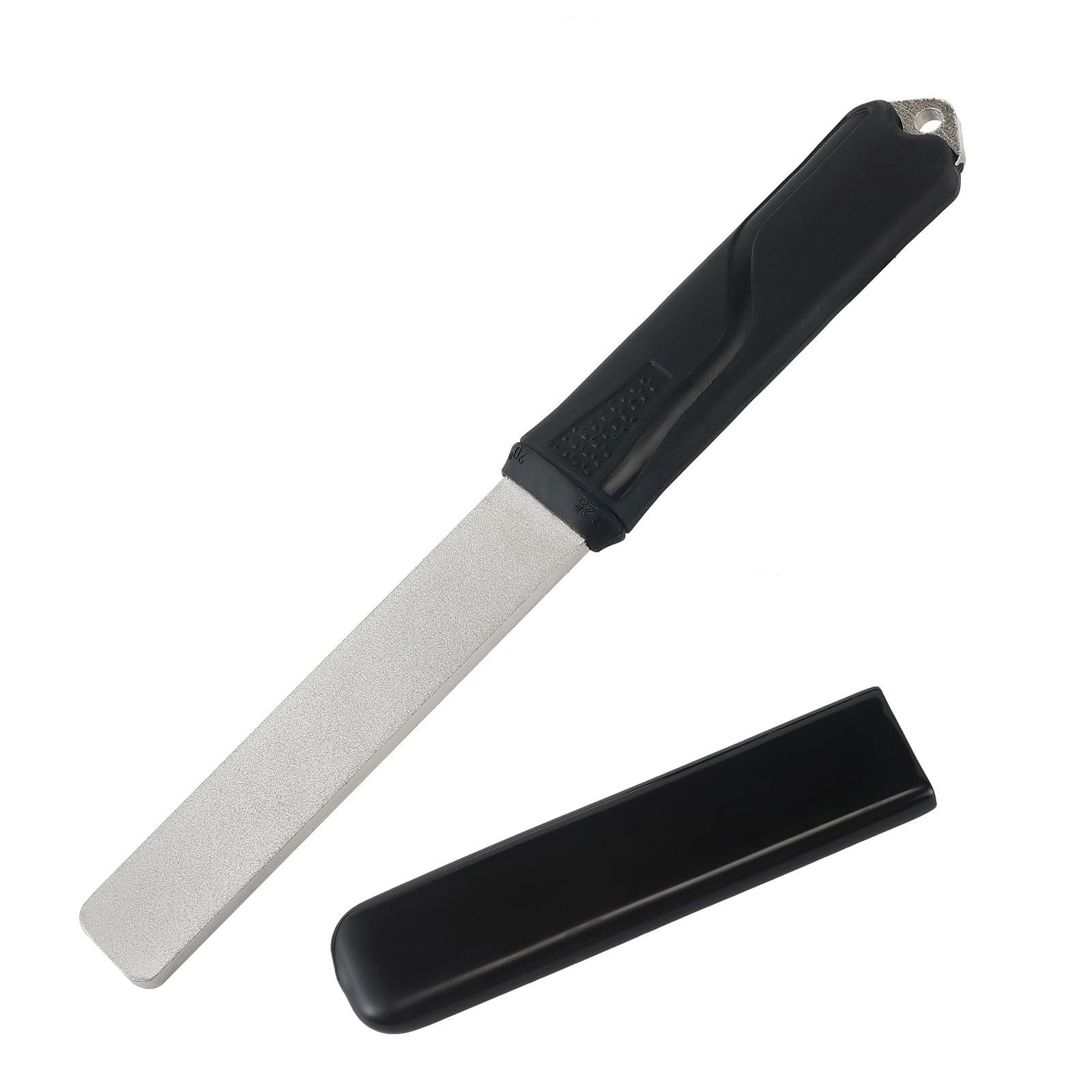
A compact dual-grit that hangs on a carabiner and sharpens in a few strokes.
This sharpener is the definition of “always within reach.” It offers the same practical 325 coarse / 1200 fine grit combination as the top pick but in a slightly more compact 8.5-inch frame. The real draw is how owners actually use it: one professional keeps it on a carabiner attached to their apron string in a busy kitchen, sharpening tools every single day. It is small and light enough for that constant carry.
The monocrystalline diamond layer is coated on full-tang stainless steel, giving it a very high hardness level for sharpening hard steels. Like the SHARPAL version, it is designed to be used dry — no oil, no water, no preparation, and no cleanup. The included matched angle guide helps you maintain a consistent bevel, and the edge guide is praised for making it easy to tune up blades without any fuss.
Reviewers point out it “sharpens my blades in just a few strokes,” and it is recommended as a convenient alternative to traditional stones. The main caveat, noted by a few, is that it is smaller than expected for the price, making it awkward for large mower blades or axes in one pass. It is a superb quick touch-up tool, not a heavy-duty workshop file.
Strengths
- Dual 325/1200 grit surfaces cover fast edge-setting and fine honing.
- Ready to use out of the package with no oil or water needed.
- Compact enough to keep on a carabiner for daily carry.
Limits
- Smaller physical size feels awkward for large mower blades.
- The rubber sleeve can be hard to remove, which owners have noted.
Best for: quick daily touch-ups on knives and small garden shears, carried right on your belt.
Think twice if: you primarily sharpen long, wide mower blades that need a longer file stroke.
5. Berry&Bird Sharpening Stone File
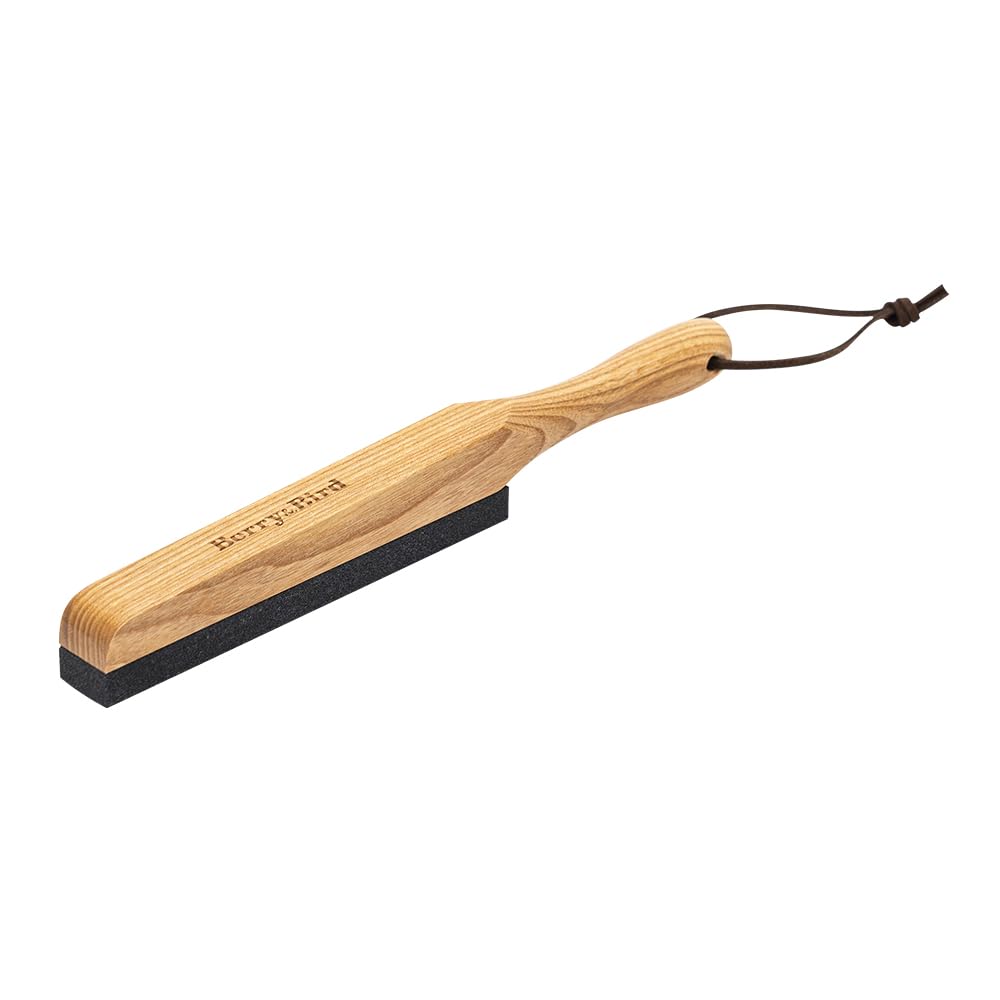
A handsome ashwood-handled file that brings old-school feel to modern blade care.
For those who like the tactile ritual of a traditional sharpening stone, this file adds a comfortable Ashwood handle that makes it easy to hold and use. It is constructed from a high-quality 180 grit black silicon carbide abrasive stone, which is a very durable abrasive that smoothly hones edges. While 180 grit is on the coarser side, it is effective for putting a fresh edge on tools that have lost their bite.
This is the sharpener for the person who wants a natural, hand-guided experience rather than a plastic gadget. Owners describe it as “an amazing sharpening tool” that completely renewed their hedge trimmer, praising its excellent quality and design. The wooden handle is noted as being nice and comfortable, with packaging that feels premium — a detail that matters when you are proud of your garden gear.
At 8.4 inches long and weighing just 3.2 ounces, it is light enough to maneuver along trimmer teeth with precision. Because it uses a traditional silicon carbide stone rather than diamond, it has a slightly different cutting feel. The trade-off is that a single 180 grit stone lacks a fine-grit side for polishing, so you may want a finer stone to finish the edge after using this one.
Classic feel: The Ashwood handle and traditional stone make sharpening feel like a craft, not a chore.
Choose it if: you appreciate a natural, hand-guided sharpening feel with a comfortable wooden handle.
Note: It is a single coarse grit, so pair it with a fine stone for the smoothest final edge.
6. Spear & Jackson 4056BS 6-in-1 Blade Sharpener

An entry-level multi-tool that hides its cleaning sponge and oil right in the handle.
If you want a single inexpensive tool to cover all your garden blade basics, this 6-in-1 sharpener is a clever package. It offers 4 sharpening options to handle a wide range of blade types, from pruning shears to hedge trimmer teeth. The clever bit is the built-in storage: a cleaning sponge and lubricating/anti-corrosion oil live right inside the handle, so you always have the accessories you need at hand.
The tungsten carbide blade material makes it effective at restoring a working edge to blunt tools. Shoppers say using it on garden tools to get everything “much sharper and much easier to use” for cutting branches and plants. It is praised as straightforward and effective for the money, bringing blunt pruners and loppers back to being usable with a soft-feel non-slip grip and a built-in hand guard for safety.
As a budget tool, it has some rough edges. A few owners struggle with the 6-in-1 design, noting that without clear instructions, it can be hard to figure out the correct angle to lay the tool so you do not accidentally dull the edge. It also works well for shears but is not suited for lawn mower blades. If you want a cheap, versatile sharpener that is easy to use, this is a solid start, but be prepared for a small learning curve.
What you get
- 4 sharpening options cover shears, pruners, and other common garden blades.
- Built-in cleaning sponge and oil keep blade maintenance in one place.
- Soft-feel grip and hand guard add comfort and safety.
Keep in mind
- Not designed for lawn mower blades, despite the multi-tool claim.
- Figuring out the right sharpening angle takes some trial and error.
Best for: the budget-minded gardener who wants one cheap tool for general pruning and shearing upkeep.
Not for: heavy-duty mower blade grinding or anyone who dislikes a bit of a learning curve.
Understanding the Specs
Grit Number
This is the size of the abrasive particles on the stone. A lower number like 220 is coarse, meaning it aggressively removes metal to fix nicks and reshape an edge. A higher number like 1200 is fine, meaning it polishes the edge to a smooth, razor-sharp finish. Many sharpeners now offer dual grits — one side for repair, one for refinement — so you can do the whole job with one tool.
Diamond-Coated vs. Traditional Stone
Diamond-coated tools bond tiny industrial diamonds to a steel base, letting them cut through hard steel faster than traditional whetstones. The biggest practical difference is that diamond sharpeners generally work dry, so you skip the messy oil or water prep and cleanup. Traditional silicon carbide stones, like the Berry&Bird, offer a classic feel but often need lubricant to prevent clogging.
Angle Guide
Sharpening requires holding the tool at the same angle as the blade’s factory bevel — usually around 20° for garden tools. An angle guide is a built-in feature that helps you maintain this angle consistently. A fixed guide (like on the SHARPAL 103N) presets the angle for you, while an adjustable guide (like the 201H) lets you dial in anywhere from 22° to 84° for different blade types.
Handheld vs. Guided Design
This is the fundamental choice. A handheld file or stone gives you total freedom to follow the curve of any blade, but requires practice to hold the angle steady. A guided sharpener holds the blade for you, making it far easier for beginners, but the fixed slots may not reach every part of oddly-shaped blades, like the hinge area on some shears.
FAQ
What angle should I use to sharpen a hedge trimmer blade?
Do I need oil or water to sharpen with diamond tools?
Can one sharpener handle both my hedge trimmer and my lawn mower blade?
What is the difference between 325 grit and 1200 grit?
What does the “6-in-1” on the Spear & Jackson mean?
Is a diamond sharpener better than a honing stone?
Why is my hedge trimmer still tearing leaves after I sharpened it?
How do I sharpen the teeth on a hedge trimmer specifically?
Final Thoughts: The Verdict
For most people, the tool for sharpening hedge trimmers winner is the SHARPAL 121N because its 325/1200 dual-grit diamond surface fixes a dull edge and then polishes it, all without oil. If you want a simple to use guided system that sets the angle for you, grab the SHARPAL 103N. And for the serious enthusiast who needs precise, repeatable angles on scissors and shears, the SHARPAL 201H is the one to reach for.
How We Picked
We do not accept paid placement. Every pick is matched to a real buyer and a real use-case; we do not hands-on test units.
Sources & Methodology
Specifications: manufacturer listings and product documentation. Review insights: verified customer reviews, as of August 2026. Pricing: not shown on this page (it changes often); check the current price via the retailer link.
As an Amazon Associate, Lawn Gear Lab earns from qualifying purchases. This does not affect which products we feature.