
Specs are compiled from manufacturer listings and verified buyer reviews and can change over time — please confirm the key details on the product page before buying.
You spray a thistle killer, but the wrong one turns your lawn brown along with the weeds. You need a formula that kills the prickly invader and spares your grass — and that choice depends on a few specific ingredients and how you apply them. Here is what actually works for lawns, flower beds, and driveways, based on manufacturer specs and what buyers really report.
I’m Rikta — the founder and writer behind Lawn Gear Lab. This guide is built by comparing the manufacturers’ published specifications and the patterns across verified customer reviews, so you get each pick’s real strengths and trade-offs instead of marketing spin.
Thistles are stubborn perennials (plants that come back year after year) with deep taproots (a single, thick root that grows straight down). The best approach depends on if you want to kill only the thistle or everything green in its path. That is what separates a good thistle killer from a bad one — selectivity (the ability to kill only certain plants).
Quick Picks
- Nufarm Change Up — Best Overall
- ALLIGARE 2,4-D Amine Weed Killer — Farm Grade
- ECO Garden PRO Organic Vinegar Weed Killer — Kid & Pet Safe
- Albaugh Gly Star Plus Herbicide — Total Kill
How To Choose The Best Thistle Killer
Thistle is a tough broadleaf weed (a plant with wide, flat leaves, unlike narrow grass blades) with a taproot (a thick central root that grows deep) that laughs at superficial spraying. To pick the right product, match the herbicide type to the location — lawn, garden bed, or hardscape — and understand the active ingredient that does the actual work.
Selective vs. Non-Selective
A selective herbicide (one with dicamba or MCPA) kills broadleaf weeds but leaves your grass unharmed. That is the go-to for lawns. A non-selective option (typically glyphosate, a chemical that stops plant growth) kills every green thing it touches, making it better for driveways, patios, or spot-treating before reseeding. Mixing them up is the fastest way to destroy your turf.
Concentrate vs. Ready-to-Use
Concentrates (liquid you dilute with water) save money in the long run and let you dial in the strength, but you need a separate sprayer. Ready-to-use (RTU) bottles are grab-and-go convenient, though you pay a premium per ounce. For a large lawn, a concentrate stretches further; for a single patch of thistle in the flower bed, an RTU sprayer is fine.
Active Ingredients That Matter
The most common thistle-fighting ingredients are 2,4-D (good general broadleaf control), dicamba (penetrates tough perennial weeds), MCPA (works on clover and thistle), and glyphosate (total vegetation kill). A blend of several actives usually beats a single-ingredient product on stubborn thistle.
Quick Comparison
| Model | Best For | Volume | Active Ingredient | Selectivity | Amazon |
|---|---|---|---|---|---|
| Nufarm Change Up | Lawn-safe thistle control | 32 oz | MCPA/Fluroxypyr/Dicamba | Selective | Amazon |
| ALLIGARE 2,4-D Amine | Farm & pasture broadleaf | 1 Gal | 2,4-D (47.2%) | Selective | Amazon |
| ECO Garden PRO | Pet & kid-safe areas | 1 Gal | Vinegar/Rock Salt | Non-selective | Amazon |
| Albaugh Gly Star Plus | Total vegetation kill | 2.5 Gal | Glyphosate (41%) | Non-selective | Amazon |
In‑Depth Reviews
1. Nufarm Change Up

Selective chemistry that hits thistle hard while your grass stays green.
Nufarm Change Up is a premium selective herbicide (a weed killer that spares grass) built for lawns, not wastelands. Its blend of three active ingredients — MCPA (51.05%), fluroxypyr (6.0%), and dicamba (4.17%) — targets over 200 broadleaf weeds including Canada thistle, dandelion, and oxalis (a common lawn weed). Yet it is labeled for cool- and warm-season turfgrasses like Bermudagrass, Kentucky bluegrass, Fescue, and St. Augustinegrass. That means your lawn stays intact while only the thistle dies — no bare patches to reseed afterward. You mix 0.46 oz to 1.1 oz per 1,000 square feet, so the 32 oz bottle goes a long way.
Buyers report the clover was gone in a little over a week, with no damage to the surrounding lawn. Unlike the non-selective Gly Star Plus further down, this one works through the leaves down to the root, so patience is part of the process — one reviewer noted you can see where you missed because those plants stay green. The 2.1-pound jug is compact, compared to the Gly Star Plus at 15 pounds, making it far easier to handle and store.
It is a concentrate, so you do need a separate sprayer, but the application is straightforward. For a homeowner fighting thistle in a manicured lawn, this is the most effective tool that will not nuke your grass.
Why it works on lawns
- Selective — kills only broadleaf weeds, spares turfgrasses
- Triple-active blend covers 200+ weed species
- Lightweight 2.1 lb jug is easy to carry and pour
What to know before buying
- Requires a separate sprayer (not RTU)
- Do not apply to a freshly cut lawn — needs leaf surface to work
- Results take about a week for full die-off
Lawn-first pick: Reach for this if you want thistle gone without killing your grass — ideal for turf with clover or oxalis mixed in.
Not for hardscapes: If you just want to clear a gravel driveway or patio joints, a non-selective total kill will be faster and cheaper.
2. ALLIGARE 2,4-D Amine Weed Killer
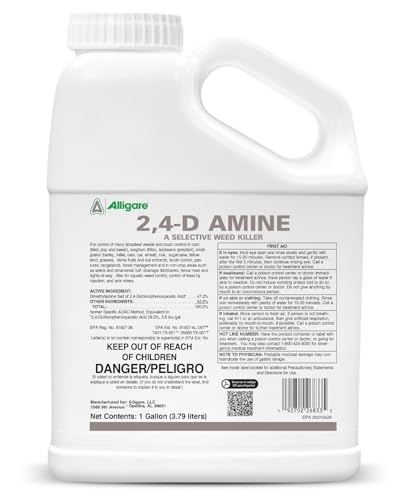
A straight-up 2,4-D concentrate that handles thistle in pastures, lawns, and even aquatic sites.
ALLIGARE 2,4-D Amine is a no-frills selective herbicide with 47.2% 2,4-D (a common broadleaf weed killer). It is a staple for farms, pastures, and larger properties. It targets broadleaf weeds like pigweed, thistle, and ragweed while leaving grass alone — but unlike the Nufarm Change Up above, it uses a single active, so it may not hit as many weed species in one pass. The 1-gallon jug (128 fluid ounces) mixes easily with water, and owners mention it works great and killed weeds within a few days.
One reviewer warns to follow the mixing instructions carefully or you will fry your grass — that is true of any 2,4-D concentrate, but the margin for error is smaller here since the active is potent. It is labeled for lawns, pastures, forests, and aquatic sites (areas with water, like ponds), giving it broader site versatility than any other pick in this list. Not for sale to Texas per some buyer reports, so check your state restrictions before ordering.
At the same 1-gallon liquid volume as the ECO Garden PRO, the ALLIGARE is a concentrate requiring dilution, while the ECO is ready-to-use. That means this gallon lasts much longer, but you need a sprayer and a bit of math.
Strengths at a glance
- High 47.2% active concentration for strong weed control
- Selective — kills broadleaf weeds, safe for grass
- Works on farms, lawns, and even aquatic environments
Potential drawbacks
- Single active ingredient — less broad-spectrum than triple-blend options
- Mixing mistakes can easily damage your turf
- Not available in some states (e.g., Texas, per customer reports)
Farm & field choice: Best for large-area broadleaf control in pastures or hayfields where grass safety matters but weed variety is limited.
Skip for single-spray simplicity: If you just have one thistle patch in your flower bed, a ready-to-use product will be less hassle.
3. ECO Garden PRO Organic Vinegar Weed Killer
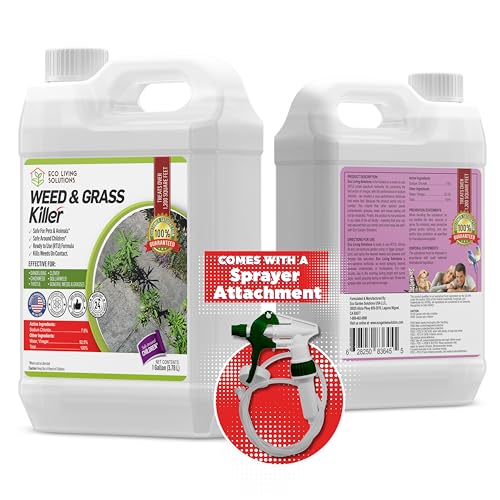
A non-toxic vinegar spray that works fast but kills everything it touches.
ECO Garden PRO is the only non-chemical option here, using natural white vinegar, organic rock salt, and biodegradable plant activators to kill weeds and grass within 24 hours. It claims immediate results, and one buyer who was skeptical because it was non-toxic said it killed the grass in their patio bricks just perfectly. It is ready-to-use (RTU) straight from the 1-gallon bottle, so no mixing, no measuring, no sprayer setup needed.
There is a catch with the included sprayer — multiple reviewers report the sprayer fails after one use or does not work at all, calling it useless and a mess to transfer. The liquid itself works, but you may want to buy a separate sprayer. At 128 fluid ounces per jug, it has a liquid volume of 128 fl oz compared to the Gly Star Plus at 320 fl oz, though it costs less upfront. It is non-selective, meaning it will kill grass, clover, moss, and thistle alike, so use it only on hardscapes, patios, or spots you plan to replant later.
For families with kids or pets who play on treated surfaces, this is the only pick that is labeled safe for bees, fish, and groundwater. The trade-off is that it may not kill the deep thistle root on the first application — vinegar burns foliage (the leaves and stems) but systemic herbicides (chemicals that travel through the plant) penetrate the root system more reliably.
Why choose organic
- Non-toxic, safe for pets, children, bees, and fish
- Visible results within 24 hours — fastest burn-down here
- Ready-to-use with no mixing or measuring
What to watch for
- Included sprayer is prone to failure — buy a separate one
- Non-selective — kills all vegetation, not just thistle
- May not kill deep taproots on first application (topical burn only)
Safe-spot spray: Ideal for patios, sidewalks, and mulch beds where kids and pets roam — the 24-hour kill speed is a bonus.
Not for lawns: If you want to keep your grass, skip this — it does not discriminate between thistle and Kentucky bluegrass.
4. Albaugh Gly Star Plus Herbicide

A massive 2.5-gallon jug of glyphosate that wipes out every plant it hits.
Albaugh Gly Star Plus is a non-selective, post-emergent systemic herbicide (a liquid you spray on growing weeds that travels through the plant) with 41% glyphosate and a built-in surfactant (a soap-like additive that helps the spray stick to leaves). It contains the same active ingredient as Roundup Ultra, but in a 2.5-gallon jug (320 fluid ounces) (320 fluid ounces). This is a 2.5-gallon volume, compared to the 1-gallon options of ECO Garden PRO and ALLIGARE, making it the best value for large-scale clearing projects on driveways, fence lines, or overgrown lots.
Customers note visible effects in 2-4 days on most annual weeds and 7+ days on perennials, with one reviewer noting it takes about 10 days to two weeks to see everything dead, but for the price it is worth it. The product is labeled for professional/commercial use and is not intended for residential lawns — it kills everything, including grass. It also has no soil residual activity (it breaks down quickly in soil), meaning you can plant new grass after the weeds are dead without worrying about chemical carryover.
At 15 pounds, this jug is heavy — over the Nufarm Change Up at 2.1 pounds — so plan for storage and pouring. Not available in CA, MT, NV, OR, WA, or WY per the manufacturer restriction. The 2.5 gallons will last a very long time for spot-treating, but only if you already have a reliable sprayer.
What makes it a powerhouse
- 2.5 gallons of concentrate — class-leading volume for the price
- 41% glyphosate with built-in surfactant for better leaf adhesion
- No soil residual activity — safe to replant soon after use
Before you buy
- Non-selective — will kill grass, flowers, and shrubs, not just thistle
- Heavy 15-lb jug is awkward to lift and pour
- Not labeled for residential use; commercial/professional only
Bulk clearance choice: Grab this for driveways, gravel paths, and large lots where you want total vegetation elimination with the biggest volume per dollar.
Not for lawns or small patches: If you only have a few thistle plants in your yard, this is overkill — a selective or RTU product will be easier and safer.
Understanding the Specs
Selectivity (Selective vs. Non-Selective)
This is the single most important spec for a thistle killer. A selective herbicide targets only broadleaf weeds and leaves your grass untouched — the active ingredients like 2,4-D, dicamba, and MCPA make that happen. A non-selective herbicide like glyphosate kills every green plant it contacts. Use selective on lawns, non-selective on patios, driveways, and gravel.
Concentration and Active Ingredients
The active ingredient percentage tells you how much actual weed-killing chemical is in the bottle. A higher percentage (like 47.2% for the ALLIGARE 2,4-D) means you use less per gallon of water. But a blend of multiple actives (like the MCPA + fluroxypyr + dicamba in the Nufarm Change Up) often works better on stubborn perennial thistle because each ingredient attacks a different weakness in the weed.
FAQ
What is the best time of year to kill thistle?
Will a selective thistle killer damage my grass?
Can I use glyphosate on my lawn to kill thistle?
How long does it take for thistle to die after spraying?
Is organic vinegar weed killer effective on thistle?
Should I pull thistle by hand before spraying?
Can I mix different weed killers together for thistle?
Will rain wash away the thistle killer?
What does “no soil residual activity” mean?
How much thistle killer do I mix per gallon of water?
Final Thoughts: The Verdict
For the majority of shoppers, the thistle killer winner is the Nufarm Change Up because its triple-active blend kills tough broadleaf weeds like thistle and clover without damaging your lawn — and at 2.1 pounds, it is easy to handle compared to bulkier options. If you want a farm-grade selective for large pastures, grab the ALLIGARE 2,4-D Amine. And for a pet-safe non-toxic spray on patios and driveways, the standout is the ECO Garden PRO with its 24-hour burn-down speed.
How We Picked
We do not accept paid placement. Every pick is matched to a real buyer and a real use-case; we do not hands-on test units.
Sources & Methodology
Specifications: manufacturer listings and product documentation. Review insights: verified customer reviews, as of July 2026. Pricing: not shown on this page (it changes often); check the current price via the retailer link.
As an Amazon Associate, Lawn Gear Lab earns from qualifying purchases. This does not affect which products we feature.