
Specs are compiled from manufacturer listings and verified buyer reviews and can change over time — please confirm the key details on the product page before buying.
Killing a succulent with kindness is a real thing. Douse them with the wrong food, and you get weak, leggy growth or burned roots—the opposite of the tight rosettes you bought them for. The trick is a formula that matches how these slow-growing plants actually feed: low in nitrogen, easy to absorb, and never harsh.
I’m Rikta — the founder and writer behind Lawn Gear Lab. This guide is built by comparing the manufacturers’ published specifications and the patterns across verified customer reviews, so you get each pick’s real strengths and trade-offs instead of marketing spin.
Whether you keep a single Jade on a windowsill or a shelf full of Echeveria under grow lights, choosing the right succulent plant food means the difference between a plant that just survives and one that shows off thick, vibrant leaves.
Quick Picks
- HiThrive 32oz Succulent Fertilizer — Best Overall
- Growth Technology GT Succulent Focus — Premium Pick
- Baby Bio Succulent Food, Concentrate, 5.9 Oz (3-Pack) — Best Value
- Espoma Organic Cactus! Plant Food, 8 oz, Pack of 2 — Clean Organic
- Miracle-Gro Succulent Plant Food, 8 fl. oz. (2 Pack) — Instant Feed
- Grow Queen All-In-One Organic Succulent Fertilizer — Granular Power
- TPS Nutrients Succulent Fertilizer, 32 oz — Compact Focus
How To Choose The Best Succulent Plant Food
Succulents are not hungry plants. Overfeeding them with a standard all-purpose fertilizer causes soft, fast growth that ruins their compact shape. The right succulent food is low in nitrogen, gentle enough to use every other watering, and easy to control so you do not burn the roots. Here is what to look for.
Liquid vs Granular vs Organic Options
Liquid concentrates let you control the exact dose and are the fastest fix for a nutrient problem — you mix them with water and feed as you water. Granular time-release foods, like the All-In-One Organic from Grow Queen, need one scoop per plant and keep feeding for months, so you can set and forget. Organic formulas often include beneficial soil microbes that support root health over time, but some liquid organics (like Espoma) smell like manure until you dilute them.
The Mixing Ratio and Feeding Frequency
The mixing ratio on the bottle is your most important safety number. A ratio like “5 drops per pint” or “½ cap per quart” prevents fertilizer burn (damage from too much salt). Feeding every two to four weeks during spring and summer is standard, while most plants need no food at all during winter dormancy (when growth stops). A product with a higher dilution ratio — like the HiThrive 32oz bottle that makes 64 gallons — gives you more feedings per bottle and a bigger safety buffer.
Number of Applications Per Bottle
The real value is not the bottle size — it is how many gallons of finished fertilizer that bottle makes. A small 5.9-ounce concentrate that makes several gallons can be far more economical than a larger ready-to-use bottle that makes only a few quarts. Check the total gallon yield in the specs to compare prices fairly.
Quick Comparison
On smaller screens, swipe sideways to see the full table.
| Model | Best For | Bottle Size | Total Yield | Item Form | Amazon |
|---|---|---|---|---|---|
| HiThrive 32oz | Longest-lasting liquid value | 32 fl oz | 64 gallons | Liquid | Amazon |
| Baby Bio 3-Pack | Smallest, most portable doses | 5.9 fl oz (3-pack) | — | Liquid | Amazon |
| Grow Queen Organic | Time-release organic feed | 1 lb bag | 100 plants / 8 months | Powder | Amazon |
| Espoma Organic 2-Pack | Trusted organic brand | 8 fl oz (2-pack) | — | Liquid | Amazon |
| Miracle-Gro 2-Pack | Instant pump-and-feed ease | 8 fl oz (2-pack) | — | Liquid | Amazon |
| Growth Technology GT | Complete mineral profile | 8.5 fl oz | — | Liquid | Amazon |
| TPS Nutrients 32oz | Compact growth focus | 32 fl oz | — | Liquid | Amazon |
In‑Depth Reviews
1. HiThrive 32oz Succulent Fertilizer
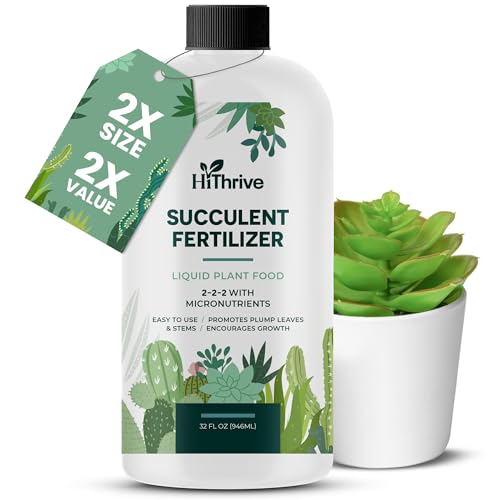
The 32-ounce giant that turns into 64 gallons of succulent food.
You mix just ¼ teaspoon per quart of water, so the bottle lasts through many seasons of indoor and outdoor succulents.
The formula carries nitrogen (N) for leaf growth, phosphorus (P) for root strength, and potassium (K) for general resilience — known together as the NPK ratio. It also adds micronutrients like calcium, magnesium, and zinc to correct specific deficiencies. Buyers report that it brought an agave plant to life, with one returning customer saying “this was the second time we have ordered this product! It has made my agave plant grow and look great!”
Unlike the Grow Queen granular option that feeds for months per application, this is a liquid you apply every other watering — it gives you total control over dosage. It is just as easy to over-use as any liquid, so stick to the ¼-teaspoon rule.
Why it earned the top spot
- Makes 64 gallons from one bottle — best yield-per-dollar by a wide margin
- Weighs 2.3 pounds versus the 1 lb Grow Queen bag, showing its dense concentrate
- Balanced NPK plus calcium, magnesium, and zinc for specific deficiency correction
Keep in mind
- Single bottle with no multi-pack option
- Requires measuring ¼ teaspoon each use — not as instant as a pump
Reach for this if: You want the most concentrated, longest-lasting liquid food and are comfortable with a quick measurement before each watering.
Look elsewhere if: You prefer a no-measure pump or a granular time-release that you apply once and forget.
2. Growth Technology GT Succulent Focus
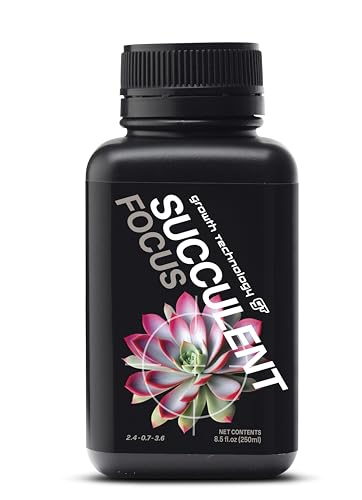
A complete 12-mineral formula that is pH buffered for perfect uptake.
This is the most technically refined liquid food on the list. GT Succulent Focus contains all 12 essential minerals, including calcium, and is pH buffered — meaning the solution stays in the ideal acidity range so nutrients stay available to the roots instead of locking up in the soil. Unlike the Espoma Organic which has a manure smell, this formula contains no sodium, chlorides, or urea.
The mixing ratio adapts to your growing method: 3-5 ml per liter for soil and 5-7 ml per liter for hydroponics (growing in water) or semi-hydro systems. Reviewers call it “the best stuff I’ve found” and one reviewer noted “my hydro plants grow like weeds with it.”
The catch is the smallest bottle on the list at 8.5 fluid ounces, and it is the priciest per ounce. If you run a large collection with a variety of succulents, the HiThrive bottle makes far more feedings for the money. But if you want a lab-grade formula with every essential mineral — especially for picky Euphorbias or semi-hydro setups — this is the one.
The lab-coat verdict: This is the product for the enthusiast who wants to know exactly what their plant is getting — a complete, contaminant-free mineral profile in every dose.
Best for: Serious collectors with varied succulents who value precise mineral nutrition over pure volume.
skip it if: You need a big bottle for a large collection — the 8.5-ounce size runs out fast when feeding many plants.
3. Baby Bio Succulent Food, Concentrate, 5.9 Oz (3-Pack)
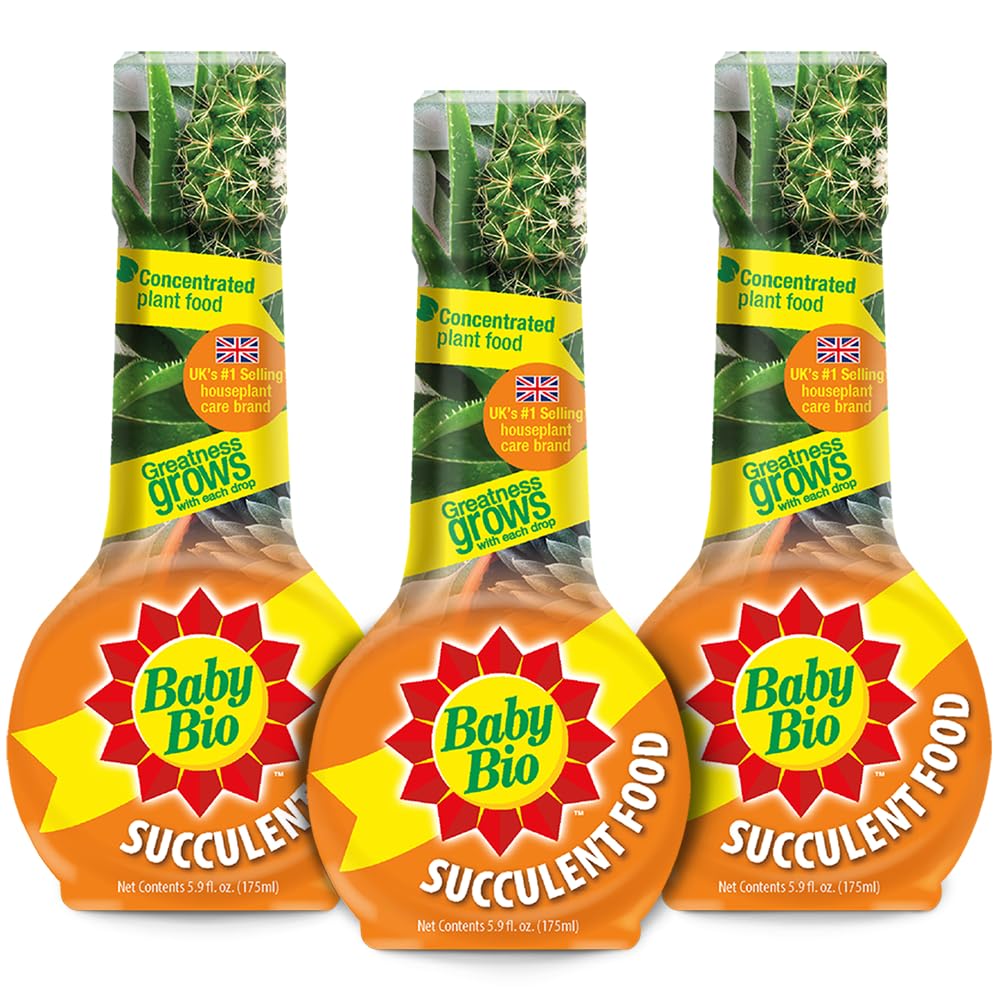
Three tiny bottles that pack a concentrated punch for houseplant lovers.
Baby Bio comes as a 3-pack of 5.9-ounce bottles — 3 bottles versus the HiThrive single bottle — so you can keep one at the office, one at home, and one in the garage without hauling a big container around. The mixing ratio is just 5 drops per pint of water, making it among the most concentrated formulas you can buy.
Owners mention “visible improvement in houseplants within weeks: healthier leaves, richer color, steady growth.” The dripper bottle makes application simple, and the formula is designed to strengthen spines on cacti while supporting balanced growth and flowering for indoor and outdoor succulents.
At only 5.9 fluid ounces per bottle versus the HiThrive’s 32 ounces, the total liquid volume is a fraction of the bigger bottle. If you have a large collection, you will be buying more frequently. For the kitchen-sill succulent keeper, the small size is actually a feature — neat storage, no measuring spoon needed.
Small but mighty
- Extremely concentrated — just 5 drops per pint of water
- 3-pack gives you flexibility to feed in different locations
- Dripper bottle is mess-free and easy to apply
Size reality check
- Only 5.9 fluid ounces per bottle — small total volume for the money
- According to buyer feedback, the formula is synthetic-derived despite the “Bio” name
Reach for this if: You keep a few succulents indoors and want the most concentrated, easy-to-store liquid option that won’t clutter your shelf.
Look elsewhere if: You feed a large, varied succulent collection and need a big bottle of concentrate.
4. Espoma Organic Cactus! Plant Food, 8 oz, Pack of 2

The organic liquid that smells like a farmyard but works like a charm.
among the most trusted names in organic plant care, Espoma’s Cactus! formula is an OMRI-listed (Organic Materials Review Institute) liquid concentrate. You mix ½ cap per quart of water and feed every 2-4 weeks during the growing season. Buyers warn that the concentrate “smells like manure but odor disappears when diluted” — one buyer mentioned no soil odor after weekly use for a full month.
Users report serious results: one saw an aloe vera “glowing” within hours, while another said the food “resuscitated my succulents.” The NPK ratio is 1-2-2, which is lighter than most all-purpose foods, but one experienced buyer noted that the nitrogen level may be too high for very slow-growing cacti — they prefer a 2-7-7 ratio for those.
It comes as a 2-pack of 8-ounce bottles, so you get 16 ounces total. The total liquid volume is the same as the Baby Bio 3-pack (17.7 oz total), but the Espoma 2-pack gives you only two bottles versus Baby Bio’s three.
The trade-off: Proven organic results and a trusted brand name, but the strong concentrate smell and slightly higher nitrogen for a cactus food are real considerations for sensitive indoor use.
Best for: Gardeners who insist on organic inputs and don’t mind a short-lived manure odor during mixing.
pass on it if: You are feeding very slow-growing miniature cacti that prefer an even lower-nitrogen ratio.
5. Miracle-Gro Succulent Plant Food, 8 fl. oz. (2 Pack)

Zero-measurement pump food for the “just feed it and go” crowd.
This is the easiest food to use in the whole lineup. The pump applicator lets you apply directly to the soil — 2 pumps for small pots, 5 pumps for large pots — or mix 8 pumps per quart of water to feed and hydrate in one step. No measuring cups, no droppers, no math.
Miracle-Gro is the household name here, and the results speak to that. One buyer’s Thanksgiving cactus grew to “6x original size” with heavy blooms, and a 2-pack lasted roughly 1.5 years for that user. The formula feeds instantly, so you see a noticeable boost in new growth after a single use.
The 8-ounce bottles are small compared to the 32-ounce HiThrive — you get 16 ounces total across the 2-pack. If you feed many plants, you will repurchase more often. But for the casual succulent owner who wants to grab a bottle and pump without thinking, this convenience is tough to top.
The convenience advantage
- Pump applicator — no measuring, no mixing if you pump directly into soil
- Instantly available nitrogen for quick green-up
- Trusted brand with consistent formulation
The size reality
- Small 8-ounce bottles — less economical for large collections
- Synthetic formula, not organic
Reach for this if: You want a grab-and-feed bottle with zero measuring — perfect for a few houseplants.
Look elsewhere if: You need a large volume of concentrate or prefer organic ingredients.
6. Grow Queen All-In-One Organic Succulent Fertilizer
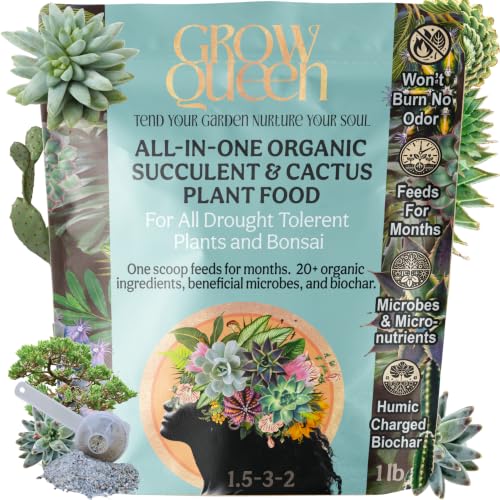
A one-pound bag that feeds up to 100 succulents for 8 months.
This is the only granular option in the lineup, and it changes the whole feeding rhythm. A single 1-pound bag equals 25 single servings that feed up to 100 succulents or 50 gallons of soil for up to 8 months — making it the longest-lasting product by coverage span. Unlike the liquid HiThrive that needs measuring every watering, you simply scoop once and let the slow-release microbes do the work for 2 to 8 months.
The formula is OMRI-listed organic, vegan, and labeled pet-friendly. It is loaded with living beneficial soil microbes that, according to the brand, improve the immune system of the plant and enrich the soil permanently. Customers note that “after 3 months, Christmas cactus cuttings bloomed abundantly with strong stems.” One reviewer called it “the absolute best and long lasting plant food for my cactuses and succulents.”
It is also the most sustainable option — non-synthetic, low-carbon footprint, and safe for waterways according to the maker. The trade-off versus liquid foods is that you cannot adjust the dose mid-season as easily. Once the granules are in the soil, they release at their own pace. If you want hands-on control of every feeding, stick with a liquid.
The 8-month commitment: A single purchase feeds a whole collection for nearly a year with no mixing, no bottles, and no measuring — ideal for anyone who hates the weekly fertilizer routine.
Best for: Large collections of succulents where mixing liquid for every watering would be a chore.
it’s not for you if: You want to control feeding strength manually or need fast correction of a nutrient deficiency.
7. TPS Nutrients Succulent Fertilizer, 32 oz
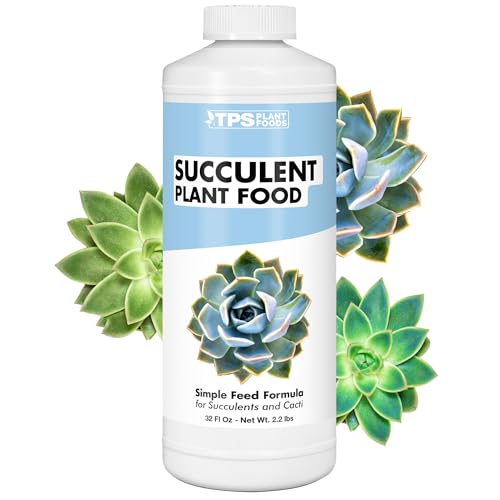
The liquid formula built to stop leggy succulents in their tracks.
TPS Nutrients markets this as a food that “helps prevent leggy succulents” (stretchy, weak stems) while encouraging thicker leaves and better plant structure — a specific focus on compact growth. The 32-ounce bottle gives you a large volume of concentrate, similar to the HiThrive 32oz, but with a different mixing ratio of 1:200 (one part fertilizer to 200 parts water).
Reviewers point out good results: one owner reported “I’ve given my succulents three feedings this early season and all of them have greened up beautifully!” Another noted their succulents “thrive with this plus a grow light.” The gentle formula is designed for container plants to avoid buildup or root stress, which is critical for potted succulents that stay in the same soil for years.
One customer observed their Christmas cactus looked green and healthy after repotting and using this fertilizer, but they were not yet seeing blooms — likely a light issue rather than a food problem. The main downside versus the HiThrive 32oz is that the TPS formula lacks the detailed micronutrient breakdown (calcium, magnesium, zinc) that the HiThrive label provides.
Why it works for compact growers
- Specifically formulated to prevent leggy stretching
- Gentle for containers — no buildup or root stress
- Large 32-ounce bottle gives good total volume
The trade-off
- Less detailed micronutrient profile than the HiThrive 32oz
- Some users with Christmas cacti not yet seeing blooms
Reach for this if: Your succulents stretch up toward the light — this is the formula designed to keep them squat and compact.
Look elsewhere if: You want a full micronutrient mineral profile and prefer a known brand with specific deficiency corrections.
Understanding the Specs
NPK Ratio
This stands for Nitrogen (N), Phosphorus (P), and Potassium (K) — the three primary nutrients. For succulents, you want a low first number (Nitrogen). High nitrogen forces fast, weak growth and ruins the compact, tight rosette shape you want. A ratio around 1-2-2 or 2-7-7 is ideal for slow-growing cacti and succulents.
Total Yield
This is how many gallons of finished fertilizer one bottle makes after mixing with water according to the instructions. A 32-ounce concentrate that makes 64 gallons is vastly more economical than an 8-ounce ready-to-use bottle that makes only a few quarts. Compare total yield, not bottle size, to find the real value.
Liquid vs Granular Form
Liquid feeds give you fast-acting nutrition and precise control over dosage — you mix them with water and apply immediately. Granular time-release foods use a single application that feeds for months, making them ideal for large collections or forgetful feeders. Granular foods often contain beneficial soil microbes that improve long-term soil health.
Organic Certification (OMRI)
OMRI (Organic Materials Review Institute) means the product is approved for use in organic gardening. These foods use natural ingredients without synthetic chemicals, and many include beneficial microbes. The trade-off is that some organic liquid concentrates (like Espoma) have a strong manure smell until diluted.
FAQ
How often should I feed my succulents?
Can I use regular plant food on succulents?
What is the difference between liquid and granular succulent food?
Does organic succulent food smell bad?
How do I apply a liquid succulent food without burning the roots?
Will succulent food help my Christmas cactus bloom?
How much succulent food does a 32-ounce bottle actually make?
Is succulent food safe for pets and kids?
Can I mix different succulent foods together?
Do I need to fertilize succulents in winter?
Final Thoughts: The Verdict
For most buyers, the succulent plant food winner is the HiThrive 32oz Succulent Fertilizer because it gives you 64 gallons of feedings from one bottle with a balanced nutrient profile that includes calcium, magnesium, and zinc. If you want a set-and-forget organic option that feeds for months, grab the Grow Queen All-In-One Organic. And for the casual houseplant keeper who wants zero measuring, the instant convenience of the Miracle-Gro Succulent Plant Food with its pump applicator is the most low-maintenance choice.
How We Picked
We do not accept paid placement, and we did not hands-on test every unit. Instead, we match each pick to a real buyer and use-case by comparing the manufacturers’ published specifications against the patterns in verified customer reviews — so you get each pick’s real strengths and trade-offs instead of marketing copy.
Sources & Methodology
Specifications: manufacturer listings and product documentation. Review insights: verified customer reviews, as of July 2026. Pricing: not shown on this page (it changes often); check the current price via the retailer link.
As an Amazon Associate, Lawn Gear Lab earns from qualifying purchases. This does not affect which products we feature.