
Vegetable gardens have an unspoken enemy: soil splashing onto your tomato leaves, moisture evaporating before the roots can drink, and a constant war against weeds that steal nutrients from your peppers and beans. A high-quality straw mulch forms a physical barrier that solves all three problems at once, creating a microclimate where your vegetables can thrive without constant intervention.
I’m Rikta — the co-founder and writer behind Lawn Gear Lab. I’ve spent countless hours studying horticultural data, comparing bale compositions, analyzing chemical-free sourcing claims, and cross-referencing verified owner feedback to identify which straw mulches actually deliver on their promises for vegetable growers.
After evaluating seven top contenders, I’ve narrowed down the field to the most effective options for any garden size. This is the definitive guide to the best straw mulch for vegetable garden beds, covering everything from moisture retention to weed seed contamination.
How To Choose The Best Straw Mulch For Vegetable Garden
Not all straw is created equal. A bale that works beautifully for animal bedding can introduce grass weed seeds into your vegetable beds, creating more work than it saves. Understanding a few key parameters will help you select the right product for your specific garden setup.
Weed Seed Contamination — The Silent Sabotage
The single biggest complaint among vegetable gardeners using straw mulch is the sudden appearance of grass shoots threading through their pepper and tomato plants. Traditional hay bales are notorious for containing viable weed seeds. Look for products labeled “processed,” “thoroughly cleaned,” or “low seed content.” The best straw mulches for vegetable gardens undergo additional filtration steps to remove seeds, dust, and chaff before packaging. Never assume a product marked “straw” is automatically seed-free.
Bonding Agents vs. Natural Interlocking
Some premium straw mulches include a tackifier — a natural, biodegradable bonding agent that makes the straw fibers stick together once wet. This feature is especially valuable for sloped beds, exposed areas with high wind, or gardens near sprinklers that blast water directly at the soil. Tackified straw holds its position and resists washout. On the other hand, some growers prefer straw that has been specially cut so the fibers naturally interlock when watered, avoiding any chemical additive while still providing wind resistance. The choice depends on your local climate and bed topography.
Coverage Volume and Bale Compression
Vegetable garden straw is sold by weight (pounds) or by volume (cubic feet). A 2.5 cubic foot bale can cover 200–500 square feet depending on whether you are applying a thin ¼-inch layer for seed protection or a thick 2–3 inch layer for weed suppression and moisture retention. Compressed bales appear smaller than their actual coverage — always check the stated coverage area rather than the bag size. For a standard 4×8-foot raised bed, you typically need 8–10 pounds of straw for a 2-inch deep layer that blocks sunlight from reaching weed seeds below.
Quick Comparison
On smaller screens, swipe sideways to see the full table.
| Model | Category | Best For | Key Spec | Amazon |
|---|---|---|---|---|
| HealthiStraw GardenStraw | Clean Mulch | Large vegetable beds & deep mulching | 3 cu ft covers 100 sq ft (2–3″ layer) | Amazon |
| EZ-Straw Seeding Mulch | Tackified | Sloped beds & high-wind gardens | 2.5 cu ft covers 500 sq ft (seeding) | Amazon |
| Gardener Select Seeding Straw | Weed-Free | Seed protection & weed-free guarantee | 2.5 cu ft covers 500 sq ft (seeding) | Amazon |
| Natural Wheat Straw (4 lbs) | All-Purpose | Container & small raised bed mulching | 4 lbs loose straw per bag | Amazon |
| CZ Grain Wheat Straw (4 lbs) | Organic | Small-scale organic beds & animal bedding | 4 lbs resealable bag | Amazon |
| Out-Grow Wheat Straw | Value | Budget-friendly first-time mulching | 1 cu ft (4 lbs) compressed box | Amazon |
| Acostop Natural Wheat Straw | Compact | Small patches & seed starting | 1 lb vacuum-sealed bag | Amazon |
In‑Depth Reviews
1. HealthiStraw GardenStraw
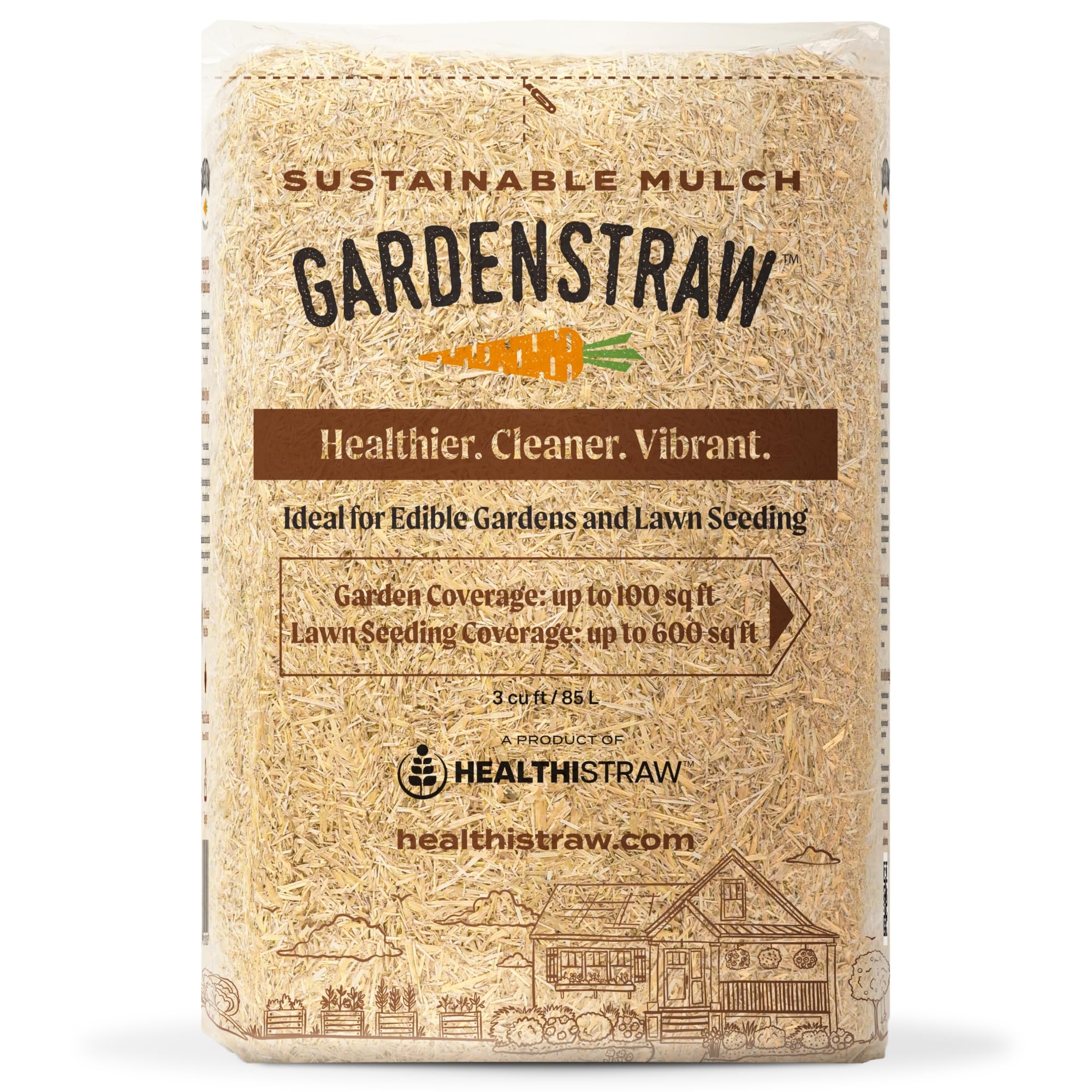
The HealthiStraw GardenStraw is the most gardener-focused bale in this lineup. This compressed 3-cubic-foot bale weighs 20 pounds but expands to cover up to 100 square feet at the 2–3 inch depth that vegetable beds actually need for effective weed suppression — far more coverage than any other product in this price tier. The straw has been specially cut so the fibers interlock naturally when watered, eliminating the need for chemical tackifiers while still holding position against moderate wind and rain.
What sets this product apart is the extensive cleaning process. The wheat straw is naturally filtered to remove dust, dirt, and the vast majority of weed seeds. Verified buyers consistently report seeing no weed germination from the straw itself, a critical advantage for vegetable growers who cannot afford to introduce grass or invasive plants into their beds. The straw breaks down within a single growing season, adding carbon to the compost pile and enriching soil organic matter without requiring removal.
The only practical limitation is the bale size — at 3 cubic feet, it is bulky and requires storage space. Some users have noted a small number of errant grass seeds in their beds, though this is rare compared to standard straw bales. For serious vegetable gardeners managing multiple raised beds or in-ground rows, this is the most balanced option available.
What works
- Interlocking fibers resist wind without chemical binders
- Exceptionally low weed seed count for clean garden beds
- Breaks down into compostable organic matter by season’s end
What doesn’t
- Bulky bale requires dedicated storage space
- Some users report occasional errant grass seeds
2. EZ-Straw Seeding Mulch with Tackifier

The EZ-Straw Seeding Mulch solves a specific problem that plagues vegetable gardeners: keeping seed in place and soil moist when beds are on a slope or exposed to drying winds. The processed straw is coated with a biodegradable tackifier — a natural bonding agent that activates when watered, causing the fibers to stick together into a protective mat. This mat holds firm even during heavy rain, preventing seed washout that can ruin a carefully planted row of carrots or beans.
At 2.5 cubic feet, this bale covers up to 500 square feet when applied at the thin ¼-inch depth recommended for seed protection. The straw is advertised as 99% weed free, and verified reviews support this claim — most users report zero weed issues after application. The tackifier also speeds up germination by maintaining consistent soil moisture, reducing watering frequency significantly compared to bare soil. The bale is UV-protected, meaning you can store it outdoors without the bag degrading.
The tackifier does create a mildly sticky residue that can be messy during application, and some gardeners prefer a product without any added bonding agent. The coverage for deep mulching (2+ inches) is lower than the HealthiStraw bale because the straw is designed for thin-layer seed protection rather than thick weed barriers. For sloped beds or windy vegetable plots, this is the most effective option available.
What works
- Tackifier prevents washout on slopes and in high winds
- Consistent moisture retention speeds seed germination
- UV-protected bag allows outdoor storage
What doesn’t
- Tackifier creates sticky residue during handling
- Thinner layer required for seed protection limits deep mulch coverage
3. Gardener Select Seeding Straw with Tackifier

The Gardener Select Seeding Straw is the closest you will get to a guaranteed weed-free mulch. Verified buyers consistently report zero weed germination from the straw itself, making this the safest choice for vegetable gardeners who have invested heavily in clean soil and want no risk of contamination. The straw is processed to remove seeds and then treated with a biodegradable tackifier that helps it stay in place over seeded areas.
The bale covers up to 500 square feet at seeding depth, and the tackifier activates once dampened to create a cohesive barrier that resists wind and light rain. Users report excellent results for keeping grass seed in place on bare patches adjacent to vegetable beds, as well as for covering direct-sown vegetable seeds. The straw is completely biodegradable and safe for pets and children, so it can be left in place as the vegetables grow through it.
Some gardeners have noted the bale weight is higher than expected — it is nearly 25 pounds — which makes transport and spreading more labor-intensive. The tackifier also means the straw clumps together when wet, making it harder to spread evenly compared to loose, non-tackified straw. For growers who prioritize a completely weed-free garden above all else, this is the strongest contender.
What works
- Exceptional weed-free track record from verified users
- Tackifier holds position on exposed garden beds
- Biodegradable with no cleanup required
What doesn’t
- Heavy bale at nearly 25 pounds
- Tackifier causes clumping when wet, complicating even spreading
4. Natural Wheat Straw (4 lbs.)

This 4-pound bag of 100% natural wheat straw offers a straightforward, no-frills mulching solution for small raised beds and container vegetable gardens. The straw arrives loose in a box, making it easy to grab handfuls and spread directly over soil without the wrestling match that compressed bales sometimes require. Verified users describe the straw as clean, dry, and light yellow in color — an indicator of good sun-curing that reduces the risk of mold or rot when applied to garden beds.
The soft texture is a genuine advantage for direct-seeded vegetables. When you have just sown carrot, radish, or lettuce seeds, a coarse straw can crush delicate seedlings or create barriers that sprouts cannot push through. This product’s finer, softer stalks allow tender shoots to emerge while still providing the moisture retention and temperature regulation that vegetables need. Users report reduced evaporation in container gardens, allowing them to water less frequently during hot weather.
The bag only contains 4 pounds, so coverage is limited — it will cover a single 4×8-foot raised bed at a thin layer, but you would need multiple bags for deeper mulching. Some users note the straw is not a reliable weed barrier, and granular fertilizer can get caught in the stalks rather than reaching the soil. For container gardeners and small-space growers, this is a convenient entry point into straw mulching.
What works
- Soft texture allows delicate seedlings to emerge without damage
- Clean and dry with minimal dust content
- Easy to handle without compression tools
What doesn’t
- Small bag limits coverage for larger beds
- Not a reliable weed barrier on its own
5. CZ Grain Wheat Straw (4 lbs)
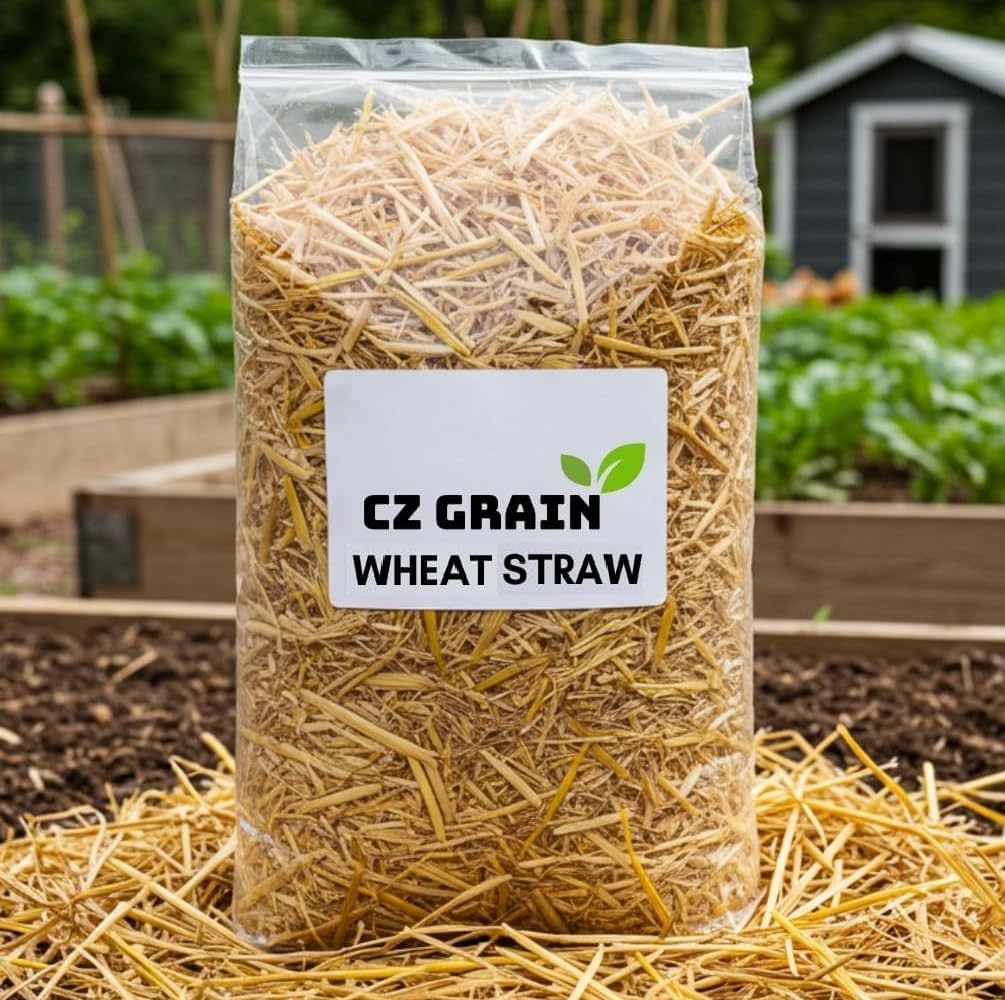
The CZ Grain 100% Natural Wheat Straw stands out for its resealable bag design and the soft, manageable texture of the straw inside. The packaging allows you to use only what you need and seal the rest for storage, preventing the straw from absorbing ambient moisture or becoming a home for pests between uses. Verified users highlight the low dust content and the pleasant, natural smell of the straw — both indicators of proper curing that also make it suitable for mixing into compost piles as a carbon-rich brown layer.
The straw pieces are described as soft and a good length, which makes them easy to work around transplants. When placed around pepper, tomato, or cucumber starts, the straw stays in position without blowing away, creating a clean visual barrier that also insulates the soil from temperature swings. Several verified reviews mention using this product for feral cat shelters during winter, confirming its moisture-repelling properties even in wet conditions.
Some buyers felt the bag contained less volume than expected for the weight, and one user reported a manure-like odor from a tightly bound bale — though this appears to be an outlier. The 4-pound size is ideal for gardeners testing straw mulch for the first time, but repeat purchases may be necessary for larger beds.
What works
- Resealable bag preserves straw dryness between uses
- Low dust content with pleasant natural smell
- Soft texture works well around tender transplants
What doesn’t
- Some users report volume is less than expected
- Occasional quality variance in bale compression
6. Out-Grow Wheat Straw (1 cu ft)

The Out-Grow 100% Natural Wheat Straw is a reliable entry-level option that packs one cubic foot of straw into a compact box. This product is grown on-site by the manufacturer, which means quality control is maintained from seed through harvest, and the straw is free of additives or chemical treatments. Verified users consistently describe the straw as clean, low in dust, and effective for moisture retention in garden beds.
For vegetable gardeners who are new to straw mulching, this box offers an affordable way to test the method without committing to a full bale. The 4 pounds of straw in this box will cover a small raised bed or several large containers with a protective layer. The straw is also well-suited for mushroom cultivation, indicating good moisture-holding capacity and structural integrity. Users report that plants stay hydrated longer and that the straw breaks down naturally into the soil over the course of the season.
One verified reviewer found a large foreign object — possibly a rock — mixed into their box, suggesting occasional quality control gaps. The size is modest, and gardeners with larger plots will need multiple boxes. For small-scale vegetable growers or those wanting to trial straw mulching at a minimal cost, this product delivers exactly what it promises.
What works
- Low dust and clean after processing
- Good moisture retention for container gardens
- Compact box size for easy storage
What doesn’t
- Small volume limits coverage for larger beds
- Occasional foreign objects found in packaging
7. Acostop Natural Wheat Straw (1 lb)

The Acostop Natural Wheat Straw arrives vacuum-sealed, which keeps the straw clean, dry, and odor-free until you open the bag. This packaging design is a significant advantage for gardeners who need to store mulch for extended periods — the vacuum seal prevents moisture infiltration, mold growth, and pest infestation that can plague open bales in sheds or garages. The bag is approximately the size of a 17-inch laptop, making it the most space-efficient option in this roundup.
For vegetable gardeners working with small patches — a few square feet dedicated to herbs, a single tomato plant in a raised bed, or a seed-starting flat — this 1-pound bag provides just enough straw without waste. Verified users have successfully used it to cover seeded circles for grass patching and to protect newly planted vegetable seeds from birds and moisture loss. The straw is made from sun-dried wheat straw with no chemicals or weed seeds, so it is safe for organic beds.
The main limitation is the price per pound. While the vacuum packaging is convenient, you pay a premium for the compact form factor compared to larger bales. It is also lightweight enough to blow away in strong winds if not wetted down after application. For micro-gardens and precise spot mulching, this is a practical choice, but it is not cost-effective for large vegetable plots.
What works
- Vacuum-sealed bag keeps straw clean and mold-free during storage
- Compact size ideal for small gardens and seed starting
- 100% natural with no chemical residues
What doesn’t
- High price per pound compared to bulk bales
- Lightweight straw can blow away easily without wetting
Hardware & Specs Guide
Bale Volume and Coverage Area
Straw mulches are sold by cubic foot, weight, or both. A 2.5-cubic-foot bale typically covers 200–500 square feet at seeding depth but only about 50–80 square feet at the 2–3 inch depth required for effective weed suppression in vegetable beds. Compressed bales like the HealthiStraw GardenStraw (3 cu ft) expand significantly when opened, so always check the stated coverage in square feet rather than relying on bag appearance. A 1-pound bag like the Acostop covers roughly 3–5 square feet at 1-inch depth — suitable for potted vegetables or small patches, not full beds.
Weed Seed Content and Processing
The most important spec for vegetable gardeners is whether the straw has been “cleaned,” “processed,” or “filtered” to remove weed seeds. Standard straw bales from feed stores often contain viable grass seeds that will germinate in your moist garden soil. Products like HealthiStraw and Gardener Select use proprietary filtration steps to remove seeds, dust, and chaff. Look for explicit claims like “99% weed free” or “low seed content” in the product description. Products that are also labeled for mushroom cultivation (like Out-Grow) undergo additional sterilization or cleaning that further reduces seed viability.
Tackifier Technology
Tackifiers are natural bonding agents — typically starch-based or gum-based — that are sprayed onto or mixed with the straw during processing. When the straw is wetted, the tackifier activates and creates a sticky surface that causes individual straw fibers to adhere to each other and to the soil beneath. EZ-Straw and Gardener Select both use tackifiers. This technology is invaluable for sloped beds, areas with heavy rain, or gardens near irrigation systems that produce strong water streams. Non-tackified straw relies on fiber length and interlocking for wind resistance, which works well for flat, sheltered beds but can fail in exposed conditions.
Biodegradability and Composting
All natural wheat straw is biodegradable, but the rate of decomposition varies based on the stalk length, thickness, and whether any bonding agents are present. Straw mulches that break down within a single growing season (like HealthiStraw and EZ-Straw) are ideal for vegetable gardens because they contribute carbon to the soil without requiring removal. Thicker, uncut straw may persist into the next year and can be tilled under as green manure. Tackifiers used by reputable brands are also biodegradable and do not leave synthetic residues. Avoid any straw product that lists synthetic binders, dyes, or preservatives on the label.
FAQ
How thick should I apply straw mulch to my vegetable beds?
What is the difference between straw and hay for vegetable gardens?
Will straw mulch attract slugs or pests to my vegetable garden?
Final Thoughts: The Verdict
For most gardeners, the straw mulch for vegetable garden winner is the HealthiStraw GardenStraw because it combines the largest coverage volume with an exceptionally low weed seed count and naturally interlocking fibers that stay in place without chemical tackifiers. If you need a mulch that holds on sloped beds or in windy conditions, grab the EZ-Straw Seeding Mulch with its biodegradable tackifier that prevents washout. And for the absolute cleanest, most weed-free option where seed contamination is unacceptable, nothing beats the Gardener Select Seeding Straw for guaranteed peace of mind in your vegetable beds.