
Specs are compiled from manufacturer listings and verified buyer reviews and can change over time — please confirm the key details on the product page before buying.
A shovel that looks fine on the shelf can snap its handle in the first frost or bend its blade on the first rock. You will not know the difference until you are leaning on it. The materials and design details — blade thickness, handle type, overall weight — decide whether a square shovel lasts a season or a decade. This guide walks you through which picks actually hold up for digging, scooping, and ice-breaking, so you skip the trial-and-error.
I’m Rikta — the founder and writer behind Lawn Gear Lab. This guide is built by comparing the manufacturers’ published specifications and the patterns across verified customer reviews, so you get each pick’s real strengths and trade-offs instead of marketing spin.
The right square shovel for you depends mostly on the handle material, blade gauge, and overall weight — and knowing how those three factors affect actual yard work is the difference between a tool that works and one that fights you.
Quick Picks
- Bully Tools Square Point Shovel – 14-Gauge Steel — Top Performer
- VNIMTI Square Shovel – 41-Inch Wood Handle — Best Value
- Union Tools 998241 Square Point Shovel – 39-Inch Hardwood Handle — Classic Build
- Ashman Heavy-Duty Transfer Shovel – 41-Inch Plastic Handle — Lightweight Pick
- Jackson Professional Eagle Square Point Shovel – 44-Inch Handle — Extended Reach
- Ashman Medium Square Shovel – 27-Inch D-Cup Handle — Budget Champion
How To Choose The Best Square Shovel
Picking a square shovel is not as simple as grabbing the cheapest option. You need to match the handle length, material, and blade strength to what you actually plan to move — dry dirt, wet snow, gravel, or ice. Here are the three specs that define how well a square shovel works for your specific job.
Handle Material and Length
The handle is where you feel every shovel load. Wood handles offer a classic feel and decent shock absorption, but they can crack if left out in wet weather. Plastic handles are lighter and maintenance-free but may flex under heavy loads. Fiberglass handles sit in the middle — they resist weather, dampen vibration, and hold up under repeated impact. Length matters too: a 41-inch handle gives you good leverage without being awkward in a car trunk, while a longer handle around 56 inches helps you move more material per load but can feel unwieldy in tight garden beds.
Blade Strength and Gauge
The blade gauge (a number that tells you the steel thickness) determines whether your shovel bends on the first rock or keeps going for years. A lower gauge number means thicker steel. For example, a 14-gauge blade is built for heavy abuse — ice breaking, gravel scooping, and prying roots. Thinner blades on budget shovels will bend under the same load. If you primarily move loose dirt or mulch, you can get away with a lighter blade, but for ice or compacted clay, thicker steel matters.
Weight and Balance
A shovel that is too light may lack the momentum to cut through hard ground or ice. A shovel that is too heavy will exhaust your arms before the job is done. The best square shovel for most people sits between 3 and 5 pounds. At that weight, you get enough heft for serious digging without feeling like you are lifting a sledgehammer every time you scoop.
Quick Comparison
On smaller screens, swipe sideways to see the full table.
| Model | Best For | Handle Length | Weight | Handle Material | Amazon |
|---|---|---|---|---|---|
| Bully Tools Square Point Shovel | Heavy-duty ice and digging | — | 5.25 Pounds | Fiberglass | Amazon |
| VNIMTI Square Shovel | Year-round versatility | 41 inches | 3.3 Pounds | Wood | Amazon |
| Union Tools Square Point Shovel | Traditional build with wood | 39.5 inches | 4.17 Pounds | Wood | Amazon |
| Ashman Heavy-Duty Transfer Shovel | Lightweight ice breaking | 41 inches | 2.2 Pounds | Plastic | Amazon |
| Jackson Professional Eagle Square Point Shovel | Long-reach heavy scooping | 56.5 inches overall | 4 Pounds | ABS Plastic | Amazon |
| Ashman Medium Square Shovel | Compact jobs and car storage | 28 inches overall | — | Plastic | Amazon |
In‑Depth Reviews
1. Bully Tools Square Point Shovel – 14-Gauge Steel

A 14-gauge steel blade that laughs at ice and packed gravel.
The blade on this shovel is the real story — a true 14-gauge steel blade (a measurement of steel thickness where a lower number means stronger steel) that stands up to breaking ice and prying rocks without bending. It uses a welded I-beam construction, meaning the blade has a center reinforcing rib that resists twisting under heavy side loads. The fiberglass handle uses triple-wall construction, which resists splintering and rot far better than wood. Buyers report that a 240-pound user has not managed to break one, which tells you the durability ceiling here is very high.
One catch: the shovel ships in two pieces, and you have to bolt the handle to the head yourself. Owners mention that lining up the holes to insert the bolts can be a challenge without a vice or extra tools. A little Loc-Tite on the Chicago screws keeps everything tight. At 5.25 pounds, this is the heaviest shovel on this list, so if you are moving light mulch for hours, you might prefer something lighter. At 59.25 inches long, it gives you the most reach of any shovel here, which helps your back during long scooping sessions.
The blade angle is fairly acute, which means the tip lifts when you try to scrape flat surfaces. One experienced user with a long-armed build noted this limitation compared to their old 30-year shovel. If your main job is scraping driveways flat, the geometry may force you to adjust your technique. But for the price of a mid-range shovel, you get a blade that will not bend, a handle that will not rot, and a build that is 100% made in the USA according to the manufacturer.
Worth the Assembly
- 14-gauge closed-back blade resists bending under ice and rock
- Fiberglass handle with triple-wall construction lasts in wet conditions
- 100% made in the USA, backed by a solid warranty
Before You Buy
- Requires assembly with bolts — a vice helps line up the holes
- At 5.25 pounds, it is the heaviest shovel here
- Blade angle is steep, making flat scraping less effective
Your go-to for brutal jobs: This is the shovel to grab when you need to break ice, dig through compacted clay, or move gravel — jobs that would bend a lighter blade.
One real limit: The extra weight and the assembly required mean it is not a grab-and-go tool for light garden work.
2. VNIMTI Square Shovel – 41-Inch Wood Handle

A wood-handled square shovel that handles four seasons without fuss.
This shovel uses a cold-rolled steel blade (steel that is pressed at room temperature to make it denser) with high-temperature quenching — a heat treatment that increases the steel’s hardness. Buyers confirm it chops through heavy icy snow without bending, which is the same kind of abuse the Bully Tools above handles, but this one does it at a lower weight. At 3.3 pounds, it is lighter than the Union Tools shovel and feels far more manageable for long sessions moving dirt or snow. The D-grip handle gives you a two-handed hold that improves control when you are levering out roots or packed snow.
At 41 inches long, this shovel fits neatly into a car trunk for use as a camping shovel or emergency snow tool. That shorter length makes it easier to store and maneuver in tight spots. That shorter length makes it easier to store and maneuver in tight spots. The wood handle gives you a classic natural grip that absorbs some vibration, but unlike fiberglass, it can crack if left out in rain and sun season after season. One reviewer noted the sturdy handgrip makes it easier to handle during long driveway clearing sessions, which matches the D-grip promise in the specs.
The blade comes with pedals on top — small ledges you step on to drive the shovel into hard ground. That design detail matters when you are digging square planting holes, which arborists sometimes recommend over round holes for better root development. The shovel head is noticeably larger than a round-point shovel, so you move more material per scoop and bend down less often. It is a solid middle ground between the ultra-heavy Bully Tools and the lightweight Ashman shovels.
Year-round workmate: The cold-rolled steel blade and 3.3-pound weight make this shovel comfortable for spring planting and brutal enough for winter ice. It is the best balance of strength and fatigue resistance in this price range.
Handle care needed: The wood handle will demand more care than plastic or fiberglass — store it dry, and it will last years.
Smart buy for mixed use: If you dig garden beds in summer and clear snow in winter, this one shovel does both without wearing you out.
skip it if: You plan to leave your shovel outside in the rain — the wood handle will not tolerate neglect like fiberglass will.
3. Union Tools 998241 Square Point Shovel – 39-Inch Hardwood Handle
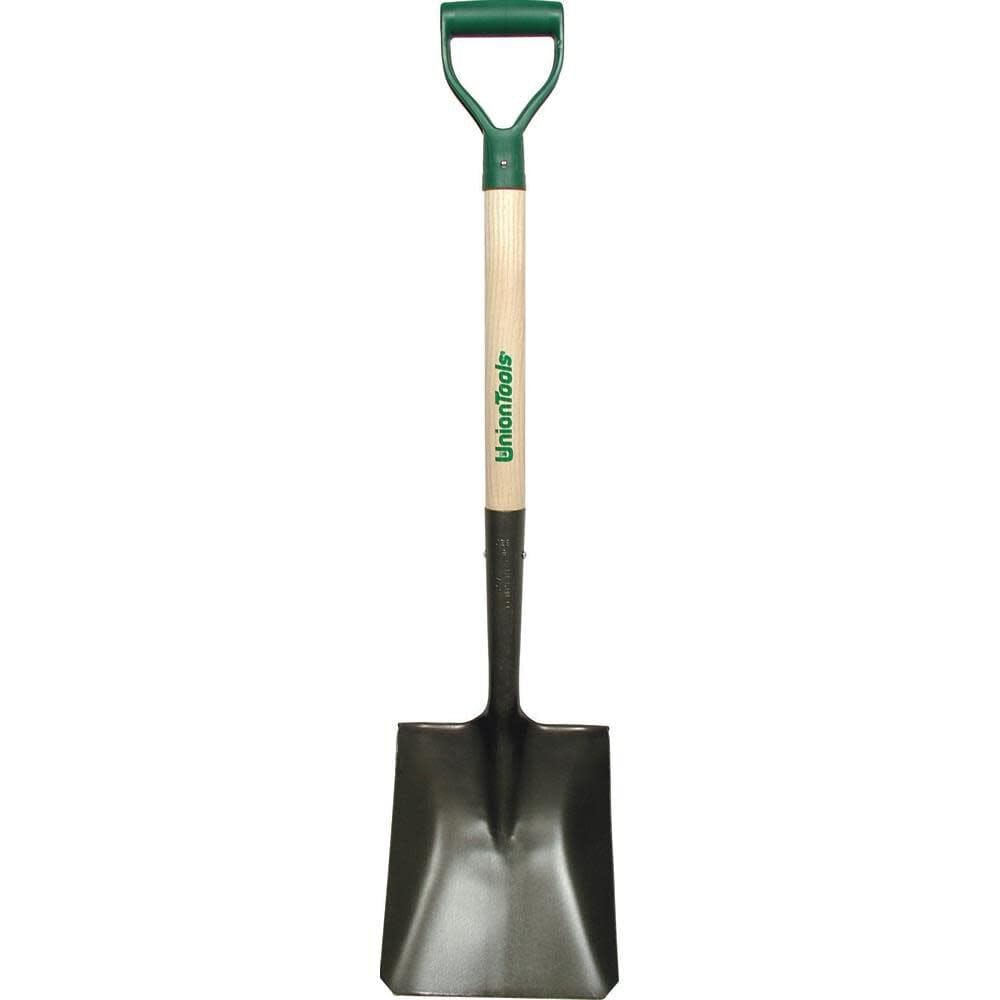
An industrial-grade blade on a classic hardwood handle that feels right.
The Union Tools shovel uses an industrial gauge open-back blade — meaning the steel is thick enough for construction-yard abuse, and the back of the blade is open (not welded closed like the Bully Tools) to shed sticky mud more easily. It has a forward turned-step, a bent lip at the top of the blade where you place your foot. That forward angle keeps your boot planted securely instead of slipping off to the side, which matters when you are driving the blade into hard-packed soil. At 4.17 pounds, it is heavier than the VNIMTI shovel but lighter than the Bully Tools, putting it right in the middle for leverage. The 39.5-inch hardwood handle is a classic choice — warm in the hand, quiet against metal, and durable if kept dry. Customers note it is significantly cheaper than comparable shovels at Home Depot or Lowes, yet feels built to the same standard. The 9-inch socket (the metal collar connecting the handle to the blade) creates a stronger joint than cheaper shovels, so the handle does not snap off under heavy prying.
One buyer mentioned their shovel arrived with a long gouge on the blade and dents on the handle. It did not affect the shovel’s function, but if cosmetic condition matters to you, inspect it on arrival. The hardwood handle is the main trade-off: it offers a natural feel that plastic and fiberglass cannot match, but it demands indoor storage and occasional oiling to prevent splitting, unlike the virtually maintenance-free fiberglass handle on the Bully Tools. One reviewer summed it up as a “pre *and* post-apocalyptic tool” after using it for heavy digging without breaking.
Traditional Strengths
- Industrial gauge steel blade resists bending under heavy loads
- Forward turned-step keeps your boot planted for powerful digging
- 9-inch socket creates a strong handle-to-blade connection
Honest Heads-Up
- At 4.17 pounds, it is noticeably heavier than the 3.3-pound VNIMTI shovel
- Hardwood handle requires dry storage to prevent cracking
- Some units arrive with cosmetic damage (gouges, dents)
For traditionalists who dig hard: The hardwood handle and forward-turned step give you the old-school feel and foot leverage that pro landscapers rely on.
Minor risk: You might need to return a unit if it arrives scratched — functionality is untouched, but it is worth checking.
4. Ashman Heavy-Duty Transfer Shovel – 41-Inch Plastic Handle

An 11.5-inch blade that weighs less than a bag of sugar.
The blade is sharpened using precision instruments, according to the manufacturer, so it slices through soil roots like a knife. The 41-inch handle is made from durable plastic that outlasts wood in wet conditions and requires no maintenance. The D-handle grip gives you two-handed control that makes the shovel feel more stable during heavy scooping. Reviewers point out it handled a blizzard with 3 inches of ice and 6 inches of snow on top — one buyer stated it was the best shovel they ever had for breaking through enough ice to dig their car out. The sharp edges work as an ice pick to break frozen snow walls from plows, which is rare for a shovel this light.
The plastic handle is the main trade-off. While it is virtually maintenance-free and resistant to rot, it flexes more than fiberglass under extreme loads. For normal snow, dirt, and mulch, that flex is not an issue, but if you habitually pry up large rocks or lever out tree stumps, you might miss the rigidity of a fiberglass handle. The manufacturer also describes the blade as “heavy-duty,” but at 2.2 pounds total, the steel is thinner than the Bully Tools 14-gauge blade. One owner reported the “inconvenient” design in a short but positive review, which suggests the handle shape may not suit every hand size. Still, for the price point, you get an unusually capable ice-breaking shovel that doubles as a general-purpose garden tool.
Shockingly capable for its weight: Most lightweight shovels bend when hitting ice — this one breaks through. The sharpened blade and D-grip make it a legit snow and dirt tool that happens to weigh only 2.2 pounds.
Flex factor: The plastic handle bends more than fiberglass, so skip major prying jobs. Stick to dirt, snow, and mulch.
Reach for this if: You want a shovel you can swing all day without fatigue — for snow, mulch, and garden soil — and you want zero handle maintenance.
Look elsewhere if: Your main job is prying rocks or digging post holes where handle rigidity is critical.
5. Jackson Professional Eagle Square Point Shovel – 44-Inch Handle

A 56.5-inch overall shovel that keeps your back straight.
The packaging lists item dimensions of 56.5 x 9.5 x 5 inches, making this the second-longest shovel here after the Bully Tools. That extra length reduces how much you have to bend, which is a real back-saver if you are laying sod or spreading gravel for hours. The blade is made from alloy steel, and at 4 pounds, it has enough heft to drive into hard soil without bouncing. The handle uses ABS plastic (the same tough plastic used in car dashboards and tool housings), which resists weather better than wood and feels solid in hand. Shoppers say the blade is “good strong quality steel” and did not bend when used as a hoe — an unusual test but a sign of side-strength. The D-grip handle provides secure handling, and the ergonomic grip reduces hand strain over long jobs. At 56.5 inches overall, it is one of the longer shovels here, offering a comfortable reach for average-height users.
One limitation: the Jackson has a 4-pound weight, versus the Ashman Heavy-Duty shovel at 2.2 pounds. That heft helps with digging power but will tire your arms faster if you are moving light material like leaves or loose mulch. The ABS plastic handle, while weather-resistant, does not absorb shock as well as wood or fiberglass. Reviews are straightforward: one buyer called it “a shovel. You shovel stuff,” which is not a complaint but also not an endorsement of any standout feature. It is a capable, no-nonsense tool with a longer reach that helps tall users avoid stooping, but it does not offer the blade gauge or impact resistance of the Bully Tools.
Reach Advantage
- 56.5-inch overall length reduces back strain for tall users
- Alloy steel blade resists bending — verified by a user who used it as a hoe
- ABS handle is weather-proof and durable
Before You Dig
- At 4 pounds, it is heavier than the Ashman Heavy-Duty shovel by a significant margin
- ABS handle does not absorb vibration as well as wood or fiberglass
- No blade gauge specified — unknown steel thickness
Best for tall users or long-reach work: The extended length and 4-pound weight give you digging power without requiring you to stoop, which helps if you have back concerns.
Not ideal for: Light garden work or extended sessions moving soft material where the extra weight will wear you out.
6. Ashman Medium Square Shovel – 27-Inch D-Cup Handle

A short-handled shovel built for truck beds and tight flower beds.
This is the compact option — at 28 inches in total length, versus the Bully Tools at 59.25 inches. That makes it ideal for keeping upright in a truck bed, using in raised garden beds, or tossing into a car trunk for emergencies without taking up much space. The blade is made from a steel alloy with a powder coating that resists rust and weather damage. The D-cup handle (a D-shaped grip at the top) gives you a two-handed hold that helps in tight spaces where a long handle would hit walls or plants. Buyers describe it as a “strong, adult-quality shovel for snow and mud” that shows no wear after a full year of use. They also note it works great for trenching and moving concrete in confined spots, which is not something you would try with a longer shovel. The square blade with narrow edges allows for precision cutting in the ground, so you can edge a border without tearing up surrounding soil.
The trade-off is obvious: you cannot move the same volume per scoop that a full-length shovel delivers. For large driveway snow removal or spreading yards of mulch, you will bend over more and take more strokes. The plastic handle, while durable and maintenance-free, lacks the stiff feel of fiberglass or wood, so it is not meant for prying heavy rocks. Reviewers also note it works well as a starter shovel for children ages 4 and up, which gives you a sense of the handle length and blade size. One buyer summed it up plainly: “It’s a fuquin shovel — well-built and sturdy.” At its price point, it is a useful niche tool rather than a primary shovel for big jobs.
Perfect for tight spaces: The 27-inch length means you can actually swing this in a crowded flower bed or between fence posts. Buyers confirm it holds up to snow and mud without wearing out.
Size limits it: You will need more scoops for any large-area work. This is a spot-tool, not a main shovel.
Grab this for: Small raised beds, truck-bed storage, emergency car shovels, or teaching a child to dig. It is surprisingly tough for its compact size.
Skip it for: Driveway snow clearing or spreading bulk material — the short handle means extra bends and more time.
Understanding the Specs
Blade Gauge and Steel Type
The blade gauge is a number that tells you how thick the steel is. A 14-gauge blade (like the Bully Tools uses) is thicker and more resistant to bending than a 16-gauge or unknown-gauge blade found on cheaper shovels. Cold-rolled steel is pressed at room temperature, making it denser than standard hot-rolled steel. Heat-treated blades (quenched at high temperatures) undergo a hardening process that makes the steel edge more durable for cutting through roots and ice. If your main use involves breaking ice or prying rocks, lower gauge numbers are better. For loose soil and mulch, the gauge matters less.
D-Grip vs T-Grip
A D-grip handle has a D-shaped loop at the top that lets you hold the shovel with one hand while gripping the handle lower down with the other. This two-handed control gives you more leverage and stability during heavy scooping. T-grip handles use a straight bar at the top and are more common on long-handled shovels. For most square shovel work — digging, edging, snow removal — a D-grip offers better control. The material matters too: plastic grips require no maintenance, wood absorbs shock better, and fiberglass combines both qualities but at a higher cost.
FAQ
What is the difference between a square shovel and a round point shovel?
How long should a square shovel handle be?
What is the best handle material for a square shovel?
Can a square shovel break ice?
What does blade gauge mean on a shovel?
How much should a good square shovel weigh?
Will a 28-inch square shovel fit in my car trunk?
How do I maintain a wood-handled square shovel?
Can a square shovel be used for edging garden beds?
What is a transfer shovel used for?
Final Thoughts: The Verdict
If you want one dependable pick, the square shovel winner is the VNIMTI Square Shovel because it combines a cold-rolled steel blade with a 3.3-pound weight that handles both summer garden work and winter ice without beating you up. If you need serious ice-busting power and the longest possible handle, grab the Bully Tools Square Point Shovel. And for tight storage or raised beds where a full-size shovel is awkward, the Ashman Medium Square Shovel is surprisingly tough for its compact 28-inch length.
How We Picked
We do not accept paid placement, and we did not hands-on test every unit. Instead, we match each pick to a real buyer and use-case by comparing the manufacturers’ published specifications against the patterns in verified customer reviews — so you get each pick’s real strengths and trade-offs instead of marketing copy.
Sources & Methodology
Specifications: manufacturer listings and product documentation. Review insights: verified customer reviews, as of July 2026. Pricing: not shown on this page (it changes often); check the current price via the retailer link.
As an Amazon Associate, Lawn Gear Lab earns from qualifying purchases. This does not affect which products we feature.