
Their piercing mouthparts drain chlorophyll from leaf cells, leaving behind stippled, bronze-colored foliage and fine webbing that signals a full-blown infestation. A targeted miticide that breaks the egg-to-adult cycle is the only reliable defense when these pests overwhelm beneficial predators.
I’m Rikta — the co-founder and writer behind Lawn Gear Lab. I spend my weeks cross-referencing botanical data, analyzing active ingredient concentrations (pyrethrins, spinosad, neem oil, and citric acid), and combing through hundreds of verified owner reports to separate the fast-acting killers from the temporary fixes that let spider mites rebound within days.
This guide compares six ready-to-use sprays and one systemic concentrate, ranking each by knockdown speed, residual duration, and plant safety across ornamentals, vegetables, and indoor gardens. Whether you need a pet-safe option for houseplants or a heavy-duty concentrate for a greenhouse, this spider mite killer breakdown gives you the data to choose with confidence.
How To Choose The Best Spider Mite Killer
Selecting the right miticide starts with understanding the active ingredient’s mode of action, the plant type you are protecting, and whether you can reapply on a strict schedule. A spray that scorches delicate new growth may work fine on mature roses but ruin a vegetable seedling.
Active Ingredient: Contact vs. Systemic
Contact killers (pyrethrin, spinosad, neem oil, citric acid) must physically hit the mite to be effective. They offer fast knockdown but have zero residual protection — new mites hatching from eggs 48 hours later are completely unaffected. Systemic products (acephate-based concentrates like Bonide 941) are absorbed into the plant’s vascular system, so mites feeding on any part of the treated plant ingest the poison. Systemics provide longer control but are restricted to ornamentals — never use them on vegetables or fruit.
Plant Safety and Phytotoxicity
Oil-based products (neem oil, pyrethrin in petroleum carriers) can burn leaf tissue under bright light or high temperatures. Enzyme-based formulas (citric acid) and spinosad are gentler on blooms and trichome-heavy plants. Always test a small area 24 hours before full coverage.
Reapplication Interval and Egg Cycle
Spider mite eggs hatch every 3–7 days depending on temperature. Any miticide label that says “reapply every 7 days” forces you to spray at least three times to catch all emerging generations. Products with a shorter allowed interval (2–3 days) let you break the cycle faster without risking phytotoxicity from over-application.
Quick Comparison
On smaller screens, swipe sideways to see the full table.
| Model | Category | Best For | Key Spec | Amazon |
|---|---|---|---|---|
| Eliminator Concentrate | Enzyme | Organic gardens & flowering plants | OMRI Listed, citric acid | Amazon |
| Bonide Systemic | Systemic | Ornamental shrubs & trees | Acephate, makes 16 gal. | Amazon |
| Garden Safe Fungicide3 | Neem Oil | General outdoor & vegetable plants | 1 gal. RTU, neem oil | Amazon |
| Fertilome Triple Action | All-in-One | Fruit trees & herbs | Insecticide + fungicide | Amazon |
| Natural Guard Spinosad | Spinosad | Vegetable gardens & ornamentals | 32 oz., kills within min. | Amazon |
| Doktor Doom Knockout | Pyrethrin | Indoor plants & greenhouses | 0.20% pyrethrin, 16 oz. | Amazon |
| Jurassipet JurassiMite | Reptile Safe | Reptile enclosures & terrariums | Non-toxic, 8.5 fl. oz. | Amazon |
In‑Depth Reviews
1. Eliminator Natural Insecticide & Fungicide Concentrate
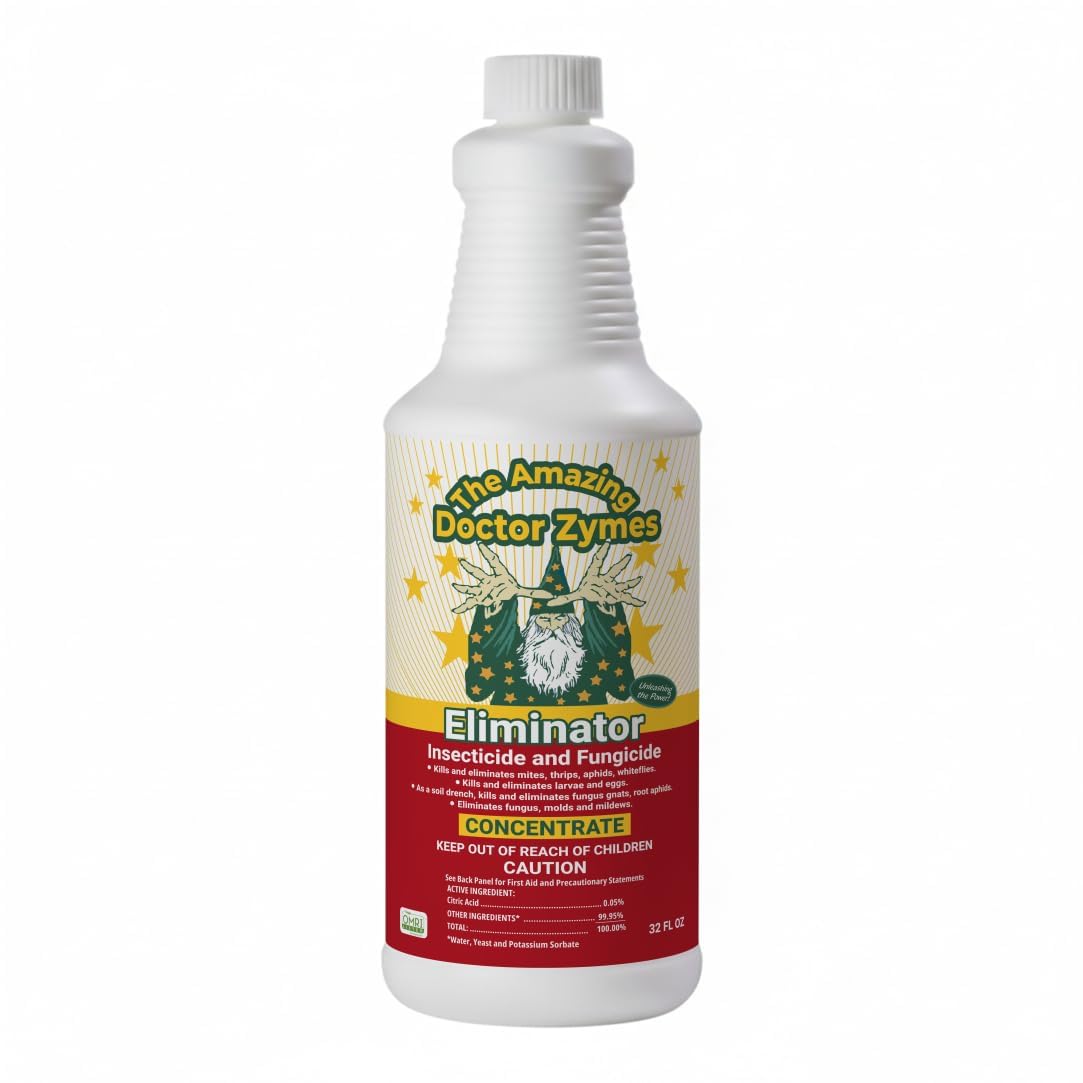
The Eliminator uses citric acid as its active ingredient, an enzyme-based formula that disrupts mite cell membranes on contact without leaving an oil residue that can clog leaf stomata. At 32 ounces of concentrate (making several gallons of spray), it delivers professional-scale coverage for greenhouses, large flower beds, and indoor grow rooms. The OMRI listing confirms it is permitted for organic production, so you can spray vegetable gardens and culinary herbs without worrying about synthetic chemical persistence in the harvest.
Owner reports consistently praise its ability to kill spider mites, aphids, and powdery mildew in one pass when applied as a foliar drench. Several indoor gardeners noted zero visible damage to trichomes or delicate flower buds, a major advantage over oil-based miticides that can smother resin glands. The concentrated format also means you adjust the dilution ratio for lighter or heavier infestations — a flexibility that pre-mixed spray bottles cannot match.
One reviewer mentioned that it took two treatments to fully knock down aphids on outdoor vegetables, and a separate report noted that beneficial insects were also killed after the first application due to the broad-spectrum nature of the enzyme. As with any non-selective contact killer, spraying in the evening after pollinators have retreated reduces collateral damage. For growers who need a residue-free, flowering-stage-safe option that covers both mites and fungal pathogens, this is the most versatile concentrate available.
What works
- OMRI Listed for organic use with zero oil residue.
- One 32-oz. bottle makes multiple gallons of spray.
- Safe for late-flowering plants without damaging trichomes.
What doesn’t
- Broad-spectrum enzyme kills beneficial insects on contact.
- May require multiple applications for heavy aphid infestations.
2. Bonide Systemic Insect Control Concentrate

Bonide 941 uses acephate, an organophosphate that the plant absorbs through its roots and translocates to every leaf and stem. When a two-spotted spider mite feeds on treated tissue, the acephate disrupts its nervous system regardless of whether the spray ever touched the mite directly. This systemic action makes it uniquely effective against mites hiding in leaf curls, under bark crevices, or on the underside of dense foliage where contact sprays rarely reach. The 16-ounce concentrate treats up to 16 gallons of finished solution, making it one of the highest-coverage options per bottle in this lineup.
Owner feedback focuses heavily on its ability to stop persistent pests — bagworms on arborvitae, thrips on ornamentals, and scale on shrubs — after contact sprays had failed. Several users noted that the smell is exceptionally strong, described as “actual poop” or “a dumpster baking in the sun,” which makes it unsuitable for indoor use or enclosed greenhouses without ventilation. The product label explicitly restricts use to ornamentals, roses, shrubs, and flower beds — never on vegetables, fruits, or herbs.
The biggest constraint is that acephate requires soil drench or foliar absorption, which means it is not an instant knockdown solution. Mites may continue feeding for 24–48 hours before the chemical builds to lethal concentration in the plant sap. Additionally, because it is broad-spectrum, it will kill any insect feeding on the plant — including bees that visit treated flowers. Apply strictly according to the label’s pre-bloom timing to minimize pollinator exposure.
What works
- Systemic protection reaches mites that contact sprays miss.
- 16-ounce bottle makes 16 gallons of finished spray.
- Highly effective against scale, thrips, and bagworms.
What doesn’t
- Extremely strong odor requires outdoor use only.
- Not labeled for vegetables, fruits, or edible plants.
3. Fertilome Triple Action 16 oz.
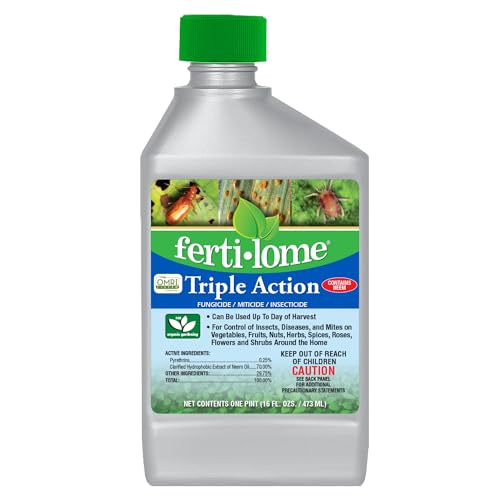
Fertilome 12245 combines a miticide, insecticide, and fungicide into a single neem-oil-based liquid concentrate. The formula controls spider mites while simultaneously preventing powdery mildew, rust, and leaf spot — three fungal diseases that often co-occur with mite damage because stressed plants are more susceptible to infection. The label permits use on fruits, herbs, nuts, spices, vegetables, roses, flowers, and shrubs, making it one of the most versatile single-bottle solutions for a mixed garden.
Long-term users report consistent results on apple trees and other fruit-bearing plants, applying it every 7–14 days throughout the growing season. The neem oil works by suffocating mite eggs and larvae, while azadirachtin (a neem derivative) disrupts feeding and molting in adult mites. Because neem is a contact and translaminar material (it penetrates leaf tissue slightly but does not become fully systemic), thorough coverage of leaf undersides is mandatory. The 16-ounce bottle is a concentrate, not a ready-to-use spray, so you must mix it with water according to the crop-specific rates on the label.
Some owners noted that the price has increased significantly over successive seasons, and a few users who followed the 7-day reapplication schedule still experienced mite resurgence when they missed a treatment window. As with all oil-based products, spraying under direct sunlight or at temperatures above 90°F can cause leaf burn. For gardeners who want a single product that addresses both mite pests and fungal issues without needing separate bottles, this remains a proven workhorse.
What works
- Controls mites, insects, and fungal diseases in one spray.
- Labeled for use on fruits, herbs, vegetables, and ornamentals.
- Proven track record on apple trees and berry bushes.
What doesn’t
- Must be mixed and measured — not a ready-to-use spray.
- Oil content can burn foliage if applied in hot sun.
4. Natural Guard Spinosad Soap 32 oz.

Natural Guard Spinosad Soap pairs spinosad — a naturally occurring soil bacterium metabolite — with insecticidal soap to create a dual-action spray that kills mites on contact and remains active on leaf surfaces for up to 24 hours. The soap breaks down the mite’s waxy cuticle, while the spinosad overstimulates the mite’s nervous system, causing paralysis and death within minutes of application. This combination is especially effective against spider mites that have developed resistance to pyrethrin or neem oil.
Gardeners with vegetable plots report that this spray kept their tomato, pepper, and cucumber plants healthy through peak summer pressure when mite populations explode. The ready-to-use 32-ounce bottle covers a moderate-sized vegetable garden or a collection of ornamental beds, though owners with larger acreage may wish for a concentrate version. One reviewer specifically noted that a single application eliminated cactus beetles that had been chewing through a collection for weeks.
On the downside, the bottle leaked during shipping for at least one customer despite secure packaging, and the spray nozzle delivers a coarse stream rather than a fine mist, making it harder to coat the undersides of leaves where mites congregate. Transferring the liquid to a pump sprayer with an adjustable nozzle solves this issue. For those who want a spinosad-based option that works quickly and is OMRI-compatible for organic gardens, this is a strong mid-range pick.
What works
- Kills mites within minutes using dual-action spinosad + soap.
- Effective on vegetable gardens and ornamental plants.
- Works on mites resistant to pyrethrin and neem oil.
What doesn’t
- Ready-to-use bottle is small for large gardens.
- Coarse nozzle makes leaf underside coverage difficult.
5. Doktor Doom Spider Mite Knockout 16 oz.
Doktor Doom Spider Mite Knockout contains 0.20% pyrethrin, a plant-derived neurotoxin extracted from chrysanthemum flowers that paralyzes mites on contact. At this concentration (roughly half the strength of pyrethrin foggers), the spray is formulated for direct application to indoor and greenhouse plants without overwhelming the room with airborne particulates. Multiple verified buyers confirmed it eliminated spider mites on indoor Meyer lemon trees, jasmine, and young maples after other products had failed.
The primary strategy recommended by experienced users is to spray at “lights off” — meaning just before the dark cycle for indoor grow lights — to prevent leaf burn caused by pyrethrin interacting with intense light. Several reviewers stressed that commitment to a 3–4 day reapplication schedule over at least two weeks is essential because the product has zero residual action; any egg that hatches after the spray dries is completely unaffected. One user who sprayed only once saw mites return on day five.
A few owners reported leaf browning on delicate plants like young maple, indicating that even at 0.20%, pyrethrin can cause phytotoxicity on extremely tender foliage. The label’s recommended 7-day interval between applications is too long to break the mite egg cycle effectively, so buyers should plan to spray more frequently (3–4 days) while watching for signs of plant stress. For indoor container plants and small greenhouse setups, this is a workable entry-level contact killer that demands discipline.
What works
- Fast knockdown of spider mites on contact.
- Suitable for indoor use when applied at lights off.
- Effective after other products failed for many users.
What doesn’t
- Zero residual activity — needs 3–4 day reapplication.
- Can burn delicate leaves on young or sensitive plants.
6. Garden Safe Fungicide3 1 Gallon
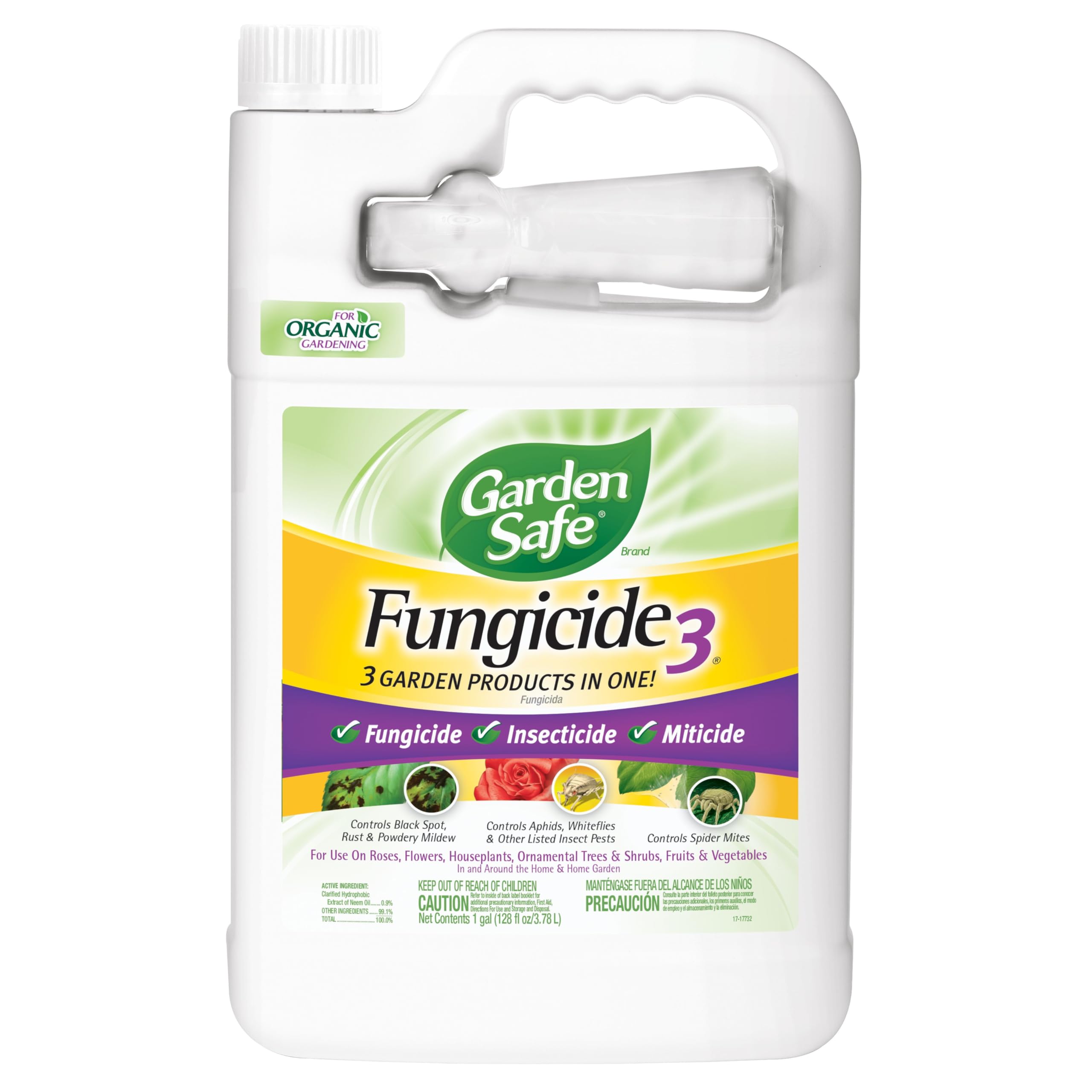
Garden Safe Fungicide3 is a ready-to-use 1-gallon spray that combines clarified hydrophobic neem oil extract with a fungicide to create a three-in-one product: miticide, insecticide, and disease preventive. The neem oil suffocates mite eggs and larvae on contact while the fungicidal component prevents black spot, rust, and powdery mildew from colonizing mite-weakened foliage. The one-gallon container is the largest ready-to-use option in this comparison, giving you immediate coverage for a large rose bed or a full vegetable patch without any mixing.
Long-term users on orchids, hibiscus, tomatoes, and blueberries reported that weekly applications throughout the growing season cured persistent powdery mildew and significantly improved leaf health and fruit yields. One reviewer described the product as “life-changing” for mildew-prone plants, noting that damaged leaves never fully healed but new growth remained clean. Because the formula is organic-certified (clarified neem oil is acceptable for organic gardening), you can spray vegetables and herbs up to the day of harvest without synthetic chemical concerns.
The built-in sprayer hose is extremely short — roughly four inches — forcing you to hold the gallon jug in one hand while spraying with the other, which is awkward for reaching lower leaves or hanging baskets. Several owners recommended transferring the liquid to a separate pump sprayer for better ergonomics. Additionally, using the full recommended dose scorched some sensitive plants when applied during daylight hours; applying it in the evening or at half-strength avoids this issue.
What works
- One gallon ready-to-use covers large areas immediately.
- Organic neem oil controls mites, insects, and fungal diseases.
- Improved yields on mildew-prone crops like blueberries.
What doesn’t
- Integrated sprayer has a very short hose — awkward ergonomics.
- Full-strength formula can burn leaves in direct sunlight.
7. Jurassipet JurassiMite 8.5 fl. oz.

JurassiMite is formulated specifically for reptile terrariums and enclosures, using a non-toxic formula that kills mites, fleas, and ticks on contact without harming the animal. It is designed to be applied directly to the reptile’s body (avoiding eyes and face) as well as to substrate, decorations, and enclosure surfaces. Unlike competing brands that mandate a multi-day interval between treatments — during which mite populations can rebound — JurassiMite can be used daily on heavy infestations, giving you tighter control over the egg-hatching cycle.
Corn snake and ball python owners reported that a single treatment eliminated all visible mites from both the snake and the terrarium, with no mite sightings over a two-month follow-up period. The spray has a mild, pleasant scent and did not cause any visible irritation or behavioral changes in the treated reptiles. The ability to reapply without a waiting period is critical because reptile mite infestations often involve both the host animal and the enclosure environment, requiring simultaneous treatment.
The most common complaint across multiple purchases is that the pump spray nozzle jams after two to six sprays due to the thick liquid consistency. Owners recommend keeping a secondary spray bottle or a fine-mist atomizer on hand to transfer the solution into. A few users noted the product worked slowly on mites lodged in ball python tubs, requiring daily application for about a week before complete eradication. If you are treating a reptile habitat, budget for a replacement spray bottle to avoid frustration mid-treatment.
What works
- Non-toxic formula safe for daily use on reptiles.
- Effective on both the animal and enclosure environment.
- Can be reapplied daily to break the mite egg cycle.
What doesn’t
- Spray bottle nozzle frequently fails after a few pumps.
- Thick liquid consistency requires a secondary atomizer.
Hardware & Specs Guide
Pyrethrin Concentration
Pyrethrin is a fast-acting neurotoxin derived from chrysanthemum flowers. Products like Doktor Doom Knockout use a 0.20% concentration — roughly half the strength of aerosol foggers — which is mild enough for direct plant application but still requires a 3-4 day reapplication schedule to catch newly hatched mites. Higher concentrations can cause phytotoxicity on tender leaves, especially under grow lights or direct sun.
Spinosad vs. Neem Oil
Spinosad (found in Natural Guard) is a bacterial fermentation byproduct that overstimulates mite nervous systems and remains active for about 24 hours on leaf surfaces. Neem oil (found in Garden Safe Fungicide3 and Fertilome Triple Action) suffocates eggs and larvae but must be applied as a thorough coat to all leaf surfaces because it does not translocate through the plant. Spinosad is better for resistant mites; neem oil is better for concurrent fungal prevention.
Systemic vs. Contact Modes
Contact killers (pyrethrin, spinosad, neem oil, citric acid) must physically hit the mite to work — any mite hiding in a leaf curl or under a bark crevice survives. Systemic products like Bonide 941 (acephate) are absorbed into the plant’s vascular system and kill mites when they feed, regardless of where the mite is hiding. Systemics provide longer residual protection but are restricted to non-edible ornamentals due to the chemical’s persistence in plant tissue.
Reapplication Interval
Spider mite eggs hatch every 3–7 days depending on temperature (faster in hot, dry conditions). A miticide with a label allowing 3-day reapplication (like JurassiMite) lets you hit every new generation. Products with a mandatory 7-day interval (like Doktor Doom) create a gap where mites can establish a new generation, requiring at least three applications to achieve full control. Shorter intervals reduce the risk of population rebound.
FAQ
Can I use a spider mite killer on vegetable plants I intend to eat?
Why do spider mites keep coming back after I spray?
What ingredient works best on mite eggs?
Final Thoughts: The Verdict
For most gardeners, the spider mite killer winner is the Eliminator Concentrate because its OMRI Listed, oil-free citric acid formula kills mites and powdery mildew without damaging flower buds or leaving harmful residues on vegetables. If you need systemic long-term protection for ornamentals, grab the Bonide Systemic — but plan for the strong odor and keep it away from edible crops. And for reptile enclosures where daily reapplication is needed to break the mite cycle, nothing beats the Jurassipet JurassiMite (just replace the spray bottle before you start).