
Solar powered grow lights promise the holy grail of off-grid horticulture: zero electricity bills paired with genuine photosynthetic support. The catch is that most units simply fail to deliver enough stored energy to bridge a cloudy day, leaving your seedlings starved for photons right when they need them most.
I’m Rikta — the co-founder and writer behind Lawn Gear Lab. I spend my days comparing photovoltaic conversion specs, analyzing battery capacities measured in milliamp-hours, cross-referencing spectral output reports, and studying hundreds of aggregated owner experiences to separate the dim disappointments from the genuinely effective solar grow systems.
This guide cuts straight through the exaggerated marketing to find the units that actually sustain photosynthetic activity through the night. Here is my curated list of the best solar powered grow lights for keeping your plants thriving without tying into the grid.
How To Choose The Best Solar Powered Grow Lights
Choosing a solar grow light means balancing solar panel size against battery storage against spectral quality. A huge panel with a tiny battery will only power a few hours of light. A massive battery with an undersized panel will never fully charge. Here are the three specs that decide whether a unit is a legitimate tool or a decorative garden ornament.
Battery Capacity — The True Runtime Limiter
Battery capacity, measured in milliamp-hours (mAh), determines how long the light can run after the sun goes down. A unit with 2,000 mAh might manage three to four hours at full brightness, while units with 10,000 mAh or higher can push eight to twelve hours. Without sufficient stored energy, even the best full-spectrum LEDs will shut off before your plants finish their nightly respiration cycle. Always check the mAh figure, not the vague “hours of light” marketing claim.
Solar Panel Wattage and Surface Area
The solar panel itself must be large enough to recharge the battery during daylight hours. A 5-watt panel on a cloudy winter day may only deliver 300–400 mA of charging current, far too little to replenish a high-capacity battery. Look for panels rated at least 10 to 20 watts with a surface area over 100 square inches. Monocrystalline silicon panels offer higher conversion efficiency than polycrystalline types, meaning they squeeze more charge from the same amount of sunlight.
Spectral Range — Full Spectrum versus Red-Blue Only
Red (635–660 nm) and blue (460 nm) LEDs are essential for photosynthesis, but plants also benefit from warm white (3000 K) and far-red (730 nm) wavelengths for stem elongation and flowering timing. Full-spectrum lights that include warm white and far-red diodes produce visible light that is easier on your eyes and more closely mimics natural sunlight. Cheaper red-blue-only panels work for basic germination but often stunt fruiting and flowering stages because they miss the full range of photosynthetic active radiation (PAR).
Quick Comparison
On smaller screens, swipe sideways to see the full table.
| Model | Category | Best For | Key Spec | Amazon |
|---|---|---|---|---|
| BestDrop Sunlike | Premium All-in-One | Overnight greenhouse coverage | 20,000 mAh battery, 20W panel | Amazon |
| BSOD 2-in-1 | Premium Outdoor | Raised bed & perimeter gardens | 4,800 Lumens, full spectrum | Amazon |
| SDOVUERC 8-Panel | Premium Panel System | Shelf & tent propagation | Daisy-chain 8 panels, 24V | Amazon |
| Ufelizor 96 LED | Mid-Range Hanging | 10×20 ft greenhouse off-grid | IP65, 12-hour night runtime | Amazon |
| ladate 96 LED Round | Mid-Range Round | Versatile greenhouse hanging | 16.6 ft cord, hemispheric lamp | Amazon |
| ladate 2-Head Clip | Budget Flexible Clip | Targeted desk & shelf plants | 8,000 mAh, red+blue spectrum | Amazon |
| Loscarol Floodlight | Budget Entry Flood | Small flower bed accent | 1,000 Lumens, pink spectrum | Amazon |
In‑Depth Reviews
1. BestDrop Sunlike Full Spectrum Solar Grow Light

The BestDrop unit enters the ring with the most impressive battery capacity in this roundup — 20,000 mAh paired with a massive 14-by-18-inch monocrystalline solar panel. That 20-watt panel can deliver up to 4,000 mA of charging current under direct sun, meaning a full charge takes roughly five hours and can power the 108-LED full-spectrum light for over twelve hours at medium brightness. The 4,200 K warm white light includes the full 390–780 nm range, so you get far-red and blue wavelengths alongside the visible spectrum, supporting everything from germination to fruiting.
Installation is straightforward: mount the large panel on a roof or wall with the included metal bracket, then hang the IP67-rated light head with a string or chain inside the greenhouse. The 17-foot cable gives enough slack to keep the panel in full sun while the light sits where your plants need it. The remote control manages auto dusk-to-dawn mode with 3/5/8-hour timers plus a manual override, though the IR sensor requires direct line of sight within 30 feet. Owners consistently report that the light stays on through the entire night cycle even in overcast coastal climates, a testament to the oversized battery buffer.
This kit represents the premium tier solely because of its integrated solar-to-battery-architecture — there is no separate plug-in charging option, meaning performance depends entirely on your local sun exposure. In persistently cloudy regions, the unit may not reach full charge every day. The 3000-lumen output is sufficient for a 4×4-foot coverage area, and the zero-heat radiation makes it safe for close-canopy placement. Backed by a three-year warranty, this is the most complete off-grid package tested.
What works
- Exceptionally large 20W panel charges quickly even in partial sun
- 20,000 mAh battery sustains 12+ hours of mid-brightness light
- Full 390-780nm spectrum supports all plant stages
- IP67 water resistance for outdoor use in rain and humidity
What doesn’t
- IR remote requires precise aiming at the receiver window
- No USB-C backup charging for extended cloudy stretches
- Large panel size may look obtrusive on small structures
2. BSOD 2-in-1 Solar Grow Light & Street Light

The BSOD is a hybrid unit designed to serve both as a plant grow light and as a security-style street light, making it unique among the list. The full-spectrum LED array covers 380 nm through 780 nm, delivering a natural white 4000 K light that is comfortable for human eyes while still driving photosynthesis. At 4,800 lumens, it is the brightest single-head fixture here, capable of covering a 6-by-6-foot raised bed with useful PAR levels. The solar panel and battery are integrated into the lamp housing rather than separated by a cord, which simplifies mounting but means the entire unit must face unobstructed sun.
The biggest caveat is that no mounting pole is included — you must supply your own pipe or bracket to position the light at the correct height. The polycrystalline panel charges fully in four to six hours of direct sun, and a full charge provides roughly four hours of light at maximum brightness. Owners report that the 2-in-1 mode works well for shading gardens in perimeter areas where wired lights are impractical, and the automatic dusk-to-dawn function pairs nicely with the motion sensor for human-pathway illumination. Customer service reviews are mixed, with some users receiving excellent support and others hearing nothing back, so buy with that variability in mind.
For a gardener who needs a dual-purpose light over a medium-sized vegetable patch and does not mind sourcing a pole, the BSOD delivers formidable brightness in a self-contained package. The remote control handles timer and mode selection, though the battery spring contacts can arrive bent, requiring a quick fix. The 12-month warranty provides some peace of mind, but the lack of a separate panel means this unit is limited by the direct sun at the exact spot you mount it — shaded installations will not charge fully.
What works
- Highest lumen output in the roundup at 4,800 lumens
- Dual-purpose grow light and security motion light
- True full spectrum from 380 to 780 nm
- Fast 4-6 hour charging time with good sun exposure
What doesn’t
- No mounting pole or bracket included
- Integrated panel means no separate panel placement
- Battery life tapers to ~4 hours at max brightness
- Customer service responsiveness is inconsistent
3. SDOVUERC 1536 LED Daisy-Chain Panel System
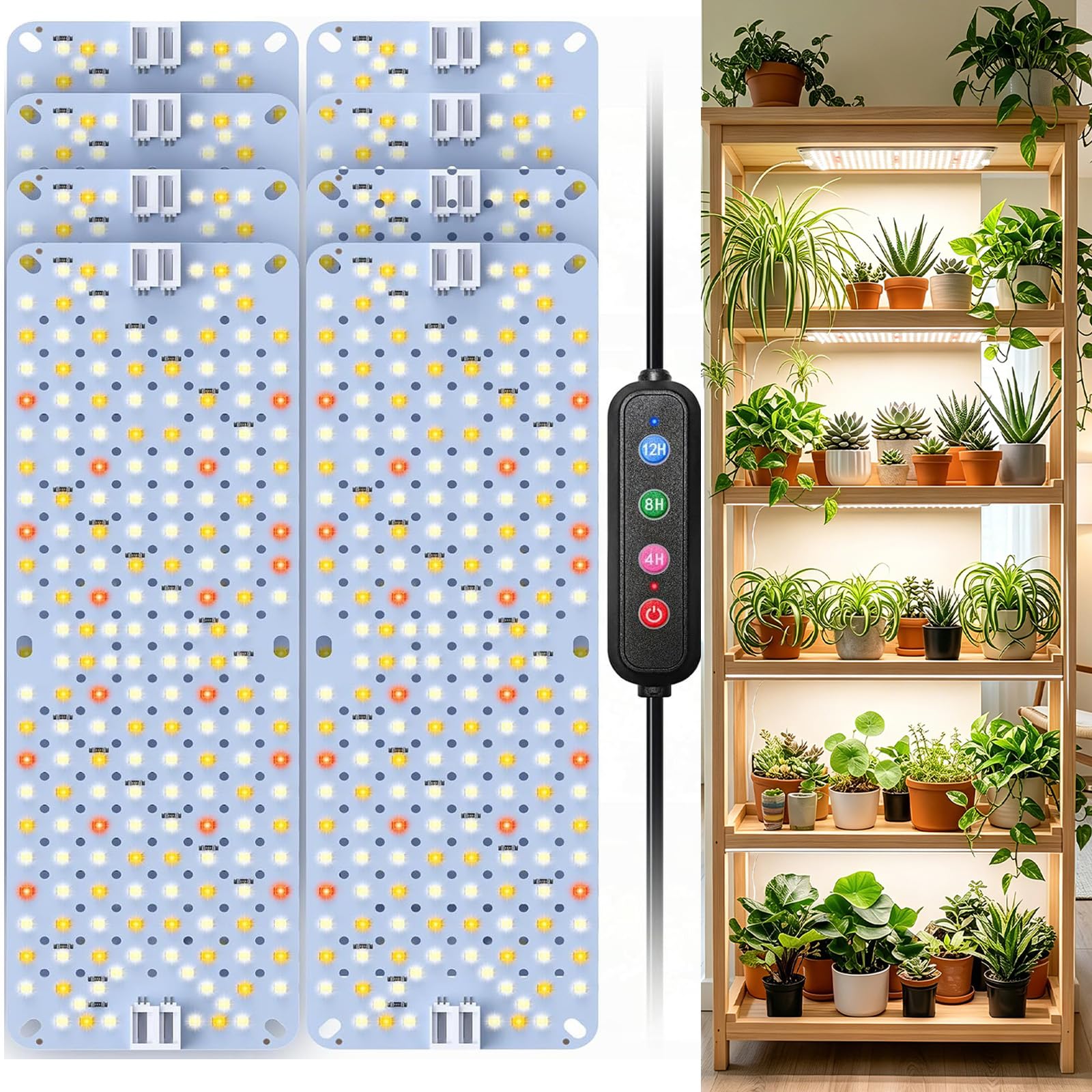
The SDOVUERC system is built for indoor shelf and grow tent setups where you need consistent, low-profile light across multiple tiers. Each of the eight panels measures 11.7 by 3.8 inches and houses 192 LEDs in a mix of 3000 K, 5000 K, and 660 nm red, giving you a full sunlight-like spectrum. The daisy-chain design lets you link up to ten panels to a single 100-watt power supply, though this unit is not solar-powered — it plugs into a wall outlet. Its inclusion here is for growers who want a premium modular system that can be adapted to solar via a separate power station, but it must be noted that this is a grid-tied panel system, not an off-grid solution.
Each panel draws only 12 W (8 W per panel at 24V reported by one owner), running cool enough for tight vertical spacing without heat stress on seedlings. The 0.8-inch thin profile and zip-tie mounts make installation under shelves nearly invisible. The timer offers six settings from 4 to 24 hours with memory retention after power loss, so your schedule stays stable. Gardeners report that placing these panels directly above seed trays triggers visible germination within 24 hours, and the 90 CRI color rendering index means the light quality is comfortable for extended workspace illumination.
The trade-off is the lack of dimming — the panels are either on or off, which limits finesse for plants that need gradual light adaptation. The aluminum PCB construction, while efficient at heat dissipation, is somewhat fragile and can crack if over-tightened during mounting. This system is ideal for propagation specialists with access to grid power who want maximum coverage per watt; it is not a standalone solar grow light, but it sets the standard for spectrum breadth and panel modularity.
What works
- Daisy-chains to one controller for uniform lighting across shelves
- Full spectrum with 3000K, 5000K, and 660nm red diodes
- 90 CRI provides comfortable light for combined human/plant spaces
- Ultra-thin 0.8-inch profile slides into tight shelving
What doesn’t
- Not solar powered; requires a wall outlet
- No dimming control — only on or off per timer
- Aluminum PCB can be fragile during installation
- Cannot set 18-hour cycle, only 4/8/12/16/20/24 hour increments
4. Ufelizor 96 LED Solar Hanging Grow Light
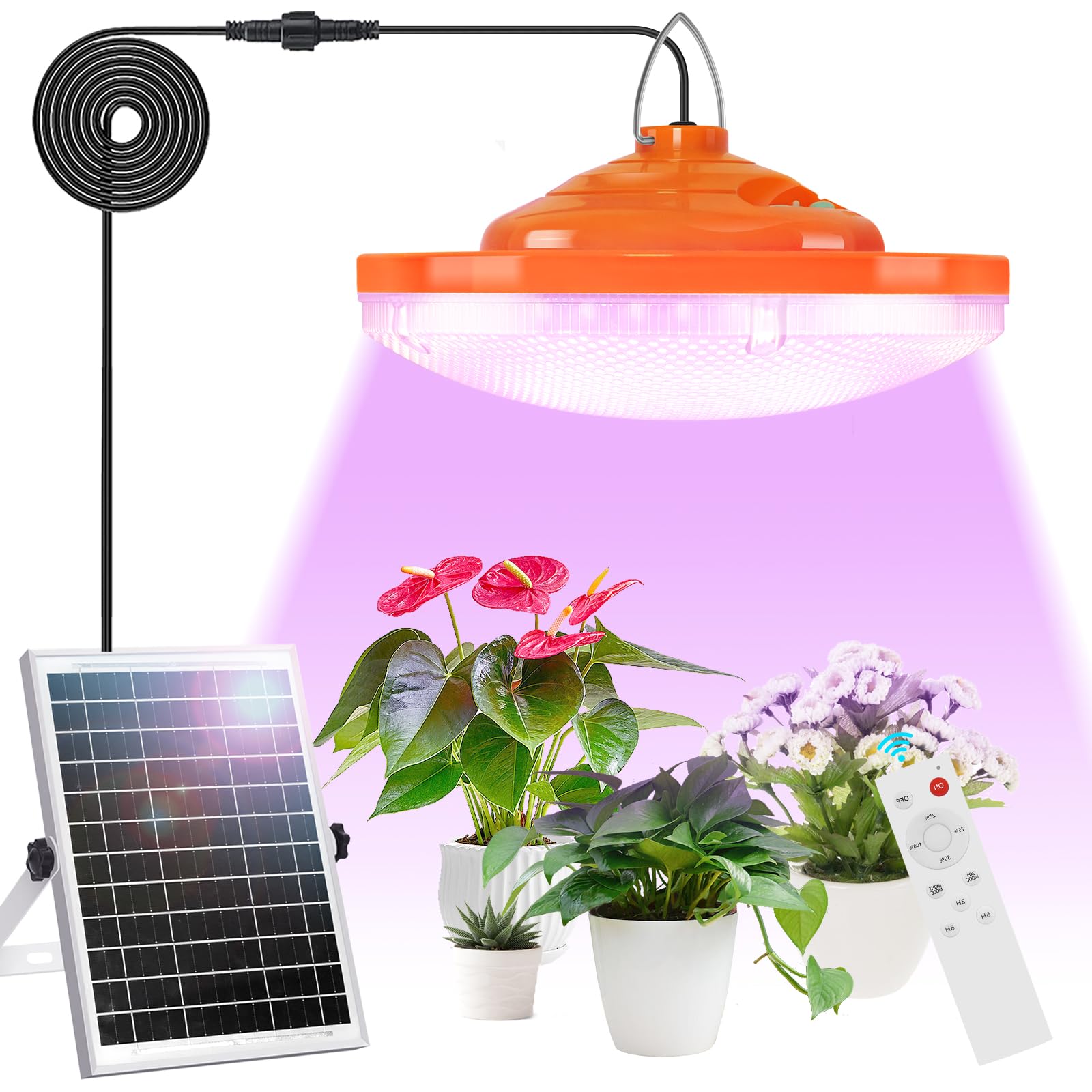
The Ufelizor hanging light splits the difference between the budget clip-ons and the premium integrated kits. Its 96-LED array is divided across warm white (3000 K), red (635 nm), blue (460 nm), and far-red (730 nm) diodes, giving it a genuinely full-spectrum output that supports all growth stages. The IP65 waterproof rating means it can hang exposed to rain without issue, and the 16.4-foot cable gives you flexibility to position the solar panel on a roof while the light drops into a 10-by-20-foot greenhouse. Owners consistently report that after a full day of sun, the light stays on for 12 hours in night mode, making it one of the better runtime performers at the mid-range price point.
The solar panel itself is the hinge-mount style with a stand, so you can either hang it or prop it on the ground facing south. The remote control handles brightness adjustment (three levels), timer settings (3/5/8 hours), and toggling between 24-hour mode and night mode. One reviewer noted that the light may blink if the receiver is too close to the panel, suggesting you keep a few feet of separation. The included USB-C charging port provides a backup for cloudy stretches, though the cable is not bundled — you supply your own USB-C cord.
This unit is best for greenhouse owners who need reliable all-night illumination without breaking the budget. The 12-hour night runtime is a significant step up from the 4–6 hour lights that dominate the budget tier. However, some users report that the plastic housing feels lightweight, and the long-term durability of the panel hinges is a question mark after seasonal temperature swings. For the price, the spectral mix and IP65 protection make it a solid mid-range contender for off-grid greenhouse use.
What works
- Full spectrum includes far-red 730nm for flowering support
- IP65 rated for direct rain exposure in outdoor greenhouses
- 12-hour night runtime with good daily solar charge
- Dual solar and USB-C charging for backup
What doesn’t
- USB-C cable not included
- Plastic hinge on panel feels less durable than metal brackets
- Light may blink if receiver sits too close to solar panel
5. ladate 96 LED Round Solar Hanging Light
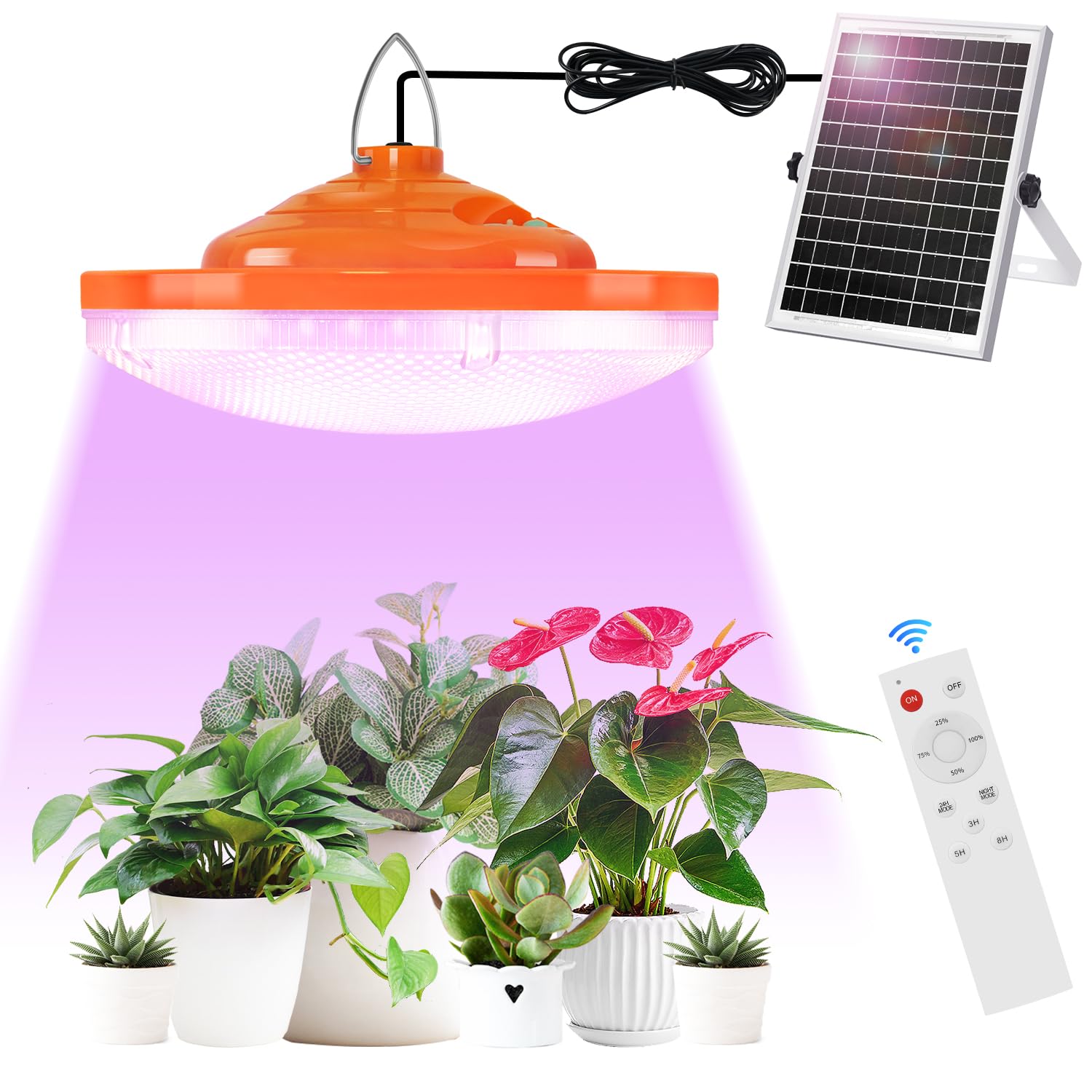
The ladate round hanging light departs from the floodlight form factor with a hemispheric lamp design that radiates light in a broader 180-degree pattern. The 96-LED array mirrors the Ufelizor in spectral composition — warm white, red, blue, and far-red — but the spherical diffuser spreads that light more evenly over a wider area, reducing hot spots directly under the bulb. The monocrystalline silicon solar panel measures a generous 13.78 by 9.25 inches and includes a 180-degree adjustable metal bracket for optimal sun angle. The 16.6-foot extension cord provides plenty of reach from panel to lamp.
Four brightness levels (25%, 50%, 75%, and 100%) give you granular control over energy consumption, letting you stretch runtime on shorter winter days. A remote controls the timer options (3/5/8 hours) and mode switching between 24-hour and night-auto. The top-mounted button also allows manual override without the remote. Owners who bought two units report consistent performance on one and intermittent failure on the other — the unit either dims unexpectedly or stops holding a charge — suggesting batch variability in the battery cells. The 1-year warranty covers this, but keeping the packaging for returns is recommended.
When it works, the ladate is an excellent choice for covering a wide greenhouse bench or a cluster of potted plants with even light distribution. The ABS plastic body is lightweight enough to hang from a single hook, and the heat dissipation design keeps the lamp cool even during extended 8-hour runs. The 100% dimming option combined with the hemispheric lens makes this the most flexible light for adjusting coverage area to plant density, but the inconsistency between units means you should test immediately upon arrival.
What works
- Hemispheric lamp spreads light evenly over a wide area
- Four brightness levels allow energy optimization for shorter days
- Large monocrystalline panel with 180-degree adjustable bracket
- Includes AAA batteries for the remote control
What doesn’t
- Battery quality inconsistency between production batches
- Some units stop holding a charge after a few weeks
- Lightweight plastic body may feel less premium than metal options
6. ladate 2-Head Clip Solar Grow Light
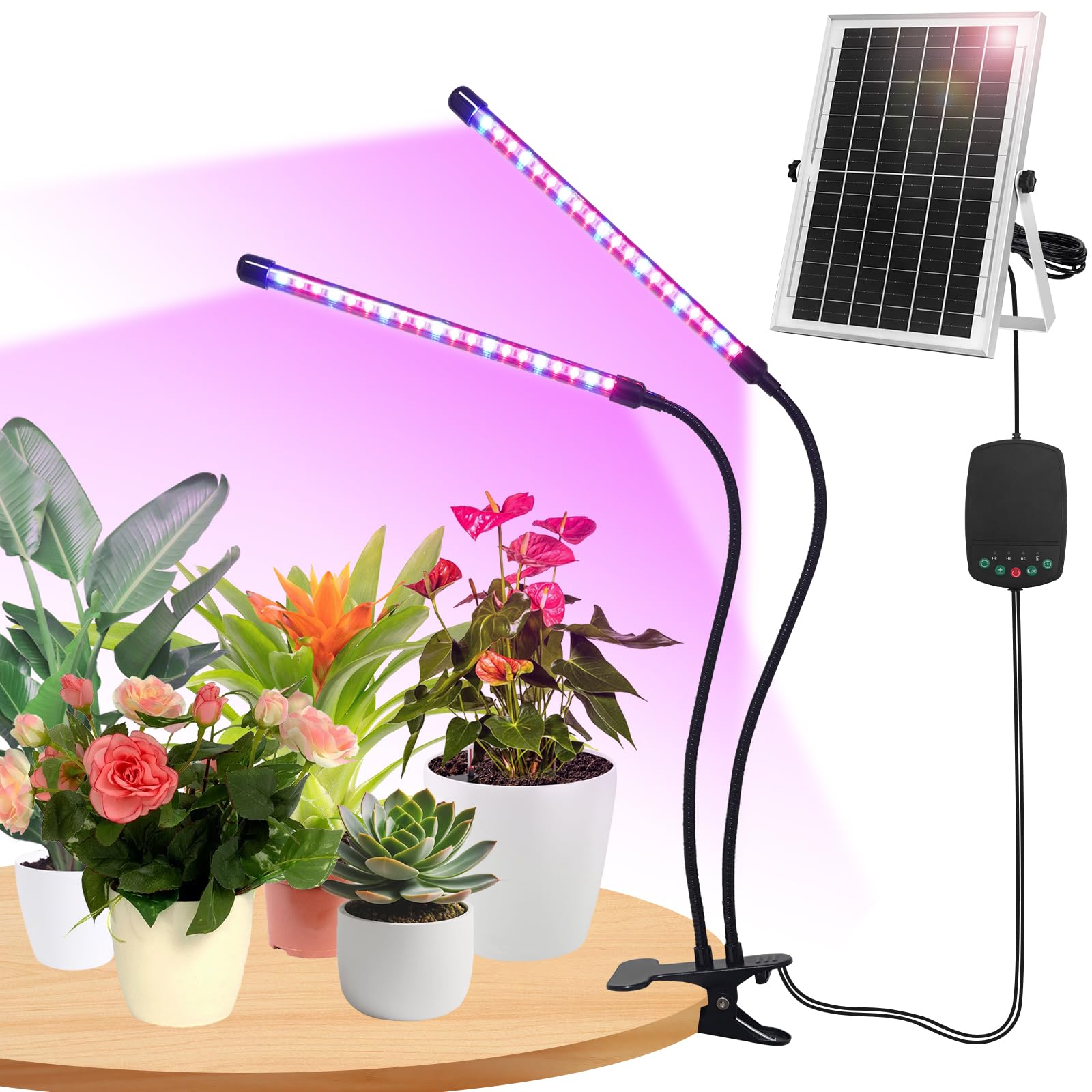
The ladate 2-head clip light is the only unit in this lineup with a gooseneck and clamp design, making it ideal for desktop propagation or under-shelf seed starting. The two heads each house 20 LEDs split between 26 red (635 nm) and 12 blue (460 nm) per side — a red-blue-only spectrum that promotes vegetative growth effectively but lacks the warm white and far-red wavelengths needed for robust flowering. The built-in 8,000 mAh rechargeable battery is substantial for its size, providing up to 10 hours of light in the lower brightness settings. The 16.4-foot solar panel cord lets you mount the panel outdoors while the clamp stays on a shelf indoors.
The clip itself has a padded metal jaw that fits edges up to about 2 inches thick without marring the surface, and the gooseneck tubing is stiff enough to hold position under the weight of the dual heads. Three spectral modes — red only, blue only, and red+blue — let you tailor the wavelength to the growth stage: red for flowering, blue for foliage, and combined for general growth. The 3/6/9 hour timers and automatic dusk-to-dawn function add convenience, though owners report that the solar charge alone delivers only about three hours of full brightness in San Diego sun, meaning regular USB-C top-ups are needed for overnight coverage.
This is a budget entry best suited for targeting one or two small potted plants or a single seed tray. The red-blue spectrum is effective for compact growth but produces a harsh pinkish glow that makes it harder to inspect plant health visually. The 1-year warranty covers defects, and some units have survived two years outdoors in coastal Southern California. For the price, the clip form factor and 8,000 mAh battery offer good flexibility for small-space gardeners who can position the solar panel in strong direct light.
What works
- Flexible gooseneck and padded clip mount easily on shelves and desks
- 8,000 mAh battery is large for this form factor
- Three spectral modes (red, blue, red+blue) for targeted growth
- USB-C charging backup for cloudy days
What doesn’t
- Red-blue only spectrum lacks far-red and warm white for flowering
- Solar charge alone provides only ~3 hours of bright light per night
- Some units stopped charging via USB-C shortly after purchase
- Metal clip can show surface rust in humid environments
7. Loscarol Solar Grow Light Floodlight
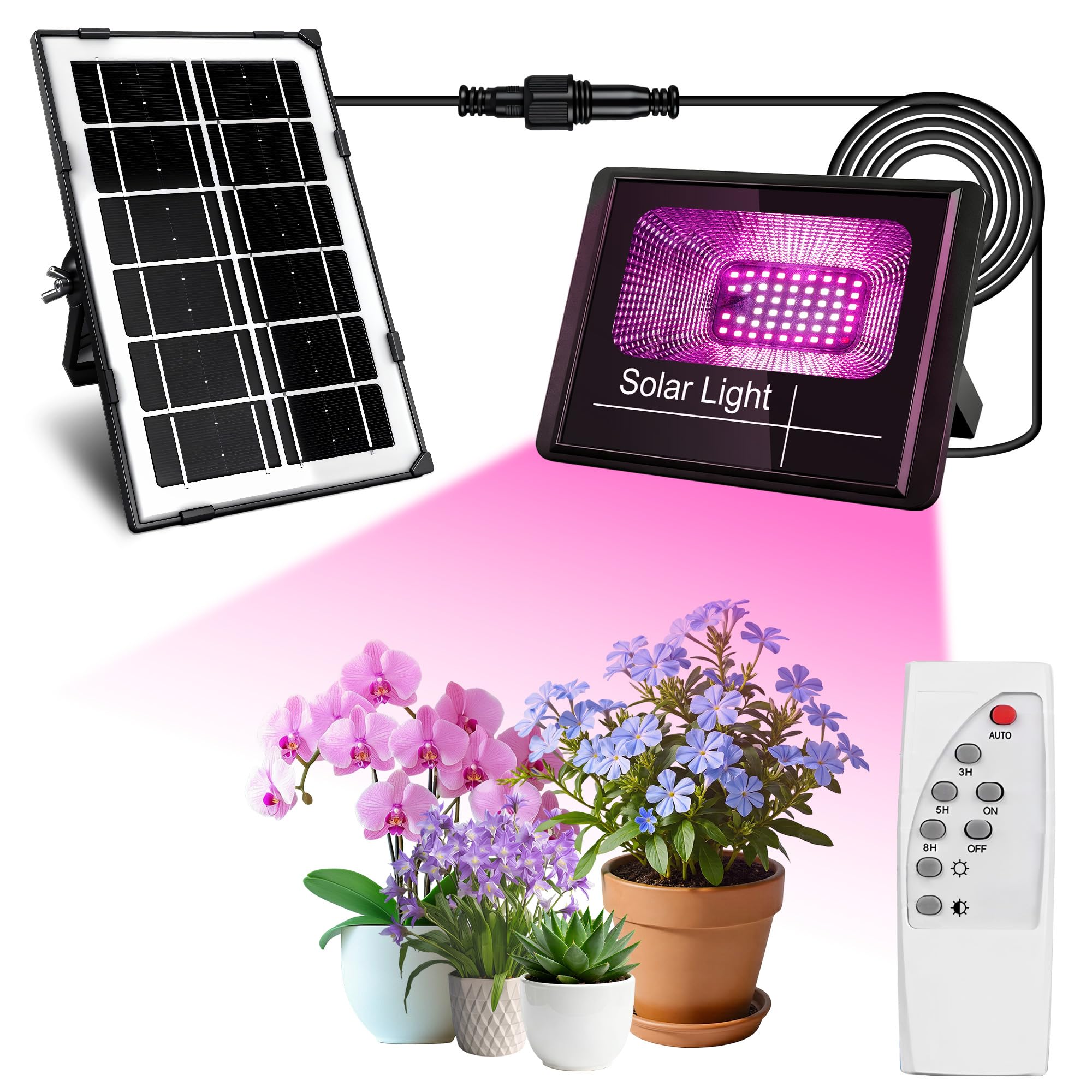
The Loscarol floodlight is the most budget-conscious option here, trading spectral sophistication for simplicity and a low entry point. Its 50 LEDs emit a pinkish light that is heavy on the red-blue combination, which covers the basic chlorophyll absorption peaks but omits the broader spectrum needed for full-cycle growth. The 1,000 lumen maximum output is adequate for accent lighting over a small flower bed or a single potted plant, but it will not support dense canopy growth or fruiting vegetables. The dual charging system — solar panel plus USB-C cable — gives you flexibility on overcast days, though the cable is not included for the USB-C charging.
The design is a compact floodlight form factor that can be wall-mounted or staked into the ground, with a 16.4-foot cord that separates the solar panel from the light head. The remote control handles three brightness levels (30%, 60%, 100%) and timer settings (3/5/8 hours). Owners report that the unit is well-packaged and works reliably out of the box for about one month, after which some units begin showing no detectable plant growth response — likely because the 1,000 lumen output at the recommended mounting height delivers insufficient PAR to drive photosynthesis beyond maintenance levels. The floodlight housing and solar panel back bracket feel somewhat fragile, so careful handling during installation is advised.
For a gardener looking to add a gentle nighttime glow to a small decorative pot or a few herb starts, the Loscarol can serve as a supplemental light rather than a primary grow source. It will not replace a mains-powered grow light for serious propagation or fruiting stages. The 30% brightness mode can stretch runtime into the early morning, but the overall photosynthetic contribution is minimal. Consider this only as an entry-level experiment or as a decorative plant accent, not a tool for active growth management.
What works
- Low entry price for first-time solar grow light buyers
- Dual solar and USB-C charging options for flexibility
- Remote-controlled brightness and timer functions
- Small footprint fits tight spaces and small pots
What doesn’t
- 1,000 lumen output is too weak for primary plant growth
- Pink spectrum lacks warm white and far-red wavelengths
- Some units show no measurable plant growth after one month
- Brackets and solar panel back feel fragile during installation
Hardware & Specs Guide
Battery Capacity Measured in mAh
Battery capacity determines how many hours the light can run after sunset. Look for at least 5,000 mAh for overnight use (8+ hours). The BestDrop unit leads with 20,000 mAh, while budget clip lights typically house 1,500–4,000 mAh. Higher mAh directly translates to longer runtime at a given brightness setting, so prioritize this over LED count when comparing units.
Solar Panel Wattage and Type
Panel wattage dictates charging speed. Monocrystalline panels are 15–20% more efficient than polycrystalline, meaning they generate more charge per square inch. A 20W panel can fully recharge a 20,000 mAh battery in about 5 hours of direct sun. Budget units with 3–5W panels may need 10+ hours of direct sun to fill a smaller battery, making them unreliable in winter or partly shaded locations.
Spectral Composition and PAR Output
Full-spectrum lights include warm white (3000 K), blue (460 nm), red (635–660 nm), and far-red (730 nm) diodes. Red-blue-only fixtures miss far-red, which is critical for the phytochrome system that governs flowering and stem elongation. Photosynthetic Photon Flux Density (PPFD), measured in µmol/m²/s, is the true metric for grow light efficacy, but few solar units publish it — use reported lumen values as a rough proxy, with 3,000+ lumens being the minimum for a 4×4-foot coverage area.
Waterproof Rating (IP Code)
For outdoor greenhouse use, look for IP65 or higher. This rating means the light is dust-tight and protected against low-pressure water jets from any direction. Units with lower IP ratings (IP44 or none) are suitable only for indoor or sheltered applications. The BestDrop and Ufelizor both carry IP65+, making them safe for exposed hanging in rain-prone climates.
FAQ
Will a solar grow light work in winter with shorter daylight hours?
How far should I hang the light from my plants?
Can I use a solar grow light indoors through a window?
Final Thoughts: The Verdict
For most gardeners, the best solar powered grow lights winner is the BestDrop Sunlike Full Spectrum Solar Grow Light because its 20,000 mAh battery and 20-watt monocrystalline panel deliver the longest real-world night runtime and the broadest spectral support for all growth stages. If you need a targeted clip-on for desk propagation, grab the ladate 2-Head Clip Solar Grow Light. And for a high-brightness versatile dual-purpose light over a raised garden bed, nothing beats the BSOD 2-in-1 Solar Grow Light.