
Watering too much or too little is the fastest way to kill a garden. A soil tester takes the guesswork out by telling you exactly what is happening underground — moisture, pH (acidity or alkalinity), nutrients, and temperature — so you can fix problems before your plants show it.
I’m Rikta — the co-founder and writer behind Lawn Gear Lab. This guide is built by comparing the manufacturers’ published specifications and the patterns across verified customer reviews, so you get each pick’s real strengths and trade-offs instead of marketing spin.
Whether you manage a vegetable patch, a lawn, or a houseplant collection, the right soil tester for garden turns vague rules into precise care that your plants will thank you for.
How To Choose The Best Soil Tester For Garden
The right soil tester depends on what you grow, how many plants you have, and how deep you want to go with the data. Here are the three things that matter most.
Match the tester type to your gardening style
Chemical reagent kits (like the Soil Test Kit 140 Tests) give you the most complete picture — they test pH, nitrogen (N) for leaf growth, phosphorus (P) for roots and flowers, and potassium (K) for plant health — but they take about an hour and require mixing soil with water and comparing color charts. Analog probe meters (like the XLUX) deliver instant moisture readings without batteries, but only measure one thing. Digital wireless meters (like the 4-in-1 EDGEVEIL) track moisture, temperature, light, and time from up to 328 feet (about the length of a football field) away, making them ideal for busy gardeners with multiple zones.
Look at probe length and durability
The probe (the metal rod that goes into the soil) must reach the root zone, not just the surface. For deep pots or outdoor beds, a probe of at least 6 to 8 inches (15 to 20 cm) is necessary. The XLUX Long Probe measures 5.5 inches (about 14 cm) longer than standard styles, letting it reach the bottom of large containers where moisture tends to pool. Single probes cause less damage to roots than double or triple probes, but triple-probe designs like the one in the 4-in-1 Wireless Tester deliver more stable readings by sampling multiple points at once.
Decide how much data you actually need
If you grow picky plants like tomatoes or blueberries that are sensitive to pH, a dedicated pH meter (like the YINMIK or LUVCOSY) is the best tool for the job. If you have a mix of houseplants and a vegetable patch and just need to stop overwatering, a simple moisture meter plus a separate NPK test kit covers nearly every scenario. For high-volume gardens with many plants across different zones, a wireless system that connects multiple sensors to one display saves hours of walking and bending.
Quick Comparison
On smaller screens, swipe sideways to see the full table.
| Model | Category | Best For | Key Spec | Amazon |
|---|---|---|---|---|
| Soil Moisture Meter for Plants, 4-in-1 Wireless | Digital Wireless | Multi-zone monitoring from indoors | 328 ft wireless range | Amazon |
| Digital pH Tester for Soil (YINMIK) | Digital pH Meter | Precise pH control with phone app | Bluetooth + 24h monitoring | Amazon |
| LUVCOSY Industrial Grade pH Meter | Digital pH Meter | Quick lab-grade pH readings | 5-year battery life | Amazon |
| Lamotte Model El – Turf and Garden Kit | Reagent Kit | Complete NPK + pH for large areas | 75 total tests | Amazon |
| HSLGOVE 7-in-One Soil Tester | Dual-Screen Analog | All-in-one beginner tool | 7 measurements with dual dials | Amazon |
| XLUX Long Probe Moisture Meter | Analog Probe | Deep pots and outdoor beds | 5.5-inch extended probe | Amazon |
| Soil Test Kit 140 Tests | Reagent Kit | Budget NPK + pH analysis | 140 tests per kit | Amazon |
In‑Depth Reviews
1. Soil Moisture Meter for Plants, 4-in-1 Wireless Soil Tester
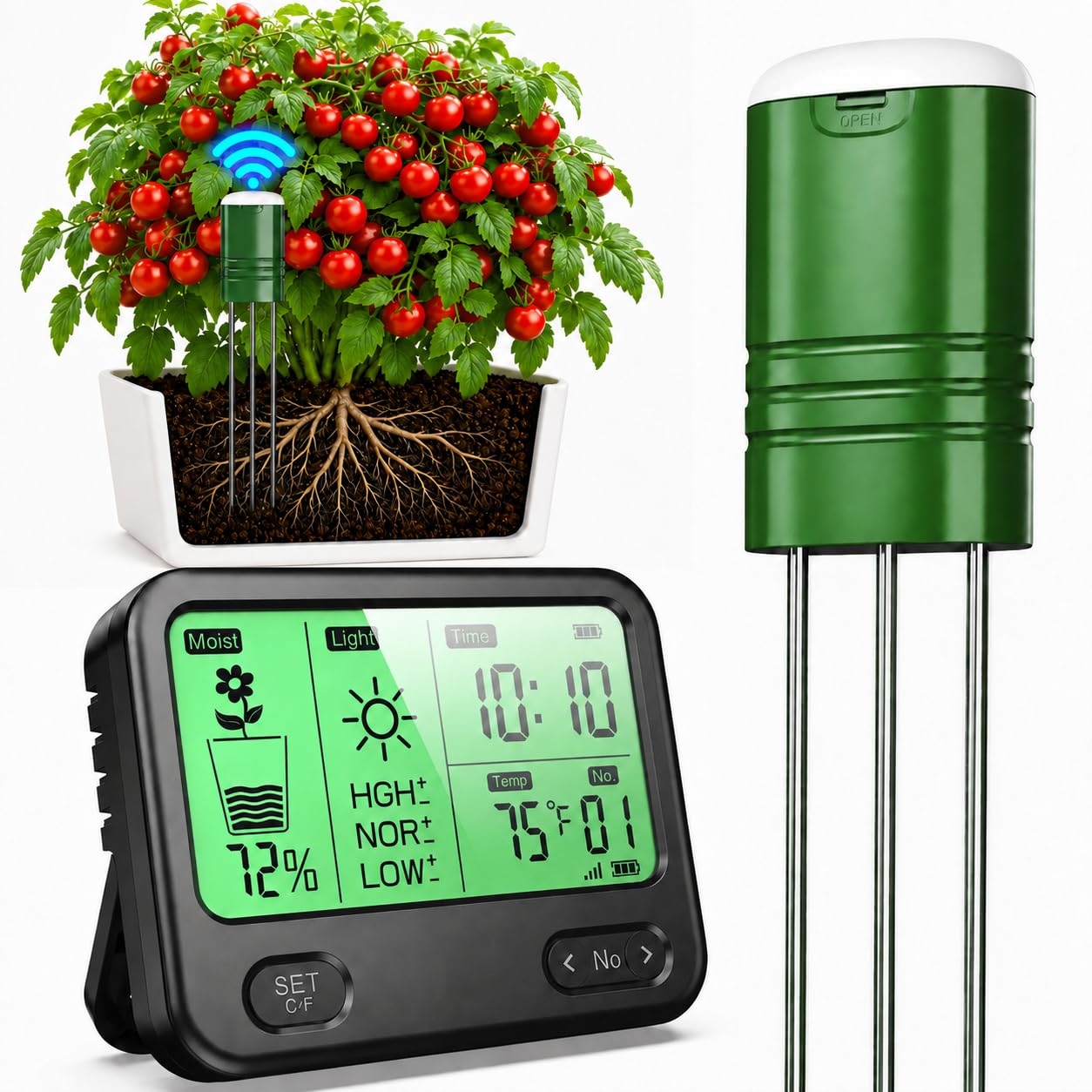
328 ft wireless range and 4-in-1 TDR technology make this the top pick for the multi-zone gardener who manages indoor pots, a balcony, and an outdoor bed from one central screen.
With a wireless range of 328 ft, you can check plant conditions from your couch, bedroom, or office, as buyers report. One display connects with up to 12 sensors, so your monitoring system grows with your plant collection without buying a new console each time. The probe is waterproof and corrosion-resistant (a common weak point on cheaper meters), and the screen shows all four data points at once — no mode-switching or menu-diving.
The honest limit is that it needs two AAA batteries (included) and works best when you insert the probe once and leave it, rather than moving it pot to pot. For the gardener who wants convenience, accuracy, and the ability to monitor from indoors, this is the pick that does it all in one package.
Why it’s great
- Wireless range of 328 feet lets you check moisture without leaving the couch
- Triple-probe TDR delivers stable readings from multiple points at once
- One display supports up to 12 separate sensors for multi-zone control
Good to know
- Requires AAA batteries and is best left installed rather than moved between pots
2. Digital pH Tester for Soil (YINMIK)

Where the top-pick wireless 4-in-1 measures four factors, the YINMIK digital pH tester focuses solely on pH and adds Bluetooth connectivity for 24-hour automatic data storage, letting you check soil pH trends over days and weeks directly from your phone.
It comes with a tapered stainless-steel dibber (a protective sleeve that shields the pH electrode) that works in everything from dense garden beds to loose potting mix. In the box you get six calibration buffer powders (to check the meter’s accuracy), a clean brush, and three LR44 batteries, so you can recalibrate as often as you like without buying extra gear. Owners mention that its accuracy matches “expensive meters” within “a few hundredths,” making it a reliable tool for finicky crops like blueberries or tomatoes that demand a specific pH window.
Choose the YINMIK over the top pick if your number-one concern is getting the pH exactly right for a specific crop, and you want historical data logged to your phone rather than just a live screen readout. The catch is that it measures pH only — you will need a separate tool for moisture or light.
Where it shines
- Bluetooth connects to an app for 24-hour automatic pH data storage
- Stainless-steel dibber protects the electrode in tough soil types
- Includes six calibration buffer powders for regular accuracy checks
Worth noting
- This tester measures pH only — you will need a separate tool for moisture or light
3. LUVCOSY Digital Soil pH Meter
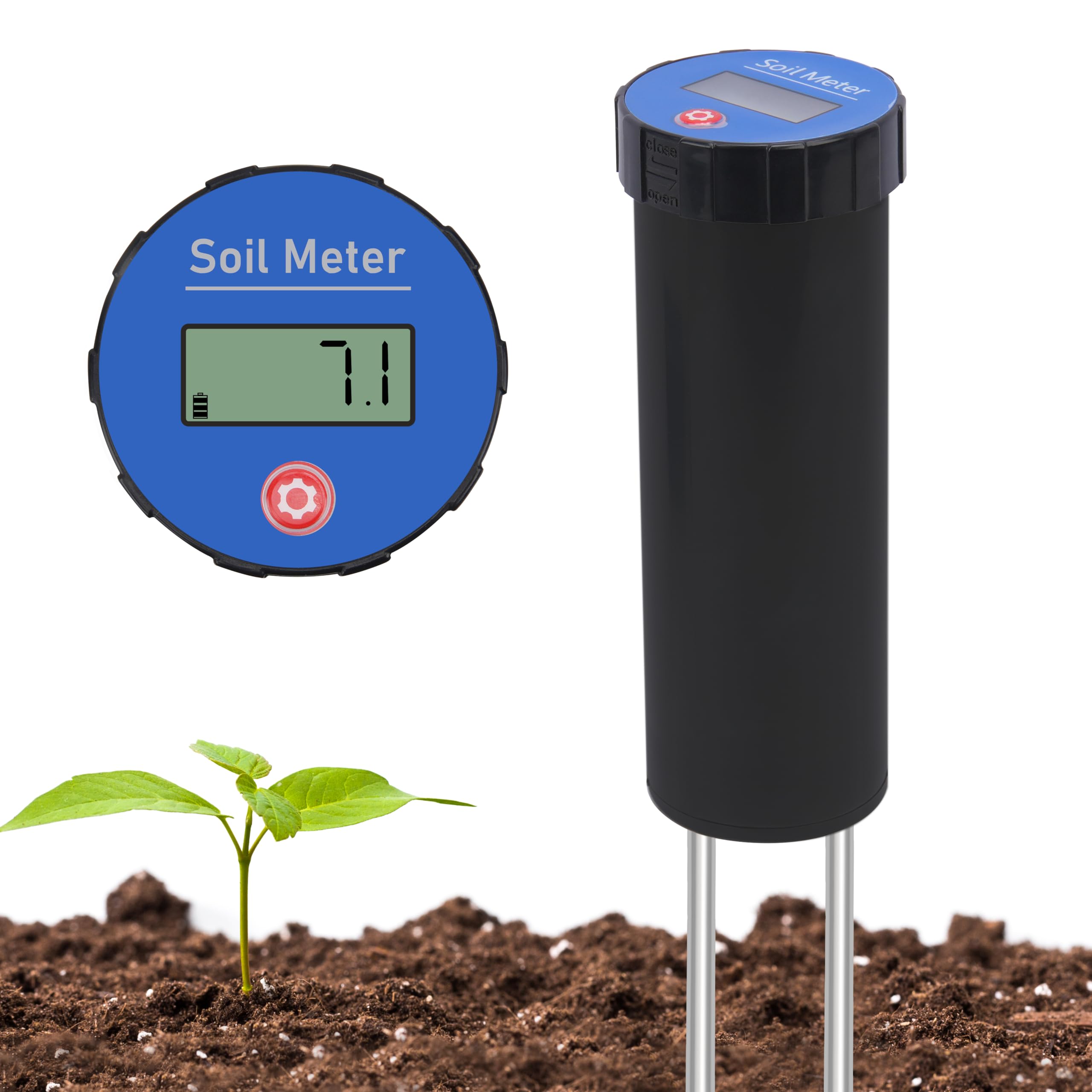
If you need a fast, no-fuss pH reading without connecting to an app or mixing powders, the LUVCOSY digital pH meter is the best choice. It is built for the gardener who walks the garden every morning and wants a quick “is it good or bad” answer on the spot. Its double-needled stainless-steel probes are highly sensitive and anticorrosive, and the display is calibration-free — meaning you can pull it out of the box, stick it in the soil, and get a reading immediately.
It delivers industrial-grade accuracy (customers note it “works quickly and accurately”) and runs on three AA batteries that the manufacturer says will last five years, making it virtually maintenance-free. At 9.6 ounces, it is light enough to carry around the yard all afternoon, and the handheld design fits comfortably in one hand. Buyers who have tried other meters call this one “awesome” and say it works exactly as described for their vegetable patches and patio tomatoes.
The standout spec is the five-year battery life — you will likely never think about replacing the batteries in this meter.
What stands out
- Calibration-free display gives instant, accurate pH readings out of the box
- Double-needled stainless-steel probes are sensitive, anticorrosive, and durable
- AA batteries are rated to last five years for virtually no maintenance
The trade-offs
- Measures soil pH only — not suitable for liquids or moisture detection
4. Lamotte Model El – Turf and Garden Soil Test Kit

The single number that matters most in this category is 75 tests per kit — and this Lamotte Model EL scores a full 75, covering 15 tests each for nitrogen, phosphorus, and potassium, plus 30 tests for pH. It delivers the deepest data without electronics, using chemical reagents and laminated color charts adapted from professional lab methods.
The downside is effort: you must collect soil samples, dry them (overnight is recommended), sift out debris, mix with the included reagents, wait for color changes, and compare against the charts. Reviewers point out that it “revealed inaccurate soil assumptions” and that the process demands patience — one reviewer noted they had to do the phosphorus test twice because initial separation was insufficient. But reviewers consistently call it the most reliable option: “If you want the truth about soil chemistry, stop here.”
At this price point, you get lab-quality precision with durable equipment that will last for years — you only need to buy replacement reagent refills. The Lamotte is the most expensive option here, but if you manage a large lawn, a vegetable garden, or a farm, the depth of data it delivers is unmatched by any probe or meter, making it a strong price-to-value read for serious growers.
The upsides
- Delivers the most complete NPK + pH data without any electronics or batteries
- Includes 75 tests (15 each for N, P, K and 30 for pH) with laminated color charts
- Professional-grade equipment that lasts years with refill reagents
Keep in mind
- Requires overnight soil drying, sifting, and careful reagent mixing — not instant
5. HSLGOVE 7-in-One Soil Tester
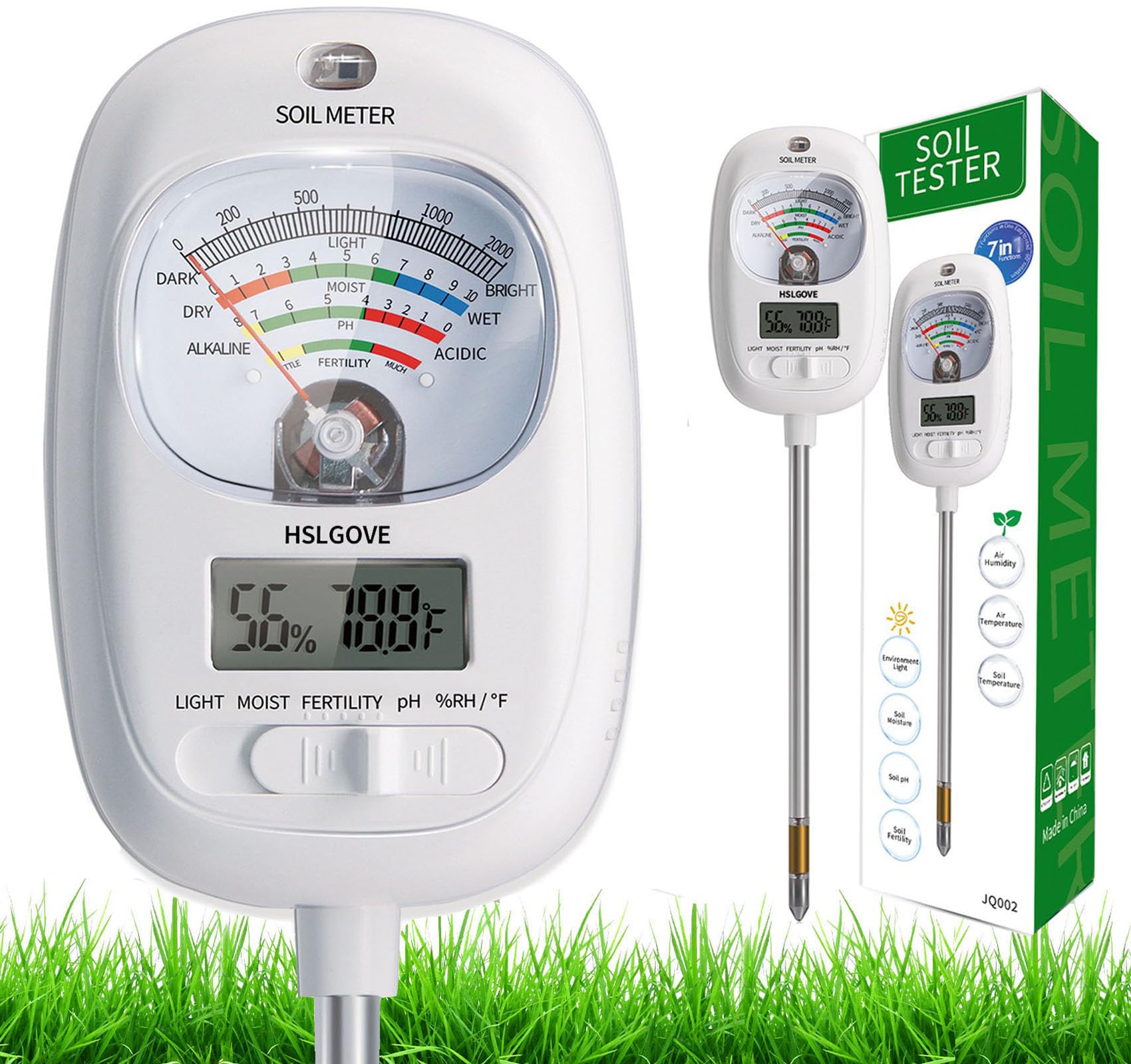
The HSLGOVE 7-in-One packs a lot of capability into a single device at a lower price: it measures soil moisture, pH, fertility, light, soil temperature, air temperature, and air humidity — all through a unique dual-dial design that combines an analog meter with an LCD screen. The LCD displays the temperature and humidity readings, while the dial shows moisture, pH, fertility, and light on the same switch-operated dial.
What you give up compared to the wireless 4-in-1 or the Lamotte kit is depth. The fertility reading is a broad measure, not a specific NPK breakdown, and some reviewers found the pH reading inaccurate (one described it as consistently reading “too acidic”). However, the majority of buyers call it accurate and easy to use — particularly beginners who want a single tool to understand whether their soil is dry, low on nutrients, or too acidic without owning four separate devices. The single probe design (6.8 inches long) is less harmful to plant roots than dual-probe meters.
This is the best choice for the new gardener or houseplant enthusiast who wants seven readings in one tool without learning how to mix powders or download apps. Just insert the probe more than 3 inches into the soil, switch the button, and read the LCD results in 3 to 5 minutes, as the manufacturer recommends — making it the perfect budget buyer for anyone seeking maximum readings at minimum cost.
Why we’d pick it
- Seven measurements in one device — moisture, pH, fertility, light, soil temp, air temp, humidity
- Dual-dial design with an analog meter plus an LCD screen for temperature and humidity
- Single 6.8-inch probe is gentle on roots and easy to insert
A few caveats
- Fertility reading is a general indicator, not a specific NPK measurement; some pH accuracy concerns noted
6. XLUX Long Probe Deep Use Soil Moisture Meter

The XLUX Long Probe is the perfect choice for anyone with deep flower pots, raised beds, or in-ground plants where moisture collects at the bottom and surface-level checks miss the problem. Its single probe is 5.5 inches longer than regular styles (14 cm extra), allowing it to reach the bottom of large containers where roots are most active — and where overwatering damage starts first.
This is a pure analog moisture meter with zero electronics — no batteries, no calibration, no app. You simply insert the probe into the soil, and the large dial immediately shows dry, moist, or wet across ten scales. Shoppers say it works perfectly for plants in the ground and in pots, with one reviewer calling it “a required tool for potted plants” and another using it to fine-tune a drip irrigation system.
The honest limit is that it measures moisture and nothing else — no pH, no light, no nutrients. Also, the manufacturer warns not to leave the probe in the soil for more than 5 minutes, as the metal tip will gradually corrode. For the gardener who already knows their pH is fine and just needs to stop drowning their plants, this is the simplest, cheapest fix.
Strong points
- Longer 5.5-inch probe reaches the bottom of deep pots and raised beds
- No batteries, no calibration, no electronics — simply insert and read the dial instantly
- Weighs just 0.32 ounces, the lightest tool in this guide by far
Before you buy
- Measures moisture only; does not test pH, light, or nutrients
- Do not leave in soil longer than 5 minutes to avoid probe corrosion
7. Soil Test Kit 140 Tests (2026 Updated Instructions)
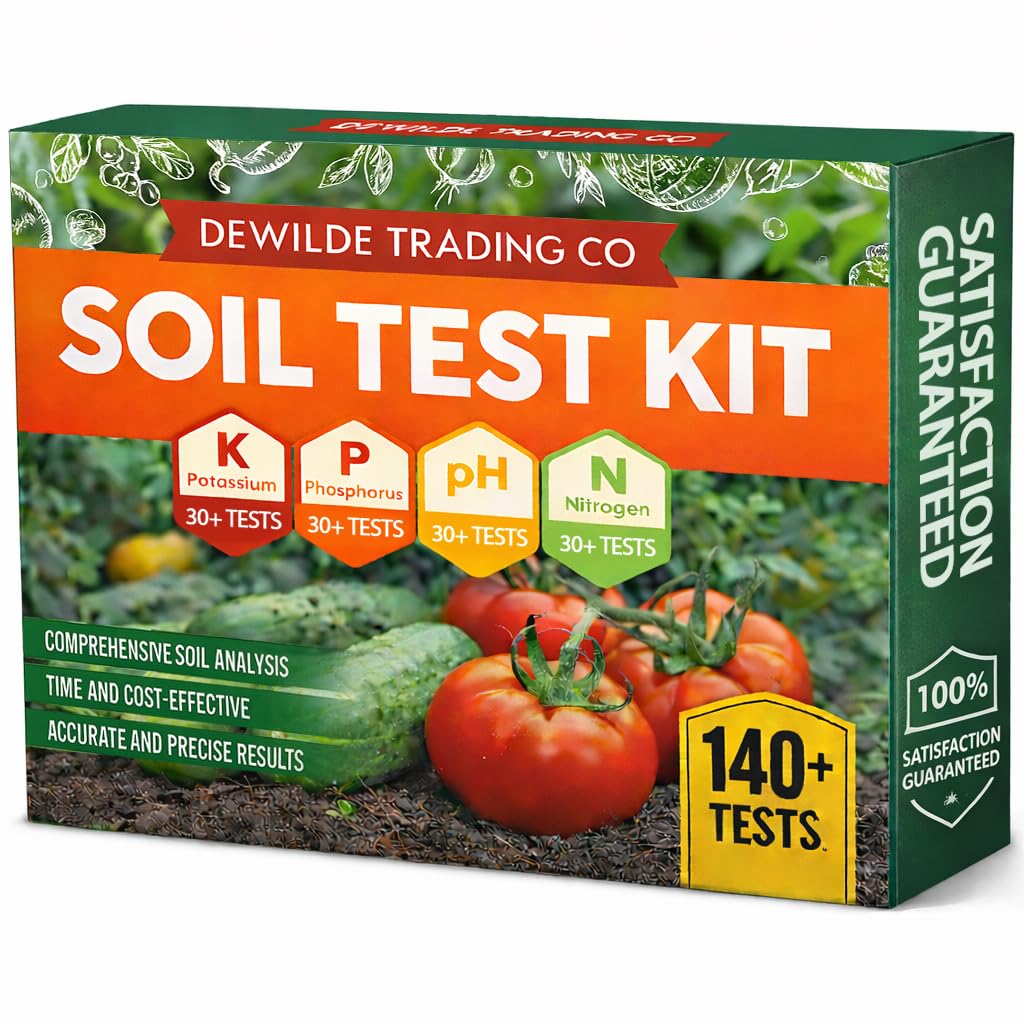
The Soil Test Kit 140 Tests is the entry-level ticket to full soil analysis without spending a lot. At this price you get about 40 tests each for pH, phosphorus, and potassium, plus roughly 20 tests for nitrogen — totaling 140 tests per kit. That is enough to test a medium-sized vegetable garden for a full growing season and still have refills left over.
What you give up compared to the more expensive reagent kits (like the LaMotte) is precision depth and convenience. The color charts are simpler, and one buyer mentioned the “instruction chart lacks NPK guidance on what to do after color matching (high/low/optimal), so you need to do a little research on what to do with the results once you have them. Also, the small beakers require two-stage testing for some steps. But the majority of buyers find it effective: one called it an “affordable kit with 120+ tests, results in under 1 hour” that “helped improve garden,” and another said it “explains why my tomatoes aren’t growing.”
This is the best pick for the budget-conscious gardener who wants to know what is happening in the soil without spending on meters or probes. It gives you the same NPK and pH data as kits costing several times more — you just have to be patient with the mixing and reading of the charts.
What we like
- 140 total tests (approximately 40 each for pH, P, and K, plus 20 for N) for a full season
- Delivers the same NPK and pH data as much more expensive kits
- Buyers report results are effective for identifying issues like high pH causing stunted tomatoes
The downsides
- Small beakers require two-stage testing; color charts lack guidance on what to do after matching
- Some reports of leakage and unresponsive seller for defective units
Understanding the Specs
Probe Length
This is the metal rod (or rods) that goes into the ground. A longer probe reaches deeper roots, where moisture and pH can differ from the surface. For houseplants in standard 6-inch pots, a 4-inch probe is fine. For outdoor beds or large planters (12 inches deep or more), look for at least 6 to 8 inches (15 to 20 cm). The XLUX Long Probe extends 5.5 inches (14 cm) beyond regular styles, letting it measure moisture at the bottom of deep containers where overwatering damage often starts.
Measurement Types (Moisture, pH, NPK, Light, Temperature)
A basic moisture meter tells you if the soil is wet or dry — helpful for watering decisions. A pH meter reveals acidity or alkalinity (important for picky plants like blueberries or tomatoes). An NPK test measures nitrogen, phosphorus, and potassium — the three primary nutrients — and requires a chemical reagent kit (mixing soil with powders and comparing to color charts). Some digital meters add light and temperature readings, which help you place plants in the right spot indoors or track soil warmth for germination timing.
Wireless Range
Only relevant for digital meters that send data to a display or phone. Range is measured in feet — the EDGEVEIL 4-in-1 wireless tester reaches up to 328 feet (about 100 meters), meaning you can leave the probe in a bed at the far end of the yard and still get a live reading from your couch. If you garden in a small apartment or a single raised bed, a range of 10 to 30 feet (3 to 9 meters) is plenty. For multi-zone gardens, 100+ feet (30+ meters) saves you from walking back and forth.
Number of Tests
Exclusive to chemical reagent kits. Each test uses a small amount of powder and solution, and the “number of tests” tells you how many times you can run each measurement before buying a refill. The Lamotte Model EL gives you 15 tests each for N, P, and K, plus 30 pH tests (75 total). The Soil Test Kit 140 Tests supplies roughly 40 each for pH, P, and K, and about 20 for N. For a standard garden, 10 to 15 tests per parameter will cover a season if you test monthly.
FAQ
Which is better for a vegetable garden — a digital pH meter or a chemical test kit?
Can I leave a soil moisture meter in the ground permanently?
What does NPK stand for and why does it matter?
How often should I test my garden soil?
Final Thoughts: The Verdict
For most people, the best garden soil tester overall is the 4-in-1 Wireless Soil Tester, because its 328-foot wireless range, triple-probe accuracy, and support for up to 12 sensors offer the best balance of depth and convenience. If you need precise pH control with app logging for a specific crop, grab the YINMIK Digital pH Tester. And for a full NPK and pH analysis on a budget, the Soil Test Kit 140 Tests delivers the most value for your money.