
Specs are compiled from manufacturer listings and verified buyer reviews and can change over time — please confirm the key details on the product page before buying.
The single biggest cause of dead houseplants and sad gardens is getting the water wrong — drowning roots or leaving them gasping. A soil test meter takes the guesswork out by telling you exactly what is happening down where the roots live, so you water only when your plant actually needs it.
I’m Rikta — the founder and writer behind Lawn Gear Lab. This guide is built by comparing the manufacturers’ published specifications and the patterns across verified customer reviews, so you get each pick’s real strengths and trade-offs instead of marketing spin.
For most home gardeners, the winner is the AiGerdinn 4-in-1 because it covers moisture, pH (acidity), fertility, and sunlight from a single battery-free probe. It is simple to use and covers the four main things that go wrong with soil. If you have deep pots and large planters, grab the XLUX Long Probe with its 5.5-inch probe that reaches the bottom zone where root rot starts. And if you want air temperature and humidity alongside your soil data in one unit, the HSLGOVE 7-in-One is the only pick here that gives you that.
Our Picks at a Glance

How To Choose The Best Soil Test Meter
Buying a soil meter is not complicated, but a few key decisions separate a tool you reach for daily from one that sits in a drawer. Focus on what you actually need to measure and where you will use it.
Probe Length and Depth
Short probes (under 5 inches) work fine for shallow pots and seed trays, but large planters and garden beds need a deeper reach to measure moisture where the roots are thickest. A long probe, like the 5.5 inches on the XLUX, lets you check the bottom of a deep pot without disturbing the top layer only.
Number of Functions
A basic moisture-only meter is the cheapest and simplest option. If you suspect your soil pH is off or your plants are not getting enough light, a 3-in-1 or 4-in-1 model adds pH, light, and fertility readings without needing a second device. Multi-function meters save space and money if you want more than just a wet/dry check.
Analog vs. Digital Display
Analog dial meters are battery-free, instantly readable, and extremely durable — just stick them in and read the needle. Digital LCD meters give you exact numbers for temperature and humidity and often come with backlit screens, but they need batteries and take a few minutes to stabilize before you get a reading.
Build Quality and Probe Material
A single metal probe is less damaging to roots than double or triple probes, and better metal alloys resist corrosion longer. Reviewers consistently mention that meters with cheap probes lose accuracy after a few months, while those with thicker metal probes hold up through repeated use.
Quick Comparison
| Model | Best For | Functions | Display | Weight | Amazon |
|---|---|---|---|---|---|
| XLUX Long Probe★ Best Overall | Deep pots and large planters | 1 (moisture) | Analog dial | 0.13 kg (4.58 oz) | Amazon |
| HSLGOVE 7-in-OneMost Versatile | Data lovers wanting every metric | 7 (moisture, pH, fertility, temp, light, air temp, air humidity) | Dial + LCD | 4.8 oz | Amazon |
| Luster Leaf Rapitest 4-Way | Digital precision with a corded probe | 4 (pH, moisture, temp, light) | Digital LCD | 7 oz | Amazon |
| AiGerdinn 4-in-1 | All-in-one value for beginners | 4 (moisture, pH, fertility, sunlight) | Large analog dial | 3.84 oz | Amazon |
| Maxsolve 2-Pack 3-in-1 | Budget-friendly multi-pack | 3 (moisture, light, pH) | Analog dial | 3.68 oz (each) | Amazon |
In‑Depth Reviews
1. XLUX Long Probe Deep Use Soil Moisture Meter
Our pick — 4.5★ from 14,500+ verified ratings; the strongest balance of quality and price.
A 5.5-inch probe that reaches the bottom of deep planters without a battery.
If you have large pots or deep garden beds, the XLUX should be at the top of your list. The probe is 5.5 inches long — notably longer than the AiGerdinn’s 2.5-to-3-inch insertion depth — so it measures moisture at the root zone instead of just the surface. The extra length means you can check conditions at the bottom of a deep pot where root rot often starts. It uses a single metal probe, which damages fewer roots than double or triple probe designs. When you pull it out, very little soil comes with it. The large analog dial has three zones (dry, moist, wet) with ten scales, making it dead simple to read at a glance.
One reviewer wrote: “Whether because of the deep probe or the specific sensor, this meter clearly responds to the different moisture states in my planters so I can have some confidence in the reading.” The needle moves immediately when you insert it, with no waiting. The catch is that the maker advises not leaving it in the soil for more than 5 minutes, because the metal tip can corrode over time if left buried. It also only measures moisture, so you will need a separate tool for pH or light. At 0.13 kilograms (about 4.58 ounces), it is similar in weight to the AiGerdinn (3.84 ounces) but feels a bit more substantial in hand.
The quick verdict: The simplest and most effective moisture-only meter for anyone with deep pots, large houseplants, or outdoor containers.
One limit: Single-function — no pH, light, or fertility readings — so if you need more than wet/dry, look at the 4-in-1 options.
Ideal for: Potted plant owners who want one reliable moisture checker that works instantly and never needs a battery swap.
Not for: Gardeners who want to measure pH or sunlight — you will need a second device for those tasks.
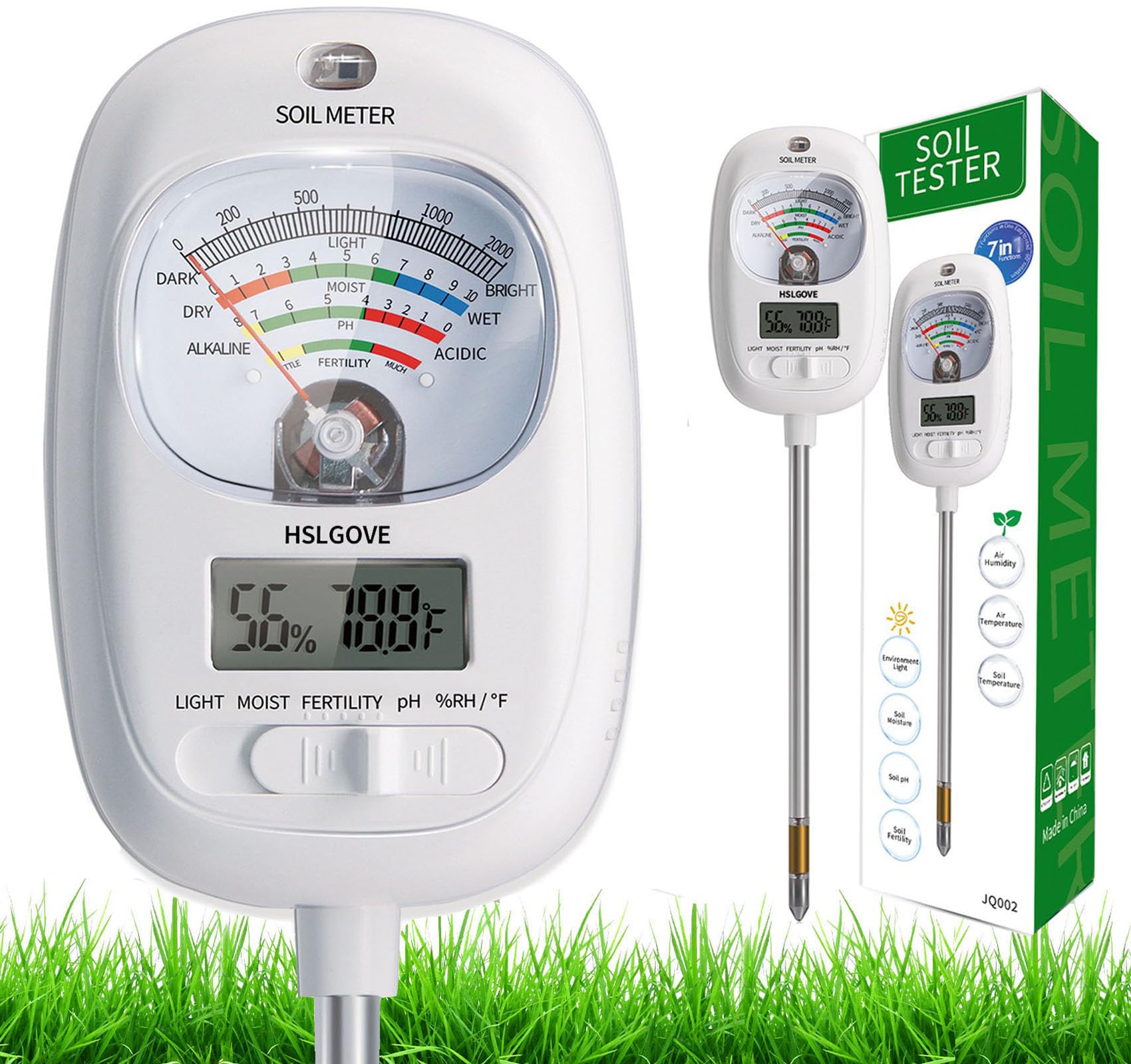
2. HSLGOVE 7-in-One Soil Test Kit
One tool that tracks your soil inside and the air around it — all at once.
This is the most comprehensive pick here because it packs seven readings into a single device: soil moisture, pH (acidity level), fertility, temperature, sunlight, plus air temperature and air humidity. The 1.6-inch chip board inside is designed, according to the maker, for beginners, so you do not need a manual to switch between modes — just one button cycles through the functions. The dual-dial and LCD (liquid crystal display) screen combo means you get analog needle responses for quick soil checks and a digital readout for the air metrics that matter when you are dialing in seedling conditions.
Buyers report the moisture, pH, and NPK (nitrogen, phosphorus, potassium) readings are accurate, and the sturdy metal probe holds up well in medium to large pots. The probe is about 6.8 inches long — shorter than the XLUX’s 5.5 inches, but still enough to reach deep into a standard planter. One reviewer noted the fertility measurement was impossible to get a consistent reading on, so treat that function as a rough guide rather than lab-grade data. The light sensor, some owners mention, can also be finicky, and the pH reading may drift if the soil is very dry. It is also heavier than the others at 4.8 ounces, so it feels substantial in hand.
Catch the full picture: If you want air temperature and humidity alongside your soil data in one unit, this is the only pick here that gives you that.
The trade-off: Batteries are required (three of them) and the LCD screen takes 3 to 5 minutes to stabilize before you trust the reading — not instant like an analog dial.
Grab this for: Gardeners who enjoy tracking multiple variables and want one tool that lives in the potting shed instead of three separate gadgets.
Pass if: You only need a quick moisture check and hate waiting for digital screens — an analog meter like the XLUX is faster and simpler.
3. Luster Leaf Rapitest 4-Way Digital Soil Analyzer
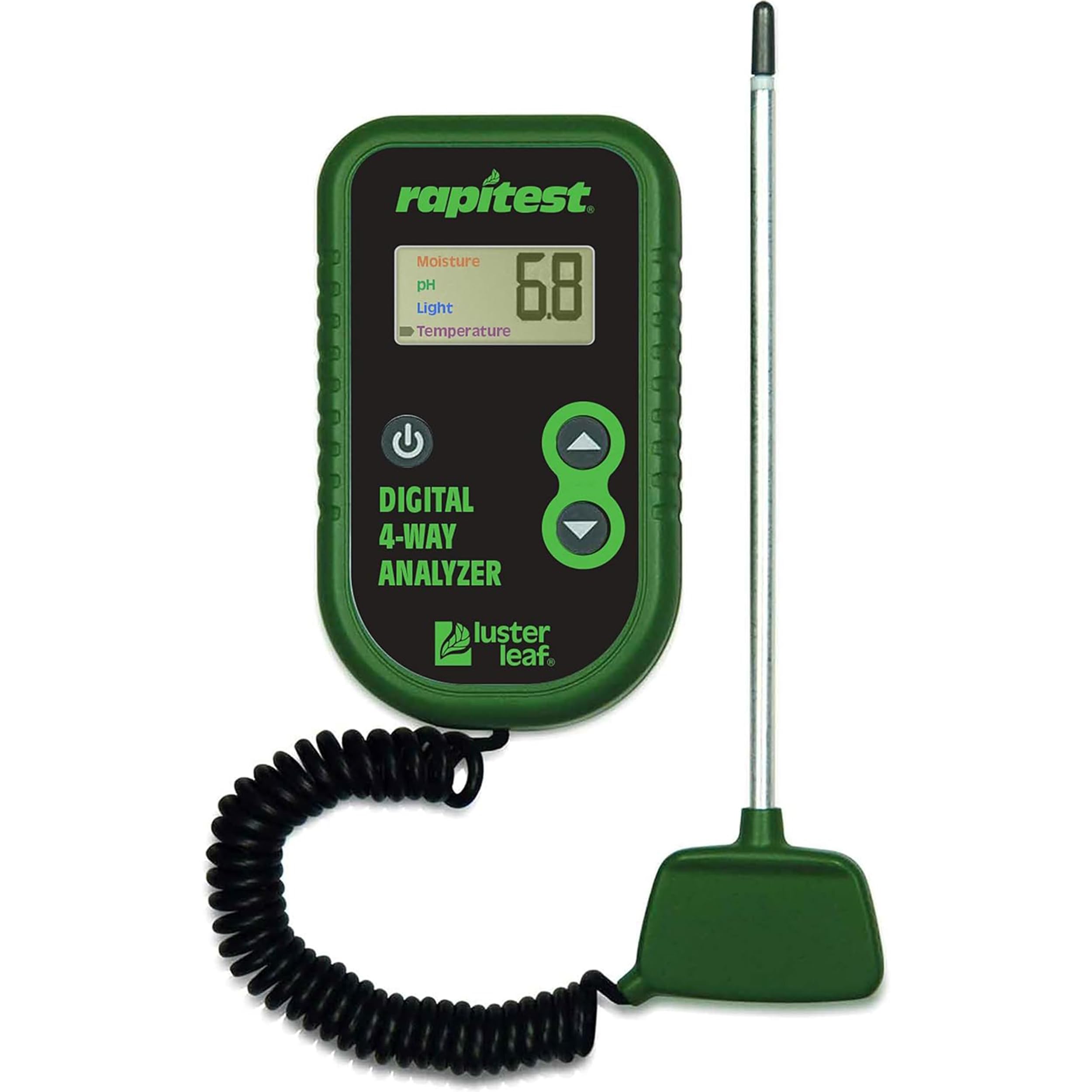
A corded probe lets you read the display while the sensor stays in the soil.
Luster Leaf is a well-known name in home soil testing. This 4-way analyzer delivers digital readings for pH, moisture, temperature, and light. The standout feature is the corded probe design — the sensor goes into the soil while the display unit sits in your hand. You do not have to crouch down to squint at a dial buried in foliage, unlike the one-piece XLUX. The included instructions come with a full pH plant list covering over 450 plants, so you can look up exactly what your specific plant needs. At 7 ounces, it is the heaviest meter here, but the extra weight comes from the sturdy build and the separate probe cable.
Customers note that the moisture and pH readings are accurate when used properly. Many say it has saved their plants from overwatering. A few reviewers had issues with the battery dying quickly or the temperature sensor maxing out at 99°F, which is fine for soil but not for hot compost piles. One customer posted a photo showing a pH reading of 6.2 against a standard buffer solution that should have read 4.01 — a serious accuracy miss that ruined 40 gallons of soil mix, according to the buyer. So while most buyers are happy, the inconsistency is note if you need lab-grade pH precision.
What stands out
- Corded probe is easier to handle than a one-piece meter
- Digital display is clear and easy to read at eye level
- 450+ plant guide helps you match readings to specific plants
Watch out for
- Temperature range stops at 99°F
- Some units arrive with dead or dying batteries, per reviews
- pH accuracy is inconsistent across batches, some reviewers point out
Reach for this if: You want a digital meter with a separate probe for easy handling and appreciate having a plant-specific reference guide included.
Look elsewhere if: Accuracy is critical for pH-sensitive crops like blueberries or seedlings — the inconsistency some shoppers say makes this a gamble for precision work.
4. AiGerdinn 4-in-1 Soil Moisture Meter for Plants
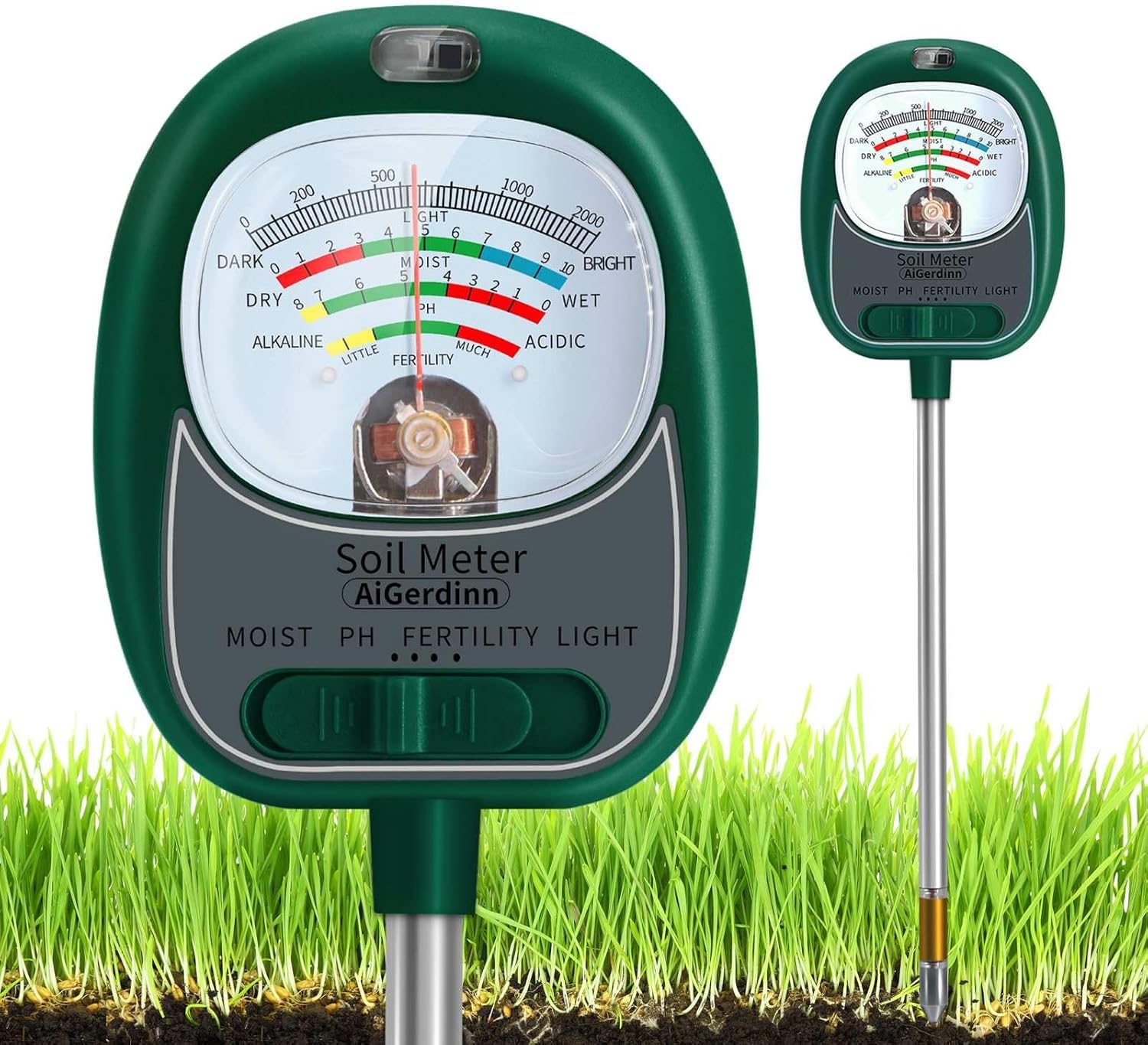
Four readings from a single battery-free probe with a dial big enough to read without glasses.
The AiGerdinn is a genuine 4-in-1 tool that measures moisture, pH (acidity), fertility, and sunlight — all from one sturdy probe and zero batteries. The oversized dial is 1.95 inches across, which is noticeably larger than most traditional hygrometers (moisture meters), making it easy for anyone to read at a glance. It uses a single probe design, so it causes less damage to roots than the multiple-prong alternatives. At 3.84 ounces, it is the lightest single meter here — 23% lighter than the XLUX at 4.58 ounces.
Buyers report the readings are accurate and that the dial is intuitive even for someone new to soil testing. One buyer called it “a must-have tool for any plant lover” and noted that the large dial makes it beginner-friendly. The maker advises moistening the soil before testing and not using it in very hard soil or liquid. The 2.5 to 3 inch insertion depth is fine for medium pots, but for deep planters you would want the XLUX’s longer reach. Keep in mind this is an analog meter, so you get a needle position rather than a precise digital number — which is perfectly fine for most home gardeners.
Why it works
- Four functions in one battery-free device
- Extra-large 1.95-inch dial is easy to read
- Single probe protects roots better than multi-prong designs
Things to know
- Needs moist soil for accurate readings — dry soil may give false results
- Probe at 2.5-3 inches is shorter than the XLUX
- Not for testing liquids or very hard clay soils
Best for: New gardeners who want one affordable tool that covers moisture, pH, fertility, and light without needing batteries or a PhD to understand the dial.
skip it if: You need to measure deep in large pots — the shorter probe depth means you will not reach the bottom zone where roots sit.
5. Maxsolve 2 Pack 3-in-1 Soil Tester

Two meters for the price of one — leave one in the garden and keep one on the kitchen sill.
This is the budget entry-level pick, and the main draw is the value: you get two 3-in-1 meters in one box. Each unit measures moisture, light, and pH (acidity) — the three most common soil concerns — and requires no batteries. The meters are lightweight at 3.68 ounces each, making them slightly lighter than the AiGerdinn (3.84 ounces). That slight weight difference is barely noticeable in hand, but it does mean the build feels a bit less substantial. The probe is shorter than the XLUX’s 5.5 inches, so these are better suited to standard pots and shallow beds rather than deep planters.
Reviewers like having a spare, especially for keeping one indoors and one outside. Several owners mention that the meters help prevent overwatering and that the readings are clear enough to act on. However, there is a notable split in feedback: while many call them “very functional,” one buyer wrote a 1-star review saying “the light meter doesn’t work and the other readings are off” — a common complaint with ultra-budget meters. Another reviewer said accuracy is “pretty good” but not lab-grade. For the price, you get two functional tools, but do not expect laboratory-grade precision from either one.
The honest take: You are buying convenience and backup, not accuracy. The second meter makes this a practical choice for a household with multiple plant zones, but the risk of getting a dud is real.
The trade-off: Inconsistent quality control means some units work fine and others are unreliable — read the return policy before buying.
Reach for these if: You want a second meter to keep in a different room or outdoor bed, and you are okay with rough readings rather than precise data.
Look elsewhere if: Accurate light and pH measurements matter for sensitive plants — the risk of inaccurate readings here is higher than with the AiGerdinn or XLUX.
Understanding the Specs
Probe Length
Probe length determines how deep into the soil you can measure. A short probe (2-3 inches) works for small pots, but for deep planters or garden beds, you need a 5-7 inch probe to reach the root zone where moisture collects. The XLUX has the longest probe here at 5.5 inches. The AiGerdinn recommends inserting 2.5-3 inches, which is fine for medium pots but misses deeper soil conditions.
Number of Functions
More functions means more data without more tools. A moisture-only meter tells you when to water. Adding pH tells you if your soil is too acidic or alkaline for certain plants. Fertility and sunlight readings help you adjust fertilizer and plant placement. The HSLGOVE 7-in-One gives you the most functions, while the XLUX is strictly moisture. Choose based on what problems you actually see — yellowing leaves might be a pH issue, not a watering one.
FAQ
Can I leave a soil moisture meter in the soil all the time?
Do I need a meter that measures pH, light, and fertility, or is moisture enough?
Are digital soil meters more accurate than analog dial meters?
How deep should I insert the probe for an accurate reading?
Can I use a soil tester in water or liquid fertilizer?
Why do some meters have a single probe and others have two or three prongs?
How long does an analog soil meter last before the probe corrodes?
What does the “fertility” reading on a soil meter actually measure?
Can I use a soil tester in very hard or compacted soil?
What is the difference between a 3-in-1 and a 4-in-1 soil meter?
Final Thoughts: The Verdict
For the majority of shoppers, the best soil test meter winner is the AiGerdinn 4-in-1 because it covers moisture, pH, fertility, and sunlight from a battery-free, single-probe design without overwhelming you with menus — perfect for everyday home gardening. If you want the deepest probe for large planters, grab the XLUX Long Probe. And for data-driven gardeners who want air temperature and humidity alongside soil metrics, the HSLGOVE 7-in-One is the one that gives you that.
How We Picked
We do not accept paid placement. Every pick is matched to a real buyer and a real use-case; we do not hands-on test units.
Sources & Methodology
Specifications: manufacturer listings and product documentation. Review insights: verified customer reviews, as of July 2026. Pricing: not shown on this page (it changes often); check the current price via the retailer link.
As an Amazon Associate, Lawn Gear Lab earns from qualifying purchases. This does not affect which products we feature.