
Specs are compiled from manufacturer listings and verified buyer reviews and can change over time — please confirm the key details on the product page before buying.
You water your plants on a schedule and feed them on schedule, but they still look sad. The missing piece is almost always what you cannot see: the pH and nutrient balance hiding in your soil. A soil pH meter is the one tool that turns that invisible chemistry into a clear reading, so you stop guessing and start fixing the actual problem. The best soil ph meter for most gardeners is the YINMIK Digital Soil pH Meter, because only it gives you a calibrated, logged digital reading that adjusts for temperature and shows you real trends.
I’m Rikta — the founder and writer behind Lawn Gear Lab. This guide is built by comparing the manufacturers’ published specifications and the patterns across verified customer reviews, so you get each pick’s real strengths and trade-offs instead of marketing spin.
To find the right meter, you match its probe length, reading accuracy, and measurement modes to the soil conditions and plants you actually have.
Quick Picks
- YINMIK Digital Soil pH Meter for Gardeners — Precision Pick
- HSLGOVE Soil Test Kit, 7-in-One — Best Value
- AiGerdinn 4-in-1 Soil Tester — Large Display
- Luster Leaf 1818 Rapitest 4-in1 Soil pH/Moisture/Fertility/Light Tester — Budget Classic
- Sonkir Soil pH Meter, MS06 3-in-1 — Light & Portable
- Vitamicor 4-in-1 Soil Tester (90° Rotation) — Budget Champion
- Maxsolve 2-Pack 3-in-1 Soil Tester — Two-Pack Value
How To Choose The Best Soil pH Meter
The right soil pH meter for you depends on two things: how many pots or beds you manage, and if you want a quick glance reading or a logged data trail. A few specs separate the reliable tools from the ones that give you a different number every time you poke the same hole.
Probe build and length
A longer probe — around 6 to 8 inches — reaches past the surface layer to where the roots are actively feeding. A probe that is too short or too flimsy bends in compacted ground, and bent prongs throw off the reading. Look for a sturdy metal probe and a shaft that stays straight when you push it in.
Analog dials versus digital screens
Analog meters run on no batteries and give you a needle reading right away, which suits quick spot-checks. They are simple but they drift if the probe surface is dirty or the soil is too dry. Digital meters need batteries but usually include automatic temperature compensation (ATC, an internal adjustment that corrects the reading based on soil temperature) and can store data, which helps if you track pH changes over a growing season.
Extra measurement modes that actually help
Many meters bundle moisture, light, and fertility readings alongside pH. The moisture mode is genuinely useful — it stops you from overwatering the same way pH stops you from missing soil chemistry problems. The light reading is often too crude to trust; the fertility reading on analog meters is typically a basic estimate based on conductivity (electrical conductance of the soil), not a lab result. A four-in-one meter is a fine tool for general plant care, but do not mistake its fertility scale for a real soil nutrient analysis.
Quick Comparison
On smaller screens, swipe sideways to see the full table.
| Model | Best For | Measurement Modes | Probe Length | Weight | Amazon |
|---|---|---|---|---|---|
| YINMIK Digital Soil pH Meter | Serious gardeners & data trackers | pH, temperature (auto compensation) | — | 13.7 oz | Amazon |
| HSLGOVE 7-in-One Soil Test Kit | All-in-one plant monitoring | pH, moisture, fertility, light, soil temp, air temp, humidity | 6.8″ | 4.8 oz | Amazon |
| AiGerdinn 4-in-1 Soil Tester | Quick multi-mode spot checks | pH, moisture, fertility, sunlight | 2.5–3 in | 3.84 oz | Amazon |
| Luster Leaf 1818 Rapitest 4-in1 | Budget garden pH & moisture | pH, moisture, fertility, light | — | 0.2 lbs | Amazon |
| Sonkir MS06 3-in-1 Soil Tester | Lightweight, no-frills moisture checks | Moisture, light, pH | 2–4 in | 2.89 oz | Amazon |
| 4-in-1 Soil Tester (Vitamicor) | Rugged outdoor & garden use | pH, moisture, light, fertility | — | 4.6 oz | Amazon |
| Maxsolve 2-Pack 3-in-1 Soil Tester | Budget-friendly two-pack | Moisture, light, pH | — | 3.68 oz (per unit) | Amazon |
In‑Depth Reviews
1. YINMIK Digital Soil pH Meter for Gardeners

You get a calibrated digital reading that logs to your phone, so you can track real pH changes across a whole season.
The YINMIK stands apart from every other meter on this list because it gives you a logged, temperature-compensated number, not a needle you have to squint at. It uses a sensitive spear-tip electrode (you also get a spare electrode free in the box) and a stainless-steel dibber sleeve that protects the tip when you push into hard ground. It measures pH and includes automatic temperature compensation (ATC, which adjusts the reading for soil temperature so you get the same number on a cold morning and a warm afternoon). You can calibrate it yourself with the included 7.0, 4.0, and 10.0 pH buffer packets — a three-point calibration that is rare at this level. The Bluetooth app stores readings over time, so you can see whether your pH adjustments are actually shifting the number.
One buyer reports that accuracy depends on getting the soil moisture right: dry soil gave readings of 8.4 to 8.6 pH, but after dampening the same spot the reading dropped to 6.4 to 6.8. So the meter itself is reliable once you give it damp soil to work with. Compared to the analog Sonkir MS06 below, the YINMIK is a completely different category — it costs more, but you get a calibrated, logged, temperature-compensated result instead of a static needle guess.
Data-rich tracking: The YINMIK logged pH data via its app so you can see trends, not just a snapshot. The free extra electrode and stainless dibber mean you are not buying a disposable probe.
Moisture-prep required: As several reviewers found, the meter reads falsely high in bone-dry soil. You must dampen the soil first for a trustworthy number.
Reach for this if: you want a lab-grade habit — calibrated readings, logged data, and a tool that earns its price across dozens of plants over multiple seasons.
Look elsewhere if: you only need a quick wet/dry or pH sanity check for a few houseplants; an analog meter like the AiGerdinn will do that for less.
2. HSLGOVE Soil Test Kit, 7-in-One
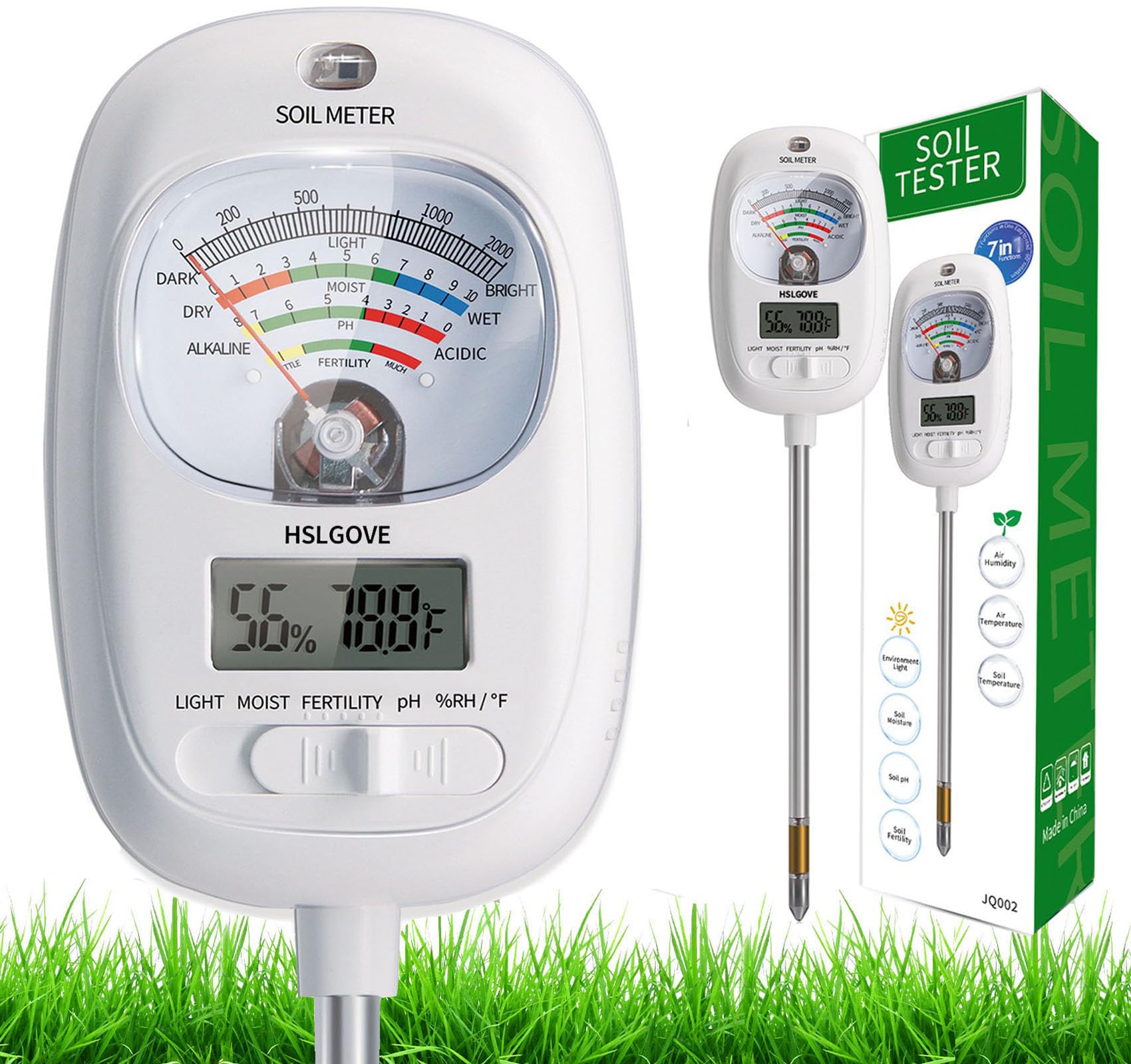
An analog-digital hybrid that reads seven things through one 6.8-inch probe, including soil temp and air humidity.
The HSLGOVE combines the simplicity of a dial meter with a small LCD screen that shows soil temperature, air temperature, and air humidity — details the purely analog meters skip. It runs on three batteries (you install them before first use) and reads soil moisture, pH, fertility, and light through a single 6.8-inch probe made from three different metals. The idea is that you get soil temp and air humidity alongside the usual four readings, making it a one-stick weather-and-soil station for a greenhouse or indoor plant corner.
Buyers report the meter is easy to read and provides consistent moisture and pH results, though one professional agronomist reviewer flagged the light sensor as non-functional and the fertility measurement as impossible to interpret reliably. Unlike any other meter here, the HSLGOVE gives you the extra temperature and humidity data without needing a second device, but like most combined meters, the extra modes (especially light and fertility) are rough estimates, not lab measurements.
What it does well
- Measures seven parameters from one probe — moisture, pH, fertility, light, soil temp, air temp, humidity.
- Clear dual display with both a dial and an LCD screen.
- Single probe design is less intrusive in pots.
Where it falls short
- Light sensor and fertility readings may be unreliable according to some buyer experiences.
- Requires three batteries (not battery-free like the analog options).
One-stop monitor: Ideal for a gardener who wants humidity and soil temp alongside basic pH and moisture, all from a single tool that sits in the pot.
Verdict caveat: Treat the light and fertility scales as rough guides — if those two readings matter critically, buy a dedicated light meter and a lab soil test.
3. AiGerdinn 4-in-1 Soil Tester
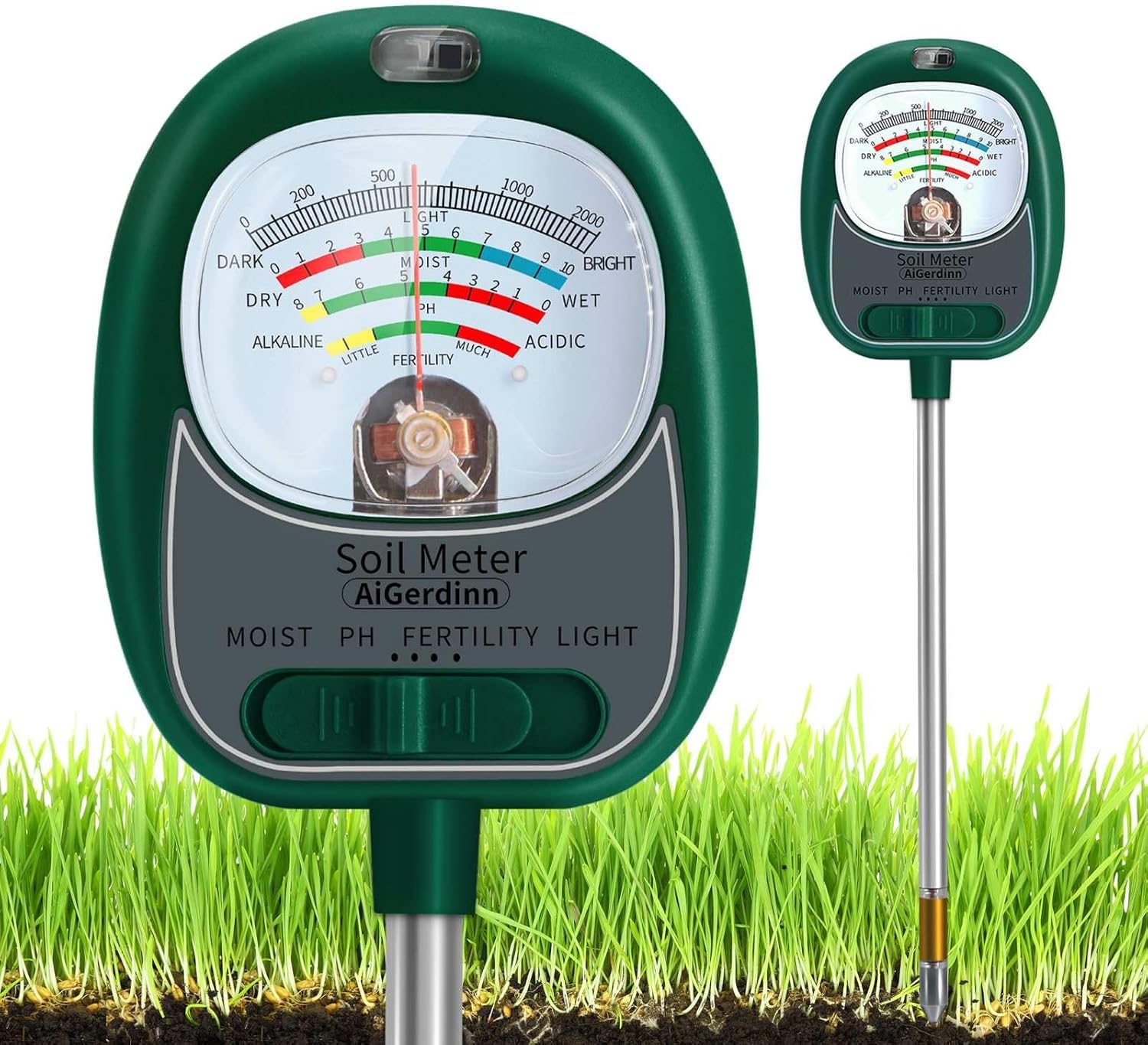
No batteries needed, and the 1.95-inch dial is easy to read without squinting.
This 4-in-1 tester stands out because of the 1.95-inch oversized dial, which makes it easy to read without squinting — useful if you are kneeling in a garden bed or have aging eyes. You do not need any batteries; you insert the probe about 2.5 to 3 inches into damp soil and switch between moisture, pH, fertility, and sunlight modes to read the needle. It weighs 3.84 ounces, which is light enough to carry around a yard without noticing it in your pocket.
Owners mention the dial is clear and the tool feels sturdy, though a few note that the single probe may struggle in very compacted or red clay soil. Unlike the dual-prong Sonkir below, the AiGerdinn uses a single metal shaft that is easier to clean but provides less surface contact. The fertility reading is a coarse scale, not a nutrient breakdown, so treat it as a “low/medium/high” signal rather than an actionable ppm number. For a quick multipurpose check across indoor pots and outdoor beds, this delivers the basics with no battery fuss.
Best for readability: The oversized dial is genuinely helpful for anyone who wears reading glasses or works in dim light.
Not for hard clay: The manufacturer warns it is unsuitable for red clay or hard soil — you must moisten and loosen the ground first or the probe cannot get a good contact.
Grab this for: a household with a mix of houseplants and a small garden bed where you want one battery-free tool that everyone in the family can read easily.
skip it if: you have heavy clay soil, need a deeper probe for raised beds, or want a digital readout with data storage.
4. Luster Leaf 1818 Rapitest 4-in1 Soil pH/Moisture/Fertility/Light Tester

Three stainless probes measure pH, moisture, fertility, and light — but you must follow a quirky prep routine to get the pH right.
The Luster Leaf Rapitest uses three stainless steel probes pushed into the soil to measure pH, moisture, fertility, and light simultaneously without any batteries. It is an inexpensive tool that is widely available, and many gardeners have used it for seasons. The catch is that several buyers emphasize it gives accurate pH and fertility readings only if you follow a specific prep routine: remove the top 2 inches of soil, use distilled water, and polish the pH probe with a dry cloth before inserting. One long-time reviewer said they got consistent results after learning that the pH probe needs a static charge activation using nylon wool — a step not printed in the instructions.
The probes are thin and bend if you force them into dry or compacted ground, so you must moisten the soil first. Compared to the Sonkir MS06 (which also uses a dual-prong design), the Luster Leaf has three prongs instead of two, which gives it more surface contact for the fertility and moisture measurements. But the same fragility applies: customers note the prongs bend easily. For the price, it works as a DIY diagnostic tool if you are willing to follow its quirky prep steps; pass on it if you want plug-and-play from the start.
Strengths
- No batteries; three probes cover pH, moisture, fertility, and light at once.
- Veteran product with a large installed base and many documented user tips.
- Inexpensive entry point for budget-conscious gardeners.
Weaknesses
- Probes bend easily in compacted or dry soil; not suitable for heavy ground.
- pH accuracy depends on a multi-step prep routine that many buyers miss.
- Light meter is widely considered too crude to trust.
Works best for: a hobby gardener who enjoys the tinkering side of gardening — prepping the soil, polishing the probe, and learning the meter’s quirks for a bargain price.
Not for you if: you want to poke the ground and get a reliable number in five seconds without reading a manual.
5. Sonkir Soil pH Meter, MS06 3-in-1

At 2.89 ounces it is the lightest meter here, but many reviewers point out the pH reading is not reliable.
The Sonkir MS06 is a 3-in-1 analog meter that reads moisture, light, and pH without any batteries. The manufacturer warns it cannot test pH of any liquid (soil only), and the needle will not move if the soil is bone-dry; you must water it first and wait.
The problem is that a significant number of buyer reviews report the pH reading is wrong. One buyer wrote they tested it against litmus paper over 20 times — the meter read a steady 5.5 pH on soils ranging from 2.5 to 9.5 pH and called it “bogus.” Another reviewer said the light sensor setting is useless. A few shoppers say it works fine as a moisture check if you understand its limits. Compared to the Luster Leaf above (which also has fragile probes but at least gives a workable pH reading with proper prep), the Sonkir has a higher chance of arriving with a dead-in-the-water pH needle. The moisture function seems more reliable, so if you only need a quick dry-vs-wet indicator and want the lightest possible tool, this fits — but do not trust its pH scale.
Best use: Use it as a lightweight moisture probe for houseplants and ignore the pH and light scales entirely.
Honest warning: Multiple buyer experiences show the pH reading is stuck or inaccurate; rely on it only as a quick check and verify with a different method if pH matters to your plants.
Reserve this for: someone who wants the cheapest, lightest dual-prong moisture checker and is willing to treat pH as a bonus that may not work.
Pass if: you specifically need to measure soil pH — invest in the YINMIK or AiGerdinn instead.
6. Vitamicor 4-in-1 Soil Tester (90° Rotation)
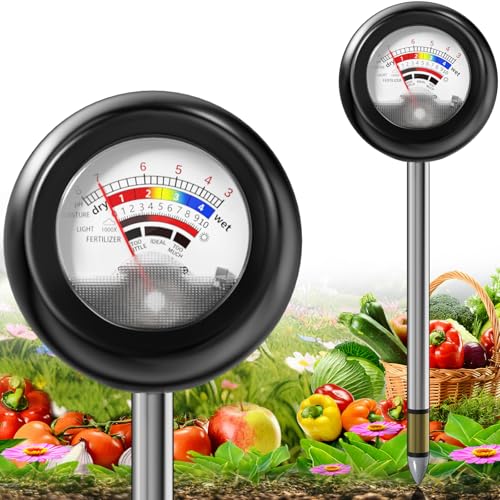
A sturdier 4-in-1 with a rotating dial face, but the needle moves inconsistently for some users.
The Vitamicor 4-in-1 measures moisture, pH, light, and fertility through a single metal probe and shows readings on a clear analog dial that rotates 90 degrees for easier viewing at different angles. It weighs 4.6 ounces versus the Sonkir’s 2.89 ounces, but that heft comes from a sturdier build that several buyers report handles outdoor use without bending. The manufacturer highlights the corrosion-resistant metal probe for long-term outdoor and indoor use.
Buyers are split. Some report it works as expected and call it a must-have for plant lovers. Others say the needle moves inconsistently, the mode switch feels flimsy, and the probe is too bulky for small pots. One reviewer described it as “inaccurate and irregular readings” that did not read zero when dry. If you test in the same hole and get a different number each time, the probe likely is not making good contact with the soil. This is a budget-tier analog meter; it works for a rough moisture and pH check in large pots and garden beds, but do not expect lab-level consistency.
What is good
- Corrosion-resistant metal probe feels sturdy in hand.
- Rotating dial makes it easier to read from above or the side.
- No batteries; plug and read in seconds.
What is not
- Inconsistent needle movement reported by several buyers.
- Bulkier probe is not suitable for small or shallow pots.
- Mode switch feels fragile according to some user experiences.
Ideal for: outdoor garden beds and large potted plants where you want a no-battery, multi-mode check and are okay with approximate readings.
Not for: small succulents or precise pH tracking — the inconsistent needle makes it unreliable for fine adjustments.
7. Maxsolve 2-Pack 3-in-1 Soil Tester

Two identical 3-in-1 meters, each weighing 3.68 ounces, so you keep one indoors and one outside.
This set gives you two meters that each measure moisture, light, and pH. No batteries, no calibration — just push the probe into the soil and read the needle. Each unit weighs 3.68 ounces and measures 2.37 x 1.3 x 10.24 inches, making it slightly more compact than the Sonkir. The 2-pack is the practical angle here: you leave one in the potting bench and one in the raised bed, or give the second to a neighbor who keeps asking about your plant care secrets.
Buyer experiences are all over the map. Several reviewers praise the set as a helpful tool that stops overwatering and simplifies plant care. A few call it useless, saying the light meter does not work and the other readings are off by a wide margin. The most common positive take is that the moisture function is decent for a quick check, and the pH reading is fine as a rough ballpark. Compared to the single-pack analog meters in this list (Sonkir, Vitamicor), the Maxsolve two-pack costs about the same as one of those, so you get a spare for free — but you also get the same reliability gamble. Use the moisture and light scales as guidelines rather than facts, and if your plants need precise pH management, skip this set.
Two-for-one deal: If you need a meter to leave in each of two locations without spending twice, this is the most cost-effective way.
Accuracy caveat: Multiple owners mention inconsistent pH readings; treat the numbers as suggestions, and cross-check with a reliable meter or test strips if pH matters.
Best for: casual indoor plant parents who just want to stop overwatering and do not need lab-accurate pH figures.
Not for: serious vegetable or blueberry growers who need to adjust soil pH within a narrow range — the reliability is too inconsistent.
Understanding the Specs
Analog vs Digital readings
Analog meters display a needle on a printed scale. They need no batteries and respond immediately, but the needle can drift if the probe surfaces are dirty, the soil is too dry, or the meter was stored vertically. Digital meters use a small sensor in the probe tip and display a precise number on a screen. They require batteries but typically include automatic temperature compensation (ATC, an internal adjustment that corrects the pH reading based on soil temperature) so you get the same result on a cold spring morning and a hot summer afternoon. For most home gardeners, an analog meter is fine for quick moisture checks; for pH adjustments, a digital meter gives a number you can act on with confidence.
Probe length and material
A probe that reaches about 6 to 8 inches into the soil gets past the dry surface layer and measures where the roots are actively feeding. Probes shorter than 3 inches only sample the top inch or two, which may be drier or more acidic than the root zone. Single-probe designs (like the AiGerdinn or HSLGOVE) push into the soil with less resistance and disturb fewer roots. Dual- or triple-probe designs (like the Sonkir or Luster Leaf) offer more surface area for electrical conductivity readings (used to estimate fertility), but the extra prongs bend more easily in compacted ground. Look for a probe made of corrosion-resistant metal — stainless steel or an alloy — so it does not rust after repeated outdoor use.
FAQ
Will a soil pH meter work in dry soil?
Can I test the pH of water or liquid fertilizer with a soil pH meter?
How deep should I insert the probe into the soil?
Why does my analog pH meter give a different reading every time I test the same spot?
Do I need to calibrate a soil pH meter?
Is the fertility or nutrient reading on a 4-in-1 meter accurate?
How long does the probe last before I need to replace it?
Can I leave a soil pH meter in the pot for continuous monitoring?
Do I need a separate meter for indoor and outdoor use?
How accurate is the light reading on a 3-in-1 or 4-in-1 meter?
Final Thoughts: The Verdict
For most people, the best soil ph meter winner is the YINMIK Digital Soil pH Meter because it gives you a calibrated, temperature-compensated digital reading that you can log over time — essential if you are adjusting pH for blueberries, vegetables, or finicky ornamentals. If you want a no-battery, all-in-one tool that also reads temperature and humidity, grab the HSLGOVE 7-in-One Soil Test Kit. And for a budget-friendly entry point with a large readable dial, the AiGerdinn 4-in-1 Soil Tester delivers reliable moisture and pH checks while staying affordable.
How We Picked
We do not accept paid placement, and we did not hands-on test every unit. Instead, we match each pick to a real buyer and use-case by comparing the manufacturers’ published specifications against the patterns in verified customer reviews — so you get each pick’s real strengths and trade-offs instead of marketing copy.
Sources & Methodology
Specifications: manufacturer listings and product documentation. Review insights: verified customer reviews, as of July 2026. Pricing: not shown on this page (it changes often); check the current price via the retailer link.
As an Amazon Associate, Lawn Gear Lab earns from qualifying purchases. This does not affect which products we feature.