
Specs are compiled from manufacturer listings and verified buyer reviews and can change over time — please confirm the key details on the product page before buying.
You cannot see what is happening below the soil surface, so watering a houseplant or garden is always a guess. A soil meter gives you a real number instead. The right one tells you exactly how moist the soil is at root level, how acidic or alkaline it is (its pH level), and sometimes even how much light or fertility (nutrient content) is present. That means you water, feed, and place each plant with confidence, not hope.
I’m Rikta — the founder and writer behind Lawn Gear Lab. This guide is built by comparing the manufacturers’ published specifications and the patterns across verified customer reviews, so you get each pick’s real strengths and trade-offs instead of marketing spin.
Whether you are tending indoor houseplants, a vegetable patch, or a flower bed, the right tool can save both your plants and your patience. This review covers the top options for your soil meter needs, from simple analog probes to digital multi-function units that also track temperature and humidity.
Quick Picks
- HSLGOVE 7-in-1 Soil Test Kit — Best Overall
- Luster Leaf Rapitest 4-Way Digital Soil Analyzer (1885) — Digital Performer
- Luster Leaf 1818 Rapitest 4-in1 Soil — Value Champion
- AiGerdinn 4-in-1 Soil Moisture Meter — Beginner’s Pick
- XLUX Long Probe Deep Use Soil Moisture Meter — Deep Reach
- Dr.meter Soil Moisture Meter S10Plus — Simple & Slim
- LUVCOSY Digital Soil pH Meter — Precision pH
How To Choose The Best Soil Meter
Not all soil meters are built the same way. The simplest only check moisture, while the pricier digital units can track pH, temperature, light, and even air humidity. To narrow it down, ask yourself what you really need to measure most often.
Analog vs. Digital Readings
Analog meters work without batteries — you push the probe into the soil and a needle swings across a dial. They are dead simple and last for years. Digital meters need batteries (or are rechargeable), but they give you a precise number on an LCD screen instead of a needle position. Digital screens can also show temperature and humidity readings that an analog dial cannot.
Single Probe vs. Multi-Probe Design
A single-probe meter disturbs less soil and damages fewer roots when you push it in and pull it out. Multi-probe meters (usually two or three prongs) are more stable in the soil and often measure pH and fertility more accurately in damp conditions, but they can be trickier to insert in compacted soil without bending the prongs.
Number of Functions (Moisture, pH, Fertility, Light, Temperature)
Most gardeners are fine with a moisture-only meter. If you grow plants that are sensitive to soil acidity (blueberries, azaleas, potatoes), a pH reading matters. The fertility function typically measures relative levels of nitrogen, phosphorus, and potassium — useful for a quick spot check but not a replacement for a lab soil test. Light meters help you decide if a spot gets enough sun for a particular plant.
Quick Comparison
| Model | Best For | Functions | Probe Length | Power | Amazon |
|---|---|---|---|---|---|
| HSLGOVE 7-in-1 | All-in-one digital tracking | 7 (moisture, pH, fertility, light, soil temp, air temp, air humidity) | 6.8 inches | Batteries (included) | Amazon |
| Luster Leaf 1885 Digital | Digital multi-function with corded probe | 4 (pH, moisture, temperature, light) | — | Battery (included) | Amazon |
| Luster Leaf 1818 Rapitest | Budget 4-in-1 with instant readings | 4 (pH, moisture, fertility, light) | — | No batteries | Amazon |
| AiGerdinn 4-in-1 | Large dial, beginner-friendly multi-function | 4 (moisture, pH, fertility, sunlight) | 2.5-3 inches inserted | No batteries | Amazon |
| XLUX Long Probe | Deep pots and in-ground planting | 1 (moisture only) | Extra 5.5 in (14 cm) probe length | No batteries | Amazon |
| Dr.meter S10Plus | Single-probe moisture check for houseplants | 1 (moisture only) | Long (thin probe) | No batteries | Amazon |
| LUVCOSY pH Pen | High-precision pH-only testing | 1 (pH only) | — | 3 AA batteries (included, up to 5 years life) | Amazon |
In‑Depth Reviews
1. HSLGOVE 7-in-1 Soil Test Kit
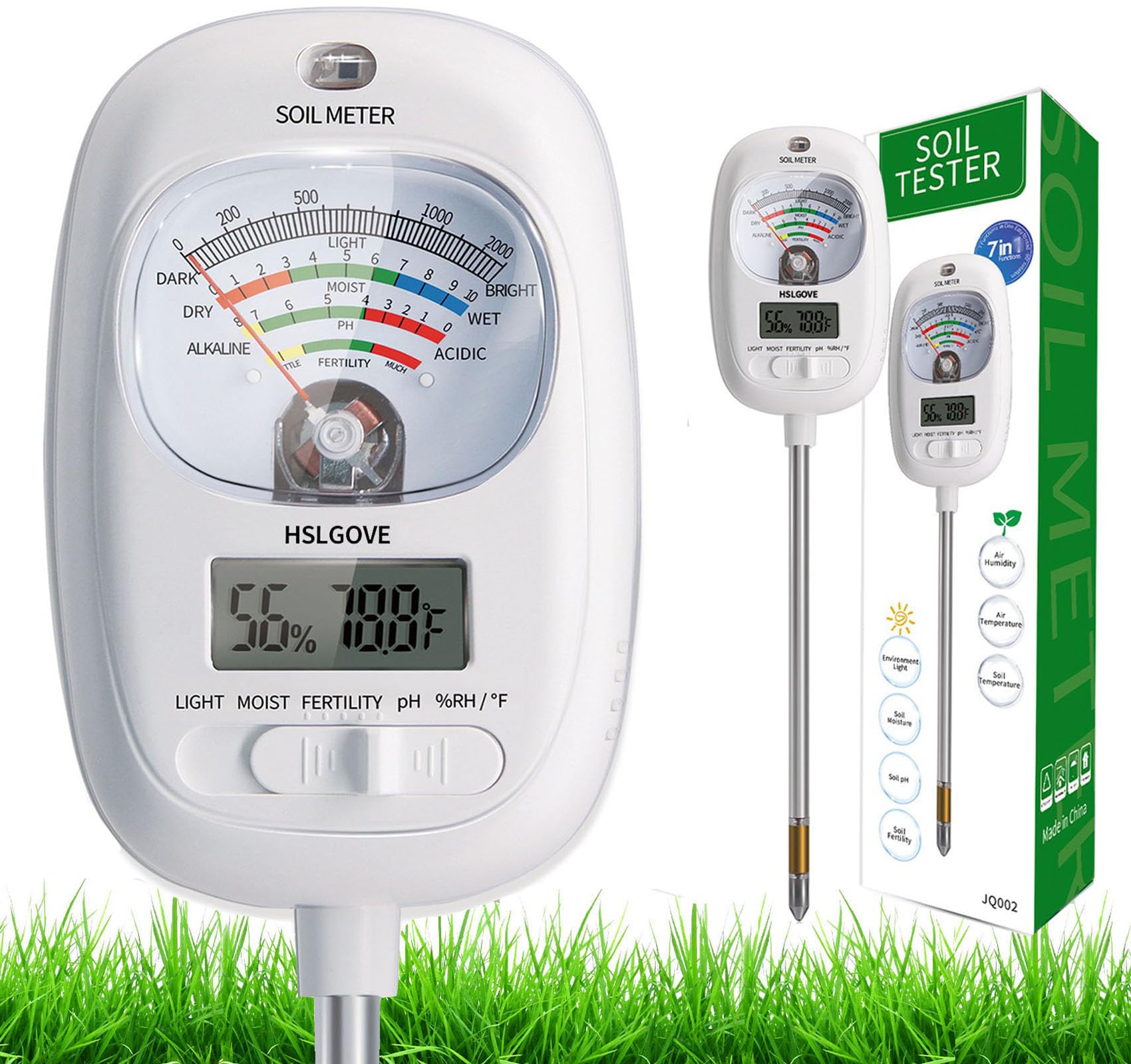
The multi-tool that tells you everything about your soil and the air around it.
Most soil meters give you one or two numbers and call it a day. The HSLGOVE 7-in-1 goes much further — it measures soil moisture, pH, fertility, light, soil temperature, air temperature, and air humidity on a single dual-screen unit. One dial shows the analog needle reading for moisture, pH, fertility, and light, while the LCD screen handles the three temperature and humidity values. Buyers report that switching between modes takes a single button press and readings stabilize within 3 to 5 minutes.
The probe is about 6.8 inches long, built from three different metals for corrosion resistance, and uses a single-probe design that disturbs less soil than a multi-prong meter. Unlike many analog meters, the HSLGOVE needs three included batteries to power the LCD display and the internal 1.6-inch chip board. It also covers more ground than the Luster Leaf 1818 (four functions, no temperature) by adding soil temperature and air humidity on that extra screen.
One limitation: the instructions say to turn the unit off by sliding the button to the LIGHT position when not in use, and the maker warns against using it in liquid or extremely hard soil. For the gardener who wants a single device that covers every environmental factor their plants experience, this is the most complete pick.
The complete picture
- Dual analog-digital display for 7 readings in one pass
- Single probe is less invasive to roots than multi-prong designs
- Includes soil temperature, air temperature, and humidity — features most meters skip
The small print
- Requires batteries for the LCD (included, but not a “no battery” meter)
- Needs 3–5 minutes for the digital readings to settle
- Not for use in liquids or hard clay soil
Grab it if: You want a single instrument that tracks every measurable growing factor — moisture, pH, nutrients, light, and temperature — without needing three separate devices.
Look elsewhere if: You only need a quick moisture check or prefer a no-battery analog tool for simplicity.
2. Luster Leaf Rapitest 4-Way Digital Soil Analyzer (1885)
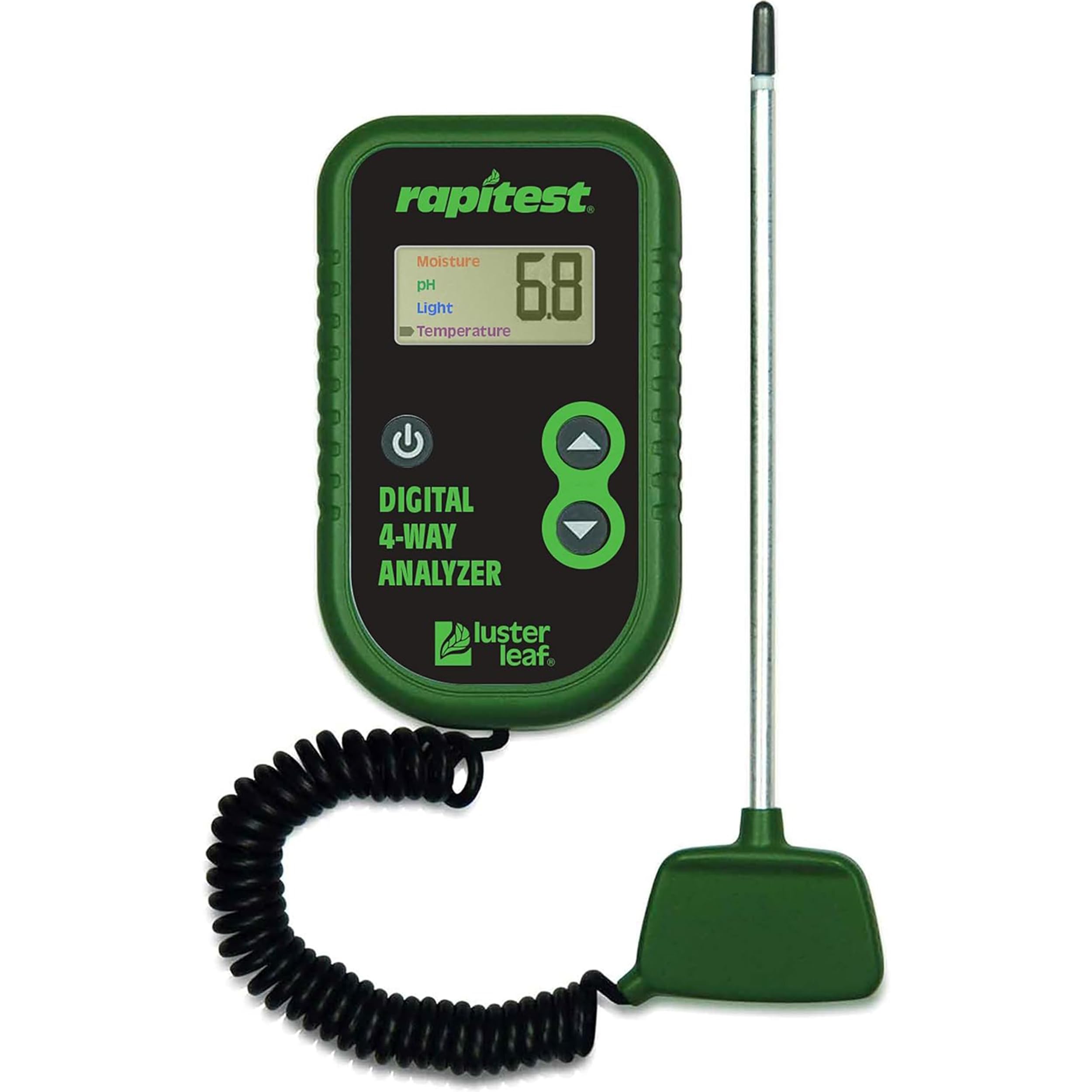
A digital meter with a separate probe wand that keeps the screen in your hand.
You do not have to crouch down to pot level to read the Luster Leaf 1885. Unlike most soil meters where the probe and dial are one rigid body, this one uses a corded probe — you insert the prongs into the soil and read the results on a separate handheld digital display. It tests pH (acidity/alkalinity), moisture, temperature, and light with a modern digital readout instead of an analog needle. The instructions include a full pH plant list covering over 450 plant varieties, so you can look up exactly what each of your plants needs.
Owners mention that the included manual is thorough, with gardening tips and result-interpretation guides that go well beyond the quick-start card most meters provide. The temperature function is useful for seasonal planting decisions, though one reviewer noted it only reads up to 99°F, which means it is not suitable for checking the internal heat of a compost pile.
A few buyers mentioned accuracy concerns with the pH sensor — one reviewer verified with standard pH buffers and found the meter read 6.2 instead of the buffer’s 4.01, a significant error. The trade-off for the convenience of a digital screen and a separate probe is that you depend on the electronics being calibrated correctly from the factory.
Why it stands out
- Corded probe makes it comfortable to read the digital display on the meter in your hand
- Includes detailed interpretation guides and a plant-pH list for 450+ species
- Digital readout is clearer than an analog dial for exact values
What to watch
- Some units have had pH calibration issues from the start
- Temperature sensor tops out at 99°F — not suitable for hot compost
- Battery-powered (included but may need replacement)
Reach for this if: You prefer a digital readout and want a corded probe that lets you read the screen upright instead of bending to ground level.
Hold off if: You need reliable pH accuracy for soil-critical plants or want a single-piece tool with no batteries.
3. Luster Leaf 1818 Rapitest 4-in1 Soil pH/Moisture/Fertility/Light Tester

The analog classic that gives you four readings without a single battery.
The Luster Leaf 1818 has been a staple for casual gardeners for years because it does a lot with very little complexity. Three stainless steel probes push into the soil and the meter instantly shows moisture, pH, fertility, and light levels — all on an analog dial with no battery required. Customers note that the fertility meter works well for quick spot checks of nitrogen, phosphorus, and potassium (NPK), and the moisture reading measures at the full depth of the probe, not just the surface.
Compared to the 4-in-1 AiGerdinn (also no batteries), the Luster Leaf adds a third probe, which several reviewers point out improves reading stability in normal garden soil. The light meter is the least praised feature — several buyers call it a rough guide rather than a precise tool. The prongs are also thin and can bend if you push into rocky or hard-packed soil, so the manufacturer explicitly says to use it only in soil.
The main gap versus a digital unit like the HSLGOVE 7-in-1 is that this meter gives only relative scales on the dial, not exact numbers, and it has no temperature or air humidity measurement. But it runs on no batteries and costs less than most digital meters, so it is tough to top for a quick multi-check.
Solid selling points
- Four functions (pH, moisture, fertility, light) in one no-battery tool
- Stainless steel prongs are durable for normal garden conditions
- Instant results, no warm-up or calibration needed
Downsides
- Prongs bend easily in rocky or compacted soil
- Light meter is less useful than dedicated light meters
- Analog scale is relative, not a precise number
Choose this for: Quick, battery-free multi-parameter checks on established garden beds and potting soil where the soil is soft and loose.
Pass if: You need an exact pH number, temperature data, or plan to push into hard clay or rocky ground regularly.
4. AiGerdinn 4-in-1 Soil Moisture Meter
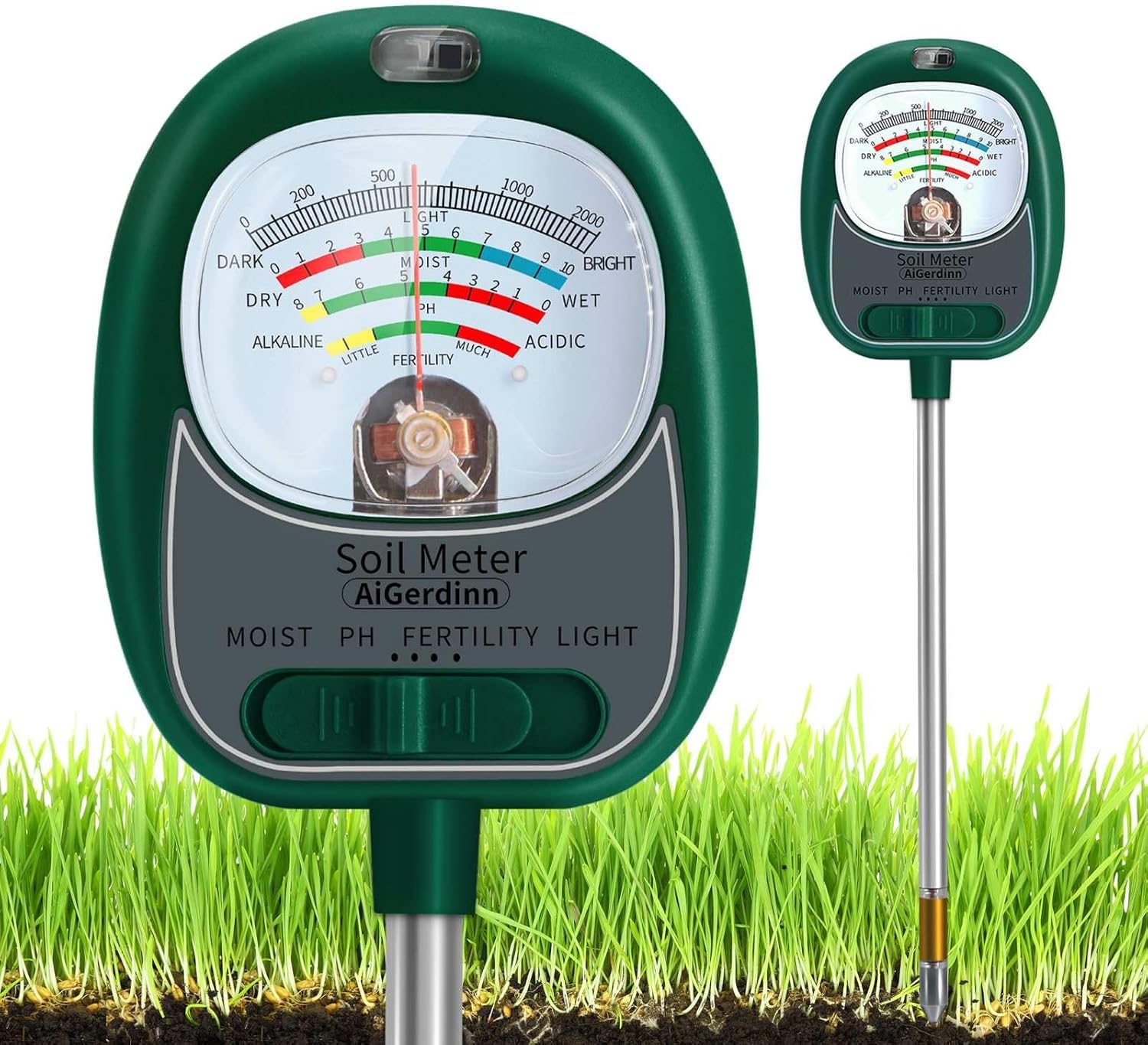
The oversized dial makes it simple for any age to read the results at a glance.
If you are new to using a soil meter, the AiGerdinn 4-in-1 is about as welcoming as it gets. It measures moisture, pH, fertility, and sunlight through a single button and displays them on a 1.95-inch oversized dial. The instructions tell you to insert the probe about 2.5 to 3 inches into the soil and read immediately. No batteries needed, and the single-probe design is intended to be gentler on roots than a multi-prong meter.
Buyers love the easy-to-read display and the fact that one button cycles through all four functions without any setup. However, one buyer mentioned the moisture reading stopped working after two months of light use, and another mentioned the pH/fertility readings are more of a general indicator than a lab-grade measurement. The manufacturer states the meter should not be used in watery or slurry soil, red clay, hard soil, or plant ash — those conditions can damage the probe.
For a very low investment, you get four functions in a straightforward package. The trade-off is the build quality may not survive years of heavy use, and the accuracy on pH/fertility is approximate rather than precise.
Who it works for
- Large 1.95-inch dial is easy for all ages to read without squinting
- Four functions (moisture, pH, fertility, sunlight) at a low entry price
- No batteries, single-probe design, and portable storage-friendly body
What to know
- Some units have failed after a few months of use, per buyer reports
- pH and fertility readings are approximate, not lab-accurate
- Cannot be used in hard soil, clay, slurry, or liquids
Best for: A first-time soil meter buyer who wants multiple functions on one easy-to-read dial without spending much.
Not ideal if: You plan to rely on it daily for precise pH work or for tough outdoor soil conditions.
5. XLUX Long Probe Deep Use Soil Moisture Meter

The extra-long probe reaches deep into large pots and garden beds where fingers cannot go.
The XLUX Long Probe does one thing — moisture detection — and it does it for the specific challenge of deep containers and in-ground planting. The probe provides an extra 5.5 inches (14 cm) of length, which means you can measure moisture at the bottom of a deep flower pot or in the ground below the surface crust. Unlike the Dr.meter S10Plus which also has a long probe for general houseplant use, the XLUX is explicitly built for larger pots and outdoor farming. It uses a single probe that causes less root disturbance than double or multiple probes.
The large dial uses ten scales across three zones (red for dry, green for moist, blue for wet), so you get a quick visual read. Shoppers say that the meter is simple, accurate, and eliminates the guesswork of overwatering and underwatering. The manufacturer warns not to leave the meter in the soil for more than five minutes, as the metal tip will gradually corrode.
It is moisture-only, so you will not get pH or fertility readings like you would from the Luster Leaf 1818 or the 4-in-1 AiGerdinn. But for the specific job of checking deep soil moisture without bending over a tiny pot dial, it is the most purpose-built option here.
Why it stands out
- Longest probe in this lineup — 5.5 inches (14 cm) beyond standard length
- Single probe is gentler on roots than multi-prong meters
- No batteries, instant reading, easy three-zone color coding
Trade-offs
- Moisture only — no pH, fertility, light, or temperature functions
- Not for use in hard soil, water, or other liquids
- Cannot be left in the soil beyond 5 minutes without risking corrosion
Pick this if: You grow plants in deep pots, raised beds, or in the ground and need to check moisture far below the surface.
skip it if: You also need pH or fertility readings and want a single multi-function device.
6. Dr.meter Soil Moisture Meter S10Plus

A thin probe and a color-coded dial make moisture checks easy for houseplant care.
The Dr.meter S10Plus is a no-frills moisture-only meter aimed at houseplant owners who want a clean, simple way to stop overwatering. The probe is long and thin — buyers report it slides easily into the soil of standard houseplant pots without disturbing the roots as much as thicker designs. The dial uses a red-green-blue color system with ten scales, so even a beginner can see at a glance whether the soil is dry, moist, or wet. No batteries, no buttons, no calibration: just push it in and read.
One useful niche: owners mention it works perfectly for monitoring moisture in worm composting bins, such as the Urban Worm Bag, where maintaining the right dampness is critical for the worms to process scraps. However, other reviewers mention that the unit arrived slightly bent on arrival or bent under pressure in dry or wet soil, and in some cases, it failed after initial use. A second undamaged unit apparently worked fine, suggesting the build can be fragile with rough handling or shipping.
Compared to the XLUX Long Probe (also moisture-only), the Dr.meter probe is thinner and more suited to houseplant pots, while the XLUX is built for deeper outdoor use. If you want a slim, low-cost tool for your indoor pots, this is a solid choice — just handle it with care.
Good for houseplant owners
- Thin, long probe fits into standard houseplant pots without disrupting roots
- Color-coded dial (red, green, blue) is beginner-friendly
- No batteries, instant moisture reading
Weaknesses to note
- Several buyers reported the unit arrived bent or failed after a short time
- Prone to bending under pressure in harder or very dry soil
- Moisture only — no pH, fertility, light, or temperature
Reach for this if: You keep a collection of indoor houseplants and want a cheap, battery-free way to check if they need water.
Look elsewhere if: You need a rugged tool for outdoor garden soil or want multi-function readings.
7. LUVCOSY Digital Soil pH Meter
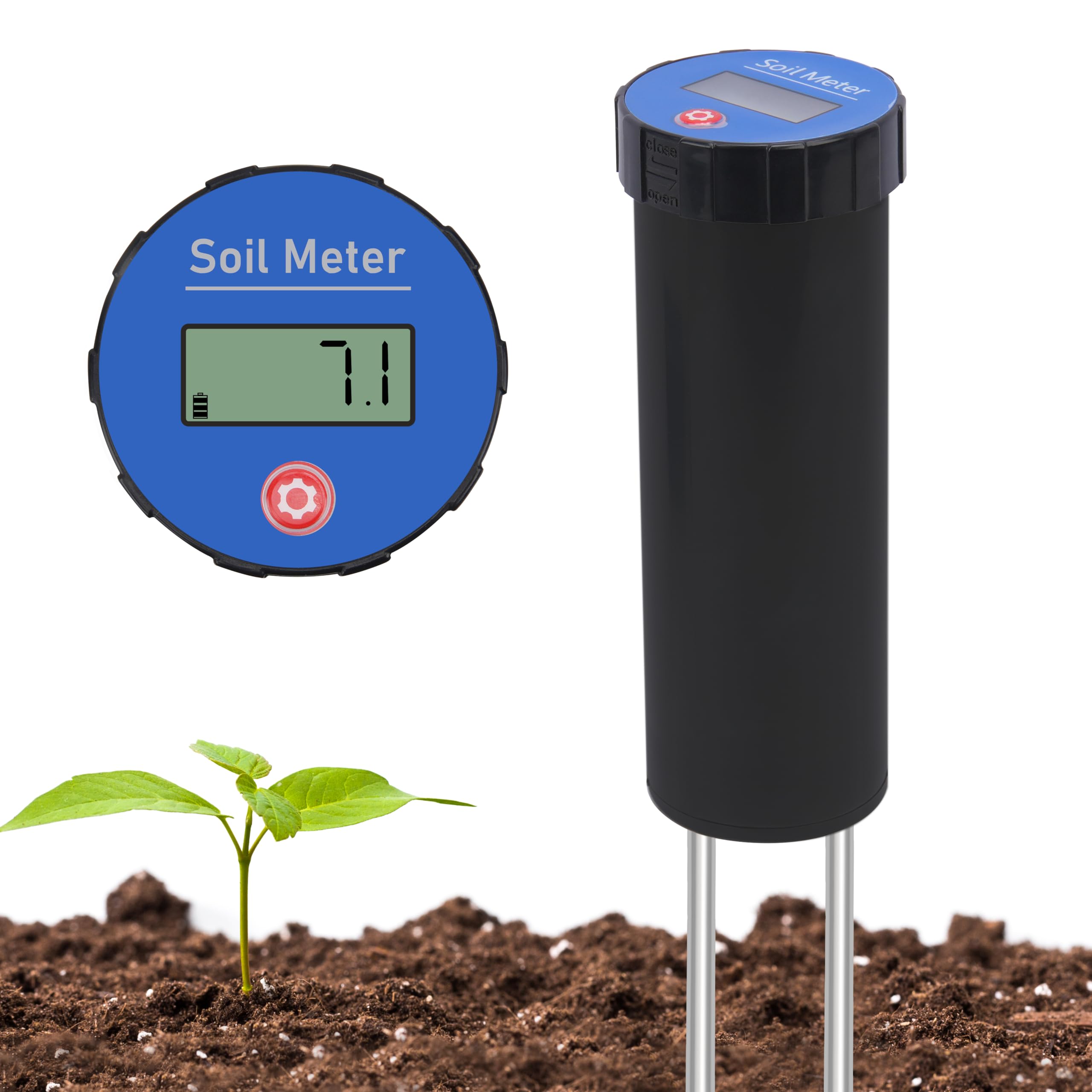
The calibration-free digital pen that gives you exact pH numbers, not just a zone on a dial.
If your growing challenge is specifically about soil acidity — for acid-loving plants like blueberries, azaleas, or potatoes — the LUVCOSY pH Meter cuts straight to that one measurement with professional-grade precision. It uses double-needled stainless steel probes that are highly sensitive and anticorrosive, and the LCD display gives an exact pH number instead of pushing a needle into a colored zone. The manufacturer calls it an industrial-grade product with embedded sophisticated algorithms, and it comes ready to use with three AA batteries already included. The company claims those batteries will last up to five years due to low power consumption.
Customers note that the readings are quick, stable, and repeatable across different spots in the same garden. One reviewer who maintains a patio full of tomatoes and peppers said they had tried other pH meters and this one worked as described. The meter weighs just 160 grams (about 5.6 ounces) and is small enough to hold like a pen, making it easy to carry around.
Unlike the multi-function meters in this guide (HSLGOVE, Luster Leaf 1818), the LUVCOSY only measures pH — no moisture, fertility, light, or temperature. It also cannot be used in liquids, only in soil. But if you want the most accurate dedicated pH reading without having to calibrate it yourself, this pick beats every other meter here on pH-only precision.
What makes it special
- Industrial-grade pH sensing without requiring manual calibration
- Double-needled stainless steel probes for repeatable, stable readings
- Battery life claimed at 5 years with included AA batteries
Limitations
- pH only — no moisture, fertility, light, or temperature function
- Not usable in liquids, only direct soil measurement
- Higher price than multi-function analog meters
Best for: The gardener who needs a reliable, no-calibration digital pH reading for specific acid-loving plants or soil amendment testing.
Not for: Anyone who wants a general-purpose moisture-and-nutrients meter or needs to test liquids.
Understanding the Specs
Analog vs. Digital Readout
Analog meters use a needle moving across a printed dial. They never need batteries and work instantly, but you read a zone (dry, moist, wet) rather than an exact number. Digital meters display a precise figure on an LCD screen, which is useful for tracking small changes in pH or temperature, but they require batteries or recharging.
Single Probe vs. Multi-Probe
A single-probe meter has one metal rod that you push into the soil. It disturbs less root structure and pulls out less soil when removed. Multi-probe meters (two or three prongs) are often more stable and can read different parameters through separate sensors, but the prongs can bend in hard soil and they displace more soil.
pH, Fertility (NPK), and Light Scales
pH measures acidity or alkalinity on a 0–14 scale, with most garden plants thriving between 6.0 and 7.0. Fertility (often labeled NPK) is a relative indicator of nitrogen, phosphorus, and potassium levels — useful for a quick check but not a replacement for a lab soil test. Light meters measure relative brightness, helping you decide if a spot gets enough sun for sun-loving or shade plants.
Probe Length and Insertion Depth
Standard probes are about 4–6 inches long. A longer probe (like the XLUX’s 5.5-inch extra-length tip) reaches deeper into pots and ground soil, giving you the moisture level at root level rather than just the surface. Most meters require you to insert the probe 2–3 inches deep for a proper reading, and you should not push all the way to the bottom of the pot.
FAQ
Can I leave my soil meter in the pot all the time?
Why does my soil meter give a different reading in dry soil vs. wet soil?
Can I use a soil meter in potting mix or soilless medium?
Do I need a separate meter for pH if my 4-in-1 already has a pH function?
How do I clean and store my soil meter to make it last?
Why does the fertility (NPK) reading show a different value each time?
Can I use a soil meter to test the moisture of compost or worm bins?
What does it mean when the needle barely moves on my analog meter?
Are single-probe meters less accurate than multi-probe meters?
How deep should I insert the probe for an accurate soil moisture reading?
Final Thoughts: The Verdict
Across the board, the best soil meter winner is the HSLGOVE 7-in-1 because it combines analog simplicity with digital precision for seven different growing factors in one sturdy unit. If you want a no-battery, no-fuss analog meter for deep garden beds, grab the XLUX Long Probe. And for precise pH-only testing that skips all the extra features, the LUVCOSY Digital pH Meter is the most accurate dedicated option.
How We Picked
We do not accept paid placement. Every pick is matched to a real buyer and a real use-case; we do not hands-on test units.
Sources & Methodology
Specifications: manufacturer listings and product documentation. Review insights: verified customer reviews, as of July 2026. Pricing: not shown on this page (it changes often); check the current price via the retailer link.
As an Amazon Associate, Lawn Gear Lab earns from qualifying purchases. This does not affect which products we feature.