
Specs are compiled from manufacturer listings and verified buyer reviews and can change over time — please confirm the key details on the product page before buying.
If you have ever watched a potted lavender plant turn yellow, get leggy, and drop leaves after a few weeks, the problem was almost certainly the soil—lavender is famously picky about drainage, and most bagged mixes hold too much water for its roots. You need a soil that lets the water run through fast enough that the roots never sit wet, yet still holds enough moisture between waterings to keep the plant from drying out completely.
I’m Rikta — the founder and writer behind Lawn Gear Lab. This guide is built by comparing the manufacturers’ published specifications and the patterns across verified customer reviews, so you get each pick’s real strengths and trade-offs instead of marketing spin.
Finding the right soil for potted lavender means choosing a mix with ingredients like perlite, pumice, and coarse sand that create the fast-draining, root-friendly environment this plant craves.
Quick Picks
- Soil Sunrise Lavender Potting Soil Mix — Best Overall
- DUSPRO 8QRT Pre-Mixed House Plant Soil Aroid — Premium Pick
- Rosy Soil Herb Mix, Organic Indoor — Eco Pick
- DUSPRO 2QRT Pre-Mixed House Plant Soil Aroid — Compact Pick
- DUSPRO 20QRT Pre-Mixed House Plant Potting Mix — Bulk Choice
How To Choose The Best Soil For Potted Lavender
Lavender is a Mediterranean plant that evolved in rocky, sandy soil that drains fast after rain. In a pot, the roots can’t escape excess water the way they would in the ground, so the potting mix you choose has to mimic that lean, gritty environment to keep the plant from drowning or rotting.
The Drainage Ingredient That Matters Most
Perlite, pumice, and horticultural sand are the three materials you want to see on the bag. Perlite (the small white volcanic glass beads) and pumice (a lightweight porous rock) both create air pockets in the soil so water flows through instead of pooling around the roots. The more chunky or coarse the mix looks, the better it will drain. A soil that feels dense or heavy in the bag is a red flag for lavender.
Organic Matter: Beneficial but Not Heavy
Lavender does not need rich, compost-heavy soil the way tomatoes or ferns do. You still want some organic material—things like peat moss, coco coir, or worm castings—to hold enough moisture to get through a couple of dry days. But the organic content should be balanced with at least an equal amount of drainage material. A mix that lists peat moss as the first ingredient and has no mention of perlite or pumice will likely stay too wet for lavender roots.
pH and Nutrient Balance
Lavender prefers a neutral to slightly alkaline pH (around 6.5 to 8.0). Most quality potting mixes fall close to neutral, but if your water or local soil is acidic, look for a bag that mentions lime or gypsum in the ingredients—those help keep the pH in lavender’s balance. You want a lean nutrient profile, not a heavy fertilizer-rich blend, because lavender flowers best when it is not overfed.
Quick Comparison
| Model | Best For | Volume | Key Drainage Ingredients | Organic Additives | Amazon |
|---|---|---|---|---|---|
| Soil Sunrise Lavender Potting Mix | Lavender-specific blend | 8 Quarts | Perlite, Pumice, Sand, Charcoal | Peat Moss, Worm Castings | Amazon |
| DUSPRO 8QRT 7-in-1 Mix | Large pots and repotting | 8 Quarts | Perlite, Pumice, Pine Bark | Coco Coir, Peat Moss, Worm Castings | Amazon |
| Rosy Soil Herb Mix | Peat-free, sustainable option | 4 Quarts | Bark Fines, Biochar | Compost, Worm Castings, Mycorrhizae | Amazon |
| DUSPRO 2QRT 7-in-1 Mix | Single small pots or testing | 2 Quarts | Perlite, Pumice, Pine Bark | Coco Coir, Peat Moss, Worm Castings | Amazon |
| DUSPRO 20QRT 7-in-1 Mix | Multiple large pots or bulk | 20 Quarts | Perlite, Pumice, Pine Bark | Coco Coir, Peat Moss, Worm Castings | Amazon |
In‑Depth Reviews
1. Soil Sunrise Lavender Potting Soil Mix (8 Quarts)

The only mix here designed specifically for lavender, and it shows in the results.
This is the straightforward answer if you just want a soil that matches what lavender roots need without any guesswork. The 8-quart bag blends peat moss, perlite, horticultural charcoal, pumice, sand, worm castings, and lime — a lineup that covers drainage (perlite, pumice, sand), aeration (charcoal), a touch of organic nutrition (worm castings), and pH balance (lime). That is a notably more complete ingredient list than most herb soils offer, especially the lime addition that helps keep the soil in the neutral-to-alkaline zone lavender prefers.
Buyers report it “produced big, bushy plants with abundant flowers” and that a grocery-store lavender that was not blooming “responded in 2 days” after repotting. The 8-quart volume is enough for a big 12-inch pot, so if you are starting or repotting a single mature lavender, you will use the whole bag at once. Unlike the DUSPRO mixes, which are designed for a wider range of aroids and herbs, this one is formulated purely for lavender — so if you also grow monsteras or ferns, you would need a second bag for them.
One honest catch: the mix is a bit rich for lavender compared to a pure mineral blend. Some lavender purists prefer grittier soil, but the reviews overwhelmingly say the plant thrives rather than getting lanky. At 8 quarts, it offers 8 quarts versus the Rosy Soil option’s 4 quarts.
Why this wins for lavender
- Formulated specifically for lavender with seven targeted ingredients
- Includes lime to manage soil pH, which most herb mixes skip
- Owners mention noticeable flowering improvement within days of repotting
Room for improvement
- May be too nutrient-rich for lavender purists who want leaner soil
- Only available in one size, so for multiple pots you will need several bags
Grab this if: you want a single bag formulated start-to-finish for lavender that buyers consistently say produces bigger blooms.
Look elsewhere if: you prefer an extremely lean mineral mix or need to repot several different plant types from one bag.
2. DUSPRO 8QRT Pre-Mixed House Plant Soil Aroid Potting Mix 7-in-1
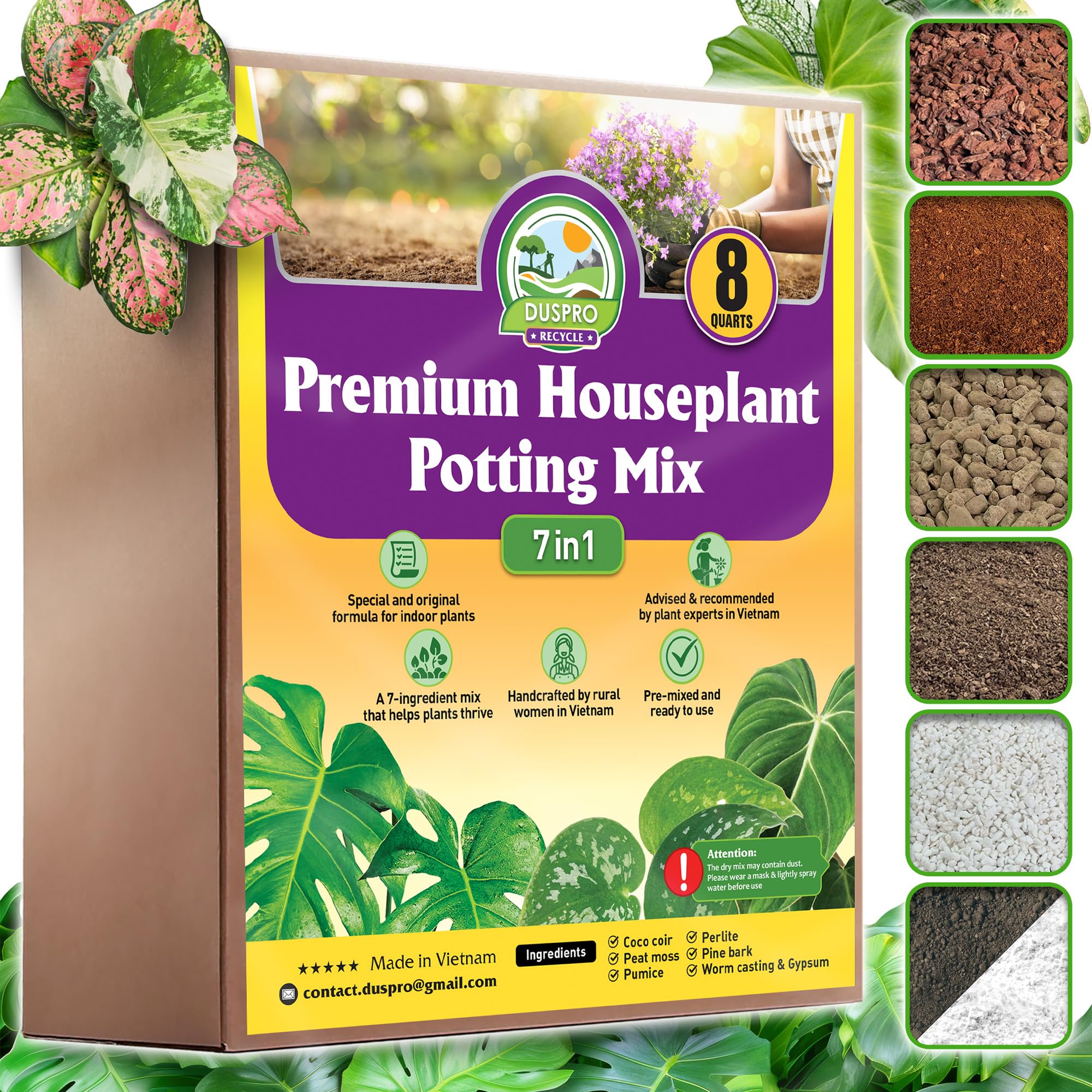
A chunky 7-ingredient mix with the drainage that lavender demands.
The DUSPRO 8-quart bag combines pine bark, pumice, coco coir, perlite, worm castings, gypsum, and peat moss into what buyers consistently call “best chunky soil mix.” That chunkiness is exactly what potted lavender needs — the pine bark and pumice create large air pockets so water drains fast, while the coco coir and peat moss provide just enough moisture retention to carry the plant through a few dry days without making the roots soggy. The gypsum in the blend helps with mineral availability and pH balance, similar to the lime in the Soil Sunrise mix above.
Unlike the Soil Sunrise bag which is lavender-only, this is a general-purpose mix that also works for monsteras, philodendrons, and other aroids — useful if you have a mixed indoor garden. Buyers mention the soil is dusty straight from the bag (a quick mist helps settle it) but that “once the plant is potted and watered it’s fine.” Reviewers also report “plants thrive with new growth in weeks” and note no mold or mildew over 6 months of use. One reviewer noted watering a monstera every 2 weeks and small pots every 10-12 days, which gives a sense of the mix’s moisture cycle.
It is important to note that this soil is formulated more broadly than the lavender-specific Soil Sunrise mix. If your only goal is a perfect lavender pH and lean nutrient profile, the Soil Sunrise is more on-target. But for the same 8-quart volume, the DUSPRO delivers a highly aerated, fast-draining mix that lavender adapts well to, and it offers more versatility for other plants in your collection.
Standout strengths
- Chunky texture with pumice and pine bark for superior lavender drainage
- Versatile 7-in-1 blend works for aroids, herbs, and other houseplants
- Customers note no mold or mildew and healthy root growth over months
One drawback
- Not specifically formulated for lavender’s pH and nutrient lean-ness
- Dusty on first pour; needs a quick mist or hydration before planting
Best for: gardeners who want one bag that can repot lavender, monsteras, and other houseplants while still giving lavender the drainage it needs.
skip it if: you want a soil that is precisely tuned to lavender’s pH and does not carry the nutrient load for tropical plants.
3. Rosy Soil Herb Mix, Organic Indoor and Outdoor Herb Potting Soil, 4 Quarts
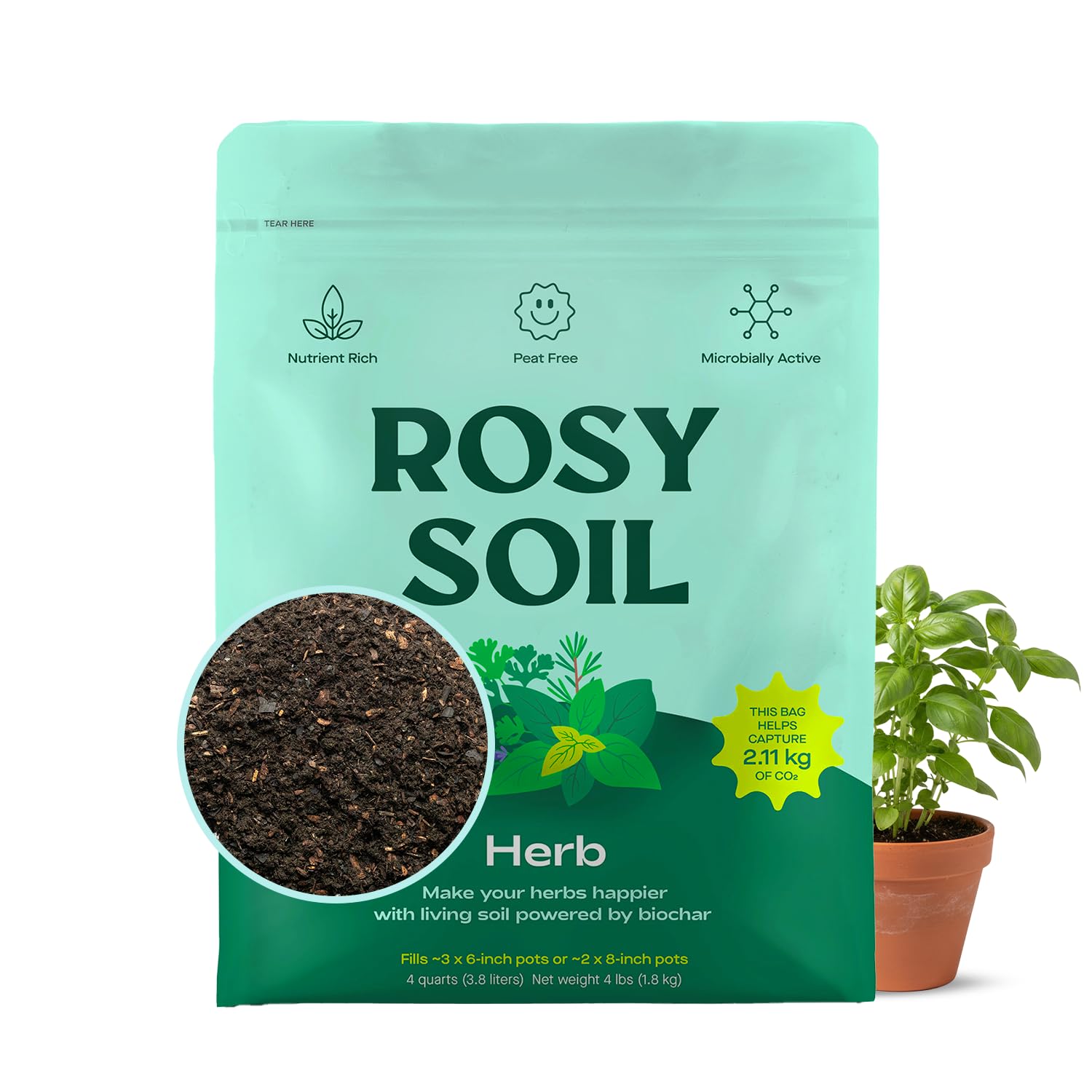
A peat-free, living-soil blend that gives lavender a light, fast-draining start.
Rosy Soil builds its herb mix around biochar (a charcoal-like material that holds nutrients like a sponge), worm castings, and mycorrhizae fungi that help roots access what they need. What makes this especially useful for lavender is that it skips peat moss entirely — peat can hold too much moisture for lavender’s taste, and its harvesting is environmentally damaging. Instead, the bag uses bark fines and compost for a fluffy, airy structure that drains quickly. The mix is also free of synthetic additives, so if you are growing culinary lavender for teas or baking, this gives you a clean organic start.
Reviewers point out this mix “worked perfectly for my seedlings” and that herbs “sprouted in record time” — which matters if you are starting lavender from seed and need a light, non-compacting medium. Another reviewer growing lavender, mint, and basil called it “the best Herb Mix I have used.” At 4 quarts, the bag fills 2 to 3 medium 6-inch pots, so it is a solid choice if you have a couple of lavender starts on a windowsill. Compared with the Soil Sunrise 8-quart option’s 8 quarts, the Rosy soil offers 4 quarts, so for one large lavender you would need the full bag.
The honest trade-off here is that this mix is designed for herbs generally, not lavender specifically. It does not include the lime or sand that a lavender-specialist blend might have, though the fast-draining structure and biochar’s pH-buffering effect do help create a suitable environment. If you are someone who wants maximum pH control and sand texture for lavender, the Soil Sunrise mix is more targeted.
Why it stands out
- Peat-free and carbon-negative, so it is a sustainable choice
- Biochar and mycorrhizae create a living soil ecosystem for strong roots
- Shoppers say rapid germination for seedlings
Consider this
- 4 quarts versus the Soil Sunrise option’s 8 quarts
- No lime or sand specifically for lavender pH balance
Reach for this if: you want a peat-free, organic, sustainable soil and are starting lavender from seed or growing a couple of small pots on a windowsill.
Look elsewhere if: you need a larger volume for a single big container or prefer a lavender-specific pH-tuned formula.
4. DUSPRO 2QRT Pre-Mixed House Plant Soil Aroid Potting Mix 7-in-1
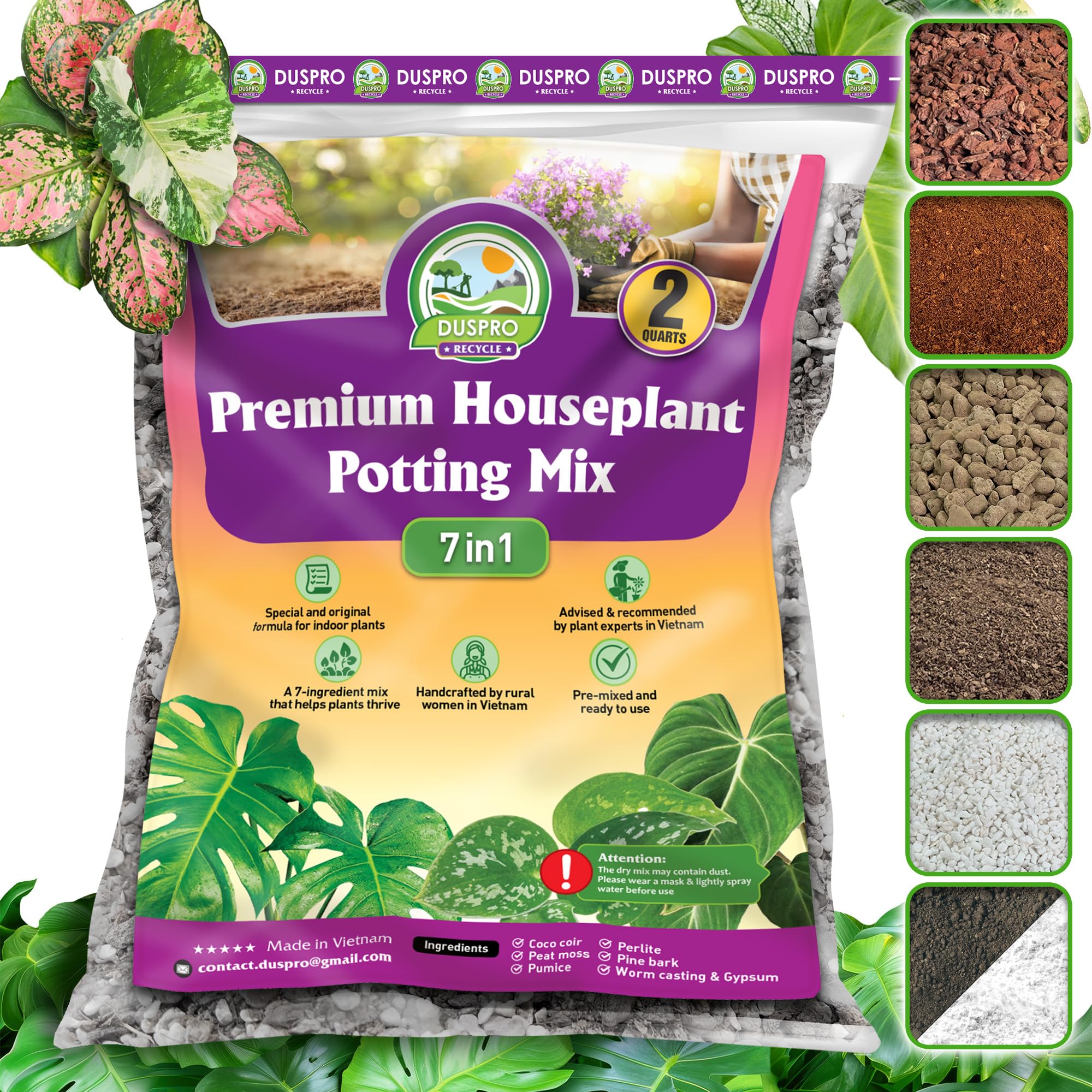
A small-bag trial size of the same chunky DUSPRO 7-ingredient formula.
This is essentially the same 7-in-1 mix — coco coir, peat moss, perlite, pumice, worm castings, pine bark, and gypsum — in a 2-quart bag that is ideal if you are potting one small lavender and do not want to store leftovers. The ratio of drainage ingredients (pumice, perlite, pine bark) to moisture-holding materials (coir, peat) is the same as the 8-quart version, so you get the same fast-draining structure that prevents lavender root rot. Buyers report the same feedback: “best chunky soil mix” and “plants thrive with new growth in weeks.”
There is a small practical difference between this 2-quart bag and the 8-quart version of the same mix. The 2-quart size is convenient if you just want to test the blend with a single small lavender plant before committing to a larger bag. One buyer mentioned the 2-quart bag filled a 6-inch pot nicely, while the 8-quart version handles a 12-inch pot. If you know lavender is going to be a long-term container plant for you, buying the 8-quart bag gives you better value per quart and fewer reorders. But for a single starter plant or a gift lavender in a 4-inch nursery pot, the 2-quart size avoids waste.
The same dustiness issue reported in the larger DUSPRO bags applies here — shaking the bag and misting the soil before use helps. And because this is not a lavender-specific formulation, the same caveat about pH applies: the gypsum helps but it isn’t as directly targeted as the lime in the Soil Sunrise mix.
Small-bag benefits
- Perfect trial size for one small lavender pot without leftover soil
- Same chunky, well-draining 7-in-1 formula as the larger DUSPRO bags
- Owners mention vigorous new growth after repotting
Keep in mind
- Price per quart is higher than buying the 8-quart version
- Not a lavender-specific pH formula
Best for: testing the DUSPRO chunky mix on a single lavender plant or repotting a small 4-inch to 6-inch pot.
pass on it if: you already know this mix works for your plants — the 8-quart bag gives you more soil for the money.
5. DUSPRO 20QRT Pre-Mixed House Plant Potting Mix 7-in-1
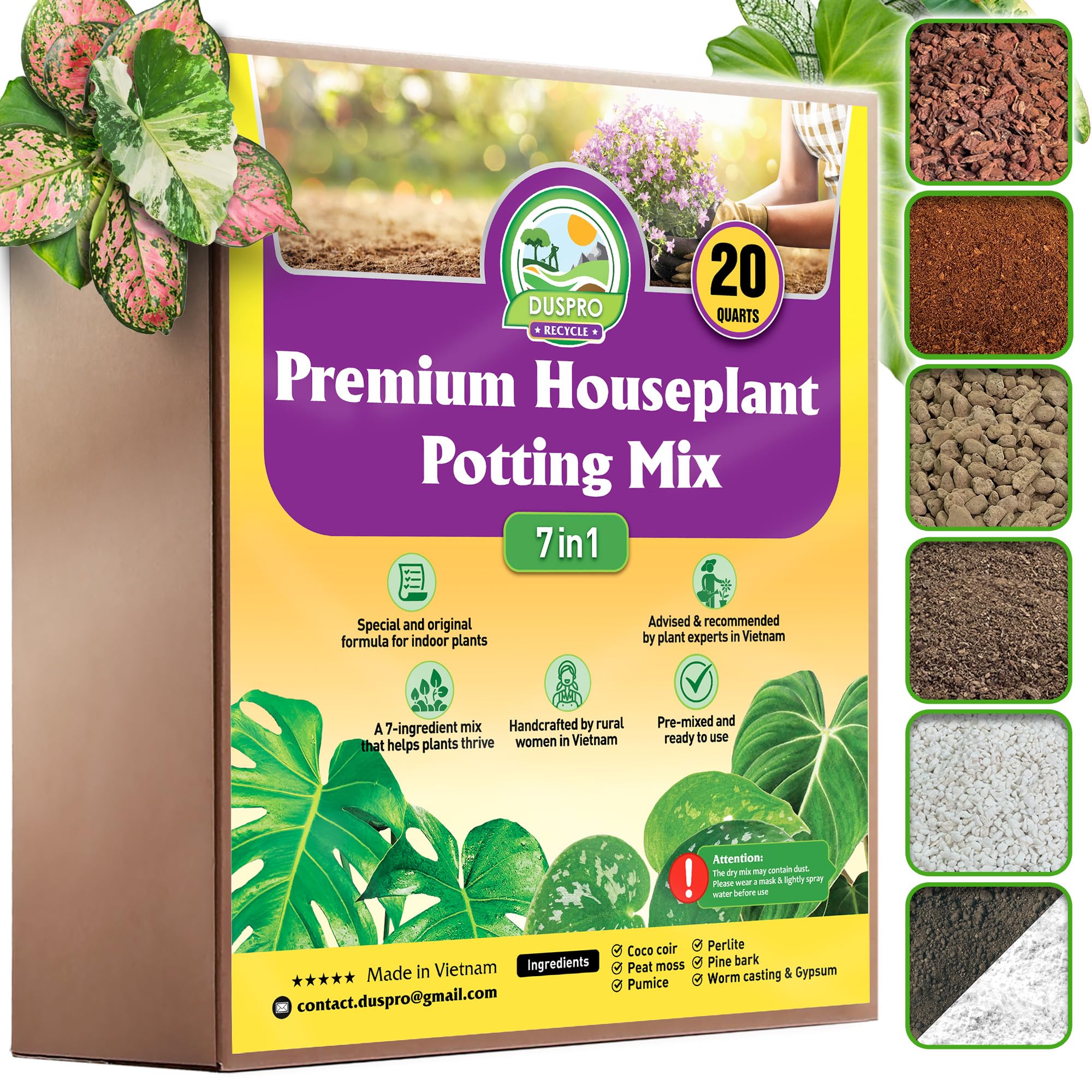
The bulk bag of the same chunky mix for multiple lavender pots or a large container garden.
If you are potting several lavender plants — or one very large container — the 20-quart DUSPRO bag is the biggest single option here. It is the same pine bark, pumice, coco coir, perlite, worm castings, gypsum, and peat moss formula that reviewers consistently praise for drainage and aeration. Customers note the soil “supports healthy root systems” and that the chunky texture “prevents overwatering” — exactly the two things lavender needs most. One owner reported the 4-quart size of this same blend filled an 8-inch, a 6-inch, and four 4-inch pots, so the 20-quart bag will handle multiple lavender containers at once.
The obvious difference between this and the smaller DUSPRO bags is volume: the 20-quart bag holds 10 times what the 2-quart bag holds. If you have a large patio with multiple lavender pots, this is the most practical option because you will not run out mid-project. However, because this is a general-purpose aroid and herb mix (not lavender-specific), the same pH caveat applies as with the other DUSPRO options — the gypsum helps, but you may want to add extra sand or perlite if you notice your lavender showing signs of moisture stress. One detail buyers mention is that the bag can be dusty on first pour; shaking it and lightly misting the soil before use minimizes that.
Compared with the Soil Sunrise 8-quart bag’s 8 quarts, this DUSPRO 20-quart bag gives you 20 quarts for large-scale planting, but it is not lavender-formulated. If you are planting a mixed garden with lavender, monsteras, and herbs side-by-side, the DUSPRO 20-quart bag is the most efficient single purchase.
Why go big
- Largest single-bag volume at 20 quarts for multiple pots or big containers
- Same proven 7-in-1 chunky formula for drainage and aeration
- Reviewers point out healthy root development and no mold over months
Things to note
- Not lavender-formulated; may need extra perlite or sand for perfect lavender drainage
- Dusty on first pour, requiring a mist before use
Best for: anyone growing multiple lavender pots on a patio or balcony and wanting a single bulk bag that handles all of them.
it’s not for you if: you only have one small lavender plant — the 2-quart or 4-quart option will save you storage space and money.
Understanding the Specs
Drainage Ingredients (Perlite, Pumice, Sand)
These are the coarse, gritty materials that create air space in the soil so water flows through instead of pooling around lavender roots. Perlite (small white volcanic glass beads) and pumice (lightweight porous rock) are the most common. The more of these you see on the ingredient list, the faster the soil will drain — which is the single most important quality for potted lavender. A mix with perlite or pumice listed near the top of the ingredients is a strong bet.
Organic Matter and Nutrient Balance
Lavender needs some organic material — peat moss, coco coir, or worm castings — to hold a little moisture between waterings, but it should not be the dominant ingredient. Too much organic matter keeps the soil wet too long and can lead to root rot. A good lavender soil has organic matter balanced roughly 50/50 with drainage material. You also want a neutral to slightly alkaline pH, which ingredients like lime (calcium carbonate) or gypsum help maintain.
Volume: How Much You Need Per Pot
Soil volumes are measured in quarts (qt). As a rough guide, a 4-inch pot needs roughly 0.5 to 1 quart, a 6-inch pot needs about 1.5 to 2 quarts, an 8-inch pot needs around 3 to 4 quarts, and a 12-inch pot needs approximately 7 to 9 quarts. That is why the Soil Sunrise 8-quart bag states it is “enough for a big 12-inch pot.” If you are repotting multiple lavenders, add up the pot sizes to pick the right bag volume.
Peat-Free vs. Peat-Based Mixes
Peat moss is the traditional moisture-holding ingredient in potting soils, but it holds water very tightly and its harvesting damages wetland ecosystems. Peat-free alternatives like coco coir (coconut husk fiber) and biochar drain faster and are more sustainable. For lavender, a peat-free or low-peat mix often works better because it dries out more quickly between waterings, matching the plant’s natural preference for lean, well-drained conditions.
FAQ
Can I use regular potting soil for potted lavender?
How much soil does one lavender plant in a pot need?
Should I add extra sand or perlite to lavender soil?
Is peat moss good or bad for lavender in a pot?
Does lavender need lime in its potting soil?
How often should I repot lavender into fresh soil?
Can I mix two different soils together for lavender?
Is it okay to use cactus soil for potted lavender?
Final Thoughts: The Verdict
For most people, the soil for potted lavender winner is the Soil Sunrise Lavender Potting Soil Mix because it is the only mix here designed start-to-finish for lavender, with lime for pH balance and a blend of perlite, pumice, sand, and charcoal that buyers confirm produces bushy plants and abundant flowers. If you want a peat-free, sustainable option that works well for starting lavender seedlings, grab the Rosy Soil Herb Mix. And for large-scale planting or a versatile chunky mix that handles lavender plus your other houseplants, the standout is the DUSPRO 8QRT 7-in-1 Mix.
How We Picked
We do not accept paid placement. Every pick is matched to a real buyer and a real use-case; we do not hands-on test units.
Sources & Methodology
Specifications: manufacturer listings and product documentation. Review insights: verified customer reviews, as of July 2026. Pricing: not shown on this page (it changes often); check the current price via the retailer link.
As an Amazon Associate, Lawn Gear Lab earns from qualifying purchases. This does not affect which products we feature.