
Specs are compiled from manufacturer listings and verified buyer reviews and can change over time — please confirm the key details on the product page before buying.
Picking the right soil for outdoor plants means the difference between a pot that struggles and one that explodes with growth. The best blends handle water just right, feed your plants for months, and make you wonder why you ever grabbed a random bag from the hardware store. This guide walks you through the top choices for containers, raised beds, and everything in between.
I’m Rikta — the founder and writer behind Lawn Gear Lab. This guide is built by comparing the manufacturers’ published specifications and the patterns across verified customer reviews, so you get each pick’s real strengths and trade-offs instead of marketing spin.
You want soil that keeps your outdoor plants alive and thriving without guesswork. The soil for outdoor plants that works best depends on three things: how it handles water, what nutrients it packs, and what is actually inside the bag.
Quick Picks
- Coast of Maine Organic & Natural Planting Soil for Vegetables & Tomatoes — Best Overall
- Premium Potting Soil Mix with Peat Moss, Vermiculite, Perlite (Made in USA) — Top Performer
- Miracle-Gro Moisture Control Potting Mix (2-Pack) — Best Value
- Michigan Peat General All Purpose Premium Potting Soil with Perlite — Big Bag Pick
- Coast of Maine Organic & Natural Bar Harbor Blend Potting Soil (2-Pack) — Premium Organic
- Miracle-Gro Potting Mix (3-Pack, 8 qt. Each) — Compact Trio
How To Choose The Best Soil For Outdoor Plants
Outdoor containers and raised beds need a soil that holds enough moisture between waterings but still lets roots breathe. The right mix also feeds your plants steadily, so you are not mixing in fertilizer every other week. Here is what to watch for.
Moisture Control and Drainage
If you tend to water too much or sometimes forget, a blend with moisture-control ingredients keeps your plants happier. Look for sphagnum peat moss, coir, or perlite in the list — these create a light, fluffy texture that holds water without turning soggy. Buyers report that blends with peat moss and perlite offer “excellent moisture retention and drainage,” which is exactly what container plants need.
Nutrient Content and Feeding
Some soils come with a starter fertilizer built in, saving you an extra step. Others rely on natural compost and organic meal (like kelp or crab shell meal) to release nutrients slowly. A mix that includes slow-release fertilizers means your plants get fed for months without you lifting a bottle. For heavy feeders like tomatoes and vegetables, a nutrient-dense soil gives you visible results days after transplanting.
Volume and Bag Size
Bag sizes vary widely — you will see 8-quart bags for smaller pots and 20-quart bags for larger containers or multiple plants. Always check the volume before buying so you do not run short mid-project. A 20-quart bag handles several 5-gallon pots, while an 8-quart bag is better for a few small planters or seed starting.
Quick Comparison
| Model | Best For | Volume | Key Ingredients | Feeds Up To | Amazon |
|---|---|---|---|---|---|
| Coast of Maine Tomatoes & Veggies | Vegetable containers | 20 Quarts | Compost, manure, peat moss | — | Amazon |
| Midwest Hearth Potting Soil | Seed starting & small pots | 8 Quarts | Peat moss, vermiculite, perlite | — | Amazon |
| Miracle-Gro Moisture Control | Potted plants & busy owners | 16 qt. (2-Pack) | Peat moss, coir, wetting agent | 6 Months | Amazon |
| Michigan Peat General Purpose | Large containers & raised beds | 50 Pounds | Reed sedge peat, perlite, sand | Slow-release included | Amazon |
| Coast of Maine Bar Harbor Blend | Premium organic gardens | 16 Quarts | Compost, perlite, kelp meal | Slow-release nitrogen | Amazon |
| Miracle-Gro Potting Mix 3-Pack | Multiple small containers | 8 qt. (3-Pack) | Potting mix blend | 6 Months | Amazon |
In‑Depth Reviews
1. Coast of Maine Organic & Natural Planting Soil for Vegetables & Tomatoes

A nutrient-packed organic blend that turns vegetable containers into thriving mini-gardens
This Coast of Maine mix is built specifically for tomatoes and vegetables, and owners mention “excellent moisture retention and drainage” plus “high nutrients cause visible growth days after transplanting.” The 20-quart bag gives you far more volume than the 8-quart bags from other brands — a 2.5x gap that matters when you are filling multiple 5-gallon pots. It contains composted manure and sphagnum peat moss, creating a lightweight texture that supports abundant growth both in-ground and in containers.
The organic compost blend is OMRI listed for organic use, which means it follows strict guidelines for natural gardening. Customers note that it may contain small twigs or undecomposed material, so you might want to pick those out if you are growing fine-root crops like carrots. One reviewer noted their wife called it “the best soil she’s tried thus far,” and several mentioned that tomatoes and zucchini thrive in 5-gallon pots with no signs of stress.
Unlike the Michigan Peat mix, which some reviewers point out brings gnats, Coast of Maine users mention an “aromatic wood material to deter insects” — a thoughtful extra for outdoor containers. Just be ready for a heavier bag; one buyer mentioned it is heavy but worth it because “plants like it grow well.”
What makes it shine
- Large 20-quart bag for multiple containers
- Organic compost with manure and peat moss feeds plants fast
- Buyers see visible growth within days of transplanting
The trade-offs
- May contain twigs or undecomposed bits that need picking out
- Bag is noticeably heavier than lighter alternatives
Reach for this if: you grow heavy-feeding vegetables like tomatoes, zucchini, or peppers in containers and want an organic boost that shows results fast.
Look elsewhere if: you need a fine, uniform soil for seed starting or root crops — the occasional woody bits can be a hassle.
2. Premium Potting Soil Mix with Peat Moss, Vermiculite, Perlite (Made in USA)

A light, fluffy mix that holds moisture without sogginess — built for strong root growth
This Midwest Hearth blend uses the same formulation professional growers rely on, combining peat moss, perlite (a volcanic mineral that improves drainage), and vermiculite (a mineral that holds water) for what buyers call a “light, fluffy texture, holds moisture without sogginess, drains well.” The 8-quart bag is compact, but it punches above its weight for starting seeds, potting small plants, or refreshing a few containers. Its pH levels are controlled to work with a wide range of plant types, so you do not have to worry about acidity surprises.
Shoppers say that it “promotes stronger roots, faster growth for indoor herbs and outdoor flowers” and that it does not harden around roots like cheaper soils can. One reviewer used it successfully for germinating petunias and called it “great for seed starting.” A common note is that you should soak the soil before use to prevent quick drainage — a small step that makes a big difference. The bag is resealable, which keeps the mix fresh between uses.
At 8 quarts, it holds about a third of the volume of the Coast of Maine option, so it is better suited for targeted use rather than filling large raised beds. Some buyers feel the price is high for the size, but many say “well worth it” for the quality. It is made in the USA and comes with no weeds or bugs, a relief after trying soils that introduce unwanted pests.
Why it works
- Professional-grade mix with balanced peat moss, perlite, and vermiculite
- Buyers report strong root growth and no hardening around roots
- Resealable bag and pH controlled for broad plant compatibility
What to note
- 8-quart size runs out quickly for larger projects
- Needs pre-soaking before first use for best moisture results
Ideal for: seed starting, small containers, and anyone who wants a fluffy, well-draining mix that promotes strong root development without compaction.
Not the best fit if: you need to fill large pots or raised beds — the volume is better suited for targeted planting.
3. Miracle-Gro Moisture Control Potting Mix (2-Pack)

Two large bags that forgive over-waterers and under-waterers alike with built-in moisture control
This 2-pack gives you two 16-quart bags of Miracle-Gro’s Moisture Control formula, which absorbs up to 33% more water than basic potting soil that does not contain sphagnum peat moss, coir, and wetting agent. It feeds your plants for up to 6 months and grows them “twice as big” compared to unfed plants, according to the manufacturer. One buyer called it “the best potting soil I’ve ever used” and credited it for fast, healthy growth in both indoor and outdoor plants.
The moisture-control technology protects against both over-watering and under-watering, which is a standout if your watering schedule is not perfect. Owners mention a “light texture with decent moisture retention,” though some mention occasional 1-inch wood chips as a minor annoyance. Another buyer praised it for working well alongside Miracle-Gro Water Storage Crystals for extra moisture-holding power during vacation weeks.
Each bag fills one 12-inch container, so the bundle covers two large pots or several smaller ones. It is slightly heavier than seed-starting mixes, but customers note it is “light enough for seed sprouting.” The main complaint was shipping speed — one buyer waited over a month for delivery — so check availability when ordering.
What you gain
- Absorbs up to 33% more water than basic soil without peat moss and coir
- Feeds plants for up to 6 months with no extra fertilizer
- Two 16-quart bags cover multiple large containers
Something to know
- Occasional 1-inch wood chips may need sifting out
- Shipping delays reported by some buyers
Reach for this if: you want a reliable soil that forgives watering mistakes, feeds for half a year, and comes in a two-pack that stretches across multiple pots.
skip it if: you prefer an organic-certified mix without synthetic ingredients — this one is not OMRI listed.
4. Michigan Peat General All Purpose Premium Potting Soil with Perlite

A massive 50-pound bag with built-in slow-release fertilizer for large-scale planting projects
When you need to fill several raised beds or a fleet of big containers, this 50-pound bag from Michigan Peat is ready to go straight from the bag — no mixing required. It combines rich dark reed sedge peat, perlite, and sand, plus starter and slow-release fertilizers are already included so your plants get steady nutrition over time. Reviewers point out it is “perfect for planting pot and container gardens” and arrives moist, which some appreciate for immediate use.
However, several reviewers report a significant caveat: “good soil but lots of gnats come out of it.” This is a recurring theme in the feedback, so if you are bringing pots indoors or near your house, be prepared to manage fungus gnats. One buyer summed it up honestly as “dirty dirt, but a good potting mix.” The blend works for vegetables, flowers, bulbs, and more, making it a versatile bulk option for gardeners with big ambitions.
At 50 pounds, this is the heaviest option in the lineup — far heavier than the Coast of Maine 20-quart bag — so consider how you will transport and store it. The pre-mixed formula saves time, but the gnat issue is a real trade-off that buyers mention repeatedly. If you are filling outdoor raised beds far from the house, the gnat risk is less of a concern.
The upside
- 50-pound bag provides massive volume for large projects
- Starter and slow-release fertilizers are already mixed in
- Ready to use straight from the bag — no blending needed
The catch
- Multiple shoppers say gnats emerging from the soil
- Extremely heavy — moving and storing it is a chore
Best for: filling large outdoor raised beds and containers where you value convenience and bulk volume over pest-free soil.
pass on it if: you are potting plants near your home or indoors — the gnat issue is a real risk based on buyer reports.
5. Coast of Maine Organic & Natural Bar Harbor Blend Potting Soil (2-Pack)
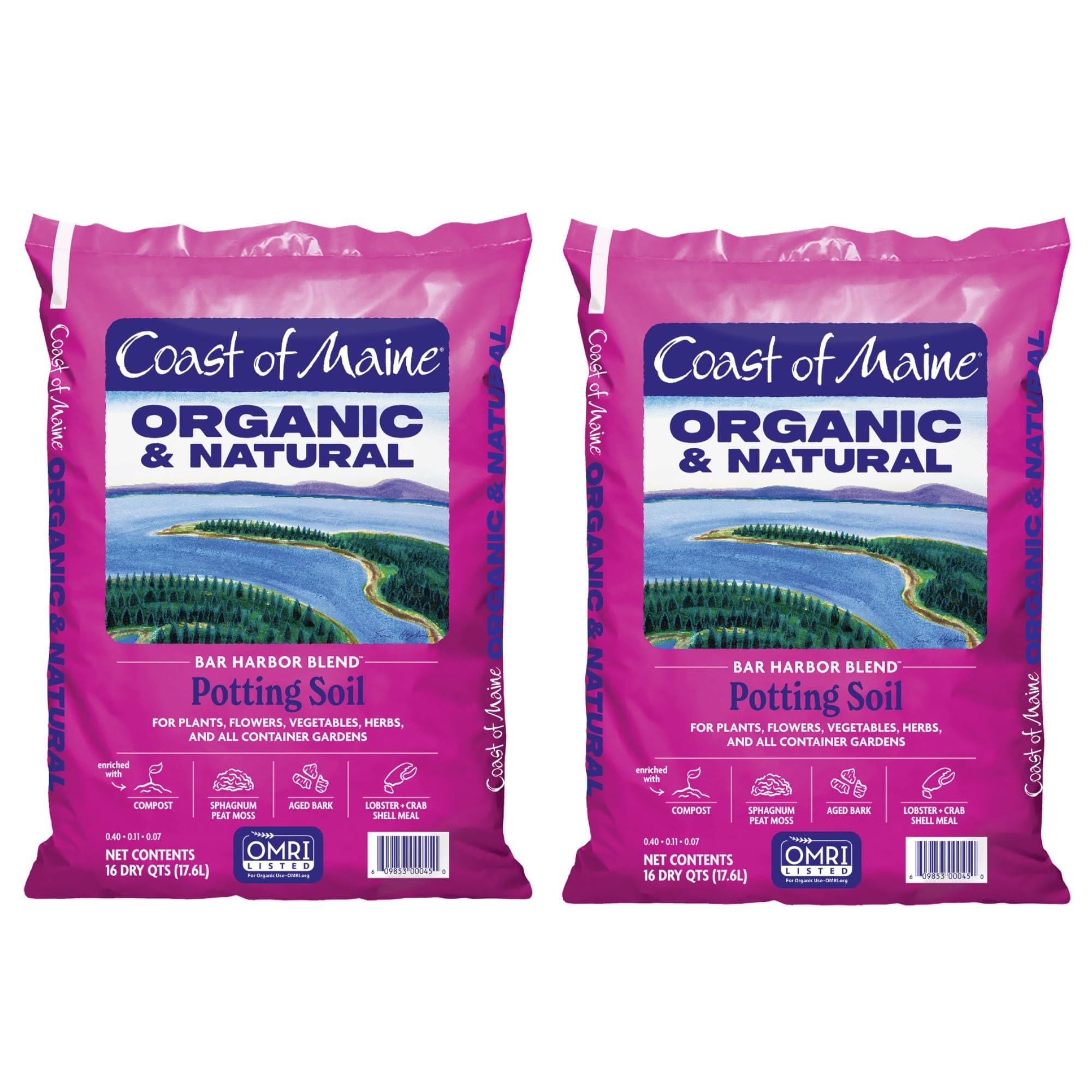
A rich organic soil with lobster and crab shell meal that makes vegetables grow beyond expectations
This Coast of Maine Bar Harbor Blend is formulated with sphagnum peat moss, compost, perlite, lobster and crab shell meal, and kelp meal — ingredients that buyers report create “nutrient-rich soil for vegetables.” One owner reported it is “darker due to compost” with a “balanced mix of perlite, coco coir/peat moss, compost” and, importantly, “no bad smell.” The two-pack gives you 16 quarts total, which owners mention was enough to mound up 8 potato plants with extra for two more planters.
Customers note that everything grows “more than I even expected,” including potatoes, peas, and tomato plants. Another reviewer switched from a major brand and said “my tomatoes never looked so good!” The soil includes natural slow-release nitrogen, so it keeps feeding your plants consistently without you needing to add fertilizer every week. It is approved for organic gardening and works for both indoor and outdoor container plants.
Compared to the standard Coast of Maine vegetable mix, this Bar Harbor Blend adds lobster and kelp meal for an even richer nutrient profile. One buyer called it “some of the best soil out there” and noted there were no unexpected weeds sprouting. The price is on the higher side, but multiple reviewers point out it is “worth the price” and note it is “not full of sticks like some others.”
Why it stands out
- Unique lobster, crab shell, and kelp meal ingredients for rich nutrition
- Shoppers say exceptional growth in vegetables and potatoes
- No bad smell, no weeds, and fewer sticks than competing blends
The trade-off
- Premium price point compared to standard potting mixes
- 16-quart total (2 bags) is less volume than the 20-quart single bag option
Perfect for: organic gardeners who want the richest possible natural nutrient blend for their vegetables and herbs — and are willing to pay for it.
Consider alternatives if: you are on a tight budget or need a single large bag — the value of this 2-pack is in the ingredient quality, not the volume.
6. Miracle-Gro Potting Mix (3-Pack, 8 qt. Each)

Three lightweight bags that are easy to carry and feed outdoor containers for six months
If you hate lugging around a heavy 50-pound bag, this 3-pack of smaller 8-quart bags makes potting a much more manageable chore. Each bag fills two 8-inch containers, and the total volume covers multiple pots without breaking your back. The mix feeds your plants for up to 6 months and grows them “twice as big” compared to unfed plants, matching the performance of the larger Miracle-Gro bags in a more portable format.
Buyers consistently praise this soil for both outdoor and indoor planting, noting it “drains well and doesn’t tend to pack down enough to be hard.” One customer observed it stays “easy to keep loose to make sure water gets to the roots of my plants,” which is a common struggle with cheaper soils that turn into a brick over time. The smaller bags are ideal for people who need to spread their soil across multiple planting sessions or who have limited storage space.
While it does not have the moisture-control technology of the Miracle-Gro Moisture Control 2-pack, this standard formula still delivers reliable results. Buyers call it “a great product” and “can’t go wrong with miracle-gro potting soil.” The main difference is that you get three separate bags instead of two larger ones, which gives you flexibility but slightly less economy per quart compared to the big bags.
What is convenient
- Three lightweight bags are easy to carry and store
- Each bag fills two 8-inch containers — good for multiple small pots
- Feeds for up to 6 months and stays loose around roots
What to weigh
- Lower total volume than the 2-pack Moisture Control option
- No added moisture-control ingredients for over-watering protection
Grab this if: you want the convenience of lightweight, portable bags and need to feed multiple small containers for months without mixing fertilizer.
Pass on it if: you are a notorious over-waterer — the Moisture Control version is a better safety net for that habit.
Understanding the Specs
Moisture Control
A soil’s ability to hold water without becoming waterlogged. Ingredients like sphagnum peat moss and coir absorb excess water and release it slowly, so your plants do not drown or dry out between waterings. The Miracle-Gro Moisture Control mix absorbs up to 33% more water than basic potting soil without these ingredients — that is a meaningful buffer if your watering schedule is not perfect.
Organic vs. Synthetic Fertilizers
Organic soils (like the Coast of Maine blends) use natural compost, manure, or meals (kelp, crab shell) to release nutrients slowly over time. Synthetic blends (like some Miracle-Gro varieties) use manufactured slow-release fertilizers that feed plants for up to 6 months. Both work — the choice depends on whether you prefer OMRI-listed organic ingredients or the convenience of a precise, timed-release formula.
FAQ
How much soil do I need for a 5-gallon pot?
Can I use potting soil for raised beds?
What is the difference between potting mix and garden soil?
How long does potting soil last in a bag?
Why does my potting soil have gnats?
What is OMRI listed and why does it matter?
Should I add fertilizer to potting soil that feeds for 6 months?
Can I mix different potting soils together?
What does perlite do in potting soil?
Is topsoil the same as potting soil for outdoor containers?
Final Thoughts: The Verdict
If you want one dependable pick, the soil for outdoor plants winner is the Coast of Maine Organic & Natural Planting Soil for Vegetables & Tomatoes because its 20-quart bag, organic compost blend, and buyers’ reports of visible growth days after transplanting make it the most effective choice for vegetable containers. If you want simple to use moisture control and 6 months of feeding, grab the Miracle-Gro Moisture Control Potting Mix 2-Pack. And for premium organic gardening with unique ingredients like lobster and kelp meal, the standout is the Coast of Maine Bar Harbor Blend.
How We Picked
We do not accept paid placement. Every pick is matched to a real buyer and a real use-case; we do not hands-on test units.
Sources & Methodology
Specifications: manufacturer listings and product documentation. Review insights: verified customer reviews, as of July 2026. Pricing: not shown on this page (it changes often); check the current price via the retailer link.
As an Amazon Associate, Lawn Gear Lab earns from qualifying purchases. This does not affect which products we feature.