
Specs are compiled from manufacturer listings and verified buyer reviews and can change over time — please confirm the key details on the product page before buying.
A Japanese maple lives half its life underground — the soil you pick decides whether those delicate roots drown, dry out, or thrive. You need a mix that drains freely but holds enough moisture for the tree’s shallow root system, all while keeping the pH low (acidic) so the leaves don’t turn yellow and drop. This guide breaks down the three best options, from a budget-friendly bag for the garden bed to professional bonsai blends that give you pinpoint control over aeration.
I’m Rikta — the founder and writer behind Lawn Gear Lab. This guide is built by comparing the manufacturers’ published specifications and the patterns across verified customer reviews, so you get each pick’s real strengths and trade-offs instead of marketing spin.
If you plant a Japanese maple in regular garden soil, the roots often struggle to breathe and rot in heavy, wet conditions. The right mix needs the opposite: a structure that lets water flow through quickly while keeping the root zone slightly moist. That is exactly what each product below is designed to do. Here is your complete guide to the best soil for japanese maple.
Quick Picks
- Coast of Maine Organic & Natural Planting — Best Overall
- Deciduous Bonsai Soil Blend Mix – 2 Quarts — Bonsai Standard
- Tinyroots Deciduous Blend Bonsai Soil — Best Value Bulk
How To Choose The Best Soil For Japanese Maple
Before you grab the first bag off the shelf, understand that a Japanese maple is an acid-loving tree with a fine, fibrous root system that hates standing water. Three factors separate a great soil from one that will stress your tree.
Drainage vs. Moisture Retention
This is the central trade-off for every maple owner. The soil must let excess water run through in seconds — if water pools on the surface, roots suffocate and rot sets in. But it also needs enough fine material (like peat moss or akadama) to hold moisture between waterings so roots don’t dry out completely. A blend that leans too far either way creates a sick tree.
Particle Size and Structure
Chunky, irregular particles create tiny air pockets in the soil that roots need to breathe. That is why bonsai blends use ingredients like pumice, akadama, and coarse sand — they do not compact the way standard potting soil does. If the soil looks like fine dust or feels heavy and dense, skip it for a maple.
Acidity (Low pH)
Japanese maples prefer a pH between 5.5 and 6.5. Soil that is too alkaline (basic) locks up nutrients, causing stunted growth and yellowing leaves. Look for a mix that explicitly says it is formulated for acid-loving plants or contains peat moss, which naturally lowers pH.
Quick Comparison
| Model | Best For | Volume | Style / Type | Key Ingredient | Amazon |
|---|---|---|---|---|---|
| Coast of Maine Organic Planting Soil | In-ground beds & large containers | 20 Quarts | Peat Moss, Compost, Aged Bark | Low pH blend | Check Amazon |
| Bonsai Outlet Deciduous Blend (2 Qt) | Small bonsai pots & precise aeration | 2 Quarts | Akadama, Pumice, Slate, Charcoal | Pre-sifted, no sifting needed | Check Amazon |
| Tinyroots Deciduous Blend (2.5 Gal) | Dedicated bonsai collections | 2.5 Gallons | Compost Mulch, Akadama, Turface, Sand | Double-sifted + trace minerals | Check Amazon |
In‑Depth Reviews
1. Coast of Maine Organic & Natural Planting Soil for Acid Loving Plants

The biggest bag for the job — a ready-to-use, low-pH blend for garden beds and large containers.
If you are planting a Japanese maple in the ground or a sizable patio pot, this Coast of Maine bag gives you 20 Quarts of pre-mixed acidic soil without any measuring or blending. It combines composted manure, sphagnum peat moss, and aged bark into a mix that is OMRI-listed (certified for organic use) and formulated to keep the pH naturally low — exactly what acid-loving maples, azaleas, and blueberries need. You open the bag and use it directly; no sifting, no amendments required.
Unlike the bonsai blends below, this is a garden-scale product made for volume. Buyers report that it has no strong odor, drains well for a compost-based soil, and holds enough moisture that plants like strawberries and rhododendrons push healthy growth quickly. One reviewer noted it was the perfect size to top off blueberry planters after the old soil had worn out — a sign that the bag is big enough for real garden work, not just a single small pot.
Why you want it for your maple
- 20 Quarts — at 20 Quarts versus the 2 Quart bonsai bag, making it right for in-ground planting or several containers
- Low pH formulation with peat moss and compost keeps acidity where maples thrive
- Ready to use straight from the bag, no mixing or screening
One thing to check
- Compacted particle structure means it retains more water than professional bonsai mixes — for a container maple in wet climate, you may want to add perlite for extra drainage
- Does not contain akadama or pumice, so it lacks the chunky air pockets that bonsai experts prefer for root aeration
Reach for this when: you are planting a Japanese maple into a garden bed or a large container where volume matters and you want a single-bag solution that is already acidic.
Move on if: your maple is in a small bonsai pot where waterlogging is a higher risk — the bonsai blends below give you sharper drainage control.
2. Deciduous Bonsai Soil Blend Mix – 2 Quarts

A professional-grade bonsai mix pre-sifted so your maple roots get oxygen from day one.
This 2-quart bag from Bonsai Outlet is a 100% natural blend of akadama, pumice, expanded slate, and horticultural charcoal — all ingredients chosen for their ability to create open, airy structure that drains freely while still holding moisture between waterings. The difference versus standard potting soil is immediate: instead of fine dust that turns to mud, you get chunky, consistent particles that let water flow straight through. Owners mention that the mix has a great balance between drainage and moisture retention, which is exactly what deciduous trees need, and that water flows through easily while roots stay hydrated without becoming soggy.
The blend is pre-sifted, meaning the heavy dust and tiny particles have already been removed, so you can pour it straight into a bonsai pot without spending an hour with a screen. It is specifically blended for Japanese maple, hornbeam, elm, and beech — the deciduous trees that need that open structure to avoid root rot. Think of it as the precision tool compared to the Coast of Maine bag above: this gives you pinpoint control over aeration in a small pot, whereas the Coast of Maine is a volume option for garden beds.
What it does well
- Pre-sifted and ready to use — no extra work, no dust cloud
- Chunky particles (akadama, pumice, slate) create air pockets roots need to breathe
- One buyer mentioned the moss on top thrived over this blend, which is a good sign for moisture regulation
What it is not
- 2 Quarts is small — at 2 Quarts versus the Coast of Maine’s 20 Quarts, so it fits a single bonsai pot, not a garden bed
- Does not include compost or bark, so it provides less organic nutrients right out of the bag than a garden mix
Ideal pick for: the bonsai grower who needs a precise, fast-draining mix that prevents root rot in a shallow pot.
skip it if: you are planting a tree in the ground — you would need many bags at 2 quarts each, and the Coast of Maine is far more economical for volume.
3. Tinyroots Deciduous Blend Bonsai Soil – 2.5 Gallon
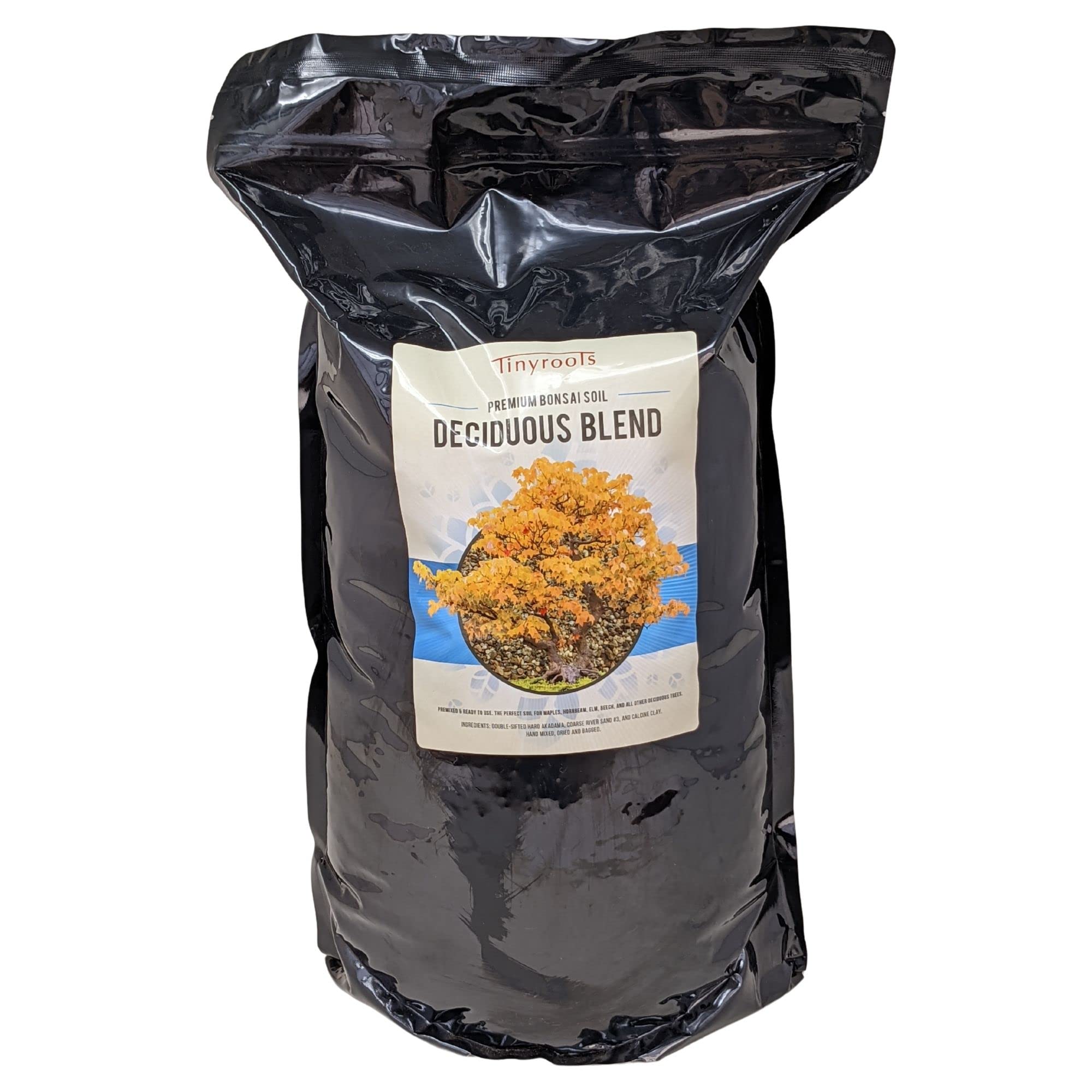
The bulk bonsai bag with double-sifted particles and 28 trace minerals for serious root health.
Tinyroots takes the same concept as the 2-quart blend above and scales it up to a 2.5-gallon bag — enough for multiple repottings or a small collection of deciduous bonsai. The mix is 100% organic and double-sifted (meaning it goes through a finer screen a second time to remove even more dust), made from compost mulch, akadama, Turface (a calcined clay that aids drainage), coarse river sand, fine pine bark, and Frit (a source of micronutrients). The result is a blend that drains aggressively while still holding enough moisture for a tree like a Japanese maple to feel at home.
Customers note excellent drainage and moisture retention specifically for deciduous bonsai, noting that the consistent, clean particles meant no sifting was needed before use. The blend also contains over 28 vital trace elements and minerals, so you are not just giving your maple a physical structure but also a nutrient foundation. Compared to the 2-quart bag, this is the smarter buy if you have more than one pot or plan to repot over a few seasons — the price per volume is notably lower.
Why it earns its spot
- 2.5 gallons fits multiple bonsai pots or one deep container — a step up in volume without switching to garden soil
- Double-sifted particles ensure consistent drainage, no dust layer on top
- 28 trace elements from the Frit ingredient feed the tree slowly over time
What to keep in mind
- Unsuitable for in-ground planting — this is purely a container/bonsai mix and would drain too fast in a garden bed
- Heavier bag than the 2-quart option; shipping weight is higher if ordering to a remote address
Go with this if: you have multiple deciduous bonsai trees and want one bag that covers several repottings with professional-grade drainage.
Look elsewhere if: you need a purely organic, compost-rich mix for a garden bed — the Coast of Maine is better suited for that use case.
Understanding the Specs
Volume (Quarts vs Gallons)
This is the single most practical spec when choosing a soil. A 20-Quart bag (like the Coast of Maine) fills a large garden bed or several big pots. A 2-Quart bag (like the Bonsai Outlet blend) covers exactly one small bonsai pot. The Tinyroots bag sits in the middle at 2.5 gallons (equal to 10 quarts) — enough for multiple repottings. Match the volume to your project: overbuying on a large bag for a single pot means wasted product; underbuying means running to the store mid-project.
Particle Size and Sifting
“Pre-sifted” means the manufacturer has already removed the tiny dust particles and heavy fines from the mix. That matters because fine dust clogs air pockets and turns the soil into mud when wet. A double-sifted blend (like the Tinyroots product) goes through a finer screen twice, giving you even more consistent particle size. If a bag is not labeled pre-sifted, you will likely need to screen it yourself — an extra hour of messy work before you can repot your maple.
FAQ
Can I use regular potting soil for a Japanese maple?
What pH level does a Japanese maple need?
How often should I repot a Japanese maple bonsai?
Will bonsai soil work for a Japanese maple planted in the ground?
What is akadama and why is it in bonsai soil?
Do I need to add fertilizer to these soils?
How do I know if the soil is draining too slowly?
Can I mix two of these soils together?
What does “double-sifted” mean for the Tinyroots product?
Is organic certification important for maple soil?
Final Thoughts: The Verdict
For most buyers, the best soil for japanese maple is the Coast of Maine Organic Planting Soil because it is ready to use, naturally low in pH, and comes in a 20-quart bag that handles everything from a single container to a full flower bed. If you are growing your maple as a bonsai and need pinpoint drainage for a small pot, go with the Deciduous Bonsai Soil Blend — its pre-sifted akadama and pumice mix is the standard choice for root health in a shallow pot. And for serious bonsai collectors who want a larger bag with double-sifted particles and 28 trace minerals, the Tinyroots Deciduous Blend offers the best value in bulk without sacrificing professional-grade drainage.
How We Picked
We do not accept paid placement. Every pick is matched to a real buyer and a real use-case; we do not hands-on test units.
Sources & Methodology
Specifications: manufacturer listings and product documentation. Review insights: verified customer reviews, as of July 2026. Pricing: not shown on this page (it changes often); check the current price via the retailer link.
As an Amazon Associate, Lawn Gear Lab earns from qualifying purchases. This does not affect which products we feature.