
Specs are compiled from manufacturer listings and verified buyer reviews and can change over time — please confirm the key details on the product page before buying.
Dahlias are heavy feeders that need loose, nutrient-rich soil that drains fast but holds enough moisture to support those dinner-plate-size blooms. The wrong mix—too dense, too acidic, or lacking organic matter—leads to stunted growth, root rot, or flowers that never open. This guide breaks down exactly which potting soils deliver the airy, fertile environment your tubers crave.
I’m Rikta — the founder and writer behind Lawn Gear Lab. This guide is built by comparing the manufacturers’ published specifications and the patterns across verified customer reviews, so you get each pick’s real strengths and trade-offs instead of marketing spin.
Choosing the right soil for dahlias — whether you are planting in raised beds, containers, or amending native garden soil — makes the difference between a so-so season and stems so strong they need staking by mid-summer.
Quick Picks
- Brut Organic Potting Soil — Best Overall
- Espoma Organic Potting Soil Mix (2 Cubic Feet) — Bag King
- Miracle-Gro Moisture Control Potting Mix (16 qt., 2-Pack) — Forgiving Mix
- Espoma Organic Vegetable & Flower Garden Soil (1 Cubic Foot) — Bed Builder
- Miracle-Gro Potting Mix (8 qt., 3-Pack) — Small-Batch Pro
- Midwest Hearth Premium Potting Soil Mix (4 Dry Quarts) — Starter Blend
How To Choose The Best Soil For Dahlias
Dahlias send out thick, tuberous roots that need room to spread and plenty of air pockets to prevent rot. The right soil feels loose and crumbly in your hand, not sticky or compacted. Here are the three factors to check before you buy.
Texture and Drainage
A dahlia’s worst enemy is soggy feet. You want a mix that holds moisture long enough to support growth but lets excess water run through freely. Peat moss, perlite, and vermiculite are the classic trio that create that light, fluffy structure. A mix with coarse perlite or sand improves drainage even further. If a bag feels dense or heavy when you lift it, it probably holds too much water for dahlias.
Nutrient Density and Organic Matter
Dahlias are heavy feeders that bloom from midsummer until frost. They need a soil rich in organic matter — think worm castings, compost, kelp meal, or alfalfa meal — to fuel that nonstop flower production. A bag labeled “for vegetables and flowers” often has the right nutrient profile. Avoid soils high in synthetic slow-release fertilizers if you prefer to control feeding yourself; organic mixes let you supplement on your own schedule.
pH Level
Dahlias prefer a slightly acidic to neutral soil, roughly between 6.0 and 7.0. Most quality potting mixes are pH-balanced to fall within that range. If you are amending native garden soil, test your ground pH first — adding lime raises it, while sulfur or peat moss lowers it. A balanced pH ensures your dahlias can actually absorb the nutrients you give them.
Quick Comparison
| Model | Best For | Volume | Key Additives | Organic | Amazon |
|---|---|---|---|---|---|
| Brut Organic Potting Soil | Premium all-around growth | 21 Quarts | Worm Castings, Trace Minerals, Kelp | OMRI Listed | Amazon |
| Espoma Organic Potting Mix (2 cu ft) | Best value for large containers | 2 Cubic Feet | Worm Castings, Alfalfa Meal, Kelp Meal | Yes | Amazon |
| Miracle-Gro Moisture Control | Consistent moisture for busy gardeners | 16 qt. (2-Pack) | Sphagnum Peat Moss, Coir | No | Amazon |
| Espoma Vegetable & Flower Garden Soil | Amending native ground beds | 1 Cubic Foot | Worm Castings, Myco-Tone | Yes | Amazon |
| Miracle-Gro Potting Mix (3-Pack) | Versatile small-batch planting | 8 qt. (3-Pack) | Feeds up to 6 Months | No | Amazon |
| Midwest Hearth Premium Potting Soil | Starting seeds and small pots | 4 Quarts | Peat Moss, Vermiculite, Perlite | No | Amazon |
In‑Depth Reviews
1. Brut Organic Potting Soil
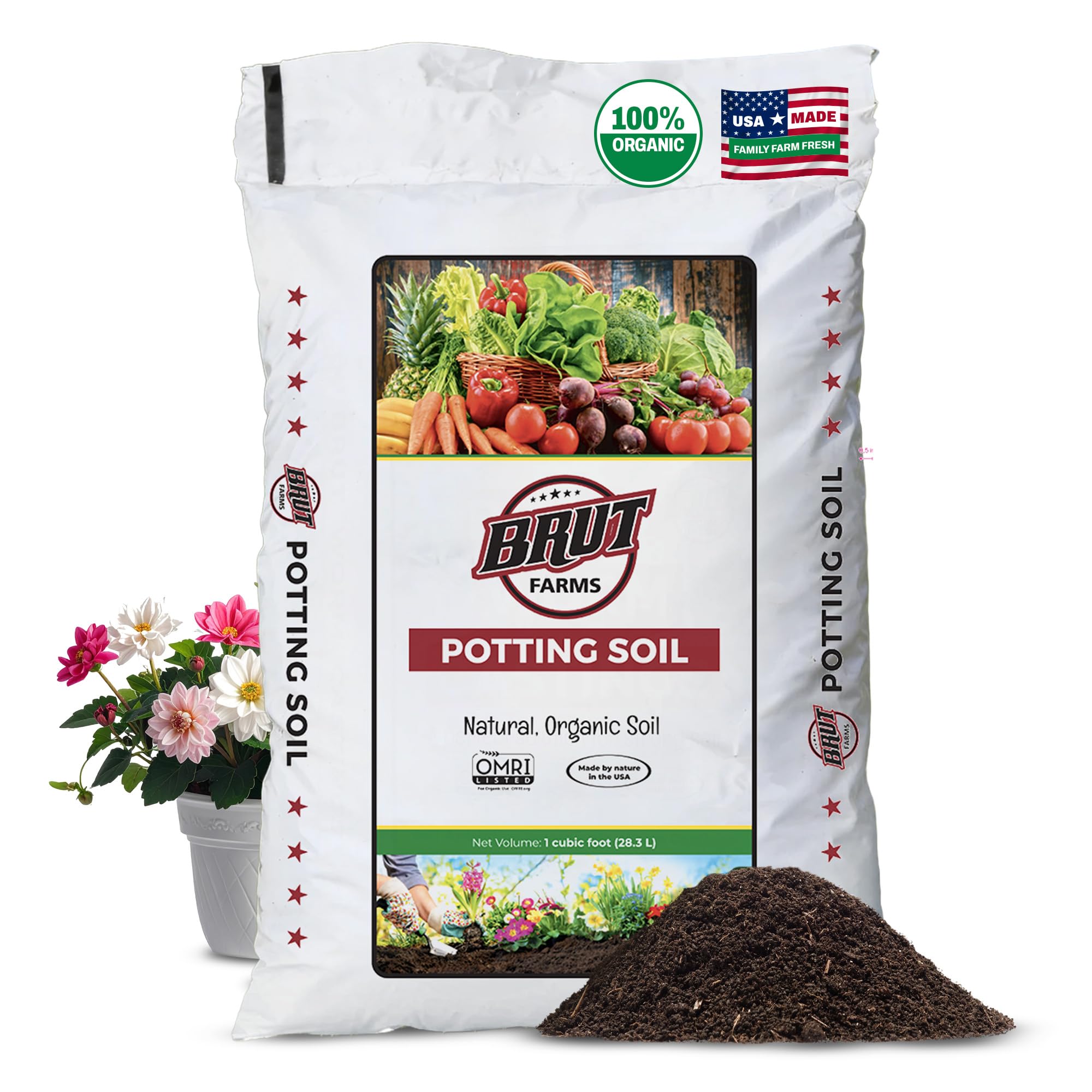
Microbe-rich organic blend that gets dahlias off to an explosive start.
This mix packs everything heavy feeders need right into the bag, so you do not have to buy extra bottles of plant food. Brut Organic Potting Soil combines worm castings (a rich source of slow-release nutrients), trace minerals from Azomite, and kelp, all of which feed your dahlias at root level. The 21-Quart bag gives you 21 quarts versus the Midwest Hearth bag’s 4 quarts — useful when you are filling half-barrels or raised beds.
Buyers report that Cara Cara orange and Lapins cherry trees showed deep green leaves and new growth within 2 days, which suggests the soil’s microbial life is active. The soil is naturally pH balanced between 6.3 and 6.5, right in the balance for dahlias. The main trade-off is the price, and some buyers noted that the fish and bone meal content can attract flies if the bag is left uncovered outdoors. Top-dress with sand or gravel if that is a concern.
Unlike the entry-level 4-quart bag from Midwest Hearth, this mix comes with enough nutrient density that you can plant directly without immediate fertilizer. It also beats the Espoma Vegetable & Flower Garden Soil in total volume while staying organic-certified — OMRI-listed means a third-party group verified it for organic use.
Container king: For dahlias in pots or raised beds where you want a single, complete soil that feeds for weeks, this is the one.
Price reality: Costs more per bag than the Espoma AP2, so budget-minded gardeners filling huge plots might prefer the Espoma 2-cubic-foot option.
Reach for this if: You want OMRI-listed organic soil with worm castings and trace minerals ready to go from the first scoop.
Look elsewhere if: You’re amending a large in-ground bed and need a much bigger volume for less money.
2. Espoma Organic Potting Soil Mix (2 Cubic Feet)

The largest organic bag here, built for raised beds and big container projects.
You get 2 Cubic Feet of organic potting mix with this Espoma bag — 2 cubic feet versus the Brut bag’s 21 quarts — making it the clear choice when you are filling multiple large containers or a raised bed. It blends sphagnum peat moss, humus, perlite, and is enriched with worm castings, alfalfa meal, kelp meal, and feather meal so your dahlias get a steady supply of nitrogen and trace nutrients. The added Myco-Tone (a proprietary blend of endo and ecto mycorrhizae — beneficial fungi that attach to plant roots to help them absorb water and nutrients) helps roots establish a symbiotic relationship with those fungi, which is a real advantage for transplanting tubers.
Reviewers mention this soil stays loamy and chunky and does not get dense or crusty over time — exactly what dahlias need to push out their thick roots. One owner with 25-year-old houseplants trusts this mix to keep sentimental plants thriving. Unlike the Miracle-Gro Moisture Control mix, this is fully organic with no synthetic fertilizers, so you control when and how much extra feeding happens.
What it delivers
- Massive 2-cubic-foot bag for the price
- Organic ingredients plus mycorrhizae for root health
- Owners mention no large sticks or wood chunks
The catch
- No built-in moisture control — you monitor your own watering
- Price per bag is higher upfront than the Brut bag despite larger volume
Best for big projects: If you’re planting a whole dahlia bed or a bunch of 15-gallon pots, this stretches further than any other pick here.
Not for small uses: A 2-cubic-foot bag is heavy and bulky if you only need to repot a couple of containers.
3. Miracle-Gro Moisture Control Potting Mix (16 qt., 2-Pack)

Absorbs excess water up to 33% more than basic soil, protecting dahlias from both extremes.
This is the pick for gardeners who worry about under- or over-watering. The Moisture Control formula uses sphagnum peat moss and coir to absorb up to 33% more water than basic potting soil, then release it gradually. For dahlias in containers that can dry out fast in summer heat, that buffer is a real safety net. The mix also feeds plants for up to 6 months, and according to the brand, it is designed to grow plants twice as big as unfed plants — which aligns with what dahlias need during their heavy bloom period.
Customers note this as the best potting soil they have ever used, saying plants in or out grow so fast they directly credit the soil. It comes as a 2-pack of 16-quart bags, so you get decent coverage for multiple containers. Unlike the organic picks from Espoma and Brut, this one uses synthetic fertilizer, so if you prefer an organic-only regimen, you will want to look at the top two picks instead. Some buyers noted occasional 1-inch wood chips in the mix, but those are a minor annoyance rather than a dealbreaker.
Compared to the standard Miracle-Gro Potting Mix (the 3-pack below), this moisture control version gives you a more forgiving watering window — especially valuable if you travel or tend to forget a day.
Vacation insurance: For dahlia growers who want a buffer against missed waterings, this mix’s coir and peat hold extra moisture without drowning roots.
Synthetic note: It works, but it is not organic — if that matters for your garden philosophy, the Espoma or Brut bags are the alternatives.
Grab for busy summers: Reliable moisture control and built-in feeding for up to 6 months take the guesswork out.
Skip for organic beds: Contains synthetic fertilizers not allowed in certified organic gardening.
4. Espoma Organic Vegetable & Flower Garden Soil (1 Cubic Foot)

Designed specifically to improve native soil when planting flowers and vegetables in the ground.
Unlike a potting mix that you use alone in containers, this Espoma Soil is meant to mix with your existing garden dirt. It is a rich blend of natural and organic ingredients enriched with earthworm castings and Myco-Tone (the same endo and ecto mycorrhizae used in Espoma’s potting mix), so it inoculates the root zone with beneficial fungi. This is the right approach if you are planting dahlia tubers straight into a prepared garden bed rather than a pot.
Reviewers point out that tomatoes and marigolds thrived in this soil — a good proxy for how dahlias will respond since they share similar nutrient demands. One reviewer noted that plants potted in Espoma outperformed those in an organic store-brand alternative, calling the quality difference noticeable. The 1-cubic-foot bag is a practical size for amending a moderate-sized bed without the heavy weight of the 2-cubic-foot AP2. Unlike the Midwest Hearth 4-quart bag which is best for starting seeds, this one has the organic matter density to support full-season growth.
The trade-off: because it is designed to mix with native soil, using it alone in a container may not give you the same drainage structure as a dedicated potting mix like the Miracle-Gro Moisture Control.
Strengths in the ground
- Myco-Tone fungi help roots expand into native soil
- Worm castings provide slow-release nutrients
- Reviewers report noticeable growth differences
Limitations
- Not a standalone container mix
- One reviewer experienced soil gnats with indoor use
Best for in-ground beds: Mix this into your garden soil before planting tubers and give dahlias a strong organic start.
Not meant for pots: Use a dedicated potting mix (like the Brut or Espoma AP2) for containers instead.
5. Miracle-Gro Potting Mix (8 qt., 3-Pack)

Three smaller bags that are easy to carry and perfectly portioned for several dahlia containers.
Each 8-quart bag fills two 8-inch containers, making this 3-pack a convenient option if you are planting a handful of dahlia pots rather than a whole bed. This is the classic Miracle-Gro Potting Mix — it feeds plants for up to 6 months and, according to the brand, is designed to promote growth with the same fertilizer formulation that has made the brand a household name. Unlike the Moisture Control version, this mix does not have the added coir and wetting agent, so you need to be more consistent with watering.
One buyer who gardens both outdoor and indoor loves this soil because it stays loose and well-draining, unlike mixes that pack down hard. Another reviewer says you cannot go wrong with Miracle-Gro potting soil. The biggest advantage over the Midwest Hearth 4-quart bag is the built-in fertilizer, which means you do not need to start feeding immediately. However, unlike the organic blends from Espoma and Brut, this mix relies on synthetic nutrients — fine for most gardeners, but a consideration if you are aiming for an organic bed.
Light and reliable: The smaller bags mean less heavy lifting, and the nutrient charge lasts a full season for most dahlias.
Watering attention needed: Without moisture-control additives, you need to check soil dryness more often than with the Moisture Control version.
Reach for this if: You want a trusted, budget-friendly potting mix for a few dahlia containers and prefer smaller bag sizes.
Look elsewhere if: You are planting a large bed or need organic certification.
6. Midwest Hearth Premium Potting Soil Mix (4 Dry Quarts)

A light, fluffy, pH-balanced mix ideal for germinating dahlia seeds or starting tubers in small pots.
This is the smallest bag in the lineup — just 4 Quarts — but it earns its place as a specialized tool for the early stages of growth. Midwest Hearth uses the same peat moss, perlite, and vermiculite blend that professional growers rely on, giving you excellent aeration and moisture control in a compact package. The pH is balanced for a broad spectrum of plants, and the texture is light enough that it will not compact around tender dahlia roots. One buyer used it to germinate petunias and called it a great seed starter — a perfect parallel for starting dahlia seeds or potting up small tuber divisions.
Reviewers praise the resealable bag and the clean, odorless texture. A common note is that the soil requires pre-soaking to retain water initially, otherwise it drains quickly — a sign of the high perlite content that dahlias appreciate. Compared to the 21-quart Brut bag, this is not a full-season soil; you will need to transplant into a larger volume or a nutrient-richer mix as your dahlias size up. Think of it as a nursery-stage soil rather than a final home.
Unlike the Espoma Vegetable & Flower Garden Soil which is designed to amend native dirt, this mix works perfectly alone in small pots for the first few weeks of growth.
What it does well
- Light, fluffy texture prevents damping off in seedlings
- Resealable bag keeps unused soil fresh
- Shoppers say no hardening around roots
Where it falls short
- Small 4-quart volume means you will need multiple bags for anything beyond a few pots
- Requires initial pre-soaking for best water retention
Best for starting: Use this for germinating dahlia seeds or potting up newly divided tubers in small nursery pots.
Not a final home: You will need to upgrade to a larger potting mix (like Brut or Espoma AP2) once your dahlias outgrow the starter pot.
Understanding the Specs
Volume / Bag Size
Soil is heavy, so bag size determines how much ground you can cover and how much you can lift at once. Quart and cubic foot are the two common units. A single 1-cubic-foot bag holds about 25 dry quarts. For a single 15-inch dahlia container, expect to need roughly 1.5 to 2 cubic feet of mix. Larger bags like the Espoma AP2 (2 cubic feet) are more economical per volume but require some muscle to move. Smaller bags like the Midwest Hearth (4 quarts) are easier to handle but only cover one or two small pots.
Organic vs Synthetic Fertilizer
Organic soils (like the Brut and Espoma bags) use natural ingredients such as worm castings, kelp meal, and alfalfa meal that release nutrients slowly as soil microbes break them down. Synthetic soils (like the Miracle-Gro mixes) provide immediately available nutrients but do not improve long-term soil microbial health. For dahlias, both work, but organic blends tend to build better soil structure over repeated seasons, while synthetic blends give a faster green-up response.
Drainage Additives
Perlite, vermiculite, and coarse sand create air pockets in the soil so water drains freely and roots get oxygen. Perlite (the little white Styrofoam-looking bits) is the most common. Too much drainage and the soil dries out quickly; too little and tubers rot. A good dahlia mix has a visible amount of perlite or a similar amendment. The Midwest Hearth mix and the Espoma bags both include perlite prominently. The Miracle-Gro Moisture Control relies more on coir and peat for water management.
Mycorrhizae
These are beneficial fungi that attach to plant roots and extend their reach for water and nutrients. The Espoma bags (both the Vegetable & Flower Garden Soil and the Potting Mix AP2) include a proprietary blend called Myco-Tone. For dahlias, mycorrhizae can help the root system establish faster after transplanting, especially in soils that are not heavily fertilized. Soils without added mycorrhizae still work fine but may not give that extra root-boosting kick.
FAQ
Can I use regular garden soil for dahlias in containers?
Should I mix compost into my dahlia potting soil?
How often should I replace the soil in dahlia containers?
What pH level is best for dahlias?
Is moisture control potting soil good for dahlias?
Can I reuse potting soil from last year for dahlias?
Does organic soil really make dahlias bloom better?
How much soil do I need per dahlia tuber?
Should I add perlite to my dahlia soil?
Can I use the same soil for dahlias and vegetables?
Final Thoughts: The Verdict
For most buyers, the best soil for dahlias is the Brut Organic Potting Soil because it combines OMRI-listed organic certification, worm castings, trace minerals, and a generous 21-quart volume in one bag — no extra amendments needed for a strong season of growth. If you want the best value for filling large beds or many containers, grab the Espoma Organic Potting Soil Mix (2 Cubic Feet). And for consistent moisture control during busy summer weeks, the Miracle-Gro Moisture Control Potting Mix is the one that saves you from wilting plants.
How We Picked
We do not accept paid placement. Every pick is matched to a real buyer and a real use-case; we do not hands-on test units.
Sources & Methodology
Specifications: manufacturer listings and product documentation. Review insights: verified customer reviews, as of July 2026. Pricing: not shown on this page (it changes often); check the current price via the retailer link.
As an Amazon Associate, Lawn Gear Lab earns from qualifying purchases. This does not affect which products we feature.