
Bermuda grass demands a specific soil environment to deliver that dense, emerald-green carpet it’s famous for. Get the texture, pH, or nutrient profile wrong, and you’re left fighting patchiness, waterlogging, or persistent yellowing that no bag of fertilizer can fix.
I’m Rikta — the co-founder and writer behind Lawn Gear Lab. I’ve spent hundreds of hours cross-referencing soil chemistry reports, comparing organic amendments, and analyzing owner feedback to pinpoint exactly which products change the game for Bermuda grass in different regional soil conditions.
After sifting through dozens of soil blends, conditioners, and amendments, I’ve isolated the seven formulations that actually deliver measurable results for warm-season turf. Whether your challenge is heavy clay compaction, sandy drainage, or depleted organic matter, this guide to the best soil for bermuda grass covers the specific solutions that work.
How To Choose The Best Soil For Bermuda Grass
Bermuda grass is a warm-season powerhouse, but its root system is shallow compared to fescue or zoysia. That means the top few inches of your soil profile dictate everything — water holding capacity, nutrient availability, and how fast the turf fills in bare spots. Picking the wrong amendment or topsoil blend wastes money and delays the thick lawn you’re after.
Prioritize pH and drainage over nutrient numbers
Bermuda grass absorbs iron and nitrogen most efficiently when soil pH sits between 5.8 and 7.0. Outside that window, even the richest fertilizer stays locked in the soil particles. Clay-heavy soils need organic amendments like humic acid or biochar to open pore space; sandy soils require peat or topsoil blends to slow water percolation. A soil test kit is cheaper than guesswork.
Match the form factor to your application method
Liquid humic acid concentrates spread rapidly over large lawns via hose-end sprayers, but they deliver short-term correction. Granular soil amendments like biochar and compost starters release carbon and microbes slowly over months, building structure deeper. Topsoil blends work best for spot-leveling or top-dressing thin areas before overseeding. Buy the format that fits your specific labor tolerance and lawn size.
Quick Comparison
On smaller screens, swipe sideways to see the full table.
| Model | Category | Best For | Key Spec | Amazon |
|---|---|---|---|---|
| The Andersons Dirt Booster Plus | Compost Starter | Building organic matter | 20 lbs, compost in 7–12 days | Amazon |
| The Andersons HumiChar | Soil Amendment | Long-term soil structure | 30% humic acid + 43% biochar | Amazon |
| Brut Organic Potting Soil | Potting Mix | Container Bermuda & small patches | 1 cu ft, OMRI listed, pH 6.3–6.5 | Amazon |
| Michigan Peat Baccto Top Soil | Top Soil | Top-dressing and leveling | 50 lbs, reed-sedge peat blend | Amazon |
| Midwest Hearth Premium Potting Mix | Potting Mix | Seed starting and small pots | 8 dry quarts, peat-perlite-vermiculite | Amazon |
| Stateside Humic20 | Liquid Amendment | Quick pH correction, large lawns | 64 oz, 20% humic acid, covers 10k sq ft | Amazon |
| Nature’s Living Super Soil Concentrate | Concentrate | Intensive root-zone feeding | 1 lb concentrate for 5 gallon pot | Amazon |
In‑Depth Reviews
1. The Andersons Dirt Booster Plus – 20 lb
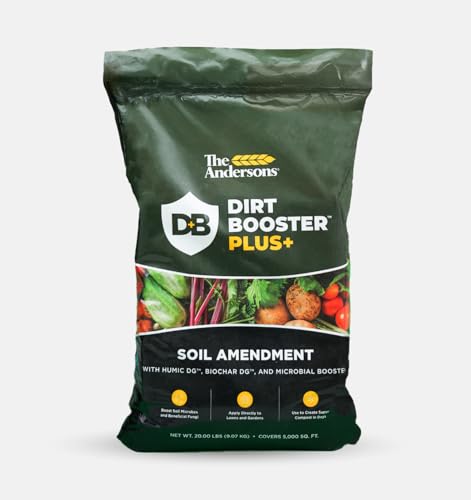
The Andersons Dirt Booster Plus is the most complete single-bag solution for transforming dead clay or depleted sand into living soil that Bermuda grass roots can actually penetrate. This 20-pound all-natural blend combines microbial inoculants, biochar, humic acid, corn distillates, and molasses — a multi-pathway approach that feeds soil biology while physically opening pore space. The granular formulation works through a standard broadcast spreader with minimal dust, eliminating the guesswork of mixing liquids or layering multiple products.
Where Dirt Booster Plus truly sets itself apart is its composting speed. Traditional top-dressing methods take months to build measurable organic matter; this formulation accelerates the process down to 7–12 days when used as a compost starter, and it continues conditioning the soil for the entire growing season when broadcast directly. Bermuda grass overseeded into clay soil treated with this amendment showed visible green-up and deeper root color within three weeks in multiple owner reports. The proprietary microbial blend includes bacterial and fungal species that break down thatch naturally, reducing one of Bermuda grass’s biggest maintenance headaches.
Pound-for-pound, this is the most aggressive soil builder in this roundup, but it requires a long-term mindset. Users in red clay regions across Georgia and the Carolinas reported that after two seasons of semi-annual applications, their formerly compacted soil turned dark and crumbly enough to cut irrigation frequency. The only catch is the price premium — this costs more per bag than simpler topsoil or straight humic acid, but the biological depth justifies the investment if you’re playing the long game with your lawn.
What works
- Accelerates compost creation in 7–12 days
- Low-dust granules work with any broadcast spreader
- Safe to apply liberally — not a synthetic fertilizer
What doesn’t
- High per-bag cost for large-acreage lawns
- Not available for sale in California
2. The Andersons HumiChar – 12 lb

HumiChar attacks two problems simultaneously: the immediate need for humic acid to chelate nutrients and unlock iron, and the long-term structural deficit that biochar fills. The 30% humic acid content is among the highest available in a granular format, delivering fast correction to pH-driven chlorosis that turns Bermuda grass lime-yellow in spring. The 43% granulated biochar acts as a permanent carbon sponge in the soil, locking water and nutrients in the root zone for decades — a critical advantage for sandy soils that drain faster than Bermuda grass can drink.
The patented DG (Dispersible Granule) Technology from The Andersons ensures the particles break down rapidly after watering, so you aren’t waiting days for the biochar to activate. Users on Southern sandy soils reported that two applications per year, combined with organic fertilizer, reduced irrigation needs by roughly 40% and fertilizer inputs by about 50% over a 20-month period. For a warm-season grass that needs steady moisture through July and August, that water retention alone justifies the switch from liquid-only conditioning programs.
The 12-pound bag covers 12,000 square feet, making it a sensible buy for quarter-acre to half-acre lawns. The only real limitation is that biochar works slowly — you won’t see a dramatic overnight transformation like you would with synthetic wetting agents. But if you’re willing to treat the soil rather than just feed the leaf, HumiChar builds a foundation that gets better every season. Not for sale in California or Oregon.
What works
- High humic acid percentage unlocks locked-up nutrients
- Biochar improves water retention in sandy soils
- DG Technology breaks down quickly after watering
What doesn’t
- Results build gradually over multiple seasons
- Restricted in California and Oregon
3. Brut Organic Potting Soil – 1 cu ft
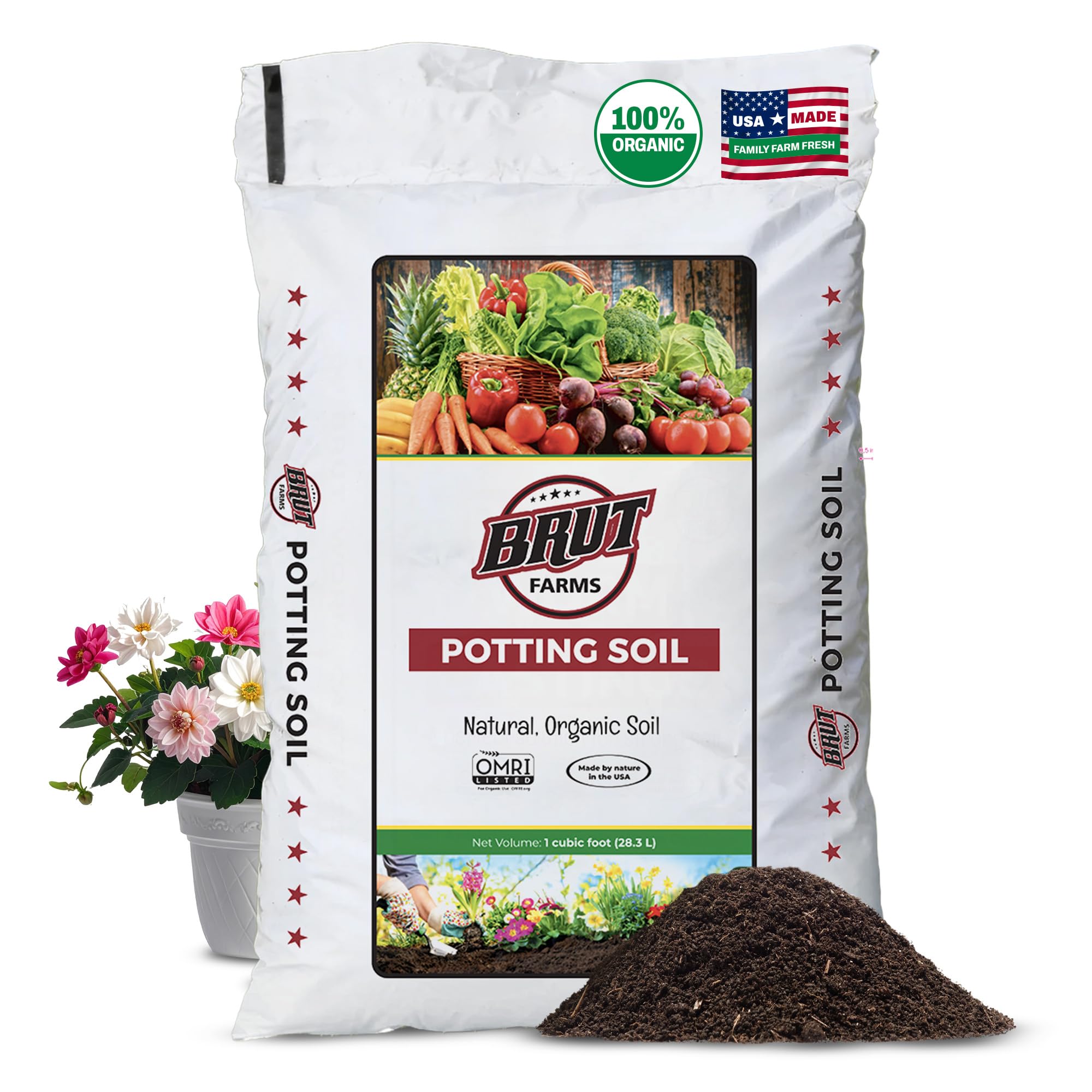
Brut Organic Potting Soil is a premium, all-purpose mix that works exceptionally well for Bermuda grass planted in containers, raised beds, or small patch repair. The formula is built on microbe-rich worm castings and trace minerals from Azomite and kelp, creating a root environment that delivers nutrients at the soil-microbe interface rather than through synthetic salt fertilizers. The pH is naturally buffered between 6.3 and 6.5, which sits perfectly in Bermuda grass’s preferred range without requiring additional lime or sulfur adjustments.
What separates Brut from generic bagged topsoil is the complete absence of filler materials. There are no sticks, wood chips, or bark fines — just peat, perlite, worm castings, and mineral amendments sifted to a consistent, fine texture that Bermuda stolons can spread through easily. The OMRI listing means it meets organic standards, which matters if you’re managing a lawn that also borders vegetable beds or has kids and pets rolling on it daily. Users reported that even finicky trees and ornamentals showed deep green new growth within two days of transplanting into this soil, suggesting the microbial population is genuinely active rather than shelf-stable dead weight.
The main trade-off is cost per cubic foot. At roughly per bag, Brut is significantly more expensive than a standard topsoil or peat blend. For large lawns requiring yards of material, this doesn’t make economic sense. But for top-dressing a 50-square-foot thin patch or filling a raised Bermuda propagation bed, the concentrated nutrition and filler-free texture justify the premium. Just be aware that the fish and bone meal content can attract flies if left exposed on the surface — a thin sand or gravel cap solves that easily.
What works
- Filler-free — no wood chips or bark
- OMRI listed with active microbial content
- pH perfectly dialed for Bermuda grass
What doesn’t
- High price per cubic foot for large areas
- Fish meal can attract flies if uncovered
4. Michigan Peat Baccto Top Soil – 50 lbs

Baccto Top Soil from Michigan Peat Company is a straightforward, screened blend of reed-sedge peat and sand that gives Bermuda grass a clean medium for top-dressing and leveling without introducing weed seeds or synthetic additives. The 50-pound bag is heavy but manageable, and the screened texture is finer than most budget topsoil brands — meaning less time spent sifting out twigs and rocks before spreading. The peat component helps sandy soils retain moisture, while the sand fraction improves drainage in heavy clay, creating a balanced texture that Bermuda stolons root into quickly.
For overseeding projects in early spring or fall, this topsoil is a reliable base layer. It provides enough organic content to buffer temperature swings at the soil surface and enough bulk density to keep seed from washing away during the first irrigation. Repeat buyers reported purchasing 18 or more bags for entire lawn renovations, citing the dark color and minimal wood debris as key advantages over generic “clean” topsoil brands that still require manual rock removal. The formulation is simple, but simplicity is exactly what you need when you’re spreading 500 pounds of material across a patchy lawn.
The biggest drawback is inconsistency in bag quality. Some lots come through with a significant amount of twigs, including pieces large enough to interfere with fine-bladed grass emergence. A session with a basic garden sifter solves the problem, but it adds labor you shouldn’t have to do. Additionally, this is a soil blend, not an amendment — it won’t correct pH issues or add concentrated nutrition the way a humic acid product would. Treat Baccto as a foundational layer, and layer your fertilizer and conditioner on top.
What works
- Cleaner than most budget topsoil brands
- Good drainage-moisture balance for Bermuda
- Available in heavy 50-pound bags for bulk work
What doesn’t
- Some bags arrive full of large twigs
- No concentrated nutrients or pH correction
5. Midwest Hearth Premium Potting Mix – 8 Dry Quarts

Midwest Hearth’s Premium Potting Soil Mix is a triple-blend of peat moss, perlite, and vermiculite designed for seed starting and small container work — not bulk lawn top-dressing. The 8-quart size is compact enough to fit on a shelf, making it a practical option for germinating Bermuda seed in trays or filling small propagation pots before transplanting into the lawn. The pH is controlled for a broad spectrum of plants, and the texture is noticeably light and fluffy, giving delicate young roots easy penetration and consistent moisture without compaction.
The resealable bag design is a small but appreciated detail for gardeners who don’t use the entire bag in one session. Users who germinated petunias and other fine-seeded plants reported strong germination rates with no damping-off issues, which suggests the mix is free from common soil-borne pathogens. For Bermuda grass specifically, this mix works well as a germination medium — just pre-soak the soil to prevent rapid drainage, as the high perlite content can initially channel water through before the peat fully hydrates.
On the downside, the 8-quart bag size limits its application to small-scale projects. Covering even a 50-square-foot bare patch of lawn with half an inch of this mix would require multiple bags, making it cost-prohibitive for anything beyond seed-starting or container repair. The light texture also means it packs down quickly under foot traffic, so it’s not suitable as a standalone top-dressing for high-use lawn areas.
What works
- Light, fluffy texture ideal for seed germination
- Resealable bag keeps leftover mix fresh
- Balanced pH for broad plant use
What doesn’t
- Small bag size impractical for lawn-level work
- Needs pre-soaking to prevent channeling
6. Stateside Humic20 Soil Conditioner – 64 oz
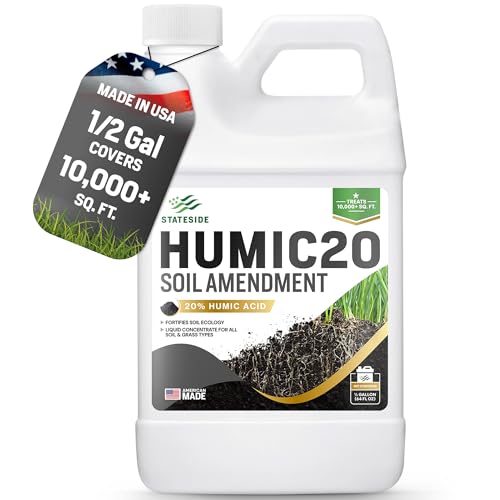
Stateside Humic20 delivers a concentrated 20% humic acid dose in a 64-ounce liquid that covers up to 10,000 square feet — making it one of the most cost-effective ways to correct mild pH imbalances and improve water penetration in established Bermuda grass lawns. The liquid form works through any hose-end sprayer, so you can treat a medium-sized lawn in 15 minutes without hauling bags or calibrating a spreader. Users on heavy clay soils reported noticeable green-up and reduced watering time after a single application, as the humic acid helped break surface tension and shuttle water deeper into the root zone.
The 20% concentration is higher than many competitor liquid humates, meaning you need less product per application to see results. The formula is versatile enough to tank-mix with nitrogen fertilizers, but the best practice is to apply it roughly two weeks after your regular fertilizer application to avoid nutrient competition. The liquid is black with a mild odor that dissipates quickly after drying, and it leaves no visible residue on turf blades — a common concern with some granular humates that coat leaves before washing down.
The limitation of any liquid amendment is that it treats the soil surface and shallow root zone but doesn’t build permanent physical structure. Biochar and compost blends physically open pore space; humic acid chemically unlocks nutrients already in the soil. For Bermuda grass growing in severely compacted clay, Humic20 is a band-aid, not a cure. Pair it with aeration and an organic top-dressing program for lasting results. The 64-ounce bottle is also not ideal for lawns under 2,000 square feet since the dilution ratios become awkward to measure.
What works
- High 20% concentration stretches coverage
- Quick hose-end sprayer application
- Visible green-up and improved water soak-in
What doesn’t
- Doesn’t build long-term soil structure
- Awkward to measure for small lawns
7. Nature’s Living Super Soil Concentrate – 1 lb

Nature’s Living Super Soil Concentrate is a unique water-only amendment designed for container growing, but its concentrated organic biology makes it a potent tool for spot-treating Bermuda grass in raised beds or large pots. The one-pound bag mixes into a five-gallon container of potting soil, creating a self-sustaining nutrient cycle where microorganisms break down organic matter and feed roots continuously. For areas where Bermuda grass is grown ornamentally or in a contained propagation bed, this eliminates the need for monthly liquid feeding.
The organic ingredients are densely packed — the bag smells aggressively of fish and compost, which is a reliable indicator of active biology rather than inert filler. Users who layered this concentrate at the bottom of their containers and topped with standard potting mix reported that their plants grew larger and denser than control plants in straight potting soil, with visibly darker foliage and thicker stems. For Bermuda grass plugs or sprigs started in pots before field transplanting, this concentrate gives the root system a strong nutritional foundation that reduces transplant shock.
The downsides are non-negotiable for residential use. The smell is potent enough to attract flies and make indoor mixing unpleasant, and the concentrate must be thoroughly incorporated into the soil — top-dressing with the raw material can create an odor problem for weeks. Additionally, the formula is designed for photoperiod flowering plants, so the NPK profile is optimized for heavy blooming rather than turf grass leaf growth. It works for Bermuda, but a turf-specific organic amendment would be a more efficient choice for pure lawn applications.
What works
- Water-only feeding after initial mix
- Dense microbial content for strong root systems
- Ideal for starting plugs and sprigs
What doesn’t
- Strong fish odor attracts flies
- Flower-optimized NPK not ideal for turf
Hardware & Specs Guide
Humic Acid Percentage
Liquid conditioners like Stateside Humic20 use 20% concentration to deliver fast chelation of soil nutrients. Granular blends like The Andersons HumiChar pack 30% humic acid for slow-release correction. Higher percentages mean faster visible green-up, but they require careful dosing to avoid locking out other nutrients.
Biochar Content
Biochar is charred organic matter that persists in soil for decades. HumiChar contains 43% granulated biochar, which physically holds water and nutrients in sandy soils. Products without biochar (like Baccto Top Soil) improve texture only while the organic matter lasts — usually one to two growing seasons before depletion.
FAQ
Can I use regular garden topsoil for Bermuda grass?
How often should I apply humic acid to my Bermuda lawn?
Will biochar fix my compacted clay soil?
Final Thoughts: The Verdict
For most gardeners, the best soil for bermuda grass winner is the The Andersons Dirt Booster Plus because it builds organic matter fast while feeding the microbial population that keeps Bermuda roots healthy season after season. If you want to reduce irrigation and fertilizer inputs long-term, grab the The Andersons HumiChar. And for quick liquid correction of pH and water penetration on a large lawn, nothing beats the convenience of Stateside Humic20.