
Specs are compiled from manufacturer listings and verified buyer reviews and can change over time — please confirm the key details on the product page before buying.
Azaleas are picky eaters. They need soil that leans acidic, roughly in the 4.5 to 6.0 pH range, or their leaves yellow and buds stall. The right soil amendment or fertilizer fixes that fast, and this guide sorts the powders, granules, liquids, and ready-to-use mixes so you can pick the one that fits your garden routine.
I’m Rikta — the founder and writer behind Lawn Gear Lab. This guide is built by comparing the manufacturers’ published specifications and the patterns across verified customer reviews, so you get each pick’s real strengths and trade-offs instead of marketing spin.
The fixes below range from quick water-soluble feeding to slow granular acidification, and every one is formulated for acid-loving plants. This is the practical list of the best soil for azaleas based on real-world results.
Our Picks at a Glance


How To Choose The Best Soil For Azaleas
Azaleas fail for one big reason: the soil around their roots is not acidic enough. Before you buy anything, test your soil’s pH. If it sits above 6.0, you need an acidifier; if it is already in the 4.5 to 6.0 range, you mostly need a balanced feed.
Fast versus slow: match the fix to your patience
Water-soluble powders and liquid concentrates drop pH within days, which is ideal for a plant that is already yellowing. Granular sulfur and organic blends work over weeks or months as soil microbes break them down — a better choice for preparing a bed before planting.
Know what your azalea is actually missing
Yellow leaves often mean an iron deficiency triggered by alkaline soil, not just low acidity. Products that pair sulfur with iron, zinc, or magnesium fix both problems at once, while plain sulfur only handles the pH side.
Quick Comparison
| Model | Best For | Form | Weight | Key Ingredient | Amazon |
|---|---|---|---|---|---|
| Miracle-Gro Water Soluble Plant Food★ Best Overall | Quick feeding | Powder | 5 lb | Acidic blend | Amazon |
| Grow More Hydrangea BlueingBluing Specialist | Blue blooms | Powder | 2 lb | Aluminum sulfate | Amazon |
| Fertilome Aluminum SulfateFast Acting | Fast pH drop | Powder | 4 lb | Aluminum sulfate | Amazon |
| Greenway Organic Sulfur | Gradual acidification | Powder | 1 lb | 99% sulfur | Amazon |
| Earth Science Fast Acting Sulfur | Pet-safe lawn care | Granules | 5 lb | Elemental sulfur | Amazon |
| Espoma Holly-Tone | Organic feeding | Granules | 4 lb (x2) | 4-3-4 + sulfur | Amazon |
| Fertilome Soil Acidifier Plus Iron | Yellow leaves | Liquid | 1 gal | Sulfur + iron | Amazon |
| Coast of Maine Planting Soil | Ready-to-use mix | Soil | 28 lb | Peat + manure | Amazon |
In-Depth Reviews
1. Miracle-Gro Water Soluble Azalea, Camellia, Rhododendron Plant Food
Our pick — over 4.5★ from 650+ verified ratings; the strongest balance of quality and price.
The crowd favorite that feeds acid lovers in minutes, not months.
Azaleas, camellias, rhododendrons, gardenias, hibiscus, hollies, hydrangeas, and orchids all drink from this 80-ounce powder. Mix it at 1:144 for indoor plants or 1:18 for outdoor ones, and the crystals dissolve completely with no gritty residue left behind.
The thing everyone raves about is effectiveness — it perks up leaves and pushes out blooms within a couple of waterings. It feeds every 7 to 14 days through a watering can or a Miracle-Gro Garden Feeder, and the maker promises it won’t burn foliage when used as directed. One owner with three decades of experience calls it cheaper and more effective than a popular holly fertilizer.
The recurring gripe is the resealable Velcro bag: it seals great until powder coats the closure, then it stops gripping. Keep a spoon handy and the closure clean and this is a painless routine.
The fast path to green
- Dissolves completely and mixes easily
- Feeds a long list of acid-loving plants
- Safe on foliage when used as directed
The packaging catch
- Velcro bag loses its seal once powder gets on it
- Easy to over-fertilize in containers
Grab this if: you want one water-soluble feed that covers azaleas plus most of your other acid-loving plants.
Watch for: the bag closure — keep it dry and powder-free or store the mix elsewhere.
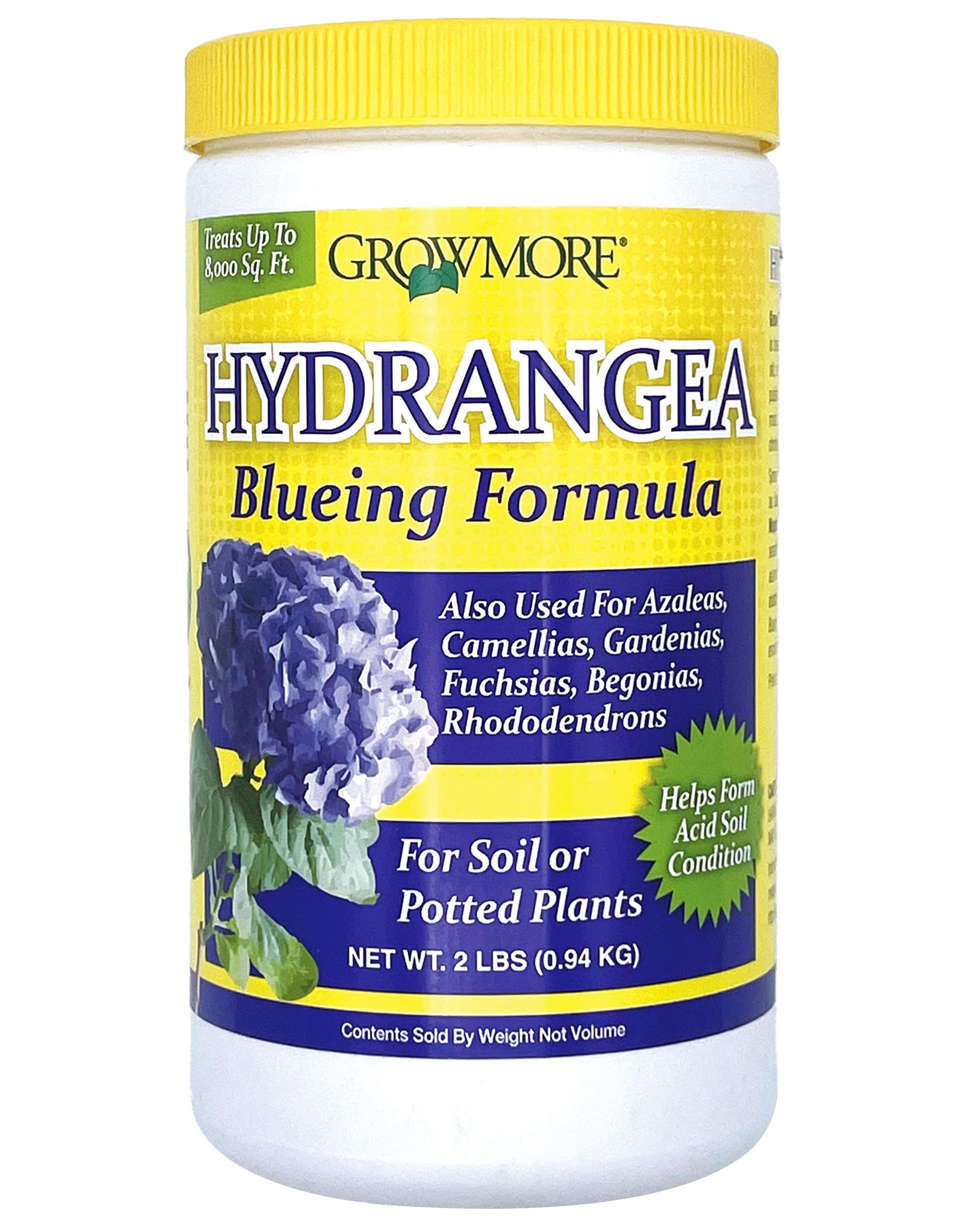
2. Grow More Hydrangea Blueing Formula
A 2-pound jar of aluminum sulfate aimed squarely at turning pink blooms blue.
The aluminum sulfate in this powder acidifies the soil around hydrangeas, azaleas, gardenias, and fuchsias, whether they live in the ground or in pots. It is a premium-feeling pick that weighs just 2 pounds, so it is a fraction of the size of the 5-pound Miracle-Gro bag above — but it is built for a very different job: color change and soil acidification rather than general feeding.
Buyers report that basic soil turned their hydrangeas pink despite earlier acidifier use; applied from early spring per the directions, this product produced purple-blue blooms — not fully blue yet, but clearly on the way. Others say their pink hydrangeas turn purplish to blue each season and that a single jar lasts several seasons. The honest trade-off is timing: start early, because the color shift takes repeated applications.
Patience pays: this is a seasonal project, not a one-feed fix — apply from early spring and expect gradual color change.
Reach for this if: your hydrangeas are stubbornly pink and you want a USA-made acidifier that outdoes home remedies.
Look elsewhere if: you need a broad all-purpose azalea feed rather than a color-focused acidifier.
3. Fertilome 32175 Aluminum Sulfate Soil Conditioner
A 4-pound powder that slams soil pH down fast when azaleas are struggling.
This conditioner creates an acid soil environment and intensifies blue color in hydrangeas, while covering azaleas, gardenias, camellias, rhododendrons, and blueberries. It holds 64 ounces — a full 25% more mix than the 80-ounce Miracle-Gro above? No: it is actually smaller, at 4 pounds versus 5 pounds, but it is far more concentrated in acidifying power.
The thing owners praise most is effectiveness. One gardener with alkaline water and soil — 8.5 and 7.5 pH — used 1.5 tablespoons per 3-gallon pot and watched runoff drop to 5 pH in days. The catch is that speed: the same reviewer admits that was too much, and another saw a smaller plant lose all its leaves from the fast action. This is dramatic and risky, so tiny doses are the rule.
Blazing fast results
- Visible pH drop in 2-3 days
- Works without burning plants when dosed right
- Covers a wide range of acid lovers
Handle with care
- Easy to overdo — foliar burn risk on small plants
- An occasional plant reacts poorly to fast pH swings
Best for: experienced gardeners with strongly alkaline soil who need a quick correction.
Not for: beginners or small container plants — start with a fraction of the dose and test between applications.
4. Greenway Biotech Organic Sulfur Powder
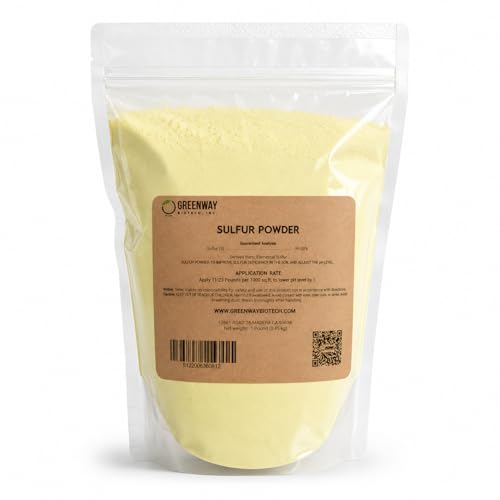
A straight 99% elemental sulfur powder for gardeners with patience.
Elemental sulfur is the most concentrated form of the stuff — this one sits at 99% — but it needs soil microbes to break it down into the sulfate plants actually use. That means it works slowly, over weeks, which is ideal for lowering pH before planting rather than rescuing a yellowing azalea right now.
Apply 1 pound per 100 square feet to correct pH across your landscape or garden. The quality earns the most praise — owners call it very fine and dust-resistant, and it does not stain clothing. The honest downside: it is a 1-pound bag, so it goes fast on a big bed, and the press-seal bag is difficult to close once opened; plan on a separate airtight container.
low-maintenance: this is a soil-prep tool, not an emergency fix — give it weeks to work.
Choose this if: you are amending a garden bed ahead of planting azaleas and want a gentle, organic acidifier.
skip it if: you need a quick rescue — the fast-acting granular or liquid picks below will do that.
5. Earth Science Fast Acting Sulfur Granules

A 5-pound granular sulfur that is safe enough for people and pets right after spreading.
These yellow granules start lowering soil pH immediately, helping hydrangeas, azaleas, and blueberries absorb more food from whatever fertilizer you pair them with. The maker’s Nutri-Bond Technology bonds the product to the soil so it stays where you put it rather than washing away with the first rain.
The yellow color does not stain skin, and the bag looks tidy on a shelf. Owners love that bigleaf hydrangeas flipped from pink and red to blue after a single spring feeding, and strawberries reportedly grow bigger next to it. The honest trade-off — as the name admits — is that “fast acting” has limits: the pellets take many waterings to fully dissolve, so it is faster than raw sulfur powder but slower than the liquid picks here.
Lawn-safe acidifying
- Safe for all grass types, people, and pets
- One feed flipped hydrangeas blue
- Does not stain skin
Pace yourself
- Pellets need multiple waterings to dissolve
- Not truly “fast” compared with liquid acidifiers
Reach for this if: you want a pet-safe granular acidifier you can spread and walk away from.
Consider the liquid instead if: you need visible pH change in days, not weeks.
6. Espoma Organic Holly-Tone 4-3-4
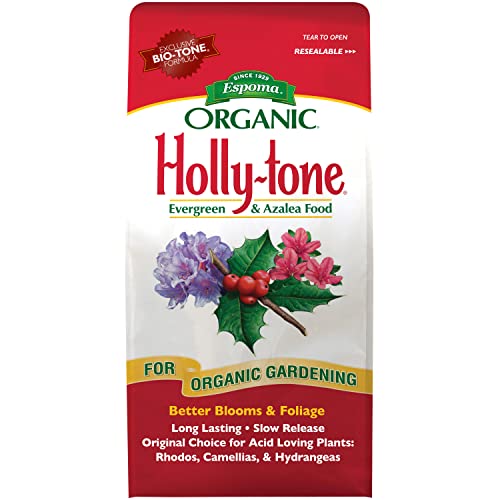
The original organic feed for acid lovers, now in a handy two-bag pack.
Holly-tone has been the go-to organic plant food for acid-loving plants since long before most brands existed. This pack ships two 4-pound bags, so you get 128 ounces of 4-3-4 fertilizer with 5% sulfur — a blend that feeds azaleas, rhododendrons, hydrangeas, blueberries, evergreens, strawberries, and camellias while slowly nudging soil acidity.
What wins people over is the plant benefits: owners mention large, beautiful blooms and dark green foliage that lasts through the year. It is approved for organic gardening and carries no sludges or toxic ingredients, and it needs no mixing — just scatter it around the drip line and water in. One owner admits the bag smells terrible for days after opening and that it did not shift hydrangea color in two weeks; blueberries and azaleas did improve, though.
The organic workhorse
- Long-lasting slow-release nutrition
- Approved for organic gardening
- No mixing required
Two honest notes
- Strong odor lingers until watered in
- Slow to change hydrangea color
Best for: organic gardeners who want a dependable spring-and-fall feeding routine for all their acid lovers.
Look elsewhere if: your goal is a fast hydrangea color change — this feeds, it does not rapidly re-dye.
7. Fertilome Soil Acidifier Plus Iron
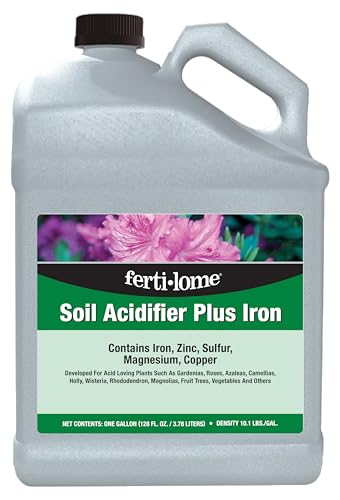
A liquid acidifier that pairs sulfur with iron to cure yellow leaves fast.
Yellow azalea leaves are usually an iron deficiency hiding behind alkaline soil. This 1-gallon liquid concentrate attacks both problems at once, mixing sulfur with iron, zinc, magnesium, and copper — the trace elements acid lovers need most. Dilute 2 tablespoons per gallon of water and drench the root zone.
The thing everyone raves about is effectiveness: it is faster and more potent than bagged acidifiers like Espoma, and a small amount suffices. Customers note fixing yellow leaves on lemon trees, hydrangeas, and blueberries after just two applications, with leaves turning green and plants perking up within weeks. The caution is real, though — it can drop pH too fast in pots if overused, so test your soil first and start small. One owner calls it “a must-have,” while another warns it adjusts pH so efficiently you must be careful.
The two-in-one cure
- Fixes iron chlorosis and acidity together
- More potent than bagged acidifiers
- Gentle on roots when dosed correctly
Go slow in pots
- Can over-acidify container soil fast
- Risk of harming plants if misused
Reach for this if: your azaleas have yellow leaves and you want one liquid fix that handles both pH and iron.
pass on it if: you prefer set-and-forget granular products or you are nervous about liquid dosing.
8. Coast of Maine Organic Planting Soil for Acid-Loving Plants

A 28-pound bag of finished organic soil, no mixing or measuring needed.
If you are planting new azaleas from scratch, this is the easiest route: a pre-mixed organic compost blend with a low-pH formulation, built from composted manure and sphagnum peat moss. The 20-quart bag is naturally lightweight, and the formula balances moisture retention with drainage so roots never sit soggy.
The quality is what owners praise most — the soil arrives dark, rich, moist, and odorless, and it moistens far more easily than typical potting mixes that let water run straight through. Plants reportedly thrive within two weeks of planting, with greener leaves, stronger stems, and more blooms. The mixed note in the data is pH: since this is a soil, not an acidifier, some owners recommend checking the pH once planted because results vary by starting conditions.
Plant and go
- OMRI-listed for organic use
- Light, fluffy, and easy to moisten
- Great for pots, beds, and indoor ferns
The pH caveat
- Results vary — check pH after planting
- Not an acidifier, so it won’t drop pH further
Grab this if: you are planting new acid lovers and want a ready-to-use organic mix that works out of the bag.
Pair it with an acidifier if: your water or existing soil runs alkaline and you need to push pH down further.
Understanding the Specs
N-P-K Ratio
The three numbers on any fertilizer bag stand for nitrogen, phosphorus, and potassium. For azaleas, a balanced feed like Espoma’s 4-3-4 keeps foliage green and supports blooms without pushing excessive leaf growth that invites pests.
Elemental Sulfur vs. Aluminum Sulfate
Elemental sulfur is the slow, organic route — soil microbes convert it to usable sulfate over weeks. Aluminum sulfate works in days but carries a real over-acidification risk, especially in pots. Match the speed to your plant’s urgency.
Fast vs. Slow Release
Water-soluble powders and liquid concentrates deliver nutrients immediately, perfect for a plant already showing yellow leaves. Granular and organic blends release over weeks or months, ideal for scheduled spring-and-fall feeding.
Trace Elements
Alkaline soil blocks iron uptake even when iron is present in the soil. Acidifiers that include iron, zinc, or magnesium — like the Fertilome liquid — fix the yellow-leaf symptom while also lowering pH, which is why they outperform plain sulfur for sick plants.
FAQ
How do I know if my azalea soil needs acidifying?
What is the difference between elemental sulfur and aluminum sulfate?
Can I use hydrangea bluing fertilizer on my azaleas?
How often should I feed azaleas?
Will soil acidifier burn my azalea roots?
What is the ideal pH range for azaleas?
Can I use regular potting soil for azaleas?
Why are my azalea leaves turning yellow even after I fertilize?
Final Thoughts: The Verdict
For the majority of shoppers, the soil for azaleas winner is the Miracle-Gro Water Soluble Plant Food because it is a proven, fast-acting feed that covers azaleas plus a long list of other acid lovers. If you want organic, set-and-forget feeding, grab the Espoma Holly-Tone. And for yellow leaves caused by alkaline soil, the Fertilome Soil Acidifier Plus Iron is the one to reach for.
How We Picked
We do not accept paid placement. Every pick is matched to a real buyer and a real use-case; we do not hands-on test units.
Sources & Methodology
Specifications: manufacturer listings and product documentation. Review insights: verified customer reviews, as of August 2026. Pricing: not shown on this page (it changes often); check the current price via the retailer link.
As an Amazon Associate, Lawn Gear Lab earns from qualifying purchases. This does not affect which products we feature.