
Azaleas in containers demand a potting mix that holds moisture without suffocating delicate roots and stays acidic enough to unlock essential nutrients. Generic bagged soil often turns alkaline over time, leading to yellowing leaves and stunted growth. The right blend of peat moss, perlite, and pine-based organic matter creates the airy, low-pH environment that keeps potted azaleas thriving through every season.
I’m Rikta — the co-founder and writer behind Lawn Gear Lab. I’ve spent hundreds of hours analyzing soil pH data, particle size distribution, and moisture retention rates across dozens of commercial mixes to identify which products consistently deliver for acid-loving container plants.
This guide walks you through the critical specs and performance trade-offs to help you choose the best soil for azaleas in pots and avoid mixes that compact, go hydrophobic, or drift out of the ideal 4.5–6.0 pH range.
How To Choose The Best Soil For Azaleas In Pots
Potted azaleas depend entirely on the limited volume of soil in their container. Unlike in-ground plants, they cannot send exploratory roots outward to find moisture or nutrients. Every spec of the mix — pH, texture, water-holding capacity, and nutrient profile — directly determines whether the plant produces vibrant blooms or declines into chlorosis and root rot. Here are the specific factors to evaluate before buying.
pH Range — The Acid Non-Negotiable
Azaleas are obligate acidophiles: they require a soil pH between 4.5 and 6.0 to access iron and other micronutrients. A mix above 6.5 locks those nutrients away, causing leaf yellowing and poor flower formation. Look for a stated pH range on the bag or product description. If a mix claims to be “pH controlled” for a broad spectrum of plants but does not specify an acidic range, it is unlikely to sustain azaleas long-term in a pot.
Texture and Drainage — The Container Imperative
Container soil must drain freely while retaining enough moisture to keep roots consistently damp. Coarse ingredients like perlite, vermiculite, and pine bark create pore spaces for oxygen exchange and water flow. A mix that is too dense — heavy on topsoil or fine sand — will compact under repeated watering and suffocate the shallow fibrous root system of a potted azalea. The volume ratio of aeration components to peat or compost is the key spec here; a mix that lists perlite or vermiculite as a primary ingredient is usually on the right track.
Organic Matter and Nutrient Content
Sphagnum peat moss provides both the acidic environment and the moisture retention azaleas need. Some premium blends add composted manure, worm castings, or slow-release organic fertilizers to feed the plant gradually. For container azaleas, look for mixes that include a low-nitrogen, acid-specific fertilizer or a microbial inoculant (mycorrhizal fungi) that improves nutrient uptake. Avoid mixes heavy in uncomposted bark fines, which can rob nitrogen from the soil as they break down.
Quick Comparison
On smaller screens, swipe sideways to see the full table.
| Model | Category | Best For | Key Spec | Amazon |
|---|---|---|---|---|
| Coast of Maine Acid Loving Planting Soil | Potting Mix | Premium organic container blend | 20 Qt, low pH, compost & peat base | Amazon |
| Soil Sunrise Acid Loving Potting Mix | Potting Mix | Ready-to-use acidic container mix | 12 Qt, pine-enhanced, pH balanced | Amazon |
| FoxFarm Happy Frog Acid Loving Fertilizer | Fertilizer | Feeding established potted azaleas | 4 lb, powder, slow-release, OMRI | Amazon |
| Espoma Organic Holly-Tone (2-Pack) | Fertilizer | All-season acid-feeding program | 8 lb total, 4-3-4 NPK, granular | Amazon |
| Midwest Hearth Premium Potting Soil | Potting Mix | General acid-loving container starter | 8 Qt, peat/vermiculite/perlite blend | Amazon |
| Dr. Earth Acid Lovers Fertilizer | Fertilizer | Organic top-dress for acid plants | 4 lb, 0.3-0.4-3 NPK, granules | Amazon |
| Midwest Hearth African Violet Mix | Potting Mix | Budget-friendly small-container use | 4 Qt, pH controlled, peat/perlite | Amazon |
In‑Depth Reviews
1. Coast of Maine Organic & Natural Planting Soil for Acid Loving Plants

The Coast of Maine blend delivers exactly what container azaleas require: a low-pH organic compost base enriched with sphagnum peat moss and aged bark that stays fluffy and aerated in a pot. At 20 quarts, this bag provides enough volume to repot several medium-sized azalea containers or top-dress a larger planter without needing to supplement with additional perlite. The OMRI listing confirms the mix meets organic standards, and the inclusion of composted manure adds a slow-release nutrient profile that supports steady leaf and bud development.
What sets this mix apart from typical bagged soils is its measured approach to moisture balance. The peat and compost blend holds water tightly enough to prevent the root ball from drying out between waterings, while the aged bark chunks create macro-pores that allow excess water to drain freely — critical for a plant that abhors standing water at the root zone. Users consistently report that blueberries, azaleas, and hollies respond with vigorous new growth and more abundant flowering within weeks of potting.
The only real consideration is that this is a soil, not a fertilizer. For an initial potting, the compost in the mix provides enough nutrition for the first four to six weeks, but you will need to supplement with an acid-specific feed like Holly-Tone or Dr. Earth during the growing season. The bag also has a notably earthy, compost-heavy aroma when first opened, which is a sign of active microbial life rather than a defect.
What works
- Excellent low-pH formula verified by OMRI organic certification
- 20-quart volume offers great coverage for multiple containers
- Composted manure provides slow-release nutrients for several weeks
- Texture stays loose and well-aerated without compacting quickly
What doesn’t
- Requires supplemental acid fertilizer for ongoing growing seasons
- Compost scent is strong upon opening and lingers for a day or two
2. Soil Sunrise Acid Loving Plant Potting Soil Mix
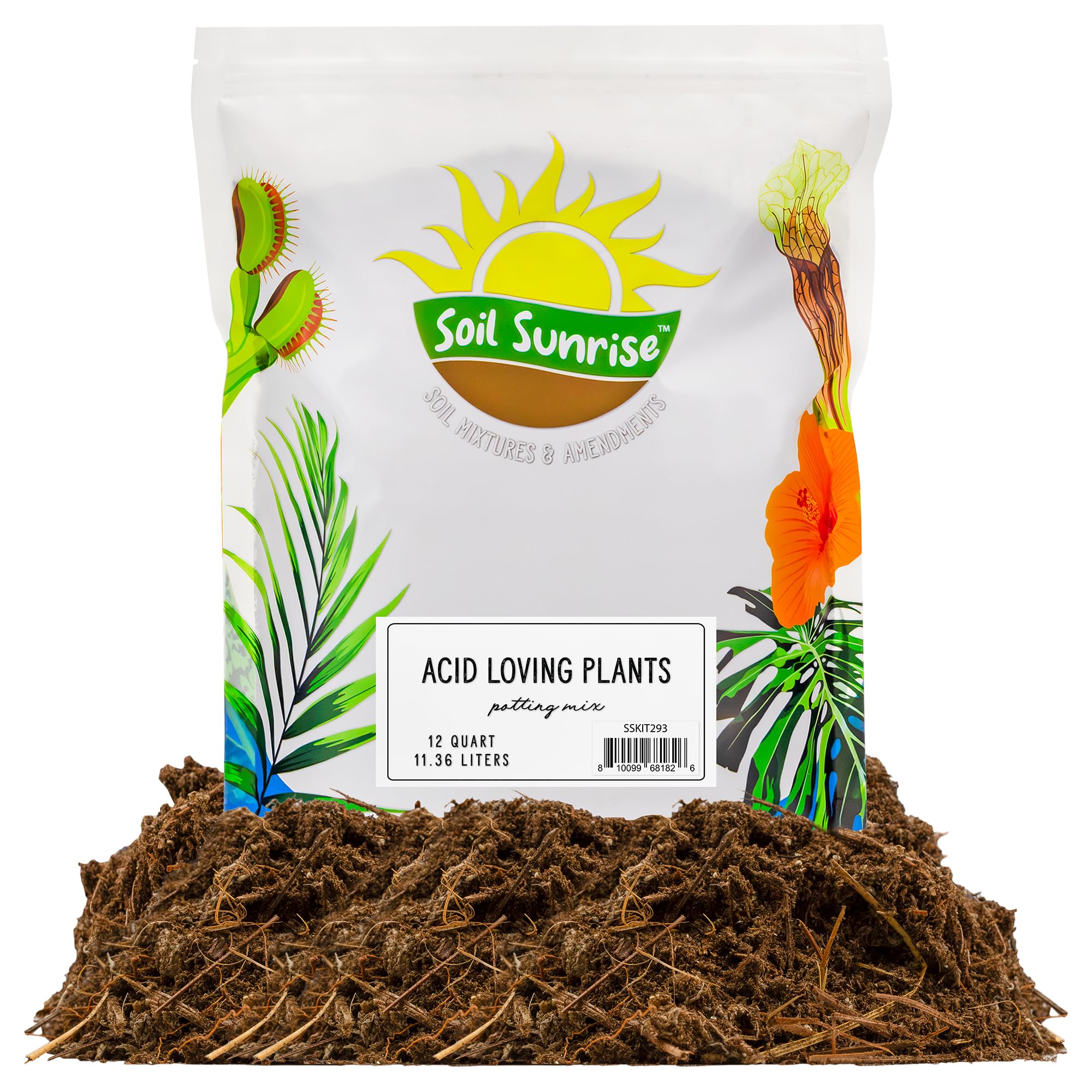
Soil Sunrise has formulated a dedicated container mix that goes beyond balancing pH — it actively acidifies through pine needle mulch and pine bark mulch, two ingredients that gradually lower the pH of the root zone as they decompose. The presence of sphagnum moss and vermiculite ensures that the mix retains moisture without becoming waterlogged, while the peat moss base provides the consistent dampness that potted azalea roots crave. This is clearly a specialist product aimed at growers who want a mix ready to use straight out of the bag for acid-loving plants.
Users report that gardenias, fuchsias, and young olive trees show measurable improvement in leaf color and shoot elongation within two to three weeks of repotting into this blend. The mix is notably lightweight, making it easy to work with during container changes, and the absence of synthetic additives aligns with organic-minded gardening approaches. The inclusion of perlite is moderate — enough for aeration without making the mix look like a bag of Styrofoam beads.
The biggest drawback is the bag size relative to the price point. At 12 quarts, the bag delivers enough mix for one or two standard 10-inch pots, which means frequent repurchases if you maintain a large collection of container azaleas. Some users also note that the mix can become hydrophobic if allowed to dry out completely — a trait common to peat-heavy blends — so consistent watering discipline is necessary.
What works
- Pine mulch ingredients actively help maintain low soil pH over time
- Lightweight, fluffy texture for strong root aeration
- Ready to use with no additional mixing required
- Excellent results reported with gardenias and azaleas
What doesn’t
- Smaller bag volume means limited coverage for larger planters
- Can become hydrophobic if the container dries out fully
3. FoxFarm Happy Frog Acid Loving Plants Fertilizer

FoxFarm’s Happy Frog series has a strong reputation among container gardeners, and this acid-loving variant lives up to that legacy. The powder formulation mixes cleanly into water at a ratio of 1/16 cup per gallon, providing a gentle feed that prevents the nitrogen surge that can burn sensitive azalea roots. The inclusion of beneficial soil microbes and mycorrhizal fungi gives potted plants a distinct advantage by colonizing the root zone and improving the uptake of water and micronutrients — exactly what a container plant with limited soil volume needs.
Growers report seeing visible results within ten days of application: new flush of green leaves on gardenias, flower buds on azaleas that had been dormant for months, and heavier fruit set on container blueberries. The slow-release mechanism ensures consistent feeding without requiring weekly reapplication, and the OMRI listing confirms it meets organic production standards. The powder mixes quickly without clumping, which is a minor but appreciated convenience during a busy weekend gardening session.
This product is strictly a fertilizer supplement, not a complete soil. You will need to pair it with a base mix like Coast of Maine or Soil Sunrise for the potting medium itself. The 4-pound bag goes further than it sounds — at the recommended dilution rate, it covers numerous watering sessions across a season. Some users note that the powder can cake slightly if the bag is not resealed tightly after use.
What works
- Mycorrhizal fungi and soil microbes improve nutrient absorption in pots
- Gentle, slow-release formula prevents burning on sensitive roots
- Powder mixes easily with no clumping issues at 1/16 cup per gallon
- OMRI listed for organic gardening compliance
What doesn’t
- Requires a compatible acidic potting soil as the base medium
- Powder can harden if bag seal is not kept airtight
4. Espoma Organic Holly-Tone 4-3-4 (2-Pack)
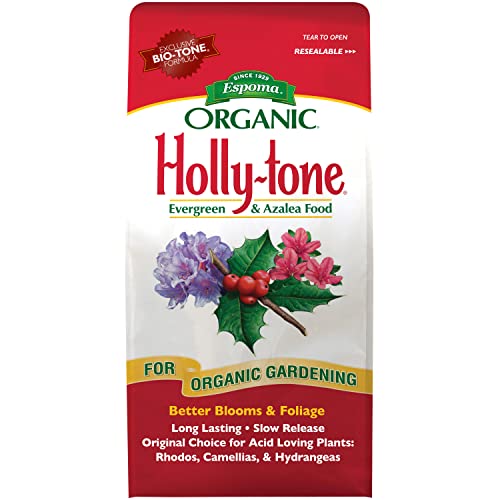
Holly-Tone has been the benchmark for acid-loving plant nutrition since 1929, and the 2-pack offering provides excellent long-term value for container gardeners who maintain multiple pots across a season. The 4-3-4 NPK ratio is deliberately low in nitrogen to encourage balanced growth without excessive leafy foliage at the expense of blooms. Adding 5% sulfur directly helps maintain a low soil pH, counteracting the natural pH drift toward alkalinity that occurs with regular tap water and fertilizer salt buildup in a container.
Users who have applied this to rhododendrons, azaleas, and arborvitae report that plants that had not flowered in two years produced abundant blooms within a single season of spring and fall applications. The granular format is simple to sprinkle around the drip line of the container — no mixing or measuring beyond a handful per pot — and watering it in triggers a slow-release feeding cycle that continues for several weeks. The 8-pound total (two 4-pound bags) is enough to carry a medium-sized container collection through an entire growing season.
The main caveat is that Holly-Tone is a fertilizer, not a soil amendment. While it will work well with any of the potting mixes in this guide, it should be applied around existing plants or during potting, not used as a substitute for a proper acid-medium mix. Some users prefer the granular format, but others note that it can attract ants if spilled on dry soil surfaces near the container rim.
What works
- Proven formulation with 5% sulfur to actively lower soil pH
- Two 4-pound bags deliver excellent seasonal coverage for multiple pots
- Granular format requires no mixing — just sprinkle and water
- Slow-release design prevents nutrient surges and root burn
What doesn’t
- Not a standalone soil — requires an acidic potting mix as the base
- Granules may attract ants if left on dry soil surface
5. Midwest Hearth Premium Potting Soil Mix (8 Dry Quarts)

The Midwest Hearth Premium Potting Soil is a solid general-purpose acidic mix that works well for azalea containers, especially smaller pots and repotting projects. It builds on the classic tri-ingredient formula of sphagnum peat moss, perlite, and vermiculite — each component is well-proportioned to deliver a lightweight, fluffy texture that allows oxygen to reach azalea roots while retaining enough moisture between waterings. The pH is controlled for a broad spectrum of plants, but the peat-dominant base skews the mix into the acidic range that azaleas prefer.
Growers report that this mix works well as a seed starter and for repotting jade plants, petunias, and herbs, which speaks to its versatility. The 8-quart bag is a good size for testing a mix before committing to larger volumes, or for handling two to three medium-sized azalea pots. The resealable bag is a thoughtful design touch that helps keep unused soil fresh and free from dust contamination.
The main limitation is that this mix is not specifically formulated for acid-loving plants the way Coast of Maine or Soil Sunrise are. The pH is “balanced” for a broad range, not skewed aggressively low like 4.5–5.5. For established potted azaleas that need a pH drop, you may need to supplement with an acidifying fertilizer like Holly-Tone or Dr. Earth to keep the root zone in the ideal range over time.
What works
- Excellent lightweight texture with balanced aeration and moisture retention
- Resealable bag design keeps unused soil fresh and dust-free
- Versatile enough for multiple plant types beyond just azaleas
- Made in the USA with consistent bag-to-bag quality
What doesn’t
- Not specifically formulated for a low pH range below 5.5
- May require acidifying fertilizer to maintain ideal azalea pH long-term
6. Dr. Earth Acid Lovers Azalea, Camellia, Rhododendron & Maple Fertilizer

Dr. Earth’s Acid Lovers fertilizer is one of the few feeds on the market that carries Non-GMO Project Verified certification alongside OMRI and CCOF organic approvals. The 0.3-0.4-3 NPK ratio is extremely low in nitrogen, making it safe to use even on stressed or recently repotted azaleas that might burn under a higher-analysis feed. The inclusion of humic acids, trace minerals, and carbohydrates supports the soil food web — an underrated advantage for container gardens where microbial populations are confined to a small volume.
Customers report that this fertilizer revived azalea bushes that were showing signs of decline and brought rhododendrons back into bloom after multiple non-flowering seasons. Gardenias also respond dramatically, with users noting more buds and darker green leaves within a month of application. The granular form is simple to use: scatter around the drip line of the container and water in well. No digging or mixing is required.
The main limitation is the small bag size — 4 pounds covers a limited number of container feedings, especially if you are applying it monthly during the growing season. The product is also primarily a fertilizer rather than a soil amendment, so it must be paired with an appropriate acidic potting soil base. Some users find the cost per feeding slightly higher than comparable synthetic feeds.
What works
- Non-GMO Project Verified and OMRI listed for organic production
- Humic acids and trace minerals support beneficial soil microbiology
- Very low nitrogen ratio prevents burning on sensitive plants
- Simple granular application with no mixing required
What doesn’t
- Small bag size limits coverage for large container collections
- Cost per feeding is higher relative to synthetic alternatives
7. Midwest Hearth African Violet Natural Potting Soil Mix (4 Dry Quarts)

While this mix is formulated for African violets, its composition — sphagnum peat moss, perlite, and vermiculite — closely mirrors the structure azaleas need in a container environment. The pH is controlled to fall in the acidic range, and the blend is light, fluffy, and free of large bark chunks that can create dry pockets in a pot. For a small container or a young azalea cutting, this mix provides a well-aerated root zone and consistent moisture at an entry-level price point.
Growers report that African violets, miniatures, and small container plants respond well to this mix, with healthy root development and no signs of compaction after several months of watering. The 4-quart bag is ideal for a single small azalea pot or for mixing with a larger base soil to adjust texture and acidity. Users also appreciate the resealable bag, which prevents the remainder from drying out between uses.
The obvious limitation is bag size — 4 quarts is a 2-gallon volume, which will only fill one 8-inch pot or two smaller 6-inch pots. For a substantial azalea container collection, you would need multiple bags. It is also not specifically formulated for azaleas, so the pH targets the 5.5–6.5 range rather than the lower 4.5–5.5 sweet spot. Pairing it with an acidifying fertilizer or adding extra peat moss may be necessary for optimal results.
What works
- Lightweight peat-perlite-vermiculite blend with excellent aeration
- Affordable price point for testing or small container projects
- Resealable bag keeps unused soil fresh for extended periods
- Consistent pH control suitable for acid-sensitive plants
What doesn’t
- Small 4-quart bag covers only one to two small pots
- pH range targets 5.5–6.5 rather than the ideal 4.5–5.5 for azaleas
Hardware & Specs Guide
pH Range
The most critical spec for any soil intended for potted azaleas is the pH range. Azaleas require a soil pH between 4.5 and 6.0 to absorb iron and manganese. A mix that does not state its pH range is a gamble — most general-purpose potting soils land between 6.0 and 7.0, which will cause leaf chlorosis and poor flowering. Products like Coast of Maine and Soil Sunrise explicitly target acid-loving plants and maintain a pH in the optimal zone. When buying, look for the phrase “low pH” or a stated range of 4.5–5.5 on the bag or product description.
Drainage & Aeration Ingredients
Container azaleas cannot tolerate soggy soil. The root system is shallow and fibrous, requiring oxygen at the root zone. Perlite is the most common aeration ingredient — it is volcanic glass that creates permanent pore spaces in the mix. Vermiculite is softer and holds moisture but also improves aeration. Pine bark fines provide both drainage and a natural acidity boost as they decompose. A good container mix for azaleas should list at least one of these as a primary ingredient rather than just sand or topsoil, which compact over time and suffocate roots.
FAQ
Can I use regular potting soil for azaleas in pots?
How often should I repot azaleas in containers?
Final Thoughts: The Verdict
For most gardeners, the soil for azaleas in pots winner is the Coast of Maine Organic Acid Loving Planting Soil because its 20-quart volume, low-pH compost blend, and organic certification deliver the best balance of value, performance, and consistency for container azaleas. If you want a ready-to-use mix with pine-enhanced active acidification, grab the Soil Sunrise Acid Loving Potting Mix. And for a reliable feeding program that maintains pH and promotes blooms throughout the season, nothing beats the Espoma Organic Holly-Tone 2-Pack.