
Every seed-starting season brings the same dilemma: you need dozens of tiny pots or cell trays, and by June you’re staring at a mountain of plastic waste that won’t break down in your lifetime. Soil blockers solve that by compressing your growing mix into dense, self-supporting cubes that hold their shape, let roots air-prune naturally, and drop directly into the garden bed without disturbing a single root hair.
I’m Rikta — the co-founder and writer behind Lawn Gear Lab. For this guide I’ve compared steel thickness, spring tension mechanics, seed-pin configurations, and dimensional tolerances across seven soil blockers, cross-referencing hundreds of verified owner experiences to separate tools that produce consistent blocks season after season from ones that jam, corrode, or crumble under pressure.
Whether you’re starting tomatoes under a grow light or scaling up a cut-flower patch, choosing the right soil blocker determines how many starts you fit on a single tray and how smoothly those seedlings transfer to the ground.
How To Choose The Best Soil Blockers
Not all soil blockers are interchangeable. The tool that produces compact 2″ cubes for a home tomato patch is completely wrong for a greenhouse grower starting two hundred lettuce plugs. The three specs that define every blocker are block size per press, metal coating quality, and the ejection mechanism — get these right and you eliminate most of the common frustrations around jammed blocks and rusty plungers.
Block size and cell count per press
A 2″ quad blocker gives you four cubes per press — ideal for tomatoes, peppers, squash, and any crop that needs decent root volume before transplanting. For fine seeds like basil, lettuce, and celery, a micro blocker producing twenty 3/4″ blocks per press packs far more starts into the same tray footprint under grow lights. The trade-off is simple: larger blocks mean fewer per press but longer time before you need to up-pot.
Steel coating and handle construction
The constant moisture exposure of wet soil mix is brutal on bare steel. Premium blockers use black EP-coated steel — the same industrial coating used on heavy tillage tools — which resists rust, soil chemicals, and abrasion for decades. Stainless steel sounds superior but the thinner gauges used in budget tools can still deform under repeated compaction pressure. Feel the handle joint: a solid spring-loaded plunger with a welded or cast base outlasts any press-fit plastic rivet design.
Seed pin configuration
Seed pins create the dimple where the seed lands. Flat-topped square pins produce a shallow depression for smaller seeds, while cylindrical or tapered pins create deeper holes that hold larger seeds like beans or squash. Most mid-range blockers include three sets of interchangeable pins. Premium systems like Ladbrooke ship pre-configured for their intended block size — you don’t swap pins, you simply buy the right blocker for your seed type.
Quick Comparison
On smaller screens, swipe sideways to see the full table.
| Model | Category | Best For | Key Spec | Amazon |
|---|---|---|---|---|
| Ladbrooke Mini 5 | Premium Manual | Versatile 1.5″ blocks for mixed gardens | 5 blocks per press, EP-coated steel | Amazon |
| Ladbrooke Micro 20 | Premium Fine-Seed | High-volume fine-seed starts | 20 x 3/4″ blocks per press | Amazon |
| FANFX 8 Block | Robust Quad | Eight 2″ blocks for medium gardens | 8 cells, robust steel build | Amazon |
| BlumWay 8 Cell | High-Volume Quad | Batch-starting multiple crop types | 8 cells, 3 seed pin sets | Amazon |
| DKALIO Upgraded 8 | Thick-Handle Quad | Comfortable extended blocking sessions | 8 cells, thick handle grip | Amazon |
| FANFX Stainless 4 | Entry Stainless | First-time soil blockers | 4 cells, stainless steel | Amazon |
| SOLIGT 4 Cell | Budget Choice | Small-garden seed starting | 4 cells, heavy-gauge steel | Amazon |
In‑Depth Reviews
1. Ladbrooke Mini 5 Soil Blocker
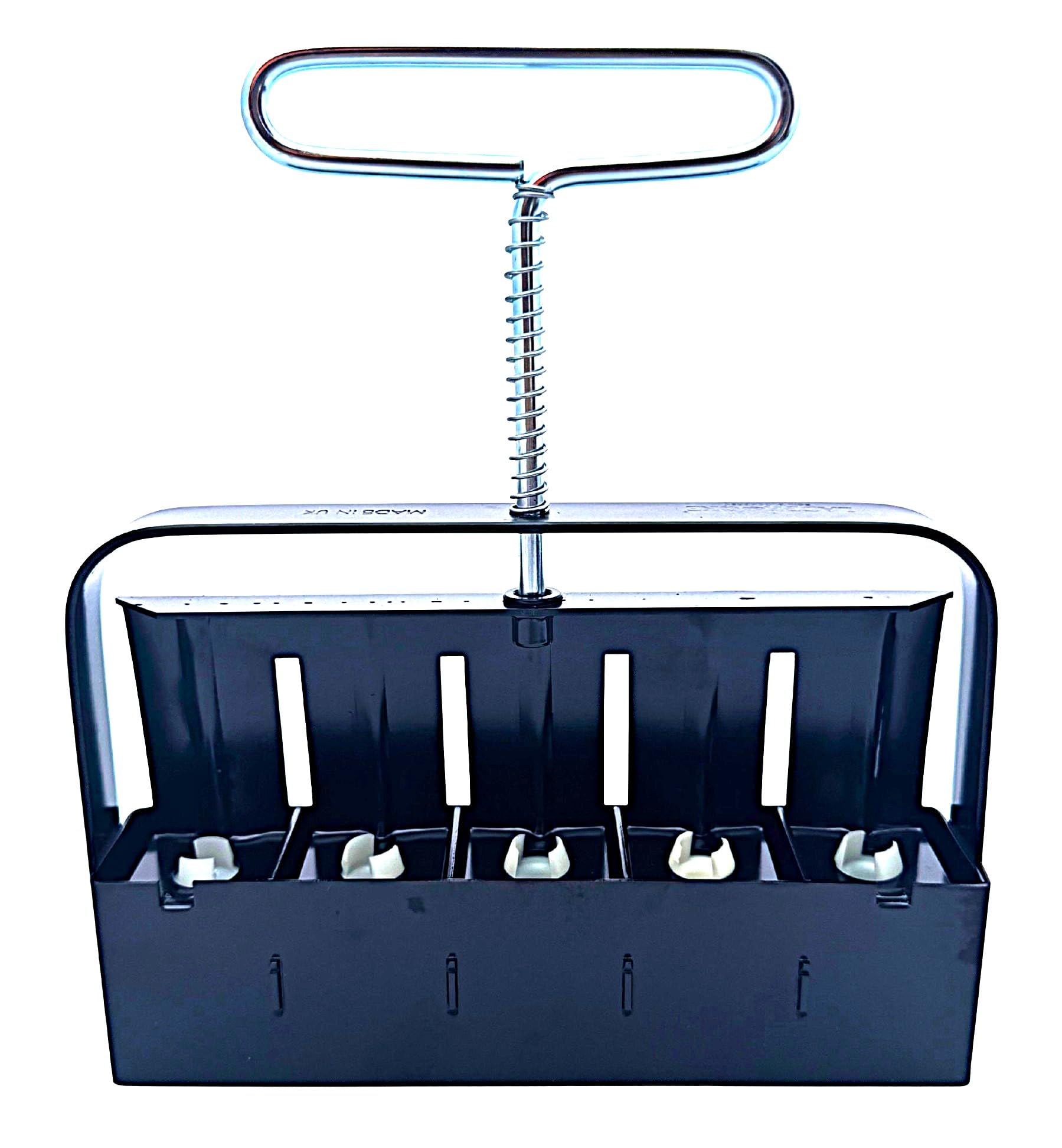
The Ladbrooke Mini 5 is the gold standard for the home gardener who wants one tool that covers spring-starting tomatoes, peppers, and squash all the way through to mid-season succession plantings. Each press delivers five 1.5″ cubes — a density that fits more starts per tray than 2″ quad blockers while still giving roots enough room to develop a robust plug before garden transplant. The EP-coated black steel resists rust far better than bare stainless when left in contact with damp mix for hours at a time.
The spring-loaded plunger mechanism is noticeably smoother than any other blocker I examined. Owners repeatedly mention the ejection force is consistent and predictable — the blocks release cleanly without sticking, which is the single biggest frustration with cheaper tools. Six 3/8″ seed pins are included, with one spare. The dimple depth is well-calibrated for medium seeds like pepper and basil, though larger bean seeds may prefer a deeper hole from a cylindrical pin setup.
Craftsmanship is what you pay for here: the handle is stamped with the Ladbrooke logo and “MADE IN UK,” the steel feels dense in the hand, and the weld joints on the plunger rod show no grinding marks or flux residue. A few owners noted the seed pins can pop out during aggressive pressing, but this is typically user error from not fully seating the pins before the first press. For a lifetime tool that handles 1,000+ blocks per season without degrading, this is the clear investment choice.
What works
- Smooth spring ejection with zero block sticking
- EP-coated steel resists corrosion from damp mix
- Five-block density optimizes tray space under lights
What doesn’t
- Not part of the Ladbrooke nesting system — no stackable block progression
- Seed pins require manual seating before each use
2. Ladbrooke Micro 20 Soil Blocker
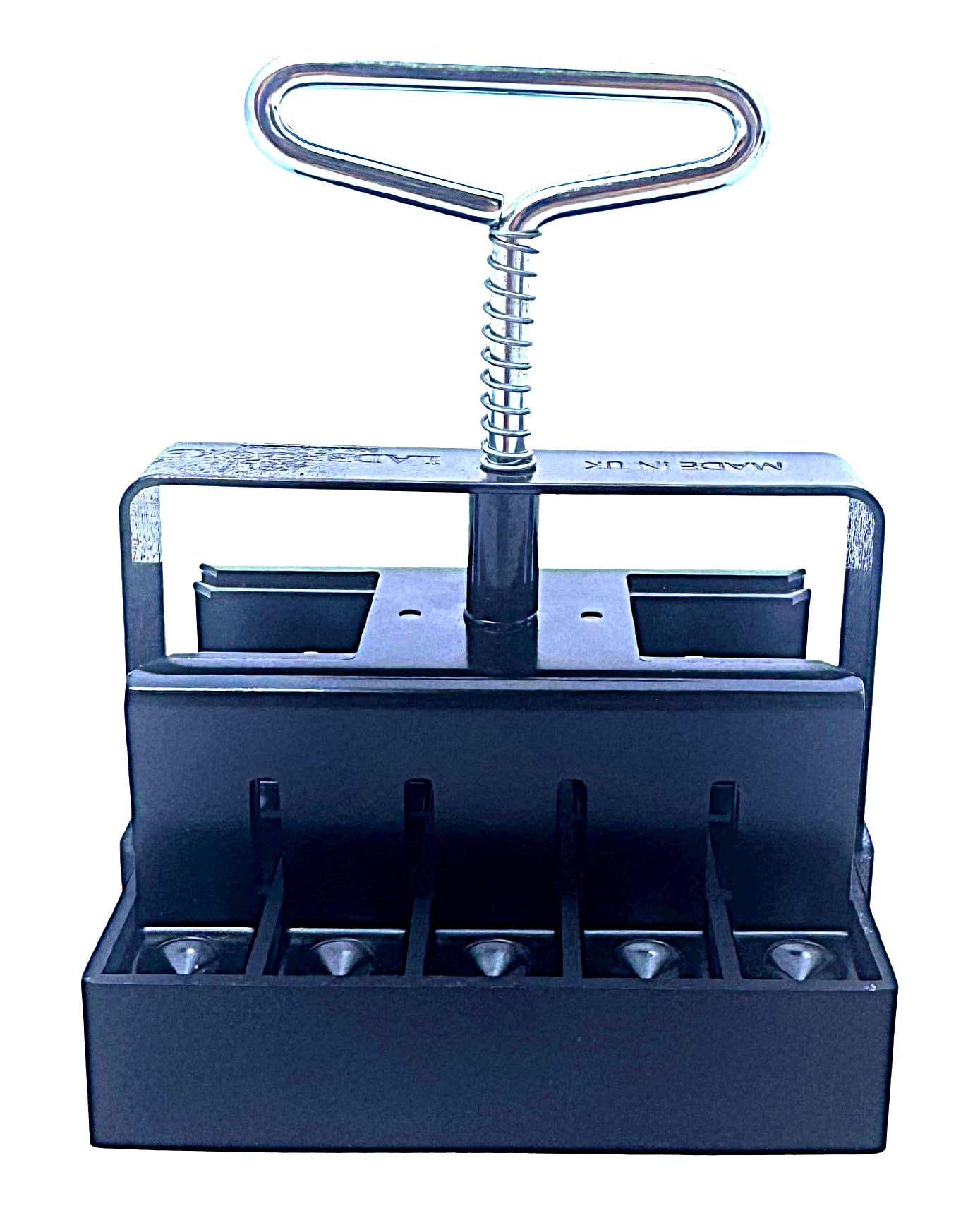
If you start a lot of fine-seeded crops — think basil, lettuce, parsley, celery, or thousands of flower plugs for a cut-flower patch — the Micro 20 is the only blocker that makes sense. Twenty 3/4″ blocks per press means you can populate a full 1020 tray in under ten presses rather than the thirty-plus presses needed with a quad blocker. The tiny block size conserves soil mix dramatically: a single batch of mix goes three to four times further than with 2″ blocks.
The smartest design feature is the nesting capability. Micro 20 blocks fit directly into the Ladbrooke Mini 4 blocker’s cavities, so you can up-pot individual blocks into 1.5″ cubes without any root disturbance — you simply press the small block into the larger cavity, fill around it, and the roots air-prune into the new medium. This eliminates the need for transplanting steps entirely. The EP-coated steel construction mirrors the Mini 5’s quality, and the tool is surprisingly compact given its 20-cell output.
The obvious limitation is block size. 3/4″ cubes dry out quickly if left exposed, and they are not suitable for crops that need more than two weeks before transplanting. The seed cavity is also tiny — you will struggle to use this for seeds larger than a pea. A few owners reported that the plastic base plate can separate from the steel plunger rod after heavy use, though Ladbrooke’s warranty covers this. For greenhouse-scale fine-seed production, nothing else comes close in efficiency.
What works
- Twenty blocks per press is unmatched for fine-seed volume
- Nests directly into Mini 4 blocks for zero-disturbance up-potting
- EP coating holds up to constant moisture exposure
What doesn’t
- 3/4″ block size limits crop types and time before transplant
- Plastic base plate is a potential weak point under heavy use
3. FANFX 8 Cell Soil Blocker

The FANFX 8 Cell blocker bridges the gap between single-quad hand tools and full commercial systems. Each press yields eight 2″ blocks — double the output of a standard quad blocker — which cuts blocking time in half for a medium-sized garden. The steel construction is noticeably thicker than the entry-level FANFX 4 model, and the added weight (1.59 kg) tells you this tool is built to withstand repeated compaction without flexing or deforming at the cell walls.
The set ships with three seed pin types: square pins for medium seeds, short cylinders for smaller seeds, and longer cylinders for deeper dimples. The variety is genuinely useful if you grow a mix of crop types and don’t want to buy separate blockers. Owners confirm that with the correct moisture ratio (roughly 2 gallons of water per batch of mix), the blocks hold their shape through transfer to the tray and remain stable for the two-to-three-week germination window.
The main friction point is the handle ergonomics. The grip is a plain steel rod with no padding, and after thirty-plus presses your palm will feel it. Wearing gloves is advisable not just for the sharp edges but for comfort. A few users also reported algae forming on block tops due to the constant moisture needed for structural stability — this is a function of the 2″ block size retaining water, not a tool defect. If you batch-start eighty-plus blocks per season, the FANFX 8 delivers the durability at a fair mid-range price point.
What works
- Eight blocks per press doubles quad output
- Thick steel body resists deformation under heavy use
- Three seed pin types cover a wide seed size range
What doesn’t
- Bare steel handle is uncomfortable for long blocking sessions
- Requires precise moisture ratio to prevent block collapse
4. BlumWay 8 Cell Soil Blocker
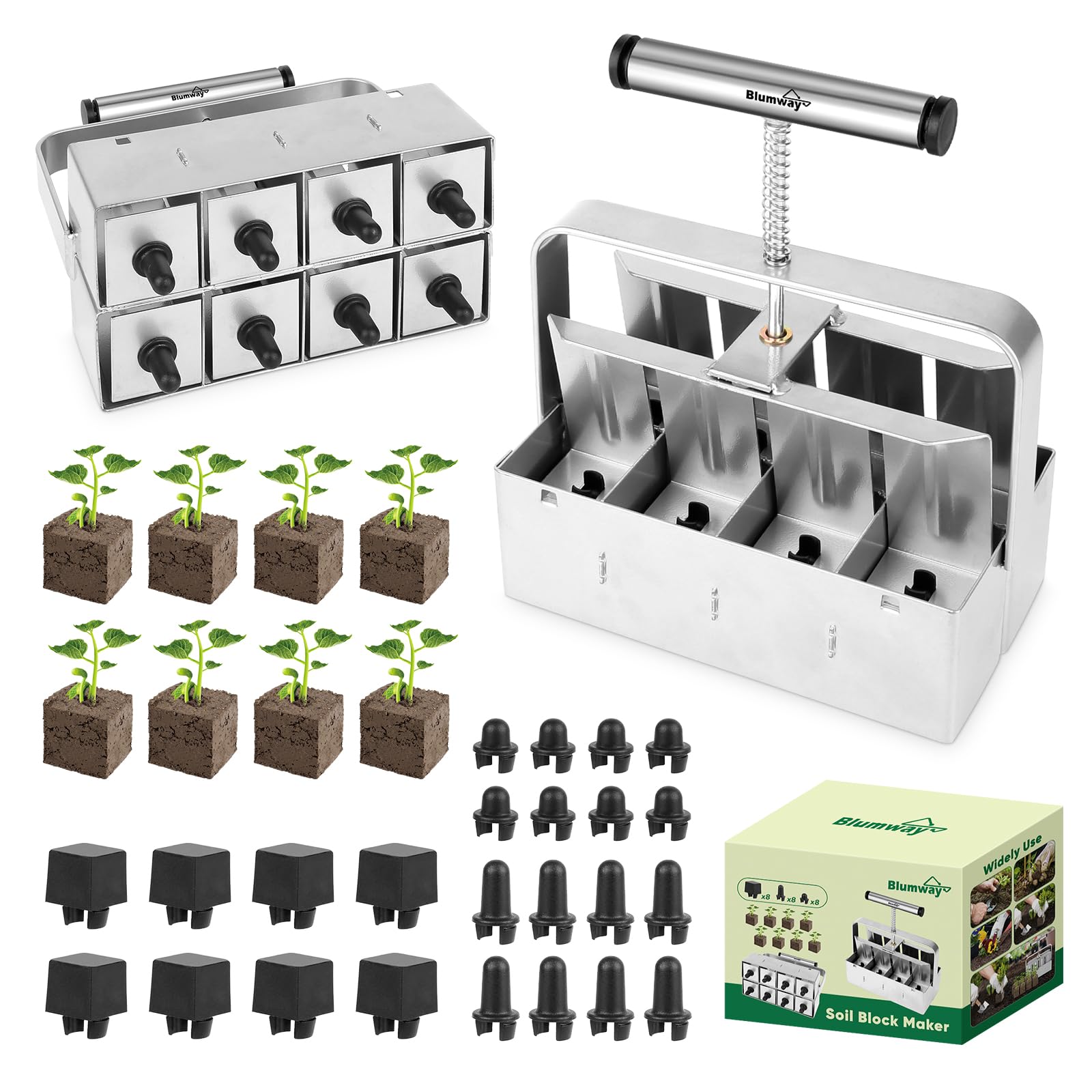
The BlumWay 8 Cell sits at the sweet spot of the price-to-performance curve for gardeners who want eight-block output without jumping to premium pricing. It’s built from stainless steel with a largely similar mold geometry to the FANFX 8, but the steel feels slightly thinner in the cell walls — something you notice if you over-pack the mix aggressively. That said, for the majority of home gardeners who block 50–100 cubes per season, the material quality is more than adequate.
The three seed pin sets (square, short cylinder, long cylinder) match the FANFX offering, and the pin dimension tolerances are tight enough that the dimples are consistent block to block. Owners specifically praise the 8-inch height of the tool, which makes it easy to store in a drawer or bucket alongside your seed-starting supplies. The assembly is straightforward — you simply press the seed pins into the backside of the blocker until they seat — and the cleaning process is quick with a hose rinse.
The primary complaint is the learning curve around moisture consistency. Multiple owners note that blocks crumble when the mix is too dry and turn into muddy pucks when it’s too wet — but this is true of every soil blocker, not a BlumWay-specific flaw. The handle grip is slightly more ergonomic than the FANFX 8, with a rounded profile that distributes pressure better. For a cost-effective entry into eight-block production that won’t leave you with buyer’s remorse, this is the strongest mid-range option.
What works
- Eight-block output at a mid-range price point
- Compact 8-inch height stores easily
- Three seed pin types in one set
What doesn’t
- Cell wall steel thinner than premium competitors
- Moisture ratio learning curve for new users
5. DKALIO Upgraded 8 Cell Soil Blocker
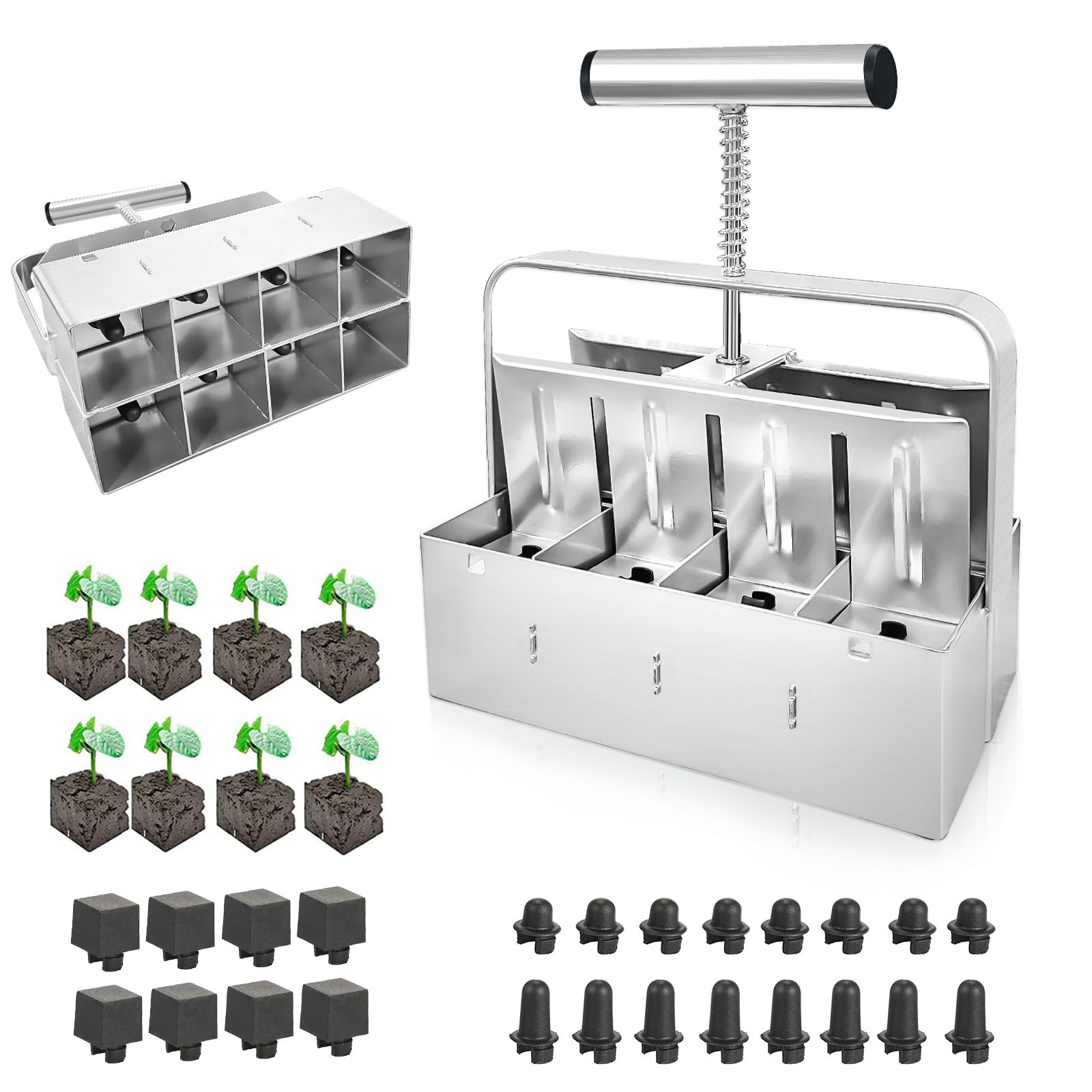
The DKALIO Upgraded 8 Cell blocker targets the specific pain point that FANFX and BlumWay both miss: handle comfort. The handle cross-section is noticeably thicker, with a larger force-bearing surface that reduces palm fatigue during extended blocking sessions. If you are blocking 200+ cubes in a single afternoon, this difference becomes the deciding factor between a productive session and a sore hand by lunch.
The steel body is heavy enough to feel substantial — 1.59 kg matches the FANFX 8 — but the cell geometry is slightly different, producing blocks with a marginally wider base that some owners say stack more stably in the tray. The ejection mechanism works reliably when the blocker is rinsed clean between batches; soil residue that dries inside the cells is the main cause of stuck blocks across all brands, and DKALIO’s smooth internal surfaces make cleaning easier than the FANFX’s slightly textured walls.
The trade-off is the included seed pin set. You get eight pins of each of the three sizes (24 total), which is generous, but several owners report that the pins fit loosely in their sockets and can fall out during the press if not fully seated. This is a minor nuisance rather than a dealbreaker — you learn to check seating before every press. One owner with hand joint pain noted the tool is manageable but challenging for long sessions, though the thicker handle helps versus ultra-skinny competitors. For comfort-focused block makers, this is the right pick.
What works
- Thicker handle reduces palm fatigue significantly
- Smooth internal cell walls resist dried-on residue
- Generous 24-piece seed pin set
What doesn’t
- Seed pins can dislodge during pressing if not fully seated
- Still challenging for users with significant hand joint pain
6. FANFX Stainless 4 Soil Blocker
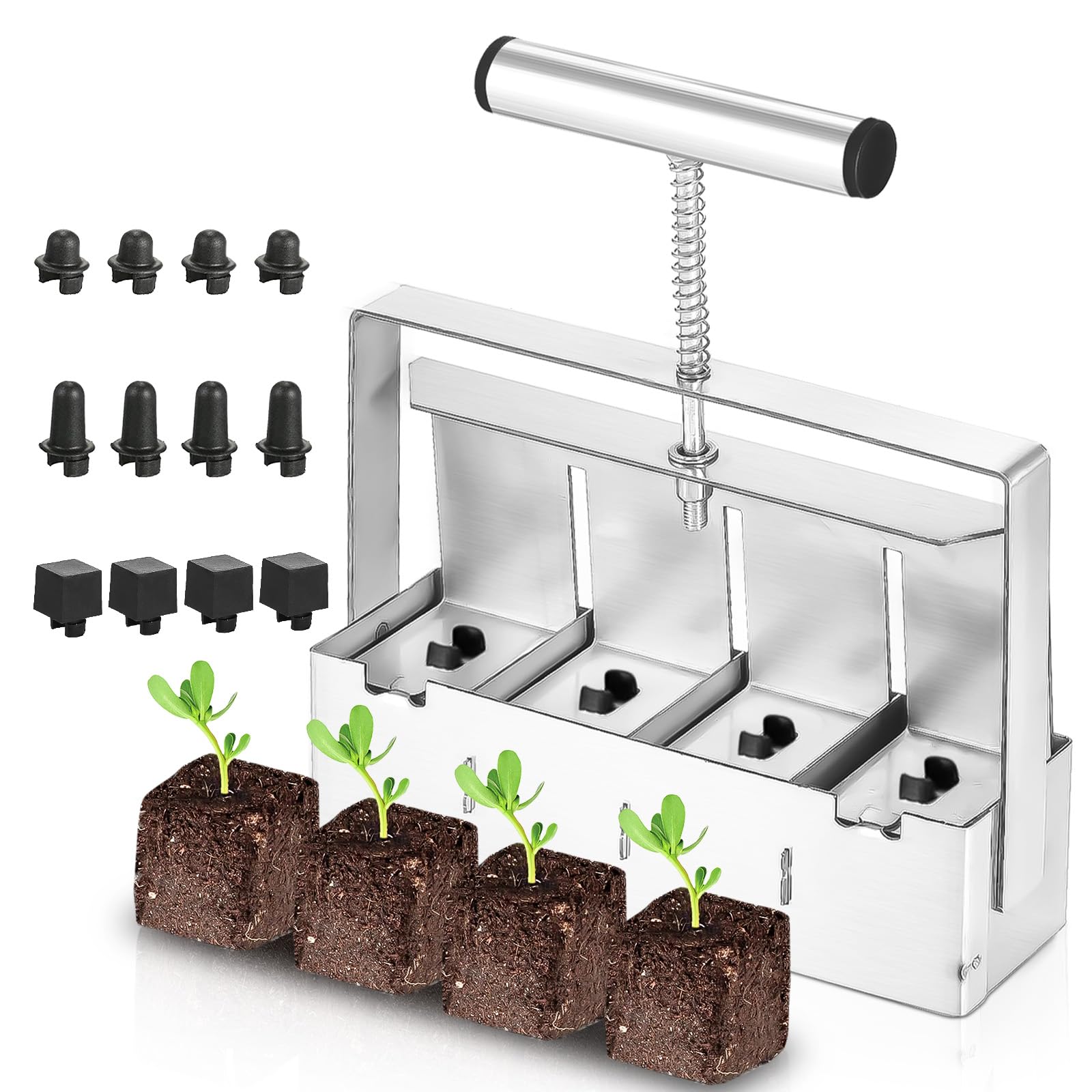
The FANFX Stainless 4 is the simplest on-ramp to soil blocking. It produces four 2″ blocks per press with a stainless steel body that won’t rust when you inevitably leave it sitting in a damp bucket overnight. The construction is solid for the price — the steel walls are thick enough to hold shape under repeated pressing, and the handle is comfortable enough for the modest volume this tool is designed for (50–80 blocks per season).
The seed pin set includes four pins of each of the three sizes, giving you the same variety as the more expensive 8-cell FANFX model. The block quality is identical to its larger sibling — as long as your mix is at the right moisture level (wet enough to clump but not muddy), the blocks hold together for transplanting. Multiple owners confirm the blocks produced better root growth than Jiffy pods and cell trays, with no circling roots and faster establishment after transplant.
The limiting factor is output. Four blocks per press means you’ll do a lot of reps to fill a standard 18-cell tray — roughly five presses per tray versus two-and-a-half for an eight-block tool. If you are starting twenty tomato plants and a few herbs, four blocks per press is perfectly adequate. If you plan to scale beyond fifty starts, you will quickly outgrow this tool. The FANFX Stainless 4 is best understood as a trial tool: it confirms whether you like soil blocking without a major cash commitment.
What works
- Stainless construction eliminates rust worries
- Three seed pin sizes included for versatility
- Low commitment price for first-time blockers
What doesn’t
- Four blocks per press is slow for larger start volumes
- Algae can form on block tops due to constant moisture
7. SOLIGT 4 Cell Soil Blocker

The SOLIGT 4 Cell blocker is the most affordable way to try soil blocking without worrying about whether you’ll use it again next season. The heavy-gauge steel body is surprisingly durable for the price — owners report no rust after two years of use and the tool has held up to being lent out repeatedly. The round handle design is genuinely comfortable, with none of the sharp edges that plague some budget tools.
Block quality is consistent at the right moisture ratio. Owners who use a 50/50 blend of potting soil and coconut coir report that blocks hold shape perfectly on the first attempt. The 2″ cube size works well for tomatoes, peppers, and most common garden vegetables, and the four-block count is fine for a small kitchen garden or a hobbyist starting a couple dozen plants. The lack of interchangeable seed pins is the main compromise — you get a single fixed dimple depth that works best for medium-sized seeds.
The build quality is where you notice the price. The steel is thinner than the FANFX or Ladbrooke options, and the handle joint is a simple press-fit rather than a welded or cast connection. Over years of heavy use, that joint is the most likely failure point. But for — the price of two plastic seed-starting kits that will fill a landfill — the SOLIGT introduces you to blocking without risk. If you end up loving the method, you can upgrade to a premium tool next season.
What works
- Comfortable round handle with no sharp edges
- Heavy-gauge steel resists rust for multiple seasons
- Lowest price point for testing the blocking method
What doesn’t
- No interchangeable seed pins — fixed dimple depth only
- Press-fit handle joint less durable than welded designs
Hardware & Specs Guide
Steel coating and corrosion resistance
Bare stainless steel (304 grade, as used by FANFX and SOLIGT) resists rust under normal use but can pit if exposed to high-salinity or acidic soil blends for extended periods. EP-coated black steel (Ladbrooke) is an industrial electro-deposited paint layer that bonds to the metal substrate at the molecular level, creating a moisture barrier that survives decades of wet-mix contact. The trade-off: EP coating can chip if the tool is dropped on concrete, while stainless is more impact-tolerant.
Block volume and root air-pruning
A 2″ cube holds roughly 8 cubic inches of mix — enough for a tomato or pepper seedling to grow 3–4 weeks before needing a larger pot. A 1.5″ cube holds about 3.4 cubic inches and covers the first two weeks. The 3/4″ Micro 20 blocks hold less than 0.4 cubic inches each, supporting fine-seed germination for 7–10 days. The air gap between adjacent blocks in the tray stops roots from circling — they hit the open air, die back, and branch into the block interior, creating a fibrous root ball that transplants without shock.
FAQ
What soil mix consistency works best for soil blocking?
Can I use regular potting soil for soil blocks?
How do I clean a soil blocker to prevent rust and stuck blocks?
Final Thoughts: The Verdict
For most gardeners, the soil blocker winner is the Ladbrooke Mini 5 because it delivers the ideal balance of block size, build quality, and ease of use — five blocks per press with a smooth spring mechanism and corrosion-proof EP coating that will outlast your seed-starting hobby. If you want to mass-produce fine-seed starts in minimal space, grab the Ladbrooke Micro 20. And for a budget-friendly introduction to the method, nothing beats the SOLIGT 4 Cell.