
Specs are compiled from manufacturer listings and verified buyer reviews and can change over time — please confirm the key details on the product page before buying.
A lawn that feels spongy underfoot or dries out too fast is telling you one thing — the soil is compacted. Tiny grass roots are being squeezed, so water, air, and nutrients have nowhere to go. The fix is aeration — poking holes into the ground to let the roots breathe. For small to medium yards, a manual spike or core aerator is faster, cheaper, and way less hassle than renting a heavy machine or paying a service. The challenge is picking the right one: spikes that bend, handles that slip, or designs that clog can turn a quick chore into a frustrating workout.
I’m Rikta — the founder and writer behind Lawn Gear Lab. This guide is built by comparing the manufacturers’ published specifications and the patterns across verified customer reviews, so you get each pick’s real strengths and trade-offs instead of marketing spin.
The nine picks reviewed here span every style and budget, from rugged spike tools to core aerators that pull real soil plugs, so you can confidently choose the best small lawn aerator for your yard without the guesswork.
Our Picks at a Glance

How To Choose The Best Small Lawn Aerator
The main choice you need to make is between a spike aerator and a core (plug) aerator. A spike aerator pushes solid metal rods into the ground, creating holes by compressing the soil sideways — which can sometimes increase compaction around the hole. A core aerator uses hollow tines to extract a small plug of soil, physically removing material from the ground, which relieves compaction more thoroughly. For occasional maintenance on soft, loamy soil, a spike tool is simpler and faster. For hard, clay-heavy soil or serious compaction problems, a core aerator is the better choice.
Spike Length and Thickness
Short spikes around 2.3 inches work for light aeration, but a spike length of 3 inches or more reaches deeper roots. Thicker spikes, around 2/5 inch in diameter, create bigger holes for better water and air movement. Thinner spikes (1/5 inch) are easier to push in but don’t open up the soil as much.
Build Quality and Materials
Heat-treated steel spikes resist bending when you hit a hidden rock or hard clay patch. Stainless steel and powder-coated finishes resist rust better than plain painted metal. Solid, welded construction at critical joints gives more durability than simple bolted assemblies that can wobble over time.
Handle Height and Foot Plate Size
A handle around 36 to 38 inches tall lets you stand upright while working, saving your back from strain. A wide foot plate (around 6 inches wide) gives you a stable platform for your full weight, and a padded or rubber grip at the top prevents blisters during longer sessions.
Quick Comparison
| Model | Best For | Type | Spike Length | Total Spikes/Tines | Amazon |
|---|---|---|---|---|---|
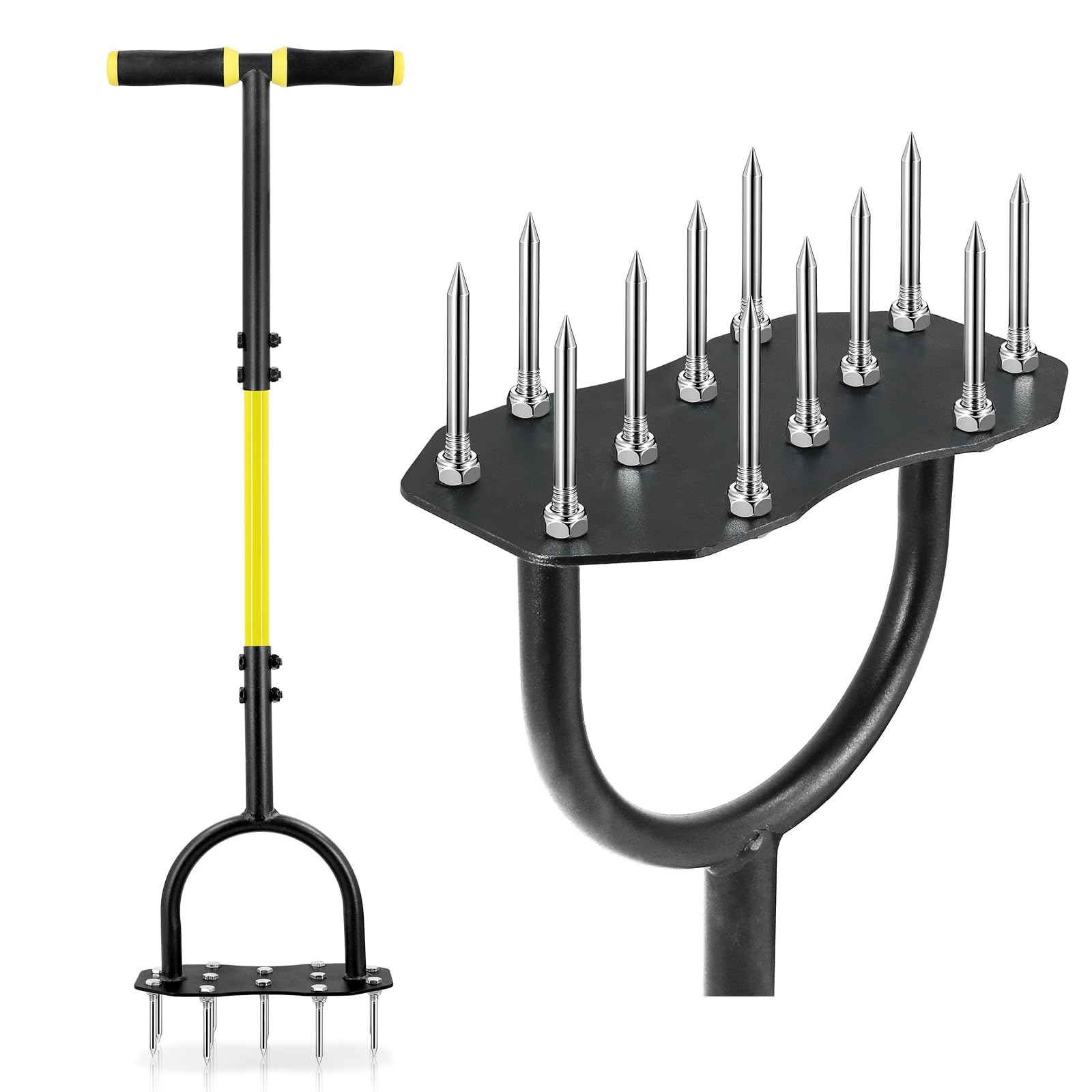
| Colwelt 38″★ Best Overall | Heavy compaction | Spike | 3.5 in | 4 | Amazon |
| Jardineer 36″Best Value | Small yard maintenance | Spike | 2.75 in | 12 | Amazon |
| Onadak 15-SpikeSpring Assist | Fast coverage | Spike (spring) | 3 in | 15 | Amazon |
| Seasky Dual-Layer | Spring assistance | Spike (spring) | 3 in | 15 | Amazon |
| Zalawn Core Aerator | Real plug extraction | Core (3 tine) | 4 in | 3 | Amazon |
| Bigwish Stainless 4-Tine | Rust resistance | Core (4 tine) | — | 4 | Amazon |
| LawnVigor Core Aerator | Small yard core aeration | Core (3 tine) | 3 in | 3 | Amazon |
| Dolibest 4-Corer | Heavy clay soil | Core (4 tine) | 3.5 in | 4 | Amazon |
| Walensee Roller | easy rolling aeration | Rolling spike | — | 30 | Amazon |
In‑Depth Reviews
1. Colwelt 38″ Heavy Duty Grass Spike Aerator
Our pick — 4.5★ from 200+ verified ratings; the strongest balance of quality and price.
Longer, thicker spikes that punch deep into compacted clay.
Most spike aerators top out at 2.3 inches in length with skinny rods, but the Colwelt uses four heat-treated steel spikes that are a full 3.5 inches long and 2/5 inch in diameter. That extra length and thickness means you create noticeably bigger holes with each plunge — more room for water and air to reach the roots. The spikes also penetrate heavily compacted soil that would bend or stop a thinner set of tines.
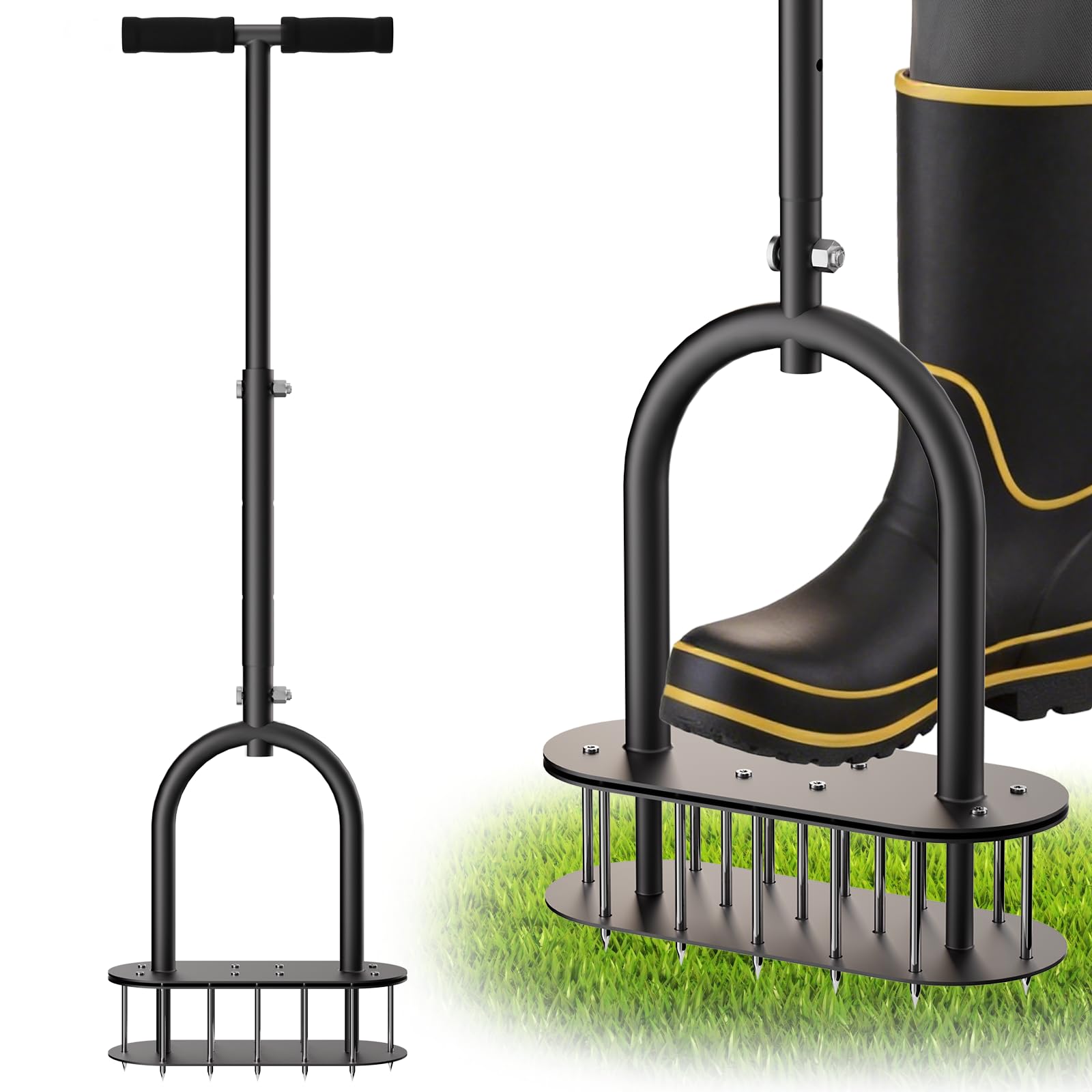
The 38-inch overall height keeps you standing straight so your lower back isn’t doing the bending. The foot plate measures 6 inches wide and 5.5 inches high — big enough for a work boot to push down securely. It is the lightest pick among the spike tools at 4.31 pounds, which makes carrying it around the yard and lifting it for the next plunge less tiring. Buyers report that one person completed a 1000-square-foot lawn in about 90 minutes, which is surprisingly fast for a manual tool.
The thing owners rave about most is how well it functions — functionality leads the praise counts by a wide margin — and the sturdy steel construction that shrugs off rust. Pre-watering the lawn, as the maker suggests, makes a big difference in how easily the spikes slide in. The only real watch-out is that four spikes cover less ground per step than a 12- or 15-spike tool, so you’ll take more steps to cover the same area.
What wins people over
- Unusually long 3.5-inch spikes for deep aeration
- Thick 2/5-inch diameter creates large holes
- Light 4.31-pound build reduces fatigue
A fair trade-off
- Four spikes per step means more plunges per square foot
- Best results require pre-watering dry soil
Reach for this if: you have compacted clay or hard soil and want maximum penetration depth per hole.
Think twice if: you want to cover a larger area quickly and prefer a higher spike count per step.
2. Jardineer 36″ Updated Spike Aerator
A well-built 12-spike design that is light enough for anyone to handle.
Where the Colwelt uses four deep-penetrating spikes, the Jardineer spreads the work across 12 heat-treated steel spikes at 2.75 inches each. More spikes per step means faster coverage with less back-and-forth, which is exactly what you want for routine maintenance on a small yard. The 36-inch height and rubber grip keep the motion comfortable and reduce hand fatigue.
The tool comes pre-assembled for the most part, with only a few bolts to tighten. That makes it one of the easier setups — you can be aerating within a few minutes of opening the box. At 5.02 pounds it is a touch heavier than the Colwelt, but the weight helps the spikes sink in on the first step. The thick steel foot plate handles full body weight without flexing.
Functionality and ease of use are the two most-discussed strong points among owners. The honest catch, mentioned in reviews, is that the spikes are durable against soil but can bend if they hit rocks, plumbing, or other buried obstacles — though the tool comes with replacement spikes. Some owners also note that the handles get dirty easily and dry slowly after rinsing.
What works
- 12 spikes per step gives good coverage per plunge
- Pre-assembled design for fast setup
- Comfortable rubber T-handle reduces fatigue
What to know
- Spikes can bend if they strike rocks or plumbing
- Handles collect dirt and dry slowly after cleaning
Best for: regular seasonal aeration on small to medium lawns where you want quick, even coverage.
Not ideal if: your soil is full of hidden rocks or construction debris.
3. Onadak 15-Spike Spring Assist Aerator
Fifteen thin spikes working together with a spring to save your legs.
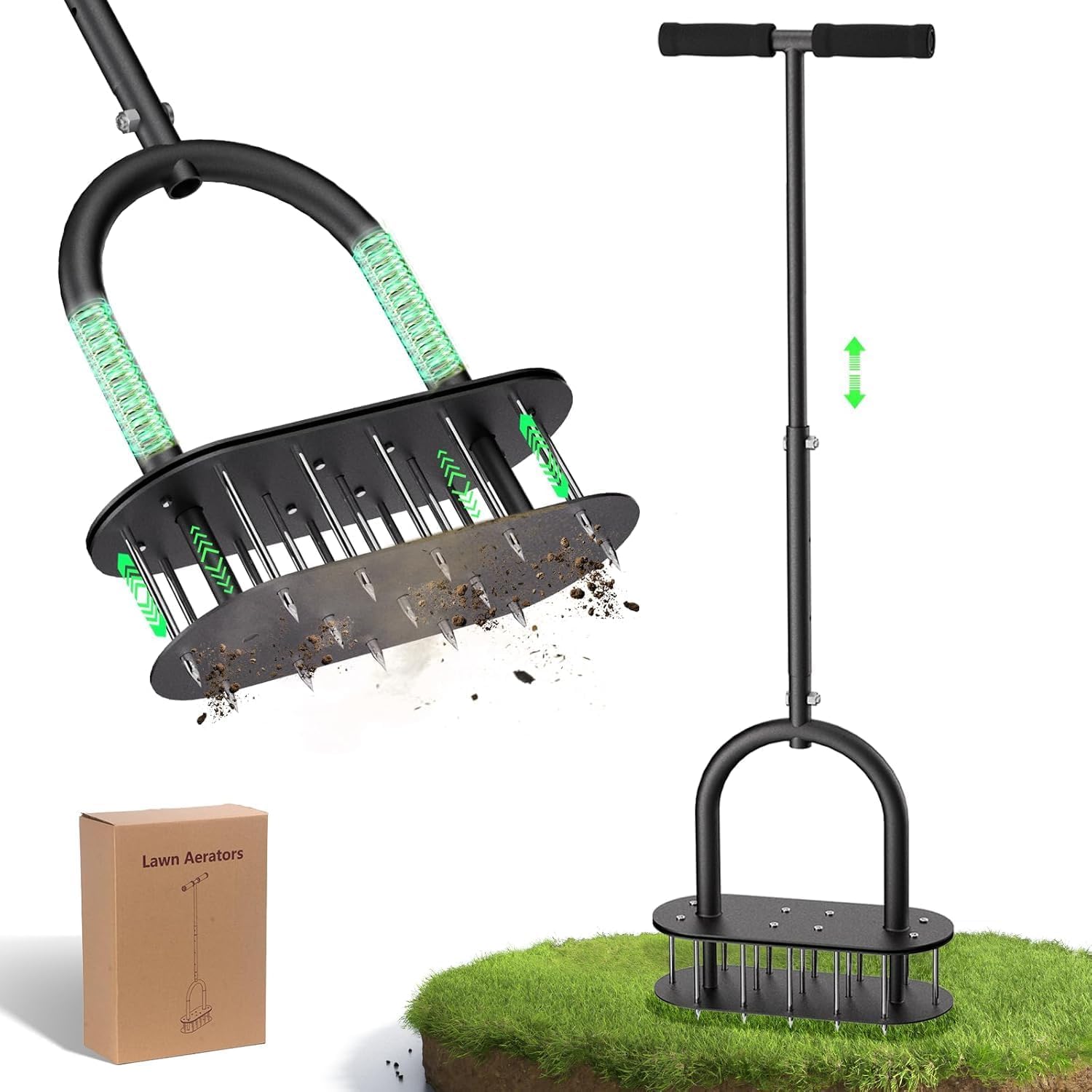
The Onadak stands out immediately for its 15 sharp metal spikes (3 inches long) and the built-in spring assist. When you step on the foot plate, the spring helps push the spikes downward — a real help on hard soil that would otherwise require bouncing your full weight to get started. The spikes are thinner than the Colwelt’s (about 1/5 inch vs 2/5 inch), so they slip in with less resistance but create smaller holes.
At 5 pounds and a 37.8-inch handle height, it fits in the same physical class as the Jardineer but covers 25% more ground with each step thanks to the extra three spikes. The foot plate is 10.6 inches wide and 0.8 inches thick — a very stable platform that feels secure under a boot. The padded T-handle is comfortable for extended sessions.
The baked enamel finish gives decent rust resistance, though the spring mechanism is an added moving part that could require attention over time. Assembly is straightforward and takes just a few minutes. A handful of owners would prefer thicker, longer spikes, but for routine maintenance on normal to slightly compacted soil the thin spikes work cleanly without tearing up large clumps of dirt.
Why it stands out
- 15 spikes cover more ground per step than 4- or 12-spike tools
- Spring assist reduces effort in hard soil
- Wide, thick foot plate offers stable footing
Consider this
- Spikes are thinner and create smaller holes
- Spring mechanism is one more part to maintain
Pick this for: faster coverage on medium lawns where you want spring-assisted penetration.
skip it if: you need deep, large-diameter holes for severe compaction.
4. Seasky Manual Dual-Layer Spring Aerator
A 15-spike aerator with a built-in dual-layer spring that helps clear debris.
The Seasky shares the same 15-spike, 3-inch-long layout as the Onadak, but adds a built-in dual-layer spring design. The spring not only helps push the spikes into the ground, it also helps retract the spikes back into the panel when you lift the tool. That retraction action scrapes off soil and dry leaves so the spikes come up clean for the next step — less bending over to pick packed dirt out of the tines.
The adjustable handle lets you set the height anywhere from 28 to 38 inches. That is a real advantage if multiple people in the household will use the tool or if you prefer a shorter lever for more downward force versus a taller one for back relief. The padded grip is comfortable and the footrest is spacious enough for any shoe type.
Quality is the most-praised aspect among owners, but durability gets mixed feedback — some users report that parts of the pole wobble during use. The handle feels a bit less substantial than the all-steel construction on the Colwelt or the Dolibest. Pre-moistening the soil is recommended for best results, especially if the ground is compacted.
What makes it useful
- Dual-layer spring clears debris from spikes automatically
- Handle adjusts from 28 to 38 inches for different heights
- 15 spikes give broad coverage per step
Be aware
- Some owners mention wobble in the pole assembly
- Durability feedback is mixed in the long term
Go for this if: you want adjustable height and a self-cleaning spike design.
Pass if: you need a rock-solid one-piece frame with no moving parts.
5. Zalawn Manual Core Aerator (3 Tine)
A true plug-pulling core aerator that doesn’t clog — a rare combination.
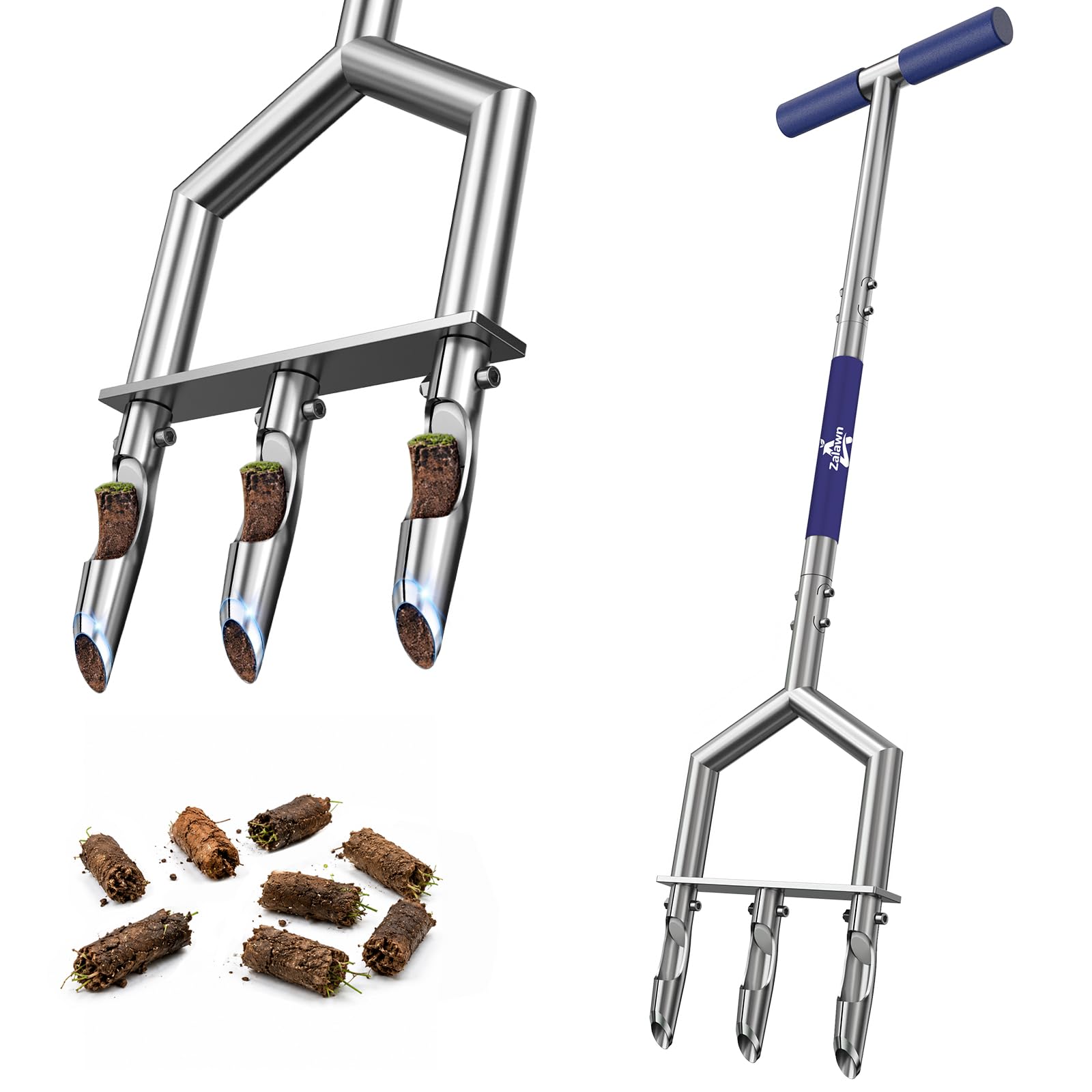
This is not a spike tool. The Zalawn uses three hollow heat-treated steel tines that extract actual soil plugs up to 4 inches deep. That plug removal is the whole point of aeration — it physically removes compacted material so the soil can loosen and roots can spread. Spike tools push soil aside, which can sometimes make compaction worse around the hole. The Zalawn solves that problem properly.
The anti-clog mechanism is the standout feature here. The tines eject the soil plugs automatically with each step, so you don’t have to stop every few plunges to poke packed dirt out of the tubes — a major frustration with cheaper core tools. The tines are also replaceable, so when they eventually dull, you don’t throw away the whole tool. Reinforced welded joints keep the frame stable even when you lean your full weight into hard ground.
The tool weighs about 5.5 pounds and is semi-assembled from the start, needing just a few minutes of bolt-tightening before use. The wide foot bar gives you good leverage. Owners consistently praise the solid build and note that watering the lawn a day before use makes the tines slide in much more smoothly. An occasional unit may struggle in bone-dry clay, but that is true of every manual core aerator.
What makes it great
- Extracts real soil plugs up to 4 inches deep
- Anti-clog mechanism keeps dirt moving out automatically
- Heat-treated steel tines resist bending and are replaceable
Keep in mind
- Core aeration is more physically demanding than spike aeration
- Best results require pre-moistening the soil
Choose this for: serious compaction relief where spike tools won’t cut it.
Avoid if: you just want quick surface holes and don’t need deep plug extraction.
6. Bigwish Stainless Steel 4-Tine Core Aerator
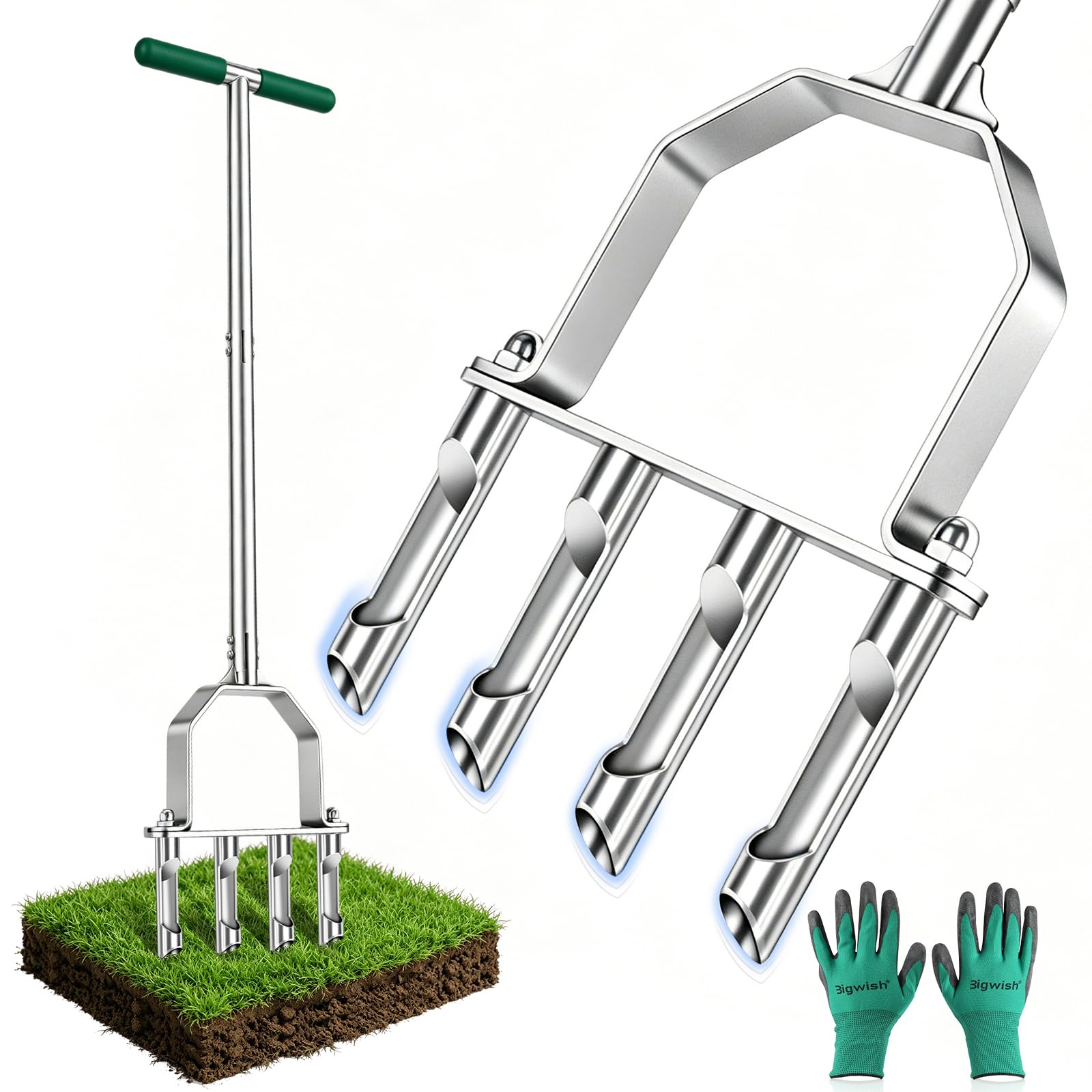
Four hollow stainless steel tines that resist rust and pull four plugs at once.
Most core aerators use painted steel that eventually flakes and rusts. The Bigwish is made from high-density stainless steel — the tines, the base, even the frame. That means no paint to chip and no rust spots after leaving it in a damp garage. The stainless steel is also forged and polished smooth, giving it a much cleaner look than the black powder-coated alternatives.
That 33% boost per step adds up over a whole lawn. The tines feature a precision tapered slot design that cuts through hard clay with noticeably less resistance than a blunt tube. An auto-eject mechanism releases the plugs automatically so you don’t have to bend and tap them out.
The ergonomic T-shaped handle has a soft padded grip and the height is adjustable to fit your stature. At roughly 5.5 pounds it is similar in weight to the other core tools, but the stainless steel construction makes it feel denser. The honest limitation is that four tines require more downward force than two or three tines, so it can be tough to sink all four evenly in very dry ground. Pre-moistening the lawn is essential.
Why it leads
- Stainless steel construction will never rust or peel
- Four tines remove 33% more soil per step than 3-tine models
- Auto-eject design prevents clogging
One trade-off
- Four tines need more downward force in hard soil
- Best results require pre-moistening
Ideal for: owners who want a long-lasting, rust-free tool for high-efficiency plug extraction.
Not for: very dry, rock-hard clay where you cannot get all four tines to sink evenly.
7. LawnVigor Core Aerator (3 Tine)
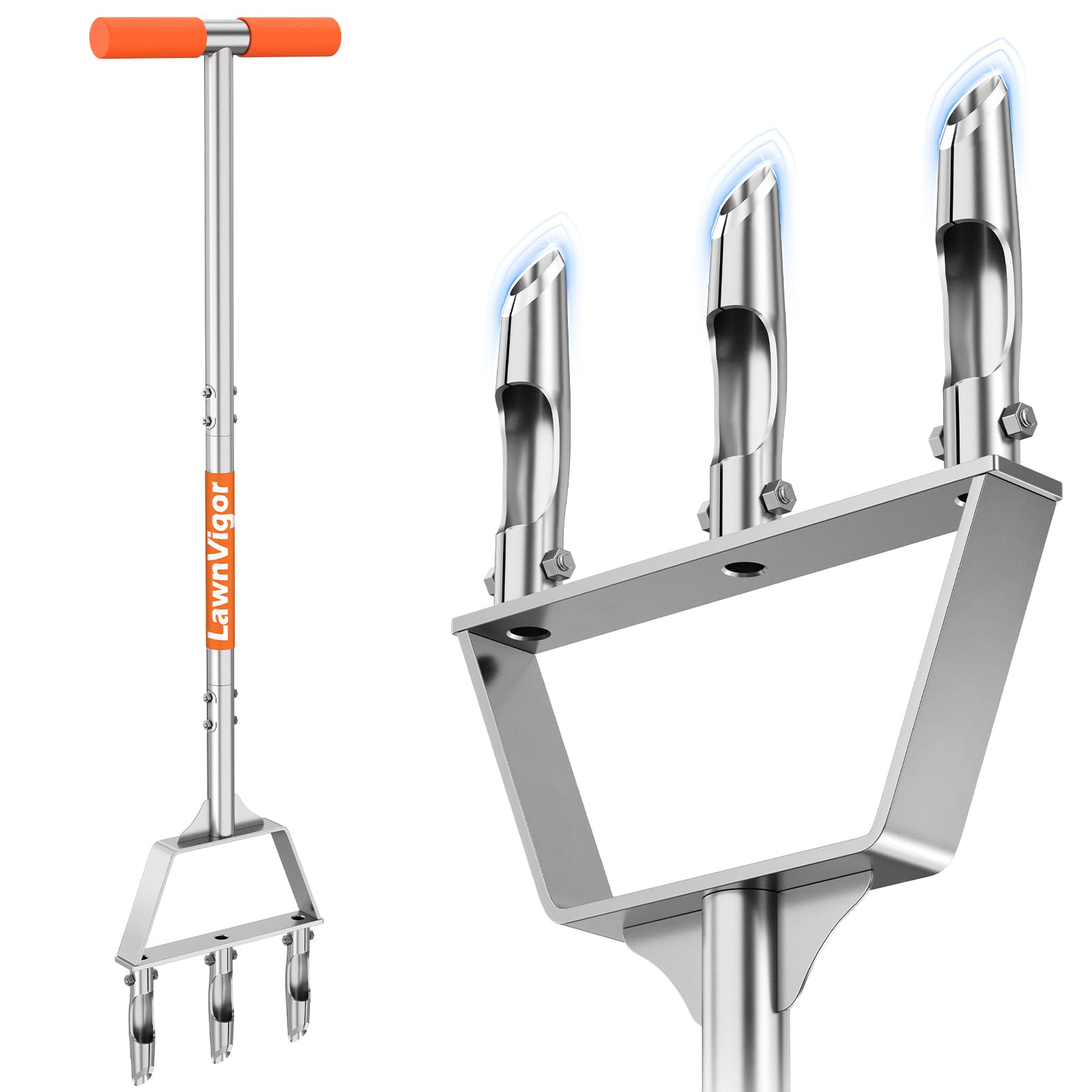
A crowd-favorite core aerator that pulls clean plugs without clogging.
You get reliable plug removal without constant stops, thanks to the LawnVigor’s three heat-treated hollow tines that pull deep 3-inch plugs — even on compacted Bermuda grass, as several owners note. The non-clogging design uses white plastic inserts inside the tines that help eject soil cores smoothly, so you are not stopping every minute to clear packed dirt. That is a real time-saver, and it is the most-reviewed core aerator in this guide by a wide margin.
At just 3.52 pounds, it is a full 2 pounds lighter than the Bigwish or Dolibest core tools. That makes a noticeable difference when you are carrying it across the yard or lifting it for each step over a long session. The heavy-duty powder-coated steel frame feels very sturdy — owners consistently describe it as “super stable” during use with zero wobble. The height is set to minimize back strain.
Assembly takes just a few minutes; the tool arrives semi-assembled with all hardware included. The main thing owners mention is that it works best on a small area or small yard — it is not designed for a half-acre lawn. A minor complaint is that grass and roots can sometimes stick in the gaps of the tines during cleanup, and the handle covers can spin slightly, which might cause blisters after a long session even with gloves.
What owners love
- Non-clogging design with plastic inserts ejects plugs cleanly
- Very lightweight at 3.52 pounds for a core aerator
- Sturdy powder-coated steel frame with no wobble
A few notes
- Not built for large yards — best on small to medium lawns
- Grip covers may spin during heavy use
Perfect for: a small yard with compacted soil that needs real plug extraction.
Consider alternatives if: you need to cover a large area and want a heavier, more sturdy frame.
8. Dolibest Stainless Steel 4-Corer Plug Aerator
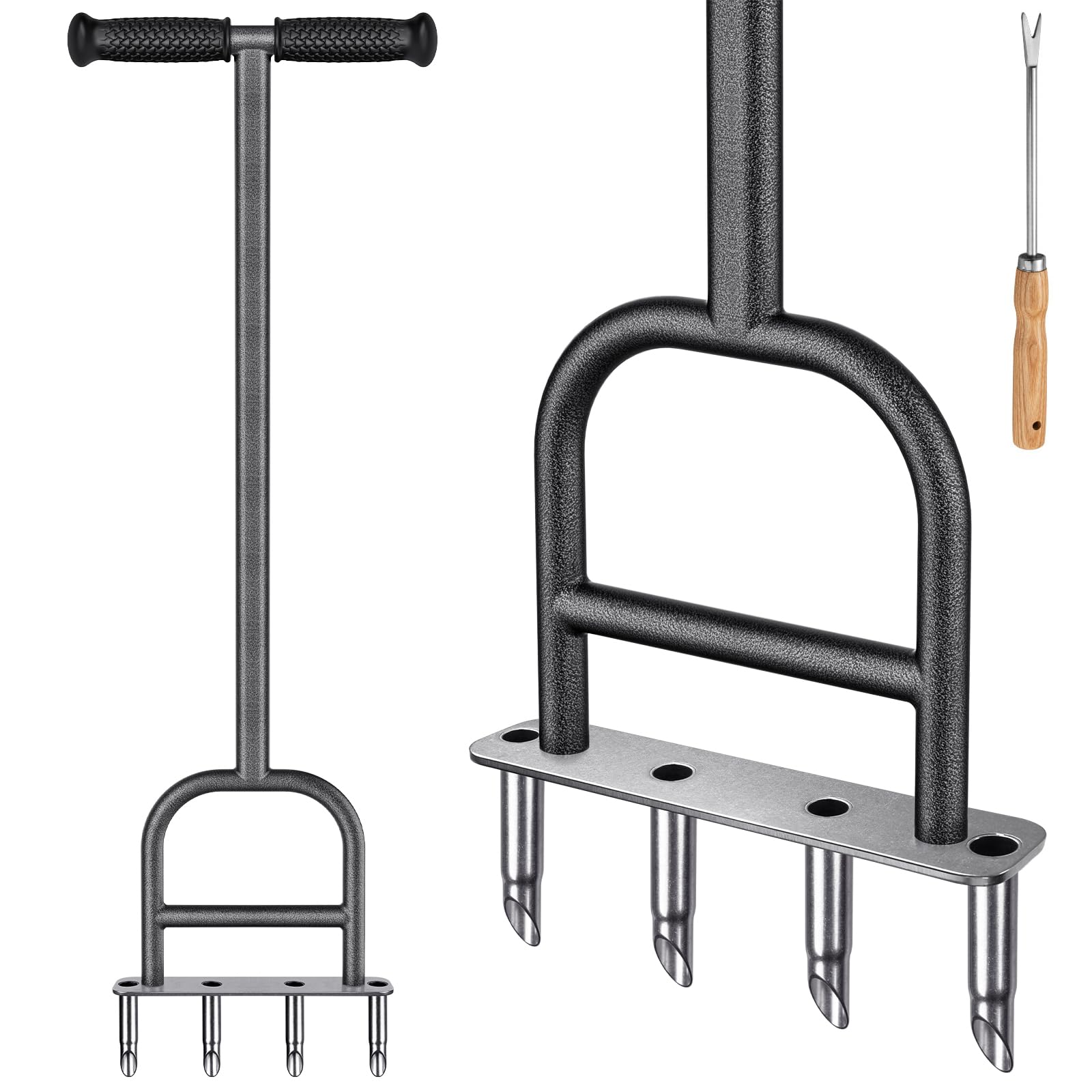
A four-plug stainless steel corer that handles heavy clay without bending.
The Dolibest takes a slightly different approach to rust resistance than the Bigwish: the frame and upper sections are powder-coated steel, but the bottom plate and the four corer plugs are stainless steel. That means the parts that actually touch damp soil and grass are rust-proof, while the painted frame still benefits from a durable finish. It is a sensible compromise that keeps the cost lower than an all-stainless tool.
Each of the four corer plugs is 3.5 inches long and 0.5 inches in diameter — slightly longer and wider than the 3-inch tines on the LawnVigor. That extra depth and width means you remove more soil volume per plug, which is better for heavy clay that needs serious decompaction. Customers note that the tool performs well even in heavy clay, though it requires the soil to be at the right moisture level — not too wet, not bone-dry.
The soft rubber grip on the T-handle prevents blisters effectively. A bonus 12-inch weeder handle tool is included for cleaning out the tines or for transplanting seedlings. The recurring honest note from reviews is that the foot step is rounded rather than flat, which can reduce leverage and require you to rock the tool side-to-side to get full depth. Soil that is too wet will cause clogs, so timing your aeration after a few dry days is important.
Strong points
- Stainless steel corer plugs resist rust and bending
- Four 3.5-inch plugs remove significant soil volume per step
- Includes a 12-inch weeder tool for cleanup
What to watch
- Rounded foot step reduces leverage vs flat designs
- Can clog if soil is too wet
Great for: clay-heavy soil where you need deep plug removal and rust resistance.
Skip if: you prefer a flat foot bar for maximum downward force with less rocking.
9. Walensee Rolling Lawn Aerator (30 Spikes)
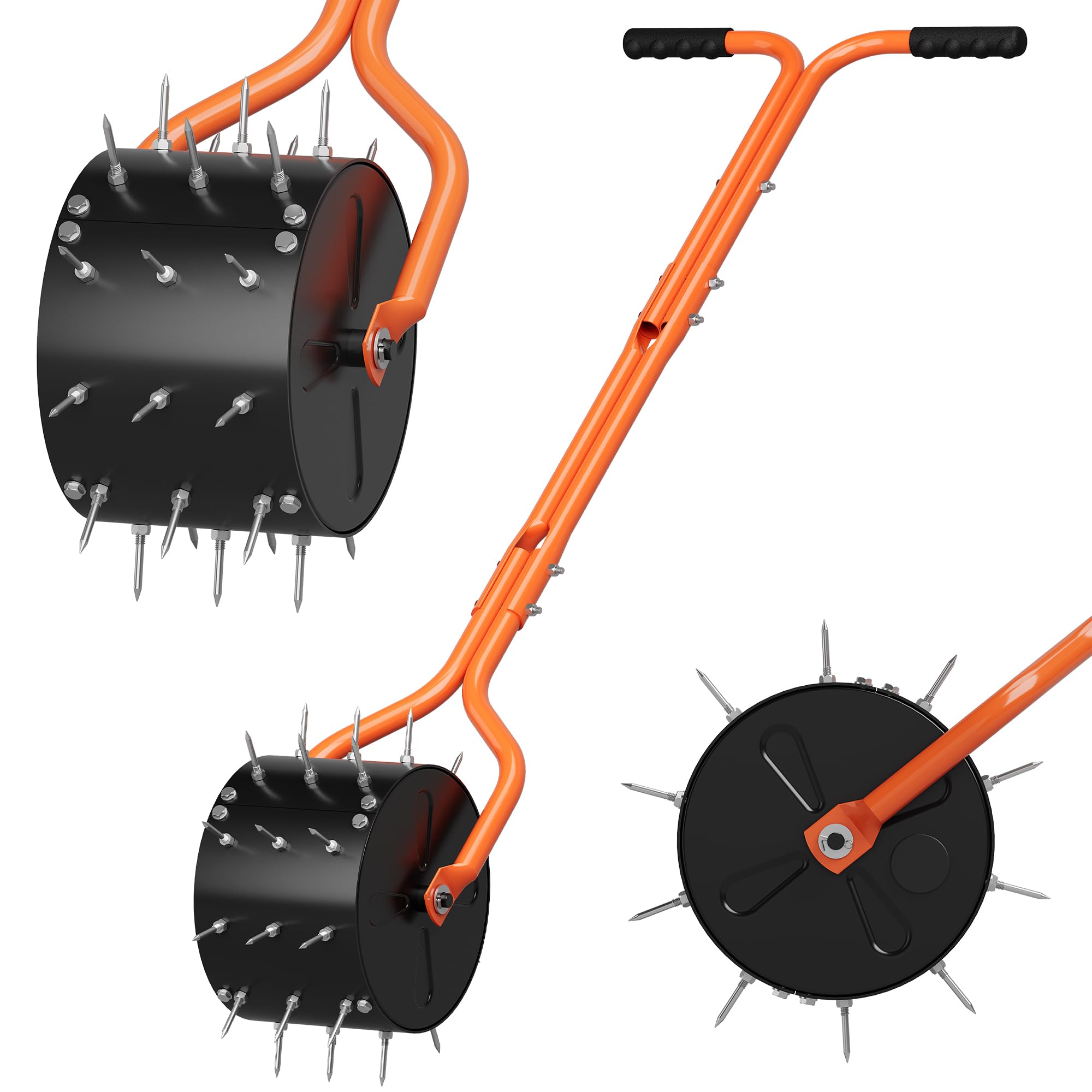
A rolling spike drum that covers ground fast — no stepping required.
The Walensee is completely different from every other tool here. Instead of plunging spikes into the ground one step at a time, you push a rolling drum fitted with 30 spikes arranged in a grid pattern. The spikes create evenly spaced holes as the drum rolls, so you can cover a small lawn in minutes rather than the hour-plus it takes with a step aerator. It is the closest thing to a walk-behind power aerator without the engine.
The drum has a 5.5-liter capacity and can be filled with small stones or pebbles to add 4 to 6 kg of extra weight. More weight pushes the spikes deeper, so you can adjust penetration depending on how compacted your soil is. The side fill port with a rubber plug makes loading and emptying simple. The integrated dual-bar handle keeps the drum balanced even when fully loaded, so it doesn’t tip sideways on uneven ground.
Owners note that it works best in forward motion — pulling it backward can partially cover the holes you just made. It is effective on dry ground and actually easier to push than on wet, sticky lawn. The spike holes from a roller are shallower than what a deep core aerator produces, so this is best for routine maintenance aeration rather than fixing severe compaction. Some owners would prefer slightly denser spike spacing for more holes per square foot.
What makes it unique
- Rolling operation covers ground much faster than step tools
- Fillable drum adjusts weight from empty to +4-6 kg
- Dual-bar handle stays balanced under load
Limitations
- Works best in forward motion only
- Shallower holes than a core aerator or deep spike tool
Pick this for: quick, light routine aeration on a small lawn without any bending or stepping.
Not the choice for: deep soil decompaction or extremely hard clay that needs plug removal.
Understanding the Specs
Spike Length and Thickness
Spike length determines how deep the holes go — longer spikes (3 inches or more) reach deeper roots and break up compaction further down. Thicker spikes (2/5 inch diameter) create wider holes that let more water and air into the soil. Thinner spikes (1/5 inch) are easier to push in but move less soil.
Core Aerator vs Spike Aerator
A spike aerator pushes solid rods into the ground, which can sometimes compact soil around the hole. A core aerator uses hollow tines to pull out a plug of soil, physically removing material and leaving space for roots to expand. Core aeration is more effective for fixing compaction, but requires more physical effort per step.
FAQ
Should I water my lawn before using a manual aerator?
How many spikes do I need for a small lawn?
Can I use a spike aerator on clay soil?
How deep should my aerator spikes be?
What is the difference between a spike aerator and a rolling aerator?
Will my aerator spikes bend if I hit a rock or root?
Is a core aerator better than a spike aerator for overseeding?
How long does a manual lawn aerator last?
Can I aerate my lawn too much?
Final Thoughts: The Verdict
For most people, the best small lawn aerator is the Colwelt 38″ because its 3.5-inch spikes are the longest in the group, its thick 2/5-inch diameter creates real holes, and the whole tool weighs just 4.31 pounds so you don’t tire out halfway through the yard. If you prefer the deeper decompaction of a true core aerator, grab the Zalawn Core Aerator — it extracts 4-inch soil plugs with an anti-clog mechanism that actually works. And for the fastest coverage with no bending or stepping, the Walensee Rolling Aerator with its 30-spike drum and fillable weight drum is the one to reach for.
How We Picked
We do not accept paid placement. Every pick is matched to a real buyer and a real use-case; we do not hands-on test units.
Sources & Methodology
Specifications: manufacturer listings and product documentation. Review insights: verified customer reviews, as of July 2026. Pricing: not shown on this page (it changes often); check the current price via the retailer link.
As an Amazon Associate, Lawn Gear Lab earns from qualifying purchases. This does not affect which products we feature.