
Specs are compiled from manufacturer listings and verified buyer reviews and can change over time — please confirm the key details on the product page before buying.
Trimming a few overgrown limbs or prepping campfire wood usually means dragging out a heavy, loud gas saw or fighting with a manual lopper. A small battery chainsaw solves that: it is a lightweight, one-handed tool you grab from the garage to quickly cut branches up to a few inches thick, without the pull-start hassle or earplugs. The trick is picking one that actually has enough power and battery life to finish the job without leaving you stranded mid-cut.
I’m Rikta — the founder and writer behind Lawn Gear Lab. This guide is built by comparing the manufacturers’ published specifications and the patterns across verified customer reviews, so you get each pick’s real strengths and trade-offs instead of marketing spin.
With a focus on cuts per charge, bar length, and real-world handling, here is the best small battery chainsaw for keeping your yard tidy and your firewood pile stocked without wrestling with a machine built for lumberjacks.
Quick Picks
- SKIL PWR CORE 20 Brushless 20V 6″ Mini Chainsaw Kit (PR0600B-11) — Best Overall
- Milwaukee Saw Pruning Cordless 12V 6IN (2527-20) — Premium Compact
- BLACK+DECKER 20V MAX Pruning Chainsaw Kit (BCCS320C1) — Budget Champion
- CRAFTSMAN V20 Mini Cordless Chainsaw (CMCCS320D1) — Reliable Workhorse
- Greenworks 24V 6″ Mini Chainsaw Cordless (CS24L210) — Ultra-Light Pick
- DeWalt Chainsaw Pruning Cordless 20V 8IN (DCCS623B) — Most Power
How To Choose The Best Small Battery Chainsaw
Three specs separate a handy tool from a frustrating one: how many cuts you get per charge, the motor type, and the bar length. Match these to the work you actually do.
Cuts Per Charge Is Your Real Runtime
Ignore the “up to X minutes” claims. A small battery chainsaw’s real-world staying power is measured in cuts per charge — the number of branch slices you get before needing to swap batteries. A saw delivering 115 cuts per charge will finish a full afternoon of pruning, while one giving 55 cuts per charge may stop halfway through the pile.
Brushless Motor vs Brushed Motor
A brushless motor (a motor that uses electronic controllers instead of physical brushes to transfer power) is more efficient, quieter, and typically lasts longer than a traditional brushed motor. It delivers more torque for the same battery size, which means it can chew through thicker branches without slowing down. Nearly every premium small chainsaw in this list uses a brushless motor — it is worth the small price bump.
Bar Length: 6-Inch vs 8-Inch
A 6-inch bar is for one-handed trimming of branches up to about 4 inches thick — most pruning and light firewood work. An 8-inch bar can handle slightly thicker cuts (up to 6 or 7 inches) but adds weight and typically requires two hands. If you mostly cut branches under 4 inches, a 6-inch bar keeps the saw light and nimble. If you regularly face thicker wood, the 8-inch gives extra reach.
Quick Comparison
On smaller screens, swipe sideways to see the full table.
| Model | Best For | Bar Length | Cuts Per Charge | Weight | Amazon |
|---|---|---|---|---|---|
| SKIL PWR CORE 20 | Best Overall | 6″ | 115 | 4.19 lbs | Amazon |
| Milwaukee 12V 2527-20 | Premium Compact | 6″ | — | 4.1 lbs | Amazon |
| Black+Decker BCCS320C1 | Budget Champion | 6″ | 55 | — | Amazon |
| Craftsman CMCCS320D1 | Reliable Workhorse | 6″ | 85 | 8 lbs | Amazon |
| Greenworks CS24L210 | Ultra-Light Pick | 6″ | — | 3.4 lbs (w/ battery) | Amazon |
| Dewalt DCCS623B | Most Power | 8″ | — | 4.6 lbs | Amazon |
In‑Depth Reviews
1. SKIL PWR CORE 20 Brushless 20V 6″ Mini Chainsaw Kit (PR0600B-11)

The light one-hander that delivers 115 cuts on a single charge.
You want a saw that keeps cutting when the pile of branches is still tall. The SKIL PWR CORE 20 delivers up to 115 cuts per charge with its included 2.0Ah battery, versus 55 cuts for the Black+Decker BCCS320C1, so you are not swapping batteries mid-job. The brushless motor (an efficient motor with no physical brushes, giving more torque and longer runtime) makes quick work of branches up to 3 inches thick, as buyers report it is a “light, well-balanced 6″ saw.”
The tool-free chain tensioning lets you tighten or loosen the chain by twisting a dial — no wrench needed. The auto-lubricating chain keeps the bar running smoothly without manual oiling, and the IPX4 water resistance (protection against splashing water from any direction) adds durability if you get caught in a drizzle. Weighing just 4.19 pounds, it is easy to hold overhead for one-handed trimming. One reviewer noted the plastic chain tensioner works fine if you do not overtighten, but the chain can sag after large cuts, needing a quick re-tension.
The catch: the safety button is awkwardly positioned compared to what some buyers are used to, and the 0.043 gauge chain is the only one that fits. But for the price, it is the best balance of power, weight, and runtime.
Why It Leads
- 115 cuts per charge outpaces most competitors
- Brushless motor for efficient power delivery
- Auto-lubricating chain reduces maintenance
- Tool-free chain tensioning saves time
Trade-Offs to Know
- Safety button design less intuitive than some
- Chain sag after larger cuts requires re-tensioning
- Only one chain gauge fits
Reach for this if: you prune regularly and want a saw that finishes the job on one battery — the 115 cuts per charge and brushless motor make it the strongest all-rounder.
Look elsewhere if: you need a tool-only option (no battery/charger) or an 8-inch bar for thicker cuts.
2. Milwaukee Saw Pruning Cordless 12V 6IN (2527-20)
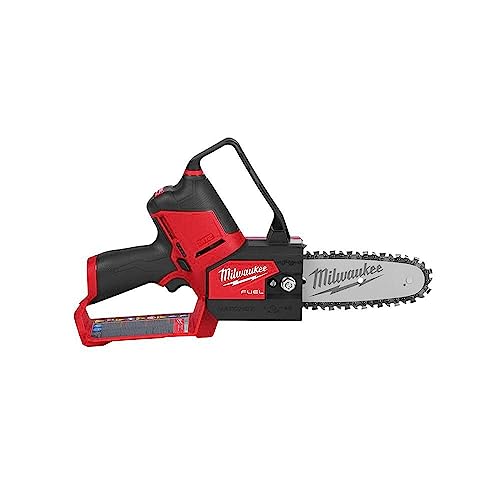
The tiny powerhouse that cuts hardwood up to 8 inches thick.
If you already own Milwaukee M12 batteries (the company’s 12-volt battery system), this tool-only saw is a no-brainer for your collection. It runs on the 12V platform yet delivers surprising torque — owners mention it “cuts 3-8″ hardwood (maple, cherry, ironwood) with ease” and gets about 45 minutes of runtime per battery. At just 4.1 pounds, it is the lightest premium option here and noticeably more compact than the Craftsman CMCCS320D1, which weighs 8 pounds.
The brushless motor and sturdy wrap-around handle make one-handed operation smooth and easy, even for overhead trimming. The chain and bar maintenance is straightforward, and the included tool handles adjustments. It measures just 16.56 inches long, making it easier to maneuver in tight spaces than the larger Black+Decker at 20.4 inches long.
The catch: the safety latch design can cause hand fatigue with prolonged use, as some customers note the trigger lock requires pressing a release button every time before cutting. And since it is tool-only, you need an M12 battery and charger — if you are not already in Milwaukee’s ecosystem, the total cost rises quickly.
Torque per pound: delivers professional-grade cutting power on a 12V platform, ideal for those already invested in Milwaukee tools.
The main trade-off: safety latch ergonomics frustrate during long sessions, and the 12V battery means shorter runtime than 20V alternatives.
Best for: Milwaukee ecosystem owners who want a compact, one-handed pruning saw that punches above its voltage rating.
skip it if: you are starting fresh — the tool-only format and 12V batteries mean a higher upfront cost vs a kit.
3. BLACK+DECKER 20V MAX Pruning Chainsaw Kit (BCCS320C1)
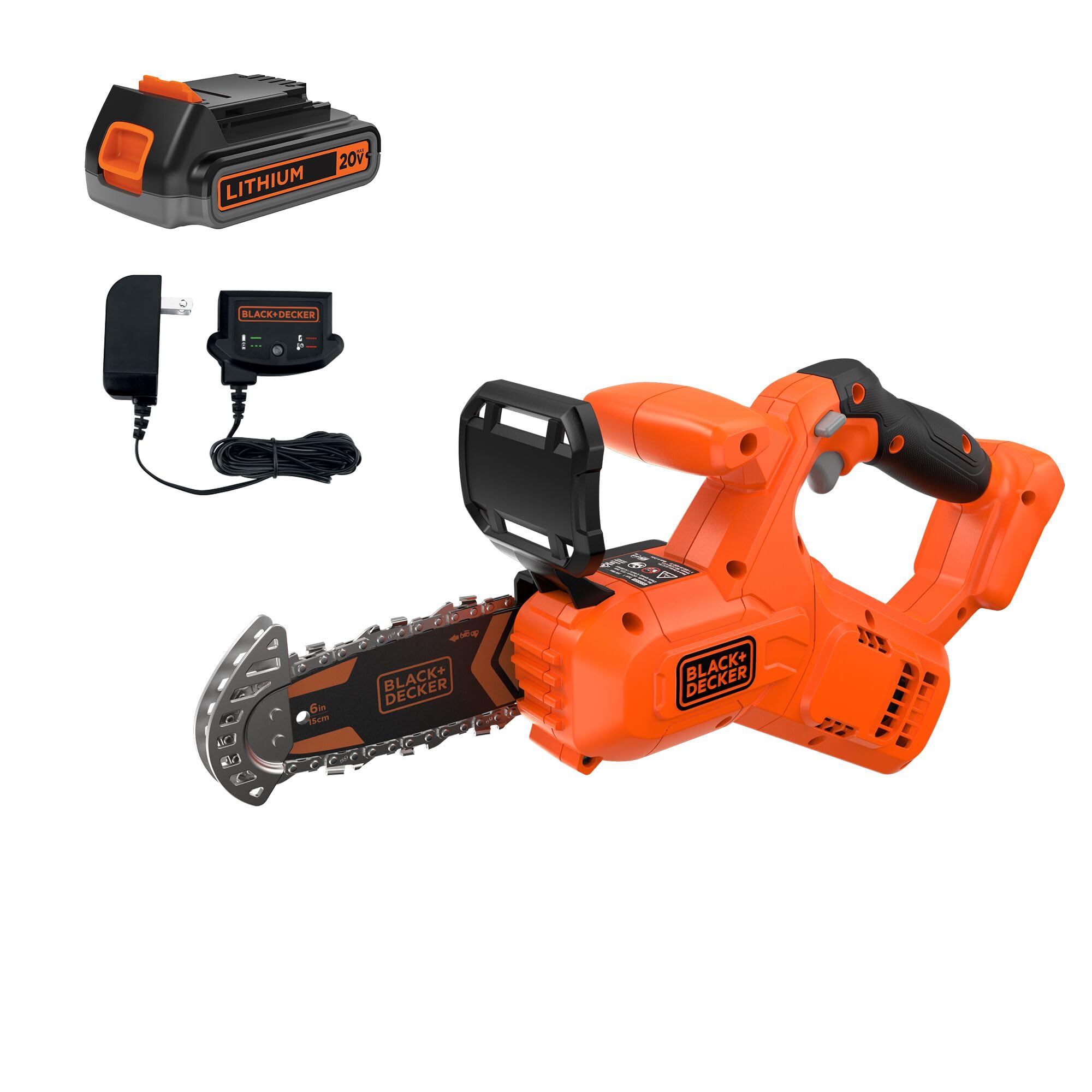
The affordable no-oil saw that is perfect for casual pruning.
Not every yard needs 115 cuts per charge. If you trim a few branches once a month, the Black+Decker BCCS320C1 offers a simpler, cheaper path. It delivers up to 55 cuts per charge with a 1 horsepower motor, versus the SKIL’s 0.73 horsepower, though it lacks a brushless motor. The 6-inch bar has a cut capacity up to 4 inches, and reviewers point out it “cuts fast” and “is perfect for 3/4-5 inch branches.” One buyer mentioned they use it on a 1+ acre property constantly.
The standout feature is the oil-free design — no bar oil reservoir, no topping up. Shoppers say you can use WD-40 as a lubricant if needed, which simplifies storage and maintenance significantly. The integrated tip guard provides stability during upcuts, and the storage sheath holds the wrench for easy removal. It is compatible with existing Black+Decker 20V batteries, so if you already own other tools from the brand, this is an instant addition.
The catch: the chain is coarser than some and tends to bind on thicker cuts, according to a few reviews. But for light yard work, this is the most budget-friendly entry.
Why It Works
- Oil-free operation eliminates mess and maintenance
- Compatible with existing Black+Decker 20V batteries
- 1 HP motor provides good cutting speed
- Storage sheath with onboard wrench holder
Watch Out For
- Only 55 cuts per charge — less than mid-range options
- Coarse chain tends to bind on thicker limbs
- No brushless motor limits efficiency
Reach for this if: you have light pruning needs and already own Black+Decker 20V tools — the oil-free design makes it the simplest saw to own.
Look elsewhere if: you need to cut more than 50 branches in one session or want a brushless motor for efficiency.
4. CRAFTSMAN V20 Mini Cordless Chainsaw (CMCCS320D1)
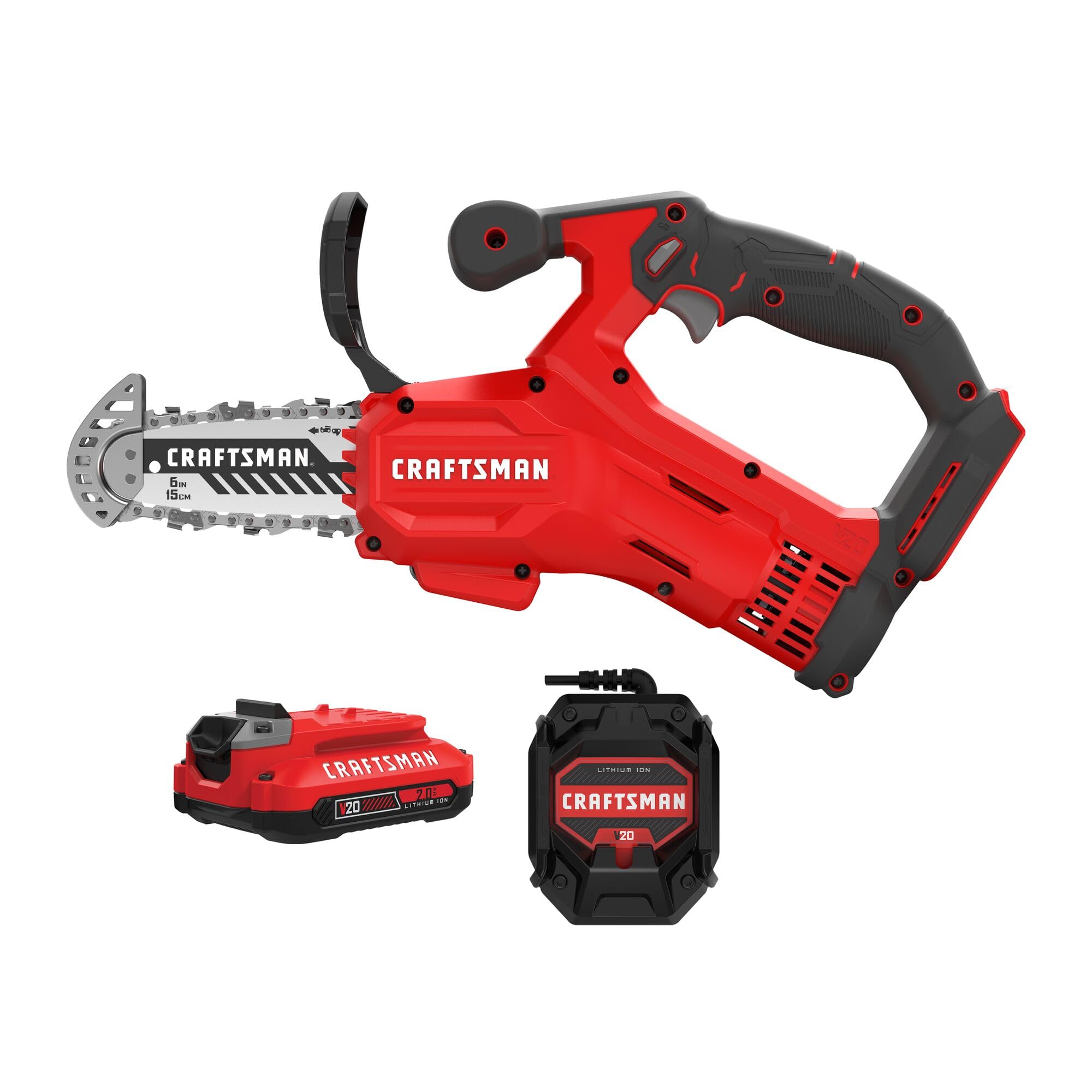
The durable workmate that runs for an hour on heavy limbs.
When you need a saw that feels solid in your hands and keeps cutting through a serious pile, the Craftsman CMCCS320D1 delivers. The 6-inch bar handles up to 4-inch thick limbs, and buyers report they “used 1 hour cutting limbs” without running out of power. The 8-pound weight makes it the heaviest in this lineup compared to the Milwaukee’s 4.1 pounds, so expect a two-handed grip for extended work.
The bolt lock chain tensioning provides reliable bar clamping, and the integrated tip guard gives control during upper cuts. The included storage sheath has an onboard wrench holder for easy removal and storage. If you already own CRAFTSMAN V20 tools, the included 2.0Ah battery and charger fit your existing collection smoothly. Plus, it comes with a 3-year limited warranty for confidence.
The catch: the tip guard sometimes gets in the way, as some owners mention. The saw requires two hands and is heavier than other options, making one-handed overhead trimming more fatiguing. And it needs chain lube, unlike the oil-free Black+Decker.
Solid and dependable: the 85 cuts per charge and CRAFTSMAN build quality make it a reliable choice for medium-sized pruning jobs.
The drawback: at 8 pounds it is the heaviest pick here, and the tip guard can be annoying on certain cuts.
Best for: CRAFTSMAN V20 owners who want a rugged saw that can handle an hour of continuous cutting without breaking a sweat.
pass on it if: you need a lightweight one-handed saw — the 8-pound weight makes it less suitable for overhead pruning.
5. Greenworks 24V 6″ Mini Chainsaw Cordless (CS24L210)
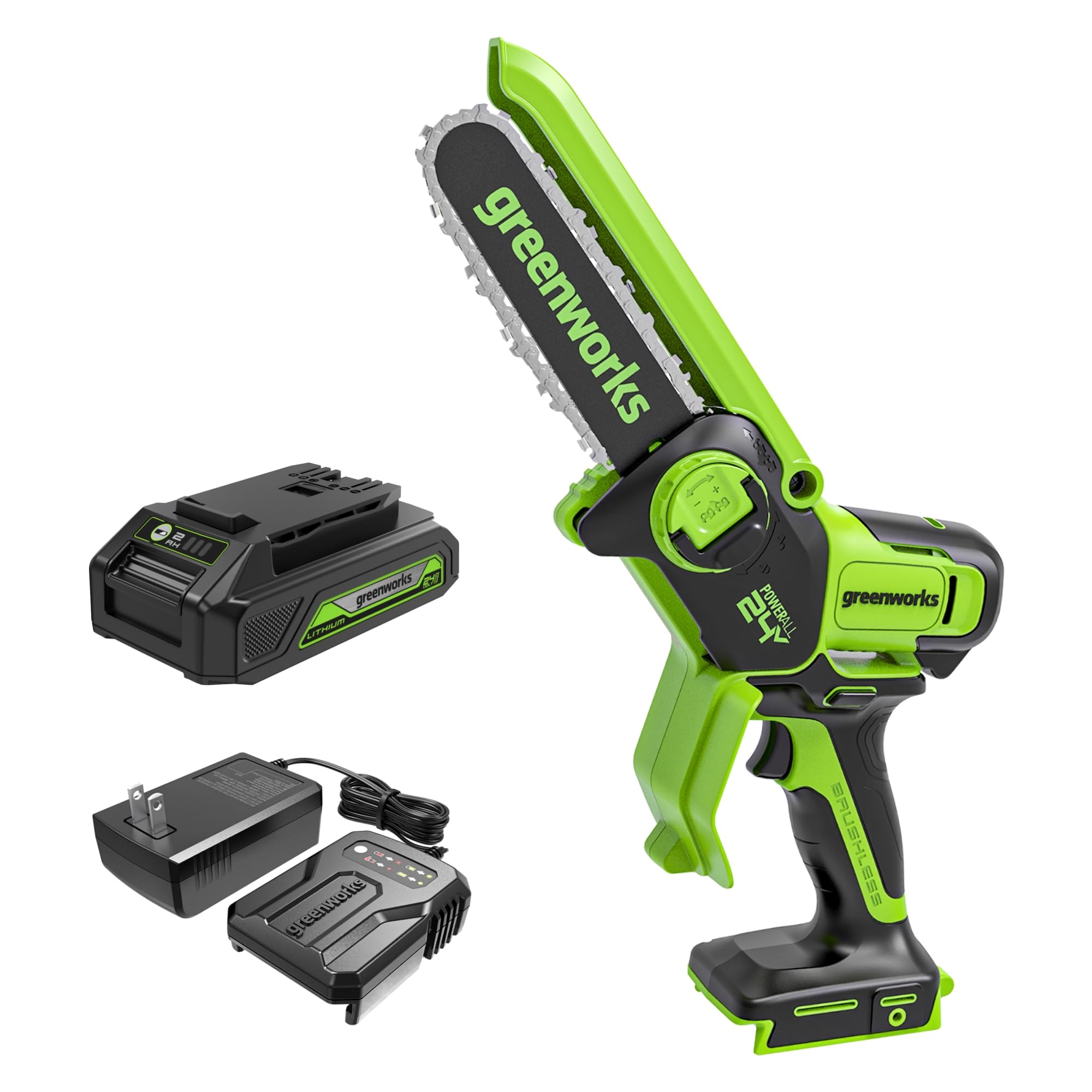
The 3.4-pound featherweight designed for smaller hands.
If weight is your first concern — maybe you are a smaller-framed user, a senior, or need to work from a ladder — the Greenworks CS24L210 is the lightest saw in this guide at 3.4 pounds with the battery installed. The 24V platform claims 20% more power and 35% longer runtime than standard 20V systems, and the 6-inch bar slices through 6-inch logs for pruning and campfire prep. Customers note it “cuts branches cleanly” and is “easy to handle and not overly heavy, especially if it’s a woman using it.”
The one-click chain tightening lets you adjust tension with one hand, and the security lock prevents accidental starts. The battery is compatible with over 125 Greenworks indoor and outdoor tools, making it a versatile addition if you already own the brand. It is designed with anti-slip handles and safety baffles for splash protection.
The catch: a common complaint is that the chain tensioning knob is plastic and flimsy — one owner reported it broke, though Greenworks replaced it under a 3-year warranty after some hold time. The saw has no auto-oiler, so you must manually oil the chain frequently to keep it cutting smoothly.
Why It Stands Out
- Weighs only 3.4 lbs with battery — lightest in the guide
- 24V platform offers more power than typical 20V saws
- One-click chain tensioning for easy adjustments
- Compatible with 125+ Greenworks tools
Downsides to Consider
- Plastic chain tensioning knob reported as fragile
- No auto-oiler — requires frequent manual lubrication
- Not designed for heavy-duty cutting
Reach for this if: you want the absolute lightest saw for one-handed trimming, especially if you are smaller-framed or need to prune from a ladder.
Look elsewhere if: you need a durable chain tensioning system or prefer auto-oiling to save maintenance steps.
6. DeWalt Chainsaw Pruning Cordless 20V 8IN (DCCS623B)

The 8-inch demon that chews through 7-inch saplings like butter.
When your “pruning” job involves clearing saplings up to 7 inches thick, you need the extra bar length. The DeWalt DCCS623B runs an 8-inch bar and a 2.8 horsepower motor — the highest horsepower in this guide — making it the most powerful option for cutting through thicker wood. Reviewers point out it “cut through some good size tree limbs like butter” and is “perfect for small to medium trees/underbrush.” One customer observed clearing saplings up to 7 inches with excellent results.
The saw works with existing DeWalt 20V batteries, and shoppers say battery life is fantastic — one user highlighted it lasts a full weekend on a single charge. It weighs about 4.6 pounds (in the middle range for this guide), and the blade stays sharp even with regular use. Since it is a tool-only model, you bring your own battery and charger, which keeps the price lower if you are already in the DeWalt ecosystem.
The catch: oil can leak if the saw is stored improperly — one buyer advises draining the oil or storing it flat with the filler cap up. It is not super powerful compared to a gas saw, but buyers confirm it is adequate for its intended use. And because it is tool-only, new buyers need to factor in the cost of a battery and charger.
Bar power winner: the 8-inch bar and 2.8 HP motor give it a clear edge for cutting thicker limbs than any 6-inch saw can handle.
The caveat: oil leakage if stored wrong, and it is tool-only so you need existing DeWalt 20V gear.
Best for: DeWalt 20V owners who need the extra bar length to clear small trees and saplings up to 7 inches thick.
it’s not for you if: you are starting from scratch — the tool-only format means a higher upfront investment for batteries.
Understanding the Specs
Cuts Per Charge
This is the most practical measure of runtime for a small battery chainsaw. It tells you how many branch slices you get before the battery dies. The range goes from 55 cuts (budget Black+Decker) to 115 cuts (SKIL). A higher number means fewer battery swaps. If you trim a few branches a month, 55 cuts is fine. If you have a full afternoon of pruning, aim for 85 or more.
Bar Length
The bar is the metal guide that the chain. A 6-inch bar is standard for one-handed pruning on branches up to about 4 inches thick. An 8-inch bar (like on the DeWalt) lets you cut slightly thicker wood (up to 6-7 inches) but adds weight and usually requires two hands. For most yard work, 6 inches is plenty. For clearing thick saplings, the 8-inch makes sense.
Brushless Motor
A brushless motor uses electronic controls instead of physical carbon brushes to deliver power to the motor. This makes the tool more efficient (runs longer per charge), quieter, and more reliable over time. Every premium pick in this guide uses a brushless motor. Budget models often use a brushed motor, which is older technology — it works, but you get less runtime and the motor brushes wear out eventually.
Auto-Oiling vs Manual Oiling
Chainsaws need lubrication on the bar and chain to reduce friction and heat. Auto-oiling means the saw has a reservoir and a pump that automatically delivers oil to the chain as you cut. Some saws, like the SKIL, have this. Others, like the Greenworks and Black+Decker, require you to manually oil the chain before or during use. Manual oiling is simpler (no oil reservoir to clean) but adds a step every few cuts.
FAQ
Will a small battery chainsaw fit on my existing battery platform?
How long does a small battery chainsaw battery last in real use?
Can a small battery chainsaw cut through thick logs?
Is a brushless motor worth the extra cost on a small chainsaw?
How do I maintain the chain on a small battery chainsaw?
What is the difference between a pruning chainsaw and a mini chainsaw?
Can I use a small battery chainsaw in the rain?
How do I carry a small battery chainsaw safely?
Why does my chainsaw chain keep coming off?
Is a small battery chainsaw safe for a beginner?
Final Thoughts: The Verdict
For most people, the best small battery chainsaw winner is the SKIL PWR CORE 20 because it combines 115 cuts per charge with a brushless motor and auto-oiling in a 4.19-pound package — the best balance of runtime, power, and weight. If you want the most compact and powerful premium option for one-handed use, grab the Milwaukee 2527-20. And for the most affordable entry point with the simplest maintenance, the standout is the Black+Decker BCCS320C1 with its oil-free design.
How We Picked
We do not accept paid placement, and we did not hands-on test every unit. Instead, we match each pick to a real buyer and use-case by comparing the manufacturers’ published specifications against the patterns in verified customer reviews — so you get each pick’s real strengths and trade-offs instead of marketing copy.
Sources & Methodology
Specifications: manufacturer listings and product documentation. Review insights: verified customer reviews, as of July 2026. Pricing: not shown on this page (it changes often); check the current price via the retailer link.
As an Amazon Associate, Lawn Gear Lab earns from qualifying purchases. This does not affect which products we feature.