
Specs are compiled from manufacturer listings and verified buyer reviews and can change over time — please confirm the key details on the product page before buying.
You cut the shrub down, but it keeps sending up new shoots. You dig, you pull, you curse, and still those roots find a way. The real battle is below the soil line, and a proper root killer works deep in the root system to stop resprouts for good. This guide cuts through the marketing to find the formulations that truly translocate through the plant and kill the whole root mass.
I’m Rikta — the founder and writer behind Lawn Gear Lab. This guide is built by comparing the manufacturers’ published specifications and the patterns across verified customer reviews, so you get each pick’s real strengths and trade-offs instead of marketing spin.
The best shrub root killer must do one thing that cheap sprays cannot: it has to be absorbed by the plant and travel deep into the root system to prevent any new growth from emerging, a process called translocation that separates truly effective herbicides from the rest.
Our Picks at a Glance

How To Choose The Best Shrub Root Killer
Not every product labeled “brush killer” actually moves through the plant’s vascular system to reach the root tips. To get a permanent kill, you need a systemic herbicide with the right active ingredient and a delivery method that matches your specific shrub problem. Here are the key factors to evaluate.
Active Ingredient: Triclopyr Is The Standard
The single most important spec to check is the active ingredient. For woody shrubs and vines, Triclopyr is the proven performer. It is a systemic herbicide that plants absorb through leaves or freshly cut stems, then move to the roots. This is the ingredient behind most of the heavy-hitting products here, from the Southern Ag options to the Remedy and Ortho concentrates.
Concentrate vs. Ready-to-Use
A ready-to-use (RTU) bottle, like the ALLIGARE Triumph or Ortho MAX, saves you the hassle of mixing. You point and spray or paint directly onto a cut stump. A concentrate like the Remedy or Crossbow requires you to measure and mix with water or diesel, but you get far more total coverage per dollar. If you have a single stump in the yard, an RTU is fine. If you are tackling a fence line or a patch of invasive shrubs, a concentrate pays off fast.
Application Method: Cut-Stump vs. Foliar
For the deepest root kill on established shrubs, the cut-stump method is the most effective. You cut the shrub down to a stump and then apply the herbicide to the fresh cut within minutes. This delivers the chemical directly into the vascular system. The foliar method (spraying the leaves) works on smaller, actively growing shrubs but requires the plant to have healthy leaf surface area to absorb the product. Buyers report better results with cut-stump application for tough, woody stumps like locust and mulberry.
Quick Comparison
| Model | Best For | Active Ingredient | Volume | Type | Amazon |
|---|---|---|---|---|---|
| Remedy Ultra★ Best Overall | Large acreage & rangeland | Triclopyr | 128 fl oz (1 Gal) | Concentrate | Amazon |
| Southern Ag CrossbowTop Performer | Large-scale brush control | Triclopyr + 2,4-D | 128 fl oz (1 Gal) | Concentrate | Amazon |
| Tordon RTU | Cut-stump precision | Picloram + 2,4-D | 32 fl oz (1 Qt) | Ready-to-Use (RTU) | Amazon |
| Southern AG Brush Killer | Targeted spot spraying | Triclopyr | 32 fl oz (1 Qt) | Concentrate | Amazon |
| Ortho MAX Poison Ivy | Residential poison ivy & brambles | Triclopyr | 24 fl oz | Ready-to-Use | Amazon |
| Image Brush & Vine | Yard vines & kudzu | Triclopyr | 32 fl oz (1 Qt) | Concentrate | Amazon |
| ALLIGARE Triumph RTU | Quick stump prevention | Triclopyr + 2,4-D | 32 fl oz (1 Qt) | Ready-to-Use (RTU) | Amazon |
In‑Depth Reviews
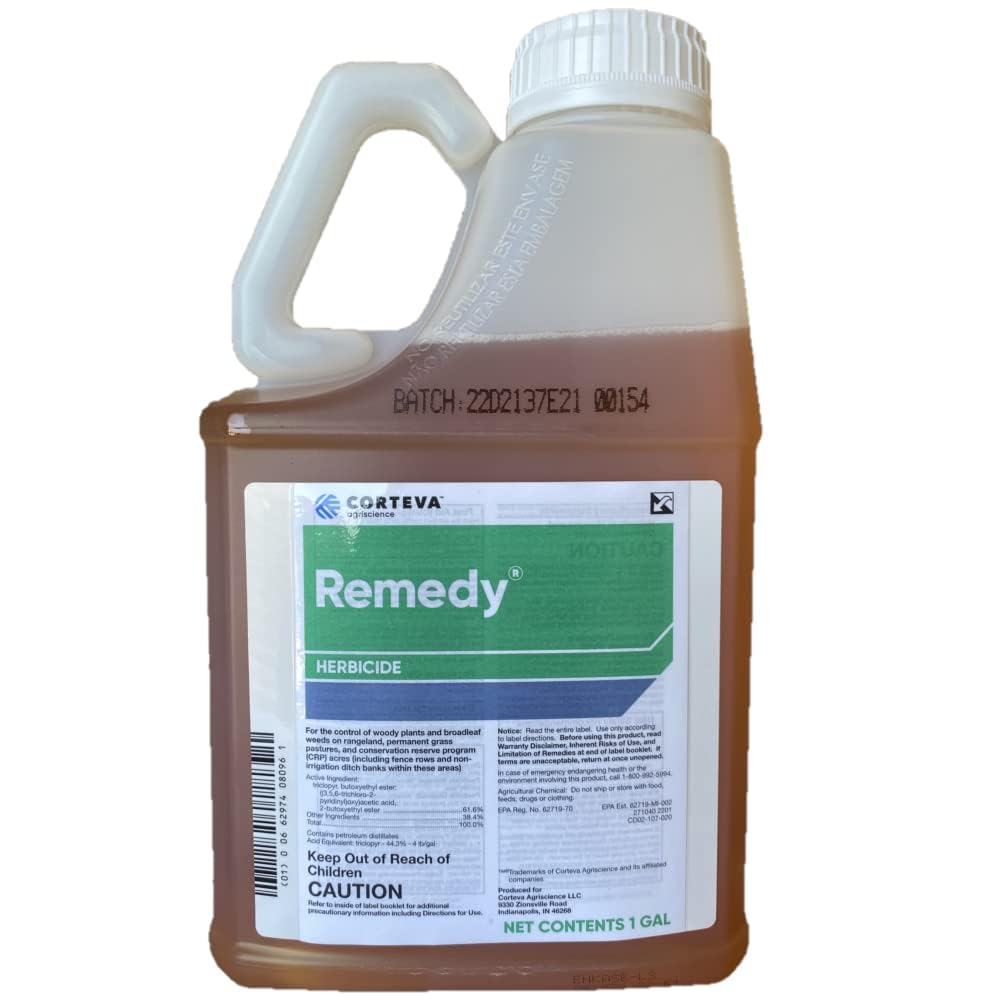
1. Remedy Ultra Specialty Herbicide
Our pick — over 4.5★ from 800+ verified ratings; the strongest balance of quality and price.
The rangeland-grade triclopyr concentrate that leaves zero survivors in its wake
This is the heavy artillery. With a 128 Fluid Ounce (1 gallon) jug of triclopyr concentrate, you get far more coverage than any premixed spray — a full 5.3 times the volume of a smaller RTU like the Ortho MAX bottle. Owners mention mixing one part Remedy with three parts diesel and applying a single squirt to cut stumps to stop even honey locust and yucca from resprouting. It is the top-rated product on this list at 4.7/5 stars from 838 ratings, making it the clear leader for anyone serious about eradicating woody brush.
The catch is the upfront cost, but one reviewer noted the price pays off because the gallon “lasts for 100+ weekly lawns in Florida.” It is a low-odor formula, and the manufacturer states it is safe for children and pets once the application has dried. Unlike the Southern Ag Crossbow, which uses a blend of triclopyr and 2,4-D, Remedy uses straight triclopyr which gives you more control over your tank mix for different weed pressures.
What earns the top spot
- 128 oz (1 gallon) of concentrate — far more value per ounce than smaller bottles
- Proven on aggressive invasives like cogon grass and multiflora rose
- Low-odor formula that works on entire plant from leaf tip to root end
The honest trade-offs
- Expensive single-purchase cost compared to RTU options
- Requires measuring, mixing, and a sprayer — not grab-and-go
Your best bet if: you have a large area, a fence line, or a pasture to reclaim and want the highest kill rate from a single jug.
Not your match if: you need to treat just one small stump and do not want to store a gallon of chemical.
2. Southern Ag Crossbow Specialty Herbicide
The dual-action concentrate that covers 2.23 acres from a single gallon
Like the Remedy Ultra, this is a one-gallon (128 oz) jug, but Crossbow adds a second active ingredient: 2,4-D alongside the triclopyr. This combination broadens the weed spectrum, making it effective on both woody brush and annual/perennial broadleaf weeds. The manufacturer claims it can make up to 96 gallons of spray solution, which translates to coverage of 2.23 acres — far more territory than any quart-sized bottle can handle.
Customers note seeing results fast: one buyer mentioned that ivy, 8-foot weeds, and small trees were fully dead within one week of application. Another reviewer pointed out that it has a “3-day soil half-life” and contains no glyphosates, which makes it a potentially safer alternative to Roundup for those concerned about soil residues. It scored 4.7/5 from 821 ratings, placing it neck-and-neck with the Remedy in user satisfaction.
Why it stands out
- Dual active ingredients (triclopyr + 2,4-D) for a broader kill spectrum
- 128 oz makes up to 96 gallons of spray — massive value per application
- Rapid die-off reported in as fast as 48 hours on many plants
Where it lags behind
- Performance can vary noticeably by soil type (excellent on some, moderate on others)
- Strong odor noted by several reviewers; gloves required
Choose this if: you need a wide-spectrum concentrate that can handle both brush and broadleaf weeds across a large property.
Look elsewhere if: you want a single-ingredient triclopyr mix for pure woody-plant control on sensitive ground.
3. Southern AG Brush Weed Killer

The entry-level triclopyr concentrate that packs the same active ingredient for less cash
This quart-sized (32 oz) bottle gives you the same active ingredient — triclopyr — as the big jugs above, but at a much smaller commitment. It covers between 512 and 1024 square feet per gallon mixed, making it ideal for a targeted spot spray on a few stubborn shrubs. One buyer applied it in the morning with full sun and reported that blackberry bushes and cherry trees were “clearly dead after a week,” a speed that rivals many premium formulas.
At 1.1 pounds, the Ortho MAX RTU is lighter, but this concentrate gives you more bang for the volume when you mix it yourself. Buyers mention it works well on blackberry and other tough shrubs in the Pacific Northwest, though they caution that it may not touch something as resilient as strangler fig. It is the most-reviewed product here at 902 ratings, giving you a large sample size to trust the 4.2/5 star average.
The value angle
- Same triclopyr active as the premium brands at a lower entry price
- Fast visible results: leaves wilted by end of day one in some cases
- Great size for homeowners who don’t need a full gallon
What holds it back
- Little 32 oz bottle runs out quickly on large patches
- Ineffective on some tough species like strangler fig
Perfect for: homeowners with a moderate patch of blackberry, poison ivy, or brush who want professional-grade triclopyr without buying a gallon.
Reconsider if: you are facing extra-tough invasives like strangler fig or need to cover more than a few hundred square feet.
4. Tordon RTU Brush Killer

The no-mix, ready-to-use formula that reviewers point out kills root systems of weed trees with just a dab on a fresh cut
This is the ready-to-use alternative to the Tordon concentrate that farmers trust. At 32 ounces, it is the same size as the Southern AG Brush Killer but pre-mixed, so you open the cap and apply it directly to a cut stump. Shoppers say the active ingredients — picloram and 2,4-D — are extremely effective on woody species like buckthorn, honeysuckle, and mulberry when applied to a fresh cut within minutes. One reviewer called it “the only thing that works to kill a hydra,” referencing the way mulberry trees send up endless shoots until the root system truly dies.
Unlike the ALLIGARE Triumph RTU (which costs less and also uses a dual-active formula), Tordon RTU has a reputation for being the professional’s choice for cut-stump work. It scored 4.6/5 stars with 546 ratings, and buyers consistently praise how little product it takes — one person said they applied it sparingly to the bark ring of a cut stump and the entire tree, including roots, died.
What makes it special
- Pre-mixed, no measuring — just open and paint onto a fresh cut
- Extremely effective on stubborn weed trees like buckthorn and mulberry
- Very small application volume needed per stump; the bottle lasts
What to watch for
- Picloram can persist in soil; avoid overspray onto ground around desirable plants
- Requires a fresh cut within minutes — less convenient for treating already-growing foliage
Reach for this if: you are facing invasive weed trees and want a proven, no-fuss stump killer that works with minimal physical effort.
Think twice if: you need to spray large areas of brush foliage rather than treating individual cut stumps.
5. Ortho MAX Poison Ivy & Tough Brush Killer

The residential RTU that targets poison ivy and oak and goes rainproof in just 2 hours
This is the smallest bottle on the list at 24 Fluid Ounces, but it is purpose-built for a specific and common pain point: poison ivy, poison oak, and wild blackberries in the yard. Buyers in Northern California report it is “100% effective on poison oak,” taking about two weeks to yellow the leaves and about a month for full kill. The triclopyr-based formula is rainproof in just 2 hours, so you can spray in the morning even if afternoon showers are forecast. Unlike the ALLIGARE RTU which is designed for cut-stump application, the Ortho MAX is meant for foliar spraying — you spray the leaves directly.
It kills over 60 types of tough brush and weeds, including kudzu and stumps. One reviewer called it the only product that works on their poison ivy after Roundup had failed. It weighs just 1.1 pounds, making it easy to carry around the yard — notably lighter than the 2-pound Image Brush & Vine concentrate bottle.
Its best features
- Rainproof in 2 hours — ideal for unpredictable weather
- Proven effectiveness on poison ivy and poison oak where other products failed
- Ready-to-use sprayer; no mixing required
Its limits
- Small 24 oz bottle covers limited area
- Slower acting than some concentrates; takes ~1 month for full die-off
Ideal for: homeowners dealing with a patch of poison ivy, poison oak, or wild blackberries in a residential yard who want a simple spray-and-walk-away solution.
Not for: large-scale brush clearing or stump killing where a concentrate or cut-stump treatment is more effective.
6. Image Brush & Vine Killer Concentrate
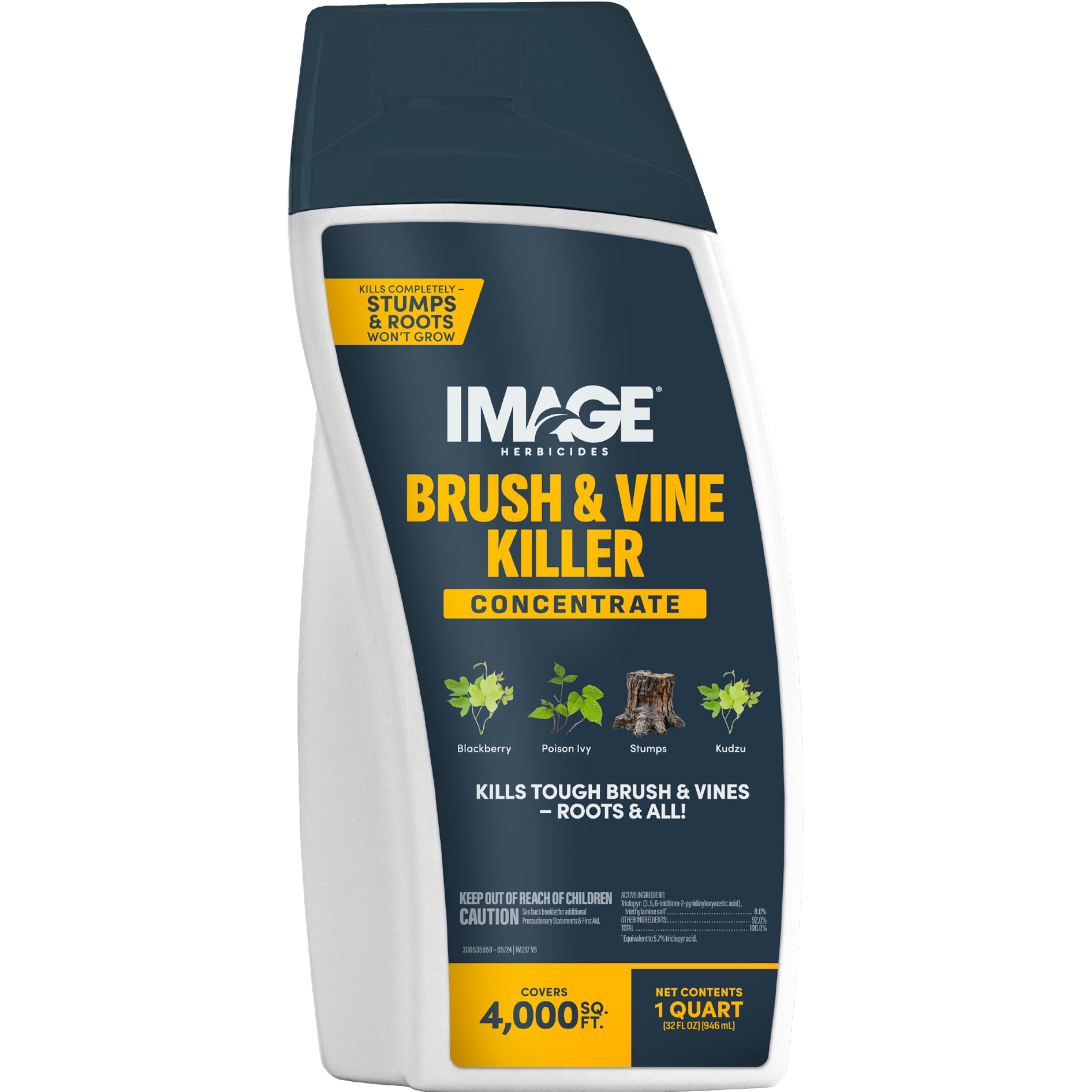
The triclopyr concentrate that tackles kudzu and horsetail at a price that undercuts the premium jugs
At 32 ounces of concentrate, this is a direct competitor to the Southern AG 32 oz bottle, but with an edge on certain tough weeds. Buyers swear by it for horsetail weed and kudzu, two of the most stubborn invasive plants. One reviewer who attacked Himalayan blackberries over 12,000-15,000 square feet reported success mixing it at 4-5 oz per gallon. The leaves yellowed in about 10 days and turned brown and dry by week four — slightly slower than the Southern AG Brush Killer’s one-week timeline on blackberry, but still effective.
It weighs 2 pounds, the same as the ALLIGARE Triumph RTU, but this is a concentrate so you get far more usable spray. The catch is that several buyers report it needs a surfactant added to work well — one reviewer uses a squirt of dish soap in the sprayer. Without it, the chemical may bead up on waxy leaves instead of soaking in.
Why it earns a spot
- Proven killer of tough invasives like kudzu, horsetail, and poison ivy
- Covers up to 4000 square feet per bottle at standard mix rates
- Lower price point than premium concentrates for the same active ingredient
Know before you buy
- Needs a surfactant (like dish soap) to be fully effective on many plants
- Slower action than the Southern AG Brush Killer — takes ~4 weeks for full die-off
Best for: budget-conscious homeowners attacking established patches of kudzu, horsetail, or poison ivy who do not mind adding a surfactant.
skip it if: you want the fastest possible knockdown or need a product that works without additional mixing steps.
7. ALLIGARE Triumph RTU Herbicide
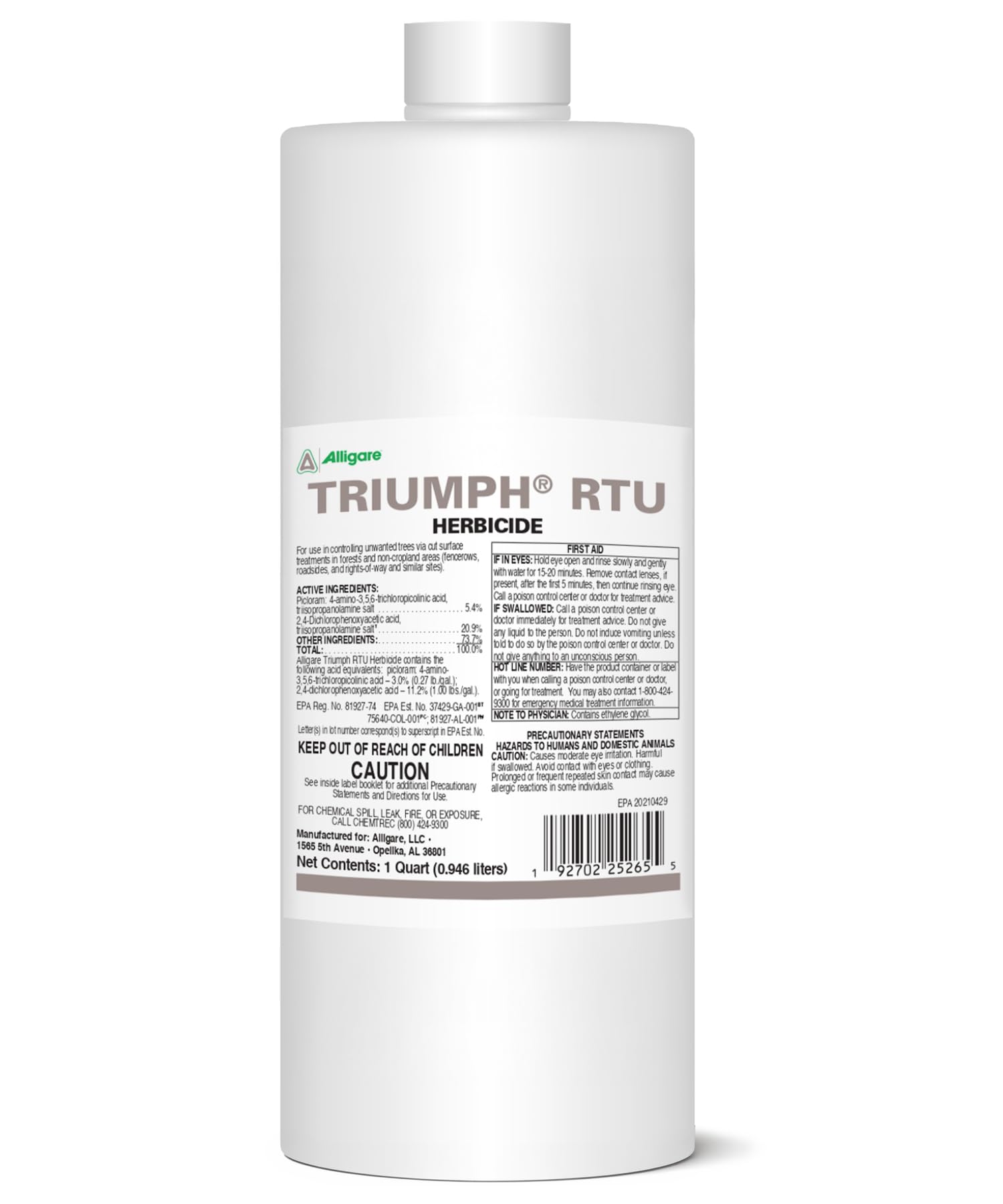
The ready-to-use stump paint that costs less than Tordon while matching its performance
This is the budget-friendly RTU alternative to the Tordon RTU, priced on the entry-level side of the spectrum. It comes in a 1-quart (32 oz) squirt bottle at 2 pounds total weight, and it is designed to be applied directly to cut stumps with no mixing required. It contains both triclopyr and 2,4-D, giving it the same dual-active punch as many premium concentrates. The built-in blue dye lets you see exactly where you have applied the product, which buyers appreciate for avoiding missed spots.
One buyer shared a compelling result: they applied it to small tree stumps, and a year later those stumps “could be kicked away,” meaning the root system had completely rotted. Another ranch owner calls it their go-to product for maintaining fence lines, noting they simply cut the brush, apply the product to the cambium layer, and stop shoots from forming. At a lower price than Tordon RTU, it offers similar performance for homeowners on a tighter budget.
What works well
- Pre-mixed with no measuring; includes blue dye for visible application tracking
- Comparable performance to Tordon RTU at a lower price entry
- Buyers confirm permanent root kill: stumps kicked away a year later
What does not
- Packaging complaints: owners mention caps coming loose during shipping
- Some users saw no results on certain bushes — results can be inconsistent
Grab this for: a quick and affordable cut-stump treatment on fence line brush or small invasive trees where you want RTU convenience.
Watch out: if you have very resilient woody species, test on one stump first before committing to full use.
Understanding the Specs
Triclopyr Concentration
Triclopyr is the active ingredient that makes a shrub root killer effective. It is a systemic herbicide, meaning the plant absorbs it through leaves or cut stems and moves it all the way to the root tips. The concentration level determines how strong the mix needs to be. Concentrates like the Southern AG 32 oz bottle are typically mixed at 4-5 oz per gallon of water. Ready-to-use products like the Ortho MAX are pre-mixed to a specific strength so you cannot mess it up, but you also pay for the water weight in shipping.
Liquid Volume & Coverage
Volume is listed in fluid ounces, quarts, or gallons. A 128-ounce gallon of concentrate like the Remedy Ultra can make dozens of gallons of spray solution, covering large areas or many cut stumps. A 24-ounce RTU bottle like the Ortho MAX covers a much smaller area. For a single stump or small poison ivy patch, a quart (32 oz) or smaller RTU is enough. For fence lines, pastures, or large invasive patches, aim for a concentrate in a quart or gallon size.
FAQ
How does a shrub root killer actually kill the roots?
What is the difference between a concentrate and a ready-to-use root killer?
How long does it take for a shrub root killer to work?
Can I apply shrub root killer to the leaves or does it have to be on a cut stump?
Is triclopyr safe to use around children and pets?
Will a shrub root killer also kill grass or desirable plants?
Does rain affect the effectiveness of a root killer?
How much area does a typical quart of concentrate cover?
Final Thoughts: The Verdict
For the majority of shoppers, the shrub root killer winner is the Remedy Ultra because its 128-ounce jug of pure triclopyr offers the best balance of power, coverage, and proven results for large brush problems. If you want the convenience of a no-mix spray for residential poison ivy, grab the Ortho MAX. And for precision cut-stump work on invasive weed trees like buckthorn and mulberry, the standout is the Tordon RTU.
How We Picked
We do not accept paid placement. Every pick is matched to a real buyer and a real use-case; we do not hands-on test units.
Sources & Methodology
Specifications: manufacturer listings and product documentation. Review insights: verified customer reviews, as of July 2026. Pricing: not shown on this page (it changes often); check the current price via the retailer link.
As an Amazon Associate, Lawn Gear Lab earns from qualifying purchases. This does not affect which products we feature.