
Specs are compiled from manufacturer listings and verified buyer reviews and can change over time — please confirm the key details on the product page before buying.
Bagging leaves gets old fast. You drag wet piles to the curb, pay for yard waste pickup, and still watch the pile shrink slowly. A shredder for leaves turns that whole process upside down: you feed branches and leaves in one end and get nutrient-rich mulch out the other, cutting your waste volume by up to 30x.
I’m Rikta — the founder and writer behind Lawn Gear Lab. This guide is built by comparing the manufacturers’ published specifications and the patterns across verified customer reviews, so you get each pick’s real strengths and trade-offs instead of marketing spin.
if you need a gas-powered chipper for thick branches or a lightweight electric model for dry leaves, this roundup of the best shredder for leaves breaks down seven top contenders with honest pros and cons.
Our Picks at a Glance

How To Choose The Best Shredder For Leaves
Before you look at any machine, decide what kind of yard waste you produce. If you only rake dry oak leaves and pine straw, a lightweight electric mulcher that uses cutting lines (like the Flowtron) can handle the job. If your cleanup includes 2-inch branches from storm damage, you will want a gas-powered chipper with a 7HP engine and a side chute for limbs. Picking a machine that matches your pile size is the single biggest money-saving decision — overbuying power wastes hundreds of dollars, and underbuying makes you fight clogs all afternoon.
Reduction ratio and what it really means
The reduction ratio (like 17:1 or 30:1) tells you how many bags of raw debris shrink into one bag of mulch. A 30:1 reduction means 30 bags of loose leaves become about one bag of fine mulch. That number matters most if you have a large property with heavy leaf drop. But be careful: that ratio depends on the material being dry. Wet leaves pack differently and will lower the effective reduction, so manufacturers usually quote the ratio for dry material. If you live in a wet climate, expect a lower real-world reduction than the box says.
Motor power: amps vs horsepower
Electric models typically use a 15-amp motor (around 1,800 watts) that runs on a standard household outlet. That is enough for branches up to roughly 1.8 inches thick, and the motor is quieter than gas engines. Gas-powered models use a 7HP engine (about 212cc) and can handle 3-inch branches. The trade-off is noise — a gas engine is loud enough to require hearing protection — and maintenance: you have to change oil, use ethanol-free fuel, and replace spark plugs. If your yard has mostly leaves and twigs, save your back and go electric. If you have a woodlot with downed limbs, gas is the realistic choice.
Cutting mechanism: blades vs cutting lines
There are two main cutting systems. Blade-based shredders (like the SuperHandy or Yeryork) use dual-edge steel blades that spin at 3,700–4,100 RPM. These handle sticks and small branches well. Line-based mulchers (like the Flowtron LE900) use braided cutting lines that whip through leaves and pine needles at high speed. The line system is better for pure leaves and grass but struggles with any wood. If you plan to shred mostly leaves with occasional twigs, a blade machine is more versatile. If you only ever feed dry leaves, a line mulcher is lighter and cheaper.
Hopper size and feeding
A wide hopper (21 inches on the Flowtron) lets you drop double handfuls of leaves without pre-sorting. The SuperHandy has a top hopper for leaves and a separate side chute for branches — a 3-in-1 design that saves you from switching tools. Look for a push paddle included in the box; it keeps your hands away from the blades. A small hopper, like the one on the SuperHandy electric model, forces you to feed slowly and can cause leaves to fall back to the ground rather than entering the machine.
Quick Comparison
| Model | Best For | Motor Power | Cutting Capacity | Reduction Ratio | Amazon |
|---|---|---|---|---|---|
| SuperHandy 7HP Gas★ Best Overall | Heavy branch cleanup | 7HP 212cc gas | 3 inches | 15:1 | Amazon |
| LawnMaster FD1503Best Value | Budget branch chipping | 15-amp electric | 1.8 inches | 14:1 | Amazon |
| Yeryork 15-Amp | Compact branch mulching | 15-amp electric | 1.8 inches | 21:1 | Amazon |
| Flowtron LE900 | Dry leaf volume | Universal motor (electric) | Leaves/pine needles only | 30:1 | Amazon |
| SuperHandy Electric 15A | Small budget yards | 15-amp 1800W electric | 1.57 inches | 17:1 | Amazon |
| Landworks Mini 7HP | Compact gas chipping | 7HP 212cc gas | 3 inches | 15:1 | Amazon |
| S1 GARDENBEAUT 7HP | Mid-range gas shredding | 7HP 212cc gas | 3 inches | 20:1 | Amazon |
In‑Depth Reviews
1. SuperHandy Wood Chipper Shredder Mulcher Ultra Heavy Duty 7HP 3 in 1
Our pick — over 4★ from 800+ verified ratings; the strongest balance of quality and price.
The heavy lifter that swallows 3-inch branches whole and turns them into mulch.
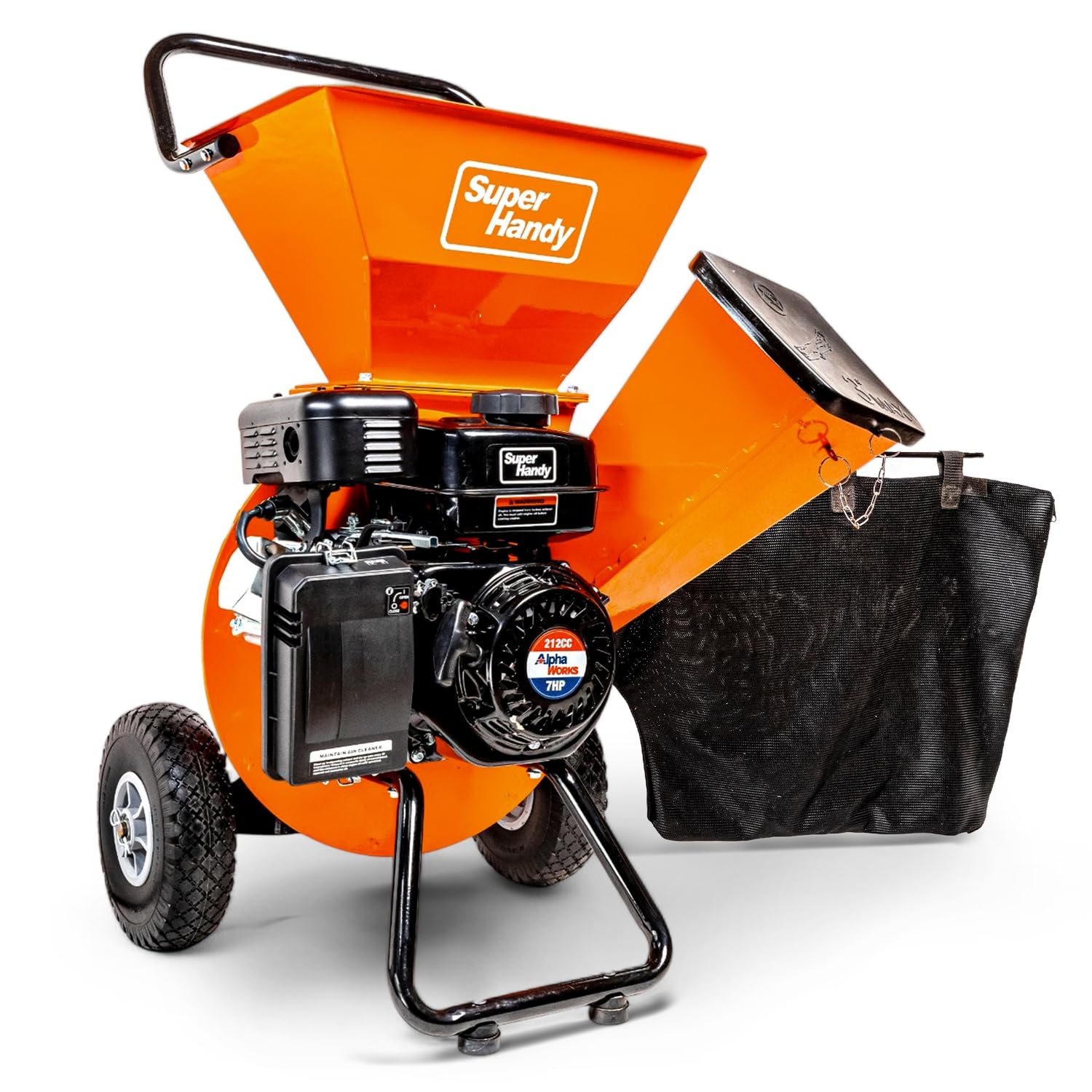
If your yard cleanup involves not just leaves but fallen limbs up to 3 inches thick, this is the machine to beat. The 7HP (the engine’s horsepower rating) 4-stroke OHV gas engine powers a 3-in-1 design: a top hopper for leaves and small debris, a side chute for branches, and an optional leaf vacuum attachment (sold separately). The reduction ratio is 15:1 when you use the top hopper for 1/2-inch material, meaning 15 bags of debris become one bag of mulch. Quoted weight is 133.7 pounds, so at 23.2 pounds on the LawnMaster FD1503, this SuperHandy is considerably heavier — plan for a stationary spot or use the tow bar (sold separately) with an ATV.
Buyers report the 7HP OHV (overhead-valve) engine starts reliably and handles branch cleanup well, but they note: “Chips up to 3″ but over 2″ jams unless short.” That means you need to pre-cut thicker branches to 2–3 feet pieces for smooth feeding. Multiple owners warn that the cloth collection bag wears out quickly from the machine’s power, so many use a tarp under the discharge chute instead. The slanted housing (a design feature where the body angles downward) reduces clogs compared to other chippers, but users say the leaf hopper is less effective than dedicated leaf shredders.
Unlike the electric models below, this gas chipper needs regular maintenance: ethanol-free fuel (87+ unleaded), engine oil (not included), hearing and eye protection, and a warm-up routine. It is EPA/CARB certified (the two main U.S. emissions certifications), so it is legal to buy and operate in California. For homeowners with wooded lots who need to clear multiple pickup loads of branches each season, the sheer capacity of the 3-inch feed chute makes this the most capable option on this list.
Where it dominates
- 7HP gas engine chews through 3-inch branches where electric models stop at 1.8 inches.
- Three separate feed paths handle leaves, sticks, and limbs without swapping machines.
- Slanted housing resists jams better than straight-chute gas models.
- Tow-bar compatible for moving around large properties with an ATV or lawn tractor.
What holds it back
- At 133.7 pounds, it is nearly six times heavier than the 23.2-pound LawnMaster — not a machine you lift or carry.
- Cloth collection bag wears quickly; owners recommend using a tarp instead.
- Loud enough to require hearing protection for the whole session.
- Leaf hopper performance is weak compared to dedicated leaf shredders.
Best for: Homeowners with wooded lots who process branches up to 3 inches thick and have a way to move a 134-pound machine.
skip it if: Your yard has only leaves and twigs — you will pay for power you do not use and fight the weight every time you move it.
2. LawnMaster FD1503 Electric Wood Chipper Shredder
The lightweight electric that punches above its weight on small branches.
At only 23.2 pounds, the LawnMaster FD1503 is the lightest chipper-shredder on this list, yet it still packs a 15-amp motor (the same power class as many bigger electric models) that spins a two-sided blade at 3,700 RPM. It handles branches up to 1.8 inches thick and claims a 14:1 reduction ratio — that is 14 bags of debris reduced to one bag of mulch. The body is made from dent-resistant polypropylene (a tough plastic that does not rust or dent like steel), so you can store it in a damp shed without worry.
Owners mention that the blades dulled after processing about four bins of material, but the machine still chipped through eight total bins of dried maple, walnut, and mulberry without overheating — even with a 100-foot extension cord. One owner noted: “Blades dulled after 4 bins; processed 8 bins total.” That means you should plan to replace or sharpen the dual-edge blade after roughly a season of moderate use. The push paddle lets you feed debris safely, but reviewers caution that the machine does not self-feed: you need to apply constant pressure to keep material moving through the chute.
Compared to the 15-amp Yeryork below, the LawnMaster matches the motor power and cutting capacity but comes with a lower 14:1 reduction ratio versus the Yeryork’s 21:1. That means the Yeryork will compress your waste bag-for-bag a little more, though both produce usable garden mulch. The real advantage here is the price-to-weight ratio: if you need something you can easily carry to the corner of the yard and plug in, this is the most portable electric chipper in the bunch.
what separates it
- Weighs just 23.2 pounds — easy to carry to any corner of the yard and store on a shelf.
- 15-amp motor handles 1.8-inch branches, and customers note reliable operation even with a 100-ft extension cord.
- Dent-resistant polypropylene body will not rust, perfect for damp garage or shed storage.
- Dual-edge blade is simple to flip or replace when dull.
The trade-off
- No self-feed — you must push every branch through, which gets tiring on large piles.
- Blades dull noticeably after processing roughly four bins of material.
- Reduction ratio (14:1) is lower than the Yeryork (21:1) and the Flowtron (30:1).
- Some branches can cause internal clogging that requires manual cleaning to clear.
Ideal for: Homeowners with occasional branch cleanup — you get real chipper power without the back strain of a heavy gas machine.
Consider something else if: You have a large wooded lot with multiple cubic yards of branches each season; the blade dulling rate will require frequent replacements.
3. Yeryork Wood Chipper, 15-Amp 1.8-Inch Cutting Capacity
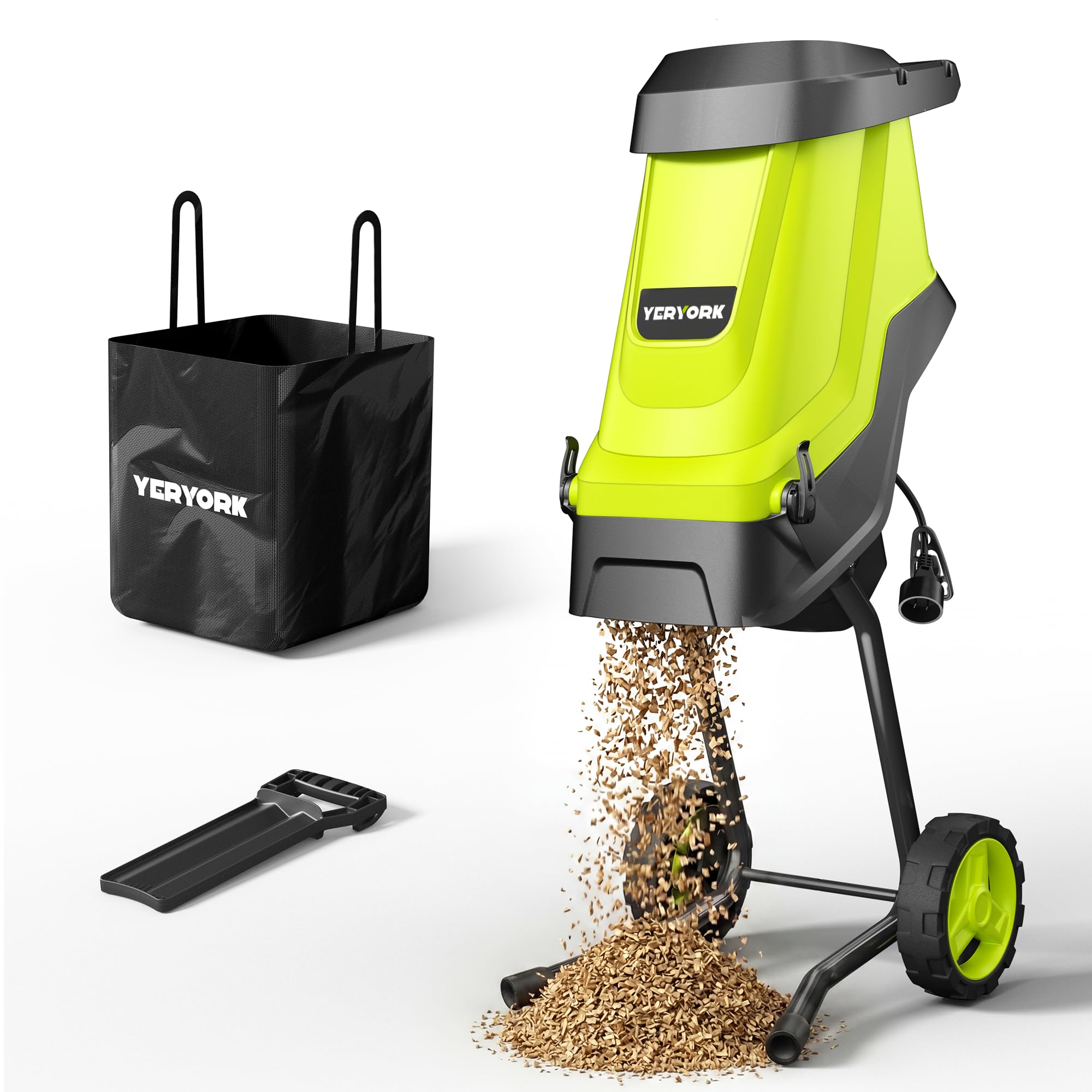
The electric model that squeezes more mulch from every branch with a 21:1 reduction.
This Yeryork chipper holds a higher reduction ratio (21:1) than the LawnMaster while using the same 15-amp motor class. That 21:1 number means one bag of finished mulch comes from 21 bags of raw material — a meaningful difference if you process a lot of yard waste each season. The secret is the 4,000 RPM motor speed (300 RPM faster than the LawnMaster) paired with SK5 high-hardness steel blades (a blade steel known for holding an edge longer than standard steel) that you can flip to the fresh side when one edge dulls.
Buyers consistently praise the anti-jamming design: the machine handles branches up to 1.8 inches without clogging as long as you follow the manual’s feed instructions. One reviewer filled the included 45L collection bag four times in the first week and called it “a workhorse.” The body comes with an IPX4 waterproofing rating (protection against water splashes from any direction), so you can keep it running in light rain without worrying about the motor. At 21.6 pounds, it is lighter than the SuperHandy electric (23.5 pounds) and easier to roll on 7-inch wheels across a lawn.
The catch is that the manufacturer explicitly warns against feeding leaves, old roots, bamboo, dry hay, straw, or frozen branches — materials that can clog the machine or damage the blades. That makes this a branch-first chipper; if your main goal is leaf mulching, the Flowtron line-based design is more appropriate. Still, for a branch-focused electric in the budget-friendly tier, the combination of 21:1 reduction, SK5 blades, and cTUVus safety certification (a North American safety mark that indicates the machine meets U.S. and Canadian standards) makes this a strong mid-range buy.
Strength by the numbers
- 21:1 reduction ratio produces more finished mulch per bag than any other electric branch chipper on this list.
- 4,000 RPM motor spins SK5 high-hardness steel blades for cleaner cuts on 1.8-inch branches.
- IPX4 waterproofing lets you work in light rain without motor damage.
- Dual feed chutes and 7-inch wheels make it easy to maneuver and load.
- cTUVus certified — independently tested for North American safety standards.
Limitations to know
- Explicitly not designed for leaves or pine needles — stick with branch-only feeding.
- No self-feed: you must push material through manually with the included paddle.
- 45L collection bag fills fast if you have more than a small yard’s worth of branches.
Reach for this if: Your yard waste is mostly branches and sticks, and you want the highest reduction ratio you can get from an electric model.
Look elsewhere if: You mainly rake leaves — the manufacturer warns against putting leaves through this machine.
4. Landworks Mini Wood Chipper Shredder Mulcher 7HP

A gas-powered chipper squeezed into a more portable steel frame.
The Landworks Mini packs the same 7HP gas engine and 3-inch cutting capacity as the SuperHandy but in a more compact chassis — dimensions of 34.6 x 32.2 x 22.8 inches — with a vertical discharge chute that swivels between 90° and 145°, so you can aim the mulch pile exactly where you want it. The 15:1 reduction ratio is identical to the SuperHandy gas model, meaning 15 bags of debris compress into one bag of mulch. The body is made from heat-treated powder-coated steel (a rust-resistant steel finish that holds up to outdoor storage), which is tougher than the polypropylene housings on the electric models.
Buyers who have owned the machine for over two years say the engine is reliable with ethanol-free gas, though they needed to replace the blades once after extended use. One long-term review mentions: “Over 2 years, used on poplar to hickory. Replaced blades once due to shredding vs chipping.” The machine self-feeds on material up to 1.5 inches, but larger branches need to be fed gradually. Owners also note that the unit prefers drier wood — fresh green material can clog the chute, and bone-dry wood creates fine dust. The adjustable discharge guide is a handy feature that the SuperHandy gas model lacks: it lets you direct the mulch stream away from your work path.
Compared to the SuperHandy gas chipper, the Landworks is more compact but shares the same engine class. The trade-off is build quality: some reviewers point out weak welds on the wheel base and the chute, though the manufacturer’s customer service sent upgraded replacement parts for free. If you need a gas chipper that takes up less shed space and want the discharge-direction flexibility, this is a solid mid-range alternative to the full-size SuperHandy.
Why it stands out
- Adjustable discharge guide (90°–145°) lets you aim mulch away from your workspace.
- Powder-coated steel body is more durable than polypropylene for long-term outdoor storage.
- Self-feeds material up to 1.5 inches — less manual pushing than electric models.
- EPA/CARB certified, so it is legal to own and operate in all 50 states.
What to watch for
- Some units arrive with weak welds on the wheel base or chute assembly.
- Not designed for fresh green material — prefers dry branches for best performance.
- Small twigs can bypass the blades and clog the discharge chute.
Perfect for: Anyone with limited shed space who still wants the 3-inch cutting power of a 7HP gas engine.
Not ideal if: You process mostly fresh green waste — this chipper prefers dry, seasoned wood to avoid clogs.
5. Flowtron Electric Leaf Mulcher & Shredder LE900

The line-mulcher that turns 30 bags of dry leaves into one bag of compost-ready mulch.
The Flowtron LE900 takes a completely different approach from the blade-based chippers above. Instead of steel blades, it uses two spinning cutting lines (similar to a string trimmer head) inside a wide 21-inch funnel hopper to pulverize dry leaves, pine needles, and grass clippings. The claim is a 30:1 reduction ratio — the highest on this list — meaning 30 bags of loose leaves become roughly one bag of fine mulch. You can adjust the particle size with a sliding lever: set it to coarse (around 8:1) for quick ground cover or fine (30:1) for compost. The machine weighs only 17 pounds, which makes it the lightest unit here and easy to lift onto a trash can or carry to different parts of the yard.
Buyers confirm it works well on dry leaves and pine needles, producing fine powder from pine straw. One owner says the LE900 “turns pine needles into fine powder.” However, the same review notes the efficiency drops as the cutting line shortens. The machine is not designed for sticks or branches — those will either jam the mechanism or damage the lines. Wet leaves are also a problem: owners in humid climates report that the motor weakens and needs frequent resetting. The motor includes a circuit breaker and reset button for overload protection, which you will likely use if you accidentally feed too much wet material.
Unlike the branch-first electric models (LawnMaster, Yeryork), the Flowtron is best when you are dealing with pure leaf volume. It sits directly on a trash can using its freestanding legs, and a bungee cord is included to secure a garbage bag around the discharge opening. Assembly takes about 30 minutes, and cutting lines are easy to replace (36 included). The trade-off is durability: the steel legs and high-density polyethylene funnel (a type of tough plastic that resists impact) feel less sturdy than a metal chipper, and some shoppers say that screws on the hopper pop out during storage.
Best part of this leaf eater
- 30:1 reduction ratio is the highest in this roundup — one bag of mulch from 30 bags of leaves.
- Adjustable coarseness lever lets you switch between fine compost (30:1) and coarse ground cover (8:1).
- Weighs only 17 pounds, so you can move it around the yard or store it on a high shelf.
- Wide 21-inch funnel hopper lets you drop in double handfuls without pre-sorting.
Where it falls short
- Cannot handle sticks or branches — this is a leaf-only machine.
- Wet leaves bog the motor down and trigger the overload reset button frequently.
- Build quality feels less rugged than steel chippers; some buyers report hopper screws loosening over time.
- Efficiency drops as the cutting lines wear down, so you need to replace them regularly.
Grab this for: The peak of leaf season when you are facing dozens of bags of dry leaves and want to reduce them into compost-ready mulch in one pass.
pass on it if: Your property has any branches mixed in with the leaves or you live in a humid area where leaves stay wet for weeks.
6. S1 Wood Chipper 7HP 212cc by GARDENBEAUT

The gas chipper that pairs a 20:1 reduction ratio with a larger rotor for faster shredding.
The S1 uses the same 7HP 212cc engine as the other gas models but steps up the reduction ratio to 20:1 — a meaningful improvement over the 15:1 of the SuperHandy and Landworks. The key difference is a 15.6-inch cutting rotor (a larger spinning drum that houses the blades and hammers) fitted with 2 blades and 6 hammers. The extra hammers help pulverize material into finer mulch more consistently, and the grilling device on the discharge outlet (a grate-like screen) filters the output so only small pieces pass through, while larger chips recirculate for further reduction.
Owners mention that the motor starts on the first pull most of the time and that the machine “demolishes 3″ and under” branches, though it prefers fresh-cut wood over dried material. One owner mentions the need to keep the machine level while running because the low-oil sensor (a safety feature that kills the engine if oil is low) will stall it on uneven ground before the engine gets damaged. That is a step up from the standard plastic wheels on most chippers.
Compared to the Landworks mini, the S1 has a higher reduction ratio (20:1 vs 15:1) and a larger cutting rotor (15.6 inches vs a smaller rotor), which means it processes material faster and produces finer output. The trade-off is that some customers note that the assembly instructions are poor — the diagrams are too small to read, and the choke sticker is backward. There is also a 1-year warranty on the machine’s construction (blades and consumables excluded) after product registration with GARDENBEAUT, which offers modest confidence compared to the Landworks’ more mixed customer service reviews.
What improve it
- 20:1 reduction ratio is the highest among the gas-powered models here.
- 15.6-inch rotor with 2 blades and 6 hammers produces finer, more consistent mulch than competitors.
- 10-inch PU wheels roll easily over rough ground without risk of punctures.
- Low-oil sensor protects the engine from damage during operation.
Drawbacks to consider
- Assembly instructions are poor — small diagrams and a backward choke sticker cause confusion.
- Not self-feeding; you must manually push branches through the chute.
- Some reviewers point out the output chute alignment is difficult to adjust and stays loose.
Choose this if: You want a gas chipper’s durability but want finer mulch output and a higher reduction ratio than the standard 15:1 gas models offer.
Think again if: You are not comfortable with potentially unclear assembly directions — the S1’s manual has been a frustration point in owner reviews.
7. SuperHandy Leaf Shredder Mulcher, Corded Electric 15A

The entry-level corded shredder that handles sticks but struggles with leaves.
This SuperHandy electric model is the most affordable option in the lineup, with a 15-amp 1,800W motor that spins at 4,100 RPM and reduces material at a 17:1 ratio. It can handle branches up to 1.57 inches thick — slightly smaller than the 1.8-inch limit on the LawnMaster and Yeryork. The body is made from durable polypropylene (a rust-resistant plastic), and it rolls on two 6-inch wheels for transport around the yard. Dual-edge reversible blades give you a fresh cutting surface when one side wears down, extending the blade life without buying replacements immediately.
Buyers have mixed experiences: some report the unit is “pretty great” for small branches with a bit of modification, while others point out a critical flaw. One owner reported: “The second time I used it, the base fell apart from the body.” That quote reflects a pattern in the reviews — the plastic housing has durability issues under sustained use, especially when processing larger piles. The hopper is small enough that leaves often fall back to the ground rather than entering the shredder, which makes it frustrating for leaf mulching specifically. Multiple shoppers say it works best for sticks and small branches, with one saying, “If you want a leaf shredder it’s best to get a dedicated one.”
Compared to the other electric models (LawnMaster and Yeryork), this SuperHandy is priced lower but also has a lower maximum cutting diameter (1.57 inches vs 1.8 inches) and a weaker build reputation. If you are in a pinch and need a branch chipper for a season or two, the price is tempting, but the consistent reviews about the base separating from the body and the small hopper make it a tough recommendation. For a few dollars more, the LawnMaster or Yeryork offers better durability and more cutting capacity in the same 15-amp class.
Why it fits a narrow budget
- Lowest entry price of any powered chipper/shredder on this list.
- Dual-edge reversible blades extend usable life without buying replacements.
- Polypropylene body resists rust and dents.
- 6-inch wheels make it easy to roll around a garage or driveway.
What the reviews reveal
- Frequent durability complaints — the base can separate from the body after limited use.
- Small hopper lets lightweight leaves fall out rather than feeding into the blades, making leaf mulching tedious.
- Maximum branch diameter is only 1.57 inches, smaller than similarly-priced electric competitors.
- Not a good fit for leaf-focused buyers despite the “leaf shredder” name.
Only consider this if: Your budget is tight and you need a temporary solution for small twigs and sticks from a small yard.
Pass on this if: You have regular leaf cleanup or expect the machine to last more than a season — the build quality concerns are well-documented in owner reviews.
Understanding the Specs
Reduction Ratio
This number (like 17:1 or 30:1) tells you how much your yard waste volume shrinks after shredding. A 30:1 ratio means 30 bags of raw leaves become one bag of fine mulch. Higher ratios are better for leaf volume, but remember these numbers are typically measured with dry material — wet leaves reduce the effective ratio. If you have a lot of leaves, look for ratios of 20:1 or higher. If you mainly process branches, 15:1 is normal because wood is denser and compresses less.
Cutting Capacity (Inches)
This spec is the thickest branch the machine can accept. Electric models top out at about 1.8 inches, while gas-powered chippers can handle 3 inches. That gap matters: a 3-inch branch is roughly the thickness of a typical fence post, while 1.8 inches is closer to a thick broom handle. Be realistic about the branches in your yard. If you have only twigs and leaves, an electric model saves weight and money. If you have fallen limbs from storms or wooded property, only a gas model with a 3-inch feed chute will handle the job without jamming.
Motor Power (Amps vs Horsepower)
Electric models are rated in amps (typically 15A, which equals about 1,800 watts). That is enough power to spin blades at 3,700–4,100 RPM and chip branches up to 1.8 inches. Gas models are rated in horsepower (typically 7HP, which is about 212cc engine displacement). Gas engines produce more torque (twisting force) for thicker wood, but they are louder, heavier, and need fuel and oil changes. Use an electric model if you have an outdoor outlet within extension cord reach — it is quieter and starts instantly. Use gas if you regularly work far from power or need to chip branches over 2 inches thick.
Cutting Mechanism (Blades vs Lines)
Blade-based shredders use hardened steel blades that spin at high speed to slice through wood and leaves. These are more durable for mixed debris that includes sticks and branches. Line-based mulchers use braided cutting lines (like a string trimmer) that whip through leaves and needles. Line mulchers are lighter and cheaper, but they only work on soft, dry material — never feed them branches or wet leaves. If you need one machine for both leaves and branches, pick a blade-based model. If you only ever shred dry leaves, a line mulcher is the lighter, more compact choice.
Hopper Design
The hopper is the funnel-shaped opening where you feed material. A wide 21-inch hopper (like on the Flowtron) lets you drop in double handfuls of leaves without pre-sorting. A smaller top hopper (13–15 inches) requires slower feeding and can reject leaves that fall out. Some gas models add a dedicated side chute for branches, which is more efficient than feeding limbs through the leaf hopper. Look for a push paddle included in the box — it keeps your hands safely away from the cutting area. A hopper that folds or rotates (like the 180° hopper on the Flowtron) makes storage easier in a small shed.
Portability and Weight
Weight determines how easily you can move the machine around your property and store it. Electric models range from 17 pounds (Flowtron) to 23.5 pounds (SuperHandy electric) — light enough to lift onto a workbench or trash can. Gas models range from 119 pounds (S1) to 133.7 pounds (SuperHandy gas) — too heavy to lift, but they come with wheels and tow-bar options. A gas chipper stays in one spot or gets towed; an electric chipper goes wherever your extension cord reaches. If you have to move the machine across a large yard, prioritize wheel size (7–10 inches) and frame stability.
FAQ
Can I put wet leaves through a leaf shredder?
What is the difference between a wood chipper and a leaf shredder?
How long does a leaf shredder blade last?
Do I need hearing protection for an electric leaf shredder?
Can I use a leaf shredder to make compost?
What size extension cord do I need for an electric chipper?
Can I shred pine cones and pine needles?
What maintenance does a gas leaf chipper need?
Is a higher reduction ratio always better?
Can I shred garden vines and corn stalks?
Final Thoughts: The Verdict
For most people, the shredder for leaves winner is the SuperHandy 7HP Gas because it handles both leaves and 3-inch branches with true 3-in-1 versatility and a proven track record from over 800 ratings. If you want a quiet, light electric model that still chisels through 1.8-inch branches, grab the Yeryork 15-Amp with its 21:1 reduction ratio. And for pure leaf-to-mulch conversion on a budget, the standout is the Flowtron LE900 with its 30:1 reduction and 17-pound weight that lets you set it directly on a trash can.
How We Picked
We do not accept paid placement. Every pick is matched to a real buyer and a real use-case; we do not hands-on test units.
Sources & Methodology
Specifications: manufacturer listings and product documentation. Review insights: verified customer reviews, as of July 2026. Pricing: not shown on this page (it changes often); check the current price via the retailer link.
As an Amazon Associate, Lawn Gear Lab earns from qualifying purchases. This does not affect which products we feature.