
Forgetting to water for three days shouldn’t mean your tomatoes curl up and surrender. The problem isn’t your memory — it’s the conventional raised bed that drains too fast or floods at the first sign of rain. A proper self-watering design uses a sub-irrigation reservoir beneath the soil, letting roots drink on demand while the surface stays dry enough to discourage fungus. That changes the calculus for anyone who travels for work, lives in a fluctuating climate, or simply wants stronger plants without the daily chore.
I’m Rikta — the co-founder and writer behind Lawn Gear Lab. I’ve spent countless hours cross-referencing reservoir capacities, material thicknesses, wicking efficiencies, and hundreds of verified owner reports to separate the planters that genuinely automate hydration from those that just sprinkle marketing dust on a standard pot.
Whether you need a compact unit for herbs on a balcony or a wheeled metal bed for a citrus tree on the patio, the right best self watering raised garden bed becomes a silent partner in your garden that handles the moisture math while you just enjoy the growth.
How To Choose The Best Self Watering Raised Garden Bed
Every self-watering bed works on the same basic principle — a reservoir holds water beneath the soil, and capillary action (wicking) draws moisture upward as the roots need it. But the execution varies wildly. The wrong choice leaves you with a soggy mess or a reservoir that evaporates in two days. Here are the three specs that separate a functional system from a frustrating one.
Reservoir Depth and Wicking Efficiency
The reservoir should sit at least 3 to 4 inches deep to provide a meaningful buffer between waterings. Shallow troughs dry out rapidly in warm weather, defeating the purpose. Look for designs that separate the soil from the water with a perforated platform or wicking fabric — this creates an air gap that prevents the soil from becoming saturated mud. The wicking medium (often geotextile fabric or a grid of capillary posts) must be robust enough to lift water to the full soil depth, not just the bottom inch.
Material Durability and UV Resistance
Polypropylene and polyethylene planters are lightweight and won’t rust, but their longevity depends entirely on UV stabilizers in the resin. Cheap plastic degrades into brittleness after a single season of full sun. Galvanized steel offers superior structural rigidity and a longer lifespan, but you must verify that the interior coating is food-grade and that the galvanization won’t leach zinc into acidic soil over time. Powder-coated metal with stainless steel hardware represents the premium tier for permanent installations.
Soil Depth for Root Development
A self-watering bed must provide at least 10 to 12 inches of true soil depth above the reservoir for tomatoes, peppers, and root vegetables. Shallow beds (6 to 8 inches) limit you to lettuce, herbs, and strawberries. Measure from the top of the growing medium down to the wicking platform — not from the top of the planter rim, which often includes empty space above the soil line.
Quick Comparison
On smaller screens, swipe sideways to see the full table.
| Model | Category | Best For | Key Spec | Amazon |
|---|---|---|---|---|
| Vegepod Small | Premium Kit | Waist-height wicking system | 39.4″ x 19.7″ bed + stand | Amazon |
| Vego Garden Rolling Metal Gen 2 | Premium Metal | Mature trees on wheels | 24″ round, 3.5″ wicking cell | Amazon |
| Lineware Galvanized Raised Bed | Mid-Range Metal | Spray irrigation & greenhouse cover | 48″ x 24″ x 56″ incl. legs | Amazon |
| Dexceder 18×17 Planter with Wheels | Mid-Range Pot | Large floor plants, mobility | 18″ diameter, 3-week reservoir | Amazon |
| Megawodar 3-Pack Elevated | Mid-Range Set | 3-unit elevated herb garden | 29.7″ x 14.4″ x 29.1″ each | Amazon |
| Mayne Cape Cod 14-Inch Square | Budget Planter | Fade-resistant entryway planter | 14″ square, double-wall PE | Amazon |
| Step2 Tremont Short Square 2-Pack | Budget 2-Pack | Lightweight porch decor | 15″ x 15″ x 14″, 0.5 cu ft | Amazon |
In‑Depth Reviews
1. Vegepod Small Raised Garden Bed

The Vegepod is the most thoughtfully engineered self-watering system in this lineup, and it shows in the details. The wicking mechanism uses a capillary fabric that draws water upward from the reservoir into the full soil depth, so established plants can go weeks without a top-up. The modular design clicks together in about 20 minutes, and the optional stand lifts the bed to 39.4 inches — a genuine back-saver for anyone who doesn’t want to kneel.
The included Vegecover functions as a greenhouse dome that tempers sun intensity and blocks pests, while the misting kit (sold separately) adds overhead humidity for seedlings. At 39.4 inches by 19.7 inches, the footprint is compact enough for a balcony or small patio, yet the 12-inch soil depth handles peppers, bush tomatoes, and root crops without restriction. Multiple owners report that the reservoir, once filled, sustains peppers and herbs for several weeks during moderate weather.
The main trade-offs are the price and the reliance on proprietary parts — the wicking fabric and cover clips are Vegepod-specific, so replacements must come from the same brand. The assembly instructions assume some familiarity with the system; a few users found the provided clips for the canopy slightly undersized. Still, for a dedicated gardener who wants a nearly self-sustaining microclimate, this is the gold standard.
What works
- Deep wicking reservoir sustains plants for weeks without refilling
- Patented Vegecover creates pest barrier and temperature buffer
- Stand option elevates bed to comfortable waist height
- High-density polypropylene resists UV degradation
What doesn’t
- Proprietary wicking fabric must be replaced through Vegepod
- Cover clip quality was inconsistent in some early batches
- Small footprint limits sprawling vining crops
2. Vego Garden Rolling Metal Citrus Tree Planter Gen 2
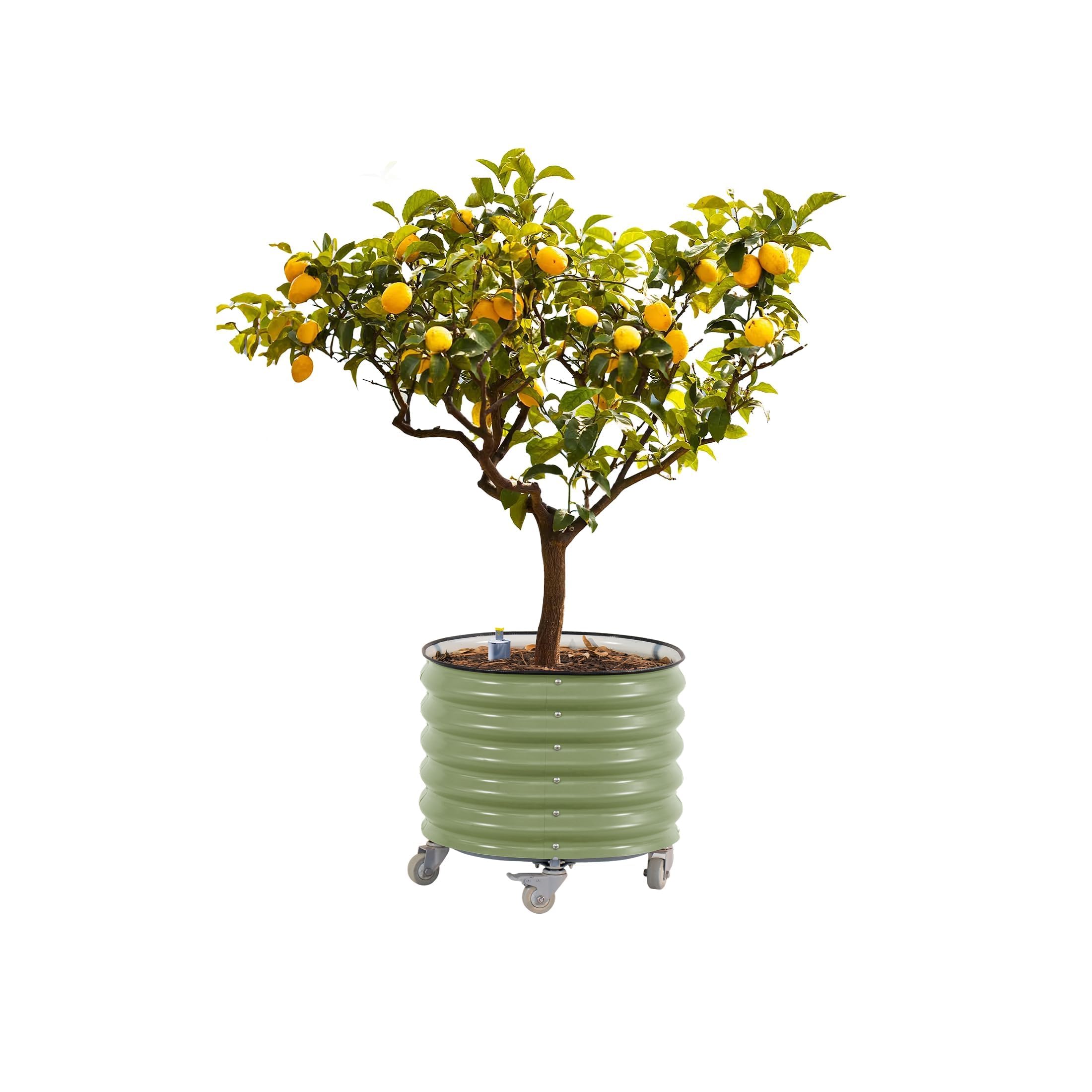
This is not a planter for shallow ornamentals. With a 24-inch diameter and 17-inch height, the Vego Garden Gen 2 is built for the serious home orchardist who wants to grow a dwarf Meyer lemon or a fig tree on a patio. The self-watering wicking cell at the bottom stands 3.5 inches tall, and the reservoir holds enough volume to keep a mature citrus hydrated for days. The metal body uses VZ 2.0 corrosion-resistant steel with a powder-coated olive green finish, and all hardware is Grade 304 stainless steel — no rust spots after repeated wet-dry cycling.
The four heavy-duty locking casters roll smoothly over concrete and wood decking, which is essential if you need to chase sun or shelter a frost-sensitive tree indoors during winter. Assembly requires about four hours because the metal panels bolt together with precision, and the instructions skip one critical step: you must fill the reservoir with water before you add soil, or the wicking cell collapses under the weight. Online videos clarify the process, but the manual should be updated.
Owner reports consistently praise the sturdiness and the fact that the self-watering reservoir actually works for deep-rooted plants — a rarity in this category. The downsides are the assembly time, the price, and the fact that the wheels only roll well on smooth, level surfaces. If you plan to keep this on a bumpy gravel patio, the rolling advantage vanishes. For everyone else, this is the most durable self-watering bed in the round category.
What works
- 3.5-inch wicking cell supports large trees and deep roots
- Stainless steel hardware and powder coat resist rust completely
- Locking casters make seasonal relocation easy
- Generous internal volume for a single mature specimen
What doesn’t
- Assembly is time-consuming and the manual misses a critical step
- Wheels require smooth flat surfaces to function properly
- Heavier than plastic alternatives when filled with wet soil
3. Lineware Galvanized Raised Garden Bed with Self-Watering System
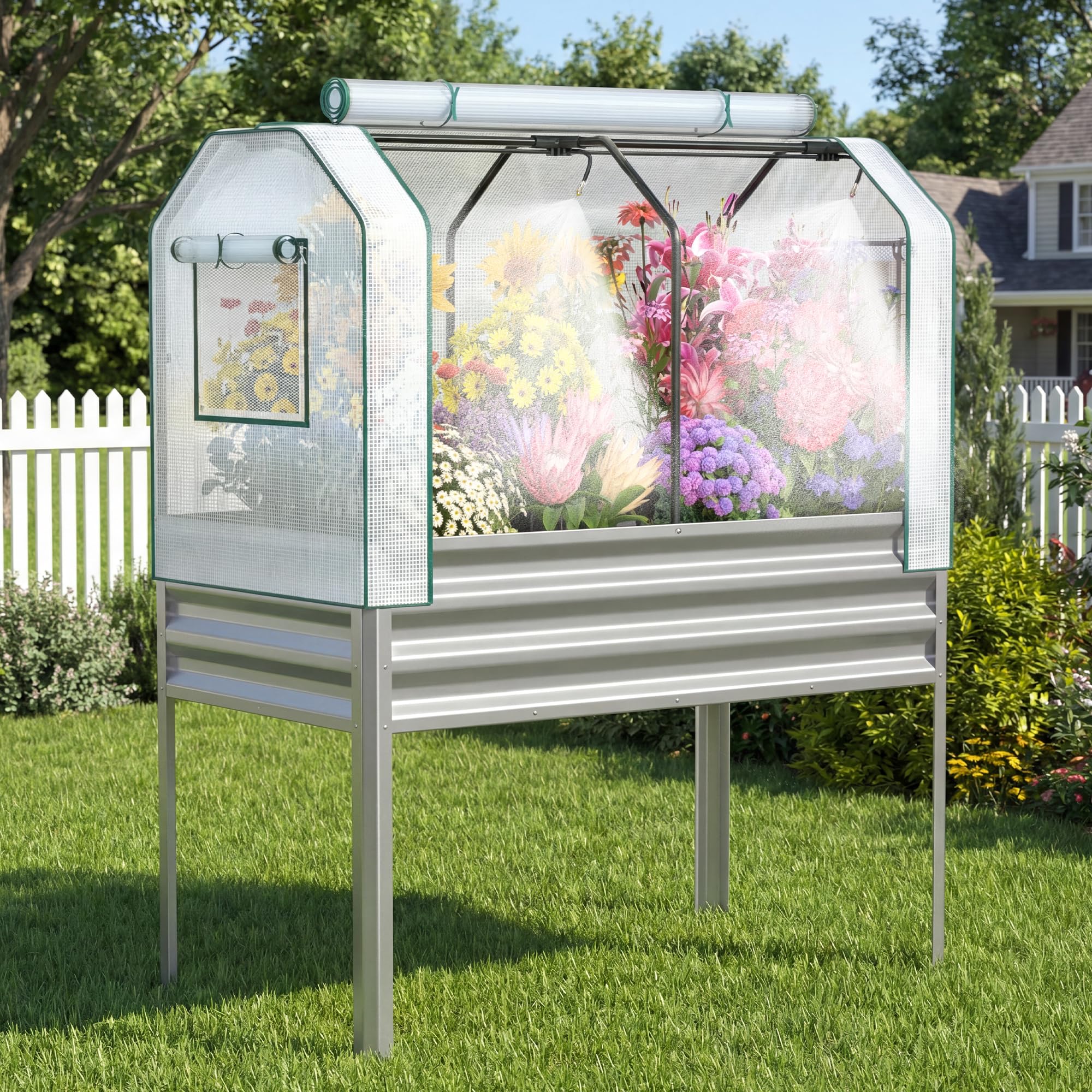
Lineware takes a different approach to self-watering — instead of a passive wicking reservoir, this bed integrates a spray irrigation manifold that distributes water evenly across the entire soil surface. The system hooks up to a standard garden hose, and the misting heads cover the full 48-by-24-inch growing area without dry spots. This is ideal if you grow a mix of plants with varying water needs, because you control the duration and frequency at the spigot rather than relying on capillary action through a single wick.
The galvanized steel panels provide structural rigidity that plastic beds can’t match, and the 32-inch legs elevate the bed to a comfortable working height — no stooping. The included PE greenhouse cover with two mesh windows creates a microclimate that extends the season by several weeks in cooler zones. Drainage is handled by multiple holes in the floor plus a non-woven fabric layer that prevents soil loss while letting excess water escape. Owners consistently mention that the drip mist system caused rapid seed germination and strong early growth.
Assembly requires a screwdriver (the included one is flimsy), and the greenhouse cover lacks clips to secure rolled-up flaps — you have to tie knots, which is awkward when opening and closing solo. The spray irrigation also means you need a hose connection within reach; this isn’t a portable solution. But for a dedicated vegetable grower who wants hands-free watering with season extension, the Lineware delivers a practical, robust package.
What works
- Spray irrigation system eliminates dry spots and manual watering
- Galvanized steel panels resist warping and rust
- Elevated 32-inch legs prevent back strain during maintenance
- Greenhouse cover extends growing season effectively
What doesn’t
- Cover flaps lack clips for easy roll-up; require tying
- Requires constant hose connection for irrigation to function
- Included screwdriver is poor quality; use your own
4. Dexceder 18×17 Self Watering Planter with Wheels

Dexceder pours serious manufacturing quality into a self-watering floor pot that looks more like a piece of furniture than a gardening tool. The container body uses a multi-layer automotive-grade matte process that gives the polypropylene a ceramic-like finish — no mold lines, no cheap gloss. The sub-irrigation reservoir sits beneath a removable inner pot with hidden handles, so you can lift the entire root ball out for repotting or inspection without disturbing the outer shell. The water level indicator on the side gives you a clear visual of how much reserve remains, removing the guesswork.
The 18-inch diameter and 17-inch height provide enough soil volume for a large fiddle leaf fig, a dwarf citrus, or a dense collection of herbs. The drainage plug and spillway hole let you customize water retention — leave the plug in for self-watering mode, pull it out for rainy outdoor conditions. Owner reports confirm that the reservoir can sustain a large houseplant for three weeks or more, though the water gauge occasionally sticks and needs a light tap to register correctly.
The wheels are a practical upgrade for anyone moving a heavy pot across a deck or indoor floor, and they lock in place to prevent accidental rolling. The main limitation is that this is a single floor pot, not a raised bed for vegetables — the depth is generous, but the footprint is circular and limited. For a statement houseplant or a patio anchor, it’s excellent. For row vegetables, look at one of the rectangular beds above.
What works
- Automotive-grade matte finish resists fading and scratching
- Removable inner pot simplifies plant swapping and cleaning
- Water level indicator provides clear reservoir status at a glance
- Drainage plug accommodates both indoor and outdoor use
What doesn’t
- Water gauge occasionally sticks; needs manual correction
- Single round pot limits crop scale and configuration
- Higher price per cubic foot compared to rectangular beds
5. Megawodar 3-Pack Elevated Self Watering Raised Garden Bed
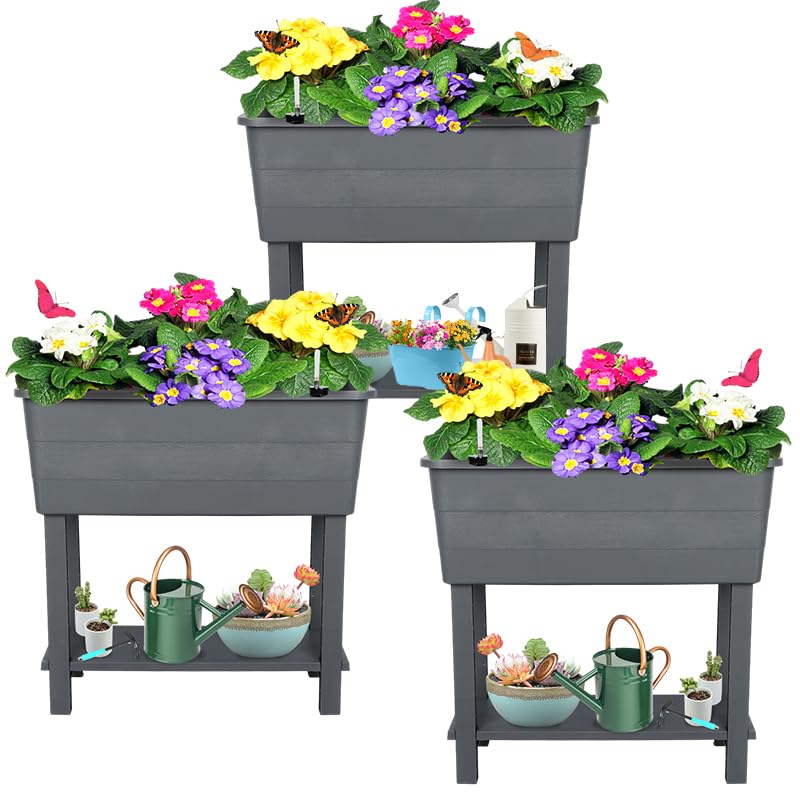
The Megawodar 3-pack fills a specific niche: three self-contained elevated planters that arrive at a competitive per-unit price. Each unit measures 29.7 inches long by 14.4 inches wide by 29.1 inches tall, with the growing surface sitting at a comfortable standing height. The self-watering reservoir uses a float gauge and fill tube system, and the drainage can be toggled open or closed to control water volume. Assembly requires no tools — the panels snap together in minutes, which owners consistently describe as refreshingly straightforward.
The polypropylene plastic is sturdy enough to hold wet soil without bowing, and the dark grey color hides dirt buildup well. Each planter includes a water gauge that shows when the reservoir needs refilling, and the reservoir can supply moisture for two to three weeks depending on plant type and weather. The elevated legs include a lower shelf that provides extra storage for tools or pots, a clever space-saver for small patios. Owners report successfully growing herbs, strawberries, and compact tomatoes in these units.
The critical weakness is the drainage design — the holes must be left open to prevent flooding during heavy rain, which means the self-watering reservoir empties in a downpour and you lose the buffer. Some owners add burlap or landscape fabric at the bottom to create a barrier between soil and the drainage slots. Also, the instructions are minimal to nonexistent; the assembly is simple enough, but first-timers may want to look up a video guide before starting.
What works
- Three planters for a bundle price that undercuts single units
- Tool-free snap assembly saves significant setup time
- Built-in water gauge and storage shelf add functional value
- Elevated height reduces bending during planting and harvest
What doesn’t
- Drainage holes must stay open; reservoir flushes in heavy rain
- Instructions are sparse; assembly relies on common sense
- Plastic UV stability is unverified over multiple seasons
6. Mayne Cape Cod 14-Inch Square Planter
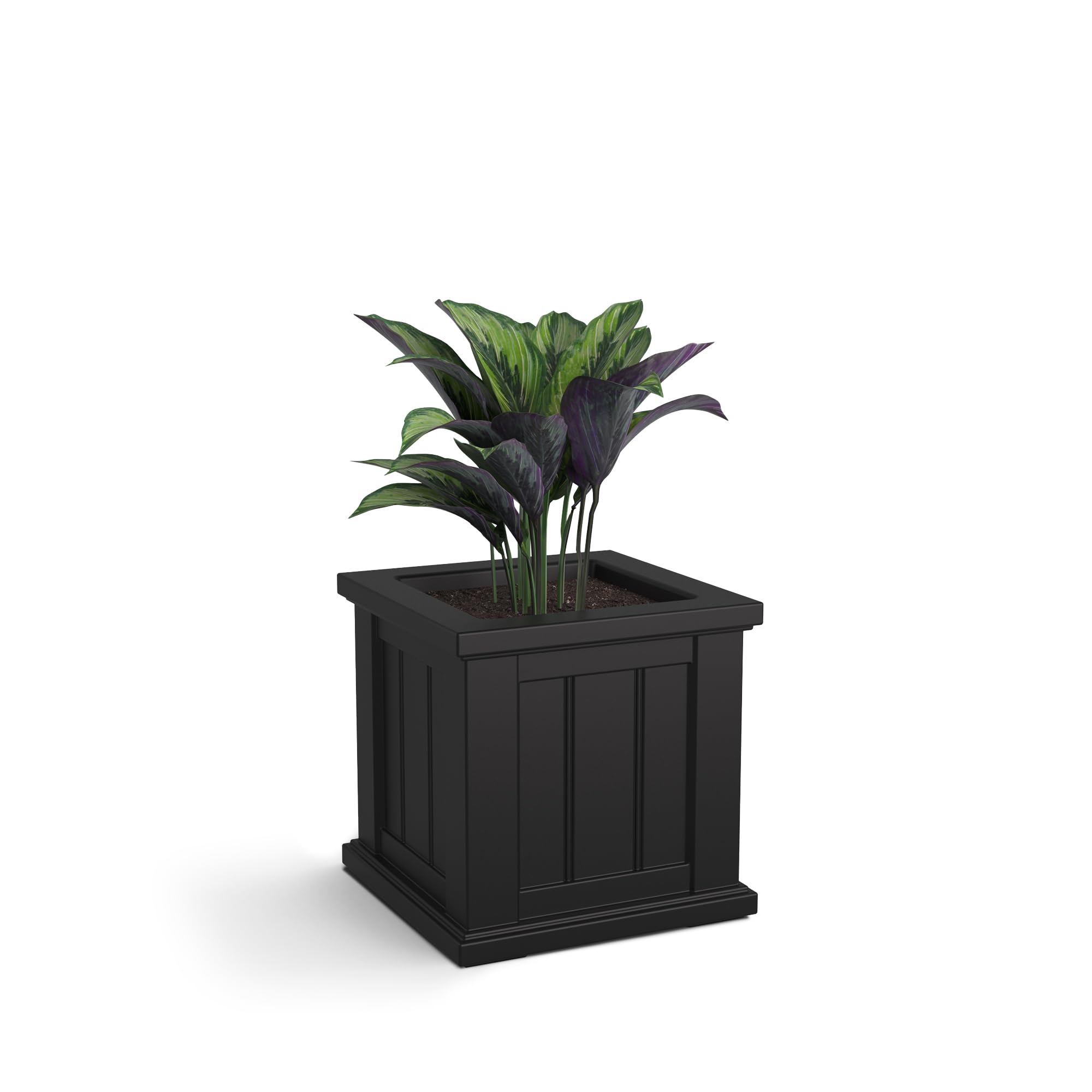
The Mayne Cape Cod planter is a rotational-molded polyethylene container that prioritizes weather resistance and aesthetic longevity above all else. The double-wall construction insulates roots against temperature swings while the UV-stabilized resin resists fading — real fade resistance, not a marketing claim. Owners who placed these on south-facing porches report that the black color remains rich after multiple seasons of direct sun. The self-watering feature uses a sub-irrigation reservoir with overflow drainage, and the entire unit is backed by a 15-year limited residential warranty, which is unusually strong for this category.
At 14 inches square, this is not a large vegetable bed. It’s a decorative entryway planter that happens to include a working self-watering system. The soil depth is adequate for annual flowers, compact herbs, and small shrubs, but you won’t grow full-size tomatoes here. The lack of pre-drilled drainage holes is a deliberate design choice — you drill only where needed, which lets you control drainage for specific plants or climates. The polyethylene material feels dense and heavy enough that it won’t tip in wind, yet light enough to reposition when empty.
The primary drawback is the price per unit relative to the growing volume. You’re paying for the manufacturing location (USA), the 15-year warranty, and the fade resistance, not for cubic inches of soil capacity. The self-watering function also lacks a water level indicator, so you have to check the reservoir manually. For a premium look with low maintenance on a front porch, this planter is excellent. For bulk vegetable production, it’s overpriced and undersized.
What works
- Double-wall polyethylene insulates roots from extreme temperatures
- UV-stabilized resin maintains color for years in full sun
- 15-year residential warranty provides long-term confidence
- Made in USA with high manufacturing consistency
What doesn’t
- Small 14-inch footprint limits crop variety
- No water level indicator in the reservoir
- High cost per cubic inch of growing medium
7. Step2 Tremont Short Square Planter 2-Pack
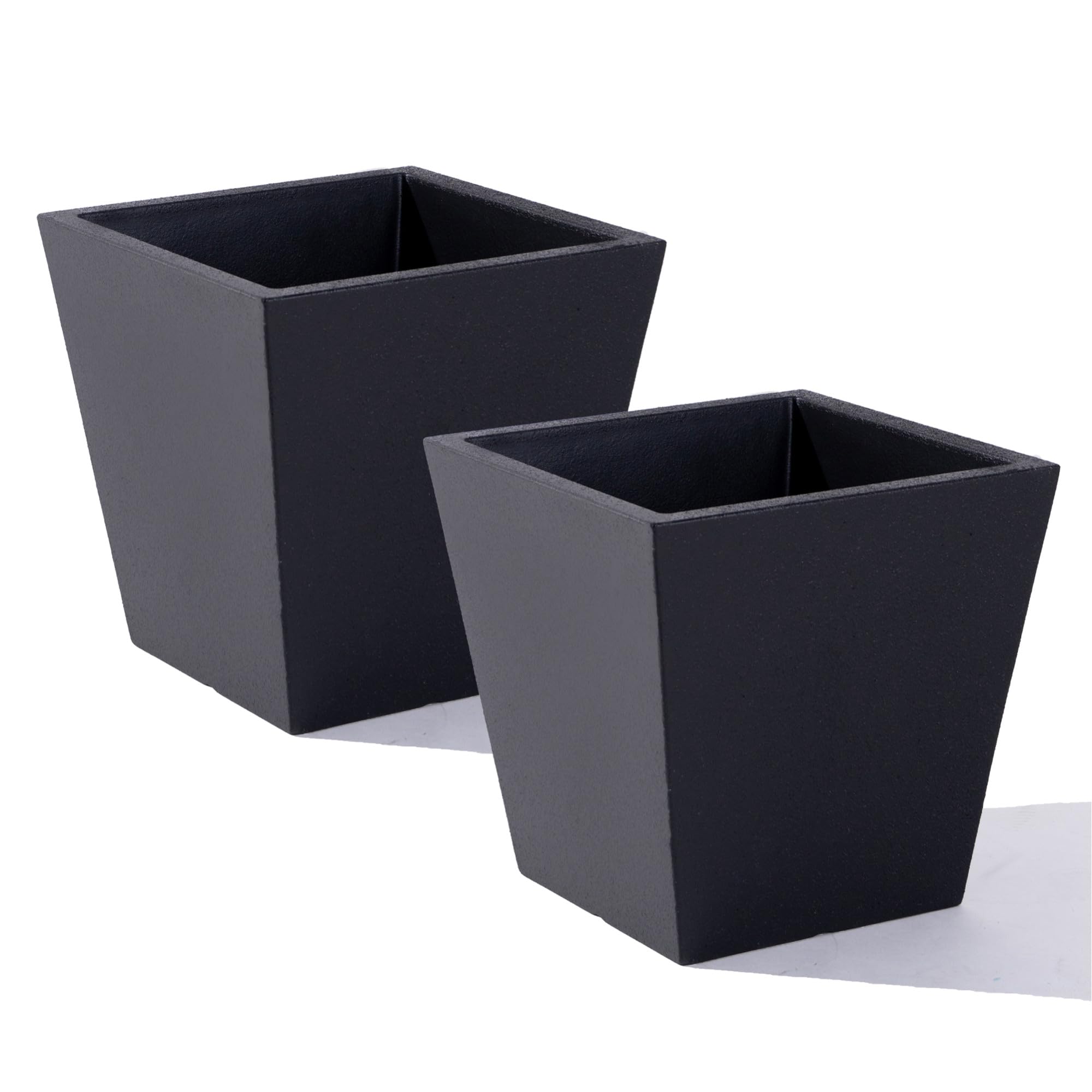
The Step2 Tremont planters are the shallowest option in this lineup at 14 inches tall, with a usable soil depth that tops out around 10 inches after accounting for the reservoir. The self-watering sub-irrigation system is straightforward — a built-in tray beneath the soil holds water that wicks upward through capillary action, and integrated drill points let you add drainage holes if you’re growing thirsty plants or dealing with rainy conditions. Each planter arrives fully assembled, so you can unbox, fill with potting mix, and plant in under five minutes.
The resin construction is lightweight (5.2 pounds each) yet feels solid enough to resist cracking from minor impacts. The onyx black color and polished finish give these a clean, modern look that blends well with most porch and patio styles. Owners consistently praise the ease of setup and the fact that the self-watering system actually keeps flowers and herbs hydrated without constant attention. The 0.5 cubic foot capacity per planter is adequate for a half-dozen annuals or a dense herb planting.
The compromises are significant for serious gardeners. The shallow reservoir dries out quickly in hot weather, and the planter lacks a water level indicator, so you have to check by inserting a finger into the soil. Some owners note that the wicking performance would improve if the manufacturer included a wick or capillary fabric — the current design relies purely on soil contact with the reservoir floor, which can create uneven moisture distribution. These are fine for decorative flowers or low-maintenance greenery, but they’re not built for demanding edibles.
What works
- Arrives fully assembled; zero setup time required
- Lightweight resin is easy to move and reposition
- Integrated drill points allow customized drainage
- 2-pack offers good value for entryway symmetry
What doesn’t
- Shallow reservoir dries quickly in warm weather
- No wick or fabric to improve capillary water movement
- Lacks a water level indicator for reservoir status
Hardware & Specs Guide
Wicking Cell Depth
The height of the water reservoir below the growing platform determines how long the bed can go between refills. Deeper cells (3.5 inches and up) provide days of buffer and support consistent capillary action. Shallow cells (under 2 inches) evaporate rapidly and force roots to stay near the surface, negating the self-watering advantage. Always measure the reservoir depth explicitly — some manufacturers quote the total planter height, not the usable water storage.
UV Stabilization & Material Grade
Polypropylene and polyethylene garden beds must contain UV inhibitors to prevent photodegradation. Without stabilizers, the plastic becomes brittle within one to two seasons of full sun exposure. Galvanized steel and powder-coated metal offer superior longevity but add weight. Check that any metal used for edible crops has a food-grade interior coating — raw galvanization can leach zinc into acidic soil over time, which may affect root vegetables.
FAQ
How often do I need to refill a self watering raised garden bed?
Can I use a self watering bed for root vegetables like carrots or potatoes?
Does the galvanized metal affect soil pH or plant health?
Final Thoughts: The Verdict
For most gardeners, the best self watering raised garden bed winner is the Vegepod Small because its wicking system, protective cover, and optional stand deliver a genuinely hands-off growing environment in a compact footprint. If you want the mobility and durability to grow a mature tree on a patio, grab the Vego Garden Rolling Metal Gen 2. And for a budget-friendly way to start three elevated beds on a balcony, nothing beats the Megawodar 3-Pack for value and convenience.