
A seed starting system is the most critical investment you’ll make for your indoor garden, yet most kits fail because of weak light penetration, uneven moisture, or flimsy trays that crack mid-season. The difference between leggy, pale seedlings and stocky, transplant-ready plants comes down to the hardware you choose—spectrum-optimized LEDs, a vapor-tight humidity dome, and a root zone that never dries out or floods.
I’m Rikta — the co-founder and writer behind Lawn Gear Lab. I’ve spent hundreds of hours dissecting the technical specs of seed starting systems: comparing photon flux density (PPFD) maps, measuring cell depth for taproot development, evaluating heat mat temperature consistency, and cross-referencing thousands of owner reports to identify which designs actually produce reliable germination rates season after season.
Whether you are raising microgreens on a kitchen counter or preparing a full vegetable transplant lineup, the right kit eliminates the two biggest failure points—inconsistent warmth and insufficient light. This guide narrows the field to the seven most capable options to help you choose a seed starting system that turns every seed into a vigorous plant.
How To Choose The Best Seed Starting System
Choosing a seed starting system means balancing light output, heat delivery, moisture control, and cell capacity. A kit that works for starting 12 basil pods on a windowsill may be too weak for a 120-cell tomato operation. Focus on the three pillars that separate a reliable kit from a disappointment.
Light Quality and Coverage
Not all grow lights are equal. Look for full-spectrum LEDs with a minimum of 20-24 total watts for a standard 10×20 tray footprint. Systems that use strip LEDs embedded in the dome lid concentrate light directly above each cell, creating more uniform PPFD than bar lights mounted on the perimeter. Adjustable brightness and a timer (3/6/12-hour cycles) allow you to match the light stage to your crop without manual intervention.
Heat Mat Thermostat Control
A waterproof heat mat sized to your tray (commonly 10×20 inches) keeps soil at the optimal 75-85°F range for most vegetable seeds. Mats without a thermostat can overshoot, cooking delicate root tips. Models with an adjustable dial let you dial down for cool-season crops or dial up for peppers and eggplant. The mat should be rated for continuous indoor use and should not create a temperature delta of more than 5°F across the pad surface.
Dome Design and Airflow
The humidity dome maintains near-100% relative humidity during germination, but stale air invites mold and damping-off. Adjustable vents on the dome top give you control: fully closed for the first 2-3 days, then gradually opened as cotyledons emerge. The dome should be tall enough (at least 4-5 inches) to accommodate seedlings for 10-14 days before needing removal, and the plastic should be thick enough—3mm or more—to resist cracking when cleaned between seasons.
Cell Configuration and Drainage
Standard 1.5-inch cells work well for herbs and leafy greens, while deeper 2-inch cells suit tomatoes, peppers, and squash that develop long taproots before transplant. Trays with removable silicone or rubber bottoms allow easy push-out of root plugs without tearing delicate roots. Drainage holes at the bottom of each cell prevent waterlogging; paired with a capillary mat or a reservoir bottom tray, they enable bottom-watering that keeps the foliage dry.
Quick Comparison
On smaller screens, swipe sideways to see the full table.
| Model | Category | Best For | Key Spec | Amazon |
|---|---|---|---|---|
| AC Infinity Heavy-Duty 5×8 | Premium Kit | Serious propagators | 3mm dome + Samsung LM301H LEDs | Amazon |
| Ahopegarden 12-Pod | Hydroponic System | Soilless growing | 5L tank + LCD touch panel | Amazon |
| URUQ 8-Pod Hydroponic | Compact System | Kitchen counter herbs | 24W LED + <20 dB pump | Amazon |
| Guioiby 120-Cell Kit | Large Capacity | High-volume transplants | 120 cells + 5 brightness levels | Amazon |
| BlumWay 2-Pack 80 Cell | Dual Tray Kit | Two-stage sowing | 80 lamp beads + 360° spectrum | Amazon |
| GROWFRIEND 40-Cell Kit | All-In-One | First-time seed starters | 40 cells + heat mat + meter | Amazon |
| SOLIGT 3-Pack 72 Cell | Self-Watering | Low-maintenance watering | Capillary mat + clear reservoir | Amazon |
In‑Depth Reviews
1. AC Infinity Heavy-Duty Humidity Dome 5×8 Germination Kit

This is the only kit on the market using Samsung LM301H EVO diodes—the same chips found in premium commercial horticulture lights—paired with a 3mm-thick humidity dome that resists cracking under repeated expansion and cleaning cycles. The dome includes height extension panels that raise the headroom to 10 inches, letting you keep the cover on for a full 2-3 weeks before transplanting. The included 10×20 heat mat has an adjustable dial, and the drip tray is sturdy enough to hold 40 rockwool cubes or cell trays without bowing.
PPFD readings with the extender installed range from 73 to 360 μmol/m²/s across the tray surface, which is sufficient for vegetative growth of peppers, tomatoes, and leafy greens. Without the extender, the corner readings drop below 30 μmol/m²/s, so you will want to use the extension from day one. The LED light bars can be programmed with an on/off schedule, and the driver runs cool enough to sit directly on the dome without overheating the interior.
Owner feedback over a full year of continuous use notes that the center of the tray dries slightly faster than the edges, which means you need to rotate or monitor moisture levels in the middle cells. The kit does not include a thermometer/hygrometer, so you should add one to track dome conditions. For growers who want a single, expandable platform that matches the build quality of AC Infinity’s exhaust fans and tent gear, this system is the most durable long-term investment.
What works
- Samsung LM301H diodes deliver commercial-grade PPFD for strong stems
- 3mm dome with extension panels provides 10-inch clearance for tall seedlings
- Complete all-in-one design: lights, mat, tray, and dome in one box
What doesn’t
- Center cells dry out faster than edge cells, requiring moisture monitoring
- No built-in thermometer or hygrometer included for dome climate tracking
- Light intensity at tray corners falls significantly without the extender installed
2. Ahopegarden Hydroponics Growing System Kit 12 Pods

This hydroponic countertop system shifts the paradigm from soil-based seed starting to soilless cultivation, using a 5-liter reservoir and an ultra-quiet pump that circulates water on a 30-minute cycle. The LCD touch panel gives you one-tap control over dual light modes—a vegetative spectrum for leafy growth and a 22-hour flowering mode that boosts fruiting response in peppers and strawberries. The light arm adjusts up to 17 inches, accommodating tomatoes and tall herbs without leaf scorch.
The 12-pod configuration uses round planting baskets and sponges, giving each plant its own dedicated space with no root competition. Multiple owners report that germination begins in 3-5 days for lettuce, basil, and mint, with the pump running silently enough to place on a desk or kitchen counter without distraction. The included A and B nutrient solutions cover the first growth cycle, and the see-through water window eliminates guesswork about when to refill.
Compared to branded hydroponic systems that cost two to three times more, this unit delivers nearly identical growth speed and ease of use. The touch panel is responsive, the build uses polished ABS that wipes clean easily, and the pump has proven reliable across many seasonal cycles. The main concession is that the light adjustment mechanism feels slightly less robust than the rest of the build—gentle handling when raising the arm preserves the tilt-lock function.
What works
- 5L tank with 30-minute pump cycle supports deep root development
- Dual light modes with 22-hour flowering timer boost fruiting crops
- Round baskets and included nutrients make setup truly plug-and-play
What doesn’t
- Light arm height adjustment feels less sturdy than the base unit
- Seed packets are not included; you must supply your own seeds
- Some herbs sprout slower than leafy greens under the vegetative mode
3. URUQ Hydroponics Growing System Indoor Garden 8 Pods
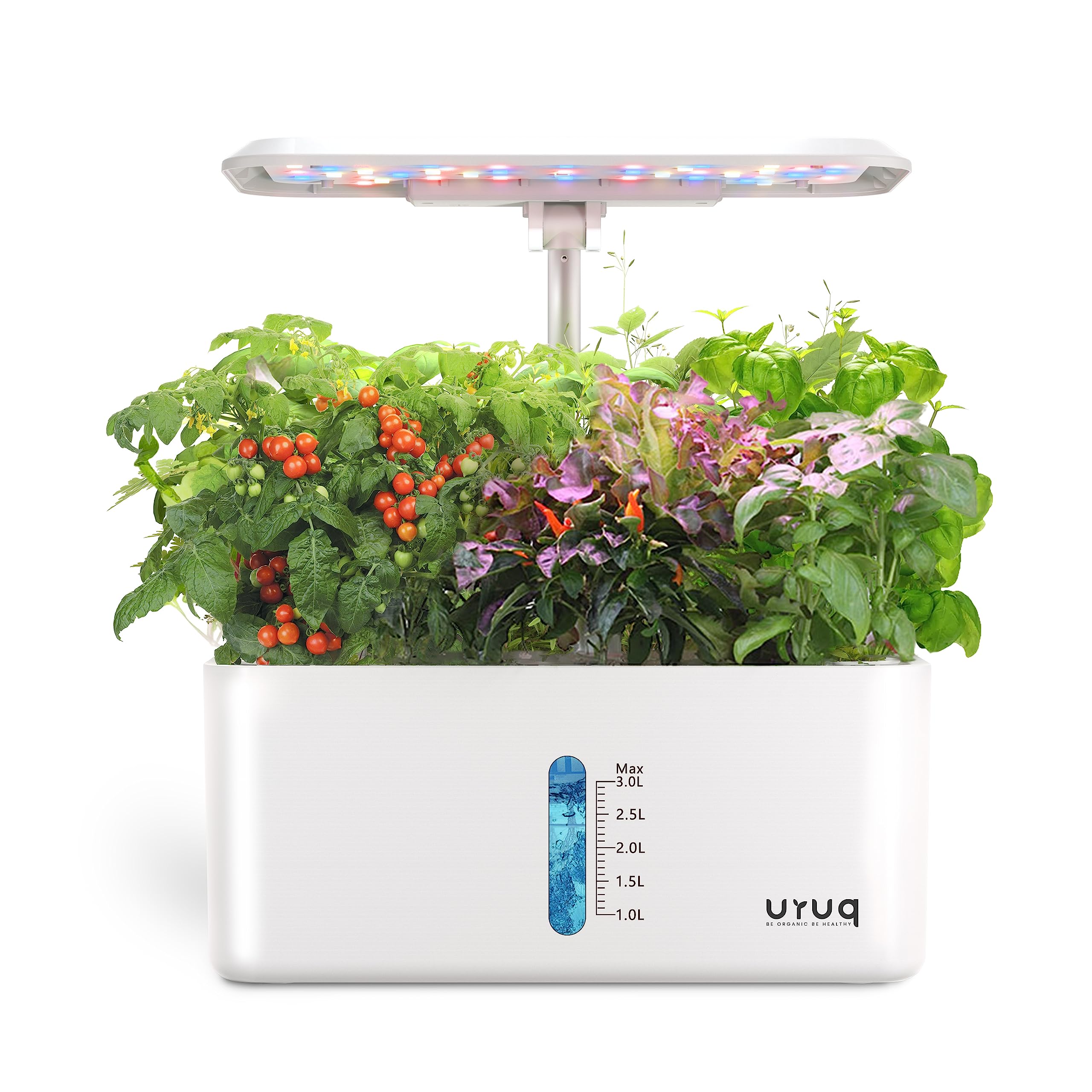
The URUQ system uses a 24-watt full-spectrum LED panel that adjusts 180 degrees and rises to 21 inches, giving tall crops like cherry tomatoes and rosemary plenty of overhead clearance. The pump uses a ceramic core that operates below 20 decibels—quieter than a refrigerator hum—and runs in 30-minute intervals to keep oxygen flowing to the root mass. The 3-liter tank has a clear water-level indicator and a low-water warning light that prevents pump burnout.
Setup takes about five minutes: insert the sponges and pods, fill the tank, add the provided liquid nutrients, and plug in the timer. The automatic 16/8-hour light cycle eliminates daily fiddling, and a dedicated vegetable/fruit mode optimizes the spectrum shift for different crop phases. Owners consistently note that basil, parsley, and mint outgrow the same varieties started in soil by a factor of three in the first three weeks.
The detachable light pole is a smart safety feature—you can remove it before cleaning the tank to avoid electrical contact with water. The pump has proven reliable across continuous operation, and the small footprint (11 x 7 inches) fits on crowded counters without dominating the space. The timer occasionally skips a cycle if the unit is unplugged and reconnected, so set the timer in a single session to keep the 16-hour schedule locked.
What works
- 24W LED panel reaches 21 inches high for tall fruiting plants
- Ceramic-core pump runs below 20 dB, barely perceptible on a desk
- Detachable light pole prevents electrical hazards during tank cleaning
What doesn’t
- Timer can drift if the unit loses power between plug-in sessions
- Only 8 pods—too small for large transplant operations
- Seeds and starter sponges are not included in the box
4. Guioiby 120-Cell Seed Starter Tray with Grow Light
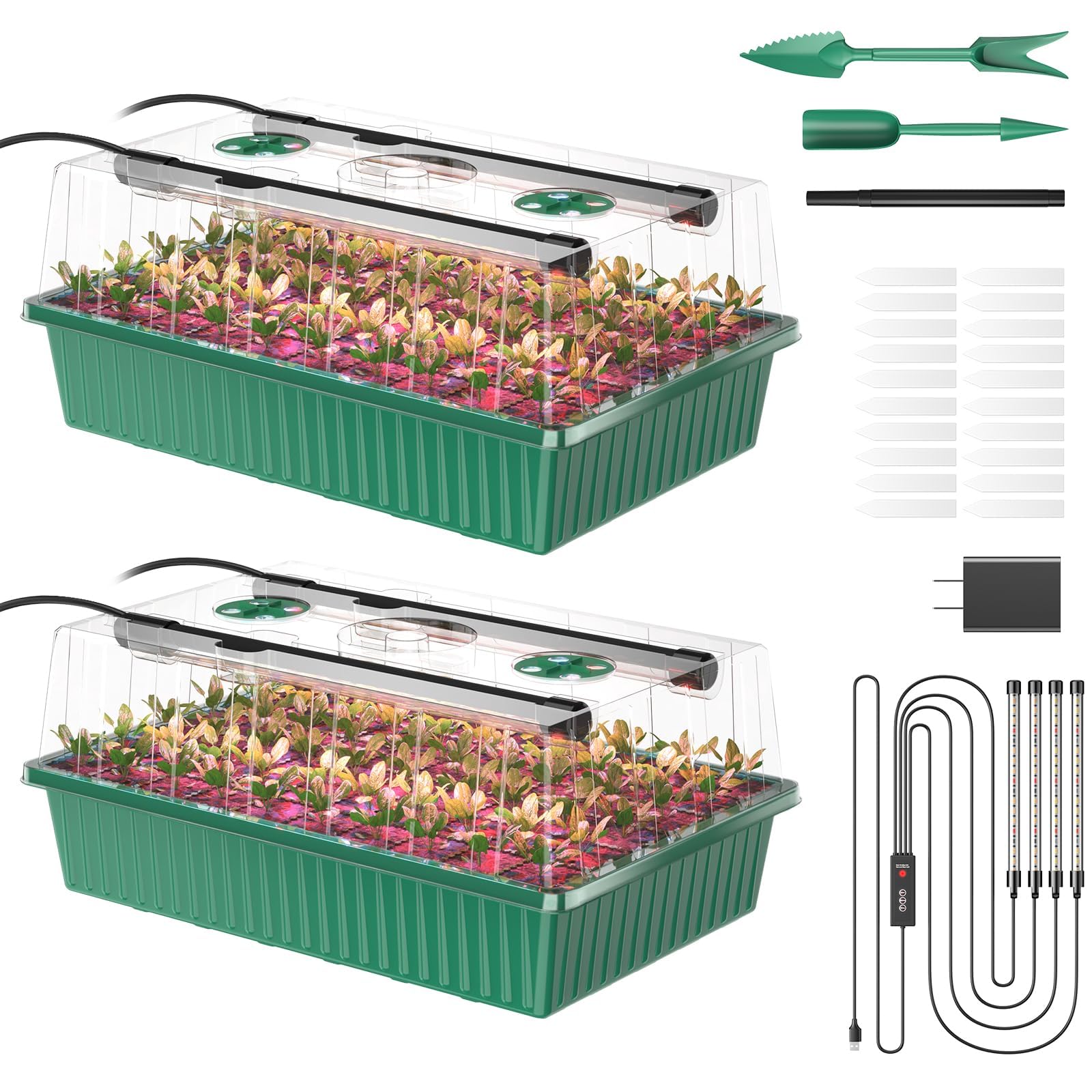
This kit packs 120 cells across two 60-cell trays, each with a dedicated humidity dome and a set of adjustable full-spectrum LED light strips that snap into the dome lid. The standout feature is the silicone bottom on each cell: instead of prying out root plugs, you push up from underneath, and the flexible rubber bottom ejects the entire root ball without tearing. This is a meaningful advantage when transplanting fragile pepper or tomato seedlings.
The LED controller offers five brightness levels and three timer presets (3, 6, or 12 hours), giving you granular control over the light dose. The domes have rotating air vents that allow incremental airflow adjustment—closed for the first 72 hours, then cracked open as the first true leaves appear. The two trays stack neatly when not in use, and the thick plastic base trays have held up to repeated handling without warping.
The humidity domes are taller than average, which is a mixed benefit: they allow longer coverage for leggy growth but create extra headspace that can dilute humidity in a dry room. Multiple owners advise removing the domes as soon as 80% of seeds have sprouted to avoid stem elongation. The silicone push-up bottoms remain flexible through multiple seasons, and the included transplanting tools help with seed placement without damaging the coir or soil surface.
What works
- Silicone push-up bottoms release root plugs without tearing roots
- 120-cell capacity suits large transplant preparations in one run
- Five brightness levels and timer presets match light to crop stage
What doesn’t
- Tall domes can dilute humidity and promote leggy stems in dry air
- Air vent dials require firm pressure to seat correctly during assembly
- Light strips are captive to the dome; cannot be repositioned independently
5. BlumWay Seed Starter Tray 2 Pack 80 Cells

The BlumWay system uses four 20-bead LED strips embedded in the dome cover, creating a 360-degree spectrum array that wraps light around each cell from multiple angles. This reduces the shadow cast by the cell walls and directs photons into the lower leaf canopy—a design that outperforms single-strip overhead lights for lateral branching in herbs like basil and oregano. The lights support both USB and AC power, giving flexibility for placement on shelves without a nearby outlet.
Each of the two trays holds 40 cells, and the clear ABS material lets you inspect root development and moisture levels without lifting the tray. The humidity dome vents are adjustable, and the included remote control lets you switch between three lighting modes and five brightness settings. Customers report that tomatoes and peppers show true leaves within 10 days when paired with a separate heating mat, and the ABS plastic has resisted cracking even after repeated washing.
The light strips are shorter than the full length of the tray, so the cells closest to the tray ends receive slightly less intensity than the center cells. The vent cover stems are also reported by several owners to be too short, making it easy for the covers to pop out during adjustment. For users who prioritize even light distribution and a cleaner vent mechanism, these two points are worth weighing against the otherwise flexible power options and sturdy ABS build.
What works
- 360° spectrum from four LED strips reduces shadow on lower leaves
- Dual USB/AC power input fits non-standard shelf setups
- Clear ABS tray walls let you check root progress without disrupting soil
What doesn’t
- Light strips do not span the full tray length—edges receive less intensity
- Vent cover stems are too short and dislodge easily during use
- Seedling plugs can be difficult to push out of the non-silicone cells
6. GROWFRIEND 40-Cell Seed Starter Kit
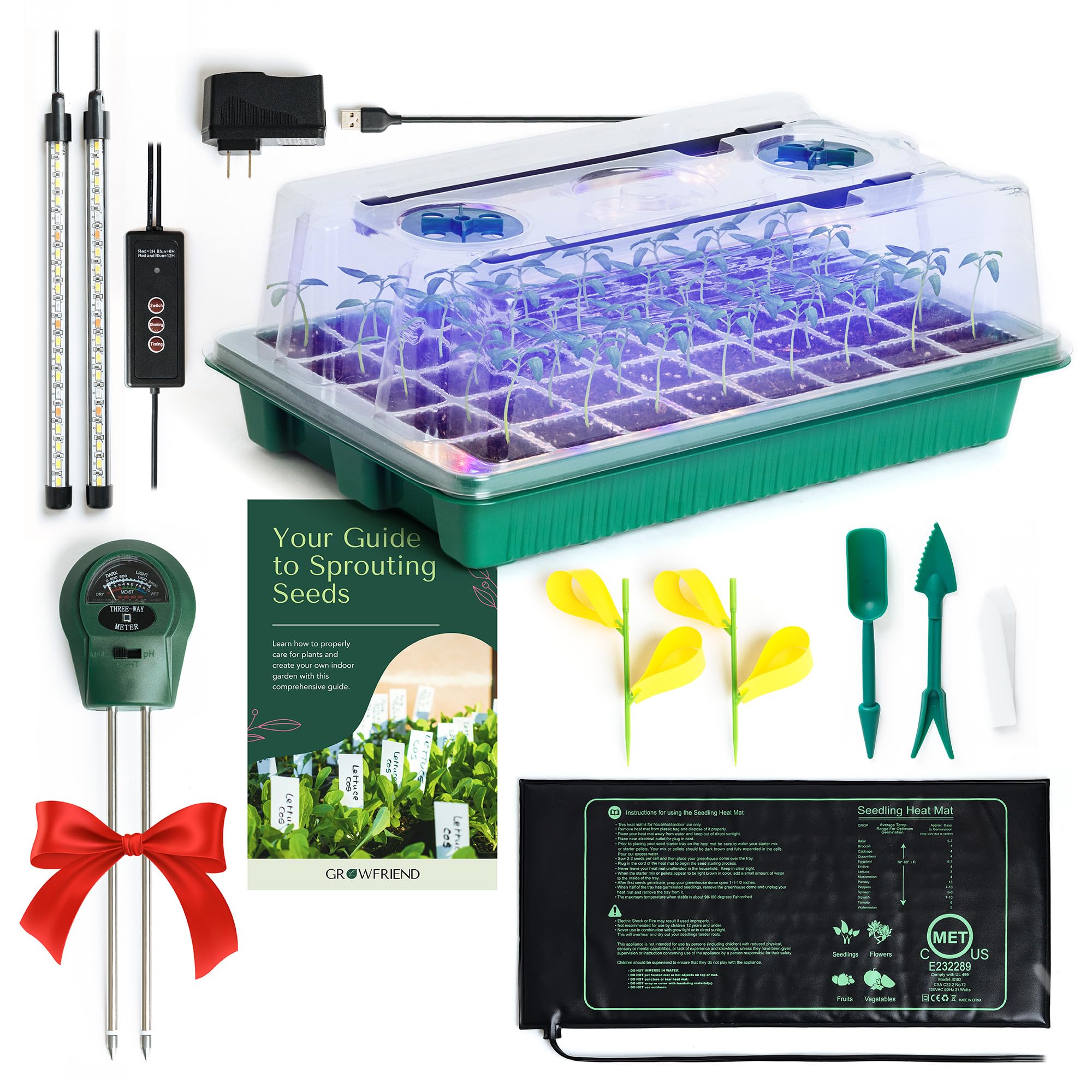
The GROWFRIEND kit bundles a 40-cell heavy-duty tray, a 10×20 waterproof heat mat, a dual-bar LED grow light with 16 white and 4 blue LEDs, a clear humidity dome with adjustable vents, a 3-in-1 soil moisture/pH/light meter, and sticky gnat traps—all in one box. For a first-time seed starter, this is the most complete drop-in package: you supply only the soil and seeds. The heat mat provides consistent bottom warmth, and the LEDs shine from a bar that sits above the dome at an adjustable height.
Owner reports from the first growing season show a 90% germination rate for common vegetables when the heat mat and dome are used together. The moisture meter helps beginners avoid the two most common mistakes: overwatering and underwatering. The meter reads from 1 to 10, and users report that keeping it in the 4-6 range during germination produces stocky, disease-free seedlings. The sticky traps catch fungus gnats before they become an infestation.
The USB charger for the grow lights has been noted to run warm during extended 12-hour cycles—several owners recommend using the lights only when someone is home, or plugging them into a low-wattage timer. The tray is not self-watering, so you must check bottom-water levels manually. A few users also reported that perimeter plants thrived while center plants lagged, which suggests the light coverage could be more uniform. Despite these caveats, the completeness of the kit and the seller’s responsive customer support make it a reliable entry point.
What works
- Most complete kit: heat mat, lights, meter, traps, and eBook included
- Heat mat accelerates germination to 90% success for common veggies
- Sticky traps and moisture meter prevent beginner mistakes
What doesn’t
- USB grow light charger gets hot during extended 12-hour cycles
- No self-watering capillary mat—requires manual bottom-watering
- Peripheral cells can outgrow center cells due to uneven light fall
7. SOLIGT Self Watering Seed Starter Trays 3 Pack 72 Cells
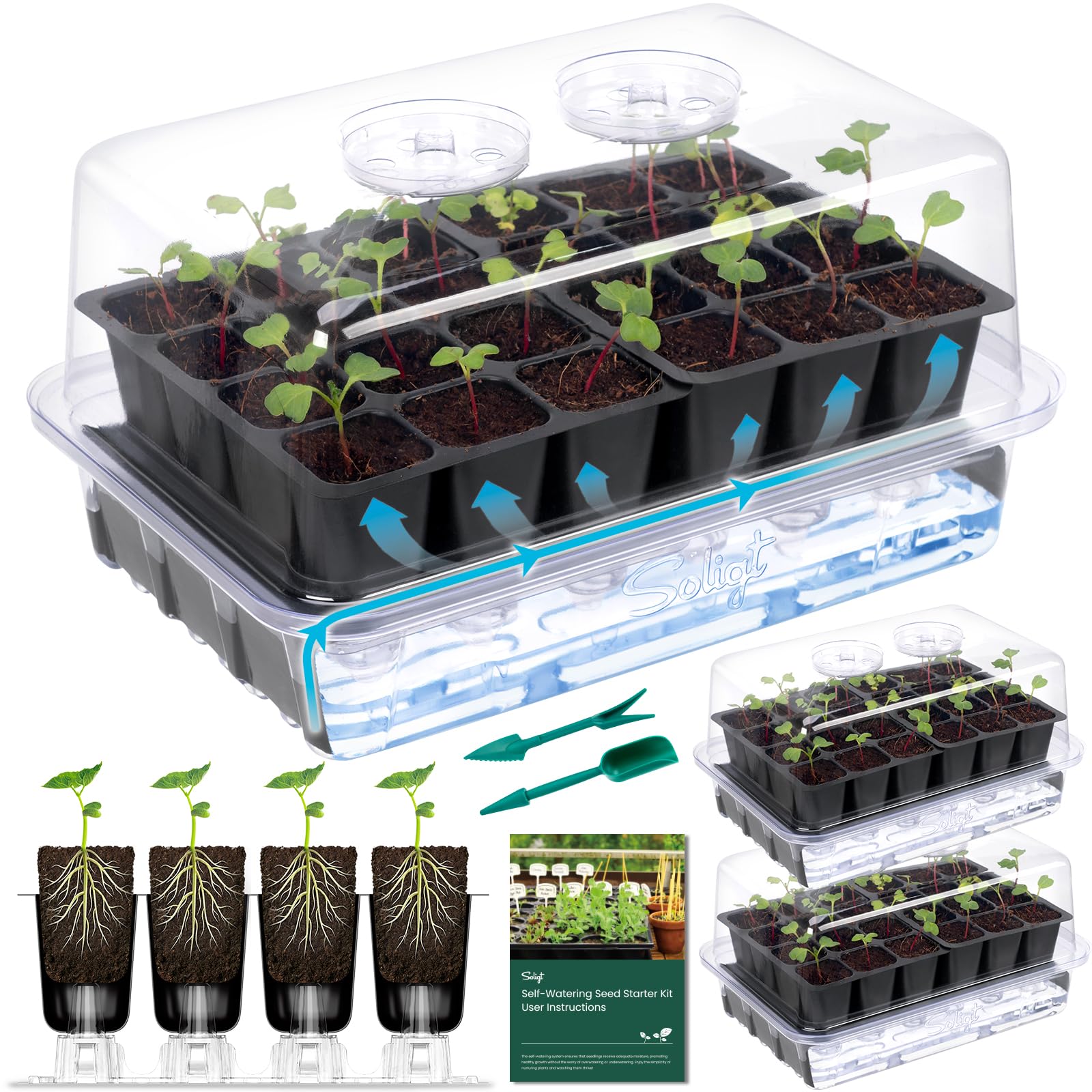
SOLIGT tackles the most common seed-starting failure—inconsistent moisture—with a true capillary mat system that wicks water from a clear bottom tray reservoir into the root zone. Each of the three packs includes two 12-cell trays (24 cells per pack, 72 total), a humidity dome, support stands, plant labels, and a step-by-step manual. The transparent reservoir lets you see the water level at a glance, and the 1.5 x 1.5 x 2.17-inch cell depth gives taproots enough room for strong pre-transplant development.
The plastic used is noticeably thicker than discount-store trays—it resists flexing when carried full of wet soil. The humidity dome has adjustable vents that allow incremental airflow increases without letting humidity crash. Owners report 100% germination on first attempts with basil, tomatoes, and peppers when the reservoir is kept at the indicated fill line (roughly 3/4 inch deep, aligned with the “S” in the SOLIGT logo). The support stands double as soil block pushers, making transplanting less disruptive.
The self-watering function has a limitation: the capillary mat wicks water effectively to cells near the edges, but cells in the center of the tray sometimes need a top-water assist until roots grow down into the mat zone. A few owners solved this by cutting a larger mat so it extends fully across the base. The kit also does not include grow lights or a heat mat, so you will need to supply those separately for year-round indoor use. For growers who already own separate lighting and heat equipment, this is a lean, effective moisture management tool.
What works
- Capillary mat self-watering keeps soil moisture consistent for days
- Extra-thick plastic trays resist cracking and are reusable for seasons
- Clear reservoir and fill-line guide eliminate watering guesswork
What doesn’t
- Center cells may need top-watering until roots reach the capillary mat
- No grow lights or heat mat included—requires separate purchase
- Three-pack offers fewer cells per tray than some single-tray competitors
Hardware & Specs Guide
PPFD and Spectrum
PPFD (photosynthetic photon flux density) measures how many usable light particles reach your seedlings per second. A reading of 100-200 μmol/m²/s is sufficient for leafy greens and herbs; peppers and tomatoes benefit from 200-400 μmol/m²/s. Full-spectrum LEDs that include some blue (400-500nm) and red (620-700nm) wavelengths produce more compact stems than white-only lights. The AC Infinity kit with Samsung LM301H diodes delivers the highest PPFD in this group, while the Guioiby and BlumWay kits use mid-power LEDs that cover 60-80% of the tray at the lower end of the useful range.
Heat Mat Size and Thermostat
The standard 10×20-inch heat mat fits the most common seedling tray footprint. Mats without a thermostat can reach surface temperatures of 90-100°F in a warm room, which slows germination of cool-season crops like lettuce and spinach. Mat models that include an adjustable thermostat dial allow you to tune between 68°F and 85°F. The GROWFRIEND mat runs without a thermostat but stays within a safe 75-85°F range based on owner reports; the AC Infinity mat has a dial thermostat. Hydroponic systems (URUQ, Ahopegarden) do not use a heat mat because the submersible pump and ambient room temperature are sufficient for germination.
FAQ
Can I reuse the cells and trays for multiple seasons?
Do I really need the heat mat, or is a warm room enough?
How long should I keep the humidity dome on after the seeds sprout?
Final Thoughts: The Verdict
For most gardeners, the seed starting system winner is the AC Infinity Heavy-Duty 5×8 Kit because its Samsung LM301H EVO LEDs and 3mm dome with height extenders create the most professional germination environment in a single box. If you prefer a completely soilless, low-mess hydroponic approach with smart controls, grab the Ahopegarden 12-Pod System. And for the highest cell capacity with root-friendly push-up bottoms, nothing beats the Guioiby 120-Cell Kit.