
Specs are compiled from manufacturer listings and verified buyer reviews and can change over time — please confirm the key details on the product page before buying.
The problem with starting seeds indoors isn’t your thumbs — it’s the kit. Most trays leak, domes don’t fit, and the lights are too weak to push a sprout past its first true leaf. A good seed starter kit sidesteps all of that by pairing a sturdy tray with a real humidity dome and, ideally, a grow light that mimics daylight rather than a bedroom lamp. The goal is simple: get every seed you paid for to germinate, then keep each one alive long enough to transplant outdoors without a mid-season stalling out.
I’m Rikta — the founder and writer behind Lawn Gear Lab. This guide is built by comparing the manufacturers’ published specifications and the patterns across verified customer reviews, so you get each pick’s real strengths and trade-offs instead of marketing spin.
This isn’t about plastic boxes that look alike on a shelf — it is an honest, spec-by-spec breakdown of what the components inside a seed starter kit actually do for you so you skip the returns and get a full tray of healthy transplants.
Quick Picks
- GROWFRIEND 40-Cell Seed Starter Kit — Best Overall
- Guioiby 120-Cell Seed Starter Kit — Top Capacity
- YJXFON 80-Cell Seed Starter Tray — Great Value
- Mr. Pen 400-Cell Seed Starter Tray Kit — Multi-Pack Pro
- Jiffy 36-Cell Seed Starting Tray Kit — Budget Champion
How To Choose The Best Seed Starter Kit
A seed starter kit is really just three things working together: a tray with cells, a humidity dome, and sometimes a light. The best one for you depends on what you are growing and where you are growing it. Here is what to look for.
Cell Count and Size
More cells do not automatically make a better kit. A 40-cell tray gives each seedling more room, so roots do not tangle before transplant time. An 80-cell tray fits more starts in the same footprint but the cells are smaller — fine for small seeds like lettuce or herbs, tight for tomatoes or peppers that grow fast. Match cell size to what you intend to grow, not just the number on the box.
Grow Light Quality
A grow light that sits a few inches above the tray is only helpful if its spectrum and intensity are right. Look for full-spectrum LEDs (a light that emits a balanced blend of red and blue wavelengths to mimic the sun). Generic white LEDs often lack the red wavelengths that drive flowering and fruiting later on. A dimmable light or one with adjustable brightness gives you control as the seedling moves from sprout to leaf.
Dome Fit and Airflow
A humidity dome (a clear plastic cover that traps warmth and moisture to speed germination) is only as good as its seal. A dome that sits loosely lets heat escape and dries out the soil. Adjustable vents on the dome let you slowly introduce fresh air as the seedlings harden off — a feature that matters more once sprouts appear than during the first few days.
Quick Comparison
| Model | Best For | Total Cells | Dimensions | Key Feature | Amazon |
|---|---|---|---|---|---|
| GROWFRIEND 40-Cell | All-in-One First Kit | 40 | 9 x 14 x 5 in | Heat Mat + Grow Lights | Amazon |
| YJXFON 80-Cell | Large Batch Variety | 80 | 9.5 x 15 x 5.5 in | Adjustable Full-Spectrum Lights | Amazon |
| Guioiby 120-Cell | High-Volume Sowing | 120 | 11 x 16.5 x 7 in | 5 Brightness Levels & Timer | Amazon |
| Mr. Pen 400-Cell | Classroom or Greenhouse | 400 | 14.5 x 9 x 4.3 in | 10-Pack with Tools | Amazon |
| Jiffy 36-Cell | Budget-Friendly Start | 36 | 11 x 11 x 4.25 in | Peat Pellets Included | Amazon |
In-Depth Reviews
1. GROWFRIEND 40-Cell Seed Starter Kit
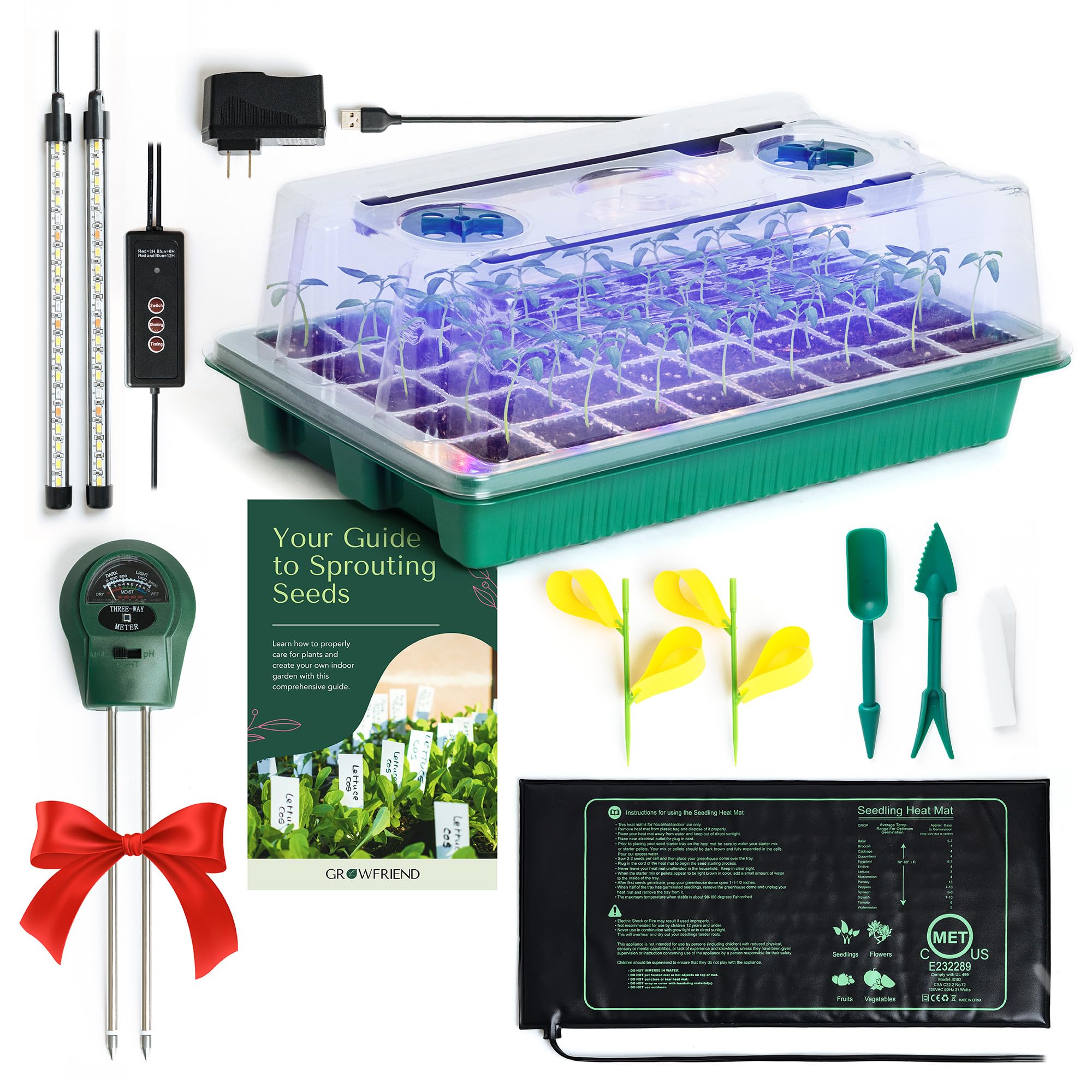
Everything you need for your first tray, with extras that actually matter.
This kit does the thinking for you. The 40-cell tray sits on a 10”x20” waterproof heat mat (a warming pad that sits under the tray to keep the soil consistently warm, which speeds up root development and germination). Above it, dual LED grow lights combine 16 white and 4 blue LEDs to simulate the full spectrum of daylight, giving your seedlings the right light intensity without you having to move the tray to a sunnier window. The polypropylene tray measures 9 x 14 x 5 inches — noticeably heavier than the Jiffy plastic tray at 2.5 pounds versus 1.74 pounds, so it stays put when you water.
Buyers report the humidity dome and heat mat worked together for a 100% sprouting rate across five seed types in a single batch, even for a first-timer with no green thumb. One reviewer noted that center plants tended to stay too wet while perimeter plants thrived — something to watch if you are filling every cell. The sticky gnat traps and soil moisture meter are a bonus, but the real win is the heat mat and light working in one rhythm, which cuts the guesswork versus the Jiffy kit that has neither.
The Thoughtful Touches
- Includes a heat mat and grow lights — two items you would buy separately.
- Adjustable brightness on the LEDs gives you control as seedlings grow.
- Sturdy polypropylene tray resists bending or cracking season after season.
Honest Trade-Offs
- The USB charger for the grow lights reported to get very hot; reviewers recommend using it only when you are home.
- Some users found that center cells stayed too wet, while edge cells dried out faster.
Best for beginners: if you want a single box that includes everything from the heat mat to the plant markers, this is the most complete starting point.
One catch: the grow lights run off USB power, so if you find the charger getting hot, monitor it closely or replace it with a standard adapter.
2. Guioiby 120-Cell Seed Starter Kit
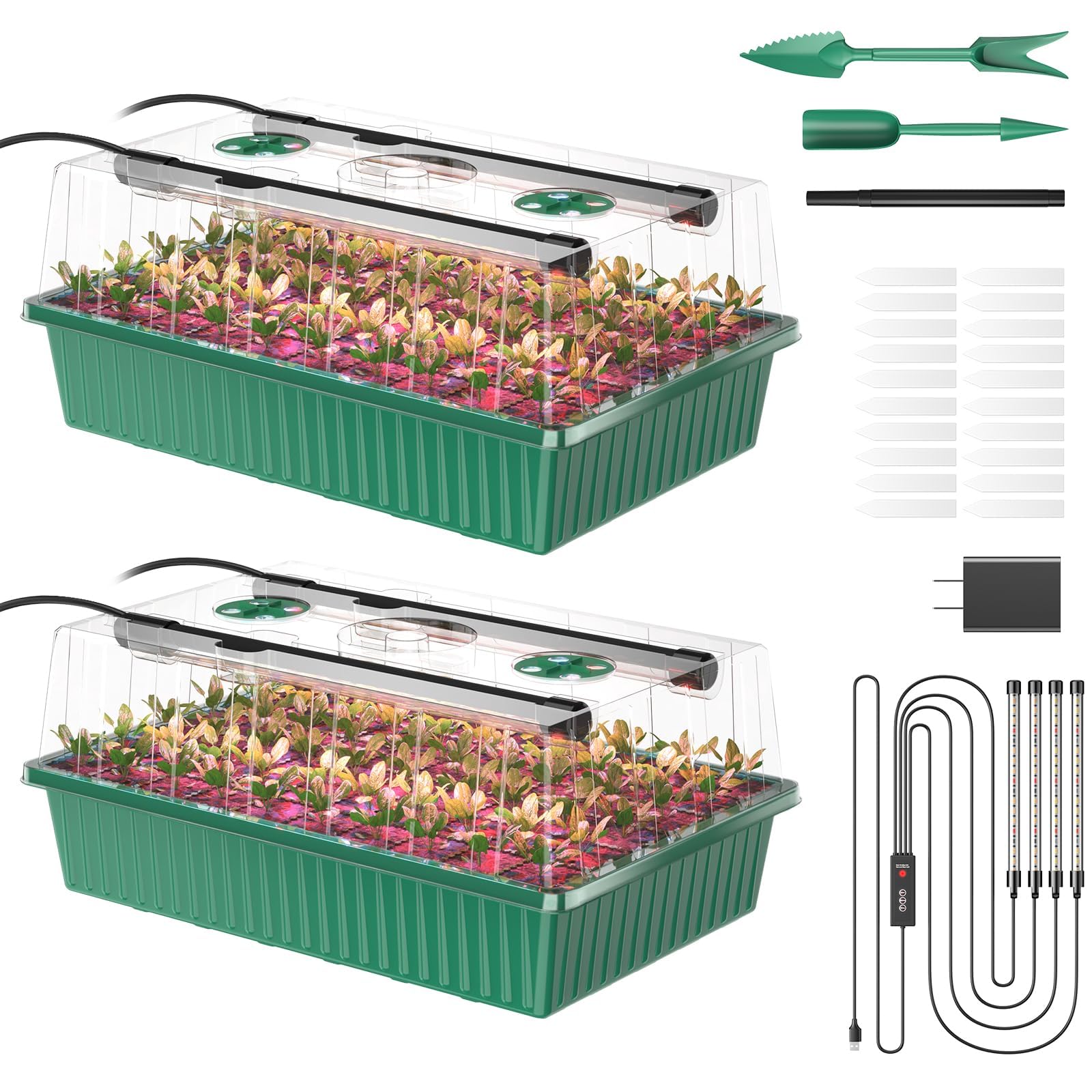
Two full trays and a light system built to grow a serious garden from scratch.
This kit jumps to 120 cells across two 60-cell trays, each with drainage holes at the bottom of every cell to keep roots from sitting in water. The full-spectrum LEDs (a light that emits a balanced blend of red and blue wavelengths to mimic the sun) come with 5 brightness levels and 3 auto-timer settings: 3H, 6H, or 12H. At 11 x 16.5 x 7 inches, it is the largest overall footprint in this lineup — 6% bigger in dimensions than the YJXFON 80-cell tray, so it takes up a solid shelf or counter space.
Owners mention the humidity dome has tall covers that delay transplanting, which is fine for leggy seedlings but means you might want to switch to a shorter dome after sprouts emerge. One experienced grower shared a tip: after most seedlings are up, open the vents, then remove the dome entirely. The silicone push-up bottoms on each cell let you pop out an entire seedling without tearing its roots — a design feature the Jiffy plastic tray lacks entirely.
The Design Wins
- Silicone push-up bottoms make transplanting easy and gentle on roots.
- 5 brightness levels and a programmable timer keep light consistent without daily fiddling.
- Clear base tray lets you see water level for easy bottom-watering.
The Design Shortcuts
- The humidity dome is tall; for most seedlings a shorter dome would be more practical.
- Assembly requires some force to install the aperture covers over the light unit.
Reach for this if: you want a large 120-cell start and value the clean transplant method of silicone push-up bottoms over traditional digging.
Look elsewhere if: shelf height is tight — the tall domes need 7 inches of clearance above the tray base.
3. YJXFON 80-Cell Seed Starter Tray
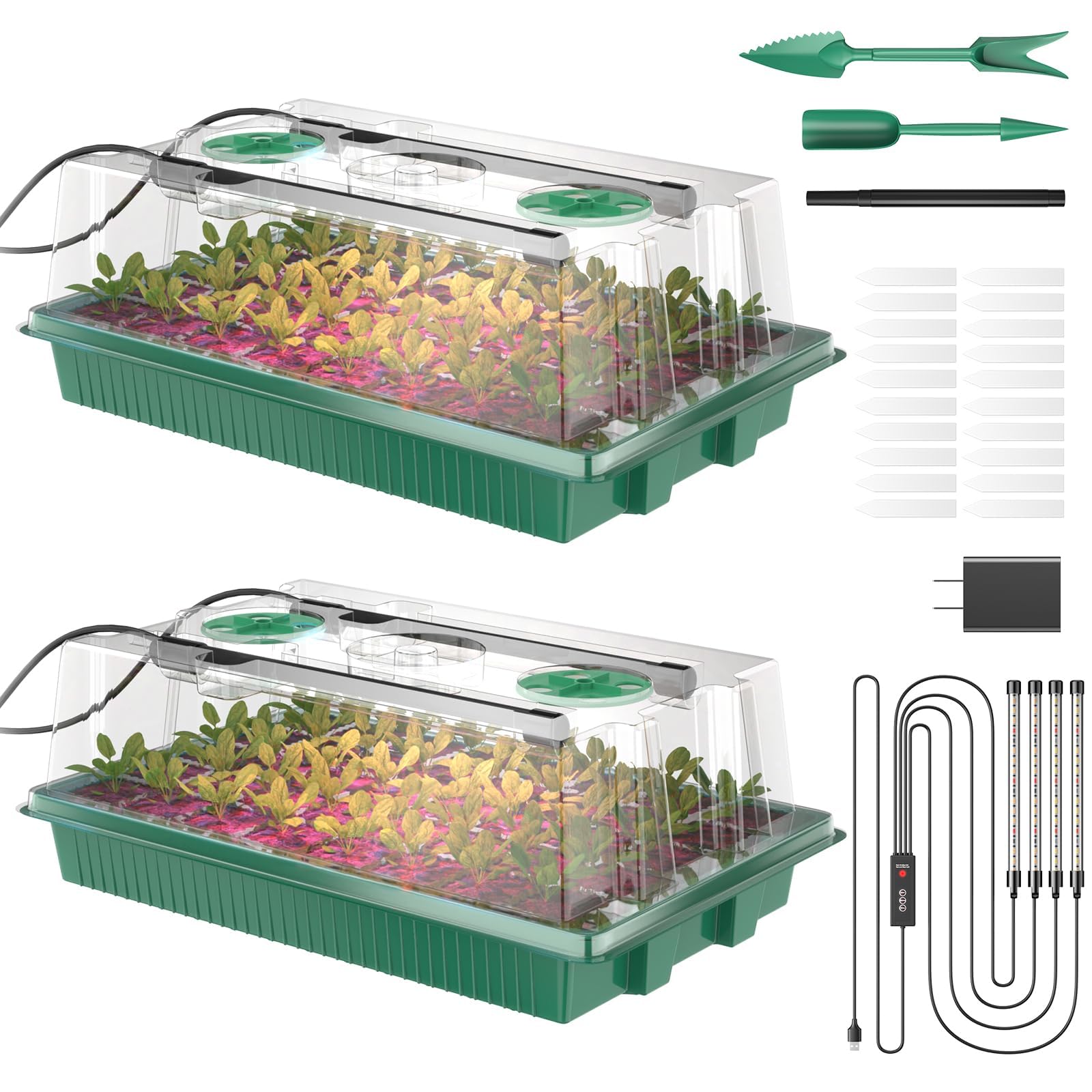
A two-tray system with lights, domes, and tools that feels thoughtful.
This kit comes with two 40-cell trays, two humidity domes, and dual full-spectrum strip grow lights that sit above the seedlings and mimic natural sunlight. The domes have adjustable vents (small openings you can open or close to control humidity levels and airflow, which helps prevent fungus growth). Each tray measures 9.5 x 15 x 5.5 inches — a slightly larger footprint than the GROWFRIEND tray, giving each of the 40 cells a bit more root room per tray.
Customers note the silicone bottoms on the cells make pushing out a seedling for transplant almost easy — a feature that the Mr. Pen trays (with their standard flat cells) do not offer. One reviewer praised the tight-fitting covers with adjustable vents, calling them effective against the fungus gnats that peat pots often attract. The included tools (a small shovel, a scoop, and plant labels) are basic but genuinely helpful for a new grower.
Two-tray flexibility: you get two independent units, so you can stagger your planting schedule — start tomatoes in one tray and wait two weeks for peppers in the other.
A minor friction: the snug lid design makes opening the dome tricky in tight shelf spaces, and lifting the inner tray for bottom watering is hard without fingernails.
Perfect for the variety grower: who wants to run two separate germination cycles side by side without buying two different kits.
Consider this: the domes fit tightly, so if you need to open them frequently for watering or inspection, the fit can be frustrating at first.
4. Mr. Pen 400-Cell Seed Starter Tray Kit
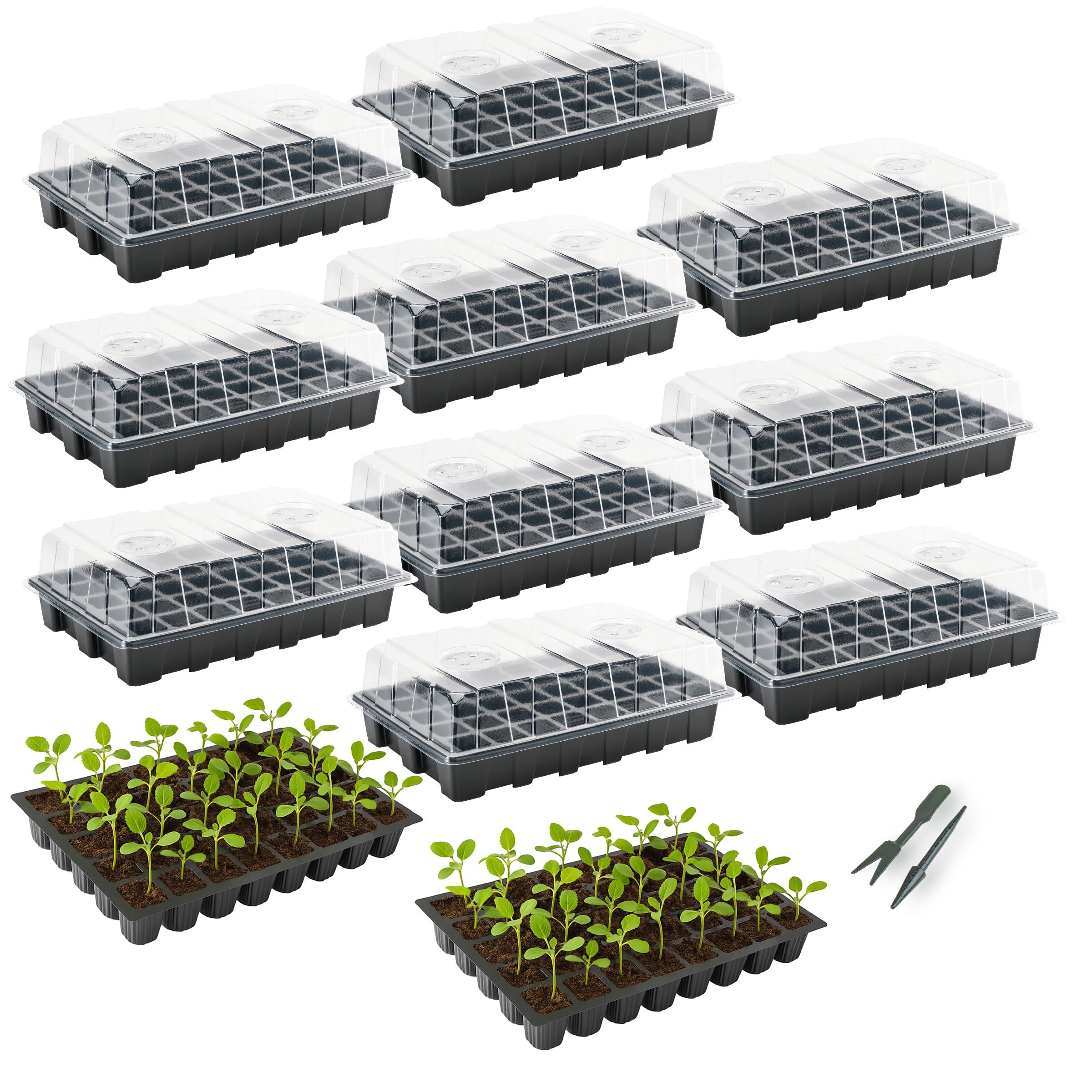
400 cells for the gardener who needs volume and doesn’t need lights.
This is a bulk solution: a 10-pack of separate tray units, each with a 40-cell tray, a base, and a vented humidity dome. Total capacity hits 400 cells, making it the largest seed starter kit in this list by a wide margin. Each dome measures 14.5 x 9 x 4.3 inches and is designed to trap warmth and moisture for faster sprouting. No grow lights or heat mats are included, so you are relying on a warm windowsill or a separate heating source — unlike the GROWFRIEND kit which bundles both.
Reviewers point out the domes slide off easily for access and retain humidity well enough that seeds sprout faster than expected. One buyer mentioned that two of the ten trays arrived with cracked plastic, though the trays still functioned. The tools included (a dibber, a widger, a mini shovel, and a scoop) are a nice touch for planting and transplanting. Compared to the Guioiby kit, the Mr. Pen trays have standard flat cells — you cannot push up a seedling from below — so transplanting involves tipping or digging.
The Volume Edge
- 10 separate kits let you manage up to 400 starts across different dates or species.
- Vented domes hold humidity well and slide off without a fight.
- Includes a full set of seed-starting tools that the YJXFON kit also provides.
The Volume Trade-Offs
- No grow lights or heat mat — you must buy those separately or use a bright windowsill.
- Plastic is thin; some trays arrived with minor cracking during shipping.
- Standard flat cell bottoms (no silicone push-up) make transplanting more delicate.
Choose this for: a classroom project, greenhouse club, or a large home garden where you need many separate kits to stagger planting.
Opt out if: you want a single integrated kit with lights and a heat mat — you will spend extra to add those to this set.
5. Jiffy 36-Cell Seed Starting Tray Kit
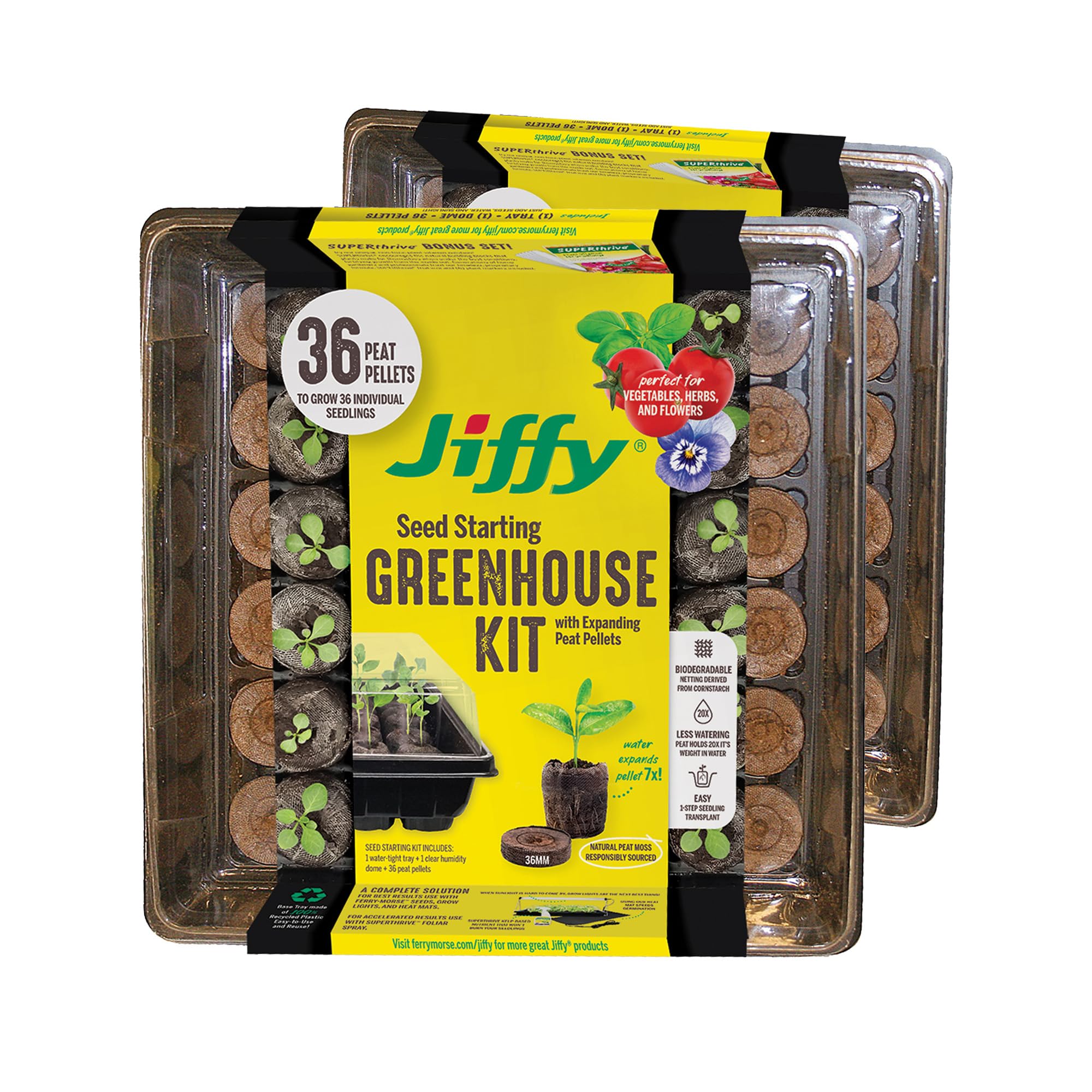
A classic peat pellet system that costs less and proves itself fast.
This 2-pack includes a plastic base tray, a humidity dome, and 72 pre-formed peat pellets (compressed disks of peat moss that expand when you add water, creating a ready-to-use soil plug in each cell). It is the lightest kit here at 1.74 pounds — a full 44% lighter than the GROWFRIEND tray — and the simplest in terms of setup: add water to the pellets, wait for them to expand, then drop seeds into each hole. The 11 x 11 x 4.25 inch tray is compact enough to fit on a standard windowsill.
Shoppers say seeds sprouted extremely fast: red morning glory grew 1.5 inches in 3 days, Mexican sunflower 0.5 inch in 3 days, marigolds hit 3 inches in 5 days, and peppers sprouted at 5 days. The consistent feedback is that the humidity dome lid does not fit well and needs tape to stay on — a clear difference versus the tighter fit of the YJXFON and Guioiby domes. One owner reported the tray itself is thin and wobbly, but worth it for the pellet quality and speed of results.
No-fuss germination: the peat pellets absorb and hold water with a built-in plant health additive, which removes the guesswork of mixing your own soil. The plastic tray is reusable, but many buyers found it cheaper to just buy a new kit after one season.
The real catch: the dome does not seal properly without tape, so heat and moisture leak out faster than in kits with a snap-fit lid.
Best for the budget-conscious starter: who wants to test indoor seed starting for under and sees the dome fit as a minor fixable issue.
Avoid if: a precise humidity seal is your top priority — the loose lid is a known pattern across nearly every review.
Understanding the Specs
Heat Mat
A heat mat is a waterproof, flexible pad that sits beneath your seed tray and gently warms the soil to a consistent temperature — typically around 10–20°F above room temperature. Seeds germinate faster when the soil is warm (most vegetables sprout best at 70–85°F), so a heat mat speeds up the process and improves uniformity. Without one, seeds in a cool room can take twice as long to sprout or fail entirely.
Full-Spectrum Grow Light
A full-spectrum grow light emits light wavelengths that cover both the blue (for leaf and stem growth) and red (for flowering and fruiting) parts of the spectrum that plants use for photosynthesis, closely resembling natural sunlight. A standard white LED bulb lacks enough red light for later growth stages. Dimmable full-spectrum LEDs let you lower the intensity when seeds first break the surface and increase it as the plant grows, preventing leggy seedlings (tall, weak stems that stretch toward a weak light source).
FAQ
Do I really need a heat mat for a seed starter kit?
How long should the grow light stay on each day?
Can I reuse a seed starter tray from last season?
What is the difference between peat pellets and loose soil in cell trays?
Why do some kits include a humidity dome while others do not?
How many cells do I need to start a home vegetable garden?
Should I bottom-water or top-water my seedlings?
What does a silicone push-up bottom do on a cell tray?
Will a seed starter kit work for starting seeds that need cold stratification?
How long before I can transplant seedlings from a seed starter kit to a garden bed?
Final Thoughts: The Verdict
For the majority of shoppers, the seed starter kit winner is the GROWFRIEND 40-Cell because it includes the two components that matter most — a heat mat and dual LED grow lights — in one sturdy polypropylene tray that stands up to repeated use. If you want a larger 120-cell capacity with a programmable timer and silicone push-up bottoms for easy transplant, grab the Guioiby 120-Cell. And for a budget-friendly introduction that lets you watch peat pellets expand and seeds sprout fast, the standout is the Jiffy 36-Cell.
How We Picked
We do not accept paid placement. Every pick is matched to a real buyer and a real use-case; we do not hands-on test units.
Sources & Methodology
Specifications: manufacturer listings and product documentation. Review insights: verified customer reviews, as of July 2026. Pricing: not shown on this page (it changes often); check the current price via the retailer link.
As an Amazon Associate, Lawn Gear Lab earns from qualifying purchases. This does not affect which products we feature.