
The idea of hauling piles of kitchen scraps and yard trimmings to the back corner of the lot and then manually stabbing, lifting, and folding a steaming heap with a pitchfork every weekend loses its charm fast. A rotating composter swaps that labor for a simple, five-second roll across the yard, aerating the load without a single ounce of back strain. The catch is that not every barrel design seals well enough to keep out rodents, aerates thoroughly enough to prevent anaerobic rot, or holds up against a full season of sun and rain without cracking.
I’m Rikta — the co-founder and writer behind Lawn Gear Lab. I’ve spent hundreds of hours comparing the wall thickness, frame gauges, bearing systems, aeration fin geometry, and real-world owner feedback across every major rotating composter on the market to separate the equipment that delivers dark, crumbly humus from the ones that just spin wet garbage.
Whether you are managing a small urban kitchen garden or a half-acre veggie plot, the control you get over airflow, moisture, and batch rotation makes a best rotating composter the single most effective upgrade for turning waste into soil without the physical toll of traditional pile management.
How To Choose The Best Rotating Composter
Selecting a tumbler is not just about the biggest drum. The interplay between chamber count, body material, aeration system, and frame rigidity determines whether your organic waste turns into usable compost in weeks or turns into a foul, muddy sludge that attracts pests. Here are the specs that separate an efficient system from a frustrating one.
Dual Chamber vs. Single Chamber Flow
A dual-chamber unit lets you fill one compartment while the other side finishes its cycle undisturbed. This continuous-batch approach eliminates the common problem of adding fresh scraps to a nearly finished pile and resetting the clock. Single-chamber tumblers work well for small households with predictable waste volume, but you must wait for the entire batch to finish before starting a new load.
Body Material and UV Resistance
Most rotating composters use either high-density polyethylene or polypropylene. Polyethylene, especially when UV-inhibited and made from recycled material, offers excellent impact resistance and flexibility in freezing temperatures. Polypropylene is stiffer and can handle higher internal temperatures, but it becomes brittle faster under continuous sun exposure if not properly stabilized. Look for “UV-inhibited” labeling to avoid cracking after two seasons.
Aeration Fin Depth and Pattern
The internal fins that break up clumps and channel oxygen are the single most important performance feature. Shallow, widely spaced fins allow material to pack into dense balls that go anaerobic. Deep fins that run the full length of the drum, combined with a generous pattern of external aeration holes, ensure oxygen reaches the center of the pile. Without adequate aeration, the composting process slows dramatically and produces unpleasant odors.
Frame Gauge and Bearing System
The frame supports the full weight of wet organic matter, which can exceed sixty pounds in a 43-gallon drum. A powder-coated steel frame with a minimum wall thickness of 1.2 mm provides the necessary rigidity. The bearing system matters even more — cheap bushings bind under load, while proper flange bearings or axles with metal sleeves allow smooth rotation even when the drum is heavy. Wobbling during rotation indicates a frame or bearing design that will fail prematurely.
Quick Comparison
On smaller screens, swipe sideways to see the full table.
| Model | Category | Best For | Key Spec | Amazon |
|---|---|---|---|---|
| FCMP Outdoor 37-Gallon Dual-Chamber | Dual Chamber | Premium continuous batch production | UV-inhibited recycled polyethylene body | Amazon |
| Marcytop 45 Gallon Dual Chamber | Dual Chamber | Large volume with reinforced steel frame | Extra-thick polypropylene panels | Amazon |
| FCMP Outdoor HOTFROG 19-Gallon | Single Chamber | Zero-assembly beginner setup | 19-gallon rolling drum, no assembly required | Amazon |
| EJWOX 43 Gallon with Thermometer | Dual Chamber | Temperature monitoring for optimal breakdown | Built-in integrated thermometer | Amazon |
| PatioZen 43 Gallon Dual Chamber | Dual Chamber | Budget-friendly rust-resistant resin build | Rust-resistant resin material | Amazon |
| Hourleey 43 Gallon Dual Chamber | Dual Chamber | Deep aeration fins for rapid breakdown | Deep fins with aeration holes | Amazon |
| Lifetime 60076 50 Gallon | Single Chamber | Maximum single-batch capacity | 50-gallon / 189-liter capacity | Amazon |
In‑Depth Reviews
1. FCMP Outdoor HOTFROG 37-Gallon Dual-Chamber Tumbling Composter
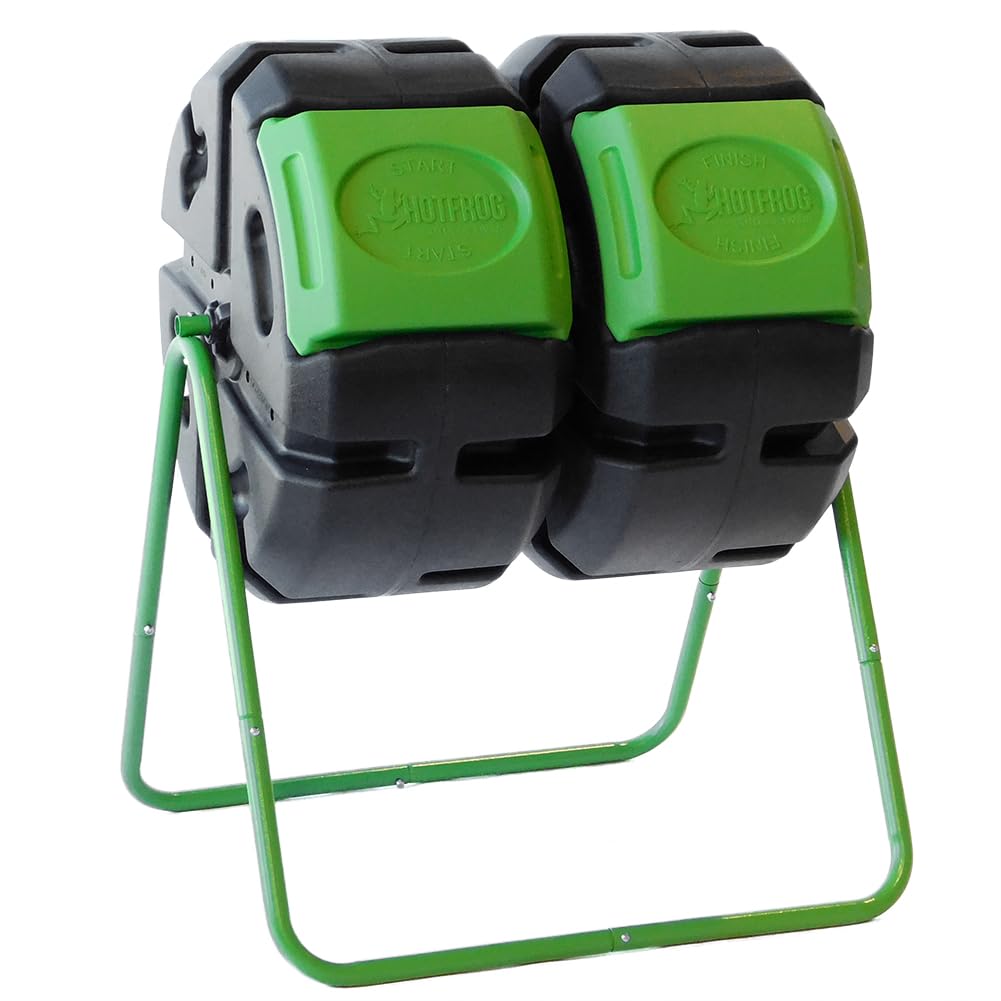
This unit uses a 37-gallon dual-chamber body constructed from UV-inhibited, BPA-free recycled polyethylene, which provides excellent impact resistance and flexibility in sub-freezing conditions. The powder-coated galvanized steel frame supports the rotating barrel without wobble, and the sliding door design on each chamber allows easy access for loading and harvesting. The ergonomic handholds molded into the plastic make turning intuitive even when the drum is fully loaded.
The aeration system relies on external vents and the internal geometry of the drum to channel oxygen through the pile. Several owners report finished compost in roughly two months with a balanced ratio of greens and browns, and the sealed design keeps odors contained effectively. The instructions are printed inside the barrel, which confuses some users initially, but the actual assembly time is around 15 minutes once the directions are located.
The sliding doors sit at the bottom when the drum is stationary, allowing excess moisture to drain naturally. A few users note minor debris leaking past the door seals, but this is manageable by maintaining the proper carbon-to-nitrogen ratio. This model hits the sweet spot between capacity, material quality, and ease of use for the serious home composter.
What works
- Fast 15-minute assembly and no interior axle to sag
- UV-inhibited polyethylene withstands years of sun exposure without cracking
- Removable sliding doors create a wide opening for effortless compost removal
What doesn’t
- Assembly instructions hidden inside the barrel causes initial confusion
- Small amounts of debris can escape around the door edges if the mix is too wet
2. Marcytop 45 Gallon Dual Chamber Compost Tumbler

The Marcytop tumbler splits its 45-gallon capacity into two 22.5-gallon compartments, each with its own sliding door and set of internal deep fins. The body uses extra-thick polypropylene panels reinforced with a powder-coated steel frame, and the hexagonal shape adds structural rigidity that resists warping under heavy loads. The orange door accents make the chambers easy to identify from a distance.
Assembly takes about 40 minutes with a rubber mallet and screw gun, as the panels snap together in a LEGO-like pattern before the brackets lock everything in place. The drum height reaches 43 inches, which reduces the need to bend excessively during loading. Some users note that a full drum becomes difficult to rotate when the material is wet, so keeping the two units unattached allows each chamber to be tumbled separately.
This unit lacks a built-in thermometer, but the large volume makes it suitable for households generating significant kitchen and yard waste. The polypropylene body resists heat buildup well, and the sliding doors stay secure during rotation. Owners report that in hot climates, composting completes noticeably faster than with smaller drums.
What works
- 45-gallon total capacity handles heavy organic waste volumes
- Hexagonal polypropylene panels provide excellent structural rigidity
- Each chamber can be loaded and tumbled independently for batch control
What doesn’t
- No built-in thermometer requires a separate purchase for temperature monitoring
- Fully wet chambers become heavy and harder to spin
3. FCMP Outdoor HOTFROG Half Size 19-Gallon Rolling Composter

This is the tumbler for anyone who wants to start composting immediately without dedicating an hour to assembly. The 19-gallon drum arrives fully assembled — slide the door onto the base and you are done. The rolling design allows the entire unit to be moved around the yard, so compost can be deposited directly at the garden bed instead of hauled in a wheelbarrow. The BPA-free polyethylene body is made from 100 percent recycled material and is UV-inhibited.
The internal deep fins and external aeration holes work together to break up clumps during rotation. At 19 gallons, the capacity fits small households with limited kitchen scraps, and the lightweight construction makes turning effortless. Several users mention that chopping materials into small pieces significantly speeds up decomposition, with finished compost appearing in as little as two weeks in hot, sunny conditions.
The lack of a metal frame means there are no rust-prone components, but the plastic body flexes noticeably under heavy loads. The side aeration holes can leak small amounts of liquid if the moisture balance is off. For a new composter or a small-space gardener, the convenience of instant setup and portability outweighs the smaller batch size.
What works
- No assembly required — ready to use immediately out of the box
- Rolling base allows easy transport to garden beds
- 100 percent recycled polyethylene with UV protection resists weather damage
What doesn’t
- 19-gallon capacity limits batch size for larger gardens
- Side aeration holes can leak liquid if the carbon-to-nitrogen ratio is unbalanced
4. EJWOX 43 Gallon Dual Chamber Tumbling Composter with Thermometer
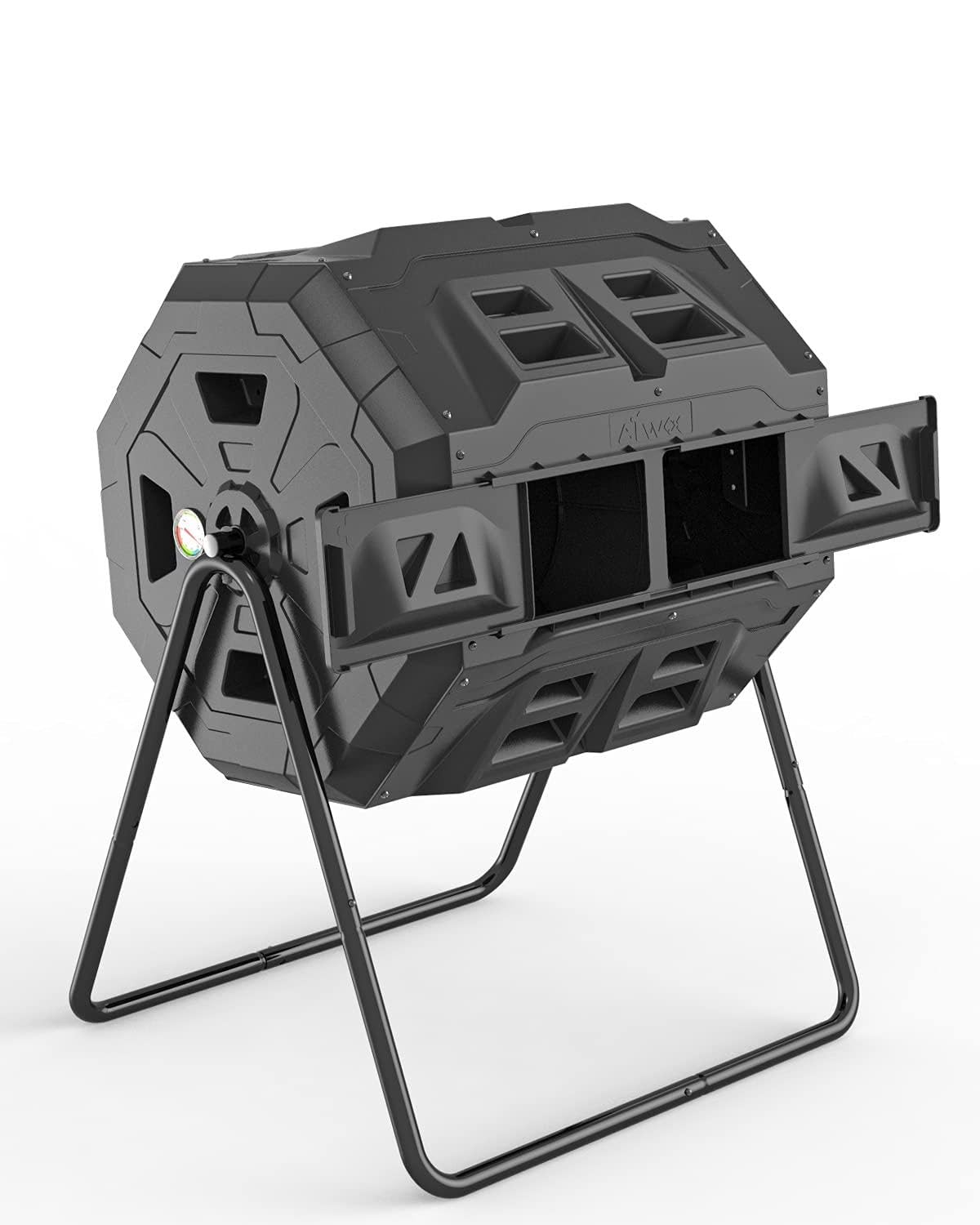
The EJWOX composter integrates a thermometer into the drum wall, allowing you to check internal temperatures without opening the lid and losing heat. The octagonal body uses a combination of alloy steel and polypropylene, and the galvanized steel frame provides a stable platform for the 43-gallon dual-chamber design. The shape helps prevent the drum from rolling off balance during rotation.
Assembly takes about 45 minutes solo, and the center divider slides into place without tools. Several owners note that the thermometer may not be perfectly accurate, but it still provides a useful reference for whether the pile is in the active thermophilic range. The tumbling action is smooth thanks to the metal axle system, and the doors open wide enough for easy loading.
The polypropylene panels hold up well against weather, but a few users report that screws can strip if over-tightened during assembly. Adding a bungee cord across the doors helps keep out curious rodents. For gardeners who want visibility into the composting process, the integrated temperature gauge offers a clear advantage over blind-tumble models.
What works
- Built-in thermometer tracks internal pile temperature without opening
- Octagonal body design prevents drum wobble during rotation
- Galvanized steel frame resists rust in outdoor conditions
What doesn’t
- Thermometer accuracy is approximate rather than laboratory-grade
- Door latch may require a bungee cord for additional security against pests
5. PatioZen Dual Chamber 43 Gallon Tumbling Composter
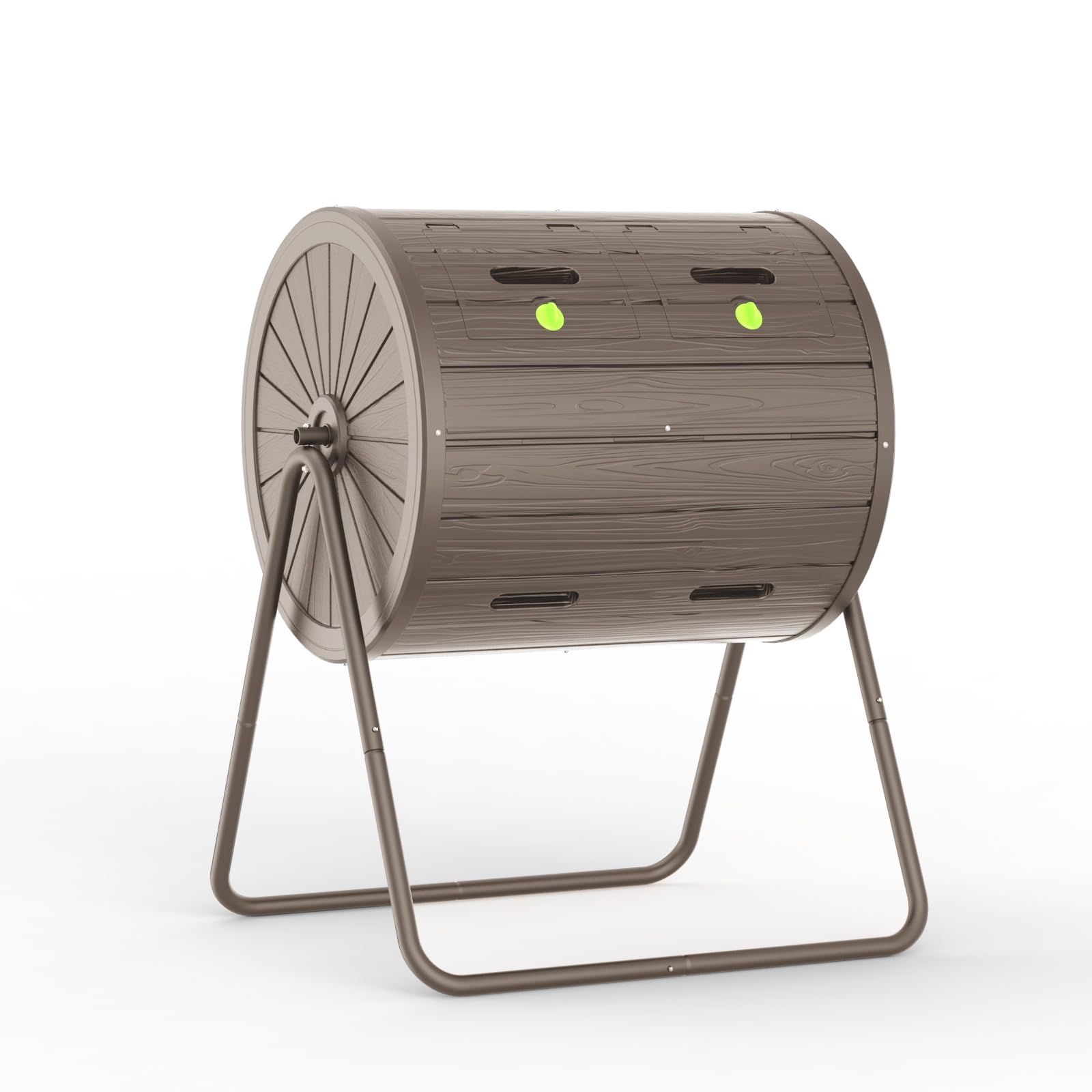
The PatioZen tumbler uses high-quality resin that resists rust and corrosion, making it a solid option for coastal or high-humidity environments. The 43-gallon capacity is split into two chambers, and the cylindrical shape allows for straightforward rotation. The 25-pound weight makes it one of the lighter dual-chamber models, which simplifies assembly and repositioning.
Assembly requires patience, as the diagram instructions are not the clearest, but several users report completing it alone. The drum turns easily even when partially filled, and the multiple grab points on the surface provide good leverage. Dual-chamber operation allows one side to mature while the other collects fresh kitchen scraps and grass clippings.
The resin body lacks the UV inhibitors found on premium brands, so positioning the composter in partial shade will extend its lifespan. The sliding doors fit securely, and the overall build feels appropriately sturdy for the price tier. For a gardener stepping up from a stationary bin without investing in a premium unit, this strikes a practical balance.
What works
- Rust-resistant resin material ideal for humid or coastal climates
- Light weight at 25 pounds simplifies assembly and movement
- Dual chambers support continuous batch composting without interruption
What doesn’t
- Resin lacks UV inhibitors and may degrade faster in full sun
- Assembly instructions rely on unclear picture diagrams
6. Hourleey 43 Gallon Dual Chamber Tumbling Composter

The Hourleey composter emphasizes airflow with deep fins running along the interior and a generous pattern of aeration holes on the drum surface. The 43-gallon dual-chamber body sits on a high-grade metal frame that provides stability during rotation. The oval shape reduces the overall footprint compared to round drums of similar capacity, making it easier to fit into tight corner spaces.
Assembly benefits from having a second person, as aligning the panels and frame requires both hands. The 360-degree turning design uses deep grooves and flaps to tumble the contents effectively, and the large removable doors make filling and emptying straightforward. Several users note that the dual-chamber design works well for separating fresh greens from older browns.
Some owners report that the rotation mechanism does not always break up dense clumps as effectively as deeper internal fins on competing models. The plastic construction handles weather well, but the frame bolts may require periodic tightening. For gardeners who prioritize a compact footprint and strong aeration, this unit delivers on those specific needs.
What works
- Deep internal fins and generous aeration holes promote oxygen flow
- Oval design saves space while maintaining 43-gallon capacity
- High-grade metal frame provides stable support during rotation
What doesn’t
- Rotation mechanism may struggle with dense, compacted clumps
- Frame bolts may loosen over time and require periodic tightening
7. Lifetime 60076 50 Gallon Compost Tumbler

The Lifetime 60076 offers the largest single-chamber capacity in this lineup at 50 gallons (189 liters), making it suitable for properties with substantial yard trimmings and leaf drop. The round drum sits on a steel frame, and the extra-large removable lid provides easy access for loading bulkier materials like pruned branches and spent vegetable plants. The single-chamber design means you process one large batch at a time, which works well for seasonal heavy-load composting.
Assembly is the most challenging aspect of this unit. Multiple owners describe the instructions as difficult to follow, and some plastic components require modification to fit correctly. The resulting structure, however, is sturdy and produces rich compost in a matter of weeks with regular weekly turning. The internal heat generation reaches thermophilic levels when the pile is properly balanced, which helps kill weed seeds.
The major long-term concern involves internal metal parts. Several reports indicate that the hardware, locking mechanism, brackets, and aeration bar begin rusting within six months of outdoor use. Rust flakes can contaminate the finished compost. This unit delivers excellent composting performance for those willing to perform periodic maintenance or replace corroded hardware, but it is not a set-and-forget solution.
What works
- 50-gallon single chamber handles the largest batch volumes of any model
- Extra-large removable lid simplifies loading bulky yard waste
- Internal heat generation reaches thermophilic range for weed seed kill
What doesn’t
- Internal metal hardware is prone to rust within six months
- Assembly is frustrating with unclear instructions and poor-fitting parts
Hardware & Specs Guide
Chamber Design and Batch Flow
Dual-chamber composters allow continuous operation by separating the active pile from the maturing pile. Single-chamber units require the entire batch to finish before starting a new load, which can create gaps in compost availability. The trade-off is that single-chamber drums generally have a simpler structure with fewer potential leak points and a lower overall weight.
Body Material and UV Resistance
Polyethylene is the preferred material for rotating composters due to its impact resistance and flexibility in cold weather. Polypropylene is stiffer and can withstand higher internal temperatures but becomes brittle more quickly under UV exposure. Look for explicit “UV-inhibited” or “UV-stabilized” labeling to ensure the body does not crack after two seasons of direct sun exposure.
Aeration System Geometry
Internal fins must be deep enough to lift and break apart the compost pile as the drum rotates. Shallow fins allow material to slide past without tumbling, creating anaerobic pockets. The distance between aeration holes on the drum surface determines how much oxygen reaches the pile center — tighter spacing with staggered rows provides the best airflow without losing too much moisture.
Frame, Bearings, and Weight Capacity
Powder-coated steel frames with a minimum gauge of 1.2 mm provide the rigidity needed to support wet organic loads without twisting. Flange bearings or metal-sleeve axles maintain smooth rotation even when the drum is heavy. Plastic bushings bind and wear quickly under load. Check the rated weight capacity of the frame before loading the drum with wet materials.
FAQ
How long does a rotating composter take to produce finished compost?
Do I need to add worms to a rotating composter?
Why does my compost tumbler smell and how do I fix it?
Final Thoughts: The Verdict
For most gardeners, the best rotating composter winner is the FCMP Outdoor 37-Gallon Dual-Chamber because it combines UV-stabilized recycled polyethylene construction, a corrosion-resistant galvanized steel frame, and sliding door access that makes batch management effortless. If you want maximum batch volume and are willing to handle occasional hardware maintenance, grab the Lifetime 60076 50 Gallon Tumbler. And for instant setup and portability in a small garden, nothing beats the FCMP Outdoor HOTFROG 19-Gallon Rolling Composter.