
Specs are compiled from manufacturer listings and verified buyer reviews and can change over time — please confirm the key details on the product page before buying.
Tree roots sneaking into your sewer line mean slow drains, gurgling toilets, and eventually a backup that costs thousands to dig up. You do not need to tear apart your yard or call a plumber every time — the right chemical root killer, poured down the toilet, travels through the pipe and kills the roots from the inside before they cause a full clog. The trick is picking the formula that actually reaches every inch of the pipe and keeps the roots from growing back for months, without harming the tree or your septic system.
I’m Rikta — the founder and writer behind Lawn Gear Lab. This guide is built by comparing the manufacturers’ published specifications and the patterns across verified customer reviews, so you get each pick’s real strengths and trade-offs instead of marketing spin.
Here is a breakdown of the best root killer for trees on the market, with the exact specs and buyer experiences that separate the one-and-done solutions from the products that leave you flushing rock salt every month. root killer for trees depends on a choice between fast-acting copper sulfate granules and advanced foaming herbicides — and this guide shows you which one fits your plumbing situation.
Quick Picks
- Roebic FRK Foaming Tree Root Killer — Top Performer
- RootX 2 LB Jar — Best Overall
- ADIOS! Sewer and Septic Root Killer — Best Value
- Sanco Root Destroyer — Budget Champion
How To Choose The Best Root Killer For Trees
All root killers do the same basic job — they poison the roots that have pushed through a crack or joint in your pipe. But the way the chemical reaches those roots and how long it stays active makes a huge difference in whether you are re-treating every six months or forgetting about it for a year.
Granular vs. Foaming Formula
Granular formulas (usually copper sulfate crystals) dissolve in water and travel down the pipe. They rely on gravity to carry them to the root mass, which means they only treat the bottom of the pipe. A foaming formula, on the other hand, expands to fill the entire pipe diameter — walls, ceiling, and all. If your root intrusion is severe or the pipe has standing water, a foam is much more likely to hit every root fiber.
Active Ingredient: Copper Sulfate vs. Dichlobenil
Copper sulfate is the old-school standard. It is cheap, effective, and safe for septic systems because it does not kill the bacteria that break down waste (the bacteria bounce back in about 15 days). Dichlobenil is a systemic herbicide — it is absorbed by the root and travels through the root system, providing longer-lasting suppression. It is the active ingredient in most premium foaming root killers.
Treatment Frequency
Some products need to be applied every six months to keep roots at bay. Others, especially the foaming dichlobenil-based ones, can last over a year between treatments. The extra money for a premium product often pays for itself in saved labor and fewer applications.
Quick Comparison
| Model | Best For | Active Ingredient | Form / Application | Item Weight | Amazon |
|---|---|---|---|---|---|
| Roebic FRK Foaming Tree Root Killer | Severe recurring blockages | Dichlobenil | Foaming granules, pour and flush | 1 lb (3-pack) | Amazon |
| RootX 2 LB Jar | Full-pipe foam coverage | — | Foaming granules, pour and flush | 2 lbs | Amazon |
| ADIOS! Copper Sulfate Root Killer | Budget septic-safe routine | Copper sulfate | Granules, pour and flush | 2 lbs | Amazon |
| Sanco Root Destroyer | Entry-level spot treatment | Copper sulfate | Crystals, pour and flush | 2 lbs | Amazon |
In‑Depth Reviews
1. Roebic FRK Foaming Tree Root Killer
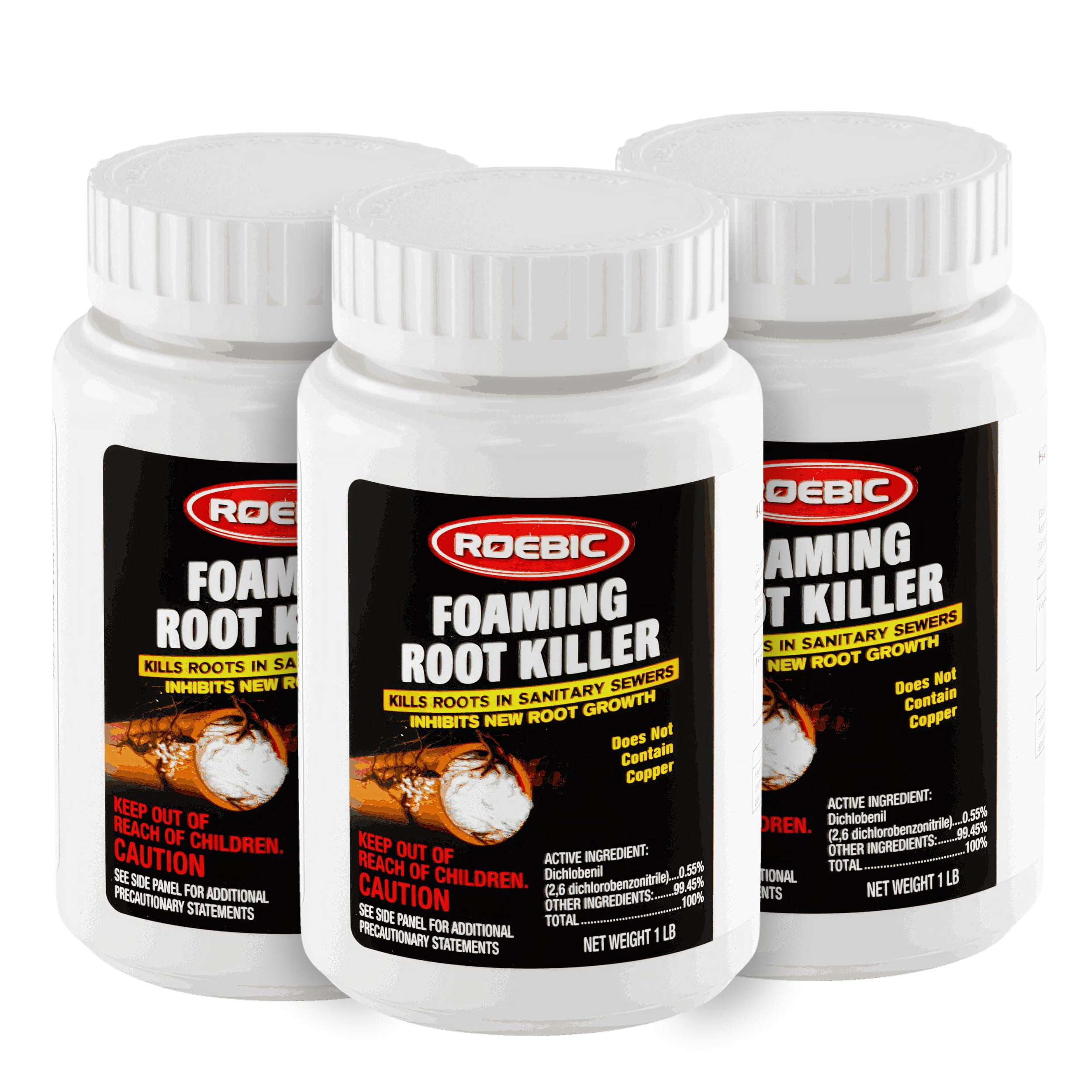
The foam that climbs the pipe walls to hit roots where granules never reach
When roots have fully encircled your pipe, pouring crystals down the bottom will miss the roots growing from the top and sides. The Roebic FRK solves that with a patented formula using dichlobenil (a systemic herbicide absorbed by the root) that foams on contact with water to fill the entire pipe line. You pour the entire 1 lb pack into the toilet, flush, and restrict water usage for 4 to 6 hours — the foam expands, coats every surface, and stops new growth throughout the pipe.
Unlike copper sulfate-based products, dichlobenil does not just kill the root tips — it inhibits regrowth for much longer. The formula also does not contain copper, so it is safe for all household plumbing and won’t affect your septic system’s bacteria. The trade-off is the price: a 3-pack costs over twice what a 2 lb jar of copper sulfate runs. But if you have had to call a plumber for root blockages before, the extra cost for a foam that treats the whole pipe is a bargain compared to a digging bill.
Reach the ceiling
- Foaming action fills the entire pipe, not just the bottom
- Dichlobenil formula suppresses regrowth longer than copper sulfate
- Safe for all plumbing types and septic systems
- Easy application — pour, flush, and wait
Know before you buy
- Premium price compared to granular alternatives
- Must restrict water usage for 4–6 hours after application
For recurring backups: If you have already had roots augered out of your pipe or want the strongest possible defense without digging, this is the pick that fills the entire pipe.
The one catch: The 4–6 hour water restriction can be inconvenient — plan your treatment for just before bed or a long trip out of the house.
2. RootX 2 LB Jar

The plumber-recommended foam that treats 50 ft of pipe in one go
RootX has a reputation among utility workers and professional plumbers — several customer reviews mention it was recommended directly by crews who deal with sewer roots daily. The 2 lb jar treats 50 ft of 4-inch pipe in a single application, and the foaming action ensures the chemical reaches roots growing from the top and sides of the pipe, not just the bottom. Buyers report that after using RootX, the roots that caused clogs every 6 months stopped coming back altogether.
One thing multiple reviewers warn about: the foam expands very quickly and aggressively. When you apply it through the toilet, you must pour water immediately after or use the cleanout with a hose, or the foam can shoot back up. The product is EPA accepted and designed as a single-use jar — you use the whole 2 lbs in one go. It is 5.25 x 5.25 x 3.9 inches in size, making the jar itself noticeably larger than the compact 1 x 1 x 1 inch packaging of the Sanco Root Destroyer (a 5.2x size gap).
RootX will not immediately open a blocked sewer line — it kills the roots over time, and the dead material flushes away gradually. If your pipe is fully clogged now, you still need to auger it first. But for ongoing prevention after a clearing, this is the closest thing to a set-and-forget product on the market.
Plumber-grade: RootX is the product professionals reach for when they want foam coverage without the premium price of some alternatives.
The learning curve: The rapid foaming requires a careful application technique — have a bucket of water ready to flush immediately after you pour the granules.
Reach for this if: You want a mid-range foam killer with professional credibility and a track record of eliminating recurring clogs.
Look elsewhere if: You need an immediate fix for a completely blocked line — auger first, then use RootX for prevention.
3. ADIOS! Sewer and Septic Root Killer

A copper sulfate granule that protects your septic while killing roots on a budget
If your root problem is moderate and you are on a septic system, ADIOS! is the budget-friendly choice that does not mess with the bacteria breaking down your waste. The copper sulfate formula is designed to be safe for septic tanks and drain fields — it does not affect the enzymes or bacteria that keep your septic system working. You apply 2 lbs twice a year to prevent roots from taking hold.
The granules dissolve in water and travel down the pipe, killing roots on contact. The catch is the same for all granular copper sulfate products: gravity carries it to the bottom of the pipe, so roots growing from the top of the pipe may get less exposure compared to a foaming formula like the RootX or Roebic FRK. For a first-time treatment or a mild intrusion, though, the low cost and simplicity make ADIOS! a solid starting point. The manufacturer recommends bi-annual use to keep roots from having time to regrow and cause damage.
Budget seal of approval
- Septic-safe copper sulfate formula does not kill tank bacteria
- Lowest price among the picks — good for routine maintenance
- Granules are simple to pour and flush without special preparation
The limits
- Granular form only treats the bottom of the pipe
- Requires re-treatment every 6 months to stay effective
Best for: Homeowners with a mild root issue who want the cheapest way to keep their septic line clear without harming the system.
skip it if: You have a severe, recurring blockage or roots growing from the top of the pipe — you need a foam killer for full coverage.
4. Sanco Root Destroyer

The entry-level copper sulfate crystal that saves you from calling a plumber
Sanco Root Destroyer is the simplest and most affordable option in this lineup — a straight copper sulfate crystal with no frills. You pour it in 1/2 lb increments into the toilet nearest the sewer line, flush after each increment, and repeat until you have reached the full 2 lb dose. The instructions are straightforward: use it twice a year, or any time you notice reduced water flow from root growth.
The manufacturer notes a key detail that sets expectations: copper sulfate will temporarily reduce bacterial action in a septic tank, but the bacteria levels return to normal approximately 15 days after treatment. One reviewer who has been using it long-term reports that applying it after augering roots kills them for about a year. Another buyer fixed a 30-year-old garage drain by using Root Destroyer twice yearly plus a monthly 1/2 lb of rock salt. The compact packaging measures 1 x 1 x 1 inches; the RootX jar is listed separately with larger dimensions.
Because it is a crystal rather than a foam, Root Destroyer only kills roots inside the leach line — it does not coat the top of the pipe. The manufacturer also warns against applying it through sink or tub drains. For the lowest entry cost into root killing, though, it gets the job done and several thousand buyers have rated it highly.
No-fuss chemistry: This is the product you grab when you want the cheapest possible solution and you are comfortable with a twice-yearly treatment schedule.
Know this: A reviewer mentions that the best results come from augering the pipe first to remove the bulk roots, then applying Root Destroyer to prevent regrowth for about a year.
Reach for this if: You are on a tight budget, have an accessible toilet near the sewer line, and are willing to re-treat every six months for reliable prevention.
Look elsewhere if: You want to treat the top and sides of your pipe, or you prefer a longer gap between treatments — step up to a foaming formula.
Understanding the Specs
Copper Sulfate vs. Dichlobenil
The active ingredient makes the biggest difference. Copper sulfate (found in ADIOS! and Root Destroyer) kills roots on contact but only where the water carries it — the bottom of the pipe. Dichlobenil (used in Roebic FRK) is a systemic herbicide that is absorbed by the root and moves through the root system, providing longer-lasting suppression. Dichlobenil also foams on contact with water, filling the whole pipe. If you have severe or recurring roots, dichlobenil is the stronger tool. For routine maintenance and mild intrusions, copper sulfate works fine and costs less.
Granules vs. Foam
Granular products dissolve in water and flow down the pipe by gravity. They are simple to use — pour, flush, done. But they only treat the bottom half of the pipe. Foaming products (RootX and Roebic FRK) expand to fill the entire pipe diameter, coating the walls and ceiling where roots often grow in through cracks at the top of the pipe joint. If your inspection camera shows roots growing from the pipe’s crown (the top), skip the granules and buy a foam. If the roots are only on the bottom, granules are perfectly adequate.
FAQ
Will root killer harm my tree?
Can I use root killer if I have a septic system?
How often do I need to apply root killer?
Can I pour root killer down a sink drain?
Will root killer immediately clear a blocked pipe?
Which root killer is best for severe recurring blockages?
How do I apply foam root killer through the toilet?
Will root killer damage my PVC pipes?
Do I need to restrict water usage after applying root killer?
One jar treats how much pipe?
Final Thoughts: The Verdict
If you want one dependable pick, the root killer for trees winner is the RootX 2 LB Jar because it combines the foaming full-pipe coverage that solves severe blockages with a price point that is lower than many premium foams — and it comes backed by recommendations from working plumbers. If you want the most advanced formula and are ready to invest in a product that uses systemic dichlobenil for longer-lasting control, grab the Roebic FRK Foaming Tree Root Killer. And for a budget-friendly routine that keeps your septic system happy, pick the ADIOS! Copper Sulfate Root Killer.
How We Picked
We do not accept paid placement. Every pick is matched to a real buyer and a real use-case; we do not hands-on test units.
Sources & Methodology
Specifications: manufacturer listings and product documentation. Review insights: verified customer reviews, as of July 2026. Pricing: not shown on this page (it changes often); check the current price via the retailer link.
As an Amazon Associate, Lawn Gear Lab earns from qualifying purchases. This does not affect which products we feature.